

One year has passed since the first outbreak of highly pathogenic avian influenza (HPAI), subtype H5N1, occurred in poultry in Asia. It was officially reported to the World Organisation for Animal Health (OIE) for the first time on 12 December 2003 by the Republic of Korea. The disease was progressively reported by nine Asian countries: Cambodia, China, Indonesia, Japan, the Lao People's Democratic Republic, Malaysia, the Republic of Korea, Thailand and Viet Nam. Human cases were reported in Cambodia, Thailand and Viet Nam.
 To respond to the crisis, FAO has implemented emergency assistance under its Technical Cooperation Programme (TCP) through a number of projects in countries that are affected or are at risk of infection. Currently three regional projects are being implemented in Asia to establish diagnostic laboratory and surveillance network coordination for the control and prevention of avian influenza (AI). FAO, with the collaboration of OIE and the World Health Organization (WHO), has assisted governments and farmers in the fight against AI. The FAO Emergency Centre for Transboundary Animal Diseases Operations (ECTAD) coordinates support in disease control and prevention, surveillance and epidemiological analysis, policy, environmental concerns, production, rehabilitation and marketing. Donors contributed in supporting FAO project activities to control the outbreak of HPAI in the region.
As of January 2005, HPAI H5N1 viruses have been officially declared as eradicated from three of the nine countries that reported disease in 2003–2004: China, Japan and the Republic of Korea. It may be extremely difficult to eradicate the disease from the remaining countries because of the various species of poultry populations and, possibly, because of the nature of the production and marketing sectors, in which seemingly normal birds harbour the virus.
In Asia, the Lunar New Year, which falls on 9 February in 2005, is a time of extended celebration during which movement of poultry and poultry products increases in the region |
Since December 2004, outbreaks of HPAI H5N1 in poultry have been reported in Cambodia , Thailand and Viet Nam , and cases affecting humans have been reported in Viet Nam . At the end of January 2005, a human case was confirmed in Cambodia – the first in that country since the HPAI crisis emerged in early 2004. In January 2005, AI virus subtype H5N1 was reported in herons in the Hong Kong Special Administrative Region of China.
In November 2004, outbreaks of HPAI subtype H7 were reported in unvaccinated chickens in Pakistan .
Improved biosecurity can help prevent spread of the AI virus |
In the short term, it is important to manage the risks to human health and prevent spread of the viruses. Improved biosecurity, stamping out of known infection, vaccination and implementation of basic public health measures can help to achieve these objectives. Active surveillance systems, based on the FAO Guiding principles for highly pathogenic avian influenza surveillance and diagnostic networks in Asia (2004), must be implemented and sustained to support early detection of infection and effective disease management.

For more information:
FAO. FAO Avian influenza disease emergency (AIDE) news (available at:
http://www.fao.org/ag/AGA/AGAH/EMPRES/tadinfo/e_tadAVI.htm).
FAO. 2004. Guiding principles for highly pathogenic avian influenza surveillance and diagnostic networks in Asia(available at http://www.fao.org/docs/eims/upload/164167/Guidingprinciples.pdf).
The current H5N1 virus has been circulating for about three years, having apparently emerged in Asian poultry in late 2001 or early 20021. Infection with related H5N1 strains has also been reported in pigs. The likelihood that HPAI viruses in Asia will give rise to a pandemic strain cannot be calculated, and the risk continues to alarm international organizations and the community at large. Several studies that examine past pandemics and address the potential of HPAI H5N1 to convert into a pandemic strain have been published recently2.
It seems that the evolution of a pandemic strain does not occur easily, even when conditions are favourable. Reid and Taubenberger3 (and Fanning)4 review the state of knowledge regarding the development of pandemic strains of the influenza virus, indicating that, despite efforts to understand the process, it is still not clear how pandemic strains have emerged. The viruses of the 1957 and 1968 pandemics appear to have obtained HA and some other genes from avian viruses and adapted to reproduce in humans5.
Countries and regional/international organizations must continue monitoring avian, porcine and human populations for the emergence of influenza viruses |
A review recently published in Nature Medicine6 provides a balanced appraisal of the current situation.
 "Webby et al7 . have examined the requirements for the emergence of pathogens. For influenza viruses, requirements include the ability of the virus to bind to receptors on cells of the respiratory epithelium. Previous pandemic strains that have contained haemagglutinins of apparent avian origin have preferentially recognized human receptors (suggesting prior mutation), facilitating human-to-human transmission. Matrosovich et al.8 report that avian and human influenza viruses attach preferentially to different cell types in cultured human respiratory epithelium – i.e. ciliated cells (avian strains) and non-ciliated cells (human strains), based on the different receptor types that these cells express. Matrosovich et al. also indicate that mucus contains receptors for avian viruses. It may be that the binding of avian influenza virus to mucus reduces the amount of virus reaching a cellular receptor, hence reducing the likelihood of disease in people exposed to these viruses.
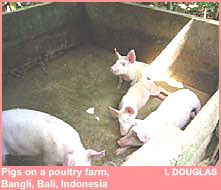 An intriguing puzzle is why H9N2 influenza viruses have not developed into pandemic strains. These viruses are widespread in poultry in Southeast Asia9. They have been present in poultry throughout Asia for considerably longer than H5N1 viruses, and are far more likely to be found in poultry in markets than H5N1 viruses10. Serological studies have demonstrated antibodies to these viruses in humans11, and they have been isolated from pigs.12 13
These findings demonstrate that a pandemic is not automatically generated even when AI viruses develop some of the capabilities to infect humans. Countries and regional/international organizations must continue monitoring avian, porcine and human populations for the emergence of influenza viruses to ensure the detection and characterization of new viruses in order to provide for early detection of recombination or other threatening changes in the nature of the viruses. No one can predict when the next pandemic strain of influenza virus, or even which strain of influenza, will emerge. It is therefore important that countries develop pandemic preparedness plans as recommended by WHO.
It is important that countries develop preparedness plans |
The inception workshop for FAO Technical Cooperation Programme (TCP) project TCP/RAS/3007 (E), “Diagnostic laboratory and surveillance network coordination for control and prevention of avian influenza in East Asia ”, was held in Beijing , China , 27–29 October 2004. The workshop was attended by delegates of the four countries participating in the project, i.e. China, the Democratic People's Republic of Korea, Mongolia and the Republic of Korea, and representatives of OIE and WHO. The workshop provided a forum for representatives of laboratory and epidemiology centres in the four countries to discuss and agree upon minimum, standardized approaches to diagnosis and the collection and analysis of epidemiological information based on the FAO Guiding principles for HPAI surveillance and diagnostic networks in Asia (http://www.fao.org/docs/eims/upload/164167/Guidingprinciples.pdf).
Discussion
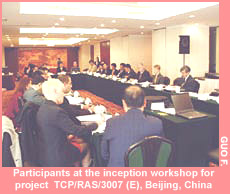 The workshop identified FAO's first priority as to optimize national performance in the early detection of infection, reporting and disease control. The second priority is to improve regional information sharing and analysis. For effective surveillance, there is a need to search out infection, especially in species that do not show obvious signs of infection. Discussion emphasized the tasks of demonstrating freedom after eradicating infection and demonstrating the absence of field virus in vaccinated flocks; the importance of using these measures in combination and maintaining close attention to disease surveillance; regional collaboration as an important underpinning of surveillance; and disease management and eradication.
Working groups
Surveillance and laboratory networks can provide rapid access to high-quality technical information |
The meeting was divided into two working groups: (1) laboratory diagnostic issues and (2) surveillance and epidemiological analysis, which reviewed the FAO Guiding principles in detail. The working groups also discussed specific aspects of implementation and developed recommendations on the further guidance, advice and support required from FAO and other international organizations to ensure sustainability of the East Asia networks.
The laboratory group considered the following issues: diagnostic procedures; direct antigen testing; confirmatory testing; occupational health and safety of workers; characterization of isolates; serological testing; use of the DIVA (differentiating infected from vaccinated animals) technique; wild bird testing; and network implementation. The priority activities to support network implementation included information exchange (i.e. the provision of updated scientific information on a regular basis); building minimum capability (including the provision of supplies and consumables to some laboratories); the provision of training and support for technical collaboration; and technical assistance to the National AI Reference Laboratory (at the Harbin Veterinary Research Institute, China) to enable it to enhance current strengths in order to operate as a network reference laboratory. It was recommended that assistance be provided by an international reference laboratory working in collaboration with FAO and OIE.
The epidemiology group generally endorsed the FAO Guiding principles . Discussion focused on the expectations of participants of the surveillance network. The main needs addressed for implementation of the epidemiology network were support for contingency planning; enhancement of information systems; and training in epidemiological analysis, at both basic and advanced levels. There is a strong need for help with the sharing of information and intelligence, particularly publications, the results of surveillance, and information about practical experience.
All countries confirmed the importance of the networks in helping to prevent a global pandemic of human influenza. The Ministry of Agriculture, China , and FAO's leadership of the network hubs is key for the implementation of sustainable networks.
Outcome
 Participating countries generally agreed on the FAO Guiding principles , recommending as an additional requirement the maintenance of a virus bank (i.e. a stock of virus antigen) and a genetic sequence database for virus isolates, as an “ideal” capability for a national laboratory or as a “minimum” capability for a network reference laboratory. Delegates agreed on the benefit of sharing information (and committed to sharing information in accordance with the project); the need to strengthen some national laboratories to meet the minimum standards defined in the FAO Guiding principles ; and the need to build the networks via a collaborative work programme that would include training for some laboratory scientists. They also agreed to share HPAI viruses isolated in the region with the network reference laboratory (Harbin Veterinary Research Institute, China ) and to provide any new/different viruses to OIE/WHO influenza reference laboratories for full characterization and comparison.
Looking forward
Participants concurred that there are several diagnostic issues that require further study and the development of improved methods, such as the serological testing of waterbirds, the development of marker vaccines/diagnostic tests and the development of more economical methods for rapid antigen detection. They identified the need to pursue these matters with collaboration among participating countries and international laboratories.
All participants agreed that the networks can and should benefit participants by providing rapid access to high-quality technical information. The development and maintenance of a common regional database could best be managed by implementation of the FAO/EMPRES-i system. The participants also agreed upon specific needs and further support for the epidemiology networks, including facilitation of contingency planning at national and regional levels; assistance with improving and maintaining systems for data capture and analysis; and training in basic data collection/analysis, as well as advanced statistical and epidemiological analysis.
1 Guan, Y., Poon, L.L.M., Cheung, C.Y., Ellis, T.M., Lim, W., Lipatov, A.S., Chan, K.H., Sturm-Ramirez, K.M., Cheung, C.L., Leung, Y.H.C., Yuen, K.Y., Webster, R.G. & Peiris, J.S.M. 2004. H5N1 influenza: a protean pandemic threat. PNAS, 101(21): 8156–8161.
2 Li, K.S., Guan, Y., Wang, J., Smith G.J., xu, K.M., Duan, L., Rahardjo, A.P., Puthavathana, P., Buranathai, C., Nguyen, T.D. Estoepangestie, A.T., Chaisingh, A., Auewarakul, P., Long, H.T., Hanh, N.T., Webby, R.J., Poon, L.L.M., Chen, H., Shortridge, K.F., Yuen, K.Y., Webster, R.G. & Peiris, J.S. 2004. Genesis of a highly pathogenic and potentially pandemic H5N1 influenza virus in eastern Asia . Nature, 430(6996): 209–213.
3 Reid, A.H. & Taubenberger, J.K. 2003. The origin of the 1918 pandemic influenza virus: a continuing enigma. J. Gen. Virol., 84: 2285–2292.
4 Reid, A.H., Taubenberger, J.K. & Fanning, T.G. 2004. Evidence of an absence: the genetic origins of the 1918 pandemic influenza virus. Nat. Rev. Microbiol., 2(11): 909–914.
5 Reid, A.H., Fanning, T.G., Janczewski T.A., Lourens, R.M. & Taubenberger, J.K. 2004. Novel origin of the 1918 pandemic influenza virus nucleoprotein gene. 2004. J. Virol., 78(22): 12462–12470.
6 Palese, P. 2004. Influenza: old and new threats. Nature Medicine, 10: S82–S87.
7 Webby, R., Hoffmann, E. & Webster, R. 2004. Molecular constraints to interspecies transmission of viral pathogens. Nature Medicine, 10: S77–S81.
8 Matrosovich, M.N., Matrosovich, T.Y., Gray, T., Roberts, N.A. & Klenk, H.-D. 2004. Human and avian influenza viruses target different cell types in cultures of human airway epithelium. PNAS, 101(13): 4620
9 Li, K.S., xu, K.M., Peiris, J.S.M., Poon, L.L.M., Yu, K.Z., Yuen, K.Y., Shortridge, K.F., Webster, R.G. & Guan, Y. 2003. Characterization of H9 subtype influenza viruses from the ducks of southern China : a candidate for the next influenza pandemic in humans? J. Virol., 77(12): 6988–6994.
10 Kung , N.Y. , Guan, Y., Perkins, N.R., Bissett, L., Ellis, T., Sims, L., Morris, R.S., Shortridge, K.F. & Peiris, J.S.M. 2003. The impact of a monthly rest day on avian influenza virus isolation rates in retail live poultry markets in Hong Kong . Avian Dis., 47(3 Suppl.): 1037–1041.
11 Cheng, x., Liu, J., He, J. & Shan, F. 2002. Virological and serological surveys for H9N2 subtype of influenza A virus in chickens and men in Shenzhen city (in Chinese). Zhonghua Shi Yan He Lin Chuang Bing Du xue Za Zhi, 16(4): 319–321.
12 Peiris, J.S.M., Guan, Y., Markwell, D., Ghose, P., Webster, R.G. & Shortridge, K.F. 2001. Cocirculation of avian H9N2 and contemporary “human” H3N2 influenza A viruses in pigs in southeastern China : potential for genetic reassortment? J. Virol., 75(20): 9679–9686.
13 xu, C., Fan, W., Wei, R. & Zhao, H. 2004. Isolation and identification of swine influenza recombinant A/swine/Shandong/1/2003(H9N2) virus. Microbes Infect., 6(10): 919–925.
