


This Review seeks to assess critically most aspects of science and management that the Panel and the Institute Management believe are important for IRRI to continue to fulfil its mission and also that of the CGIAR on rice. It is a forward looking review based on the belief that, because it takes more than 10 years for the design, creation and adoption of new varieties and associated technologies, any review of an institute like IRRI needs to look ahead at least 15 years to assess the appropriateness of today’s activities.
IRRI has a global responsibility for rice under the CGIAR umbrella. This is an extraordinary responsibility given that 44% of the world’s population has rice as its staple food and 65% of the world’s poor rely on rice for survival. The CGIAR mission has been adopted by IRRI, and reformulated to IRRI’s particular responsibilities as stated in its mission:
to improve the well-being of present and future generations of rice farmers and consumers, particularly those with low incomes.
The Centre today consists of some 900 staff, of whom 105 are international staff and 784 are nationally recruited. These numbers are much reduced from those of 1997 when IRRI had 1,680 staff, which became further reduced to 1,115 in 1998, at the time of the last EPMR. This reflects the reducing resources at IRRI’s disposal over the preceding decade. Today’s resources are distributed with approximately 52% to core and 48% to special projects.
These reductions need to be evaluated against the total of the CGIAR over the past decade and set against the background whereby, over the past 5 years, there has been an unparalleled increase in investment in rice research worldwide in developed and developing countries, especially China. They have occurred at the very time that rice science has been progressing as never before and others have been investing more to create and drive the new science.
IRRI’s outputs have been substantial in previous decades. Early emphasis was placed on plant breeding and the release of improved varieties. The early impact was extraordinary, giving rise to the so called Green Revolution. Over the years, IRRI’s strategy has become more complex, as all have recognized that providing new germplasm can meet only some of the goals. The environments that can benefit from Green Revolution high yielding rice varieties are limited and therefore different products need to be generated and can only be devised successfully by being selected from materials already adapted to these environments, evaluated across many sites and deployed in more complex farming systems. Over the past few years, IRRI has increasingly recognized the growing competencies of some of the NARS, its partners, and today does not aim to produce finished varieties for them but instead mostly seeks to produce germplasm that they can develop.
IRRI’s mandate is to deliver outputs that are public goods. It clearly seeks to retain their role in spite of the many challenges that have emerged in the past 5 years. These include threats to the unrestricted movement of germplasm and restrictions on the use of genes and other biotechnology reagents due to the filing of patents. These changes are serious challenges to the strategies of the CGIAR and IRRI in particular.
IRRI today is faced with dilemmas on a scale probably never experienced previously. These greatly complicate planning for the future and the priority setting exercises. They include the complexities of poverty in Asia and how IRRI can contribute to its alleviation most effectively over the coming decades. There are the opportunities and challenges associated with the extraordinary development in rice genomics, developed outside the CGIAR System, the use of transgenic plants and intellectual property rights affecting germplasm, tools and genes. There are parallel developments in many other relevant areas of research, such as modelling, spatial analysis systems, and information technology, just to mention a few. Then there are new developments in the CGIAR and decreasing core budgets. All these need to be managed against the increasing competitiveness of global science. The magnitude of these issues is such that we now elaborate on some of those newer external factors that will influence the future of IRRI and its role in rice research. This serves as a background to evaluate how IRRI should evolve to ensure its cost-effectiveness in the coming decades.
For the last fifteen years, a question has been persistently nagging IRRI and its donors: does it have any real role to play in the future that would justify investment at the rate of 30 million dollars or so every year? There is no doubt that it has been a very successful and productive organization throughout its life, and if past history is to be the sole guide to future prospects, there is no question that IRRI should continue to enjoy the support of its stakeholders.
But the question refuses to go away, notwithstanding IRRI’s insistence that past gains must not be merely enjoyed, but also defended, and the main means to do so is to invest in yet more research. Fears of environmental degradation and long-term decline in potential yields have led IRRI to conduct some very fundamental research, even though the basic thesis has now been questioned, partly by work done by IRRI staff itself. Nonetheless, research stimulated by the concern for the sustainability of productivity within irrigated areas has led to some useful recommendations, for example for changes in cultivation practices in the rice-wheat areas of South Asia. The ever-present threat posed by insects and pathogens has been tackled in environmentally undisruptive ways. Meanwhile, the main thrust that has established IRRI’s reputation, namely its genetics and plant breeding, has continued on its highly successful path, now enhanced by new biotechnological tools.
Both as a result of IRRI’s work as well as of other developments, rice has kept pouring out of Asian farms, bringing rice prices down continuously, until they have touched historic lows in real dollar terms. Projections of future rice supply-demand balances and therefore of future price trends undertaken by IFPRI economists indicate that the world can look forward to further price declines, thanks in part to slowing population growth and in part to continued diffusion of modern varieties to newer areas[2]. The baseline projection indicates that real rice prices will fall by a further 22% between 1997 and 2025. Indeed, in some countries, high economic growth has led to a slowing down of consumption growth and to a decline in per capita consumption of rice. The Malthusian fear of population growth outstripping supply potential that led some far-sighted individuals to establish IRRI in 1960 is, it seems, no longer operative.
An important caveat has to be inserted at this point. The decline in dollar prices has relevance for international rice traders, but for few other people, and decidedly not for most rice consumers and producers in Asia. To get at that one has to look at the domestic prices. Figures 1.1 and 1.2 show data of real wholesale rice prices in domestic currencies for selected Asian countries going back to 1966, as well as of the real dollar prices of internationally traded rice. While these domestic prices have undoubtedly dropped from the high levels of the mid-1960s, the decline seemed to have stopped after about 1975, unlike the decline in real world prices (in dollars) which continued after 1975. The main reasons were both a depreciation of the exchange rates, and the increasingly protective trade regime for rice, as some of the importing countries achieved self-sufficiency.
Furthermore, the forecast of a continued fall in the dollar price for rice in the baseline projection is based on the assumption that "governments make no major changes in their agricultural and economic policies and investments if population grows at the rate given in the United Nations medium projections". As far as investments are concerned, two important items are worth bearing in mind: investments in research, both at the national level and at IRRI; and just as importantly, investments in irrigation which in the last two decades have sunk to much lower levels relative to the level reached in the 1970s[3]. This lower level of irrigation investment is also projected into the future.
Without the investment in research, the yield growth that Asian countries have been enjoying over the last few decades can no longer be sustained. The projections indicate that future rice prices are strongly influenced by assumptions about the future trend in yield growth. Thus if the growth rate of yield between 1997 and 2025 is half that of the baseline projection - 0.5% instead of 1.0%, the latter itself half that experienced between 1967 and 2000 - then rice prices will jump by roughly 50% from their levels in 1997.
Nonetheless, the baseline assumption of future rice investments being able to maintain a yield growth of 1% per year seems modest enough, and recognizes the diminishing returns that are inevitable after the stellar performance of the last third of the 20th century. If, on the other hand, there are to be new breakthroughs, whether with hybrid rice or with the new plant type, and yield growth were to accelerate by about 20% in developed and 40% in developing countries over the baseline growth rates, the effect in the rice markets will be no less spectacular, with rice prices in 2025 dropping by almost 60% from their levels in 1997.
Figure 1.1 - Trend in Real Price of Rice, Major Importing Countries in Asia, 1966-2003

|
Note: Wholesale price of rice deflated by general price index. |
|
|
Source: |
1966-1998: World Rice Statistics database. |
|
|
1998-2003: Websites of national statistical organizations. |
Figure 1.2 - Trend in Real Price of Rice, Major Exporting Countries in Asia, 1966-2003
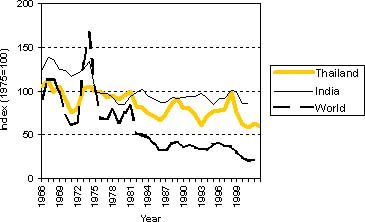
|
Note: Wholesale price of rice deflated by general price index. |
|
|
Source: |
1966-1998: World Rice Statistics database. |
|
|
1998-2003: Websites of national statistical organizations. |
These projections indicate a lower bound to yield growths at a level somewhat less than 1% that must be achieved in the coming decades for rice prices not to rise substantially, a figure that appears to be attainable. There is therefore less urgency to produce a bigger pile of rice merely to keep up with demand; less urgency, but not complacency. Even with the slackening of demand due to lower population growth rate and smaller income elasticity, the baseline projection from IFPRI indicates that the world would still need an extra 132 million tons of milled rice between now and 2025. Continued investments in research still need to be done, both at IRRI and in the national agricultural research systems.
Another reason not to be complacent is the water situation faced by the world today. Increasingly, the world is waking up to the quite strong possibility that water is becoming more scarce, none more so than in northern China. The CGIAR has set up Water for Food as one of the Challenge Programmes for the System, in which IRRI is participating. In approaching this problem, IRRI needs to bear in mind that rice is among the most water-intensive crops grown. As such, it is the least efficient converter of water into calories, and it probably would make more sense for the world to obtain its calories from other cereals, such as wheat. Given that Asians will still want to consume and produce rice, IRRI must find a better solution for them. It turns out that IRRI has, for well over a decade, undertaken research to increase water productivity in rice production, and has some promising leads on how to do so successfully in the field.
The bigger pile of rice that has come out of Asian farms has naturally had an impact on the national economies, which have led in a few cases (e.g. Indonesia, at least before 1997, Vietnam after 1989) to tremendous growth in incomes of the farmers themselves. This by itself has led to a reduction of poverty, even though most of the farmers who benefited from the new technology worked on well-watered land, and therefore could not be counted among the poorest of the poor people in rural Asia. Nonetheless, there is no question that the standard of living of these farmers has improved from a level which was quite modest to something that approaches prosperity[4]. To be sure, income inequality has increased within such farming communities. That is partly due to the in-migration of people coming in to share in the prosperity of the favourable areas from parts that were even worse off, and to the growth of rural non-farm activities, which generate income for households with a more skewed distribution than farm income.
But the contribution of the bigger pile of rice in reducing poverty did not lie in the income it generated for the beneficiary farmers; much more importantly, it helped a great number of rice-deficit households in both urban and rural areas. Most poor people are drawn from these ranks. They benefited from the new technology in two ways: they could purchase their rice much more cheaply, and, for those in rural areas, they could obtain more employment because of the increased labour demand that arose from the intensification of production.
A third pathway out of poverty, arguably the most important, is through the acceleration of economic growth made possible by the relaxing of the food constraint. The story of Asia’s emergence as an industrial powerhouse is now well known, but this would not have been possible without the prerequisite agricultural growth, to which the Green Revolution contributed a great deal. It is the higher economic growth that is responsible for much of the reduction in poverty that has occurred.
Tremendous as these achievements may have been, they mostly lie in the past. Farmers who benefited directly from the new technology, mostly living in favourable environments, could no longer be counted among the poor. Most of the promising technology in IRRI’s and the national research systems’ pipeline is still geared to this group. Yet the new technology has also left behind in its wake a large number of rice farmers mired in poverty, some of whom have even seen their conditions worsened by the new technology, which lowered the price of their rice without giving them the higher productivity.
It is true that the more favourable of these unfavourable areas, such as Eastern India, have benefited from increasing productivity during the last decade and a half. Increased use of groundwater and, in the case of deep-flooded areas, a shift of the cropping calendar away from wet to dry season, has allowed farmers to reap the benefits of the modern varieties. Even without these changes in the water regime, some of the better rainfed areas find that they can profitably use the modern varieties. This indicates that the momentum of productivity growth from the Green Revolution has not died down yet.
For the poor rice consumers, a decline in rice prices will undoubtedly continue to benefit them, but the impact will be reduced relative to what it was in the last decades of the 20th century, as rice occupies less and less of their budgets. Having said that, it is necessary to point out that the poorest 40% of rural households in Bangladesh still spend as much as 35% of their budgets on rice, and in Vietnam, the bottom quintile of households in Vietnam spends 47%.[5]
The employment effect of the new technology is also going to be less, as farms are increasingly mechanizing their operations. Indeed, it is facing a dilemma here. In the past, IRRI has been somewhat reluctant to introduce labour saving technologies, because of the adverse employment effects. But in countries where wages are rising because of developments outside the rice sector, there is now also a need to ensure that rice farming remains viable, and labour saving technologies will have to be introduced.
Finally, lower food prices will still feature in accelerating economic growth, particularly in countries that are in their earlier stages of industrialization, e.g. Bangladesh, Vietnam, and Sri Lanka. But for those countries that are somewhat beyond that stage, the price of rice is no longer a central issue.
One final observation on the issue of poverty, IRRI has always conducted part of its research with the aim of benefiting producers in less favourable environments. This was done, even though hard-headed calculations showed that it would not have been worthwhile, as has indeed turned out to be the case. Results from the investments on upland ecosystem research have been meagre. Still no research yield has come through. The question that now needs to be addressed is whether rice research could cost-effectively contribute to poverty reduction in these unfavourable areas and whether IRRI should expand its budgets for programmes and projects catering to them.
The term ‘unfavourable’ actually ranges from the more favourable rainfed environments, which have a fairly high water table allowing for the use of groundwater resources and therefore have great potential, all the way to the recalcitrant uplands. The criticism has been levelled that, as long as IRRI works exclusively on a single crop, it cannot do anything useful in these upland areas, and in response, IRRI has begun to move into ‘rice-based systems’.
A key issue for this review is therefore how much resource IRRI should put into these unfavourable areas as a whole vis-à-vis the irrigated areas and, within the broadly defined unfavourable areas, what strategies are worth following.
Of all the CGIAR Centres, IRRI has the most compact mandate because it works on a single commodity, and 90% of it is grown in Monsoon Asia. As long as there is the perception that more of the world’s poor people are in Asia than anywhere else, IRRI can justify its working almost exclusively there. Even though that perception reflected the truth accurately and remains true to this day, donors’ perception seems to have shifted for they now place a greater priority on the poor in Africa.[6]
The problem in Africa is complex, not only because of the nature of the problems to be tackled, but because WARDA, the CGIAR Centre charged with rice research in West Africa, is now in some difficulties for reasons beyond its control. IRRI nevertheless is drawn towards working in Africa. Before deciding to do so, IRRI needs to address the following question: can it spare the limited resources that would need to be diverted from Asia to Africa - and by this is meant not just the funding, which IRRI should be able to obtain from the donors - but also its limited core of competencies? In short, does it have the comparative advantage to convert the extra funding into good results on the ground? In the review that follows, we shall bear in mind these questions.
In its mandate to bring better technology to rice farmers, IRRI works in close collaboration with its counterpart in the national systems. One of the better side-effects of the Green Revolution was to convince many Asian governments that investment in agriculture (particularly agricultural research) pays. Surprisingly, except in the Philippines until about 1990, investments made by IRRI did not crowd out investments in the national systems. Since the emergence of IR8, many large- and medium-sized Asian countries have expanded their agricultural research systems. Over time, many (although not all) of these research systems have acquired capabilities that enabled them to interact profitably with IRRI, in some cases on an equal basis. As a result, the work done at IRRI began to shift to encompass more upstream research. Thus in breeding, IRRI now no longer releases new varieties to be directly used in farmers’ fields. Release of such varieties is now done by the national systems, based on lineages that have IRRI’s varieties among them. IRRI’s work is confined to pre-breeding lines that are potentially useful to the national systems, leaving to the latter the task of adapting the varieties to cope with the environments or the quality demands specific to their countries. Similarly, some of the training that used to be done by IRRI has been turned over to the stronger national systems.
In their development, IRRI has served as a beacon and a role model. It has also been a mentor. IRRI has provided training to many scientists now in senior positions in the national systems. Thus, these national systems are not merely clients of IRRI, but feel themselves to be its stakeholders.
Not to be overlooked, however, are those countries that for a variety of reasons, such as wars or the small size of the countries, do not yet have a research system that can deliver the kind of product that is taken for granted in the medium and large countries discussed above. These countries do require considerable assistance from IRRI, which it tries to provide to the extent that bilateral special project funding permits. One country that has obtained such help that is now well on the way to autonomous development of its research system is Vietnam.
The emergence of a large number of peer research systems in Asia will thus feature in our discussion of the direction towards which IRRI is to move. Alongside this change is the emergence of the private sector, mostly in developed countries, as active investors and producers in the field of agricultural research. This raises its own complex set of issues.
It is safe to believe that selection, evaluation and adoption of new varieties will continue to be a strong driver to reduce poverty either directly or indirectly. Thus this component of the strategy of the CGIAR since its inception will remain intact for some decades to come. However, the process of plant breeding that drives the availability of new varieties is beginning to change radically and the rate of change will accelerate over the next two decades. The new situation arises from the technical developments called ‘genomics’. Genomics seeks to describe every gene in a species, provide rapid ways to survey allelic variation and to follow chromosomal segments in breeding programmes through generations. Knowledge of which chromosomal segments correlate with desirable and undesirable traits allows for the rapid selection of plants with the desired traits. Genomics provides for the first time the means of surveying all genes in plants essentially simultaneously. Because plant breeding involves the recombination of genes and chromosomal segments, genomics and plant breeding superimpose themselves on one another naturally.
The field of rice genomics has opened up extremely rapidly over the past five years due to publication of the nucleotide sequence of essentially all the chromosomal DNA of rice. This extraordinary achievement changes the options and methods of rice breeding for all time. It is very relevant for the CGIAR and IRRI to query which countries and organizations will lead in the new technical innovations of genomics that will drive rice improvement in the future. This can be predicted in general terms but it is difficult to make precise predictions.
A brief survey of recent events in rice genomics will serve to illustrate how the situation has changed so much. It reveals that investments outside the CGIAR are driving the future genomics based approaches to rice improvement. CGIAR’s investment in rice genetics is being and will continue to be dwarfed by other investment and organizations across the world and across life sciences.
The Japanese took the lead in the late 1999s by providing a complete DNA sequence of a japonica variety for the world but soon found that, to complete it, an international effort was more sensible and appropriate, especially given the examples of how the sequence of several other species were completed via planned, coordinated international efforts. This ‘perfect’ version of a rice genome is expected to be published in 2004 or 2005. However, both Monsanto and Syngenta have published separately, ‘draft’ versions of a rice genome sequence. It is probable that these companies spent over US$80 million to gain these DNA sequences on rice varieties. A Chinese laboratory has also announced a complete genome sequence for an indica rice variety, performed at a very fast pace, and published it with descriptions of what genes could be found within it.
Estimates of 30,000 to some 50,000 genes have been predicted in rice chromosomes. However, it is very difficult to accurately predict genes in DNA sequences and so there will be a long-term effort to gain correct annotations of the genome by numerous projects worldwide, involving a large number of plant scientists in the public and private sectors. New concepts of genes and their role in determining traits are emerging from large investments in arabidopsis research and transferred to knowledge on rice. The technologies that have brought all this about were developed outside plant science.
Thus we note that, in contrast to previous decades, the information platform for advanced rice breeding in the public sector has been facilitated by some large investments by, for example, Japan, China, Monsanto and Syngenta, as well as the US and EU Governments. These investments total hundreds of millions of dollars and were made outside the CGIAR planning framework.
To make the genome sequence useful for plant breeding it is necessary to relate predicted or known genes and genetic variation to phenotypes or traits. A trait is usually determined by combinations of genes and so it is necessary to connect combinations of DNA sequences to traits. Substantial programmes originating in China, Japan, Europe, Australia, Korea India and the USA have emerged to do some of this and some of the leading laboratories have formed an informal consortium, the Rice Functional Genomics Consortium, under IRRI’s leadership.
Given the dramatic change in both the scale of investment and places of discovery in science underpinning rice breeding, what have been the implications for IRRI and its breeding programmes? IRRI reacted, following the challenge from the 5th EPMR, to the possibility that it would be left behind in the building of platforms of discovery for rice breeding. It found itself in this position due to a combination of rapid decision making by other governments/organizations, technical developments outside rice biology, completely inadequate CGIAR resources, and a failure to recognize how rapidly the centre of gravity of rice molecular genetics research would move out of IRRI and the CGIAR. IRRI needed to be on the inside of the progress and capable of using new information. It has thus expanded its capabilities in bioinformatics, created an open source database on rice genomics/genetics for its own purpose and its partners/clients and sought special links with the major information providers. It has equipped a new laboratory to ensure it can use the latest molecular biology technology in the assessment of genetic variation and gene expression and has created and provided thousands of lines which collectively are likely to carry a mutation in most genes. This very valuable germplasm, if exploited by others around the world, will help IRRI to remain a valued contributor to current rice genomics/genetics.
Today, IRRI is recognized as a contributor and valuable actor in rice molecular genetics, even though its competitive investment is not very large. What about the future? What should its role be in serving the NARS and helping to alleviate poverty? What can its role be?
One of its primary declared aims is to put into the hands of breeders knowledge and systems for exploitation of the International Rice Genebank Collection it houses, on trust, on behalf of mankind. These can be radically mined now compared with 10 years ago and opportunities will emerge very rapidly. The goals of the International Functional Genomics Consortium include providing information or a function for each and every gene in the rice genome within a decade. Already, sufficient genetic materials are available to enable every QTL to be traced by a molecular polymorphism in many rice breeding lines and this will be extended to ensure that the knowledge and tools exist to track and stack any chromosome sequence in a directed way in a breeding programme. IRRI can be and is planning to be a major contributor to this goal. The existing major actors will continue to be major actors also. A major question remains: is IRRI going to take and sustain the lead in helping the scientific community worldwide to fulfil the dream of mining the vital genetic information that is in the germplasm it holds uniquely on trust for the world and in disseminating the information worldwide via linked databases? If it does not do this, the arguments for the germplasm remaining with IRRI may lose value and CGIAR’s position be undermined.
The building of correlations between polymorphisms in DNA sequences and phenotypes is a very large activity in human genetics and in the large private sector plant breeding companies. They are driving the innovations that are key for increasing speed, reducing costs and thereby enabling adoption. There will be many surprises. Small biotechnology companies as well as large knowledge suppliers are likely to become significant suppliers. It is hard to predict therefore what will be the acceptably cost-effective way of defining and measuring genetic variation embedded in 100,000 rice genotypes and linking this to phenotypes and the design of directed breeding programmes. It is unlikely that IRRI will be at the forefront of the innovations and their application to crop plants. So it must be decided how and where new investments and partnerships are made by IRRI/CGIAR to attain the new reachable goals faster and cheaper. Perhaps the most likely model will be to outsource some of the very high throughput molecular biology tasks via a consortium to the private sector or to some as yet unidentified laboratory in China, India or the USA.
While it is difficult to predict how and with what technology the goals of finding a function for each rice gene and tracking markers in breeding programmes will be reached, it is reasonable to assume this will get done with or without CGIAR funding over a decade or so and that the information will be in the public domain.
Many were surprised to learn that Monsanto and Syngenta invested perhaps US$100 million to sequence the rice genome when there is little profit to be gained from rice and it is not a crop of apparent direct interest to them. The reason for the investment is the genetic synteny between grass genomes and the opportunity to file patents on a large collection of monocot genes. Discovery of the gene-order along rice chromosomes predicts the order along maize and wheat chromosomes as well as along barley, sorghum and millet chromosomes, etc. Thus, knowing the genetic linkages in rice predicts genetic linkages in maize, thereby enhancing the efficiency of designing more competitive molecular breeding strategies for maize. There is more than enough profit in the USA maize market to allow investment in sequence knowledge gathering in rice.
The existence of genetic synteny amongst the grass genomes has also opened up the question of how much rice research will get boosted by the reverse flow of information from maize. The USA commercial and public sector investment in QTL, mapping, genomic analysis and genetics in maize is relatively huge and destined to increase as plant genomics/genetics becomes more efficient. Within 5 years it is likely that the complete maize genome will also be sequenced. The information flow on the linkage between maize genes and traits will accelerate and this will become applicable to guide rice research. Therefore, going forward it must be realized that the global investment in molecular genetics underpinning breeding in maize, wheat, etc. will be helping rice breeding indirectly or directly. Add to this the worldwide discovery of useful transgenes that can be deployed across species and it should be recognized that the CGIAR investments in rice research will be dwarfed by other investments of somewhat direct benefit to rice breeding. One asks therefore whether the CGIAR will define or play much of a part in the decision making of investment in rice molecular genetics underpinning the world’s rice breeding from 2010 onwards. This would leave IRRI in a changed and difficult position versus its undisputed status and role in the past.
The Panel members urge that the Science Council and the CGIAR react to the fact that the future scientific basis of rice breeding for the poor will be determined by the investment strategies, policies and discoveries of others. It would appear that the CGIAR needs to participate in broader based collaborations and partnerships to facilitate its mission on rice, let alone on all its other crop improvement missions.
Throughout the world, major changes are occurring in relation to IP in research and business, including plant breeding. The Convention on Biological Diversity declared that nations have sovereignty over plant genetic resources in their territory. This, in turn, led to the International Treaty on Plant Genetic Resources for Food and Agriculture, soon to come into force, considered crucial for continued exchange and advances in plant breeding. In the agreement, the majority of food crop groups, including all the Oryza genus are included in a multilateral system of exchange, thus enabling IRRI to still exchange rice germplasm with others under agreed conditions.
Under the TRIPS (Trade-Related Aspects of Intellectual Property Rights) agreements of the World Trade Organization, most leading industrialized countries have complied with the adoption and enforcement principles to protect their germplasm while most developing countries have focused on meeting the minimum standards that apply to them. IPR and ownership principles, long established in many industrialized countries, have been specifically introduced to protect inventors and to stimulate investment in innovative R&D. Patents and other rights are granted, based on novelty and utility criteria, in response to specific applications for enforcement in specific countries. Legally granted IPR on technology signifies that persons or organizations not holding licenses to the particular property are not free to use the protected property or make products from them in the specified territories.
IRRI, as an international Centre, must adhere to germplasm ownership and IPR legislation and principles. This means it is neither free to use all technologies and germplasm for research nor to distribute products made with technologies that carry ownership rights, in the absence of appropriate MTAs and licenses. This is a major operational change from a few years ago and the consequences must be recognized by donors and client countries.
This means that IRRI is not free to adopt all state-of-the-art methods and technologies to carry out its mission. These facts are inconsistent with the principles on which the CGIAR was founded, namely that all the CGIAR Centres should create only international public goods and distribute them to anyone who requests or needs them. The inconsistencies create many difficulties for IRRI and the other Centres today and demand new operational strategies.
For IRRI, the implications are substantial and will become more so during the coming decade. Some of the biggest gains for agricultural productivity are likely to come through the adoption of transgenes and the use of germplasm where there are restrictions on use. This has already been demonstrated by the adoption of transgenes conferring pest, herbicide and disease resistance and soon to be further illustrated by a host of other genes including those conferring drought resistance. It can also be expected that many of the genes discovered by the private sector from its sequencing of the rice genome will have been submitted for patenting in some countries and will continue to be submitted as valuable new utilities for them are discovered.
With this scenario of the source of future proven breakthrough advancements in germplasm improvements, the issue is whether the poor are going to be served by IRRI with top quality proven science and discoveries, patented or not, or only with unprotected, probably less proven and inferior technology that takes longer to develop.
The challenges have already been exposed by the leading transgenic technologies to date. Bt transgenic technology has been championed by China and many other countries. One can imagine that individual countries will independently make internal decisions and possibly/probably enable adoption of the technologies more efficiently than happens in the international Centre. This is a serious issue for the perceived role of the Centre and can lead to a serious undermining of that role.
Who holds the IPR that IRRI needs to use? Besides the private sector, many universities in the industrialized countries file for patents on their leading discoveries. Thus, IPR should not be considered as being synonymous with profit-making industries. The problems created by IPR for agricultural development for the poor have been recognized and initiatives have been taken to encourage leading universities and companies to donate technology for humanitarian purposes in aid of the poor, as defined by various criteria, so as to avoid many of the problems. The level of success of these initiatives remains to be seen. They are unlikely to remove the problems in Asia and rice growing countries elsewhere.
There are natural tensions between the many components of the CGIAR system. The CGIAR is not a legal entity and all its donors have a seat at the table, making it rather impotent as a decision making body. The Centres are legally autonomous and each Centre Board has the authority and ultimate responsibility for determining and carrying out its programmes and policies. However, the CGIAR has recently re-established its scientific advisory group in a new Science Council that is envisaged to have some jurisdiction over the science of the Centres. Furthermore, as witnessed by the strong growth in special project funding at the expense of core funding, donors obviously have strong wishes, divergent from each other, with respect to what the Centres do. In addition, last year the CGIAR introduced Challenge Programmes to which it is expected the Centres will bid and win funds. A significant portion of the funds come from the previously expected budgets of the Centres. Whatever their merits, these Programmes necessarily distort the Programmes of the Centres away from previously accepted, presumably high priority goals and Trustees were not consulted about these changes.
All of these issues create difficulties for all members of the CGIAR family. They create difficulties in particular for the Centres’ Management and Boards of Trustees. Difficulties need to be resolved or minimized, otherwise they sap energy from the science and purpose of the Centres, create cost inefficiencies and, especially, undermine the aspirations of talented people. IRRI is no exception and many issues stemming from these structural tensions were noted.
While it is not the place for an EPMR to solve these tensions involving multiple layers of leadership, the Panel nevertheless strongly urges that they be addressed because, if allowed to fester, they could so greatly reduce the effectiveness of the system, including IRRI’s, that much potential to decrease poverty will be needlessly lost.
This EPMR has been conducted at a time when there is still a need for more rice, although there is evolvement towards sufficiency from the dynamic thrusts of previous decades in some favourable areas, and continuing inadequacies in other areas. We ask: what are IRRI’s comparative advantages in continuing to address these needs. At the time of this EPMR, IRRI and the CGIAR are facing extraordinary scientific opportunities, but also - as is often the case - new threats and concerns. The question is how can and how will IRRI take advantage of the new science so that it will not become marginalized in 10 years time, but will instead become an actor in one of the most spectacular contributions to crop biology of all times and a leader in harnessing it for the poor.
|
[2] Sombilla, M. et al. 2002: A
long-term outlook for rice supply and demand balances in South, Southeast and
East Asia, In M.Sombilla, M. Hossain and B.Hardy (eds.), 2002:
Developments in the Rice Economy. Los Baños, IRRI. [3] To some extent, reduced public investment in irrigation which is fairly well documented is being compensated by private investment in tubewells, the size of which is not known. [4] See for example Hayami, Y. and M. Kikuchi, 1999: A rice village saga: three decades of Green Revolution in the Philippines. Los Baños, IRRI. [5] Figures on Bangladesh are compiled by the Social Sciences Division, IRRI from the Household and Expenditure Survey 2000, conducted by the Bangladesh Bureau of Statistics. Figures on Vietnam are from Hoanh, C.T. et al. 2002: Rice Supply and Demand Scenarios for Vietnam. In: M.Sombilla, Mahabub Hossain and B.Hardy (eds.), 2002: Developments in the Rice Economy. Los Baños, IRRI. [6] Latin America raises no issue for resolution, as CIAT has the mandate to be the CGIAR Centre that works on rice in Latin America, and its relationship with IRRI as the global germplasm centre poses no problem. |
