


Computerized data processing and analysis is necessary to deal effectively with the large volumes of data generated by a multispecies trawl survey, and this section is written with the assumption that adequate computer facilities are available. Of course, basic information can be summarized on hand calculators but the scope of such calculations is extremely limited and slow in comparison with computer processing.
Data processing encompasses a wide array of procedures starting with completing and/or coding data from original field logs preparatory to transfer onto cards, magnetic tape, etc., passing through various audit procedures, and ending with a complete file of the survey data on tape or disc. The optimum procedures depend to some extent on the characteristics of the available computer system as well as the objectives of the survey; and no single system or approach is ideal or practical for all surveys. However, there are some important general aspects of handling data which are applicable in all cases - the most important of these are quality control and efficiency in that order. Data processing procedures developed at the Fisheries Laboratory in Woods Hole, Massachusetts, USA, are described in considerable detail, and may be referred to as an example of how data processing may be done (Grosslein, 1969b). An abbreviated and somewhat modified version of these procedures is also described by Doubleday (1981). Specific examples of quality control procedures are given in these reports, as well as suggestions for efficient ways of summarizing basic data in table format. In general, it is more efficient and more accurate to transfer “raw” data into the computer and let the computer do as many of the tedious computations as possible. However, in some cases it is preferable to record data at sea in a form which necessitates some hand calculations prior to data entry into the computer. For example, in the Woods Hole system length frequency expansion factors are calculated by hand at the same time the sampling fractions are checked while coding the trawl logs (for details see Grosslein, 1969b). The development of computer audit procedures is also described in this report, and illustrates how major errors can be detected with simple computer checks. An outline of step-by-step procedures for all stages of the data processing is included to explain the proper sequence of events. Finally, a summary is provided of the routine data listings which have been generated after standard audits are completed, and which have proved useful in a variety of ways. Further treatment of this large subject is beyond the scope of this report.
A great variety of useful information is available from multispecies surveys, and frequently it is found that valuable insight is possible on problems that were not envisaged when laying out objectives of the survey. Here only the basic data on population abundance and structure (age/length) will be emphasized and the reader should consult the manuals and papers referenced here and referred to in the training course for additional kinds of outputs.
The stratified mean catch per haul (equivalent to mean catch-per-unit area of bottom swept by a standard haul) in kilogrammes or numbers, can be used either as an unadjusted relative abundance index or it can be adjusted according to the ratio of relative to absolute density (assuming some independent population data are available) and expanded to represent the absolute abundance for the total survey area. It should be emphasized that abundance indices can be used to monitor trends in abundance whether or not they can be adjusted for catchability coefficients, as long as these coefficients remain fairly constant. There is good evidence now that catchability coefficients are sufficiently stable so that surveys can be relied upon to show major population trends (e.g., Clark, 1979). However, environmental anomalies cause large changes in catchability coefficients from time to time, therefore the index for any one year could be seriously biased as, for example, in the 1969 survey index of mackerel off the US east coast (Anderson, 1979). In that year cooler temperatures apparently delayed onshore migration of mackerel and a large proportion of the population was still outside the survey area when the cruise was conducted. Thus it is risky to rely on results of a single survey especially for migratory and semi-pelagic species, and this serves to emphasize the importance of maintaining a standard time series.
The formulas for the stratified mean and variance in section 2.5 are applicable but the positive skewness of distributions of trawl catches raises problems in constructing valid confidence limits and statistical tests of significance based on normal theory.
It should be noted that for the negative binomial distribution:
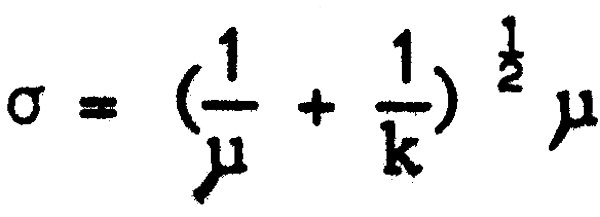
For a fixed value of k and relatively large (with respect to 1/k) values of μ, σ is approximately a linear function of μ (see Pennington and Grosslein, 1978). To the degree that the standard deviation and the mean are linearly related, a log transformation will stabilize the variance but not necessarily result in a normal distribution of transformed variables. The general consequences of lack of normality can be serious when constructing confidence limits and a possible way around the problem is through use of the delta distribution (Pennington and Grosslein, 1978).
In addition to the stratified mean weight or numbers, it is common to estimate population length frequencies and age-specific mortality rates (for aged species) from trawl surveys (Clark, 1979). These analyses can be valuable supplements to (or substitues for) estimates derived from commercial statistics. Pre-recruit estimates are another valuable output from trawl surveys as are total finfish biomass indices (Clark and Brown, 1977; Clark, 1979). The same basic stratified estimators are applicable to all of these outputs.
