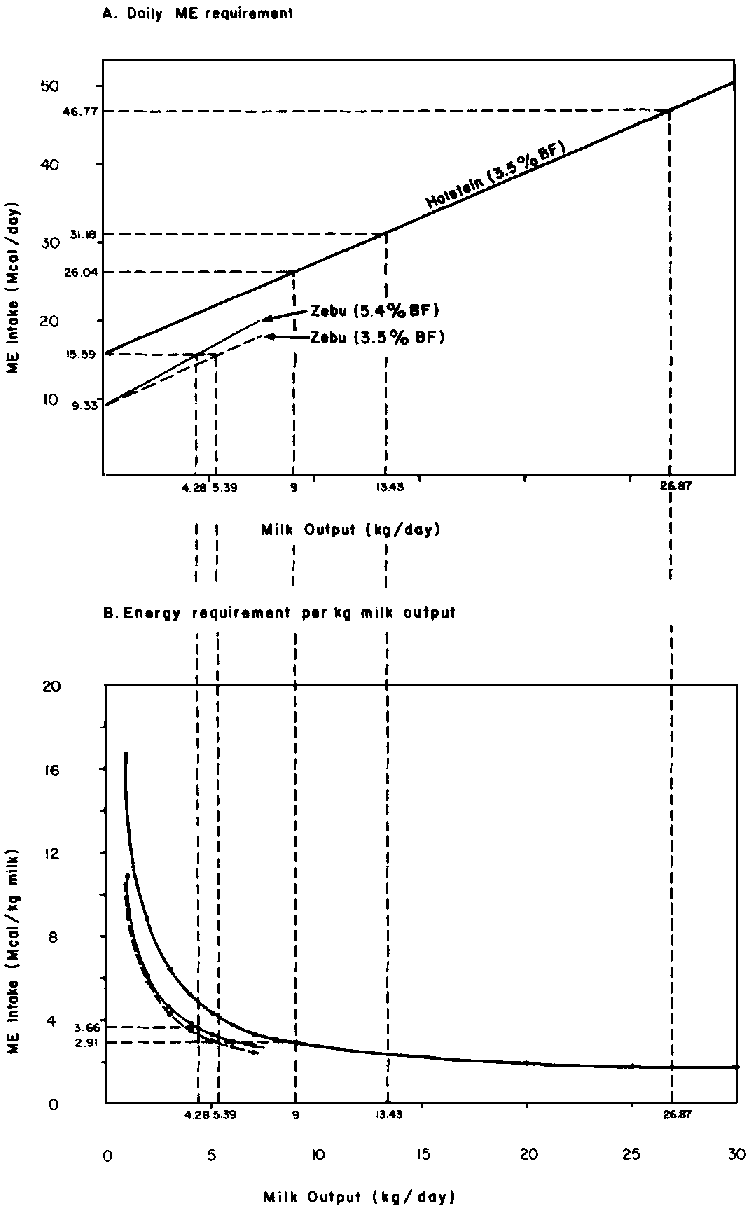
In this example, we discuss the daily metabolizable energy (ME) requirements in relation to daily milk output and the corresponding ME requirements per kg of milk output for a high and a low potential animal. The basic relationships are presented in Figures 1A and 1B. In this example, the daily metabolizable energy (ME) requirements in relation to daily milk output and the corresponding ME requirements per kg of milk output are shown for a high and a low potential animal. Figure 1A shows the relationship between daily feed energy requirements and daily milk output for a 450 kg holstein producing 3.5% butter fat (BF) milk and a 275 kg zebu producing 5.4% BF milk. The equations used areaa/:
Holstein: Mcal MEb/ per day = 15.59 + 1.16 (kg milk) @ 3.5% BF (1)
Zebu: Mcal ME per day = 9.33 + 1.462 (kg milk) @ 5.4% BF (2)
Adjusting equation (2) to correct for BF level at 3.5% obtains equation (3):
Zebu: Mcal ME per day = 9.33 + 1.16 (kg milk) @ 3.5% BF (3)
a/ Requirements for the holstein were taken from the National Research Council (1978, Table 2) with maintenance increased 20% to 0.15964W.75 Mcal ME per day to adjust for sparse grazing (NRC p. 3). Maintenance requirements for zebu were taken from King (1983, table 25) at 0.481W.75 MJ ME = 0.1152W.75 MCAL ME. An additional 20% was added to correspond to the adjustment made for holsteins, increasing the maintenance requirement to 0.1382W.75. An additional adjustment is warranted for walking (grazing) but will not alter the general analysis or conclusions to be drawn. Requirements for milk are 1.16 Mcal ME/kg of 3.5% BF and 1.462 Mcal ME/kg milk for 5.4% BF milk.b/ Megacalories (Meal) of metabolizable energy (ME).
Equations for Figure 1B are derived by dividing equations (1), (2) and (3) by kg milk or by simply dividing each daily energy requirement level from Figure 1A by its corresponding milk output level. Thus, Figure 1B shows how the energy requirements per unit of output vary in relation to the level of daily output.
In Figure 1A, the daily ME requirement for maintenance is shown at the intercept or where the milk output is zero. Maintenance requirements for the zebu are lower than for the holstein because the zebu requires less energy per unit metabolic weight and is lighter in weight. However, the energy requirement line is steeper for the zebu than for the holstein because of the higher BF content of its milk. The lower dashed line shows the equivalent requirement for 3.5% BF milk for a given daily output of milk in kg.
In this example, maintenance requirements for the holstein are 1.67 times the maintenance requirements for the zebu. An ME intake of 1.67 times the maintenance requirement for the zebu corresponds to a milk yield of 4.28 kg of 5.4% BF milk per day or 5.39 kg of 3.5% BF content milk per day (Figure 1A). The ME required per kg of milk at this level of daily ME intake is 3.66 Mcal ME/kg milk @ 5.4% BF or 2.91 Mcal ME/kg of 3.5% BF milk (Figure 1B)c/
c/ The milk production potential of many zebus is well below 4.28 kg of milk per day, thus an ME intake of 1.67 times maintenance may be divided between milk and weight gain for such low milk producers.
To produce at the same level of efficiency of feed energy (the same ME per kg of 3.5% BF corrected milk), the holstein must produce 9 kg of 3.5% BF milk per day (Figure 1B). This would require 26.04 Mcal of ME/day or 1.67 times its daily maintenance requirement (Figure 1A).
Kiwuwa et al (1983) reported average milk yield of zebu cows of 929 kg per 303 day lactation (3 kg/day) at the Asela Experiment Station in the Ethiopian highlands. While these animals may not have represented the best producing zebu available, they were supplemented during the dry season, 4 months prior to parturition and during lactation. Thus, perhaps the 3 kg average milk output per day represents a maximum that might be achieved under good range conditions. Hence, normal energy intake of zebu cows may be well below maintenance requirements for a very high producing cow. And under poor grazing conditions a high producing cow may do well to survive: a more or less permanent state of nutritional anestrous would be very likely, reducing output to zero or less.
In the present example, the energy required by the zebu to produce 3 kg of 5.4% BF milk daily is 13.72 Mcal of ME. The corresponding ME requirement per kg of 5.4% BF milk is 4.57 Mcal (13.72/3). The equivalent amount of 3.5% BF milk is 3.78 kg per day at 3.63 Mcal of ME per kg of 3.5% BF corrected milk. To obtain the same feed energy efficiency (i.e. 3.63 Mcal ME/kg milk), the holstein would produce 4.31 kg of milk, requiring 22.91 Mcal of ME per day. Because of its higher maintenance requirement the holstein in this example must consume 1.67 times as much feed per day as the Zebu to attain the same level of feed efficiency. With the same total feed intake as the holstein, 1.47 zebus can produce the same quantity of milk adjusted to 3.5% BF.
At very low output per head the low potential animals can utilize feed more efficiently than high potential animals. However, low potential animals reach their maximum efficiency at very low outputs. With adequate feed supplies, the higher potential animals can attain much greater levels of feed efficiency. Thus, while the zebu is able to achieve its genetic potential under very limited feed availability, and under conditions with standard deviations in feed supply dipping below survival standards for high potential animals, the high potential animal becomes more efficient after only modest increase in assured feed supplies.
Figure 1. Relationship between daily rates of milk output and energy requirements