


Since the last EPMR, there has been little in the form of a formal mechanism in place at ICRISAT by which priorities are set, even though the staff continued to contribute methodological papers on the subject. Under pressure of the donor community, the Centre has increasingly taken into consideration the development agenda of the community and of the stakeholders. As pressure on the budget increased, ICRISAT has strategically broadened its scope and interacted with an ever increasing number of stakeholders and donors, greatly complicating the resolution of diverging agendas and reconciliation of these diverse interests with the mission of the centre.
For a view of the evolution in priorities as the Vision and Strategy of the Centre has shifted the Panel first consulted the Medium Term Plans (MTPs). Although these provided an insight into the project portfolio dynamics, the frequent restructuring of the research programme structure makes an analysis of the changes in priorities difficult to discern. The Centre's MTPs generally provided the results of a presumed priority setting exercise but little in terms of how this was arrived at.
The Panel requested the Centre to indicate which areas of research were dropped, de-emphasized and taken up in the past 7 years, and why. The response showed that large parts of the research agenda were terminated because the mission was accomplished or because the problem had resolved itself or was not likely to be solved with the resources at hand. But, many topics also were dropped because of a lack of funding, in part due to donor fatigue. The areas taken up were largely in line with the newest Vision and Strategy
By its own admission, the Centre lacked a deliberate process of weighing one option against another in generating its research agenda during the review period. This is surprising given the wide mandate and the multitude of challenges of the Centre in terms of geography, disciplines, crops and production systems. The result has been a rather scattered, sometimes poorly balanced research agenda over which opportunities for funding and personal interests have had undue influence. This is not to say that ICRISAT has not addressed very serious issues and has not been successful.
The Centre is aware of the problem and since 2000 has been engaged in a full-fledged regional and global priority setting exercise which is based on the Vision and Strategy Until 2010 (see section 4.1). This has been very much welcomed by its staff. The results and effectiveness of this priority setting exercise mechanism will need to be assessed in the years to come.
In the period 1996-2002 ICRISAT scientific staff produced a total output of 2241 separate documents. Both peer reviewed scientific journal articles (694) and conference/workshop papers (727) appear to be standard outlets for research results. After declining between 1996 and 1999, the number of publications increased significantly (Figure 3.1). This indicates that the current staff of ICRISAT has shown an increase in productivity in the second half of the review period, as far as scientific publications are concerned.
Figure 3.1 - Annual number of publications at ICRISAT, 1996 - 2002

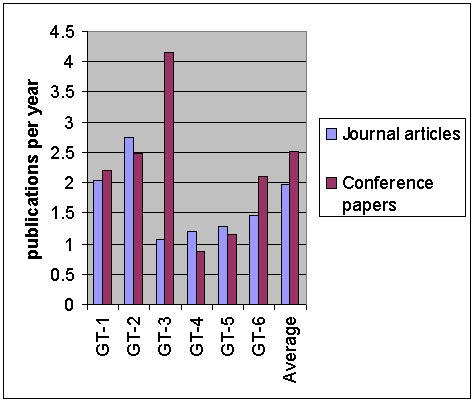
For the staff working at ICRISAT in 2002 the average output was 2.0 journal articles and 2.5 conference papers authored per scientist per year. There was substantial variation in average number of publications per year per scientist, ranging from 0.14 to 7.43 for journal articles, and 0.4 to 14.0 for conference papers (for staff that had spent at least 2 years at ICRISAT). For journal articles, the averages for GT1 and GT2 scientists are above the mean, while those for the other GTs were significantly less than the mean (Figure 3.2).
Figure 3.2 - Average publications per scientist by Global Themes, 1996 -2202
The numbers for refereed journal articles are similar to those for ICARDA in the 1994-1998 period (germplasm enhancement - 2.6, production systems - 1.6, INRM - 0.5, and social sciences 0.4). They substantially exceed figures reported in the 2001 5th External Programme and Management Review of IITA (crop improvement - 1.6, INRM <1, socioeconomics <0.3). Likewise, at ICRAF all internationally recruited scientists and postdocs produced an average of 1.64 published items of all types in the period 1993-1997.
At the request of the Panel, ICRISAT analyzed the citation of its journal publications using the ISI (Institute for Scientific Information) Essential Science Indicators. About half of all the journal articles published by ICRISAT are in journals (137) that either do not have an impact factor (IF),[2] or are not covered by the ISI database (too recently established, local journals etc.). This suggests that ICRISAT scientists are either targeting poorer quality work towards such outlets, as they assume they cannot get them published in the premier league of journals, or they are targeting such journals to ensure that their information reaches a preferred intended audience other than that of scientists who have easy access to comprehensively stocked libraries. ICRISAT management believes that the latter is the more convincing rationale and give the example of The African Crop Science Society Journal (15 entries in the data base) which has no impact factor attributed to it, yet ICRISAT scientists use such outlets because they reach many NARS collaborators and others in sub-Saharan Africa whereas papers in the premier league journals may not do so.
Of the journals that have an impact factor in the ISI database just over two thirds of ICRISAT articles were published in 79 journals with impact factors ranging from 0.1-1.0. These included, most popularly, papers in Crop Science (IF 0.69), in the Journal of Agricultural Science, Cambridge (IF 0.67) and in Euphytica (IF 0.62), which are highly respected journals. At the "highest end of the spectrum" about one third of the articles published in IF journals had impact factors ranging from 1.02 to 7.25. Popular journals in this category were Theoretical and Applied Genetics (IF 2.36), Plant and Soil (IF 1.22), Field Crops Research (IF 1.07) and Plant Disease (IF 1.02).
In terms of numbers of citations per paper there is also a big variability. Many papers received no citations in other ISI covered journals. However, the top two ICRISAT papers with 94 and 32 citations respectively are very creditable (substantially higher than the top publications at two other recently reviewed CGIAR Centres). It should be noted that these two papers are of importance to agriculture well beyond the SAT regions and have thus reached a scientific public which would otherwise be less interested in quoting ICRISAT mainstream publications.
The Panel concurs with management that the analysis of ICRISAT's published output suggests the ICRISAT scientific community, in general, is reasonably productive and an adequate proportion of its work (journal articles in journals with adequate IF and books and book chapters from reputable publishers) has been deemed of acceptable standard by the global scientific community.
3.3.1 Genetic resource and cultivars
The quality of ICRISATs research on genetic resources is judged as being very high since the last EPMR. The last EPMR considered this to be ICRISAT's greatest success (their page xiii). The many accessions of the ICRISAT-mandate crop species in the gene bank are valued by the world-wide scientific community in that many seed samples have been requested and distributed to scientists in many countries. The gene bank is reasonably secure in that a majority of the accessions have been placed in long-term storage. Much germplasm has been extensively characterized by ICRISAT, and use of the main collections has been facilitated by establishing core and mini-core collections. The ICRISAT sub-Panel Report in March, 2000 of the Systemwide Review of Plant Breeding Methodologies in the CGIAR made the following assessment (their page vii). "The ICRISAT Genetic Resources programme continues to ably undertake its charge for collection, preservation, and management of germplasm. The recent shift in its major efforts from collection to pointed rescue, analysis, and description of diversity in its crop germplasm is positive and timely. Research initiated in establishing core collections, genomic analysis of diversity, screening, characterization, and enhancement of wild relatives for important and rare agronomic traits, studies on assessment of farmer management of genetic resources will all greatly enhance breeding efforts of the mandate crops everywhere." The EPR Panel agrees with this assessment, except to note that much more has been achieved in several of the areas since the assessment of the sub-Panel in March, 2000, for example the work on establishing the core collections has been completed. Also, the assessment of farmer management of genetic resources appears to have been transferred to other research units of ICRISAT, which appears to be appropriate, and was implicitly recommended by the Sub-Panel (their section 7.6 on page 32).
The Sub-Panel claimed (their page vi) that "Plant Breeding at ICRISAT has been the strength of the Institute in the past. A great deal of the global contribution that the institute has made is due to its plant breeding efforts." The EPR Panel feels that this also is valid for the last decade. ICRISAT-bred germplasm is valued as indicated by the extensive use of ICRISAT parental lines in developing hybrid varieties of pearl millet and sorghum in India, and the private sector financial support for the sorghum and pearl millet breeding programmes as was described in section 2.2. The quality of ICRISAT's cultivars is judged as being very high. As was pointed out in section 2.1 on Centre-wide recognition, ICRISAT received King Baudouin Awards in 1998 and 2002, principally for the pigeonpea and chickpea cultivars that it developed. Additional information on the quality of the cultivars developed by ICRISAT for all of their mandate crops, as judged by the extent of their adoption by farmers and their economic impacts, is presented in section 2.2 on achievements and impact in crop improvement. It is noteworthy, that in recent years several scientists working in the pearl millet, groundnut, sorghum, pigeonpea and chickpea teams have received major personal scientific awards that testify to the quality and importance of their research on crop improvement.
International public goods are also generated by the biotechnology programme (GT1 and its forerunner, GREP-P5) that have substantial value for use by public and private sector scientists and consumers. Notable IPG's are the following: (1) various intermediate products of interspecific crosses between cultivars and wild species, which have provided breeders with useful traits to develop hybrids in pigeonpea and disease-resistant cultivars of groundnut and chickpea; (2) applied genomic technologies (maps, markers, mapping populations, pre-breeding lines, database) and methods (MAS for disease resistance) developed in pearl millet, sorghum, chickpea and groundnut; (3) breakthroughs in regeneration and transformation technologies (protocols, transgenic lines) that have opened-up opportunities for developing transgenic products of ICRISAT's mandate pulse crops; and (4) an ELISA assay developed for detecting aflatoxin that has the potential to solve major problems relating to the occurrence of this damaging toxin in human and livestock food and feed chains.
3.3.2 NRM products
The quality and extent of international public goods developed by ICRISAT in natural resource management was not clear to the EPR Panel (refer to section 2.3 for a discussion of the difficulties of assessing the achievements and impact in NRM since the last EPMR). However, the various IPM and IDM technologies developed for the grain legume crops appear to be of high quality and are being adopted by many farmers.
Socioeconomics database. A number of ICRISAT databases are in the public domain, and can be ordered online at the ICRISAT web site. They include data from Village level studies (VLS), District level studies, and Research Evaluation and Impact Assessment (REIA).
ICRISAT Economics Programme initiated VLS at six locations in Andhra Pradesh and Maharashtra states in India in May 1975. They were extended to Gujarat in 1980 and Madhya Pradesh in 1981 in India and few villages in Burkina Faso and Niger in Africa. Data collection ended in 1985. Only the Indian data set is available in the database. The major objective of Village Level Studies (VLS) was to understand the socioeconomic, agrobiological, and institutional constraints to agricultural development in the semi-arid tropical (SAT) area.
The District level database contains district level data for 384 districts in 13 States in India from 1966 to 1994, containing statistics on area and production under major crops, etc.
The REIA database contains information on - research themes, core and complementary funding, ICRISAT research output, constraints limiting adoption and diffusion of technologies, and gender analysis of groundnut production technology adoption and diffusion.
The databases are in high demand. Over the last 3 years 98 requests were filed, with the vast majority (56%) naturally from India, followed by the US (19%) and Europe (16%). The Panel commends ICRISAT for making the databases available on line. They are of good quality, and the VLS data has proved to be one of ICRISAT's most valuable contributions to the knowledge on the socioeconomics of the SAT in India. While the Burkina Faso VLS data is apparently available on request for those that know about it, the Panel is disappointed to note that ICRISAT has not made similar investments in putting the African VLS database in the public domain as has been done for the Indian database.
Genetic resources and biotechnology databases. ICRISAT'S genetic resources database contains information on the germplasm holdings of ICRISAT's mandate crops: sorghum (35000 accessions), pearl millet (20500 accessions), chickpea (16990 accessions), pigeonpea (12550 accessions) and groundnut (14000 accessions), as well as an additional collection of small millets (7000 accessions). The database contains information on passport data (23 fields), agronomic-morphological characterization data (14-21 traits depending on the crop) and evaluation data on resistance to biotic/abiotic stress as well as quality parameters. On average, 93.75% of the total collection has been characterized over the last 25 years making the database the largest and one of the most comprehensive databases of these SAT crops. The Systemwide Information Network for Genetic Resources (SINGER) has recognized that ICRISAT's genetic resources database is one of the best among the CGIAR Centres. Although no data exists on the number of visitors accessing the sites, it is perceived that the database has been accessed extensively based on the number of on-line seed requests received by the Genetic Resources Unit. This database can be accessed through the intranet and internet websites of ICRISAT and SINGER. It has various links to other related sites. However, the user must be knowledgeable enough to navigate the web to be able to access the particular information needed.
The genomic databases of the Applied Genomics Laboratory (AGL) can be grouped into three categories. These are:
Databases of ICRISAT-generated materials (13,936 total records) - cloned SSRs from groundnut and ESTs from chickpea; sorghum DNA marker-based maps (comparison of 14 maps); sorghum and rice synteny
Searchable sequence databases developed from public domain databases (1,062,238 total records) - unique subsets of SSR containing ESTs (36, 503 records) from sorghum, Medicago and soybean have been identified for microsatellite marker development.
Searchable databases of other related legumes and cereals (8,429 total) - unique subsets of public domain full sequence SSRs and annotated ESTs of rice, soybean, Medicago, cowpea, pea, Vicia faba, lentil, lupin, stylos, Phaseolus bean and mungbean)
The Panel commends ICRISAT for developing in such a short period, a relatively large and informative database of these less researched mandate crops. The sizes of these databases will increase further once the data from ICRISAT generated markers (SSRs from groundnut and ESTs from chickpea) are completed. These genomic databases could be characterized as original, unique, and of immense value considering the manner in which these were constructed. Data in the genomics databases is only available on the intranet until associated journal publications or theses are accepted whereupon it is internet enabled. A small proportion of marker data is proprietary and will only ever be available to ICRISAT scientists and collaborators under its staff confidentiality clause. This internal policy of restricted access has been lamented by some of the NARS interviewed by the Panel. Although the Panel is very pleased to note that ICRISAT has initiated to place some of the databases in the public domain, efforts must be exerted to make these databases available to the larger community as soon as possible if they are truly to be considered as IPGs.
As stated in the Foreword to the current Vision and Strategy document, ICRISAT's goal is to harness the power of technology for development, food security, poverty alleviation and environmental protection, targeted at poor rural families in general, and women in particular; targeted at specific goals and implemented through genuine partnerships. A CCER on the topic was commissioned in 1999, and gave guidance for improving the Centre's activities. In a recent survey among scientists, partnership building was ranked 10th among the 97 output items clearly indicating the importance ICRISAT assigns to the activity.
3.5.1 Host Country Linkages
Host country linkages of any CGIAR Centre always warrant special consideration. India has the largest share of ICRISAT's target clientele, the poor people of the SAT. It has also a very strong NARS and huge resources including human and financial capital. The last EPMR pointed out that the fundamental issue affecting ICRISAT's relationships in India is the perceived degree of overlap in their programmes. It suggested that ICRISAT should resolve this problem besetting the relationship between ICRISAT and the ICAR system, the institution primarily responsible for agricultural research activities in India. Information available to the Panel suggests that relations at the scientific and administrative levels between ICRISAT and the ICAR system have dramatically improved since the last EPMR. In addition to its long standing collaboration with ICAR, linkages have expanded to include universities, other public institutions and private sector and foundations in India. Thus enhanced host country ties were achieved through new partnership models, which included the incubator and biotechnology research parks, active participation in bilateral projects and joint R&D project planning and implementation. The Panel judged these developments as very positive and vital to ICRISAT's continued success in its delivery of its global products and services. The Panel commends ICRISAT for going out of its way not only to resolve the problem but for its efforts to enhance its relationships in India.
3.5.2 Linkages in Asia and Africa
Partnership building activities at ICRISAT cover a wide range. In Asia a formal approach to collaboration and partnership-based research was initiated in the mid-eighties with the formation of regional networks. Based on feedback from Asian NARS who wanted a single-window for all partnership-based research with ICRISAT, the Cereals and Legumes Asia Network (CLAN) was formed in 1992. It has established mechanisms for partnership among the 13 network member countries, and between ICRISAT and member country NARS. Consequently, all research collaboration, both bilateral and multilateral, employs the CLAN umbrella. Activities involved regional coordination of R&D activities, priority setting for ICRISAT research, building of linkages with the regional Asia-Pacific Association of Agricultural Research Institutions (APAARI), as well as activities along the strategic-basic-applied-adaptive research continuum.
In Africa partnership arrangements range from posting of ICRISAT scientists into NARS to enhance partnership and collaboration, and other bi-lateral, multi-lateral, joint research activities through special projects involving the private sector, NGOs and farmer organizations. In addition, there have been ecoregional and Systemwide initiatives, capacity building, networking, active participation in NARS Programme reviews and the development of medium term plans, participation of NARS in ICRISAT regional planning meetings, attendance at NARS planning meetings, research reviews and consultancies by ICRISAT or NARS in their domains of comparative advantage, as well as a visiting scientist scheme. ICRISAT has also established a number of regional hubs to address the research needs of the Sub Regional Organizations (SROs), has contributed to their priority setting, and hosts a number of SRO networks.
The Panel observed that partnerships arrangements now include those aimed at enhancing the capacity of countries to better exploit the opportunities provided by the IPGs produced by ICRISAT to produce National Public Goods (e.g., the posting of ICRISAT scientists within NARS, joint planning of NARS research activities, in service training of NARS scientists, etc.) as well as those aimed at contributing more directly to the production of IPGs (joint planning of ICRISAT regional research activities, participation of consortia of NARS in regional research activities, etc.). There appears to have been a shift in recent times from the former to the later types of partnerships, particularly in Asia where there is more and more collaboration at the strategic-basic end of the research continuum.
The Panel commends ICRISAT for the vigor with which it has pursued the development´ of appropriate partnerships with the NARS and other stakeholders. During interviews and contacts with ICRISAT's collaborators the Panel observed that there was general satisfaction among donors and other international partners with the degree and quality of ICRISAT's partnership arrangements. However, some of the NARS expressed the need for more involvement in the preparation of ICRISAT's regional research plans, and in the joint preparation and submission of projects to donors for funding. The Indian NARS expressed to the Panel its readiness to strengthen its national and regional partnership with ICRISAT. It was evident to the Panel that ICRISAT scientists are making efforts to address this long-standing criticism of IARCs by their NARS partners. However, this is an issue that management needs to keep constantly under review.
3.5.3 Inter-Centre and Systemwide Partnerships
ICRISAT is involved in a large number of collaborative projects with other IARCs and Advanced Research Institutions. Memoranda of Understanding exist with IFPRI, IWMI, ISNAR, ICARDA, IFPRI, ILRI, CIAT, INIBAP, TSBF, IITA, ICRAF, IFDC and over 30 ARIs. The Centre is also engaged in a number of CGIAR Systemwide Programmes (Desert Margins Initiative of which it is the convening Centre, Systemwide Genetic Resources programme, CGIAR consortium for collaboration on agricultural research and development in Central Asia, etc.) During its review The Panel was not made aware of any major issues relating to partnerships with other Centres. ICRISAT pays adequate attention to nurturing its Inter-Centre and Systemwide partnerships.
3.5.4 Training
Training has been ICRISAT's strength in the past. On-site training, focused largely on commodity-related activities, has been its main mode of delivery. This had led to limited access of African partners to training in India, primarily because of the high travel costs involved. In addition, the NARS-evolving needs especially in Asia, led to a demand for methodology- rather than crop-based training. With dwindling resources and changing demands, which were highlighted in the 1999 CCER Panel report, ICRISAT responded by undertaking a paradigm shift on its training strategy. From generic mass on-site training, its training programme shifted into three modes: scholarly studies, joint project attachments and specialized training courses. Scholarly studies provided training for candidates of MSc., Ph.D., or equivalent degrees by carrying out their thesis research at an ICRISAT location while completing their course work at a recognized university, either in a developing or developed country. Joint project attachment, is a non-degree oriented training, which likewise provides a learn-by-doing experience while contributing to the shared ICRISAT/NARS research project agenda. Specialized courses are focused on providing training in cutting-edge technologies and methodologies as well as other contemporary topics. The training modes are very much in agreement with the results of the recent survey conducted among ICRISAT scientists, which viewed training as one of the four categories of outputs used to assess science quality. The Institute-wide average responses included in the top-ten list of the most important training activities were the following: higher degree students (Rank 3), training workshops (Rank 5), young scientist in-house mentoring (Rank 6) and training courses (Rank 10). Other students and non-degree training were ranked as the least important.
The EPR Panel notes that the paradigm shift in training strategy gave ICRISAT the flexibility to tailor the training options based on demand/need. It provided the training unit as well with an innovative solution to the funding constraints by sourcing non-traditional partnerships. The scholarly studies and joint project attachments have led to the generation of international public goods of high quality and usefulness to the scientific community. With the new training modes, ICRISAT is now better positioned to serve a wider range of needs within the upstream-downstream continuum to a larger number of partners.
It is clear to the Panel that the staff and management of the training unit (renamed Learning Systems) are exerting all efforts to fulfill its functions to disseminate information and technologies generated by ICRISAT's research programmes. The Panel also notes that the training unit has taken advantage of the IT environment in Patancheru, and collaborated with Information Systems to implement a pilot ICT-enabled distance learning module, which could offer tremendous opportunities for maximizing training and information dissemination. However, the Panel cautions the management and its partners to re-examine more rigorously the "Virtual University for the SAT" initiative. This concern is discussed further in section 6.4.
3.5.5 Staff and Staff Assessment
The staffing of ICRISAT has seen major changes over the review period, greatly weakening the centre. According to "ICRISAT 1996-2002 at a glance", international recruited staff went from 80 in 1996 to 38 in 2002 and postdocs, research fellows, visiting scientists and special project scientists went from 36 to 15 in 2001 to return to 30 in 2002. The loss was compensated in part by reclassifying/upgrading and hiring nationally recruited research staff (SMG/RRS) largely in India, which went from 6 in 1996 to 59 in 1997 and tapered off to 45 in 2002. At the same time nationally recruited support staff was nearly halved to 858 in 2002. A primary cause of this trend has undoubtedly been the reduced income which stood at 29 million dollars in 1996 and at around 20 million in 2002. Of that, unrestricted core nearly halved (56%) to 9 million, with 3.6 million in globally restricted and 7.4 million in restricted grants making up the rest. The consequence for the Asian - Africa staffing balance has been that out of 122 scientists (IRS and RRS), postdocs, research fellows and special project scientists in 1996, 54 were in Africa (44%) whereas in 2002 this had dropped to 38 of 113 or 33%. The situation with regard to scientific support is worse, with only 42% of the 1996 support staff remaining in Africa in 2002. The African continent captures around 20-25% of the support staff (scientific and administrative).
Under conditions of such duress, the possibilities of retaining high quality scientists are limited. The Panel has met many of the scientists and is impressed with their dedication to the centre, but is equally concerned about the effects on morale of job insecurity and inequity in resource allocation amongst regions.
By its own admission in the EPR Briefing Document (Assessment of Science Quality at ICRISAT), "methods for assessing the quality of scientific outputs at the Centre were rather crude". In an environment of retrenchment this has become a concern of the scientists of the Centre (p. 4). The Panel is pleased to note that management is now increasingly aware of the need for fair appraisal of the entire range of outputs, and recognizes that these outputs might differ among Global Themes. As a first step to remedy the situation the Centre did an analysis of the scientists' perception of the relative ranking of outputs to the institute. Overall, the science community of the Centre still values the written scientific outputs, closely followed by new techniques and varieties, fund raising and partnership building. It also showed a low esteem for posters, press releases, software development and GIS products, administrative duties etc. GT differences were confirmed. Management also needs to take into account the requirements of donors and other stakeholders.
In evaluating staff quality, the Panel also took account of the judgment of outside institutions as expressed through awards and honours for exceptional research work and services to science, agriculture and society; invited lectures and keynote addresses; memberships of national and international committees; honorary Professorships and fellowships; and M.Sc. and Ph.D. students supervised.
Twenty-nine professional staff received 65 awards and honours during the review period. Twenty-seven staff sat on 77 external panels and committees, which included advisory panels of international initiatives, national steering committees and international organizing committees of important conferences. Information on invited lectures show that 31 staff delivered 113 invited and keynote addresses. In addition, staff members supervised 98 M.Sc. and Ph.D. students. Several staff hold honorary professorships and fellowships in Universities in India and abroad.
The Panel considers that the above statistics show that ICRISAT's research is being recognized, and translated into invitations that would influence and contribute to other research agendas.
Overall, the Panel considers the quality of the Centre staff to be at par with those of sister institutes. However ICRISAT's scientific staff strength and operational resources are inadequate, given the research agenda at hand.
|
[2] The number of all current
citations to source items published in a journal over the previous two years and
dividing by the number of articles published in the journal during the same
period - a ratio between citations and recent citable items published |
