While the prevalence of livelihood diversification is now well-recognised (Reardon, 1997; Ellis, 1998; 2000), there remains ample scope for differences in interpretation about what this signifies, especially for poverty reduction strategies and policies. This section provides a synthesis of some of the key factors that emerge from diversification research, from which connections to the role of natural resource access institutions are then later derived.
Studies of rural income portfolios generally converge on the once startling figure that, on average, roughly 50 per cent of rural household incomes in low income countries are generated from engagement in non-farm activities and from transfers from urban areas or abroad (remittances and pension payments being the chief categories of such transfers). This has been verified by recent studies in Africa (Bryceson & Jamal, 1997; Ellis & Freeman, 2004), as well as past evidence from Africa and Asia (Reardon, 1997). In Latin America, the average figure is slightly lower, at around 40 per cent (Reardon et al., 2001).
There is evidently a great deal of variation around these mean figures at the household level, but less variation than might be supposed when comparing sample evidence across different countries in a particular region. A strong positive correlation between the proportion of household income obtained from non-farm sources and overall household income per capita has been observed in numerous studies (Adams & He, 1995; Barrett et al., 2001; Ellis & Freeman, 2004). It is also widely found that while diversity of income sources is prevalent across different income classes, the nature of this diversification differs greatly between better off and poorer households. The better off tend to diversify in the form of non-farm business activities (trade, transport, shop keeping, brick making etc.) while the poor tend to diversify in the form of casual wage work, especially on other farms.
The way diversification patterns change across the income ranges is illustrated for a case-study of 344 rural households in Tanzania in Table 1 below.
It is observed that the average farm/non-farm split for the entire sample is almost spot on the 50:50 division that was referred to earlier as a widespread finding in Africa and elsewhere. The relative dependence on agriculture declines across the income ranges from 68 percent for the poorest quartile to 43 percent for the richest. It is notable that the share of livestock in the income portfolio of the top quartile more than doubles compared to the bottom quartile, and the share of non-farm business income quadruples from 11 to 44 percent of the income portfolio.
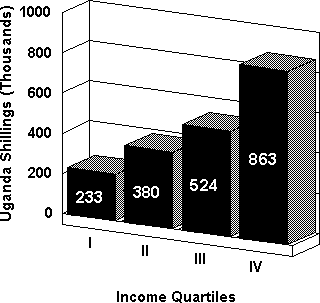
It might be thought that the attention paid by better off households to non-farm activities would result in the neglect and poor performance of their farming activities. Not so at all. Table 2 below shows for a cross-country sample of 1,355 households conducted in 2001 and 2002 (of which the Tanzania example given above was a part) how agricultural productivity per hectare rises steeply across the income ranges. Net farm output per hectare in a series of country samples was between three and six times higher for the top income quartile of households compared to the lowest income quartile. The result for Uganda, as a representative case, is graphed in Figure 2 below.
Table 1: Tanzania - income portfolios by income
quartile
(sample of 344 rural households, 2001)
- composition of household incomes % -
|
Income Sources |
Income Quartile |
|
|||
|
I |
II |
III |
IV |
Total |
|
| |
n=87 |
n=88 |
n=88 |
n=81 |
n=344 |
|
Maize |
27.1 |
21.5 |
15.1 |
7.9 |
12.4 |
|
Rice |
12.3 |
14.2 |
10.3 |
8.8 |
10.0 |
|
Other Crops |
23.3 |
19.9 |
23.8 |
11.8 |
16.3 |
|
Livestock |
5.0 |
7.7 |
6.5 |
14.1 |
11.0 |
|
Sub-Total Agric |
67.7 |
63.3 |
55.7 |
42.6 |
49.7 |
|
Wages |
14.6 |
8.9 |
9.3 |
11.0 |
10.5 |
|
Non-Farm |
11.5 |
23.7 |
29.3 |
44.0 |
36.1 |
|
Transfers |
6.3 |
4.2 |
5.7 |
2.5 |
3.7 |
|
Total |
100.0 |
100.0 |
100.0 |
100.0 |
100.0 |
Source: Ellis & Mdoe (2003)
Table 2: Four Countries - net farm output per ha, by income quartile (US$/ha)
|
Country |
Income Quartile |
Ratio |
|||
|
I |
II |
III |
IV |
IV:I |
|
|
Uganda |
131 |
215 |
295 |
487 |
3.7 |
|
Kenya |
135 |
266 |
358 |
430 |
3.2 |
|
Tanzania |
81 |
108 |
156 |
381 |
4.7 |
|
Malawi |
18 |
44 |
84 |
109 |
6.0 |
Source: Ellis & Freeman (2004)
Figure 2: Uganda - rising farm output per ha with rising incomes
This result is not new, certainly for studies in Sub-Saharan Africa. Non-farm income generates cash that can be used to improve farm yields by hiring labour and purchasing farm inputs (Evans & Ngau, 1991). It may also reduce risk aversion and encourage innovation such as trials of new crop varieties due to the cushion that it provides against the potential failure of new methods. More broadly, a strong flow of non-farm income sources have been observed to bring environmental benefits, reversing environmental degradation and resulting in investment in improved soil and water management as well as rising yields (e.g. Tiffen et al., 1994).
Interpreting the dynamics of rural livelihood diversification is critical for deciding on whether and how to facilitate the process, and the changing role of natural resources access for rural families. The orthodoxy that has been restated in countless different ways over the decades (from Mellor, 1966 to IFAD, 2001) is that rural poverty reduction depends on rising yields in agriculture, creating growth linkages in rural non-farm sectors (e.g. Hazel & Haggblade, 1993; Delgado et al., 1998). According to this conventional wisdom the flow of wealth creation is inevitably from farming outwards, and primacy is given to policies that can stimulate innovation and change in agriculture. In recent times, such policies have been more hands off than hands on, with a high reliance on markets to deliver an encouraging economic environment for agricultural growth. Nevertheless, a continued public role is considered by some observers to exist in the area of technology promotion, including, controversially, the potential of GM crops to provide fresh impetus to farm output growth (Lipton, 2001).
A growing body of literature argues, however, in a different direction to the agriculture-centred orthodoxy. Certainly in Sub-Saharan Africa, diversification can be represented as a failure of agriculture to provide a sufficient livelihood for a substantial proportion of rural dwellers (Bryceson & Bank, 2001; Bryceson, 2002). According to this argument, an active process of ‘deagrarianization’ is occurring whereby farming becomes a part-time, residual, or fall-back activity and livelihoods become increasingly oriented to non-farm and non-rural activities. Some of the factors implicated here are long term demographic and economic trends; others are associated with economic policies. The main factors driving ‘deagrarianization’ in rural Sub-Saharan Africa would appear to be:
decreasing farm size caused by sub-division at inheritance, to the point where even under favourable agro-economic conditions, farming can only provide a part-livelihood;
increasing inability of young people to access enough land to take up farming as their main occupation;
poor farm performance and, in some instances, declining yields due to declining soil fertility;
increased climatic variation, causing greater extremes across seasons and years
declining returns to farming due to factors in the policy or global environment, including:
- dismantling of subsidies, especially on fertilizer,
- increased price instability following market liberalization,
- poor geographical coverage by private traders, especially in remote areas,
- low agricultural prices due to world price trends, aggravated for some crops by the export subsidies of rich countries
the impact of HIV/AIDS when superimposed on these other disadvantages, in many areas reducing significantly the availability of able-bodied labour to carry out physically onerous agricultural tasks.
The deagrarianization hypothesis obtains qualified support from rural livelihoods research conducted in four African countries in 2001 and 2002, some of the findings of which have been reported in preceding paragraphs (see footnote 1 and Tables 1 and 2 above). Some key findings that emerge from that research are as follows (Ellis & Mdoe, 2003; Ellis, Kutengule & Nyasulu, 2003; Ellis & Freeman, 2004):
the rural poor tend to exhibit a highly eroded asset status, manifested by land holdings below 0.5 ha., no cattle or goats, low levels of educational attainment of household members, no savings, and decline in some elements of ‘social capital’ (community level social support; civil security); to these must be added the depleting effects on household labour caused by HIV/AIDS infections;
a tremendous reliance on subsistence amongst customary tenure small farmers in general, and especially amongst poor rural households: subsistence ratios with respect to maize production are commonly in the range of 80 to 95 per cent, and for grain deficit households can be routinely 100 per cent (i.e. zero market sales);
the emergence over the past 5-10 years of an expanding category of subsistence farm household that can only at best produce enough maize to cover 6-8 months consumption, this coverage shrinking to 3-5 months in years when there are climatic shocks (too much rain, hailstorms, shortened rains, droughts etc.);
subsistence ratios in total household income that decline steeply with rising per capita income: for example, in the Malawi country study comprising 280 households, the lowest income quartile exhibited a subsistence ratio in total income of 44 per cent, while for the highest income quartile this fell to 18 per cent (Ellis, Kutengule & Nyasulu, 2003);
as already noted (Tables 1 and 2 above), reliance on crop and livestock production in total livelihood portfolios that declines steeply as per capita income rises, and net farm income that rises steeply across the income ranges.
These widely observed rural livelihood patterns shed light on the dynamics of rural vulnerability. The poorest and most vulnerable are those most heavily reliant on agriculture, and most strongly locked into subsistence within agriculture. The same category of the rural poor also tend to be dependent on work on other farms in order to cover the deficit in their household food balance. This exacerbates rather than diminishes their vulnerability for two reasons: first, labour on other farms can mean neglect of good cultivation practices on own farms (Alwang, 1999); and, second, work on other farms proves an unreliable buffer when adverse natural events occur that affect all farms in a geographical zone.
While the latter findings apply with particular force in Sub-Saharan Africa, in other regions it is often the landless rural poor that are found to constitute the most vulnerable group. This group, as well as relying on wage labour, may also depend on natural resource use through access to common property resources (CPR) due to lack of land or insufficient land to support subsistence needs (Beck & Nesmith, 2001). Their livelihood activities include gathering wild foods (honey, fruits, insects), harvesting forage crops, collecting firewood, making charcoal etc. Hunter-gatherers, nomadic pastoralists, shifting cultivators, migrant fisherfolk and forest-dwelling people are included in the CPR-dependent poor; their vulnerability may be high due to insecurity of resource access and ownership, but their income and asset status can exhibit wide variations, with some households within such groups (for example migrant fisherfolk - Allison, 2003; Allison & Mvula, 2002) being wealthy compared to resident land-owning households in the same locations.
CPR-dependent livelihood systems are often associated with ethnic minorities and ‘indigenous groups’ and such groups are often found in areas of environmental or biodiversity conservation interest. For these reasons, they sometimes assume greater prominence in international policy discourses than their absolute numbers perhaps warrant. Among people living around protected areas, for example, promotion of livelihood diversification away from dependence on ‘wild’ natural resources, or securing their use rights to such resources to promote ‘sustainable use’ are two alternative interventions implemented by integrated conservation and development programmes (Salafsky & Wollenberg, 2000).
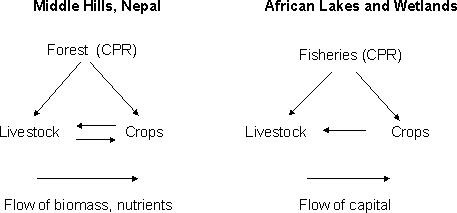
The diversification literature tends to categorise livelihood sources as either farm or non-farm, with the latter often implicitly being taken to be non-natural resource based (trading, construction, service industries etc). In practice, many farming systems comprise a complex mix of activities that take place within recognisable farm boundaries (crop agriculture) and those that may take place both on farms and on commonly held resources. Two such examples are the ‘tri-economies’ of hillside farming systems of Nepal and lakeshore areas of Sub-Saharan Africa (Box 1), where the use of common property resources has long been an integral component of household strategies. Non-farm activities as diverse as ecotourism and brick-making are also natural-resource based. Thus, access to natural resources remains critical to rural livelihoods, whether they are based primarily on ‘agriculture’ in its narrow sense or not.
The overall monetization of the agrarian economy is highly pertinent to the vulnerability status of rural populations. If markets are working well, and trade and exchange are flourishing, then this increases the cash in circulation in rural areas and gives individuals broader alternatives to construct diverse livelihoods that help to reduce vulnerability. The prevalence of subsistence behaviour towards the lower end of rural income distributions militates against these conditions occurring; indeed, on the contrary, the more families seek, or are pushed by external pressures into seeking, security from subsistence, the less options are created to construct more diverse and secure livelihoods. This is because their cash economy, literally, shrinks; and with this happening, the scope for monetised activity of all kinds also shrinks.
Potential exit routes from rural poverty and vulnerability are to some extent revealed by the livelihood patterns of the better off. Fundamentally, these patterns reveal an interdependence in the achievement of livelihood security between diverse non-farm and farm components, in which the farm component simultaneously becomes more productive and diminishes in importance within a diverse livelihood portfolio. Better off households are distinguished by ‘virtuous spirals’ of accumulation typically involving diverse livestock ownership, engagement in non-farm self employment, and diversity of on-farm and non-farm income sources (Ellis & Freeman, 2004).
To summarise this discussion on rural livelihood diversification, it is the dynamic factors at work that create or recreate relative poverty or wealth that need to become the focus of poverty reduction policies. Numerous studies have observed that moving out of poverty is a cumulative process, often achieved in tiny increments. Assets are traded up in sequence, for example, chickens to goats, to cattle, to land; or, cash from non-farm income to farm inputs to higher farm income to land or to livestock (Ellis & Mdoe, 2003). It is also well established that a critical constraint slowing down or preventing such ‘virtuous spirals’ is the inability to generate cash that can be turned into savings and investment. A fundamental role of diversification in a poverty reduction context is that it helps to overcome that constraint. As such, diversification should be broadly encouraged by policy. The degree to which it is not so is discussed in due course; in the meantime we shortly turn to consider more closely natural resource access aspects of evolving rural livelihoods.
|
BOX 1 Interdependence of Private Farms and Common Property Resources: The ‘Tri-Economies’ of the Middle Hills of Nepal and the Lakeshore Regions of Africa. Middle Hills, Nepal In Nepal’s middle hills, agriculture is the primary livelihood activity, based on the ownership of small terraces of farmland. Many farmers lack access to chemical fertilizer, so that soil structure and fertility are maintained by the use of compost and the addition of crop residues and leaf litter gathered from forests that are either held in common or state-owned. Grasses and leaves for livestock fodder are gathered from forests, as are fallen leaves used for livestock bedding. Manured livestock bedding forms the majority of compost later spread on farmland. Livestock are either kept in paddocks or grazed on fallow land or in the common property forests and upland pastures. The biomass and fertility transfers are indicated by arrows in the figure below. Richer households may supplement farming with incomes from local businesses or employment. They often have land outside the village and may spend only part of the year in the hills. They commonly have irrigated as well as unirrigated land holdings; extensive on-farm tree resources, grazing land and private forest and a substantial number of livestock. Middle households commonly have land-holdings and cattle, but only modest private tree resources and grazing land. They tend to be heavily dependent on inputs to their farming systems (fodder, leaf-litter, grazing land) from common forest land. Poorer and landless households depend on non-land based activities such as labouring, artisanal work and non-timber forest product collection; they have specific needs from the forest distinct from the other wealth-rank groups, such as charcoal for blacksmithing and fuelwood and medicinal plants
African Lakes and Wetlands Around the shores of the African Great Lakes, the wetlands of the Sudd and Niger delta and shallow inland lakes such as Lake Chad and similar, smaller waterbodies scattered throughout Africa, the agricultural economy is typically based on a combination of cultivation of private land and access to common property resources. Households combine crop agriculture with fisheries and livestock grazing. Crop agriculture, which often includes paddy rice in wetland areas, takes place on land held under customary tenure (including land claimed when lake levels retreat seasonally or when lake levels drop more extensively due to inter-annual climatic variations). Floodplains and seasonally inundated areas that are not claimed by individual households for crop agriculture are also typically used for livestock grazing. Fisheries have been state-controlled but are managed as de facto commons, with access regulations developed within local societies. Resident households typically combine all three activities. Wealthier households own assets related to fishing (boats, nets, traps) and may have control over access to the best fishing areas. They also own more land and livestock than other groups, as well as owning non-farm businesses (shops, accommodation for rental etc). Middle-income households often own land, but have not generated sufficient capital to own substantial fishing-related assets, although they may have shares in a fishing net and male household members may work as crew labourers on fishing boats. They also have land, used largely for subsistence cropping and small numbers of livestock. Lower-income households also have access to land, used for subsistence cropping. They own few livestock and have access to fishing opportunities only as crew labourers on boats owned by others. Much of their cash income comes from low-paid wage labour in agriculture and fishing. There are also specialist fisherfolk and livestock keepers who visit lakeshore and wetland areas as migrants. Migrants typically access common property resources, sometimes in exchange for informal fees and taxes paid to resident community leaders. As in the Nepal case, there is a net flow of resources from common property systems to farms. In this case, it is cash, rather than nutrients and biomass. Fishing is typically used as a means of generating surplus cash, which is banked in the form of livestock or used to purchase agricultural inputs, improving agricultural productivity for households engaged in fishing relative to households that are not.
|
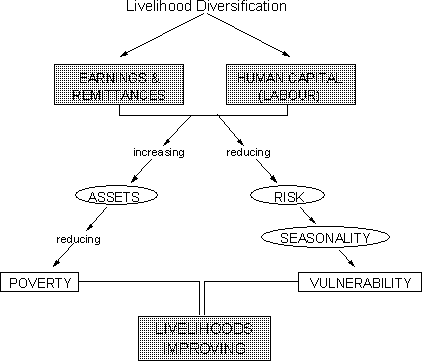
The positive poverty and vulnerability reduction attributes of livelihood diversification are summarised in Figure 3. Livelihood diversification is both partly predicated on, and itself increases, human capital in terms of experience, skills and willingness to innovate. Livelihood diversification generates earnings and remittances that tend to alter significantly the options open to the household by providing it with cash resources that can be flexibly deployed. These factors contribute to lessening vulnerability by ameliorating risk and reducing the adverse consumption effects of seasonality. They also result in increasing assets beyond human capital, thereby permitting poverty to be reduced. In general, livelihood diversification improves livelihoods, and to the extent that it fails to do so, this can often be traced to adverse institutional environments that penalise people on the move.
Figure 3: Positive Attributes of Livelihood Diversification