


The initiative described in this publication evolved from a regional workshop organized by FAO in collaboration with UNESCO in 2002 at Hyderabad, India with the participation of several Asian countries.5 The consultation was held, in turn upon the recommendation of members of the Asia Pacific Network for Food and Nutrition (ANFN)6 and other collaborators who found the FMFH initiative could supplement other main development initiatives targeted at hunger, malnutrition and related problems.
The Hyderabad workshop reviewed the FMFH educational materials and the practical issues in using education to fight hunger and malnutrition. Subsequently, four of the participating countries, namely Bangladesh, India, Indonesia and Nepal, formulated and finalized action plans for using the FMFH materials in schools and socially disadvantaged communities. In Bangladesh and Nepal,7 the FMFH educational material was reviewed by relevant national-level actors in order to adapt this to local conditions and formulate strategies for country wide implementation.
In India, it was decided to adapt the FMFH educational initiative for use in 27 schools in four regions of the country in partnership with leading public health and educational institutions and a non-profit organization.
The FMFH educational package was developed by FAO to serve as a “springboard” to stimulate reflection, discussion and action. The model classroom lessons on key aspects of hunger, nutrition and food security are meant to be used by teachers to encourage students explore the root causes of hunger and malnutrition. There are three categories of lessons for each of three broad school levels: primary, intermediate and secondary. All three levels cover the following topics: “What is hunger and malnutrition?”, “Who are the hungry?”, “Why are people hungry and malnourished?” and “What can we do to help end hunger?”8
|
FMFH Lessons What is hunger and malnutrition? Who are the hungry? Why are people hungry and malnourished? What can we do to help end hunger? |
The lessons can be modified in scope, language, discussion and activities to suit local conditions and the level of cognitive development of the students. Teachers are free to develop other approaches and hold additional classroom and extra-curricular activities.
The teachers were encouraged to use the FMFH materials throughout the school year after adapting the lessons to local circumstances, culture and available classroom facilities. The duration of the lessons could be changed, although each lesson is meant to be covered in three classes of approximately 45 to 60 minutes each. Teachers could thus cover a topic in greater or less detail in keeping with the students’ needs. Moreover, international events and days such as World Food Day offered an opportunity to build on children’s awareness of food security issues.
Outline of FMFH lessons
|
Lesson |
Objectives |
Concepts |
|
What is Hunger and |
To understand why we need food To know that we need many different foods To know who is hungry |
Importance of food Nutrients and basic nutrition concepts Importance of consuming variety of food What is hungerMagnitude of the problem, who are most at risk All countries and regions have some people who are hungry |
|
Why are People Hungry |
To understand the food system that feeds people To understand what it means to be food secure |
The system and processes that provide food; the system can break down at any time point Food security and its three pillars: availability, accessibility and use of food The food system must work to help ensure food security |
|
What can we do to Help End Hunger |
To know that we all can and should act to fight hunger
To identify how we can fight hunger and malnutrition in our communities |
Everyone can be a ‘hero’ in fighting hunger and contribute even in small ways to fight hunger Actions that can be taken Children are encouraged to apply what they have learned to their own communities |
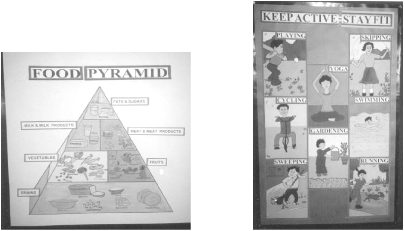
Five locations were chosen in north, east, west and south-central India for using the FMFH initiative: one in the north, in Delhi by the Lady Irwin College; one in the east, in Kolkata by the All India Institute of Hygiene and Public Health; one in the west, in Mumbai by St Gregorius School; and two in south-central India, in Hyderabad, urban by the National Institute of Nutrition (NIN) and Hyderabad, rural by the Dangoria Charitable Trust (DCT). The number of schools and school children covered were different for each location (Table1).
The duration of the initiative in all five locations was between three to five months. The five implementing teams selected the schools after consulting with local authorities. Four of the five teams worked with urban school children. The exception was the Dangoria Charitable Trust (DCT), Hyderabad, which worked with rural high school children in Medak District, Andhra Pradesh state.
The initiative also targeted children of low-income urban families who could not afford a formal education for their children. The team from St Gregorius School in Mumbai reached out to migrant construction workers’ children between five and ten years of age. The aim was to make school children from relatively affluent families aware of the hardships faced by underprivileged children by bringing the two groups of children together through collaborative activities, thereby instilling in the former a spirit of partnership and empathy with the latter.
|
FMFH lessons were adapted and taught to 1123 urban and rural children from different socio-economic backgrounds in four regions of India |
The Mumbai school involved 26 auxiliary staff members in the intiative for communication with the migrant construction worker parents in the local language. Similarly, the Kolkata team reached out to urban slum communities whose children were studying in the schools covered by the FMFH initiative. Story telling sessions, drama performances, group discussions and exhibitions were organized in the slum communities to encourage the involvement of the residents.
Table 1: Number of schools and children provided FMFH lessons
|
Location |
Institution |
Number of schools |
Description of children |
Number of children |
|
Hyderabad (Urban) |
National Institute of Nutrition |
10
(5 experimental 5 control) |
From grades VIII and IX. |
Experimental: 358 Control: 312 |
|
Hyderabad (Rural) |
Dangoria Charitable Trust |
3 rural high schools |
From grades VII and VIII |
Coverage not mentioned |
|
Mumbai
(Urban) |
St.Gregorius School |
1 |
From grade IX
Children of migrant construction workers |
160 |
|
Delhi (Urban) |
Lady Irwin College |
10
(6 government 4 public) |
From grades V, VII and IX (Govt. schools cater to low income [settlement colonies] and public schools to upper income children) |
Grade V: 363
Grade VII:367 Grade IX: 393 |
|
Kolkata
(Urban) |
All India Institute of Hygiene and Public Health |
3 |
Primary school children from urban slums |
Coverage not mentioned |
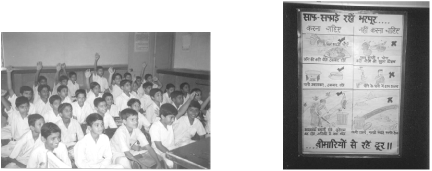
The teams implementing the initiative were free to choose the teaching methods. Each team first held training workshops for science teachers in the chosen schools. Based on the response obtained from the teachers, the FMFH lessons were and modified to suit local conditions. The teachers took part in the design of the teacher training to make it relevant and practical. The Delhi team also prepared a Nutrition Primer for use by the teachers. All teams used supplementary teaching materials/methods (Table 2).
The Mumbai team combined the FMFH activities with existing social service programmes that reached out to underprivileged social groups such as the literacy skills programme.
Table 2: Supplementary teaching aids used by the various project teams
|
Location |
Institution |
Aids used |
|
Hyderabad (Urban) |
National Institute of Nutrition |
Ten posters prepared on topics identified by teachers Skit covering all concepts highlighted in FMFH, performed by children’s theatre group |
|
Hyderabad (Rural) |
Dangoria Charitable Trust |
Drawing competitions Message for the day on notice board Maintenance of vegetable gardens in two schools with space Discussion on the daily diet of children Exhibitions at the end of the project. Exhibits prepared by children and teachers: charts, models, display of local food varieties, models showing distribution of hunger in the world. |
|
Mumbai
(Urban) |
St. Gregorius School |
Workshops
Essay competitions Case studiesSocial service (literacy) programme for children of migrant construction workers |
|
Delhi (Urban) |
Lady Irwin College |
Posters, charts, flip book, stick puppets and flash cards Nutrition primer for teachers |
|
Kolkata
(Urban) |
Government school, Community, NGO |
Charts, games, role plays and demonstrations |
The school children themselves took active part in the translation of the FMFH manual during an interactive workshop organized for this purpose. This ensured that the lessons were meaningful for them. More workshops were held later after many children showed keenness to participate in such sessions. A physician and nutritionist held awareness building workshops for auxiliary staff participating in the FMFH initiative.
In Delhi, the team from Lady Irwin College held a consultation involving nutrition experts, academics, researchers, administrators and teachers before modifying the FMFH lessons.
Their suggestions also led to the inclusion of some government schools catering to underprivileged children so as to cover children from all socio-economic backgrounds and not just children from high-income families.
The Delhi team reached out to children from all three levels of education covered by the FMFH modules. A total of 1 123 children were included in the initiative. The majority of children were under nine years old. About one-third of the children were 9 to 18 years old and studying in intermediate and secondary level classes.
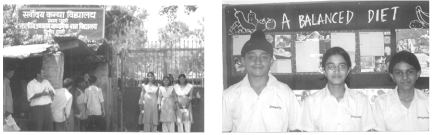
The Kolkata team used the same approach as the Delhi team in adapting the FMFH materials. Community leaders as well as teachers took part in workshops to understand the FMFH approach. Besides primary school children, the Kolkata initiative also reached out to community members including the children’s parents using role playing, exhibitions and group discussions.
Each team used a different method to assess the impact of the FMFH lessons on the pupils. The Kolkata team used a qualitative approach while the teams in Delhi, Mumbai and one in Hyderabad measured the impact using the children’s responses to pre- and post-test questionnaires.
|
The school children themselves took active part in the translation of the FMFH manual during an interactive workshop organized for this purpose. This ensured that the lessons were meaningful for them. |
The National Institute of Nutrition (NIN), Hyderabad used a statistical analytical method to assess impact. For this, NIN carried out a pilot study involving 49 member schools of the Confederations of Voluntary Associations (COVA) located in the old city of Hyderabad. Seventy-five children were randomly selected and given a questionnaire with 22 multiple-choice questions. The questions were related to hunger, food insecurity, nutrition deficiency disorders and FAO.
Two questions also related to the children’s preferences of learning methods. The assessment found that 80 percent of the children preferred classroom lectures followed by teaching aids like charts, posters as well as the play-way method.
For the main study, NIN selected ten schools at random from among control and experimental groups. The children were given questionnaires to test their knowledge before and after the FMFH intervention. One school dropped out of the study. Post-intervention responses were obtained from 254 out of 358 children in the control group and 216 out of 312 children in the experimental group. In order to see if the children remembered the FMFH lessons taught them, they were given a second post-intervention test after two months.
St Gregorius School in Mumbai evaluated the impact of the FMFH lessons through a post-intervention test questionnaire, essays written by the children and discussion of case studies. The knowledge acquired by the auxiliary staff was tested by holding cookery competitions for them.
The teams from Lady Irwin College, Delhi, NIN and DCT, Hyderabad compared the pre- and post-test scores both for teachers and children. The first two teams conducted pre- and post-intervention tests on all children who took part in the initiative.
However, DCT held two tests with a sample of between 15 to 22 children) in each of the three schools, selecting the children on the basis of regular school attendance prior to the FMFH intervention.
A quiz was conducted including objective questions on nutrients, their functions and food groups. Data were analyzed by the proportion t-test. Open-ended questions were asked to judge the children’s knowledge and opinions on FMFH issues.
5NIN. 2002. Report of the FAO-UNESCO Inter-Country Workshop on Feeding Minds, Fighting Hunger, Malnutrition and Food Insecurity. Hyderabad, India, National Institute of Nutrition.
6FAO. 2001. Report of the Regional Expert Consultation of the Asia-Pacific Network for Food and Nutrition on reviewing implementation of national food-based dietary guidelines (FBDGs), Bangkok, Thailand, 20-23 November 2001. Bangkok, FAO Regional Office for Asia and the Pacific.
7TU. FAO. 2004. Feeding Minds, Fighting Hunger Nepal Project. Implementational consideration of Fighting Hunger educational package. Report of the Expert Consultation Workshop. Kathmandu. Kathmandu, Tribhuvan University, FAO.
8FAO. 2001. Feeding Minds, Fighting Hunger Partnership. Feeding Minds, Fighting Hunger. A World Free from Hunger. Rome, FAO.
