1. Approach
In March 1992, on behalf of the Third WARDA External Review Panel, the Executive Secretary of TAC distributed a questionnaire to 33 individuals in various institutions in the WARDA member countries who had professional links with rice research. The basis for selection of participants was the mailing list provided by WARDA.
The objective of the survey was to elicit respondents' opinions on (a) the importance to them of various programmes and activities of WARDA over the past five years (i.e., 1986-91), and (b) the expected importance of WARDA's work during the next decade (i.e., 1992-2001).
The respondents were asked to evaluate each area of WARDA's work in terms of a ranking using the following scale: 1, not valuable at all; 2, slightly valuable; 3, moderately valuable; 4, extremely valuable. Each programme area was evaluated in terms of research, training and information activities. The programme areas were subdivided according to activities. The respondents were also asked to evaluate the effectiveness of collaboration with WARDA and other CGIAR Centres, agreement with WARDA's Strategic Plan and Five-Year Work Plan, and importance of and involvement in the three rice environments.
In addition to the above numerical evaluation, respondents were also requested to comment on: WARDA's new organizational structure, operations and programmes; relevance and coverage of WARDA's activities; WARDA's collaborative mechanisms, WARDA's interactions during the preparation of the Strategic Plan and the Medium-Term Work Plan, WARDA's strengths, weaknesses and contributions, and benefits from rice-related programmes of IRRI, IITA and CIAT. Finally, the respondents were requested to add any comments or observations concerning WARDA's programmes that may be useful to WARDA and the External Review Panel.
2. Results
There was only 27% return. Five replies were received in English, four in French. All the respondents were male and from NARS; most were research scientists, although two were research administrators. Seven were active collaborators with WARDA and three of these were also users of WARDA information services. The remaining two, while not actively engaged in other ways, attended WARDA seminars or workshops. One respondent reported less than three years association with WARDA, while all the rest reported more, the majority having more than six years of association.
2.1. Numerical Evaluation
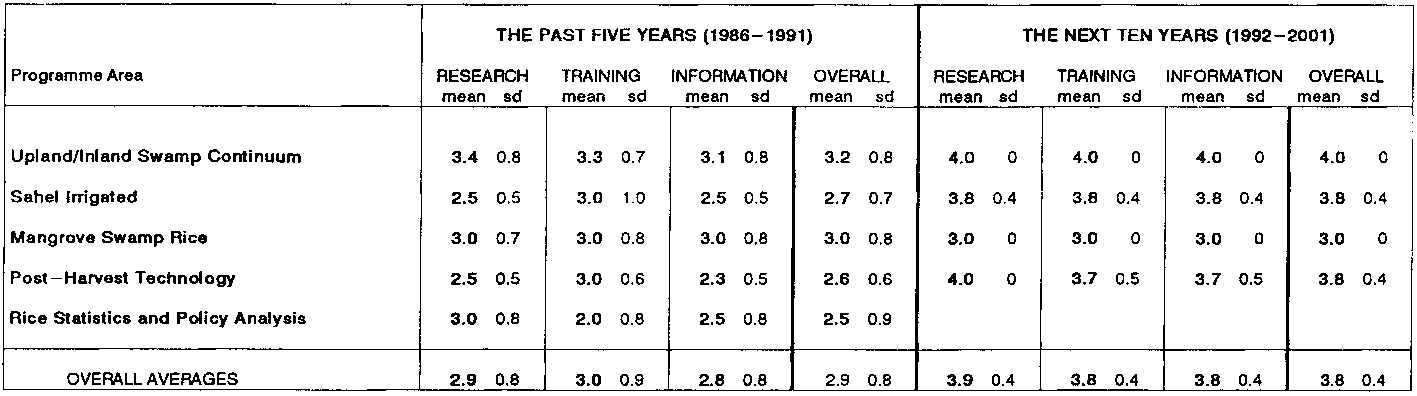
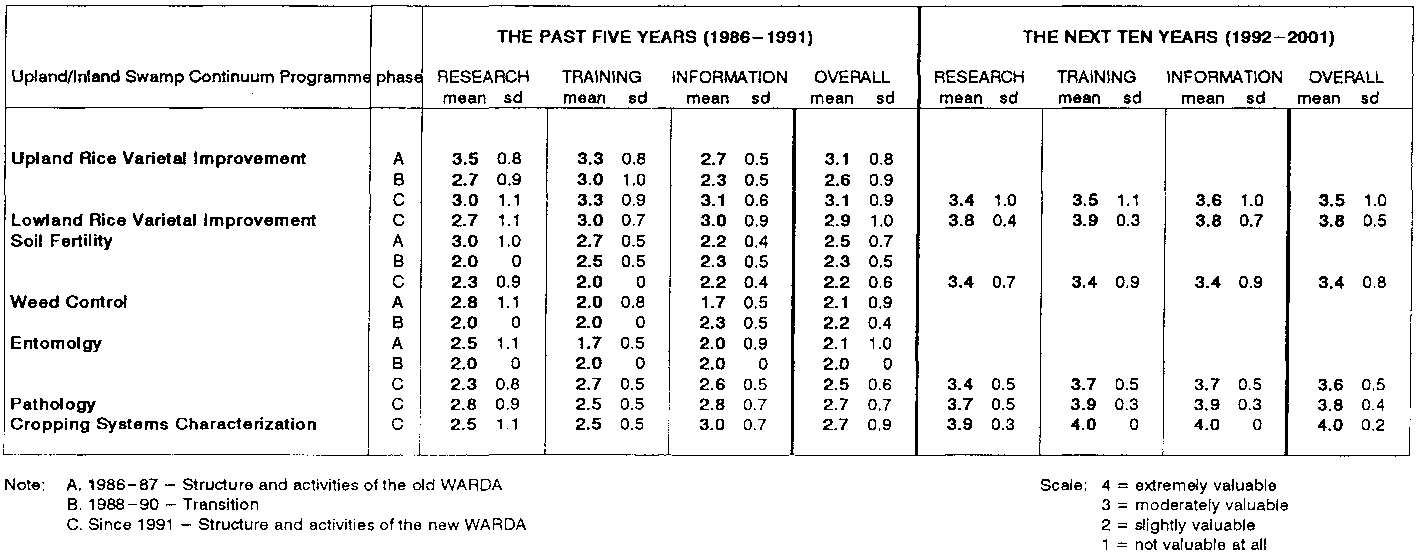
Responses by programme area for each activity (i.e., research, training and information) for the past five years, and for the next decade are summarized in Table 1. Responses on the activities of the Upland/Inland Swamp Continuum Programme, WARDA's main programme for the past five years and for the next decade, are summarized in Table 2. Responses regarding the effectiveness of WARDA's collaboration, agreement with WARDA's Strategic Plan and Five-Year Work Plan, and importance and involvement in the three rice environments are presented in Table 3.
The score achieved for all WARDA's activities combined for the past five year (1986-91) was 2.8 (Table 1). Research, training and information activities were considered more or less of comparable importance, with combined average scores of 2.9, 2.9 and 2.7 respectively. In terms of specific programmes, the Upland/Inland Swamp Continuum Programme was regarded as the most valuable (3.2) followed by the Mangrove Swamp Rice Programme (3.0), and the Sahel Irrigated Programme (2.7).
The combined importance given to all WARDA's future (1991-2001) activities was higher (3.7) than the combined value for the past five years (2.8). This was also true for research (3.7), training (3.6) and information (3.6) activities, all of which were considered of comparable importance. In terms of specific programmes, the activities of the Upland/Inland Swamp Continuum Programme and the Sahel Irrigated Programme were regarded as extremely important (4.0 and 3.8 respectively), with activities of the Mangrove Swamp Rice Programme as moderately important (3.0). Thus, the relative importance of the future Sahel Irrigated Programme was perceived as being of greater importance than in the past.
Table 2 shows the scores for the activities within the Upland/Inland Swamp Continuum Programme during the three phases of WARDA during the past five years (i.e., A - old WARDA: pre 1988, B - WARDA during transition: 1988-90, C - new WARDA: 1991 onwards), and for the next ten years. Scores for phase C are higher than for phases A and B with the upland rice varietal improvement and entomology programmes, whereas with the soil fertility programme, the trend is somewhat mixed. Scores for all future activities were significantly higher than for the past five years.
WARDA's collaborative mechanisms (Table 3) were all highly valued. There was strong high agreement with WARDA's new organization structure and operations, and for WARDA's environment-based research approach. However, there was relatively less agreement with WARDA's interactions with NARs over its Medium-Term Work Plan. Collaboration with IITA and IRRI was rated as highly beneficial, but with CIAT, not so. Collaboration through IITA networks was rated as relatively more beneficial than through IRRI, whereas IRRI's research, training and information activities were considered relatively more beneficial than IITA's. Overall, upland/inland swamp continuum rice environment was considered the most important, followed by the Sahel irrigated environment as second most important, with mangrove swamp a close third. The extent of involvement of national programmes was proportional to the importance of the various rice-growing environments.
2.2. Qualitative Responses
The main thrust of the qualitative responses was that direct collaboration and a committed partnership with NARS was where WARDA's strengths and hopes for the future lie. Most of the comments were centred around the Centre's efforts so far, especially in reinforcing the NARS' capacity for research, and suggestions for the future.
WARDA's involvement of NARS in the priority setting and planning of research was generally well received, and the improvement in WARDA since its reorganization was recognized. Some dissatisfaction was expressed that NARS' voice was too weak (or not carefully enough listened to) in the interaction about plans, and that research efforts are not always concentrated where they are most needed.
It was considered that WARDA's research should be 'basic' (to avoid duplication with NARS) and be concentrated on the search for new hardy, resistant and high-yielding varieties. The Centre's activity in developing appropriate rice technology was commended and there was strong agreement with the environmentally-based programme. General concern was expressed about funding levels for research at the Centre, and the need to maintain momentum in the joint initiatives and programmes was emphasized.
Information and training were considered to be WARDA's most useful services. The information exchange, SDI and document list services were generally well received. It was suggested that prompt publication of research news and the initiation of bilateral publications in which to encourage national scientists could further improve the information service.
Training at the technical level was considered to be good. However, there was a recurring plea for the Centre to provide help with training national scientists at the graduate and postgraduate levels. The posting or visits of WARDA staff to NARS was thought to be of direct benefit for training and cooperation.
TABLE 1: EVALUATION OF IMPORTANCE OF WARDA'S PAST AND FUTURE ACTIVITIES - OVERALL SCORES
TABLE 2: EVALUATION OF IMPORTANCE OF WARDA'S PAST AND FUTURE UPLAND/INLAND SWAMP CONTINUUM PROGRAMME
TABLE 3: EVALUATION OF EFFECTIVENESS OF COLLABORATION, EFFECTIVENESS OF WARDA'S NEW STRATEGIC PLAN AND FIVE YEAR PLAN, IMPORTANCE OF RICE ENVIRONMENTS AND EXTENT OF INVOLVEMENT BY NATIONAL PROGRAMMES, AND BENEFITS FROM IITA, IRRI AND CIAT
|
|
mean |
sd |
Scales |
||
|
1: COLLABORATIVE PROGRAMMES |
|||||
|
|
1.1 WARDA In-House Review |
3.8 |
0.4 |
4 = extremely valuable |
|
|
1.2 NARS-WARDA Working Groups Meetings |
3.9 |
0.3 |
3 = moderately valuable |
||
|
1.3 NARS-WARDA Task Forces Meetings |
4.0 |
0 |
2 = slightly valuable |
||
|
1.4 INGER |
3.9 |
0.3 |
1 = not valuable at all |
||
|
2: WARDA'S NEW STRATEGIC PLAN AND FIVE-YEAR PLAN |
|||||
|
|
2.1 Organizational Structure |
3.6 |
0.5 |
4 = completely agree |
|
|
2.2 Environment-based Research |
3.7 |
0.7 |
3 = moderately agree |
||
|
2.3 Interaction over Plans |
2.9 |
0.6 |
2 = slightly agree |
||
|
3: RICE ENVIRONMENTS |
|||||
|
|
3.1 Importance of Rice Environments |
||||
|
|
Upland/Inland Swamp Continuum |
3.9 |
0.3 |
4 = extremely important |
|
|
Sahel Irrigated |
2.8 |
0.9 |
3 = moderately important |
||
|
Mangrove Swamp |
2.6 |
1.2 |
2 = slightly important |
||
|
|
3.2 Involvement of National Programmes |
||||
|
|
Upland/Inland Swamp Continuum |
3.9 |
0.3 |
4 = extremely active |
|
|
Sahel Irrigated |
2.8 |
0.9 |
3 = moderately active |
||
|
Mangrove Swamp |
2.5 |
1.1 |
2 = slightly active |
||
|
4: BENEFITS FROM OTHER CGIAR CENTRES |
|||||
|
|
4.1 IITA |
||||
|
|
Research |
3.3 |
0.8 |
4 = extremely beneficial |
|
|
Training |
3.4 |
0.5 |
3 = moderately beneficial |
||
|
Information |
3.1 |
0.9 |
2 = slightly beneficial |
||
|
Networks |
3.1 |
0.6 |
1 = not beneficial at all |
||
|
|
4.2 IRRI |
||||
|
|
Research |
3.9 |
0.3 |
|
|
|
Training |
3.5 |
0.5 |
|
||
|
Information |
3.3 |
0.7 |
|
||
|
Networks |
3.0 |
1.1 |
|
||
|
|
4.3 CIAT |
||||
|
|
Research |
1.6 |
0.5 |
|
|
|
Training |
1.3 |
0.5 |
|
||
|
Information |
1.5 |
0.5 |
|
||
|
Networks |
1.5 |
0.5 |
|
||