

© FAO/Giuseppe Bizzarri
This chapter provides guidance on the underlying possible motivations for the reform of an existing SPI or the establishment of a new one, considering the specific situation and context of a given country. The first section helps identify if an SPI for agrifood transformation is needed and what its potential benefits are. The second section offers some insights on how to assess existing gaps in knowledge mobilization for decision-making for agrifood systems and helps map and assess the science–policy advisory landscape.
© FAO/Giuseppe Bizzarri
An agrifood system covers the journey of food from farm to table – including when it is grown, fished, harvested, processed, packaged, transported, distributed, traded, bought, prepared, eaten and disposed of. It also encompasses non-food products that constitute livelihoods and all of the people, as well as the activities, investments and choices, that play a part in getting us these food and agricultural products (FAO, 2022). Central to these systems are various actors and functions that operate at different levels, influenced by determinants or drivers such as governance structures, technological advancements, environmental factors and socioeconomic conditions (Figure 5). Agrifood systems primarily focus on food security,3 the situation that exists when all people, at all times, have physical, social, and economic access to sufficient, safe, and nutritious food that meets their dietary needs and food preferences for an active and healthy life. However, long-term impacts extend to broader and more diverse areas (Ericksen, 2008; Ingram, 2011; Van Berkum, Dengerink and Ruben, 2018; Caron et al., 2018; Dekeyser et al., 2020). These include (i) food security, nutrition, and health; (ii) inclusive economic growth, employment and livelihoods; (iii) sustainable resource utilization and environmental preservation; and (iv) territorial balance and equity (David-Benz et al., 2022).
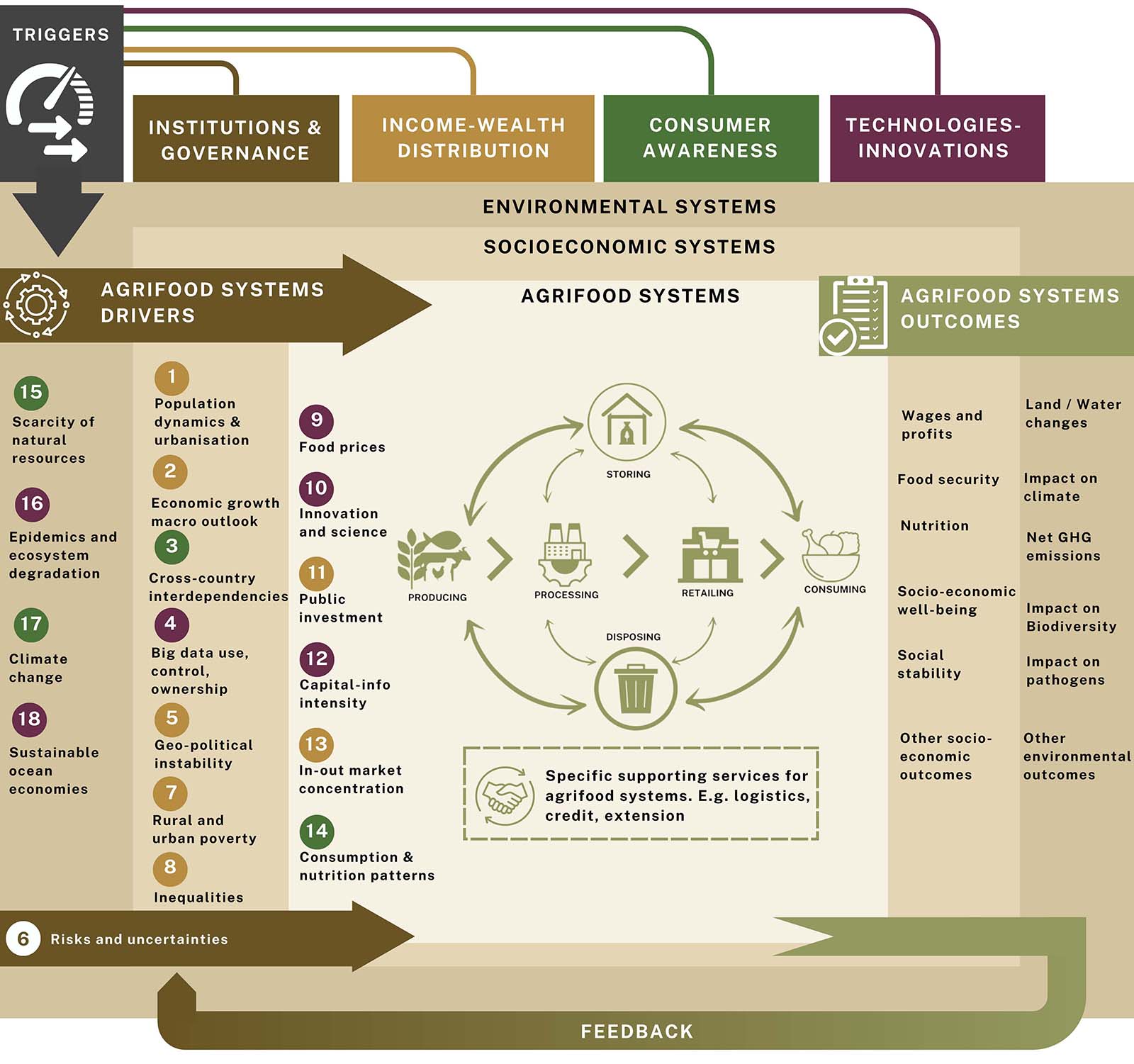
Source: Adapted from FAO. 2022. The future of food and agriculture - Drivers and triggers for transformation. The Future of Food and Agriculture, no. 3. Rome. https://doi.org/10.4060/cc0959en
Furthermore, agrifood systems are characterized by significant power and resource disparities and encompass a broad range of actors, from individual consumers and small-scale producers to multinational corporations. Additionally, food is deeply intertwined with culture and spiritual beliefs, serving not only as a vital sustenance but also as a fundamental aspect of the social fabric in most societies.
Before considering the creation or reform of an agrifood SPI, it is crucial to understand the current state and functioning/performance of agrifood systems within the country, the capacities of the existing institutional setting for a systemic approach to planning, decision-making and implementation, the way data and evidence are used in policymaking processes, and what potential benefits to expect from a better knowledge mobilization environment (see Box 2). At the same time, in order to navigate the intricacies of agrifood systems without feeling overwhelmed, it can be beneficial to initiate the analysis by concentrating on a specific and manageable problem.
Brazil offers one of the most successful examples of establishing an SPI that had an important impact in shaping public policies for agrifood systems, with a focus on food and nutrition sovereignty and security and the human right to food. The Brazilian example stresses the multidisciplinary nature of research needed for an effective SPI as well as the willingness of governments to seek to base their actions on evidence. The National Council for Food and Nutrition Security (CONSEA), the Brazilian Research Network on Food and Nutrition Sovereignty and Security (PENSSAN), and government demands of studies and research through specific public calls are the three main SPI mechanisms in the country. CONSEA, fully financed through public funds, was established as an outcome of social mobilization plus a governmental decision (Leão and Maluf, 2012) and serves as a space for social engagement with a composition of 2/3 civil society representatives and 1/3 government representatives from various ministries. It has helped in establishing dialogue between researchers, social actors, and public managers. Positive outcomes of CONSEA’s work include programmes for priority acquisition of food from family farming, reorientation of school meals, promotion of agroecology, reduction of agrochemical use, food and nutrition education, and addressing the needs of diverse communities. An important product of CONSEA was to stimulate and create conditions for the emergence of PENSSAN to promote academic research in food, nutrition and agriculture. An interdisciplinary perspective with a focus on public policies, dialogue with organizations and social movements and the recognition of different forms of knowledge production have guided the development of the PENSSAN Network (Maluf, 2018). Principles that guide the network’s performance include: respecting diverse forms of knowledge generation and methodological diversity; independence and autonomy from governments, political parties, national and international organizations and private interests; gender, ethno-racial and generational equity; among others. Amid a phase marked by denialism and a lack of government commitment during the COVID-19 pandemic, the PENSSAN Network secured financial backing from non-governmental entities. This support was crucial for conducting two comprehensive nationwide surveys utilizing the Brazilian Food Insecurity Scale. The Brazilian experience underlines the importance of intersectoral policies at different scales and acknowledges the challenges in achieving dialogue between different stakeholders (Figure 6) as well as the sharing of objectives and resources between government sectors.
Sources: Leão, M.M. & Maluf, R. 2012. Effective Public Policies and Active Citizenship: Brazil’s experience of building a food nutrition security system. ABRANDH, Oxfam International. https://policy-practice.oxfam.org/resources/effective-public-policies-and-active-citizenship-brazils-experience-of-building-313051/
Maluf, R. 2018. An interdisciplinary and participatory approach to setting research priorities in Brazil. https://pesquisassan.net.br/wp-content/uploads/2018/06/An_interdisciplinary_and_participatory_approach_to_setting_research_priorities_in_Brazil._Renato_S._Maluf.pdf

© FAO/Lalo de Almeida
Different agrifood systems assessment methods exist in the academic and grey literature, with various entry points, ranging from national or regional scale to local systems and households. Some studies target the agricultural value chain, exploring its components and governing institutions. Recent literature stresses the need for a systemic view of these aspects. Most discussions about translating agrifood systems thinking into practical actions have primarily taken place at the macro-level. However, there is an increasing emphasis on the territorial level as a pathway to practical implementation (David-Benz et al., 2022). The Food Systems Countdown to 2030 Initiative (FSCI) offers a robust foundation for assessing food systems challenges and opportunities, together with identifying gaps and developing national monitoring systems adapted to country needs (see Box 3).
Before engaging in reforming an existing SPI or establishing a new one, it is important to take stock of existing organizations/actors involved in science–policy interface activities and structures/processes in place that could qualify as an SPI. This mapping of potential elements of a science–policy interface ecosystem4 should be done from a descriptive as well as evaluative standpoint, i.e. what works and what does not work, as well as to understand the relationships and influence of different actors. In this regard, the FAO Regional Office for Europe and Central Asia has initiated a regional baseline analysis of national level SPI mechanisms in Europe and Central Asia (see Box 4).
The FSCI is an interdisciplinary, collaborative data-driven effort that provides the first science-based monitoring system to track the state of food systems transformation using 50 indicators across five themes: diets, nutrition, and health; environment, natural resources, and production; livelihoods, poverty, and equity; governance; and resilience (Fanzo et al., 2021). The baseline dataset indicates that no country demonstrates an ideal status across all indicators (Schneider et al., 2023). While various aspects of food systems correlate with a country’s income level (high-income nations generally outperform others on most indicators, followed by middle-income and low-income countries), many exceptions exist. For example, high-income countries fare worse in the consumption of sugar-sweetened beverages and pesticide usage, while among low-income countries, Mozambique and Uganda rank near the global median across all indicators. These findings underscore the necessity of adopting a food systems-specific approach to monitoring. Even though there are gaps in the availability of data for the selected indicators across all countries and over time, the data can be leveraged at the national level to monitor UN Food Systems Summit (UNFSS) voluntary commitments and assess where interventions need to be prioritized for positive outcomes. Going forward, annual reports will support evidence-based policymaking and accountability, including by considering interactions among food systems domains and outcomes.
Sources: Fanzo, J., Haddad, L., Schneider, K.R., Béné, C., Covic, N.M., Guarin, A., Herforth, A.W. et al. 2021. Viewpoint: Rigorous monitoring is necessary to guide food system transformation in the countdown to the 2030 global goals. Food Policy, 104: 102163. https://doi.org/10.1016/j.foodpol.2021.102163
Schneider, K.R., Fanzo, J., Haddad, L., Herrero, M., Moncayo, J.R., Herforth, A., Remans, R. et al. 2023. The state of food systems worldwide in the countdown to 2030. Nature Food, 4(12): 1090–1110. https://doi.org/10.1038/s43016-023-00885-9

© FAO/Luis Tato
In Moldova, at the end of 2023, desk research, qualitative questionnaires and follow-up interviews, were employed to elucidate the drivers, barriers, norms, and attitudes that prevail in the interactions between scientists and policymakers. A total of 57 respondents, including policymakers and scientists from the agrifood and environmental sectors participated. The survey revealed a high degree of understanding of how policy is formulated in both sectors. Over half of the respondents from the environment field and almost all respondents from the agrifood field consider that integrating science and knowledge into decision-making is essential. Despite the revealed lack of understanding of the SPI concept and lack of the formal SPI mechanisms, both policymakers and scientists participate in ad hoc SPI processes. The main forms of science–policy collaboration are working groups, technical-scientific and advisory councils, requests for expertise for legislative and normative acts, public consultations, work sessions aimed at ensuring the transfer of research and innovation, clusters by sectors and products, elaboration of national standards, guidelines, and recommendations. The main barriers to effective SPIs in both sectors include: the lack of alignment of scientific evidence with policymaking needs, the dearth of analysis on the impact of policy implementation, general outdatedness and limited effectiveness of the current research-innovation ecosystem (that might arise from frequent reorganizations), workforce ageing and insufficient funding of the research sphere. Additional challenges stem from the resistance of policymakers to scientific opinions and to incorporating scientific evidence in policy outputs, unclear messaging on policy priorities, as well as frequent government reshuffles, change of paradigms and directions of public policies. To overcome the current shortcomings, solutions are seen in a stronger political will to cooperate, adjusting the research process to the policy needs while clarifying the policy priorities, improving the research infrastructure, increasing funding and investment in research human capital, adapting scientific findings to policy development needs and presenting them in more fit-to-policy formats, like guides, scientific syntheses and methodical instructions, as well as engaging more diverse stakeholders of the SPI ecosystem and holistically addressing agrifood systems and environmental challenges.
© FAO/Lekha Edirisinghe
In mapping organizations and actors, a first approximation to make this exercise easier, is to differentiate between actors/organizations that could be (mainly) categorized as knowledge or evidence producers, knowledge or evidence users, knowledge or evidence brokers and science communicators (as an example, see Figure 7, focusing on actors within science advisory ecosystems, excluding knowledge or evidence users). Such a broad categorization tends to reinforce a linear model perception, but it should only be conceived as a heuristic to position conceptually where organizations/actors put most of their efforts (even if they may have activities in the four categories), prioritizing knowledge from those most directly affected.
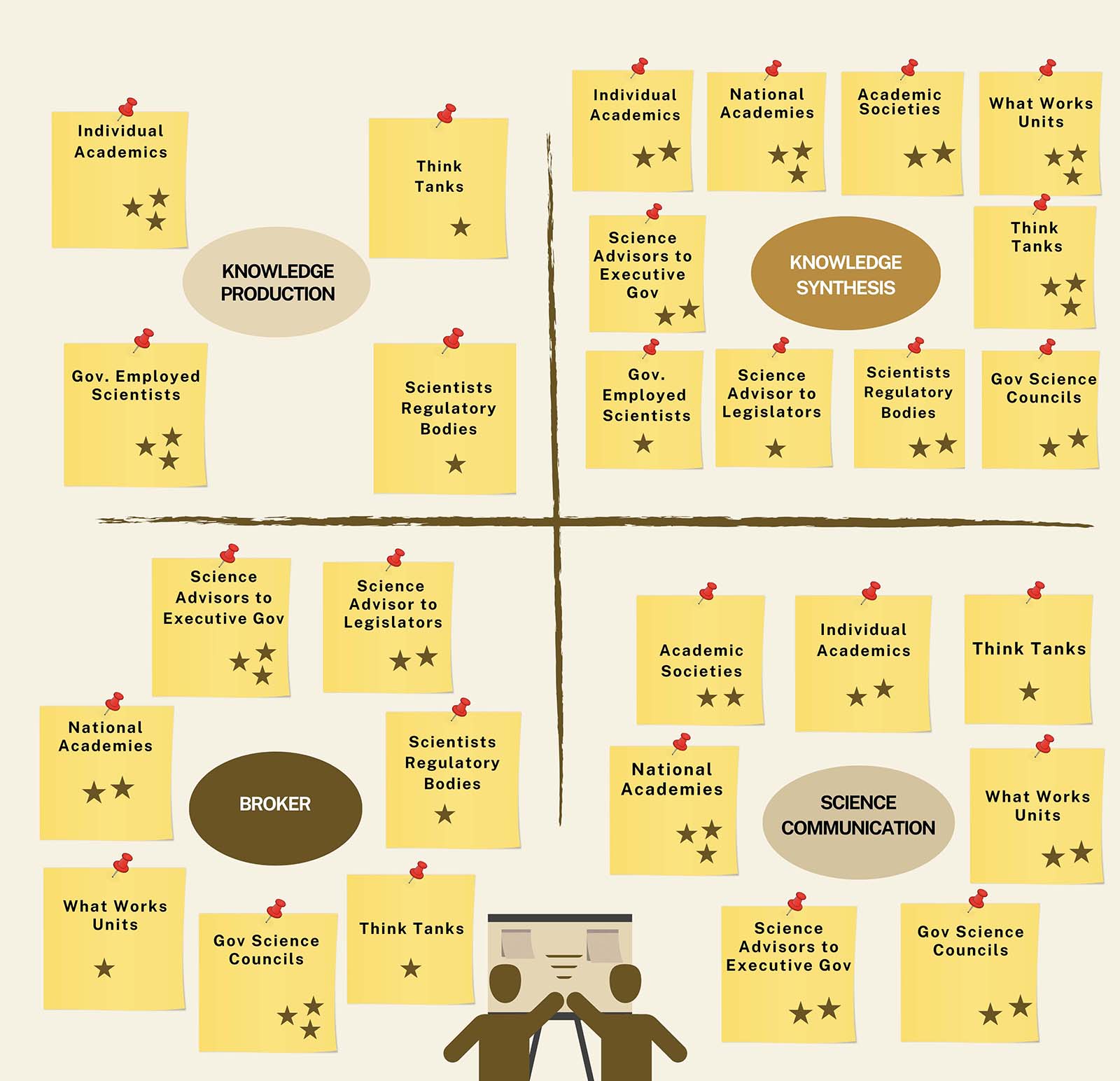
Source: Adapted from Gluckman, P.D., Bardsley, A. & Kaiser, M. 2021. Brokerage at the science–policy interface: from conceptual framework to practical guidance. Humanities and Social Sciences Communications, 8(1): 84. https://doi.org/10.1057/s41599-021-00756-3
Under the project Building capacity for evidence-informed policy in governance and public administration in a post-pandemic Europe,5 funded by the European Union and implemented with the support of the European Commission’s Joint Research Centre (JRC) and the Organization for Economic Co-operation and Development (OECD), a knowledge gap self-assessment framework has been established. This framework serves to assess relevant knowledge areas, providing insights into the capacity for science-for-policy and identifying potential areas for capacity building. It allows stocktaking and evaluation of the current state of affairs in terms of individuals, organizations, collaborations among organizations and systems and policy frameworks. It also includes a dynamic component on the evolution of this science for policy ecosystem as well as an analysis of what has been and factors driving/impeding change. It is partially reproduced in Annex 2 (personal communication).6
In any given country, it will be necessary to assess whether an existing agrifood-related SPI can be strengthened or if a new one needs to be set up (see Box 5 on the creation of an SPI mechanism for the global instrument on plastic pollution). Generally, if an SPI exists that is already addressing, or is closely related to, agrifood systems topics, engaging with this SPI should be the preferred approach. Nonetheless, certain aspects may need strengthening – it seems that many SPIs could improve or align with most recent insights on SPI functioning and effectiveness. Many SPIs operating at the global level, for instance, are known to have room for improvement in relation to the existing evidence/literature on SPIs (e.g. Stevance et al., 2020; Welch et al., 2024). At the national level, 70 percent of countries are making efforts to establish or strengthen food systems governance (UN, 2023). This trend is particularly pronounced in low and low-middle-income countries. Usually, these governance efforts focus on cross-sectoral collaboration and aim at engaging multiple stakeholders at various scales, including local, subnational, and national for collective action.
For an existing SPI in a given national context, it is important to assess its performance and functioning, its effectiveness in terms of influencing policymaking, and to consider and analyse what should change, the reason for the change, and the mechanisms to address key barriers and bring about that change. With an existing SPI, there may be different reasons for strengthening or revitalization. Coordination mechanisms, for instance, might be weak and need to be revitalized after changing governments. Furthermore, work might be facing obstacles and happening in silos due to bureaucratic barriers and budget accountability by sectors (UN, 2023).
It is critical to understand clearly the extent and quality of the engagement between science and policy by structure and actors already in place. A theory of change guiding improvement activities and with a clear purpose is helpful (Oliver, 2022). In some cases, if no SPI can be found, it may be necessary to create a new national-level SPI on agrifood systems.
The need for resources, competencies, long-term fund-raising efforts for establishing and then maintaining continuity can sometimes be underestimated. Therefore a serious consideration of whether the topic can be included in an existing and, ideally, well-functioning SPI (which would then still need additional resources to cover the increased scope) is important. A whole suite of considerations would be required for the establishment of a new SPI. These include determining who holds the authority, where the SPI could be situated, what needs would be addressed, and how to attract and train competent staff, among other issues.
Plastic pollution poses a significant global threat, with implications that extend beyond environmental and human health concerns to socioeconomic consequences relating to consumption patterns and intergenerational justice. While significant scientific advancements have led to a deepening understanding of these risks, emerging evidence underscores the need for scientific support in developing and implementing the global instrument on plastic pollution currently under negotiation. Furthermore, effectively tackling the plastic pollution crisis requires harnessing the latest scientific advancements and solutions, which are continually evolving. Establishing an SPI mechanism is therefore essential. It should draw on the most up-to-date and robust scientific evidence across disciplines to develop comprehensive strategies that balance environmental protection, human health, and socio-economic factors, engaging with communities and practitioners. Key functions of the scientific body should include evaluating, synthesizing and serving as a repository for available scientific information and knowledge; facilitating knowledge generation on current and emerging issues, and on solutions; supporting policy advice, implementation and monitoring; and communicating useable knowledge and policy-relevant advice (International Science Council, 2023). These functions should include the participation of relevant stakeholders in reviewing, testing and validating existing knowledge and solutions, supporting new research, and ensuring public outreach. The scientific body addressing plastic pollution must be independent, demand-driven, and outcome-focused, ensuring practical and actionable scientific advice. Given the complex and multifaceted nature of plastic pollution, the body must adopt a transdisciplinary approach, leveraging insights from a diverse range of disciplines and knowledge systems. Additionally, it should be inclusive, facilitating stakeholder participation, enabling co-production of usable, legitimate, and trusted knowledge and solutions. Close collaboration with existing and emerging initiatives, such as the Basel, Rotterdam, and Stockholm Conventions, and the Science–Policy Panel on chemicals, waste, and pollution (SPP), is essential to ensure coordination and effectiveness. Nevertheless, given the limited scope of these entities, e.g. the Stockholm and Basel Conventions do not address the vast array of over 16 000 plastic chemicals, it is crucial to avoid overreliance and ensure the scientific body’s autonomy and effectiveness.
Source: International Science Council. 2023. ISC Policy Brief: Creating a strong interface between science, policy and society to tackle global plastic pollution. Paris, International Science Council. https://council.science/wp-content/uploads/2023/11/ISC_policy_brief_plastics_WEB.pdf
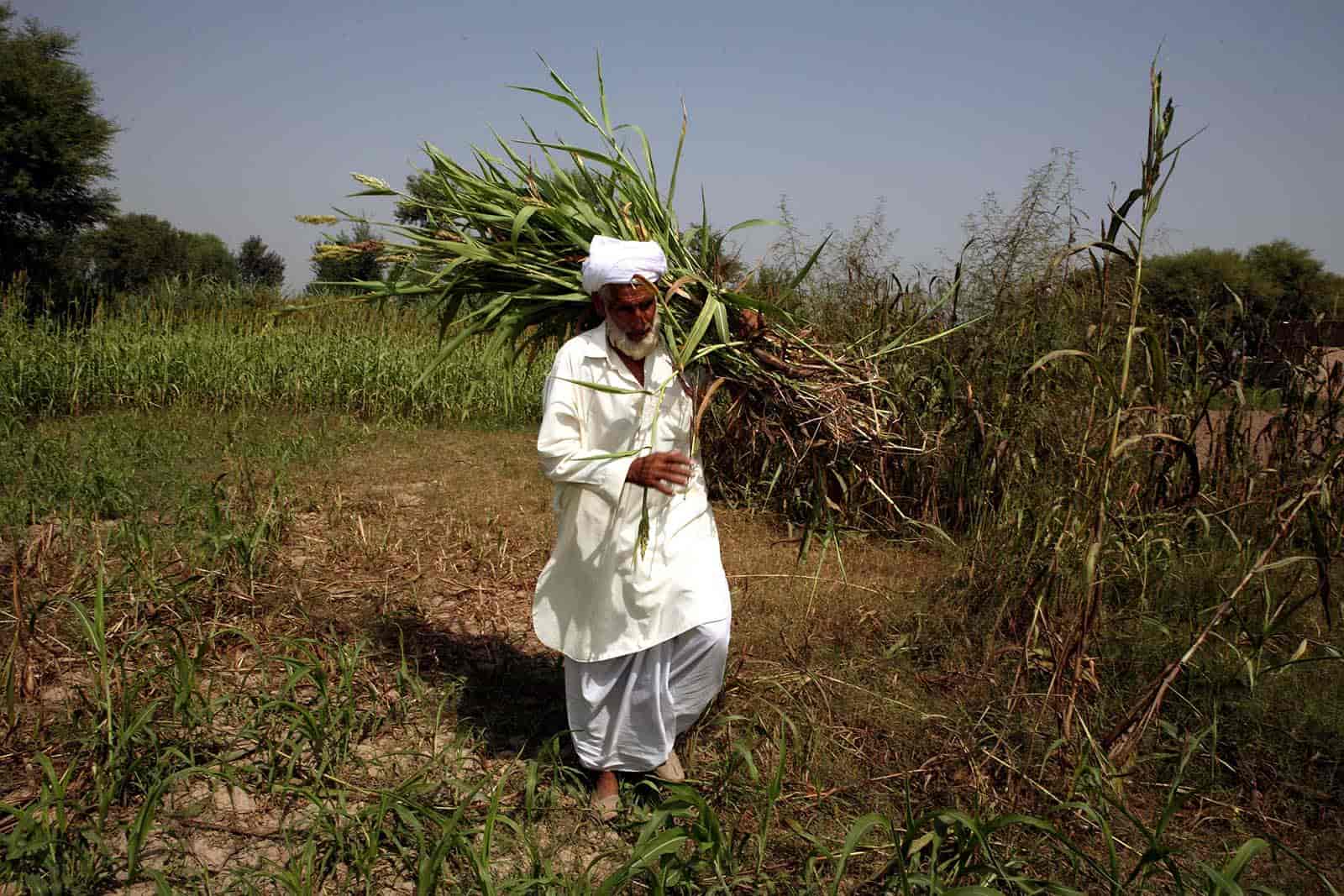
© FAO/Asim Hafeez


Required citation:
FAO 2024. Guidance on strengthening national science–policy interfaces for agrifood systems. Rome, FAO. https://doi.org/10.4060/cd3125en
The designations employed and the presentation of material in this information product do not imply the expression of any opinion whatsoever on the part of the Food and Agriculture Organization of the United Nations (FAO) concerning the legal or development status of any country, territory, city or area or of its authorities, or concerning the delimitation of its frontiers or boundaries. Dashed lines on maps represent approximate border lines for which there may not yet be full agreement. The mention of specific companies or products of manufacturers, whether or not these have been patented, does not imply that these have been endorsed or recommended by FAO in preference to others of a similar nature that are not mentioned.
ISBN 978-92-5-139322-2
© FAO, 2024
Some rights reserved. This work is made available under the Creative Commons Attribution-NonCommercial-ShareAlike 3.0 IGO licence (CC BY-NC-SA 3.0 IGO; https://creativecommons.org/licenses/by-nc-sa/3.0/igo/legalcode).
Under the terms of this licence, this work may be copied, redistributed and adapted for non-commercial purposes, provided that the work is appropriately cited. In any use of this work, there should be no suggestion that FAO endorses any specific organization, products or services. The use of the FAO logo is not permitted. If the work is adapted, then it must be licensed under the same or equivalent Creative Commons licence. If a translation of this work is created, it must include the following disclaimer along with the required citation: “This translation was not created by the Food and Agriculture Organization of the United Nations (FAO). FAO is not responsible for the content or accuracy of this translation. The original [Language] edition shall be the authoritative edition.”
Disputes arising under the licence that cannot be settled amicably will be resolved by mediation and arbitration as described in Article 8 of the licence except as otherwise provided herein. The applicable mediation rules will be the mediation rules of the World Intellectual Property Organization http://www.wipo.int/amc/en/mediation/rules and any arbitration will be conducted in accordance with the Arbitration Rules of the United Nations Commission on International Trade Law (UNCITRAL).
Third-party materials. Users wishing to reuse material from this work that is attributed to a third party, such as tables, figures or images, are responsible for determining whether permission is needed for that reuse and for obtaining permission from the copyright holder. The risk of claims resulting from infringement of any third-party-owned component in the work rests solely with the user.
Sales, rights and licensing. FAO information products are available on the FAO website (www.fao.org/publications) and can be purchased through publications-sales@fao.org. Requests for commercial use should be submitted via: www.fao.org/contact-us/licence-request. Queries regarding rights and licensing should be submitted to: copyright@fao.org.
Cover photograph: © FAO/emergencies