After studying individual Centre proposals, TAC looked at the implications of these proposals when aggregated for CGIAR priorities, in particular by undertaking, commodity, and production sector.
Table 1 provides an overview of the proposed allocation of resources by undertaking and activity for the period 1999-2001 and compares it with estimates of actual spending in 1997, proposed spending in 1998, and the MTM97-endorsed proportions for 2000. Overall, the Committee is pleased to note that there is considerable congruence between the profile endorsed and Centre proposals. It should be noted, however, that the CGIAR is still under-investing slightly in activities for increasing productivity, in particular in germplasm improvement. TAC cautions the members of the Group and the Centres against further reducing investment in this activity. The Committee would also like to point out that investment in areas such as documentation, publications and training for professional development, are somewhat against the trend endorsed by the Group at MTM97.
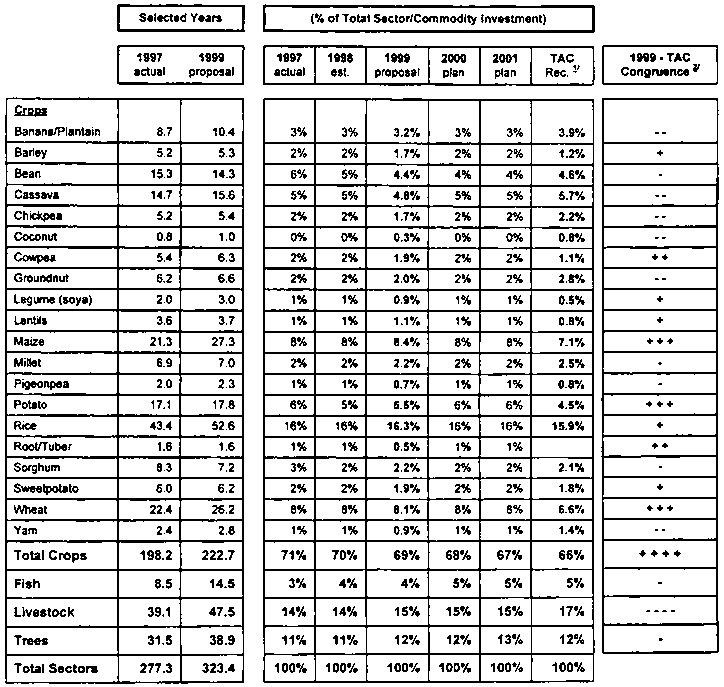
With respect to sectors and commodities (Table 2), TAC notes that work on fish and forestry is proceeding towards the 2000 targets endorsed by the Group at MTM97, but livestock remains below the trend projected while, as a compensating category, the 1999 proposals will lead to crops being relatively oversubscribed. TAC is more concerned, however, about projected shortfalls in investment in water management and regrets that the current classification system does not allow for a quantification.
With respect to crop commodities, TAC notes that the centre proposals for bananas/plantains, cassava, coconut, groundnut, and yam imply levels well below those endorsed at MTM97 and not evidently on trend towards those levels. At the same time, a number of crops are relatively well above the trend line towards the Group-endorsed 2000 levels, including barley, cowpea, maize, potato (but see Section 3, CIP), and wheat. TAC emphasizes that the latter are above the relative levels endorsed in 1997. In absolute terms, TAC applauds Centre efforts to gain additional support for such research.
TAC will revisit these themes in its ICW98 presentation to the Finance Committee and to the Group. TAC's intent here is to simply call to members' attention the outcomes of this early analysis in the hope that the information will be useful as bilateral negotiations with centres emerge.
Table 1: CGIAR Research Agenda - By Activity, 1997-2001 (percentage distribution)
|
Increasing Productivity |
1997 (actual) |
1998 (est.) |
1999 (proposal) |
2000 (Plan) |
2001 (Plan) |
CGIAR endorsed |
|
40% |
37% |
37% |
37% |
36% |
39% |
|
|
of which: |
||||||
|
Germplasm Enhancement & Breeding |
19% |
18% |
18% |
18% |
17% |
20% |
|
Production Systems Development & Management |
20% |
19% |
19% |
19% |
19% |
19% |
|
Protecting the Environment |
17% |
18% |
19% |
19% |
19% |
18% |
|
Saving Biodiversity |
11% |
11% |
11% |
11% |
12% |
11% |
|
Improving Policies |
11% |
12% |
12% |
12% |
12% |
12% |
|
Strengthening NARS |
21% |
22% |
21% |
21% |
21% |
20% |
|
of which: |
||||||
|
Training & Professional Development |
7% |
8% |
8% |
8% |
8% |
9% |
|
Documentation, Publications, Info. Dissemination |
7% |
7% |
7% |
6% |
7% |
5% |
|
Organization & Management Counselling |
3% |
3% |
3% |
3% |
3% |
3% |
|
Networks |
4% |
4% |
4% |
4% |
4% |
3% |
|
TOTAL |
100% |
100% |
100% |
100% |
100% |
100% |
Source: CGIAR Secretariat
Table 2: 1997-2001 Agenda Investments by Sector and Commodity (in US$ million and percentages)
1 CGIAR Priorities and Strategies for Resource Allocation During 1998-2000, MTM 1997 (Doc - SDR/TAC:IAR/96/6.2).2 Variances: one "+" or one "-" is up to US$ 1.5 m; two is $1.5 to $3 m; three is $3 to $ 6 m; four is more than $6 m.
Source: CGIAR Secretariat
D/W8445