1.0 Introduction
The Mwenje and Mufurudzi dams offer two different options of management procedures of fisheries resources. Both are community-based and have reached, through negotiation with state authorities, seemingly adequate tenure modifications. They illustrate the contribution of the Rapid Rural Appraisal (RRA) method for the institutional modifications needed, both, to mobilize human resources and to implement management procedures leading to the sustainable exploitation of fisheries from small water bodies.
2.0 The Mwenje Dam
2.1 Location
The Mwenje Dam is located in the Chiweshe Communal lands within the Mazowe District in Mashonaland Central Province. The dam is fed by Mwenje river, and Sawi and Nyakasanga rivers. The Mwenje river is part of the Mazowe system. The dam region has reliable rainfall. The dam did not dry up even during the bad drought of 1992.
2.2 Fisheries Management in the Mwenje Dam without ALCOM
The dam was managed by the Department of National Parks and Wildlife Management (DNPWM) -- mandated to manage all wildlife in Zimbabwe including fish. Management entailed determining the fishing effort for the dam and issuing of licences to fishermen. The Department controls access to the dam through policing and flushing out illegal fishermen. Because of the multiplicity of small size dams in Zimbabwe, effective control by the Department is difficult. So illegal fishing by both outsiders and locals went on unabated. The uncontrolled fishing led to a poor performance of the fishery thereby resulting in decreased benefits for the communities living around the dam.
Under the circumstances the community members expressed concern over the illegal fishing in the dam and conflicts the legal fishermen had with outsiders. They stated that If they had the authority to manage the dam they would do so.
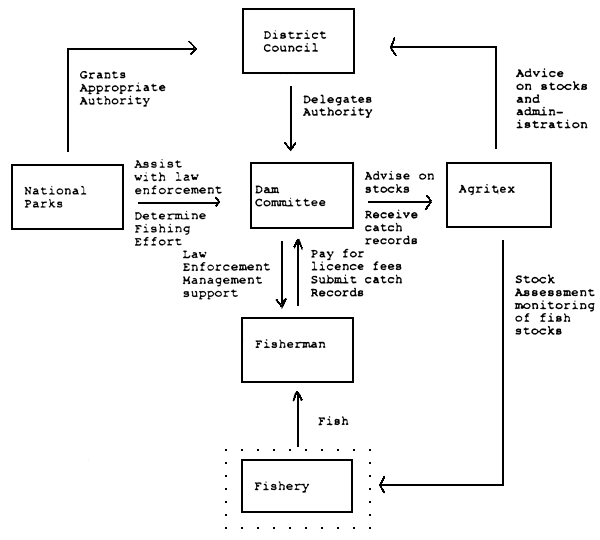
ALCOM intervened through a government request, to establish a community-based management of fisheries resources within the national legal framework of fishing regulations. The District Council requested and obtained from the DNPWP the devolution of its authority to manage the Dam to the District Council. In turn, the District Council devolved this authority to a community-based management committee. This allowed the community to exercise effective control of the reservoir fisheries and set up their own rules to govern access to the fishery, including the number of fishermen who would be allowed to fish.
2.3 Proposed Organisational Arrangements for Management
ALCOM carried out a fish resource assessment of the dam and a Rapid Rural Appraisal (RRA) to establish a socio-economic baseline, community needs and interest in fisheries management. As a result of the RRA and the Report on the Fisheries Status, the community requested that a Steering Committee be formed to examine the proposals for management of the fisheries resource. The Steering Committee invited views from various government departments and ALCOM to determine those that would participate in the management of Mwenje dam. The four villages were chosen was by consensus.
The community-based management of fisheries resources for Mwenje dam is vested in the elected Dam Committee. Villagers who reside around the dam elect the representatives who form the Delegates Conference which is the fishery governing body. The Delegates Conference then elect the Management Committee within which operate the fish wardens. The Management Committee decides on the constitution for the Delegate Conference, the fishing by-laws, the fishing effort (i.e. number of fishermen); and reports first to the Delegates Conference and then to the District Council.
The Delegates Conference comprises 40 members, 10 from each village surrounding the dam. The villages are Nyachuru, Mufuka, Munyengeterwa and Chemadzimbabwe. The Management Committee has 12 members, the chairman, vice chairman, treasurer, secretary and 8 members of which two are fish wardens. The fish wardens are responsible for patrolling the dam to control access to the dam. They are paid a nominal wage by the Management Committee. The fishermen, both, rod, and liners, and gill-netters, pay fishing licences to the Management Committee. The licence fees were decided by the Management Committee and approved by the Delegate Conference and the District Council. Out of the moneys from the fishing licences come the wage of the fish wardens and sitting allowances for the committee members.
The Management Committee requested the District Council to apply for Appropriate Authority from the DNPWM. The implementation of the fishing by-laws for the Mwenje dam Committee took two years. This was the time needed to vest Appropriate Authority status to the District Council.
Implementation of the fishing regulation started in July 1993. This was based on the verbal approval of the fishing regulations and an extended award of the Appropriate Authority when the Chiweshe District Council merged with the Mazowe Rural Council who had Appropriate Authority status for waters within their areas. The final approval of the Appropriate Authority status was received by the Council in April 1994.
In summary, based on experience gained, Appendix A contains a management scheme which synthesizes the a community-based management of fishery resources.
3. The Mufurudzi Dam
3.1 Location
The Mufurudzi Dam is located in the Madziwa communal lands within Shamva District in Mashonalnad Central Province. The dam is fed by Mufurudzi and Nyamasanga rivers. The principal river is the Mufurudzi which is a tributary of Mazowe system. The Shamva District also has reliable rainfall. The dam did not dry up during the bad drought of 1992.
3.2 Fisheries Management in Mufurudzi Dam without ALCOM.
The fisheries management in the Mufurudzi dam followed the same characteristics of the Mwenje dam described earlier. ALCOM also intervened through governmental request to establish a community-based management of fisheries resources. Likewise, the DNPWM devolved its authority to manage the dam to the District Council. The management specific procedure, however, differed from those of the Mwenje dam.
3.3 Proposed Organisational Arrangements for Management
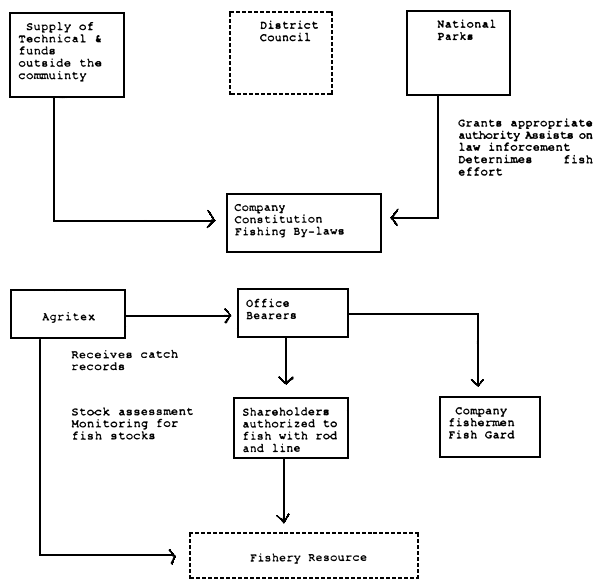
Community-based management of fisheries resources for Mufurudzi dam is vested in the Community Company composed by the community members surrounding the dam. The Company elected Office Bearers who are responsible for the day-to-day management of the business of fishing. The Office Bearers hire fishermen to fish for the company and Fish Guards to control access to the fishery during the night by illegal fishermen. The Company works in close collaboration with the District Council and other government departments such as the DNPWM, Agritex and Department of National Resources.
The shares entitles shareholders a share of profits at the end of the year. Since the dam is an important source of income the community members also undertake policing of to look after the dam. The implementation of the Community Company was a lengthy process, however.
The first contacts were made in January 1992, when ALCOM with the assistance of the DNPWM, and in collaboration with the District Administrator (DA), identified the Mufurudzi dam as a pilot project. Eventually the DA requested ALCOM for technical assistance for the whole process.
Accordingly, ALCOM carried out a fish resource assessment of the dam and a Rapid Rural Appraisal (RRA) to establish the socio-economic baseline, community needs and interest in fisheries management. As a result of the RRA and the Report on the Fisheries Status the community requested that a Planning Committee be formed to examine the proposals for management of the fisheries resource. The Planning Committee invited the DA to present a concept for Community Company and ALCOM to present alternative management options. The Community Company was chosen as the option that would bring the most benefits to the community.
The Planning Committee with the assistance from ALCOM proposed a Company Constitution and Fishing by-laws for Mufurudzi Dam. These were polished by the DA and presented to the District Council for approval. After Council's approval the Planning Committee established dates for the sell of shares. Out of the originally planned 1 500 shares, 364 were bought. Each share costs 10 $Z and during the first issue of shares only one share could be bought per family. The Office Bearers were elected and the activities for the Company were launched.
It took two years for the Community Company to take on its current operating level. It is too early to conclude whether the Community Company scheme is preferable to the previous described. The role played by the DA in this process was decisive. For example, the DA applied and obtained funds for the Company from the New Zealand High Commission without involving the Planning Committee. With these funds it was possible to procure boats and nets for the Company. It was essentially a top-down rather than bottom-up approach. The DA soon realised that more time was needed with the community members than anticipated. So the assistance of a volunteer from VSO from the UK was obtained. The volunteer is presently working with the community on a day-to-day basis. The presence of the volunteer for the past six months or so has speeded up the operations of the Community Company.
The Community Company was instituted on 18 March 1994. So fishing has started. Policing of the dam is beginning to bear fruit. The future of the Community Company appears bright. It will be very important to monitor if other communities follow up this example, particulary in the absence of such a rare and committed DA that played a decisive role in this case. Undoubtedly, the DA's leadership can be questioned as a “top-down” approach. But in the process of general economic development, leadership emanating from the national government structure is a rare commodity and does make a difference in the expected outcome. In brief, based on the experience gained, Appendix B synthesizes a Community-Based company for the management of fisheries resources.
3.4 Conclusion
Although both cases are not yet fully operational, they exhibit promising characteristics for success. Above all, the RRA for both cases was designed and executed by a Zimbabwean scientist in shona. Secondly, local participation from the national governmental organizations was very active, particularly in the case of the D.A. in the Mufurudzi dam - who even obtained financing from other international donors. Thirdly, through the RRA methodology the “felt needs” of the population adjacent to the dams were identified. So, their commitment to suitable exploitation and management was secured. At present, both dams need extension work, advise on management stocks, and necessary, biological/limnological information for the proper stocking. An essential and necessary element is already in place: a community-based management and control of the fisheries resources. Without it, there would not make any sense to stock dams even the biotechnical information were available. Therefore, in the final analysis, the national governmental authorities implicated in inland fisheries: Agritex and NPWM, will an the overriding role in instituting the conditions for sustainability.
APPENDIX A
Model for Community-based management of fishery resources
APPENDIX B
Model for Community-based Comapany for Management of Fisheries Resources