
APPENDIX II
DRAFT AND REVISED DRAFT MAXIMUM RESIDUE LIMITS FOR PESTICIDES
(Advanced to Step 8 of the Codex Procedure)
MRL (mg/kg) |
Step |
Note | |||||
CM |
1207 |
Rice hulls1 |
50 |
8 |
||
AF |
1053 |
Sorghum forage (dry) 1 |
5 |
8 |
||
AB |
0541 |
Soya bean hulls1 |
0.3 |
8 |
||
AV |
0702 |
Sunflower forage1 |
5 |
8 |
||
AB |
0447 |
Sweet corn cannery waste1 |
7.4 |
8 |
||
VW |
0448 |
Tomate paste1 |
10 |
8 |
||
AM |
0660 |
Almond hulls |
50 |
8 |
||
VS |
0621 |
Asparagus |
15 |
8 |
||
VR |
574 |
Beetroot |
0.1 |
8 |
||
VR |
577 |
Carrot |
0.5 |
8 |
||
VO |
0440 |
Egg plant |
1 |
8 |
||
MO |
0098 |
Kidney of cattle, goats, pigs and sheep |
3 |
8 |
||
MO |
0099 |
Liver of cattle, goats, pigs and sheep |
1 |
8 |
||
GC |
0645 |
Maize |
0.02 |
(*) |
8 |
|
AF |
0645 |
Maize forage, |
400 |
dry |
8 |
|
AS |
0645 |
Maize fodder |
250 |
8 |
||
OC |
0645 |
Maize oil, crude |
0.1 |
8 |
||
MM |
0095 |
Meat (from mammals other than marine mammals) |
0.05 |
8 |
||
ML |
0106 |
Milks |
0.05 |
8 |
||
FT |
0305 |
Olives |
30 |
8 |
||
OC |
0305 |
Olive oil, virgin |
25 |
8 |
||
VO |
0445 |
Peppers, sweet |
5 |
8 |
||
CM |
1206 |
Rice bran, unprocessed |
170 |
8 |
||
AS |
0649 |
Rice straw and fodder. Dry |
120 |
8 |
||
CM |
1205 |
Rice, polished |
1 |
8 |
||
AF |
0651 |
Sorghum forage, green |
20 |
8 |
||
OC |
0541 |
Soya bean oil, crude |
0.2 |
8 |
||
VD |
541 |
Soya bean (dry) |
0.2 |
8 |
||
AL |
0541 |
Soya bean fodder |
15 |
8 |
||
AL |
1265 |
Soyabean forage (green) |
30 |
Dry wt |
8 |
|
OC |
0802 |
Sunflower seed oil, crude |
0.05 |
8 |
||
VO |
0448 |
Sweet corn, corn on the cob |
0.1 |
8 |
||
VR |
0508 |
Sweet potato |
0.02 |
(*) |
8 |
|
SO |
0802 |
Sunflower seed |
0.2 |
8 |
||
VO |
0448 |
Tomato |
5 |
8 |
||
JF |
0448 |
Tomato juice |
3 |
8 |
||
TN |
0085 |
Tree nuts |
1 |
8 |
||
VR |
0506 |
Turnip, Garden |
1 |
8 |
||
GC |
0654 |
Wheat |
2 |
8 |
||
CF |
1211 |
Wheat flour |
0.2 |
8 |
||
CF |
1210 |
Wheat germ |
1 |
8 |
||
CM |
0654 |
Wheat bran, unprocessed |
2 |
8 |
||
AS |
0654 |
Wheat straw and fodder, dry |
30 |
8 |
||
20 2,4-D
FC |
0001 |
Citrus fruits |
1 |
Po |
8 |
|
22 DIAZINON
MM |
814 |
Goat meat |
2 |
(fat) |
8 |
|
MO |
98 |
Kidney of cattle, goats, pigs and sheep |
0.03 |
8 |
||
MO |
99 |
Liver of cattle, goats, pigs and sheep |
0.03 |
8 |
||
MM |
98 |
Meat of cattle, pigs and sheep |
2 |
(fat) |
8 |
|
FP |
9 |
Pome fruits |
0.3 |
8 |
||
30 DIPHENYLAMINE
ML |
812 |
Cattle milk |
0.0004 |
(*) F |
8 |
|
FP |
230 |
Pear |
5 |
Po |
8 |
|
49 MALATHION
VS |
621 |
Asparagus |
1 |
8 |
||
VP |
61 |
Beans, except broad bean and soy bean |
1 |
8 |
||
FB |
20 |
Blueberries |
10 |
8 |
||
VC |
424 |
Cucumber |
0.2 |
8 |
||
VL |
485 |
Mustard greens |
2 |
8 |
||
VA |
385 |
Onion, Bulb |
1 |
8 |
||
VA |
0389 |
Spring onion |
5 |
8 |
||
VO |
447 |
Sweet corn (corn-on-the-cub) |
0.02 |
8 |
||
JF |
448 |
Tomato juice |
0.01 |
8 |
||
VL |
506 |
Turnip greens |
5 |
8 |
||
59 PARATHION-METHYL
FP |
226 |
Apple |
0.2 |
8 |
||
VB |
41 |
Cabbages, Head |
0.05 |
8 |
||
DF |
269 |
Dried grapes (=currants, raisins and sultanas |
1 |
8 |
||
FB |
269 |
Grapes |
0.5 |
8 |
||
FS |
247 |
Peach |
0.3 |
8 |
||
VD |
72 |
Peas (dry) |
0.3 |
8 |
||
62 PIPERONYL BUTOXIDE
MO |
1280 |
Cattle kidney |
0.3 |
8 |
|||
MO |
1281 |
Cattle liver |
1 |
8 |
|||
MM |
812 |
Cattle meat |
5 |
(fat) |
8 |
||
ML |
812 |
Cattle milk |
0.2 |
F |
8 |
||
GC |
80 |
Cereal Grains |
30 |
Po |
8 |
||
FC |
1 |
Citrus fruits |
5 |
8 |
|||
JF |
1 |
Citrus juice |
0.05 |
8 |
|||
DF |
167 |
Dried fruits |
0.2 |
Po |
8 |
||
PE |
112 |
Eggs |
1 |
8 |
|||
VC |
45 |
Fruiting vegetables, Cucurbits |
1 |
8 |
|||
MO |
0098 |
Kidney of cattle, goats, pigs & sheep |
0.2 |
8 |
Excluding cattle kidney | ||
VL |
483 |
Lettuce, Leaf |
50 |
8 |
|||
MO |
0099 |
Liver of cattle, goats, pigs & sheep |
1 |
8 |
|||
OC |
645 |
Maize oil, Crude |
80 |
PoP |
8 |
||
MM |
0095 |
Meat (from mammals other than marine mammals) |
2 |
8 |
Excluding cattle meat | ||
ML |
0106 |
Milks |
0.05 |
F |
8 |
Excluding cattle milk | |
VL |
485 |
Mustard greens |
50 |
8 |
|||
AL |
72 |
Pea hay or pea fodder (dry) |
200 |
(dry) |
8 |
||
AL |
528 |
Pea vines (green) |
400 |
(dry) |
8 |
||
SO |
703 |
Peanut, Whole |
1 |
8 |
|||
VO |
51 |
Peppers |
2 |
8 |
|||
PM |
110 |
Poultry meat |
7 |
(fat) |
8 |
||
PO |
111 |
Poultry, Edible offal of |
10 |
8 |
|||
VD |
70 |
Pulses |
0.2 |
Po |
8 |
||
VL |
494 |
Radish leaves (including radish tops) |
50 |
8 |
|||
VR |
75 |
Root and tuber vegetables |
0.5 |
8 |
Except carrot | ||
VL |
502 |
Spinach |
50 |
8 |
|||
VO |
448 |
Tomato |
2 |
8 |
|||
JF |
448 |
Tomato juice |
0.3 |
8 |
|||
CM |
654 |
Wheat bran, Unprocessed |
80 |
PoP |
8 |
||
CF |
1211 |
Wheat flour |
10 |
PoP |
8 |
||
CF |
1210 |
Wheat germ |
90 |
PoP |
8 |
||
CF |
1212 |
Wheat wholemeal |
30 |
PoP |
8 |
||
79 AMITROLE
FB |
0269 |
Grapes |
0.05 |
8 |
||
FP |
0009 |
Pome fruits |
0.05 |
(*) |
8 |
|
FS |
0012 |
Stone fruits |
0.05 |
(*) |
8 |
|
85 FENAMIPHOS
FP |
226 |
Apple |
0.05 |
(*) |
8 |
|
FI |
327 |
Banana |
0.05 |
8 |
||
VB |
402 |
Brussels sprouts |
0.05 |
8 |
||
VB |
41 |
Cabbages, Head |
0.05 |
8 |
||
OC |
691 |
Cotton seed oil, Crude |
0.05 |
(*) |
8 |
|
MO |
105 |
Edible offal (mammalian) |
0.01 |
(*) |
8 |
|
PE |
112 |
Eggs |
0.01 |
(*) |
8 |
|
MM |
95 |
Meat (from mammals other than marine mammals) |
0.01 |
(*) |
8 |
|
ML |
106 |
Milks |
0.005 |
(*) |
8 |
|
OC |
697 |
Peanut oil, Crude |
0.05 |
(*) |
8 |
|
PO |
110 |
Poultry meat |
0.01 |
(*) |
8 |
|
PO |
111 |
Poultry, Edible offal of |
0.01 |
(*) |
8 |
|
94 METHOMYL
AB |
0691 |
Cotton seed, hulls1 |
0.2 |
8 |
||
AB |
1203 |
Cotton seed, meal1 |
0.05 |
8 |
||
AV |
0495 |
Rape seed forage1 |
0.2 |
8 |
||
AB |
0541 |
Soya bean hulls1 |
1 |
8 |
||
AB |
1265 |
Soy bean meal1 |
0.2 |
8 |
||
VD |
0071 |
Beans (dry) |
0.05 |
8 |
||
VP |
0526 |
Common bean (pods and/or immature seeds) |
1 |
8 |
||
SO |
0691 |
Cotton seed |
0.2 |
8 |
||
OR |
691 |
Cotton seed oil, Edible |
0.04 |
8 |
||
MO |
105 |
Edible offal (mammalian) |
0.02 |
(*) |
8 |
|
PE |
112 |
Eggs |
0.02 |
(*) |
8 |
|
GC |
0645 |
Maize |
0.02 |
(*) |
8 |
|
AF |
0645 |
Maize forage |
50 |
8 |
||
OR |
645 |
Maize oil, Edible |
0.02 |
(*) |
8 |
|
MM |
0095 |
Meat (from mammals other than marine mammals) |
0.02 |
(*) |
8 |
|
ML |
0106 |
Milks |
0.02 |
(*) |
8 |
|
FS |
0245 |
Nectarine |
0.2 |
8 |
||
GC |
0647 |
Oats |
0.02 |
(*) |
8 |
|
FS |
0247 |
Peach |
0.2 |
8 |
||
FS |
14 |
Plums (including prunes) |
1 |
8 |
||
VR |
0589 |
Potato |
0.02 |
(*) |
8 |
|
PM |
110 |
Poultry meat |
0.02 |
(*) |
8 |
|
PO |
111 |
Poultry, Edible offal of |
0.02 |
(*) |
8 |
|
SO |
495 |
Rape seed |
0.05 |
8 |
||
AL |
541 |
Soya bean fodder |
0.2 |
8 |
||
OC |
541 |
Soya bean oil, Crude |
0.2 |
8 |
||
OR |
541 |
Soya bean oil, Refined |
0.2 |
8 |
||
AS |
161 |
Straw, fodder (dry) and hay of cereal grains and other grass-like plants |
10 |
8 |
||
96 CARBOFURAN
SO |
0691 |
Cotton seed |
0.1 |
8 |
||
SO |
0495 |
Rape seed |
0.05 |
(*) |
8 |
|
AS |
0649 |
Rice straw and fodder (dry) |
1 |
8 |
||
CM |
0649 |
Rice, husked |
0.1 |
8 |
||
103 PHOSMET
TN |
0085 |
Tree nuts |
0.2 |
8 |
||
AM |
0838 |
Almond hulls |
50 |
8 |
||
TN |
0660 |
Almonds |
0.1 |
(*) |
8 |
|
FP |
0226 |
Apple |
3 |
8 |
||
JF |
0226 |
Apple juice |
0.2 |
8 |
||
FC |
0001 |
Citrus fruits |
3 |
8 |
||
AB |
0001 |
Citrus pulp, dry |
10 |
8 |
||
SO |
0691 |
Cotton seed |
0.1 |
8 |
||
OR |
0691 |
Cotton seed oil, Edible |
0.2 |
8 |
||
DF |
0269 |
Dried grapes (=currants, raisins and sultanas) |
12 |
8 |
||
MO |
0105 |
Edible Offal (Mammalians) |
0.1 |
(*) |
8 |
|
PE |
0112 |
Eggs |
0.1 |
(*) |
8 |
|
JF |
0269 |
Grape juice |
1 |
8 |
||
FB |
0269 |
Grapes |
7 |
8 |
||
DH |
1100 |
Hops, dry |
100 |
8 |
||
CF |
1255 |
Maize flour |
0.2 |
8 |
||
OC |
0645 |
Maize oil, crude |
0.7 |
8 |
||
OR |
0645 |
Maize oil, edible |
0.5 |
8 |
||
MM |
0095 |
Meat (from mammals other than marine mammals) |
0.1 |
(*) (fat) |
8 |
|
ML |
0106 |
Milks |
0.1 |
(*) F |
8 |
|
JF |
0004 |
Orange juice |
0.3 |
8 |
||
OC |
0698 |
Peanut oil, crude |
0.3 |
8 |
||
OR |
0698 |
Peanut oil, edible |
0.3 |
8 |
||
PM |
0110 |
Poultry meat |
0.1 |
(*)
|
8 |
|
PO |
0111 |
Poultry, edible offal of |
0.1 |
(*) |
8 |
|
FS |
0012 |
Stone fruit |
4 |
8 |
||
DT |
1114 |
Tea, Green, Black |
5 |
8 |
||
VR |
0577 |
Carrot |
0.1 |
8 |
||
MO |
0096 |
Edible offal of cattle, goats, horses, pigs & sheep |
0.02 |
(*) |
8 |
Animal commodity, no residues are expected from consumption of feed commodities with oxamyl as evaluated by JMPR |
PE |
0112 |
Eggs |
0.02 |
(*) |
8 |
Animal commodity, no residues are expected from consumption of feed commodities with oxamyl as evaluated by JMPR |
MM |
0095 |
Meat (from mammals other than marine mammals) |
0.02 |
(*) |
8 |
Animal commodity, no residues are expected from consumption of feed commodities with oxamyl as evaluated by JMPR |
ML |
0106 |
Milks |
0.02 |
(*) |
8 |
|
SO |
0697 |
Peanut |
0.05 |
8 |
||
AL |
0697 |
Peanut fodder |
0.2 |
8 |
||
VR |
0589 |
Potato |
0.1 |
8 |
||
PM |
0110 |
Poultry meat |
0.02 |
(*) |
8 |
|
PO |
0111 |
Poultry, Edible offal of |
0.02 |
(*) |
8 |
Animal commodity, no residues are expected from consumption of feed commodities with oxamyl as evaluated by JMPR |
FC |
0001 |
Citrus fruits |
0.5 |
8 |
||
MO |
0105 |
Edible offal (mammalian) |
0.1 |
(*) |
||
MM |
0095 |
Meat (from mammals other than marine mammals) |
0.1 |
(fat) |
8 |
|
ML |
0106 |
Milks |
0.02 |
(*) F |
8 |
|
VO |
0450 |
Mushrooms |
0.3 |
8 |
||
FP |
0009 |
Pome fruit |
5 |
8 |
||
PM |
0110 |
Poultry meat |
0.05 |
(*)
|
8 |
|
GC |
0649 |
Rice |
0.01 |
(*) |
8 |
|
AS |
0649 |
Rice straw and fodder, dry |
0.7 |
8 |
||
FP |
0226 |
Apple |
0.2 |
8 |
||
VR |
0577 |
Carrot |
0.02 |
8 |
||
GC |
0080 |
Cereal grains |
2 |
Po |
8 |
|
FC |
0001 |
Citrus fruits |
0.02 |
8 |
||
PE |
0112 |
Eggs |
0.02 |
(*) |
8 |
|
VB |
0042 |
Flowerhead brassicas |
0.1 |
8 |
||
FB |
0269 |
Grapes |
0.2 |
8 |
||
TN |
0666 |
Hazelnuts |
0.02 |
(*) |
8 |
|
Mo |
0098 |
Kidney of cattle, goats, pigs and sheep |
0.03 |
(*) |
8 |
|
VA |
0384 |
Leek |
0.2 |
8 |
||
VP |
0060 |
Legume vegetables |
0.2 |
8 |
||
MO |
0099 |
Liver of cattle, goats, pigs and sheep |
0.03 |
(*) |
8 |
|
MO |
0098 |
Kidney of cattle, goats, pigs and sheep |
0.03 |
(*) |
8 |
|
ML |
0106 |
Milks |
0.05 |
8 |
||
VO |
0450 |
Mushrooms |
0.05 |
8 |
||
FS |
0245 |
Nectarine |
0.05 |
8 |
||
FT |
0305 |
Olives |
1 |
8 |
||
VA |
0385 |
Onion, Bulb |
0.05 |
8 |
||
FS |
0247 |
Peach |
0.05 |
8 |
||
FS |
0014 |
Plums (including Prunes) |
0.05 |
8 |
||
VR |
0589 |
Potato |
0.01 |
(*) |
8 |
|
PM |
0110 |
Poultry meat |
0.1 |
(fat) |
8 |
|
PO |
0111 |
Poultry, edible offal of |
0.02 |
(*) |
8 |
|
VD |
0070 |
Pulses |
1 Po |
8 |
||
VR |
0494 |
Radish |
0.01 |
(*) |
8 |
|
FB |
0275 |
Strawberry |
0.2 |
8 |
||
SO |
0802 |
Sunflower seed |
0.05 |
(*) |
8 |
|
VO |
0447 |
Sweet corn (corn-on-the-cob) |
0.02 |
(*) |
8 |
|
DT |
1114 |
Tea, Green, Black |
5 |
8 |
||
VO |
0448 |
Tomatoes |
0.3 |
8 |
||
TN |
0688 |
Walnuts |
0.02 |
(*) |
8 |
|
CF |
1211 |
Wheat flour |
0.3 |
PoP |
8 |
|
CF |
1212 |
Wheat wholemeal |
2 |
PoP |
8 |
|
FB |
0264 |
Blackberries |
5 |
8 |
||
VC |
0424 |
Cucumber |
1 |
8 |
||
FB |
0021 |
Currants, Black, Red, White |
0.5 |
8 |
||
FB |
0269 |
Grapes |
3 |
8 |
||
DH |
1100 |
Hops, dry |
50 |
8 |
||
VA |
0384 |
Leek |
2 |
8 |
||
VO |
0445 |
Peppers, sweet |
2 |
8 |
||
FB |
0272 |
Raspberries, Red, Black |
5 |
8 |
||
FB |
0275 |
Strawberry |
5 |
8 |
||
VO |
0448 |
Tomato |
3 |
8 |
||
196 TEBUFENOZIDE
AM |
660 |
Almond hulls |
30 |
8 |
||
TN |
660 |
Almonds |
0.05 |
8 |
||
FI |
326 |
Avocado |
1 |
8 |
||
FB |
20 |
Blueberries |
3 |
8 |
||
VB |
400 |
Broccoli |
0.5 |
8 |
||
VB |
41 |
Cabbages, Head |
5 |
8 |
||
FC |
1 |
Citrus fruits |
2 |
8 |
||
FB |
265 |
Cranberry |
0.5 |
8 |
||
FB |
0269 |
Grapes |
2 |
8 |
||
DF |
269 |
Dried grapes (=currants, raisins and sultanas) |
2 |
8 |
||
PE |
112 |
Eggs |
0.02 |
(*) |
8 |
|
FB |
0269 |
Grapes |
8 |
|||
VL |
53 |
Leafy vegetables |
10 |
8 |
||
HH |
738 |
Mints |
20 |
8 |
||
FS |
245 |
Nectarine |
0.5 |
8 |
||
FS |
247 |
Peach |
0.5 |
8 |
||
TN |
672 |
Pecan |
0.01 |
(*) |
8 |
|
VO |
0051 |
Peppers |
1 |
8 |
||
PM |
0110 |
Poultry meat |
0.02 |
(*) |
8 |
|
SO |
0495 |
Rape seed |
2 |
8 |
||
FB |
0272 |
Raspberries, red, black |
2 |
8 |
||
GS |
0654 |
Sugar cane |
1 |
8 |
||
VO |
0448 |
Tomato |
1 |
8 |
||
FP |
0226 |
Brassica vegetables |
2 |
8 |
||
VL |
0053 |
Leafy vegetables |
10 |
8 |
||
204 ESFENVALERATE
PE |
0112 |
Eggs |
0.01 |
(*) |
8 |
|
PM |
0110 |
Poultry meat |
0.01 |
(*) (fat) |
8 |
|
PO |
0111 |
Poultry, Edible offal of |
0.01 |
(*) |
8 |
|
SO |
0495 |
Rapeseed |
0.01 |
(*) |
8 |
|
AS |
0654 |
Wheat straw and fodder, dry |
2 |
8 |
||
205 FLUTOLANIL
PE |
0112 |
Eggs |
0.05 |
(*) |
8 |
|
MO |
0098 |
Kidney of cattle, goats, pigs and sheep |
0.1 |
8 |
||
MO |
0099 |
Liver of cattle, goats, pigs and sheep |
0.2 |
8 |
||
MM |
0095 |
Meat (from mammals other than marine mammals) |
0.05 |
(*) |
8 |
|
ML |
0106 |
Milks |
0.05 |
(*) |
8 |
|
PO |
0111 |
Poultry edible offal |
0.05 |
(*) |
8 |
|
PM |
0110 |
Poultry meat |
0.05 |
(*) |
8 |
|
CM |
1206 |
Rice bran, unprocessed |
10 |
8 |
||
AS |
0649 |
Rice straw and fodder, dry |
10 |
8 |
||
CM |
0649 |
Rice, husked |
2 |
8 |
||
CM |
1205 |
Rice, polished |
1 |
8 |
||
206 IMIDACLOPRID
FP |
0226 |
Apple |
0.5 |
8 |
||
AB |
0226 |
Apple pomace, dry |
5 |
8 |
||
FS |
0240 |
Apricot |
0.5 |
8 |
||
FI |
0327 |
Banana |
0.05 |
8 |
||
AS |
0640 |
Barley straw and fodder (dry) |
1 |
dry |
8 |
|
VP |
0061 |
Beans, except broad bean and soya bean |
2 |
8 |
||
VB |
0400 |
Broccoli |
0.5 |
8 |
||
VB |
0402 |
Brussels sprouts |
0.5 |
8 |
||
VB |
0041 |
Cabbages, head |
0.5 |
8 |
||
VB |
0404 |
Cauliflower |
0.5 |
8 |
||
GC |
0080 |
Cereals grains |
0.05 |
8 |
||
FC |
0001 |
Citrus fruits |
1 |
8 |
||
AB |
0001 |
Citrus pulp, dry |
10 |
8 |
||
VC |
0424 |
Cucumber |
1 |
8 |
||
MO |
0105 |
Edible offal (Mammalian) |
0.05 |
8 |
||
VO |
0440 |
Egg plant |
0.2 |
8 |
||
PE |
0112 |
Eggs |
0.02 |
(*) |
8 |
|
FB |
0269 |
Grapes |
1 |
8 |
||
DH |
1100 |
Hops, dry |
10 |
8 |
||
VA |
0384 |
Leek |
0.05 |
(*) |
8 |
|
VL |
0482 |
Lettuce, Head |
2 |
8 |
||
AS |
0645 |
Maize fodder |
0.2 |
dry |
8 |
|
AF |
0645 |
Maize forage |
0.5 |
dry |
8 |
|
FI |
0345 |
Mango |
0.2 |
8 |
||
MM |
0095 |
Meat (from mammals other than marine mammals) |
0.02 |
(*) |
8 |
|
VC |
0046 |
Melons, except Watermelon |
0.2 |
8 |
||
ML |
0106 |
Milks |
0.02 |
(*) |
8 |
|
FS |
0245 |
Nectarine |
0.5 |
8 |
||
AF |
0647 |
Oat forage (green) |
5 |
dry |
8 |
|
AS |
0647 |
Oat straw and fodder, dry |
1 |
dry |
8 |
|
VA |
0385 |
Onion, Bulb |
0.1 |
8 |
||
FS |
0247 |
Peach |
0.5 |
8 |
||
FP |
0230 |
Pear |
1 |
8 |
||
TN |
0672 |
Pecan |
0.05 |
8 |
||
VO |
0051 |
Peppers |
1 |
8 |
||
FS |
0014 |
Plums (including prunes) |
0.2 |
8 |
||
PM |
0110 |
Poultry meat |
0.02 |
(*) |
8 |
|
PO |
0111 |
Poultry, Edible offal of |
0.02 |
(*) |
8 |
|
VR |
0589 |
Potato |
0.5 |
8 |
||
SO |
0495 |
Rape seed |
0.05 |
(*) |
8 |
|
AF |
0650 |
Rye forage (green) |
5 |
dry wt |
8 |
|
AS |
0650 |
Rye straw and fodder, dry |
1 |
dry wt |
8 |
|
VC |
0431 |
Squash, Summer |
1 |
8 |
||
VO |
0447 |
Sweet corn (corn-on-the-cob) |
0.02 |
(*) |
8 |
|
VR |
0596 |
Sugar beet |
0.05 |
(*) |
8 |
|
AV |
0596 |
Sugar beet leaves or tops |
5 |
dry wt |
8 |
|
VO |
0448 |
Tomato |
0.5 |
8 |
||
VC |
0432 |
Watermelon |
0.2 |
8 |
||
CM |
0654 |
Wheat bran, unprocessed |
0.3 |
8 |
||
CF |
1211 |
Wheat flour |
0.03 |
8 |
||
AS |
0654 |
Wheat straw and fodder, drya |
1 |
8 |
||
1 These letters and codes are preliminary and might change in future.
APPENDIX III
DRAFT AND REVISED DRAFT MAXIMUM RESIDUE LIMITS FOR PESTICIDES
(Advanced at Step5/8 of the Codex Procedure)
MRL (mg/kg) |
Step |
Note | |||||
48 LINDANE
GC |
0640 |
Barley |
0.01 |
(*) |
5/8 |
|
MO |
0105 |
Edible offal (mammalian) |
0.01 |
(*) |
5/8 |
|
PE |
0112 |
Eggs |
0.01 |
(*) |
5/8 |
|
GC |
0645 |
Maize |
0.01 |
(*) |
5/8 |
|
MM |
0095 |
Meat (from mammals other than marine mammals) |
0.1 |
(fat) |
5/8 |
|
ML |
0106 |
Milks |
0.01 |
(*) |
5/8 |
|
GC |
0647 |
Oats |
0.01 |
(*) |
5/8 |
|
PO |
0111 |
Poultry edible offals |
0.01 |
(*) |
5/8 |
|
PM |
0110 |
Poultry meat |
0.05 |
(fat) |
5/8 |
|
GC |
0650 |
Rye |
0.01 |
(*) |
5/8 |
|
GC |
0651 |
Sorghum |
0.01 |
(*) |
5/8 |
|
AS |
0081 |
Straw and fodder (dry) of cereal grains |
0.01 |
(*) |
5/8 |
|
VO |
1275 |
Sweet corn (kernels) |
0.01 |
(*) |
5/8 |
|
GC |
0654 |
Wheat |
0.01 |
(*) |
5/8 |
|
59 PARATHION-METHYL
FS |
0245 |
Nectarine |
0.3 |
5/8 |
||
63 PYRETHRINS
GC |
0080 |
Cereal grains |
0.3 |
Po |
5/8 |
|
83 DICHLORAN
FB |
0269 |
Grapes |
7 |
5/8 |
||
FS |
0245 |
Nectarine |
7 |
Po |
5/8 |
|
FS |
0247 |
Peach |
7 |
Po |
5/8 |
|
196 TEBUFENOZIDE
MO |
0105 |
Edible offal (mammalian) |
0.02 |
(*) |
5/8 |
|
MM |
0095 |
Meat (from mammals other than marine mammals) |
0.05 |
(fat) |
5/8 |
|
ML |
0106 |
Milks |
0.01 |
(*) |
5/8 |
|
APPENDIX IV
DRAFT AND REVISED DRAFT MAXIMUM RESIDUE LIMITS FOR PESTICIDES
(Advanced at Step5 of the Codex Procedure)
MRL (mg/kg) |
Step |
Note | |||||
27 DIMETHOATE
VS |
0620 |
Artichoke, Globe |
0.05 |
5 |
||
VB |
0402 |
Brussels sprouts |
0.2 |
5 |
||
VB |
0041 |
Cabbage, Head |
2 |
5 |
||
VB |
0404 |
Cauliflower |
0.2 |
5 |
||
VS |
0624 |
Celery |
0.5 |
5 |
||
FC |
0001 |
Citrus fruits |
5 |
5 |
||
VL |
0482 |
Lettuce, Head |
5 |
5 |
||
FI |
0545 |
Mango |
1 |
Po |
5 |
|
FT |
0305 |
Olives |
0.5 |
5 |
||
VO |
0445 |
Peppers, sweet |
5 |
Po |
5 |
|
GC |
0654 |
Wheat |
0.05 |
5 |
||
AS |
0654 |
Wheat straw and fodder, dry |
1 |
5 |
||
37 FENITROTIHION
GC |
0080 |
Cereal grains |
10 |
Po |
5 |
|
CM |
0654 |
Wheat bran (unprocessed) |
30 |
PoP |
5 |
|
72 CARBENDAZIM
VS |
0621 |
Asparagus |
0.2 |
5 |
||
FS |
0013 |
Cherries |
10 |
Th |
5 |
|
VP |
0526 |
Common bean (pods and/or immature seeds) |
0.5 |
Th |
5 |
|
FI |
0345 |
Mango |
5 |
5 |
||
SO |
0697 |
Peanut |
0.1 |
(*) Th |
5 |
|
AL |
0697 |
Peanut fodder |
3 |
Th |
5 |
|
VO |
0444 |
Peppers, Chili |
2 |
5 |
||
VD |
0541 |
Soya bean (dry) |
0.5 |
Th |
5 |
|
VC |
0431 |
Squash, Summer |
0.5 |
Th |
5 |
|
VR |
0596 |
Sugar beet |
0.1 |
(*) Th |
5 |
|
AV |
0596 |
Sugar beet leaves or tops |
10 |
Th |
5 |
|
84 DODINE
FS |
0013 |
Cherries |
3 |
5 |
||
FS |
0245 |
Nectarines |
5 |
5 |
||
FS |
0247 |
Peach |
5 |
5 |
||
FP |
0009 |
Pome fruits |
5 |
5 |
||
86 PIRIMIPHOS-METHYL
GC |
0080 |
Cereal grains |
7 |
Po |
5 |
|
ML |
0106 |
Milks |
0.01 |
5 |
||
CM |
0654 |
Wheat bran, Unprocessed |
15 |
PoP |
5 |
|
94 METHOMYL
AL |
1020 |
Alfalfa fodder |
20 |
5 |
||
AL |
1021 |
Alfalfa forage (green) |
25 |
5 |
||
GC |
0640 |
Barley |
2 |
5 |
||
AL |
61 |
Bean fodder |
10 |
5 |
||
VP |
61 |
Beans, except broad bean and soya bean |
1 |
5 |
||
VB |
0040 |
Brassica vegetables |
7 |
5 |
||
VS |
0624 |
Celery |
3 |
5 |
||
AB |
0001 |
Citrus pulp, Dry |
3 |
5 |
||
VC |
0045 |
Fruiting vegetables, Cucurbits |
0.1 |
5 |
||
FB |
0269 |
Grapes |
7 |
5 |
||
VL |
0053 |
Leafy vegetables |
30 |
5 |
||
AL |
0528 |
Pea vines (green) |
40 |
5 |
||
VR |
0589 |
Potato |
0.02 |
(*) |
8 |
|
AL |
1265 |
Soya bean forage (green) |
40 |
5 |
||
GC |
0654 |
Wheat |
2 |
5 |
||
CM |
654 |
Wheat bran, Unprocessed |
3 |
5 |
||
CF |
1211 |
Wheat flour |
0.03 |
5 |
||
CF |
1210 |
Wheat germ |
2 |
5 |
||
95 ACEPHATE
VS |
0620 |
Artichoke, Globe |
0.3 |
5 |
||
VP |
0061 |
Beans, except broad bean and soya bean |
5 |
5 |
||
MO |
0105 |
Edible offal (Mammalian) |
0.05 |
5 |
||
PE |
0112 |
Eggs |
0.01 |
(*) |
5 |
|
VB |
0042 |
Flowerhead brassicas |
2 |
5 |
||
FC |
0003 |
Mandarins (incl Mandarin-like hybrids) |
7 |
5 |
||
MM |
0095 |
Meat (from mammals other than marine mammals) |
0.05 |
5 |
||
ML |
0106 |
Milks |
0.02 |
5 |
||
FS |
0245 |
Nectarine |
2 |
5 |
||
FS |
0247 |
Peach |
2 |
5 |
||
VO |
0051 |
Peppers |
5 |
5 |
||
FP |
0009 |
Pome fruit |
7 |
5 |
||
PM |
0110 |
Poultry meat |
0.01 |
(*) |
5 |
|
PO |
0111 |
Poultry, Edible offal of |
0.01 |
(*) |
5 |
|
VD |
0541 |
Soya bean (dry) |
0.3 |
5 |
||
96 CARBOFURAN
GC |
0645 |
Maize |
0.05 |
(*) |
5 |
|
AF |
0645 |
Maize forage |
0.2 |
5 |
||
VR |
0589 |
Potato |
0.2 |
5 |
||
VR |
0596 |
Sugar beet |
0.2 |
5 |
||
AV |
0596 |
Sugar beet leaves or tops |
0.7 |
5 |
||
VS |
0620 |
Artichoke, Globe |
0.2 |
(Ac) |
5 |
|
VP |
0061 |
Beans, except broad bean and soya bean |
1 |
(Ac) |
5 |
|
VB |
0041 |
Cabbage, head |
1 |
5 |
||
SO |
0691 |
Cottonseed |
0.2 |
5 |
||
MO |
0105 |
Edible offal (Mammalian) |
0.01 |
(*) |
5 |
|
PE |
0112 |
Eggs |
0.01 |
(*) |
5 |
|
VB |
0042 |
Flowerhead brassicas |
0.5 |
(Ac) |
5 |
|
AV |
1051 |
Fodder beet |
30 |
5 |
||
AM |
1051 |
Fodder beet leaves or tops |
0.02 |
5 |
||
FC |
0003 |
Mandarins |
0.5 |
(Ac) |
5 |
|
MM |
0095 |
Meat (from mammals other than marine mammals) |
0.01 |
(*) |
5 |
|
ML |
0106 |
Milks |
0.02 |
5 |
||
FS |
0245 |
Nectarine |
0.5 |
(Ac) |
5 |
|
FS |
0247 |
Peach |
0.5 |
(Ac) |
5 |
|
VO |
0051 |
Peppers |
2 |
(Ac) |
5 |
|
FP |
0009 |
Pome fruit |
0.5 |
(Ac) |
5 |
|
VR |
0587 |
Potato |
0.05 |
5 |
||
PM |
0110 |
Poultry meat |
0.01 |
(*) |
5 |
|
PO |
0111 |
Poultry, Edible Offal of |
0.01 |
(*) |
5 |
|
VD |
0541 |
Soya bean (dry) |
0.1 |
(Ac) |
5 |
|
VR |
0596 |
Sugar beet |
0.02 |
5 |
||
AV |
0596 |
Sugar beet leaves or tops |
30 |
5 |
||
VO |
0448 |
Tomato |
2 |
5 |
||
SO |
0691 |
Cotton seed |
0.05 |
5 |
||
MO |
0105 |
Edible offal (Mammalian) |
0.05 |
(*) |
5 |
|
PE |
0112 |
Eggs |
0.05 |
(*) |
5 |
|
GC |
0645 |
Maize |
0.05 |
(*) |
5 |
|
AF |
0645 |
Maize forage |
0.05 |
(*) |
5 |
|
MM |
0095 |
Meat (from mammals other than marine mammals) |
0.05 |
(*) |
5 |
|
ML |
0106 |
Milks |
0.03 |
(*) |
5 |
|
VR |
0589 |
Potato |
0.05 |
(*) |
5 |
|
PM |
0110 |
Poultry meat |
0.05 |
(*) |
5 |
|
PO |
0111 |
Poultry, Edible offal of |
0.05 |
(*) |
5 |
|
AS |
0649 |
Rice |
0.05 |
(*) |
5 |
|
VR |
0596 |
Sugar beet |
0.3 |
5 |
||
AV |
0596 |
Sugar beet leaves or tops |
0.05 |
(*) |
5 |
|
VL |
0482 |
Lettuce, Head |
15 |
5 |
||
207 CYPRODINIL
AM |
0660 |
Almond hulls |
0.05 |
(*) |
5 |
|
TN |
0660 |
Almonds |
0.02 |
(*) |
5 |
|
FP |
0226 |
Apple |
0.05 |
5 |
||
GC |
0640 |
Barley |
3 |
5 |
||
VP |
0061 |
Beans, except broad bean and soya bean |
0.5 |
5 |
||
VC |
0424 |
Cucumber |
0.2 |
5 |
||
DF |
0269 |
Dried grapes (= Currants, Raisins and Sultanas) |
5 |
5 |
||
MO |
0095 |
Edible offal (Mammalian) |
0.01 |
(*) |
5 |
|
VO |
0440 |
Egg plant |
0.2 |
5 |
||
PE |
0112 |
Eggs1/ |
0.01 |
(*) |
5 |
|
FB |
0269 |
Grapes |
3 |
5 |
||
VL |
0482 |
Lettuce, Head |
10 |
5 |
||
VL |
0483 |
Lettuce, Leaf |
10 |
5 |
||
MM |
0095 |
Meat (from mammals other than marine mammals) |
0.01 |
(*) (fat) |
5 |
|
ML |
0106 |
Milks |
0.0004 |
(*) |
5 |
|
VA |
0385 |
Onion, Bulb |
0.3 |
5 |
||
FP |
0230 |
Pear |
1 |
5 |
||
VO |
0445 |
Peppers, Sweet |
0.5 |
5 |
||
PM |
0110 |
Poultry meat |
0.01 |
(*) (fat) |
5 |
|
PO |
0111 |
Poultry, Edible offal of |
0.01 |
(*) |
5 |
|
DF |
0014 |
Prunes |
5 |
5 |
||
FB |
0272 |
Raspberries, Red, Black |
0.5 |
5 |
||
FS |
0012 |
Stone fruits |
2 |
5 |
||
AS |
0081 |
Straw and fodder (dry) of cereal grains |
10 |
5 |
||
FB |
0275 |
Strawberry |
2 |
5 |
||
VC |
0431 |
Squash, Summer |
0.2 |
5 |
||
VO |
0448 |
Tomatoes |
0.5 |
5 |
||
GC |
0654 |
Wheat |
0.5 |
5 |
||
CM |
0654 |
Wheat bran, unprocessed |
2 |
5 |
||
208 FAMOXADONE
GC |
0640 |
Barley |
0.2 |
5 |
|||
AS |
0640 |
Barley straw and fodder (dry) |
5 |
5 |
|||
VC |
0424 |
Cucumber |
0.2 |
5 |
|||
FB |
0269 |
Grape |
2 |
5 |
|||
AB |
0269 |
Grape pomace dry |
7 |
5 |
|||
DF |
0269 |
Dried grapes (raisin) |
5 |
5 |
|||
MO |
0105 |
Edible offal (mammalian) |
0.5 |
5 |
|||
PE |
0112 |
Eggs |
0.01 |
(*) |
5 |
||
MM |
0095 |
Meat (from mammals other than marine mammals) |
0.5 |
Fat |
5 |
||
ML |
0106 |
Milk |
0.03 |
(F) |
|||
VR |
0589 |
Potato |
0.02 |
(*) |
|||
PM |
0110 |
Poultry meat |
0.01 |
(*) |
|||
PM |
0111 |
Poultry, edible offal |
0.01 |
(*) |
|||
VC |
431 |
Summer squash |
0.2 |
||||
VO |
0448 |
Tomato |
2 |
||||
GC |
0654 |
Wheat |
0.1 |
||||
CM |
0654 |
Wheat bran, unprocessed |
0.2 |
||||
AS |
0654 |
Wheat straw |
7 |
||||
209 METHOXYFENOZIDE
AM |
0660 |
Almond hulls |
50 |
5 |
|||
AB |
0226 |
Apple pomace, dry |
7 |
5 |
|||
VB |
0400 |
Broccoli |
3 |
5 |
|||
VB |
0041 |
Cabbages, head |
7 |
5 |
|||
VS |
0624 |
Celery |
15 |
5 |
|||
SO |
0691 |
Cotton seed |
7 |
5 |
|||
DF |
0269 |
Dried grapes (raisins) |
3 |
5 |
|||
MO |
0105 |
Edible Offal (mammalian) |
0.02 |
5 |
|||
PE |
0112 |
Eggs |
0.01 |
5 |
|||
FB |
0269 |
Grapes |
1 |
5 |
|||
VL |
0482 |
Lettuce, head |
15 |
5 |
|||
VL |
0483 |
Lettuce, leaf |
30 |
5 |
|||
GC |
0645 |
Maize |
0.02 |
(*) |
5 |
||
AS |
0645 |
Maize fodder |
60 |
5 |
|||
AF |
0645 |
Maize forage |
50 |
5 |
|||
MM |
0095 |
Meat (for mammals other than marine mammals) |
0.05 |
(fat) |
5 |
||
ML |
0106 |
Milks |
0.01 |
5 |
|||
VL |
0485 |
Mustard greens |
30 |
5 |
|||
FP |
0009 |
Pome fruit |
2 |
5 |
|||
VO |
0051 |
Peppers |
2 |
5 |
|||
FP |
0009 |
Pome fruits |
2 |
5 |
|||
PM |
0110 |
Poultry meat |
0.01 |
(*) |
5 |
||
PO |
0111 |
Poultry, edible offal of |
0.01 |
(*) |
5 |
||
DF |
0014 |
Prunes (dried plums) |
2 |
5 |
|||
VL |
0502 |
Spinach |
50 |
5 |
|||
FS |
Stone fruit |
2 |
5 |
||||
VO |
0447 |
Sweet corn (corn-on-the-cob) |
0.02 |
(*) |
5 |
||
VL |
0448 |
Tomato |
2 |
5 |
|||
TN |
0085 |
Tree nuts |
0.1 |
5 |
|||
APPENDIX V
CODEX MAXIMUM RESIDUE LIMITS FOR PESTICIDES RECOMMENDED FOR REVOCATION
MRL (mg/kg) |
Step |
Note | |||||
AL |
1021 |
Alfalfa forrage green |
100 |
T |
CXL-D |
|
VS |
621 |
Aspergus |
10 |
T |
CXL-D |
To be revoked once the related MRL(s) reach Step 8 |
FI |
0327 |
Banana |
5 |
T |
CXL-D |
|
GC |
0640 |
Barley |
5 |
T |
CXL-D |
|
AL |
1030 |
Bean forrage green |
100 |
CXL-D |
||
VR |
0574 |
Beetroot |
2 |
CXL-D |
To be revoked once the related MRL(s) reach Step 8 | |
FB |
0264 |
Blacberries |
10 |
T |
CXL-D |
|
FB |
0020 |
Blueberries |
7 |
T |
CXL-D |
|
VB |
0041 |
Cabbages, Head |
5 |
T |
CXL-D |
|
VR |
0577 |
Carrot |
2 |
T |
CXL-D |
To be revoked once the related MRL(s) reach Step 8 |
MM |
0812 |
Cattle meat |
0.2 |
T |
CXL-D |
|
AL |
1023 |
Clover |
100 |
T |
CXL-D |
|
VP |
0526 |
Common bean (pods and/or immature seeds) |
5 |
T |
CXL-D |
|
SO |
0691 |
Cotton seed |
1 |
T |
CXL-D |
|
VD |
0527 |
Cowpea (dry) |
1 |
T |
CXL-D |
|
FB |
0265 |
Cranberry |
7 |
T |
CXL-D |
|
VC |
0424 |
Cucumber |
3 |
T |
CXL-D |
|
FB |
0266 |
Dewberries (including boysenberry and loganberry) |
10 |
T |
CXL-D |
|
PE |
0112 |
Eggs |
0.5 |
T |
CXL-D |
|
VO |
0440 |
Egg plant |
5 |
CXL-D |
To be revoked once the related MRL(s) reach Step 8 | |
MM |
0814 |
Goat meat |
0.2 |
T |
CXL-D |
|
AS |
0162 |
Hay or fodder (dry) of grasses |
100 |
T |
CXL-D |
|
FI |
0341 |
Kiwuifruit |
10 |
T |
CXL-D |
|
VL |
0053 |
Leafy vegetables |
10 |
T |
CXL-D |
|
AF |
0645 |
Maize forage, |
100 |
T |
CXL-D |
To be revoked once the related MRL(s) reach Step 8 |
VC |
0046 |
Mellons, except water mellons |
3 |
T |
CXL-D |
|
AO3 |
0001 |
Milk products |
0.1 |
T |
CXL-D |
|
ML |
0106 |
Milks |
0.1 |
T |
CXL-D |
To be revoked once the related MRL(s) reach Step 8 |
AO5 |
1900 |
Nuts (whole in shell) |
10 |
T |
CXL-D |
|
GC |
0647 |
Oats |
5 |
T |
CXL-D |
|
VO |
0442 |
Okra |
10 |
T |
CXL-D |
|
FT |
0305 |
Olives |
10 |
T |
CXL-D |
To be revoked once the related MRL(s) reach Step 8 |
DM |
0305 |
Olives, processed |
1 |
T |
CXL-D |
|
VR |
0588 |
Parsnip |
2 |
T |
CXL-D |
|
AL |
0528 |
Pea vines (green) |
100 |
T |
CXL-D |
|
AL |
0697 |
Peanut fodder |
100 |
T |
CXL-D |
|
SO |
0703 |
Peanut, Whole |
2 |
T |
CXL-D |
|
VP |
0063 |
Peas (pods and/or immature seeds) |
5 |
T |
CXL-D |
|
FS |
0014 |
Plums (including prunes) |
10 |
T |
CXL-D |
|
VR |
0589 |
Potato |
0.2 |
T |
CXL-D |
|
PM |
0110 |
Poultry meat |
0.5 |
T |
CXL-D |
|
PO |
0113 |
Poultry skin |
5 |
T |
CXL-D |
|
VC |
0429 |
Pumpkins |
3 |
T |
CXL-D |
|
VR |
0494 |
Radish |
2 |
T |
CXL-D |
|
FB |
0272 |
Raspberries, Red, Black |
10 |
T |
CXL-D |
|
GC |
0649 |
Rice |
5 |
T |
CXL-D |
|
GC |
0649 |
Rice |
50 |
St. 7D |
||
CM |
0649 |
Rice, Husked |
5 |
T |
CXL-D |
|
GC |
0650 |
Rye |
5 |
T |
CXL-D |
|
MM |
0822 |
Sheep meat |
0.2 |
T |
CXL-D |
|
GC |
0651 |
Sorghum |
10 |
T |
CXL-D |
|
AF |
0651 |
Sorghum forage, green |
20 |
CXL-D |
To be revoked once the related MRL(s) reach Step 8 | |
VD |
541 |
Soya bean (dry) |
1 |
CXL-D |
To be revoked once the related MRL(s) reach Step 8 | |
AL |
1265 |
Soyabean forage (green) |
100 |
CXL-D |
To be revoked once the related MRL(s) reach Step 8 | |
VC |
0431 |
Squash, Summer |
3 |
T |
CXL-D |
|
FB |
0275 |
Strawberry |
7 |
T |
CXL-D |
|
VR |
0596 |
Suggar beat |
0.2 |
T |
CXL-D |
|
AV |
0596 |
Suggar beat leaves or tops |
100 |
T |
CXL-D |
|
VR |
0497 |
Swede |
2 |
T |
CXL-D |
|
VO |
1225 |
Sweet corn (kernels) |
1 |
T |
CXL-D |
|
VO |
0448 |
Tomato |
5 |
T |
CXL-D |
To be revoked once the related MRL(s) reach Step 8 |
TN |
0085 |
Tree nuts |
1 |
T |
CXL-D |
To be revoked once the related MRL(s) reach Step 8 |
GC |
0654 |
Wheat |
5 |
T |
CXL-D |
|
CM |
0654 |
Wheat bran, unprocessed |
20 |
T |
CXL-D |
To be revoked once the related MRL(s) reach Step 8 |
CF |
1211 |
Wheat flour |
0.2 |
T |
CXL-D |
|
CF |
1212 |
Wheat wholemeal |
2 |
T |
CXL-D |
|
VC |
0433 |
Winter squash |
3 |
T |
CXL-D |
|
20 2,4-D
FC |
0001 |
Citrus fruits |
2 |
CXL-D |
||
22 DIAZINON
MM |
97 |
Meat of cattle, pigs and sheep |
0.7 |
CXL-D |
To be revoked once the related MRL(s) reach Step 8 | |
FP |
9 |
Pome fruits |
2 |
CXL-D |
To be revoked once the related MRL(s) reach Step 8 | |
34 ETHION
FC |
0081 |
Citrus fruits |
5 |
CXL-D |
||
37 FENITROTIHION
CP |
1211 |
White bread |
0.2 |
CXL-D |
||
48 LINDANE
VR |
0577 |
Carrot |
0.2 |
CXL-D |
||
PE |
0112 |
Eggs |
0.01 |
CXL-D |
To be revoked once the related MRL(s) reach Step 8 | |
PM |
0110 |
Poultry meat |
0.05 |
CXL-D |
To be revoked once the related MRL(s) reach Step 8 | |
SO |
0495 |
Rape seed |
0.05 |
CXL-D |
||
VR |
0596 |
Sugar beet |
0.1 |
CXL-D |
||
AV |
0596 |
Sugar beet leaves or tops |
0.1 |
CXL-D |
||
49 MALATHION
FB |
20 |
Blueberries |
0.5 |
CXL-D |
To be revoked once the related MRL(s) reach Step 8 | |
CM |
0654 |
Wheat bran,Unprocessed |
20 |
CXL-D |
||
CF |
1212 |
Wheat wholemeal |
2 |
CXL-D |
||
55 OMETHOATE
Delete all proposed MRLs |
||||||
60 PARATHION-METHYL
VB |
41 |
Cabbages, Head |
0.2 |
CXL-D |
To be revoked once the related MRL(s) reach Step 8 | |
VD |
82 |
Peas (dry) |
0.2 |
CXL-D |
To be revoked once the related MRL(s) reach Step 8 | |
64 PYRETHRINS
GC |
0080 |
Cereal grains |
3 |
CXL-D |
To be revoked once the related MRL(s) reach Step 8 | |
VR |
0589 |
Potato |
0.5 |
CXL-D |
||
VR |
0591 |
Radish Japanese |
0.2 |
CXL-D |
||
83 DICHLORAN
FB |
0269 |
Grapes |
10 |
CXL-D |
To be revoked once the related MRL(s) reach Step 8 |
||
VL |
0428 |
Lettuce, Head |
10 |
CXL-D |
|||
FS |
0247 |
Peach |
15 |
CXL-D |
To be revoked once the related MRL(s) reach Step 8 |
||
FS |
0014 |
Plums (including prunes) |
10 |
CXL-D |
|||
FB |
0275 |
Strawberry |
10 |
CXL-D |
|||
VO |
0448 |
Tomato |
0.5 |
CXL-D |
|||
85 PENAMIPHOS
FI |
327 |
Banana |
0.1 |
CXL-D |
To be revoked once the related MRL(s) reach Step 8 | |
VB |
402 |
Brussels sprouts |
0.05 |
CXL-D |
To be revoked once the related MRL(s) reach Step 8 | |
VB |
41 |
Cabbages, Head |
0.05 |
CXL-D |
To be revoked once the related MRL(s) reach Step 8 | |
94 METHOMYL
AS |
0640 |
Barley straw and fodder, dry |
5 |
CXL-D |
||
VP |
0526 |
Common bean (pods and/or immature seeds) |
2 |
CXL-D |
To be revoked once the related MRL(s) reach Step 8 | |
SO |
0691 |
Cotton seed |
0.5 |
CXL-D |
To be revoked once the related MRL(s) reach Step 8 | |
VL |
0480 |
Kale |
5 |
CXL-D |
||
GC |
0645 |
Maize |
0.05 |
CXL-D |
To be revoked once the related MRL(s) reach Step 8 | |
AS |
0645 |
Maize fodder |
50 |
CXL-D |
||
AF |
0645 |
Maize forage |
50 |
CXL-D |
To be revoked once the related MRL(s) reach Step 8 | |
MM |
0095 |
Meat (from mammals other than marine mammals) |
0.02 |
CXL-D |
To be revoked once the related MRL(s) reach Step 8 | |
ML |
0106 |
Milks |
0.02 |
CXL-D |
To be revoked once the related MRL(s) reach Step 8 | |
FS |
0245 |
Nectarine |
5 |
CXL-D |
To be revoked once the related MRL(s) reach Step 8 | |
GC |
0647 |
Oats |
0.5 |
CXL-D |
To be revoked once the related MRL(s) reach Step 8 | |
FS |
0247 |
Peach |
5 |
CXL-D |
To be revoked once the related MRL(s) reach Step 8 | |
VR |
0589 |
Potato |
0.1 |
CXL-D |
To be revoked once the related MRL(s) reach Step 8 | |
VL |
0502 |
Spinach |
5 |
CXL-D |
||
96 CARBOFURAN
AS |
0645 |
Maize fodder |
5 |
CXL-D |
||
SO |
0088 |
Oilseed |
0.1* |
CXL-D |
||
CM |
0649 |
Rice, husked |
0.2 |
CXL-D |
To be revoked once the related MRL(s) reach Step 8 | |
FS |
0247 |
Peach |
1 |
CXL-D |
||
FP |
0009 |
Pome fruits |
0.5 |
7 |
||
VO |
0448 |
Tomato |
1 |
7 |
||
103 PHOSMET
TN |
0085 |
Tree nuts |
0.1 |
CXL-D |
To be revoked once the related MRL(s) reach Step 8 | |
AL |
1020 |
Alfalfa fodder |
75 |
CXL-D |
||
AL |
1021 |
Alfalfa forage (green) |
30 |
CXL-D |
||
TN |
0660 |
Almonds |
0.1 |
CXL-D |
To be revoked once the related MRL(s) reach Step 8 | |
FP |
0226 |
Apple |
5 |
CXL-D |
To be revoked once the related MRL(s) reach Step 8 | |
JF |
0226 |
Apple pomace, Dry |
80 |
CXL-D |
||
FS |
0240 |
Apricot |
7 |
CXL-D |
To be replaced by MRL for stone fruits | |
FC |
0001 |
Citrus fruits |
5 |
CXL-D |
To be revoked once the related MRL(s) reach Step 8 | |
AB |
0001 |
Citrus pulp, Dry |
40 |
CXL-D |
To be revoked once the related MRL(s) reach Step 8 | |
VP |
0526 |
Common bean (pods and/or immature seeds) |
20 |
CXL-D |
||
SO |
0691 |
Cotton seed |
0.1 (*) |
CXL-D |
To be revoked once the related MRL(s) reach Step 8 | |
FB |
0265 |
Cranberry |
10 |
CXL-D |
||
VC |
0424 |
Cucumber |
0.5 |
CXL-D |
||
DF |
0269 |
Dried grapes (=currants, raisins and sultanas) |
10 |
CXL-D |
To be revoked once the related MRL(s) reach Step 8 | |
PE |
0112 |
Eggs |
0.1 |
CXL-D |
To be revoked once the related MRL(s) reach Step 8 | |
FT |
0297 |
Fig |
2 |
CXL-D |
||
FB |
0269 |
Grapes |
10 |
CXL-D |
To be revoked once the related MRL(s) reach Step 8 | |
DH |
1100 |
Hops, dry |
30 |
CXL-D |
To be revoked once the related MRL(s) reach Step 8 | |
AS |
0645 |
Maize fodder |
10 |
CXL-D |
||
AF |
0645 |
Maize forage |
10 |
CXL-D |
||
MM |
0095 |
Meat (from mammals other than marine mammals) |
0.1 |
CXL-D |
||
ML |
0106 |
Milks |
0.1 |
CXL-D |
To be revoked once the related MRL(s) reach Step 8 | |
AM |
0738 |
Mint hay |
50 |
CXL-D |
||
FS |
0245 |
Nectarine |
7 |
CXL-D |
To be replaced by MRL for stone fruits | |
FS |
0247 |
Peach |
7 |
CXL-D |
To be replaced by MRL for stone fruits | |
AL |
0697 |
Peanut fodder |
10 |
CXL-D |
||
AL |
1270 |
Peanut forageo (green) |
10 |
CXL-D |
||
GC |
0651 |
Sorghum |
5 |
CXL-D |
||
AF |
0651 |
Sorghum forage (green) |
10 |
CXL-D |
||
AS |
0651 |
Sorghum straw and fodder, Dry |
10 |
CXL-D |
||
|
DT |
1114 |
Tea, Green, Black |
10 |
CXL-D |
To be revoked once the related MRL(s) reach Step 8 | |
FI |
0327 |
Banana |
0.2 |
CXL-D |
||
VP |
0061 |
Beans, except broad bean and soya bean |
0.2 |
CXL-D |
||
VS |
0624 |
Celery |
5 |
CXL-D |
||
SB |
0716 |
Coffee beans |
0.1 |
CXL-D |
||
GC |
0645 |
Maize |
0.05 |
CXL-D |
||
VA |
0385 |
Onion, Bulb |
0.05 |
CXL-D |
||
SO |
0697 |
Peanut |
0.1 |
CXL-D |
To be revoked once the related MRL(s) reach Step 8 | |
AL |
0697 |
Peanut fodder |
2 |
CXL-D |
To be revoked once the related MRL(s) reach Step 8 | |
FI |
0353 |
Pineapple |
1 |
CXL-D |
||
VR |
0075 |
Root and tuber vegetables |
0.1 |
CXL-D |
To be revoked once the related MRL(s) reach Step 8 | |
VD |
0541 |
Soya Bean (dry) |
0.1 |
CXL-D |
||
VC |
0431 |
Squash, Summer |
2 |
CXL-D |
||
GS |
0659 |
Sugar cane |
0.05 |
CXL-D |
||
VC |
0432 |
Watermelon |
2 |
CXL-D |
||
FP |
0226 |
Apple |
1 |
CXL-D |
To be replaced by MRL for pome fruits | |
VB |
0402 |
Brussels sprouts |
1 |
CXL-D |
||
VB |
0041 |
Cabbages, Head |
1 |
CXL-D |
||
FC |
0001 |
Citrus fruits |
1 |
CXL-D |
To be revoked once the related MRL(s) reach Step 8 | |
SO |
0691 |
Cotton seed |
0.2 |
CXL-D |
||
MO |
0105 |
Edible offal (mammalian) |
0.05 |
CXL-D |
To be revoked once the related MRL(s) reach Step 8 | |
MM |
0095 |
Meat (from mammals other than marine mammals) |
0.05 |
CXL-D |
To be revoked once the related MRL(s) reach Step 8 | |
ML |
0106 |
Milks |
0.05 |
CXL-D |
To be revoked once the related MRL(s) reach Step 8 | |
VO |
0450 |
Mushrooms |
0.1 |
CXL-D |
To be revoked once the related MRL(s) reach Step 8 | |
FP |
0230 |
Pear |
1 |
CXL-D |
To be replaced by MRL for pome fruits | |
FS |
0014 |
Plums (including prunes) |
1 |
CXL-D |
||
PM |
0110 |
Poultry meat |
0.05 |
CXL-D |
To be revoked once the related MRL(s) reach Step 8 | |
VD |
0541 |
Soya bean (dry) |
0.1 |
CXL-D |
||
VO |
0448 |
Tomato |
1 |
CXL-D |
||
VS |
0620 |
Artichoke, Globe |
0.05 |
CXL-D |
||
FI |
0327 |
Banana |
0.05 |
CXL-D |
||
VD |
0071 |
Beans (dry) |
1 |
CXL-D |
To be replaced by MRL for pulses | |
VB |
0040 |
Brassica vegetables |
0.2 |
CXL-D |
To be replaced by MRL for flowerhead brassicas | |
VA |
0036 |
Bulb vegetables, except fennel, bulb |
0.1 |
CXL-D |
To be replaced by the MRLs for leek and onion bulb | |
SB |
0715 |
Cacao beans |
0.05 |
CXL-D |
||
GC |
0080 |
Cereal grains |
1 |
CXL-D |
To be revoked once the related MRL(s) reach Step 8 | |
SB |
0716 |
Coffee beans |
2 |
CXL-D |
||
MO |
0105 |
Edible offal (mammalian) |
0.05 |
CXL-D |
||
PE |
0112 |
Eggs |
0.01 |
CXL-D |
To be revoked once the related MRL(s) reach Step 8 | |
VD |
0561 |
Field pea (dry) |
1 |
CXL-D |
To be replaced by the MRL for pulses | |
FT |
0297 |
Fig |
0.01 |
CXL-D |
||
VO |
0050 |
Fruiting vegetables other than cucurbis |
0.2 |
CXL-D |
||
FB |
0269 |
Grapes |
0.05 |
CXL-D |
To be revoked once the related MRL(s) reach Step 8 | |
DH |
1100 |
Hops, Dry |
5 |
CXL-D |
||
FI |
0341 |
Kiwifruit |
0.05 |
CXL-D |
||
AL |
0157 |
Legume animal feeds |
0.5 |
CXL-D |
||
VP |
0060 |
Legume vegetables |
0.1 |
CXL-D |
||
VD |
0533 |
Lentil (dry) |
1 |
CXL-D |
To be replaced by the MRL for pulses | |
FC |
0003 |
Mandarins |
0.05 |
CXL-D |
||
VC |
0046 |
Melons, except watermelon |
0.01 |
CXL-D |
||
ML |
0106 |
Milks |
0.02 |
CXL-D |
To be revoked once the related MRL(s) reach Step 8 | |
VO |
0450 |
Mushrooms |
0.01 |
CXL-D |
To be revoked once the related MRL(s) reach Step 8 | |
SO |
0088 |
Oilseed |
0.1 |
CXL-D |
To be revoked once the related MRL(s) reach Step 8 | |
SO |
0088 |
Oilseed, except peanut |
0.1 |
CXL-D |
||
FT |
0305 |
Olives |
0.1 |
CXL-D |
To be revoked once the related MRL(s) reach Step 8 | |
FC |
0004 |
Oranges, Sweet, Sour |
0.05 |
CXL-D |
To be replaced by the MRL for citrus fruits | |
SO |
0697 |
Peanut |
0.01 |
CXL-D |
||
FI |
0353 |
Pineapple |
0.01 |
CXL-D |
||
FP |
0009 |
Pome fruits |
0.1 |
CXL-D |
To be revoked once the related MRL(s) reach Step 8 | |
PM |
0110 |
Poultry meat |
0.01 |
CXL-D |
To be revoked once the related MRL(s) reach Step 8 | |
PO |
0111 |
Poultry, edible offal of |
0.01 |
CXL-D |
To be revoked once the related MRL(s) reach Step 8 | |
VR |
0075 |
Root and tuber vegetables |
0.01 |
CXL-D |
To be replaced by the MRLs for individual commodities | |
FS |
0012 |
Stone fruits |
0.05 |
CXL-D |
To be replaced by the MRL for nectarine and peach | |
AS |
0081 |
Straw and fodder (dry) of cereal grains |
0.5 |
CXL-D |
||
FB |
0275 |
Strawberry |
0.05 |
CXL-D |
To be revoked once the related MRL(s) reach Step 8 | |
DT |
1114 |
Tea, Green, Black |
10 |
CXL-D |
To be revoked once the related MRL(s) reach Step 8 | |
FT |
0312 |
Tree tomato |
0.02 |
CXL-D |
||
CF |
1211 |
Wheat flour |
0.2 |
CXL-D |
To be revoked once the related MRL(s) reach Step 8 | |
CF |
1212 |
Wheat wholemeal |
1 |
CXL-D |
To be revoked once the related MRL(s) reach Step 8 | |
VR |
0574 |
Beetroot |
0.05 |
CXL-D |
||
MF |
0812 |
Cattle fat |
0.05 |
CXL-D |
||
MO |
1280 |
Cattle kidney |
0.2 |
CXL-D |
||
MM |
0812 |
Cattle meat |
0.05 |
CXL-D |
||
MO |
0812 |
Cattle, Edible offal of |
0.05 |
CXL-D |
||
PE |
0112 |
Eggs |
0.05 |
CXL-D |
||
GC |
0645 |
Maize |
0.05 |
CXL-D |
||
AS |
0645 |
Maize fodder |
0.05 |
CXL-D |
||
AF |
0645 |
Maize forage |
0.05 |
CXL-D |
||
ML |
0106 |
Milks |
0.05 |
CXL-D |
||
VR |
0589 |
Potato |
0.05 |
CXL-D |
||
PF |
0111 |
Poultry fats |
0.05 |
CXL-D |
||
PM |
0110 |
Poultry meat |
0.05 |
CXL-D |
||
PO |
0111 |
Poultry, Edible offal of |
0.05 |
CXL-D |
||
VR |
0596 |
Sugar beet |
0.05 |
CXL-D |
||
AV |
0596 |
Sugar beet leaves or tops |
0.05 |
CXL-D |
||
FB |
0021 |
Currants, Black, Red, White |
5 |
CXL-D |
To be revoked once the related MRL(s) reach Step 8 | |
VC |
0425 |
Gherkin |
2 |
CXL-D |
||
FB |
0275 |
Strawberry |
3 |
CXL-D |
To be revoked once the related MRL(s) reach Step 8 | |
VO |
0448 |
Tomato |
2 |
CXL-D |
||
170 HEXACONAZOLE
FP |
0226 |
Apple |
CXL-D |
|||
FI |
0327 |
Banana |
CXL-D |
|||
SB |
0716 |
Coffee beans |
CXL-D |
|||
FB |
0269 |
Grapes |
CXL-D |
|||
GC |
0654 |
Wheat |
CXL-D |
|||
AS |
0654 |
Wheat straw and fodder, Dry |
CXL-D |
|||
196 TEBUFENOZIDE
MO |
1280 |
Cattle kidney |
0.02 |
CXL-D |
Replaced by Eddible offal (mammalian) | |
MO |
1281 |
Cattle liver |
0.02 |
CXL-D |
Replaced by Eddible offal (mammalian) | |
MM |
812 |
Cattle meat |
0.05 |
CXL-D |
||
ML |
812 |
Cattle milk |
0.01 |
CXL-D |
||
APPENDIX VI
DRAFT AND REVISED DRAFT MAXIMUM RESIDUE LIMITS FOR PESTICIDES
(Returned to Step 6 and 3 of the Codex Procedure)
MRL (mg/kg) |
Step |
Note | |||||
FP |
226 |
Apple |
20 |
6 |
||
FS |
13 |
Cherries |
25 |
6 |
||
VC |
424 |
Cucumber |
3 |
6 |
||
DF |
269 |
Dried grapes (=currants, raisins and sultanas) |
50 |
6 |
||
FB |
269 |
Grapes |
25 |
6 |
||
VC |
046 |
Melons, except watermelon |
10 |
|||
FS |
245 |
Nectarine |
3 |
6 |
||
FSO |
247 |
Peach |
20 |
|||
FS |
14 |
Plums (including prunes) |
10 |
6 |
||
FP |
9 |
Pome fruits |
15 |
6 |
||
FB |
272 |
Raspberries, Red, Black |
20 |
6 |
||
FB |
275 |
Strawberry |
15 |
|||
VO |
448 |
Tomato |
5 |
6 |
||
FS |
0013 |
Cherries |
20 |
6 |
||
FC |
0001 |
Citrus fruits |
15 |
6 |
||
JF |
0001 |
Citrus juice |
0.5 |
6 |
||
AB |
0001 |
Citrus pulp, dry |
4 |
6 |
||
DF |
0269 |
Dried grapes (=currants,
|
50 |
6 |
||
FB |
0269 |
Grapes |
40 |
6 |
||
JF |
0269 |
Grape juice |
30 |
6 |
||
AB |
0269 |
Grape pomace, dry |
80 |
6 |
||
FS |
0012 |
Stone fruits |
10 |
6 |
||
22 DIAZINON
VB |
41 |
Cabbages, Head |
0.5 |
6 |
||
27 DIMETHOATE
GC |
640 |
Barley |
2 |
6 |
||
FB |
0269 |
Grapes |
2 |
6 |
||
VP |
63 |
Peas (pods and succulent=immature seeds) |
1 |
6 |
||
FS |
14 |
Plums (including prunes) |
1 |
6 |
||
FP |
9 |
Pome fruits |
0.5 |
6 |
||
AV |
596 |
Sugar beet leaves or tops |
0.1 |
6 |
||
VO |
448 |
Tomato |
2 |
6 |
||
VL |
506 |
Turnip, Greens |
1 |
6 |
||
VR |
506 |
Turnip, Garden |
0.1 |
6 |
||
41 FOLPET
FP |
226 |
Apple |
10 |
6 |
||
DF |
269 |
Dried grapes (=currants, raisins and sultanas) |
40 |
6 |
||
FB |
269 |
Grapes |
10 |
6 |
||
VL |
482 |
Lettuce, Head |
50 |
6 |
||
FB |
275 |
Strawberry |
5 |
6 |
||
VO |
448 |
Tomato |
3 |
6 |
||
49 MALATHION
AL |
1020 |
Alfalfa fodder |
200 |
6 |
||
AL |
1021 |
Alfalfa forage (green) |
500 |
(dry) |
6 |
|
AL |
1023 |
Clover |
500 |
(dry) |
6 |
|
AL |
1031 |
Clover hay or fodder |
150 |
6 |
||
SO |
691 |
Cotton seed |
20 |
6 |
||
OC |
691 |
Cotton seed oil, Crude |
13 |
6 |
||
OR |
691 |
Cotton seed oil, Edible |
13 |
6 |
||
AF |
162 |
Grass forage |
200 |
6 |
||
AS |
162 |
Hay or fodder *dry) of grasses |
300 |
6 |
||
GC |
645 |
Maize |
0.05 |
6 |
||
AS |
645 |
Maize fodder |
50 |
6 |
||
AF |
645 |
Maize forage |
10 |
(dry) |
6 |
|
GC |
651 |
Sorghum |
3 |
6 |
||
GC |
654 |
Wheat |
0.5 |
6 |
||
CF |
1211 |
Wheat flour |
0.2 |
6 |
||
AF |
654 |
Wheat forage (whole plant) |
20 |
dry wt |
6 |
|
AS |
654 |
Wheat straw and fodder, Dry |
50 |
6 |
||
61 PARATHION-METHYL
AL |
1020 |
Alfalfa fodder |
70 |
6 |
||
AL |
1021 |
Alfalfa forage (green) |
70 |
6 |
||
AL |
1030 |
Bean forage (green) |
1 |
Fresh wt |
6 |
|
SO |
691 |
Cotton seed |
25 |
6 |
||
OC |
691 |
Cotton seed oil, Crude |
10 |
6 |
||
OR |
691 |
Cotton seed oil, Edible |
10 |
6 |
||
AS |
162 |
Hay or fodder (dry) of grasses |
5 |
6 |
||
GC |
645 |
Maize |
0.1 |
6 |
||
CF |
1255 |
Maize flour |
0.05 |
6 |
||
OC |
645 |
Maize oil, Crude |
0.2 |
6 |
||
OR |
645 |
Maize oil, Edible |
0.1 |
6 |
||
AL |
82 |
Pea hay or pea fodder (dry) |
80 |
6 |
||
AL |
528 |
Pea vines (green) |
40 |
6 |
||
SO |
495 |
Rape seed |
0.05 |
6 |
||
OC |
495 |
Rape seed oil, Crude |
0.2 |
6 |
||
OR |
495 |
Rapeseed oil, Edible |
0.2 |
6 |
||
AV |
0596 |
Sugar beat leaves or tops |
0.05 |
(*)
|
6 |
|
GC |
654 |
Wheat |
5 |
6 |
||
CM |
654 |
Wheat bran, Unprocessed |
10 |
6 |
||
CF |
1211 |
Wheat flour |
2 |
6 |
||
AS |
0654 |
Wheat and straw fodder, dry |
10 |
6 |
||
65 THIABENDAZOLE
VO |
450 |
Mushrooms |
60 |
6 |
||
FC |
001 |
Citrus fruits |
3 |
Po |
6 |
|
73 CARBENDAZIM
FI |
0327 |
Banana |
0.2 |
6 |
||
GC |
0640 |
Barley |
0.5 |
6 |
||
AS |
0640 |
Barley straw and fodder |
2 |
6 |
||
VD |
0071 |
Beans (dry) |
0.5 |
6 |
||
FB |
0018 |
Berries and other small fruits |
1 |
6 |
Except grapes | |
VR |
0577 |
Carrot |
0.2 |
6 |
||
MM |
0812 |
Cattle meat |
0.05 |
(*) |
6 |
|
PF |
0840 |
Chicken fat |
0.05 |
(*) |
6 |
|
VC |
0424 |
Cucumber |
0.05 |
(*) |
6 |
|
MO |
0105 |
Eddible offal (mammalian) |
0.05 |
(*) |
6 |
|
PE |
0112 |
Eggs |
0.05 |
(*) |
6 |
|
VP |
0529 |
Garden pea, Shelled |
0.02 |
6 |
||
VC |
0425 |
Gherkin |
0.05 |
(*) |
6 |
|
FB |
0269 |
Grapes |
3 |
6 |
||
VL |
0482 |
Lettuce, Head |
5 |
6 |
||
ML |
0106 |
Milks |
0.05 |
(*) |
6 |
|
FC |
0004 |
Oranges, Sweet, Sour |
1 |
6 |
||
VO |
0051 |
Peppers |
0.1 |
Th |
6 |
|
PM |
0110 |
Poultry meat |
0.05 |
(*) |
6 |
|
SO |
0495 |
Rape seed |
0.05 |
(*) |
6 |
|
AS |
0649 |
Rice straw and fodder, Dry |
15 |
6 |
||
CM |
0649 |
Rice, Husked |
2 |
6 |
||
GC |
0649 |
Rye |
0.05 |
6 |
||
GC |
0654 |
Wheat |
0.05 |
(*) |
6 |
|
AS |
0654 |
Wheat and straw fodder, Dry |
1 |
6 |
||
VB |
0400 |
Broccoli |
0.1 |
6 |
||
VB |
0041 |
Cabbages, Head |
0.2 |
6 |
||
VB |
0404 |
Cauliflower |
0.05 |
6 |
||
VL |
0482 |
Lettuce, Head |
1 |
6 |
||
VL |
0483 |
Lettuce, Leaf |
1 |
6 |
||
85 PENAMIPHOS
VO |
51 |
Peppers |
0.5 |
6 |
||
VO |
448 |
Tomato |
0.5 |
6 |
||
VC |
432 |
Watermelon |
0.05 |
(*) |
6 |
|
GC |
0640 |
Barley |
10 |
6 |
||
GC |
0647 |
Oats |
10 |
6 |
||
GC |
0649 |
Rice |
10 |
Po |
6 |
|
94 METHOMYL
FP |
0226 |
Apple |
2 |
6 |
||
FP |
0230 |
Pear |
0.3 |
6 |
||
96 CARBOFURAN
VC |
4199 |
Cantaloupe |
0.2 |
6 |
||
VC |
0424 |
Cucumber |
0.3 |
6 |
||
FC |
0206 |
Mandarin |
0.5 |
6 |
Originate from the use of carbosulfan | |
FC |
0004 |
Oranges, Sweet, Sour |
0.5 |
6 |
Originate from the use of carbosulfan | |
VC |
0431 |
Squash, Summer |
0.3 |
6 |
||
VO |
0447 |
Sweet corn (corn-on-the-cob) |
0.1 |
6 |
||
103 PHOSMET
FS |
0240 |
Apricot |
10 |
6 |
||
FB |
0020 |
Blueberries |
15 |
6 |
||
FC |
0001 |
Citrus fruits |
3 |
6 |
||
FS |
0245 |
Nectarine |
10 |
6 |
||
FP |
0230 |
Pome fruit |
10 |
6 |
||
FI |
327 |
Banana |
0.2 |
6 |
||
VR |
0589 |
Potato |
0.5 |
6 |
||
FC |
0001 |
Citrus fruits |
3 |
6 |
||
VC |
0424 |
Cucumber |
1 |
6 |
||
VC |
0046 |
Melons, except watermelon |
1 |
6 |
||
VO |
0051 |
Peppers |
5 |
6 |
||
VL |
0053 |
Leafy vegetables |
2 |
6 |
||
AB |
0001 |
Citrus pulp, Dry |
0.1 |
6 |
||
FC |
206 |
Mandarin |
0.1 |
6 |
||
FC |
0004 |
Oranges, Sweet, Sour |
0.1 |
6 |
||
FP |
0226 |
Apple |
0.05 |
6 |
||
GC |
0640 |
Barley |
0.05 |
(*) |
6 |
|
AS |
640 |
Barley straw and fodder, Dry |
2 |
6 |
||
VB |
0041 |
Cabbages, Head |
0.05 |
(*) |
6 |
|
MF |
0812 |
Cattle fat |
0.05 |
(*) |
6 |
|
VD |
526 |
Common bean (dry) |
0.1 |
6 |
||
SO |
0691 |
Cotton seed |
0.05 |
6 |
||
PE |
0112 |
Eggs |
0.05 |
(*) |
6 |
|
FB |
0269 |
Grapes |
0.1 |
6 |
||
VL |
0480 |
Kale |
0.01 |
(*) |
6 |
|
VB |
0405 |
Kohlrabi |
0.05 |
6 |
||
FC |
0204 |
Lemon |
0.2 |
6 |
||
MM |
0097 |
Meat of cattle, pigs & sheep |
0.05 |
(*) |
6 |
|
ML |
0106 |
Milks |
0.01 |
(*) |
6 |
|
FC |
0004 |
Oranges, Sweet, Sour |
0.2 |
6 |
||
FP |
0230 |
Pear |
0.05 |
6 |
||
MF |
0818 |
Pig fat |
0.05 |
(*) |
6 |
|
VR |
0589 |
Potato |
0.05 |
(*) |
6 |
|
PF |
0111 |
Poultry fats |
0.05 |
(*) |
6 |
|
PM |
0110 |
Poultry meat |
0.05 |
(*) |
6 |
|
GC |
650 |
Rye |
0.05 |
6 |
||
AS |
650 |
Rye straw and fodder, Dry |
2 |
6 |
||
MF |
0822 |
Sheep fat |
0.05 |
(*) |
6 |
|
VR |
0596 |
Sugar beet |
0.05 |
(*) |
6 |
|
AV |
0596 |
Sugar beet leaves or tops |
0.05 |
(*) |
6 |
|
GC |
0654 |
Wheat |
0.05 |
(*) |
6 |
|
AS |
654 |
Wheat straw and fodder, Dry |
2 |
6 |
||
193 FENPYROXIMATE
FP |
226 |
Apple |
0.3 |
6 |
||
FB |
269 |
Grapes |
1 |
6 |
||
FC |
4 |
Oranges, Sweet, Sour |
0.2 |
6 |
||
ML |
0812 |
Cattle milk |
1 |
6 |
||
204 ESFENVALERATE
SO |
0691 |
Cotton seed |
0.05 |
6 |
||
VO |
0448 |
Tomato |
0.1 |
6 |
||
GC |
0654 |
Wheat |
0.05 |
6 |
||
APPENDIX VII
PROPOSED DRAFT GUIDELINES ON THE USE OF MASS SPECTROMETRY (MS) FOR IDENTIFICATION, CONFIRMATION AND QUANTITATIVE DETERMINATION OF RESIDUES - At Step 3 of the Codex Procedure
Whenever chromatographic techniques are used in screening or confirmation proper settings of the retention time windows is pivotal. Care should be taken that the instrument is adjusted correctly before starting the analysis, a system suitability test should be performed prior to each batch of analysis1. Retention times data base should be adjusted for the current conditions2. In phase 1 tolerance intervals of 1.5 to 3% of the absolute retention time may be applied for capillary GC depending on the peak shape. For confirmation of the retention time the absolute tolerance intervals will increase at higher retention time. The tolerance interval should be less than 1 sec for an RT less than 500 sec. For retention times between 500 and 5000 sec. an interval of 0.2% RRT is recommended. For higher retention times 6 sec. is an suitable interval.
Confirmatory tests may be quantitative and/or qualitative but, in most cases, both types of information will be required. Particular problems occur when residues must be confirmed at or about the limit of determination but, although it is difficult to quantify residues at this level, it is essential to provide adequate confirmation of both level and identity.
The need for confirmatory tests may depend upon the type of sample or its known history. In some crops or commodities, certain residues are frequently found. For a series of samples of similar origin, which contain residues of the same pesticide, it may be sufficient to confirm the identity of residues in a small proportion of the samples selected randomly. Similarly, when it is known that a particular pesticide has been applied to the sample material there may be little need for confirmation of identity, although a number of randomly selected results should be confirmed. Where “blank” samples are available, these should be used to check the occurrence of possible interfering substances.
The necessary steps to positive identification are a matter of judgement on the analyst’s part and particular attention should be paid to the choice of a method that would minimise the effect of interfering compounds. The technique(s) chosen depend(s) upon the availability of suitable apparatus and expertise within the testing laboratory.
Gas Chromatography/Mass spectrometry (GC/MS)
Residue data obtained using mass spectrometry can represent the most definitive evidence and, where suitable equipment is available, it is the confirmatory technique of choice. The technique is also used commonly for residue screening purposes (phase 1). Mass spectrometric determination of residues is usually carried out in conjunction with a chromatographic separation technique to provide retention time ion mass/charge ratio and abundance data simultaneously. Quantitative transmission of labile analytes through the chromatographic system is subject to problems similar to those experienced with other detectors. For quantification, the ions monitored should be those that are the most specific to the analyte, are subject to least interference and provide good signal-to-noise ratio.
When using selected ion monitoring (SIM), tolerance intervals of ion ratios and retention times based on injection of pesticide standard in pure solvent at the concentration close to critical level should have been established at this point. The tolerance intervals for the ion ratios should be within the limits of ± 30 % of absolute ion abundances ratios. When 2 (or 3) selected ion ratios are within the established tolerance intervals the residue is confirmed3. For a small number of pesticides the mass spectrum may only exhibit one specific ion. In this case alternative confirmation should be sought.
When the ions detected still indicate the possible presence of a residue the result may be reported as tentatively identified. However, when the result would lead to regulatory action, further confirmation of analyte identity shall be sought. This can be achieved with the same GC-MS equipment, by injecting matrix-matched standards of the suspected analyte, in order to compensate for matrix influence on ion ratios. In this case subsequent injections of matrix matched standard and suspected sample has to be made. The deviation of RRT of analyte in standard and suspected peak in sample should typically be less than 0.1 %. Two ion ratios measured in a sample should be within the tolerance interval calculated based on the ion ratios in matrix-matched standard. The residue is considered to be confirmed if it complies with the general rule stated above. If the ion rations are not within the tolerance intervals, additional confirmation of identity may be obtained by the use of alternative analytical techniques, examples are listed in Table 6.
Further confirmation by mass spectrometry can be accomplished by acquisition of the “complete electron-impact mass spectrum (in practice generally from m/z50 to beyond the molecular ion region. The absence of interfering ions is an important consideration in confirming identity. Additional confirmation of identity may be obtained by (i) the use of an alternative chromatographic column; (ii) by the use of an alternative ionisation technique (eg chemical ionization); (iii) by monitoring further reaction products of selected ions by tandem mass spectrometry (MS/MS or MSn); or (iv) by monitoring selected ions at increased mass resolution.
Mass spectrometric determinations should satisfy similar analytical quality control criteria to those applied to other systems.
HPLC and HPLC-MS
Confirmation of residues detected following separation by HPLC is generally more problematic than where gas chromatography is used. If detection is by UV absorption, production of a complete spectrum can provide good evidence of identity. However, UV spectra of some pesticides are poorly diagnostic, being similar to those produced by many other compounds possessing similar functional groups or structures, and co-elution of interfering compounds can create additional problems. UV absorption data produced at multiple wavelengths may support or refute identification but, in general, they are not sufficiently characteristic on their own. Fluorescence data may be used to support those obtained by UV absorption. LC-MS can provide good supporting evidence but, because the spectra generated are generally very simple, showing little characteristic fragmentation, results produced from LC-MS are unlikely to be definitive. LC-MS/MS is a more powerful technique, combining selectivity with specificity, and often provides good evidence of identity. LC-MS techniques tend to be subject to matrix effects, especially suppression, and therefore confirmation of quantity may require the use of standard addition or isotopically-labelled standards. Derivatisation may also be used for confirmation of residues detected by HPLC (Table 6).
Thin Layer Chromatography (TLC)
In some instances, confirmation of gas chromatographic findings is most conveniently achieved by TLC. Identification is based on two criteria, Rf value and visualisation reaction. Detection methods based on bioassays (e.g. enzyme -, fungal growth or chloroplast inhibition) are especially suitable for qualitative confirmation as they are specific to certain type of compounds, sensitive and normally very little affected by the co-extracts4,5. The scientific literature contains numerous references to the technique6. The quantitative aspects of thin-layer chromatography are, however, limited. A further extension of this technique involves the removal of the area on the plate corresponding to the Rf of the compound of interest followed by elution from the layer material and further chemical or physical confirmatory analysis. A solution of the standard pesticide should always be spotted on the plate alongside the sample extract to obviate any problems of non-repeatability of Rf. Over-spotting of extract with standard pesticide can also give useful information. The advantages of thin layer chromatography are speed, low cost and applicability to heat sensitive materials; disadvantages include (usually) lower sensitivity and separation power than instrumental chromatographic detection techniques and need for more efficient cleanup in case of detections based on chemicals colour reactions.
Derivatisation
When selecting ions for GC/MS confirmation based on a derivative, the selected ions must be structurally significant for the residue and not only represent fragments of the derivatizing agent. Whereas derivatisation might be a valuable way to confirm the identity of a residue, it should be taken into account that it will also add an extra element to the uncertainty of a quantitative confirmation .
This area of confirmation may be considered under three broad headings.
(a) Chemical reactions
Small-scale chemical reactions resulting in degradation, addition or condensation products of pesticides, followed by re-examination of the products by chromatographic techniques, have frequently been used. The reactions result in products possessing different retention times and/or detector response from those of the parent compound. A sample of standard pesticide should be treated alongside the suspected residue so that the results from each maybe directly compared. A fortified extract should also be included to prove that the reaction has proceeded in the presence of sample material. Interference may occur where derivatives are detected by means of properties of the derivatising reagent. A review of chemical reactions which have been used for confirmatory purposes has been published by Cochrane, W.P. (Chemical derivatisation in pesticide analysis, Plenum Press, NY (1981)). Chemical reactions have the advantages of being fast and easy to carry out, but specialised reagents may need to be purchased and/or purified.
(b) Physical reactions
A useful technique is the photochemical alteration of a pesticide residue to give one or more products with a reproducible chromatographic pattern. A sample of standard pesticide and fortified extract should always be treated in a similar manner. Samples containing more than one pesticide residue may give problems in the interpretation of results. In such cases pre-separation of specific residues may be carried out using TLC, HPLC or column fractionation prior to reaction.
(c) Other methods
Many pesticides are susceptible to degradation/transformation by enzymes. In contrast to normal chemical reactions, these processes are very specific and generally consist of oxidation, hydrolysis or de-alkylation. The conversion products possess different chromatographic characteristics from the parent pesticide and may be used for confirmatory purposes if compared with reaction products using standard pesticides.
Table 6. Detection methods suitable for screening (Phase 1) and confirmation (Phase 2) of residues.
Phase 1 - Screening | ||||||||||
GC with capillary column – ECD, NPD, FPD, PFPD |
GC-MS |
LC-MS |
LC-DAD or scanning UV |
LC-UV/VIS (single wavelength) |
LC-fluorescence |
GC with packed column – ECD, NPD, FPD |
TLC – enzyme -, fungal growth or chloroplast inhibition | |||
Phase 2, confirmation |
GC – capillary column – ECD, NPD, FPD, PFPD |
x1 |
x1 |
x |
x |
x |
x |
x |
x | |
GC-MS |
x |
X12 |
x |
x |
x |
x |
x |
x | ||
LC-MS |
x |
x |
x |
x |
x |
x |
x | |||
Full scan techniques |
x |
x |
x |
x |
x |
x |
x |
x | ||
(MS)n, HRMS, alternative ionisation techniques |
x |
x |
x |
x |
x |
x |
x |
x | ||
LC-DAD or scanning UV |
x |
x |
x |
x |
x |
x |
x | |||
LC-UV/VIS (single wavelength) |
x |
x |
x |
x |
x | |||||
LC-fluorescence |
x |
x |
x |
x |
x |
x | ||||
TLC – enzyme, fungal growth or chloroplast inhibition |
x |
x |
x |
x |
x |
x |
x |
X23 | ||
Derivatisation |
x |
x |
x |
x |
x |
x |
x |
x | ||
Specific isomers profile |
x |
x |
x |
x |
x |
x |
x |
|||
1 – Either the column of different polarity, which results in different elution order of the residues and contaminants eluting in the vicinity to the peak of interest, or another specific detector shell be used.
2- The same GC-MS technique can be used for the phase 2 (confirmation) if different ions are selected or tolerance intervals are established based on matrix matched solutions.
3 – Mobile or stationary phase of different polarity shall be used.
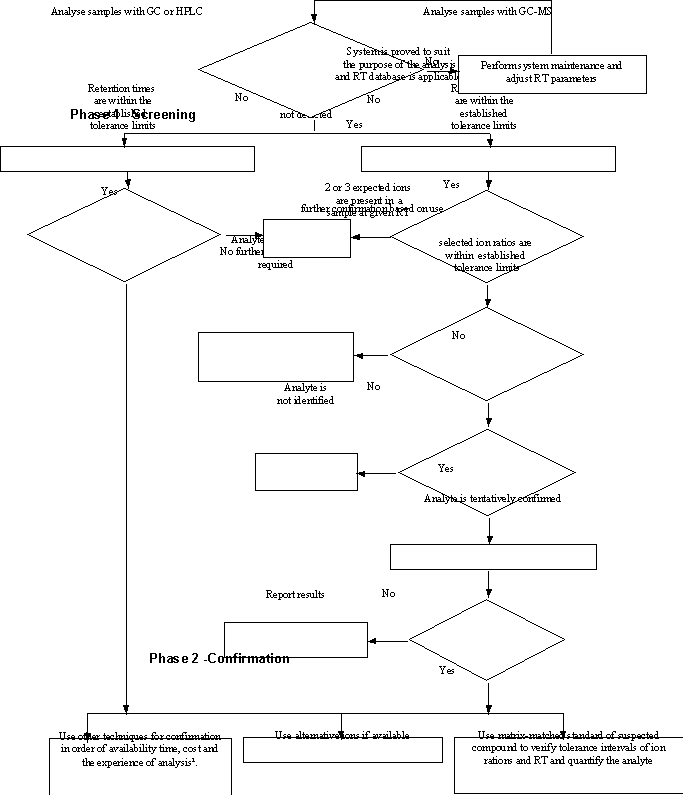
Figure 2. Schematic Representation of Screening and Confirmation (Phase 1 and Phase 2) for Pesticide Residues
1 - Unusual values including banned substances, MRL violation or study requirements as in e.g. exposure assessment
2 – Refer to table 6 for other means of confirmation
3 - For a small number of pesticides the mass spectrum may only exhibit one specific ion. In this case alternative confirmation should be sought.
APPENDIX VIII
PROPOSED DRAFT GUIDELINES ON ESTIMATION OF UNCERTAINTY OF RESULTS
- At Step 3 of the Codex Procedure
According to the CCMAS guidelines on measurement uncertainty at step 5 of the Codex procedure, it is a requirement under ISO/IEC 17025 that laboratories determine and make available the uncertainty associated with each analytical method and result. To this end, food laboratories operating under Codex guidelines should have available considerable data derived from method validation /verification, inter-laboratory studies and in-house quality control activities, which can be applied to estimate the uncertainties particularly for the routine methods undertaken in the laboratory.
1.1 CONCEPT AND COMPONENTS OF UNCERTAINTY
Measurement uncertainty refers to the ‘uncertainty’ associated with data generated by a measurement process. In analytical chemistry, it generally defines the uncertainty associated with the laboratory process but may also include an uncertainty component associated with sampling and qualitative confirmation.
The uncertainty ‘estimate’ therefore describes the range around a reported or experimental result within which the true value can be expected to lie within a defined level of probability. This is a different concept to measurement error which can be defined as the difference between an individual result and the true value. The reporting of uncertainty is intended to provide a higher level of confidence in the validity of the reported result.
Contributions to data uncertainty are manifold and described in detail in Tables 1and 2. The evaluation of uncertainty ideally requires an understanding and estimation of the contributions to the uncertainty of each of the activities involved in the measurement process.
In general, the uncertainty of measurements is comprised of many components, arising from activities involved with the sample. The uncertainty of an analytical result is influenced by three major phases of the determination:
Ø External operations: sampling (SS), packing, shipping and storage of samples7;
Ø Preparation of test portion: sample preparation and sample processing (SSp);
Ø Analysis (SA): extraction, cleanup, evaporation, derivatisation, instrumental determination
The combined standard (SRes) and relative (CVL) uncertainty may be calculated according to the error propagation law:
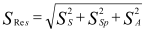 ;
; 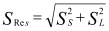 (1)
(1)
If the whole sample is analysed the mean residue remains the same and the equation can be written as:
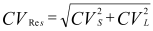 and CVL =
  (2)
(2)
2.1 ERRORS IN ANALYTICAL MEASUREMENTS
In most measurements we can distinguish between three types of errors: gross, random and systematic errors.
Gross errors refer to unintentional/unpredictable errors while generating the analytical result. Errors of this type invalidate the measurement. Laboratory quality assurance procedures should minimize gross errors. It is not possible or desirable to statistically evaluate and include the gross errors in the estimation of uncertainty. They need no further discussion in this document.
Random errors are present in all measurements, and cause replicate results to fall on either side of the mean value. The random error of a measurement cannot be compensated for, but increasing the number of observations and training of the analyst may reduce the effects.
Systematic errors occur in most experiments, but their effects are quite different. The sum of all the systematic errors in an experiment is referred to as the bias. Since they do not sum to zero over a large number of measurements, individual systematic errors cannot be detected directly by replicate analyses. The problem with systematic errors is that they may go undetected unless appropriate precautions are taken. In practice, systematic errors in an analysis can only be identified if the analytical technique is applied to a reference material, the sample is analysed by another analyst or preferably in another laboratory, or by re-analysing the sample by another analytical method. However, only if the reference material matches identically in terms of analyte, matrix, and concentration does it meet the ideal conditions for determining the bias of the method. The bias of a method may also be investigated by recovery studies. However, recovery studies assess only the effects of analysis (SA) and do not necessarily apply to naturally incurred samples, or components of the bias that may be introduced prior to the analytical step. In pesticide analysis, results are not normally corrected for the recovery, but should be corrected if the average recovery is significantly different from 100%. If the result has been corrected for recovery, the uncertainty associated with recovery should be incorporated in the uncertainty estimation of the measurement.
Some examples of sources of errors are illustrated in Tables 1 and 2 It should be noted that not all sources mentioned have to be evaluated in the uncertainty estimation. Some sources are already incorporated in the overall uncertainty, while others are negligible and may be disregarded. However, it is important to recognise and assess all sources before elimination. Further information may be obtained from published documents8,9.
Table 1: Sources of error in preparation of the test portion
Sources of systematic error |
Sources of random error | |
Sample preparation |
The portion of sample to be analysed (analytical sample) may be incorrectly selected |
The analytical sample is in contact and contaminated by other portions of the sample |
Rinsing, brushing is performed to various extent, stalks and stones may be differentially removed | ||
Sample processing (SSp) |
Decomposition of analyte during sample processing, cross contamination of the samples |
Non homogeneity of the analyte in single units of the analytical sample |
Non homogeneity of the analyte in the ground/chopped analytical sample | ||
Variation of temperature during the homogenisation process | ||
Texture (maturity) of plant materials affecting the efficiency of homogenisation process | ||
Table 2: Sources of error in analysis (SA):
Sources of systematic error |
Sources of random error | |
Extraction/Cleanup |
Incomplete recovery of analyte |
Variation in the composition (e.g. water, fat, and sugar content) of sample materials taken from a commodity |
Interference of co-extracted materials (load of the adsorbent) |
Temperature and composition of sample/solvent matrix | |
Quantitative determination |
Interference of co-extracted compounds |
Variation of nominal volume of devices within the permitted tolerance intervals |
incorrect purity of analytical standard |
Precision and linearity of balances | |
Biased weight/volume measurements |
Incomplete and variable derivatisation reactions | |
Operator bias in reading analogue instruments, equipment |
Changing of laboratory-environmental conditions during analysis | |
Determination of substance which do not originate from the sample (e.g. contamination from the packing material) |
Varying injection, chromatographic and detection conditions (matrix effect, system inertness, detector response, signal to noise variation etc.) | |
Determination of substance differing from the residue definition |
Operator effects (lack of attention) | |
Biased calibration |
Calibration | |
Whilst there are a number of options available to laboratories for the estimation of measurement uncertainty, there are two preferred procedures described commonly as the ‘bottom up’ approach and the ‘top down’ approach1,10
The bottom-up method:
The bottom up or component-by-component approach incorporates an activity-based process whereby the analyst breaks down all the analytical operations into primary activities. These are then combined or grouped into common activities and an estimate made of the contribution of these activities to the combined uncertainty value of the measurement process. The bottom up approach can be very laborious and requires a detailed knowledge of the whole analytical process. The benefit to the analyst is that this approach provides a clear understanding of the analytical activities which contribute significantly to the measurement uncertainty and which therefore may be assigned as critical control points to reduce or manage measurement uncertainty in future applications of the method.
The top-down method:
The top down approach is based on method validation and long-term precision data derived from laboratory control samples, proficiency testing results, published literature data and/or inter-laboratory collaborative trials. Uncertainty estimates based on inter-laboratory studies may also take into account the between-laboratory variability of the data and is likely to provide the most reliable estimate of the method performance and the uncertainty associated with its application. It is important to acknowledge however that collaborative studies are designed to evaluate the performance of a specific method and participating laboratories. They normally do not evaluate imprecision due to sample preparation or processing as the samples generally tend to be highly homogenized.
Pesticide residue analytical laboratories normally look for over 200 residues in numerous commodities that lead to practically infinite number of combinations. Therefore it is recommended that, for estimating the uncertainty associated with multi residue procedures, laboratories use a properly selected range of analytes and sample matrices which represents the residues and commodities to be analysed in terms of physical chemical properties and composition according to the relevant parts of the Revised Guidelines on Good Laboratory Practice instead of establishing the uncertainty for each method/analyte/matrix combination.
In summary, laboratories should use either their own long-term precision data or the activity-based procedure (component by component calculation) to establish and refine the uncertainty data.
In certain situations it may also be appropriate to estimate the uncertainty contribution due to sample variability. This will require an understanding of the analyte variability within the sample lot and is not readily available to the laboratory or the analyst The values obtained from the statistical analysis of over 8500 residue data (Table 4) provide currently the best estimate11. These estimates can be incorporated into the combined uncertainty value.
Likewise it may be necessary to take into consideration the stability of analytes during sample storage and processing if these are likely to result in analyte variability between analysts and laboratories.
3.1 UNCERTAINTY ESTIMATES OF RESULTS INVOLVING ANALYSIS OF MULTI-COMPONENTS
The estimation of uncertainty of results for multi-component residues arising from the application of technical mixtures including structural and optical isomers, metabolites and other breakdown products may require a different approach particularly where the MRL has been established for the sum of all or some of the component residues. The assessment of the random and systematic errors of the results based on the measurements of multiple peaks is explained in detail in a recent publication12 and should be consulted where necessary.
The establishment of the standard deviation of a series of tests ran by a single laboratory, as a measure of standard uncertainty, requires the results a large data-set that is not always available. However, for smaller amounts of data the true standard deviation can be estimated as follows:
Depending on the number of observations (n), the relation of the true (σ) standard deviations, calculated (S) standard deviations, and the expected range of the mean value ( ) at 95% probability are illustrated in Table 3. The multiplying factor, f, provides the link between the estimated and true values as the function of the number of measurements.
Table 3 The values of f for calculation of expected ranges of standard deviation and mean values
n |
Smin=f1σ |
Smax=f2σ |
|
f1 |
f2 |
f3 | |
5 |
0.35 |
1.67 |
1.24 |
7 |
0.45 |
1.55 |
0.92 |
15 |
0.63 |
1.37 |
0.55 |
31 |
0.75 |
1.25 |
0.37 |
61 |
0.82 |
1.18 |
0.26 |
121 |
0.87 |
1.13 |
0.18 |
The guidance values for standard uncertainty, given in Table 4, are based on a large number of data and can be used to assess the reality of the estimated uncertainty in a laboratory in order to avoid an unreasonable high or low value.
Table 4. Typical expected uncertainties of major steps of pesticide residue analysis
Procedure |
Relative uncertainty |
Comments |
Sampling of commodities of plant origin.
|
Medium and small commodities. (Sample size ≥10)a: 26-30%b |
For testing compliance with MRLs, the sampling uncertainty is 0, as the MRLs refer to the average residues in bulk samples. |
Large commodities.
| ||
Sampling of animal products |
The relation between the number of samples (n) to be taken for detection of a specified percentage of violation (βp) with a given probability (βt), is described bya: 1-βt = (βp)n |
The primary samples should be selected randomly from the whole lot. |
Sample processing
|
Largely varying depending on sample matrix and equipment. No typical value can be given. The analysts should try to keep it2 below 8-10%. |
It may be influenced by the equipment used for chopping / homogenising the sample and the sample matrix, but it is independent from the analyte. |
Analysis
|
Within laboratory reproducibility: 16-53% for concentrations of 1μg/kg to 1 mg/kgc.
|
The typical CVA can be conveniently determined from the recovery studies performed with various pesticide-commodity combinations on different days and during the use of the method. |
Notes:
(a) Codex Secretariat. Recommended method of sampling for the determination of pesticide residues for compliance with MRLs, ftp://ftp.fao.org/codex/standard/en/cxg_033e.pdf .
(b) Ambrus A. Soboleva E. Contribution of sampling to the variability of residue data; www.iaea.org/trc
(c) Codex Secretariat, Revised Guidelines on Good Laboratory Practice in Residue Analysis ftp://ftp.fao.org/codex/alinorm03/al03_41e
(d) Alder L., Korth W., Patey A., van der Schee and Schoeneweis S., Estimation of Measurement Uncertainty in Pesticide Residue Analysis, J. AOAC International, 84, 1569-1578, 2001
In addition to the estimated uncertainties made by the individual laboratories, regulatory authorities and other risk managers may decide on a default expanded uncertainty of measurements which can be used in judging compliance with MRLs (See section 5) based on between-laboratories reproducibility values. For instance, a 50% expanded uncertainty for CVL is considered to be a reasonable default value.
If required, the result should be reported together with the expanded uncertainty, U, as follows
Result = x ± U (units)
The expanded uncertainty, U, may be calculated from the standard combined uncertainty (SRes) with a coverage factor of 2 as recommended by EURACHEM or with the Student t value for the level of confidence required (normally 95%) where the effective degree of freedom is less than 20. The respective calculations for the expanded uncertainty are as follows
U = 2SRes or U = tν,0.95SRes
The numerical value of the reported results should follow the general rule that the last digit can be uncertain. Rounding the results should be done only when the final result is quoted since rounding at the initial stages of calculation may introduce unnecessary bias in the calculated values.
ANNEX 1: Proposals to Include of new Commodities in the Codex Classification
ANNEX 2: PROPOSAL FOR REGROUPING COMMODITY GROUPS
FC Group 1 Citrus fruits
• Small citrus fruits (e.g. lemons, limes, mandarins)
• Big citrus fruits (e.g. oranges, shaddocks, pomelos)
(A problem could be the division of the commodities among the two groups, as there exists a lot of varieties from one crop being on the one hand small and on the other hand big.)
FB Group 4 Berries and small fruits
• 4-1 Cane berries (e.g. blackberries, raspberries, dewberries)
• 4-2 Bush berries (e.g. blueberries, currants and gooseberries)
• 4-3 Other small fruited berries (e.g. grapes, strawberries)
VA group 9 Bulb vegetables
• 9-1 Bulbs (e.g. onions, shallots)
• 9-2 Whole bulb vegetables (e.g. spring onions) (whole plants without roots)
VB group 10 Brassica vegetables
• 10-1 Flowerhead cabbages (e.g. cauliflower, broccoli)
• 10-2 Head cabbages (e.g. cabbage, white, red)
• 10-3 Leafy Brassicas (codes from Leafy vegetables e.g. Chinese cabbage, mustard greens)
kohlrabi?
VC group 11 Fruiting vegetables, Cucurbits
• 11-2 Edible peel (e.g. cucumber, courgette)
• 11-2 Inedible peel (e.g. melon, pumpkins)
VO group 12 Fruiting vegetables, other than Cucurbits
• 12-1 Solanaceae (e.g. tomatoes, peppers)
• 12-2 Mushrooms
VL group 13 Leafy vegetables (including Brassica leafy vegetables) change in Leafy vegetables, except Brassica leafy vegetables
VR group 16 Root and tuber vegetables
A new group is proposed for the foliage of root and tuber vegetables or the tops or leaves should be added to the leafy vegetable group and to the animal feeds (sugar beet tops).
GC group 20 Cereal grains
• 20-1 Small grains (e.g. millet, teff)
• 20-2 Grains (e.g. wheat, barley, rice)
• 20-3 Immature grains (e.g. sweet corn)
ANNEX 3: OTHER AMENDMENTS (SYNONYMS, SCIENTIFIC NAMES, EXPANSION OF CODES, REGROUPING)
APPENDIX X
Member countries are required to nominate chemicals for the Priority List using the following procedure:
1.1 Criteria for Inclusion of Compounds on the Priority List
Before a pesticide can be considered for the Priority List it:
(a) must be available for use as a commercial product; and
(b) must not have been already accepted for consideration.
To meet the criteria for inclusion in the priority list the use of the pesticide must: give rise to residues in or on a food or feed commodity moving in international trade, the presence of which is (or may be) a matter of public health concern and thus create (or have the potential to create) problems in international trade.
1.2 Criteria for Selecting Food Commodities for which Codex MRLs or EMRLs should be Established
The commodity for which the establishment of a Codex MRL or EMRL is sought should be such that it may contain pesticide residues and form a component of international trade. A higher priority will be given to commodities that represent a significant proportion of the diet.
Governments are recommended to check if the pesticide is already in the Codex system.
NOTE: Pesticide/commodity combinations which are already included in the Codex system or under consideration are found in a working document prepared for and used as a basis of discussion at each Session of the Codex Committee on Pesticide Residues. Consult the document of the latest session to see whether or not a given pesticide has already been considered.
If the pesticide is not in the Codex system, governments should prepare a proposal for evaluation by completing the Appendix “Pesticide Information for CCPR” below.
In this process:
(i) consult with the manufacturer(s) about the existence of sufficient toxicological and residue data and confirm that the manufacturer(s) would be willing to submit data to the JMPR, and in what year, and;
(ii) submit the information to the Ad hoc Working Group on Priorities with a copy to the Secretary, Codex Alimentarius Commission using the format in the Appendix “Pesticide Information for CCPR”.
2.1 New Chemicals
For new chemicals the information to satisfy the criterion of whether the propose new chemical is a “safer” or “reduced risk” chemical should be provided using Item 6 “Justification for use” of Section on Pesticide Information for CCPR below.
The nominating country is required to provide:
• The names of the chemical(s) the proposed chemical is likely to replace;
• A summary of acute and chronic dietary exposure calculations encompassing the range of diets considered by the CCPR; and
• Other relevant information to support the proposed new chemicals as a replacement chemical.
2.2 Periodic Re-evaluation
2.2.1 Chemicals that have not been reviewed toxicologically for more than 15 years and/or not having a significant review of maximum residue limits for 15 years taking into account the heavy workload of JMPR will be nominated as the Ad hoc Working Group on Priorities for consideration for review.
2.2.2 Governments may wish to propose a pesticide for re-evaluation and to do so according to Section Pesticide Information for CCPR below.
2.3 Evaluation
Where the pesticide has already been evaluated by the JMPR and MRLs, EMRLs or GLs have been established the following situations may arise:
2.3.1 The JMPR may note a data deficiency in a Periodic Re-evaluation or New Chemical evaluation.
In response, industry or other interested parties may pledge to supply the information to the appropriate Joint Secretary of the JMPR with a copy to the Chair of the Working Group on Priorities. Following scheduling in the JMPR tentative schedule, the data from industry or other interested parties should be submitted subsequently to the appropriate Joint Secretary of the JMPR.
2.3.2 The CCPR may place a chemical under the four-year rule, in which case the government or industry should indicate support for the specific CXLs to the FAO Joint Secretary of the JMPR, with a copy to the Chair of the Working Group on Priorities. Following scheduling in the JMPR tentative schedule, any data in support of maintenance of the CXL(s) would be submitted to the FAO Joint Secretary of the JMPR.
2.3.3 Where a government member or industry seeks to expand the use of an existing Codex chemical; that is, obtain MRLs for one or more new commodities where some CXLs already exist for other commodities. The request for consideration would be directed to the FAO Joint Secretary of the JMPR and copied to the Chair of the Working Group on Priorities. Following scheduling in the JMPR tentative schedule, the data would be submitted to the FAO Joint Secretary of the JMPR.
2.3.4 A government member or an industry may seek to expand the use of an existing CXL. For example a new GAP may necessitate a larger MRL. In this case the request should be made to the FAO Joint Secretary with a copy to the Chair of the Working Group on Priorities. Following scheduling in the JMPR tentative schedule, the data would be submitted to the FAO Joint Secretary of the JMPR.
2.3.5 Where the CCPR requests a clarification or reconsideration of a recommendation from the JMPR, the relevant Joint Secretary will schedule the request for the next JMPR.
2.3.6 Where a serious public health concern exists in relation to a particular pesticide, government members should notify the WHO Joint Secretary of the JMPR promptly and provide appropriate data to the WHO Joint Secretary.
3.1 New Chemicals
When prioritising new chemicals for evaluation by the JMPR, the Committee will consider the following criteria:
1. If the chemical has a reduced acute and/or chronic toxicity risk to humans compared with other chemicals in its classification (insecticide, fungicide, herbicide);
2. The date nominated;
3. The date that data will be submitted (availability of data);
4. The availability of international/national reviews and coordination with other national/international lists; and
5. Allocating new chemicals to be evaluated on a 50:50 basis with periodic re-evaluation chemicals to be evaluated.
3.2 Periodic Re-evaluation
When prioritising chemicals for periodic re-evaluation by the JMPR: the Committee will consider the following criteria:
1. Chemicals that have not been reviewed toxicologically for more than 15 years and/or not having a significant review of maximum residue limits for 15 years taking into account the heavy workload of JMPR;
2. The year the chemical is listed in the list for Candidate Chemicals for Periodic Re-evaluation –Not Yet Scheduled;
3. The date that data will be submitted;
4. If the intake and/or toxicity profile indicate a high level of public health concern.
5. Whether the CCPR has been advised by a national government that the chemical has been responsible for trade disruption;
6. If there is a closely related chemical that is a candidate for periodic re-evaluation that can be evaluated concurrently;
7. Allocating periodic re-evaluation chemicals to be evaluated on a 50:50 basis with new chemicals to be evaluated.
3.3 Evaluations
When prioritising proposed residue evaluations by the JMPR for food commodities, the Working Group on Priorities will consider the following criteria:
1. The date the request was received;
2. The date the data can be submitted;
3. Whether the data is submitted under the 4-year rule for evaluations of extra data; and
4. The nature of the data to be submitted.
for evaluation
for reevaluation
1. NAME:
2. STRUCTURAL FORMULA:
3. CHEMICAL NAME:
4. TRADE NAME:
5. NAMES AND ADDRESSES OF BASIC PRODUCERS:
6. JUSTIFICATION FOR USE:
7. USES: MAJOR
MINOR
8. COMMODITIES MOVING IN INTERNATIONAL TRADE AND LEVELS OF RESIDUES:
9. COUNTRIES WHERE PESTICIDE IS REGISTERED13:
10. NATIONAL MAXIMUM RESIDUE LIMITS:
11. COMMODITIES FOR WHICH THE NEED FOR ESTABLISHING CODEX MRLS IS RECOGNIZED:
12. MAJOR INTERNATIONAL USE PATTERN:
13. LIST OF DATA (TOXICOLOGY, METABOLISM, RESIDUE) AVAILABLE:
14. DATE DATA COULD BE SUBMITTED TO THE JMPR:
15. PROPOSAL FOR INCLUSION SUBMITTED BY (COUNTRY):
The following are the tentative schedules to be evaluated by the FAO/WHO Joint Meeting on Pesticides Residues (JMPR) from 2004 to 2013
2004 JMPR
2005 JMPR
2006 JMPR
2007 JMPR
2008 JMPR
2009 JMPR
2010 JMPR
2011 JMPR
2012 JMPR
Toxicological evaluations |
Residue evaluations |
New Compounds |
New Compounds |
Periodic re-evaluations |
Periodic re-evaluations |
aldicarb (117) | |
cycloxydim (179) | |
dithianon (028) | |
fenbutatin oxide (109) | |
Evaluations |
Evaluations |
2013 JMPR
Toxicological evaluations |
Residue evaluations | |
New Compounds |
New Compounds | |
Periodic re-evaluations |
Periodic re-evaluations | |
dichlorvos (025) | ||
dicofol (026) | ||
diquat (031) | ||
etofenprox (184) | ||
fenpropathrin (185) | ||
Evaluations |
Evaluations | |
ANNEX I
CHEMICALS PROPOSED FOR PRIORITY LISTING BUT FOR WHICH FURTHER CONSIDERATION IS REQUIRED BEFORE A DECISION CAN BE MADE.
DDT (EMRLs)
Gentamicin, oxytetracycline hydrochoride.
MRLs for various pesticides on spices based on monitoring data.
APPENDIX XII
PROPOSED DRAFT AND REVISED DRAFT MAXIMUM RESIDUE LIMITS FOR PESTICIDES
(Retained at Step 7 and 4)
MRL (mg/kg) |
Step |
Note | |||||
AL |
1021 |
Alfalfa forage (green) |
5 |
fresh wt |
4 |
|
MO |
1280 |
Cattle kidney |
1 |
4 |
||
MO |
1281 |
Cattle liver |
0.5 |
4 |
||
MM |
812 |
Cattle meat |
0.05 |
4 |
||
ML |
812 |
Cattle milk |
0.3 |
4 |
||
PE |
0840 |
Chicken eggs |
0.01 |
(*) |
7 |
|
PM |
0840 |
Chicken meat |
0.01 |
(*) |
7 |
|
PO |
0840 |
Chicken, Edible offal of |
0.05 |
7 |
||
SO |
0691 |
Cotton seed |
0.2 |
7 |
||
OC |
0691 |
Cotton seed oil, Crude |
0.5 |
7 |
||
AM |
1051 |
Fodder beet |
0.3 |
7 |
||
AV |
1051 |
Fodder beet leaves or tops |
0.3 |
fresh wt |
4 |
|
SO |
0697 |
Peanut |
0.05 |
7 |
||
VP |
0063 |
Peas (pods and succulent=immature seeds) |
0.2 |
7 |
||
VR |
0589 |
Potato |
0.1 |
7 |
||
VD |
0070 |
Pulses |
0.2 |
7 |
||
SO |
0495 |
Rape seed |
2 |
7 |
||
OC |
0495 |
Rape seed oil, Crude |
5 |
7 |
||
OR |
0495 |
Rapeseed oil, Edible |
5 |
7 |
||
CM |
1206 |
Rice bran, Unprocessed |
0.02 |
(*) |
7 |
|
CM |
0649 |
Rice, Husked |
0.02 |
(*) |
7 |
|
CM |
1205 |
Rice, Polished |
0.02 |
(*) |
7 |
|
OC |
0541 |
Soya bean oil, Crude |
0.2 |
7 |
||
OR |
0541 |
Soya bean oil, Refined |
0.2 |
7 |
||
VR |
0596 |
Sugar beet |
0.3 |
7 |
||
AV |
596 |
Sugar beet leaves or tops |
0.3 |
fresh wt |
4 |
|
SO |
0702 |
Sunflower seed |
0.2 |
7 |
||
MM |
0812 |
Cattle meat |
0.1 |
(fat) |
7 |
|
ML |
0812 |
Cattle milk |
0.0005 |
(*) |
7 |
|
MO |
0812 |
Cattle, Edible offal of |
0.01 |
(*) |
7 |
|
VR |
0589 |
Potato |
30 |
Po |
7 |
|

1 Soboleva E. Ambrus A., Application of system suitability test for quality assurance and performance optimization of a gas chromatographic system for pesticide residue analysis, J. Chromatogr. A. 1027. 2004. 55-65.
2 Lantos J., Kadenczki L., Zakar F., Ambrus A. Validation of gas chromatographic Databases for qualitative identification of active ingredients of pesticide residues in Fajgelj A. Ambrus A. (eds) Principles of Method Validation, Royal Society of Chemistry, Cambridge, 2000, pp 128-137.
3 Soboleva E. Ahad K. Ambrus A. Applicability of some MS criteria for the confirmation of pesticide residues, http://www.iaea.org/trc
4 Ambrus1* Á.,. Füzesi2 I.; Susán2 M.; Dobi3 D., Lantos4 J., Zakar5 F., Korsós4 I., Oláh3 J., Beke3 B.B., and L. Katavics5 A cost effective screening methods for pesticide residue analysis in fruits, vegetables and cereal grains, J. Environ Sci. Health B39 2004 accepted for publication.
5 Ambrus Á.; Füzesi I.; Lantos J.; Korsos I.; Hatfaludi T. Repeatability and Reproducibility of Rf and MDQ Values with Different TLC Elution and Detection Systems. J. Environ Sci. Health B39 2004 accepted for publication.
6 IUPAC Report on Pesticides (13) (Bátora, V., Vitorovic, S.Y., Thier, H.-P. and Klisenko, M.A.; Pure & Appl. Chem., 53, 1981, 1039-1049
7 Packing, shipping, storage, and laboratory preparation of samples may have significant influence on the residues detected, but their contribution to the uncertainty can often not be quantified based on the current information. Examples of such errors are eg selection of sampling position, time of sampling, Incorrect labelling decomposition of analytes or contamination of the sample
8 EURACHEM Guide to Quantifying Uncertainty in Analytical Measurements, 2nd ed. 1999, http://www.measurementuncertainty.org
9 Ambrus A. Reliability of residue data, Accred. Qual. Assur. 9, pp. xx. 2004
10 ISO, Guide to the Expression of Uncertainty in Measurement, ISO. Geneva, 1993
11 Ambrus A and Soboleva E. Contribution of sampling to the variability of residue data; www.iaea.org/trc
12 Soboleva E., Ambrus A., Jarju O., Estimation of uncertainty of analytical results based on multiple peaks, J. Chromatogr. A. 1029. 2004, 161-166
13 Countries should provide detailed information on the registration status at the time of proposing a compound for inclusion in priority lists and again when the compound is scheduled for JMPR review.