


The Village Reforestation Project in the Northwest of the Groundnut Belt (Projet de reboisement villageois dans le nord-ouest du bassin arachidier - PREVINOBA), Tivaouane, Senegal, started in 1986 for a period of three years. Its second phase had a duration of five years and was concluded in 1994. The project is in the district (Département) of Tivaouane, Thiès Region, which is part of the agro-ecological zone known as the "groundnut belt". It is implemented by the Department of Water, Forests, Hunting and Soil Conservation of the Ministry of Environment and Protection of Nature. It is financed by the Government of the Netherlands, and supported by technical assistance from FAO. The project is one of nine projects that constitute FAO's Programme of Forestry Development Assistance to the Government of Senegal. Technical coordination between the projects of this programme is the responsibility of the Rural Forestry Development Support Project (Appui au programme de développement de la foresterie rurale).
The project area is approximately 2 5001 with a rural population of roughly 210 000 people, living in 907 small villages, which constitute 13 Rural Municipalities (Communautés rurales). The main ethnic groups are the Wolof (80%), Peul (9%) and Sérère (8%). The majority is muslim (95%), illiterate (90% of the women and 80% of the men) and young (60%).
The climate in the north is sahelian and in the south sudano-sahelian. During the dry season from November to July a hot, dry wind blows (the harmattan), while the monsoon blows during the rainy season (mid-July to mid-October). Precipitation is low and poorly distributed in time and space. Average rainfall during 1982 and 1991 was between 315 and 350 mm annually. Topographically, the region is flat, except in the southwest. The soils are poor and strongly affected by wind erosion. Agriculture is predominant, extensive, rain-fed and traditionally based on a yearly rotation of groundnuts, millet, cowpeas and fallow. In general, productivity is decreasing because of soil degradation. Livestock husbandry is practised in combination with agriculture. In addition to livestock in and around the compounds, cattle are kept semi-sedentarily around the villages. Furthermore, the project area plays an important role in the transhumance (seasonal migration of cattle herds) from the northern pastoral region to the agricultural zone of the south. Forest and tree resources are very scarce in the region. Leaves, fruits and other products from trees and shrubs are collected for human and animal food and for the production of handi-crafts. Women and children are responsible for the collection of fuelwood.
Demographic pressure (annual population growth is estimated at 3%) is generating a rapid growth in the demand for agricultural, livestock and forestry products. Extensive land use, combined with unstable climatic conditions, is one of the main factors contributing to a growing pressure on the existing natural resources, deteriorating the living conditions of the population and creating a generalized process of environmental degradation. As a consequence, seasonal migration is a widespread phenomenon.
The general objective of the project is to contribute to the battle against desertification through the improvement of the natural environment and the living conditions of the rural population. The mid-term objectives are: (1) to promote the large-scale participation of the population in forestry activities in order to increase their impact on the protection of the environment; (2) to restore the forestry cover for local self-sufficiency in forestry products based on sustainable output and ensuring the enrichment of the soils; and (3) to increase the financial means of the farmers as a result of incomes generated by silvicultural activities. The immediate objectives are oriented towards: (1) the consolidation of the local capacity for the promotion of rural forestry in terms of motivation, technical know-how and economic resources; (2) integrated village land use management, comprising the integration of forestry activities into agriculture and livestock husbandry and the elaboration of an integrated plan for the management of natural resources; and (3) the institutional strengthening of the forestry service.
Project activities to achieve these immediate objectives are reflected in its internal organization: a training and extension division for the elaboration of approaches, methods and tools for training and forestry extension at institutional and community level; a management and silviculture division, responsible for the development and verification of technical proposals; and a monitoring and evaluation unit. Externally, close interinstitutional links have been developed between the project and other governmental and non-governmental technical services at different levels in the region (agriculture, livestock, education, planning and development, etc.).
The methodological approach has not been developed in isolation but through dialogue with similar community forestry projects in Senegal, other Sahelian countries and elsewhere. Instead of pressuring local communities to participate in project activities through incentives (putting the sustainability of these activities at risk), the approach of this project is to create the conditions for a permanent dialogue between the local population and the "development agents". The point of departure is to support the local people in taking their development into their own hands according to the principles of self-help: the implementation of their own projects through analysis of the situation, determination of priorities, selection of actions to be undertaken, and mobilization of local knowledge and means.
The approach aims to develop an iterative process of identification, planning, implementation, evaluation, and back to identification, etc. In the end, this. will result in the accountability of the beneficiaries for their projects. Based on the annual planning of activities, the villagers progressively take charge of these activities through the combination of their own knowledge and skills and the application of new technologies. The approach strengthens their capacity for appraisal, problem identification and analysis, organization, training, implementation and monitoring and evaluation. It brings together efforts and knowledge as well as promoting the sharing of responsibilities and a mutual commitment of the different parties involved. In addition, the approach seeks to strengthen the coordination and collaboration between the different governmental and non-governmental agencies working in the same area in order to identify their complementarity and to implement or support mutually agreed activities.
A distinction is made between two categories of actors. The first category is the principal actors (the villagers), who initiate actions and decide to implement them for their own benefit, either at community level, or at the level of the specific interest group (e.g. youth clubs, women's groups), or at individual level. In the second category are the support actors (development agents) who provide their political, technical, educational or organizational support for planning and implementation of activities. These include administrative and local authorities, technical/educational project staff, peasant associations and NGOs.
Methods and tools developed by the Research and Support Group for Peasant Self-help (GRAAP - Groupe de recherche et d'appui pour l'autopromotion paysanne) have been adapted and improved. Many of these methods and tools have been used in the field, such as theatre, cassettes, village maps, intervillage visits, etc. In addition, particularly during the planning phase, PRA methods and tools are frequently used, such as historical profiles, transect walking and listing of intervening factors.
At regional or zone level, the first step is to inform the different authority levels about the project, to explain its methodology and to present its staff. These contacts are maintained during project implementation, providing regular feedback and strengthening institutional support and collaboration. The next step is a general appraisal of the socio-cultural, economic and ecological characteristics of the region and the development of criteria for the selection of villages to work with. This general appraisal is supported with more specific environmental profiles prepared by the forestry staff. On the basis of the results of this preparatory work, an action plan is prepared, which will constitute an important tool for the orientation of the project staff.
Based on the appraisal studies, target villages are selected for direct project support. In each village, workshop meetings are conducted by the project staff with the villagers. At these meetings, villagers are asked to analyse their natural environment on the basis of their own observations and experiences, discussing the role they can play in the battle against desertification and degradation of their environment. These exercises are aimed at the identification of needs, opportunities and constraints. A series of educational support materials, produced by GRAAP, are used for these workshops. The role of the project staff is to orient and facilitate these workshops and to promote the evolution of this process into a self-sustaining activity. These workshops are organized in public places and have been attended by both old and young people of both sexes.
The following step for the villages is the prioritization and selection of the forestry activities they will undertake. This process is supported by the project staff, who provide technical assistance in such areas as species selection, tree production and management techniques. Initially, these activities are carried out on an experimental and educational basis. The next step is the organization and programming of activities, aimed at strengthening the local capacity to assume full responsibility for their implementation. Villagers adapt the activities to their specific needs and conditions and integrate them into their agricultural production systems. In most cases, existing local organizations assume the coordinating responsibility, delegating specific tasks to forestry committees. The project policy is not to work with blueprint organizational proposals but to promote design by the villagers themselves of the most adequate organizational structure, according to their own customs and traditions.
Farmers' training is an important component of the project. In PREVINOBA, farmers' training is conceived in terms of the exchange of experiences between the farmers and the project. During the first phase of the project, theoretical and practical training for contact farmers from different villages took place at project offices. The idea was to achieve a multiplier effect upon their return to their villages. Results were disappointing, so this training method was modified in 1992 and decentralized to village level, thereby also making it more accessible to women.
The project incorporates systematic monitoring, which permits the different actors not only to supervise and control implementation of the activities but also to identify specific aspects to be strengthened, adjusted or modified. With technical support from the project, the village forestry committees usually supervise the project activities carried out at family and community level. In addition, field visits by the project team, administrative authorities and local representatives are organized in order to strengthen the political and institutional commitment to these local level initiatives for forestry development.
The final step is evaluation. A distinction is made between ongoing evaluation, self-evaluation and global evaluation. The ongoing evaluation is annual, retrospective and guided by the local forestry committee. Its main emphasis is on technical aspects of tree production and management. The self-evaluation of project implementation by the village takes place annually during village meetings. Specific materials, based on the GRAAP approach, have been developed to support and orient this process of self-evaluation and to use the results as inputs for planning. A global evaluation of the technical packages and results, village participation and the project methodology is carried out annually, and all actors directly involved in the project take part. The results of these exercises are used as internal discussion points for corrective actions and as an agenda for further dialogue during meetings with other parties involved.
The approach of the project contains important components designed to achieve a real strengthening of local accountability for sustainable community forestry development. In general, very important conditions are being met in the field: motivation and interest, technical knowledge and skills, strong local organizations, rights and equitable benefit sharing. Overall, the experience of the PREVINOBA project indicates that the participatory approach leads to a progressive accountability of the villages and appropriation of the project by the participants. There is an active participation of the villagers in forestry activities, and in particular of women, in spite of their heavy daily workload. Investments are made by the villages themselves with their own resources to finance the fencing of village woodlots and to purchase new materials. More and more village organizations have adopted measures such as sanction systems for the protection of the environment.
There is a common understanding of the project objectives and approach among the different parties involved. At village level this understanding reveals itself through a significant change of attitude towards external support, which has come to be considered as something temporary. Village land use management (gestion des terroirs villageois) has proven to be an appropriate framework for designing project interventions using the participatory approach. It has taken at least five years, however, to develop the methods and tools of this approach on the basis of practical field experience, and to make the different parties involved familiar with their use. These years of collaboration and partnership between the project and the villages have resulted in a strengthening of village capacity for diagnosis, organization, implementation and evaluation. In addition, new technologies have been learned, with regard not only to forestry and related activities but also to developing skills for improving existing land use management systems.
The village land use management plan contains the signed contracts between the village and the project, the action programme and a draft management plan. New working and exchange relations within the community and between the community and the outside world have been defined. It has been strongly emphasized in the planning phase that it is :up to the villagers to implement what they have planned. The role of the project is to help the villages during the planning phase and to provide them in due time with the necessary support, such as training and technical and organizational advice.
At institutional level, an increasing number of governmental and non-governmental agencies are providing support to project-related activities through specific services that are beyond the capacity and mandate of the project or the forestry department. These services are delivered for the implementation of microprojects, such as health centres, functional adult literacy courses, small-scale irrigation or grain mills. These microprojects are identified and designed in the context of the village action plans promoted by the project. For their implementation, PREVINOBA assumes the role of catalyst and facilitator, mobilizing its institutional network.
The project has been able to establish close relations with the "Multifunction Centres for Rural Development" (Centres d'expansion rurale polyvalents), administrative authorities and local representatives. This has had a positive impact on the use of the participatory planning approach in village land use management. Interinstitutional coordination and collaboration are extremely useful, if not indispensable, for effective participatory planning and the mobilization of external support for the village plan implementation. As demonstrated in PREVINOBA, the establishment and consolidation of interinstitutional collaborative networks requires the project to provide specific inputs and attention, and to promote this activity systematically. On the other hand, the resources available from the project and the collaborating institutions are too limited to respond effectively to the increasing claiming capacity of the target villages. In order to "democratize" the delivery of external support, some kind of interface is needed between villages and the institutions, such as intervillage peasant associations. Such associations could also play an important role in ensuring that regional or departmental resource management planning exercises take the village plans into consideration.
This project, located in the northern Andean Highlands of the Department of Potosi in southwestern Bolivia, started in 1991 for a period of five years. The National Secretary of Natural Resources and Environment of the Ministry of Sustainable Development and Environment is responsible for its execution, with technical assistance from FAO and 'international fund from the Dutch Government.
The project fits into the framework of the National Forestry Action Plan of the Bolivian Government. For its formulation, lessons learned from a similar project in Peru have constituted important guiding principles. These lessons were related particularly to the technical component, in such areas as the promotion of indigenous tree species, the conceptualization of community forestry extension and the importance of local planning.
The Department of Potosi is composed of two regions, divided by the north-south Lipez mountain chain. The western part, at an altitude of 4 000 m, is flat, very dry and famous for its impressive salt lakes (salares). The population density is very low as the natural resources are extremely limited. Agriculture consists mainly of potato and sorghum cultivation, but extensive raising of llamas and alpacas plays an important role in the household economies. The natural vegetation is limited to indigenous grasses and shrubs. On the eastern side of the chain of the Lipez mountains the situation is very different, with altitudes varying between 2 500 and 3 900 m and various ecological zones. This permits more diversified livestock activity and agriculture, as well as a diversity of tree species. In this environment of contrasts, the natural resources are limited and deteriorating. Poor soils, scarcity of water, high altitudes and corresponding climatological adversities (such as ice-winds and hail storms), combined with socio-economic factors like demographic pressure, decreasing agricultural production and productivity, and inadequate support services are seriously affecting the sustainability of natural resource use and, hence, the living conditions of rural families.
The project works in the northeastern part of the Department of Potosi with approximately 140 peasant communities scattered over the provinces of Chayanta, Quijaro, Cornelio Saavedra, Linares, Tomas Frias and Chichas North. The case study was carried out in peasant communities in Chayanta, a province with an area of about 4 800 km2, a population of 130 000 persons and an average density of 27 persons per km2. The population is q'echua speaking and of different ethnic origins. The peasant community in this region is a small organizational unit, which is part of a more complex traditional structure. The families, grouped together in small or big ranchos, are the basic unit of the organizational structure. These ranchos are sometimes called "patrilocal groups". A number of these groups together constitute a cabilde. The next level is made up of various cabildos and is called the ayllu menor or sullka ayllu and constitutes a socio-political unit with direct authority over territorial issues. Anthropological studies indicate that the Ayllu system is weakening, although it is still an important factor in the project area because it constitutes the historical framework of socio-political and economic conflicts between communities.
Adult illiteracy is high, particularly among women, and enrolment rates at primary level are still low because of structural constraints. There is usually only one school teacher for the first six grades, without any support, equipment or teaching materials. Similarly, health services are poor and hardly accessible because of poor infrastructure. Finally, this is a region with a very high rate of seasonal out-migration (77%) among the adult male population, mainly during June, July and August. Permanent migration is estimated at 20%. Seasonal migration of women is very limited as they take care of the household and the animals during off-season.
The development objective of the project is to contribute to improving the living standards of the peasants of the Bolivian Highlands. This should be done through the integration of sustainable forestry activities into existing production systems, in order to satisfy the need for forestry products, increase agricultural and livestock production and preserve natural resources. Since mid-term, the project's national-level objectives have been the adoption of a national forestry development strategy, which includes the application of a community forestry methodology for the Bolivian Highlands and the budgeting of the necessary resources. At community level, the mid-term objective is to increase the availability of fuelwood, construction wood, fodder, fruits and other forestry products.
The immediate objectives are: (1) the integration of tree planting management into agricultural and livestock land use systems in order to get benefits from the trees, improve the output of the production systems and conserve and protect soils and water; (2) the verification of the extension and training methodology and the community forestry technical menu in order to develop an approach suited to the Bolivian Highlands; and (3) the development of the institutional capacity to promote community forestry approaches within governmental and non-governmental organizations in the Department of Potosi, and to contribute to the formulation and elaboration of departmental forestry development policies and planning.
The methodological approach can be summarized as follows. The project promotes a technical menu called "Community Forestry Development" at village level. This technical menu consists of tree production, planting and management and the commercialization of forestry products. It is oriented towards agroforestry, in order to integrate forestry and tree activities within agriculture and livestock production systems. Extension activities (promotion, training, research, monitoring and evaluation) are oriented towards establishing a dialogue with the local communities on the basis of this technical menu. As soon as the local communities have decided to start forestry activities, the extension worker starts supporting them in the -preparation of their "Community Forestry Plans". A clear distinction must be made between Community Forestry Development, which is an institutional proposal, and the Community Forestry Plan of the communities, which is an adaptation of the institutional proposal on the basis of local needs and priorities determined by the local communities. The approach can be visualized as follows.
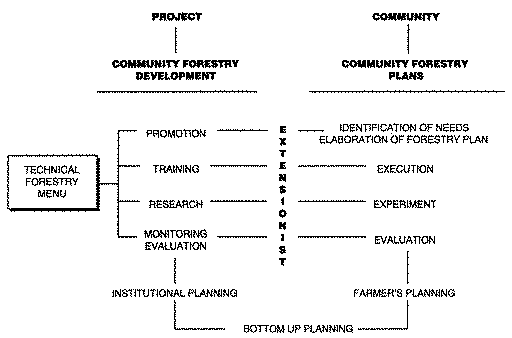
Figure 5.1: The community forestry approach
In this approach, the extension worker assumes the role of promoter, facilitator and trainer, supporting and orienting the local communities in the planning, implementation and evaluation of their forestry development. This methodological approach can best be described as "participatory extension for community forestry": it is flexible, process-oriented and based on partnership. There is no predetermined technical package, nor a detailed field manual with rigid instructions on what to do. Instead, much emphasis is given to pre- and in-service institutional training of the extension staff in order to develop and strengthen their appreciation of the basic criteria for participatory extension. A proper understanding of the project objectives and methodology is of paramount importance.
Rapid rural appraisal methods and tools are integrated into this extension approach. They are not used exclusively or in particular for planning purposes in preparing the Community Forestry Plans but are seen as more general tools of participatory extension. They enable the extension worker to better analyse and understand local realities and dynamics. This understanding of the local reality (production system, agricultural calendar, local politics, power and conflicts, the role of women, land tenure, etc.) constitutes the strategic framework in which to identify, plan and execute activities. In other words, it permits the project to identify constraints and opportunities for intervention. RRA tools such as transect walks, diagrams, mapping, interview techniques and drawings are taught as part of the basic extension skills training programme.
In general, linkages are established with the communities as follows. During the first months, the extension worker familiarizes him- or herself with the local reality, assessing constraints and opportunities for intervention on the basis of discussions and meetings with local authorities and selected local population groups. His or her role during this first phase also involves informing the local community about project objectives and methodology. This is usually done at community meetings, under the chairmanship of the community president. It is during these meetings that the decision is taken whether to start forestry activities and how to organize the preparation of the Community Forestry Plan. In most cases a working group, called a forestry committee, is selected by the farmers to assume this responsibility and to act as the counterpart of the extension worker.
The members of these groups are called "forestry promoters" (promotores forestales). Since there is such a high amount of seasonal migration of the male population, most of the members of these groups are women. They are not paid by the project, because these responsabilities are perceived as special social duties for the benefit of the community. The members are compensated by being freed from., other communal work. As these committees are supposed to replace the extension worker after some years, regular training opportunities are provided to their members by the project. The training at group and at community level is focused on the local realities, experiences and knowledge. Its methodology is based on the principles of practice, dialogue and reflection. Concretely, this means that local knowledge of sites, species and management is identified, discussed and incorporated when designing the Community Forestry Plan. When implementing its Plan, the community trains itself through practice and generates learning experiences, which are shared with others. When evaluating a tree production cycle or a planting activity, the community reflects on the results achieved and the difficulties encountered, seeking ways to improve the results next time. When preparing the next productive cycle, the lessons learned from previous implementation experiences are used and further deepened, for example by making adjustments to the forestry calendar.
In many cases, project participants stated that the project has contributed to a strengthening of the internal organization of the ranchos. For example, in the case of the community of Uma Jila, it was reported that "before the extension worker came to this community, no regular meetings were held" and that "the project has unified the population more than ever before". This process of internal strengthening is the result of a number of factors. The local communities in this region are very well aware of the multiple benefits of forestry activities for the improvement of their household economies. These activities do not compete with other work to be done, as they do not require a permanent or large-scale mobilization of labour. "The work is easy and we work only a few hours; we never work the whole day with the trees," as one of the respondents said. The time factor is particularly important in the Andean system, because almost all available time has to be invested in this very complex system of agriculture and live-stock production, leaving little space for other productive activities.
Practical training in new technologies has also proved to be important: "Formerly, we didn't have this system of production and planting of trees. We have learned now how to do it ourselves and we really like it." Although indigenous tree production technologies seem to be limited mainly to natural regeneration, there is a general knowledge and understanding of the importance of forests and trees for soil conservation and for improving the productivity of the land. In addition, a custom has developed among the farmers to experiment with tree species when returning home after their frequent "interecological" commercial travelling in the region. This custom also helps to explain why the project is being received with real interest by the farmers.
A final important factor in this context relates to the organizational activities of the project. As explained, the project actively promotes local forestry committees as mechanisms for articulating community decisions concerning forestry activities. The functioning of these committees in relation to the community has not been dictated by the project but has been defined by the communities themselves: "We do the organizing by ourselves, and the planning with German, the extension worker. We keep our records to see who is missing and who is working and that way we keep control." In practice, these committees function as a management unit through which the community organizes itself on the basis of a programme of activities, defined with the support of the project. These committees have developed their own mechanisms for the division of work, which fit into the traditional structures and systems. The division of labour in forestry activities is done according to the labour type. As in agriculture, only a few of the activities are done exclusively by women or by men; most of the work is shared between both genders, depending on the time of the year (because of the seasonal migration of men).
Traditional mechanisms are used by the local communities for the organization of forestry work. In most cases, each member of the forestry committee has a small working group of families under his or her authority, with specific, complementary responsibilities for the implementation of the Community Forestry Plan. This system of organization of work reflects the traditional system of the faena, or communal work done by small family groups in rotation which permits the community and the families to rationalize and economize the allocation of labour in turn, facilitates the development of an important participatory potential within the community, and explains why families indeed are participating in forestry activities and consider the Community Forestry Plan their own.
Although the above description clearly displays the elements of strengthening (organization), enabling (training) and empowering (decision-making) of local communities, some additional observations should be made in this context. There were several instances where the project interventions were limited to one sector or secondary rancho of a primary rancho. As these two levels are considered parts of the same patrilocal unit with its own socio-political mandate, negative repercussions might occur if the processes at secondary rancho level are further consolidated without including or compensating superior levels of community organization. This depends on the balance of power between the different levels. It is also possible that certain secondary ranchos might be in an increasingly independent position.
The issue of those who do not participate in the community forestry activities, their perceptions and their experiences, is to be' placed within this framework of organizational levels and customary relationships within local communities. At the level of the rancho, participation in community forestry activities is determined by the residential location of the family groups in relation to the community nursery. Families living nearby will participate in the project, while those of the same community who are living in another place (secondary rancho) are practically excluded. As one farmer stated:
... So, we decided to start in the mountains first. We have worked two days, all of us, constructing the nursery and the fences. Then we also prepared the seed beds and when the seedlings already were growing, they got annoyed with us because we didn't show up one day. They said that we were lazy and then they moved the nursery to another place, even farther away in the mountains. Since then, we do not participate any more. We hope to have our own nursery one day, though we don't dare ask the project to help us. But we want to have the nursery, with or without them.
There is no doubt that the geographical distance plays a role, since time availability is a structural constraint. In this case, certain other factors could have intervened as well. The decision of where to construct the community nursery depends, among other things, on technical and economic criteria such as availability of water, land, construction materials and accessibility. Its location therefore tends to be linked to those parts of the communities that are relatively better off.
The forestry and agricultural calendars constitute the framework for programming of activities, and it should be respected in order to minimize risks of tree production and planting failures. The farmers are well aware of this. Experience has shown that local communities cannot invest much time in preparatory activities. The attitude in general is: "Let's start when the time has come and find out if it works." Therefore, one or two months after the extension worker has started to work with the local community, the first annual Community Forestry Plan will be prepared. As soon as this plan has been approved by the community, it will become an important frame of reference for the extension worker's own monthly workplan.
The case study shows that local forestry planning capacity has been strengthened significantly after a few years of activity. Through practical experience, local communities have improved their ability to develop their plans on the basis of local constraints and opportunities. Similarly, the project has strengthened its own capacity to respond more effectively to the Community Forestry Plans as the project staff has developed a better understanding of local realities. The project has been able to adjust its own annual planning procedures. Annual inputs, activities and planned outputs or results are based, within the framework of the project document, on the profiles of the community forestry plans.
The project has signed a number of agreements of collaboration with governmental and non-governmental organizations that are promoting rural development in the project area. The aim is to institutionalize the methodological approach and technical menu of the project, and, in particular, to develop and verify agroforestry systems. In addition, the project has developed a network of departmental institutions with which specific activities are developed.
The project also supports a large number of governmental and non-governmental institutions in their efforts to initiate forestry projects and activities in communities where they are working. This support is provided through training of their field staff in community forestry methodologies, provision of inputs such as seeds and planting materials and technical follow-up visits in the field. The participatory approach of the project and the research results obtained so far (such as those regarding customary organizational structures) have proven to be highly relevant for most of the institutions working in this region.
In this context, it is worth noting that the present Government of Bolivia is giving high priority to decentralization and regionalization. The development plans and strategies currently being developed are oriented toward the most deprived sections of the population and put emphasis on direct participation of the population, improvement of the natural environment and sustainable development. Therefore, the objectives, methodology and strategy of the project fit very well into the current policy framework of the Government.
The Malakand/Dir Social Forestry Project is being implemented by the Forestry Department of the North West Frontier Province (NWFP) in Pakistan, and funded by the Dutch Government. Technical assistance is provided by DHV Consultants in the Netherlands and EDC in Pakistan. The project started in 1987 in the provincially administered tribal area known as Malakand Agency. At the start of its second phase, its coverage was extended to the Dir District.
In Malakand Agency about 50% of the land area is arable. The remainder is made up of hills too steep to farm. Almost all arable land is privately owned. More than half of the households are landless and depend heavily on agricultural wage labour for their livelihood. Among the landowners, 32% have less than 1 ha of land. The hillsides are generally owned by communities and sometimes by sections within the communities. About 73% of the people have ownership rights to the hillsides through these groups. However, except in the rare cases where some form of management exists, the hills are open to free access by all. The majority of the villages have access to these hillsides. In some of these, the gujars (livestock herders) and landless constitute the dominant group. These people rely heavily on the hillsides to meet their fodder and fuelwood needs. The areas of project intervention are dominated by either small landowners, farmers or tenants and non-farming landlords.
In Dir District, only about 10% of the area is arable. Here, too, hillsides make up a large part of the land mass and usually are held jointly by the communities. Hillside use is the same as in Malakand Agency. The people draw on them heavily to meet their needs for timber, fodder and fuel. Fodder is very scarce, and is often imported from other districts, especially for the lean period in winter. As compared to Malakand Agency, Dir is better endowed with forestry resources, though they are unevenly distributed. Whereas the northern mountains have a preponderance of forests, the lower areas are devoid of them. The coniferous forests in the upper reaches of the hillsides (outside the project area) are officially state-owned, although they are also covered by customary rights systems of the local people. Oak forests, which occur all along the different valleys, are disappearing steadily because of uncontrolled use and the ever rising demand for fuelwood.
All villages in the project area in Malakand have an elementary school for boys, and 65% have an elementary school for, girls. Secondary school facilities are few for boys and almost absent for girls. Basic services of health, water supply and electricity are present in most of the villages (53%, 63% and 82% respectively). In Dir District, literacy is very low (7%), especially among women. Public services are generally lacking.
Ethnicity, religion and gender play a fundamental role in the socio-cultural, economic and political power structure of the villages. The Pukthun values of power and female segregation (purdah) are very important in the context of the project. The management of commonly owned areas depends on the willingness of people to decide upon obligations for controlled use. However, this is often complicated by power conflicts, a common feature in Pathan society. Moreover, because of the purdah system, men deliberately ignore women's role in the use and management of trees, shrubs and grasses, since women are supposed to stay at home. Under these circumstances, projects that promote participatory approaches and try to bring the different groups together, talking about equity and benefits for all (including women), face a difficult task. Religion and politics play an important role in people's lives. Religious leaders are among the most influential members of the society and people's faith in them is very strong. Nearly all men are associated with one or another political party, and these associations are mostly used to further personal interests.
The development goal of the project is to "contribute to raising the standard of living in Malakand Agency and Dir District by improving the productivity and use of the hillsides and marginal farmlands". The project objectives are (1) to restore a suitable vegetation to the denuded hillsides and marginal farmlands in order to create a sustainable, ecologically and economically improved living environment; (2) to further develop an extension approach for these field activities; and (3) to foster institutionalization of this extension approach at local level and within the NWFP Forestry Department. Although these objectives have been maintained during the years, the emphasis changed in methods for achieving them soon after project inception in 1987. The initial exclusive emphasis on establishment of forest plantations on denuded hillsides was changed to include other components, such as range management, training, extension and women's activities.
From its second phase onwards, the Malakand project has gradually developed an approach it calls "Village Land Use Planning" (VLUP). This approach can best be described as a structured participatory planning and implementation process. It is a blend of RRA techniques, awareness raising, participatory planning and programming, social organization, implementation of land use interventions and monitoring and evaluation. The approach is based on principles that more or less coincide with the assumptions of participatory planning as outlined in the conceptual framework in Chapter 1. Key concepts in this approach are participation, social organization, control, distribution of benefits and responsibilities, integrated approach and gender specificity. The VLUP approach has been incorporated in a field manual, which is being further developed and tested. The seven steps of VLUP, as defined in mid-1993, are outlined in Figure 5.2, below. It is interesting to quote some of the guiding principles for users of the manual as they indicate how this approach is perceived.
You are a social forester. This means your role is to help villagers to restore and/or maintain vegetation on hillsides and marginal farmlands in such a way that the land is productive and remains so in the future. You can help them in their planning of optimal land use. Villagers are the owners and/or users of the land, so they are responsible and take decisions on its management. You advise and support them...
In order to be able to help the villagers you first have to understand clearly their present land use, the role of different user and owner groups in this present use and their main needs, constraints and opportunities. It also helps them to think about and formulate how they want to develop their areas in the future. The villagers provide this information and this helps them to become more aware of their present problems as well as possible solutions. Through this form of cooperation a relationship of trust and understanding is gradually established between villagers and the Project...
The role of the Forest Development staff and the villagers in the VLUP process differs. During data collection you take the initiative by collecting all relevant data, analysing them and discussing them with the villagers, while the villagers provide us with information, list their problems and possible solutions and discuss and adjust the findings. However, during social organization and the development of management plans, the villagers are the main responsible actors, supported by you.
The objective of VLUP is to assist the local. population in the-development of a management plan to sustainably increase the productivity of vegetation (trees, shrubs and grasses) on privately or commonly owned hillsides and farmlands. The outcome of this planning process is a village land use plan based on (1) an assessment of socio-economic and biophysical constraints and opportunities in the village, (2) the needs and desires of land users, and (3) the services that the project can provide, summarized in what is called the "social forestry menu". This menu is developed for three types of land use: natural vegetation, vegetation established by the Forestry Department and agricultural lands. For each, potential project activities during the establishment, maintenance and the harvesting period have been identified. These technical interventions are complemented with supporting activities such as organization, training and awareness raising. As in the Bolivian case, the formulation of the local plan is not seen as an entirely open-ended process, being based instead on what the project can deliver as inputs and services, and on local constraints, needs and opportunities.
Explicit attention is being paid to gender issues, both by promoting women's activities and in particular by trying to make the VLUP approach more gender specific. This is done by the directly involving a women's team during the VLUP process, incorporating gender analysis techniques, and organizing the planning process in such a way that the results of the activities of the women have to be discussed with the men. However, the project has encountered serious difficulties in constituting a women's team and integrating gender issues in the day-to-day planning and implementation of activities, mainly because of cultural factors (the purdah system).
The planning process is implemented by the villagers together with an interdisciplinary team of outsiders, consisting of a Range Forest Officer, a Forester and Forest Guard, a Social Organizer, a female Programme Officer and a female Forest Extensionist. Experience has demonstrated that the process, up to the implementation of the first plans, takes around 20 days per village, spread over a period of two to three months, depending on the local conditions. Broadly speaking, the following phases can be distinguished during the process (see Figure 5.2): (1) preparation; (2) data collection; (3) analysis of village land use; (4) social organization; (5) development of a general village management plan; (6) development of management plans for specific land use units; and (7) implementation and monitoring of the management plans.
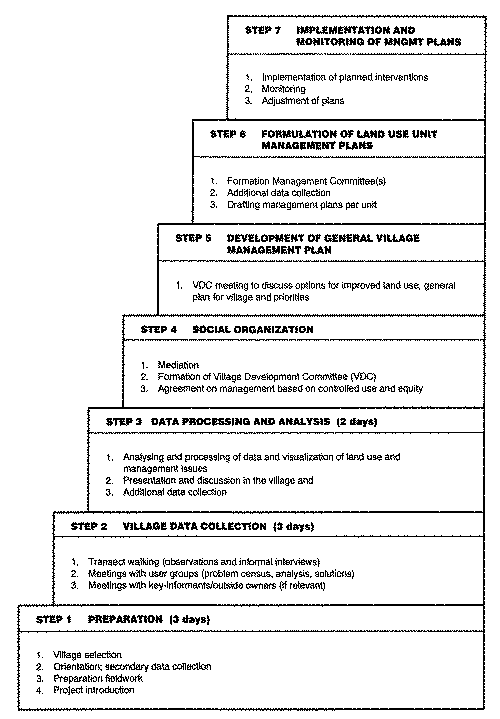
Figure 5.2: The village land use planning apps,
During the preparation phase, basic information is collected in the village and at the office by the VLUP team. The methodology for data collection and processing is based on RRA techniques. Only information that is specifically needed for drafting a general village development plan is collected. Data collection activities encompass field observations, updating of the village map, informal interviews focusing on key issues in social forestry, user group meetings to complete a problem census and an analysis of hillside management, and use of key informants. During data processing, information is exchanged and cross-checked among the men and women. Processing is done with the aid of pre-defined forms. These include a description of key issues and results of the problem census for each user/interest group, ownership relations, local institutions and organizations, a fodder calendar and data on the role of women in land management. Information on land use and ownership is visualized in the map. The village is subdivided into management units based on criteria of ownership and use. Finally the data are presented and discussed with the villagers, resulting in adjustments and identification of further data collection needs.
During this phase, data collection and processing is done by the project in collaboration with all the villagers in general, not with a specific group. Because village social structure is highly stratified, any village working group collaborating with the project at this stage would be dominated by the local elite. This might be counterproductive for the project, which seeks opportunities to establish relationships with the other groups as well (other lineage groups, women and non-owners such as tenants and settled nomads).
The next step is the formation of Village Development Committees (VDCs), comprising representatives from the different owner-lineages. Whenever the circumstances in the villages permit, the project also promotes involvement of representatives of non-owners. The findings of the case study indicate that this has not always been successful. However, while the composition of the VDCs is an important factor, its profile does not necessarily constitute a rigid framework for further planning and action.
The VDC approves the village development plan as a broad outline, based on an analysis of the problem census and what is called a "goal statement exercise". In this exercise, the villagers define their needs for hillside products (fodder, fuel and construction material from grasses, shrubs or trees), the location where they will produce them and the consequences for actual land use management.
Next, the VDC and the project discuss the formation of a management committee for each management unit. Management committees are composed of owners and users of a specific area, the management unit. A management unit can be, for example, a side valley or a hill of a village, which is owned by one or more lineages and used by tenants living in or near it for grazing and cutting.
After approval of this operational set up, the management committees start working with the project. Walking transects are made and discussions held in the management units to make an inventory of the present vegetation, management practices, regulations for land use and needs and options for change. A management proposal is worked out, indicating the needed products, the location where they can be produced, activities required to produce the outputs, required inputs, timing and distribution of rights (benefits) and obligations (costs) among interested groups and the project or Forestry Department. In this way, local land use management projects are defined and presented for approval to the VDC and the project. If approved, an agreement is signed between the VDC/management committee and the project/Forestry Department in which the rights and obligations of both parties are specified.
Once the plans have been approved, implementation starts and each of the parties involved assumes its responsibilities. The project staff continues visiting the villages in order to identify problems during implementation and to provide training of committee members. An annual joint evaluation is envisaged, covering the results so far and reviewing the applicability of the plan. The plans are not considered blueprints, but are seen rather as indicative and flexible instruments to stimulate conscious decision-making about the management of an area.
Conflicts of interest and power at village level are one of the major constraints faced by the project. These conflicts occur not only between owners and non-owners, but also between groups of owners, as in the case of a village called Totakan. In this village, the project (before the development of the VLUP system) approached the landowners, who, of course, constitute the most powerful group. They agreed with the project to reforest some of their village communal area, which was partially commonly managed by all the three lineage groups (khels) and partially subdivided among them.
At the same time, the project told them that it would help in a development scheme, also within the village. The three khels came up with a list and then out of the list selected the construction of a water canal, which was to be jointly funded by the project and the village, the project being the major contributor. The canal was to benefit all the three lineage sections (kandai). The sections of the Mubarik and Dadi khel were completed, but then money ran out before the canal could reach the section of the Ismail khel. This has generated conflicts between the three khels, which have been further deepened as a result of disputes over the protection of the communal area under reforestation. As the four-year agreement with the project has been completed, the project has withdrawn its support, leaving the area open to intruders. According to the other two khels, the Ismail khel wants to be part of any decisions that are made about the areas belonging to the individual sections, such as the appointment of watchmen, which the others do not accept. The heads of the sections want to take decisions regarding their respective sections with no interference from other khels, even though they are all part of the same VDC.
The landless, tenants and livestock herders (gujars) were not approached for any of the activities. They first became aware of them when the reforestation areas were closed off. They believed that the project was there for the benefit of the owners only. However, although initially upset over the closure of the area, the gujars saw the benefit later on in the form of good quality grasses, which had been scarce in these nearby areas. Some of them did not mind paying for it but suggested that for the two monsoon months of July and August, the areas should be open for free grass collection by those who could not afford to buy it, and then closed off again. They preferred to have a controlled system implemented in the areas rather than being completely closed off.
As we have seen, because of internal conflicts among the owner groups, their reforestation project has failed and the area is left open without a controlled management system. But it is interesting to note that the exclusion of the group of non-owners does not mean that these people do not follow what is happening. On the contrary, they make up their minds and, as demonstrated in this case, can come up with their own proposals and suggestions. During the first phase of the project, many such important lessons were learned, constituting the basis for the design of the VLUP methodology. This approach helps adapt project interventions to divergent (and sometimes conflicting) interests at the local level, as demonstrated in the following examples, where the implementation of the approach is under way.
When conducting the VLUP exercise in 1993 in a village called Jabbar, the project proposed a division of the village into 42 land use units. The villagers, through the VLUP exercise, changed this to only seven units. The project staff, which had not sufficiently understood the village social system and use of the area, realized its mistake and agreed with the VDC proposal. It is interesting to note that members of all six lineage groups of the village have ownership rights in every unit. According to them, this makes protection very easy because each of the six groups has an interest in every unit. Their elders had thought up this system to keep intruders out and protect their investments jointly. The VDC decided which units were to be treated as priority, which the project accepted.
In one of the selected units the project proposed a bigger area for planting, which the VDC did not accept. They said that they were planning a canal on one part of the area and that it would be pointless to plant trees there as they would have to be taken out later on. The VDC also curtailed the planting proposal of the project in another section as that was used by the main village for grazing. Another reason for selecting relatively small areas for planting was that they want to be practical. It would take a long time to establish new trees on large areas and they preferred to see the results before expanding the planting area. It should be done a little at a time, as the farmers put it. The project suggested planting eucalyptus, but the villagers did not accept because they had experience of its extremely poor survival rate in heavy snowfall areas. Therefore, the villagers suggested other species they already knew, which the project accepted.
On the other hand, the project has been able to introduce some innovations, such as in the traditional system of fines (nagha). Before, whoever caught the offenders was rewarded with the nagha amount for his diligence. Now the nagha money goes into the village fund, which the project helped set up. An interesting point is that the nagha for the women offenders had been fixed by the villagers at twice the amount imposed on men. The argument was that women, who did not know how to lop trees, were destroyers of the forests, so that heavier penalties would mean that they would abstain from going into protected areas and breaking the rules. The project suggested that the men use a uniform system for both men and women without distinction and that it would train the women in lopping trees. The men eventually agreed. The project spoke to the women about this issue, but they did not think they were doing any harm. The women were not yet fully involved in or informed about the project and its activities. Some information relevant to the whole village reaches the women through the village loudspeakers but men, in general, do not discuss project issues with them.
One of the constraints mentioned by the villagers is that they feel the project is moving too slowly. After six months to a year they have not gone further than meetings. As farmers are generally action-oriented and want to see results,. expressions of waning interest appear quickly. The project on the other hand, keen to avoid mistakes of the past, prefers to practise great caution. Another point mentioned by the villagers is that since they are farmers, they do not have much time to devote to meetings without disturbing their work and, hence, their livelihood. The timing of the meetings was also mentioned as a constraint, since they sometimes took place during heavy workload hours when the villagers are busy in the fields. The project is well aware of these constraints. A schedule for the VLUP exercise has been defined and supporting materials, such as forms, have been produced in order to ensure that the process indeed generates the expected outputs in the shortest possible time.
The National Forest Policy of 1991 and the Forestry Sector Master Plan constitute the framework of strategic planning of the Forestry Department. Although people's participation is considered as an important component, a proven framework for strategic planning of social forestry is still lacking. The experience of the project shows that people's participation should be given a central role, and also that the Department should integrate its various programmes of watershed, hill forest, range management and farm forestry, not hesitating to combine several into a single project.
In this context, it is interesting to mention the network of extension services established some years ago in order to facilitate the exchange of different project field experiences in the region. During its last meeting in April 1994, some 40 participants of the NWFP extension coordination network met for an expert consultation on village land use planning. Representatives from other projects and officials of the Forestry Department discussed the applicability of the VLUP approach in their own working areas, reviewed options for further standardization and worked out a plan of action for the coming period. The quality of the comments of the participants at this meeting and the keynote address of the Chief Conservator of the Forestry Department indicate that the institution is gradually creating more and more opportunities for community forestry.
On the other hand, it became clear that before this approach can be applied on a wider scale, the Forestry Department would need to re-examine its mandate and policies. The Department needs to formulate long-term strategies and goals, determining the allocation of national and international resources and defining the role of the private sector (including local communities) in conjunction with its own. Only when these factors are clear will it be possible to determine whether a larger-scale application of the social forestry approach can contribute to those long-term goals or not.
At institutional level, planning takes place according to a prescribed standard governmental procedure of drafting, scrutiny and approval of all kinds of project documents. It is at this level that serious constraints exist concerning the planning process (top-down, output-oriented, blueprint approach). As has been mentioned before, the project faced these constraints during its first phase. However, it turned out to be possible to overcome some of these constraints by drafting more flexible and open-ended annual working plans and organizing monthly strategic meetings. In addition, before drafting the project document for the second phase, a detailed and systematic analysis was made of the lessons learned during the first phase.
This method, in which the institution takes stock of experiences, is important for strengthening the learning capacity of the project. It is also an important tool for generating more institutional support for corrective measures. It is gradually becoming clear at institutional level that the social forestry approach comprises a participatory planning process of the negotiations with and between the villagers, whose final outcome can never be planned beforehand. The annual plans will have to allow for this, for example by only specifying how many VLUPs will be carried out and maybe in which villages, leaving flexibility in the setting and achievement of implementation targets. In other words: the process can be planned but not the outcome.
However, it takes time and experimentation to establish organizational structures that facilitate decentralized planning. This requires delegation of authority, participatory leadership skills at different levels of the organization, strong motivation and commitment and smooth communication. In other words, adequate management of social forestry programmes requires a participatory management style within the organization: the lessons learned in the field have to be systematically fed back into the organization so that appropriate decision-making can take place. Therefore, control of progress and staff performance is important. Monitoring the quality of performance of extension workers is not easy, however, since one must follow the quality of the process as well as the physical outputs.
The division of work and responsibilities in the Forestry Department is laid out in the service rules. In general, the Forestry Department staff has successfully taken up social forestry tasks on a pilot basis. These new tasks have not yet been reflected in the service rules, however. At institutional level, the position of "extension worker" does not exist. So far, the project has contracted "social organizers" to assume these tasks. The question is whether special extension positions should be created within the Forestry Department and what extension tasks can be carried out by officers in currently existing positions (such as Forest Guards). The project experiences have demonstrated that extension skills can be acquired by personnel in existing staff positions. Besides, the combination of technical and extension skills in a single position increases the institutional commitment and support to social forestry. Job specialization at field level, on the other hand, would mean that forestry technicians would keep on working only with trees and the extension staff only with people.
The Malakand experience demonstrates that in spite of many institutional constraints, the social forestry approach is receiving more and more attention and priority at institutional level. Currently, an action plan is being implemented by a number of projects and programmes in order to develop common denominators based on lessons learned from the VLUP approach. The goal is to define a minimum level of standardization, which will facilitate the institutionalization of the approach. But, as indicated above, it is not just a question of defining a standardized approach. The organizational implications must be worked on as well. The Malakand project defines its role in this connection basically in terms of: (1) human resource planning (number, levels and skills required); (2) systems development (communication and information management); and (3) extension and management training programmes. These three components constitute instruments to generate the managerial and organizational innovations in the Forestry Department, which are necessary to conduct social forestry programmes.
