Housing for small ruminants in the humid tropics is important to protect the animals from rainfall and heat. Excessive moisture without proper shelter leads to a greater incidence of diseases such as pneumonia and worm infestation.
When no housing is provided, the build up of heat load in the animals' bodies may also become acute. Heat accumulation results in various symptoms of stress. Local breeds, such as East African goats for example, have been shown to possess considerable tolerance to heat, possibly due to their ability to increase ventilation and reduce water loss in urine and faeces and their shiny coats which do not absorb the sun's rays. Exotic animals, by contrast, require good housing when introduced into the tropics to reduce the effects of temperature, humidity and rainfall.
Very little is known at present about the efficiency of different types of animal houses and how they influence production. One of the reasons for the increased disease incidence which occurs widely with commercialization may well be housing which is inadequate under intensive production conditions. In West Africa, small ruminant housing for commercial production generally consists of ground-level sheds with open sides; In tropical Asia, however, housing for goats is usually built on stilts to protect the animals from waterlogging and worm infestation. Materials vary from discarded wood or tree branches to high quality timber, with roofs of thatch, leaves or metal sheets. Slatted floors of wood, bamboo or metal may also be used.
Housing for small ruminants should be designed to provide good ventilation and drainage as well as protection from the sun and rain. The construction need not be elaborate or expensive, but the houses should be easy to maintain and clean. The possibility of insect damage to housing materials must also be considered. There should be a rood overhang of at least 1 m to prevent rain from splashing in at the sides, and the animals should have access to the houses at all times of the day and night.
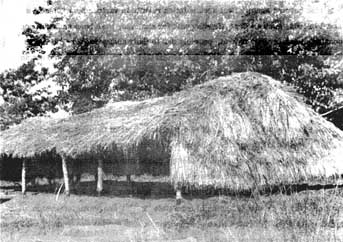
Ground-level housing prototypes for small ruminants are being developed by ILCA using inexpensive local materials. A shed developed to suit local conditions in the derived savanna area is illustrated in Figure 5.
Figure 5. Small ruminant housing designed by ILCA in the derived savanna zone of Nigeria