 Previous - Next
Irrigated forest plantations in dryland areas
It is possible to establish irrigated plantations for commercial fuelwood, pole, timber and fodder production. Irrigation allows us to use water-demanding species which would not grow under arid and semi-arid conditions. We may use a continuous or intermittent water source, or even wastewater.
1. Irrigation using a continuous water source
Three types of irrigation systems may be used depending on topographical and soil conditions: gravity irrigation; sprinkler irrigation; or focalized irrigation.
a. Gravity irrigation
Surface flooding is the simplest form of gravity irrigation. It is easy to implement on gently sloping land. Water is conveyed in ditches, then released and allowed to spread over the area. The drawback here is that the water is not evenly distributed. This system is not very suitable for tree and shrub crops.
Border irrigation is a form of surface flooding where the water is guided by parallel ridges 3 to 30 metres apart. The land should slope regularly but moderately, and the ridges should run parallel to the slope. Sandy soil is not suitable for this type of irrigation, unless the strips are fairly short. A drainage ditch should be dug at the bottom of each strip to collect excess runoff. In agro-forestry, this technique allows tree planting along the ridges and crop planting on the strips.
Imbibation irrigation involves dividing the land into small horizontal compartments which are filled with water that is then left to seep into the soil. This method calls for considerable labour to prepare the land and fill the compartments.
Furrow irrigation is a commonly used method. The furrows extend from the main feeder channel. They may run along parallel, regularly spaced lines to provide moisture to the root zones of the trees, usually planted on one side of the furrow, or follow the contour lines, allowing for better water distribution. Maintaining the channels is the main constraint with this type of irrigation.
b. Sprinkler irrigation
This is the most commonly used method in topographically irregular areas that are not easily levelled, or on irregularly sloping land, or again where a quick supply of relatively small quantities of water are required temporarily. This type of irrigation is used mainly to help young trees develop their roots in the direction of the groundwater.
c) Focalized systems
Focalized irrigation systems, a generic term used to designate the various drip irrigation methods, are among those that provide moisture at the base or around the root system of the plant. Water is brought through supply pipes, placed below or above the soil surface, in which holes have been made, or which have been fitted with calibrated nozzles.
The essential components of these systems are: a pressurized water source, a regulatory device, and a main canal with lateral branches and distributors.
To obtain the required pressure of water source, a pump or tanks and reservoirs are usually necessary. The regulatory device is placed at the highest point. The advantage of these systems is that they do not require a perfectly level terrain as do the gravity systems. They enable the correct quantities of water to be applied and are easy to use, requiring little labour after installation. Their main drawback (apart from their cost) is the risk of the pipes, especially the orifices and nozzles, becoming blocked with sand, earth, organic matter, or even algae. Another drawback is that they promote root development over a very small area. In the event of a system breakdown, prompt repair is essential to ensure that the trees with insufficiently developed root systems do not die.
2. Irrigation using an intermittent water source: rainwater harvesting
For tree plantations, rainwater is used directly and does not have to be stored. Four techniques are used:
- runoff cropping;
- alternate strip cropping
- terrace cropping;
- flood water spreading;
a. Runoff cropping
The drainage basins are divided into several micro-drainage basins depending on the area each tree requires (between 20 and 100 m² depending on rainfall and water requirements). The trees are planted at the lowest point of each micro-basin. If the roots have difficulty penetrating the soil (stoney or laterite soil), 1.5 m deep holes are dug and filled with loose soil. The trees are always planted at the bottom of a small depression about 40 cm deep. The depression collects and stores the runoff from the rest of the micro-drainage basin.
b. Alternate strip cropping
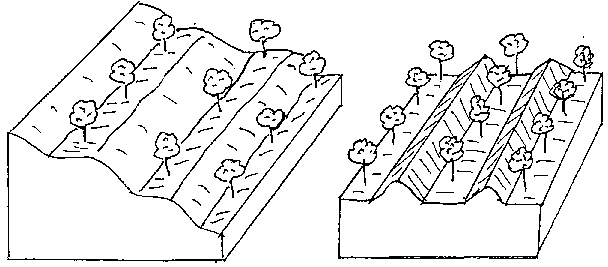
Alternate strip cropping uses runoff from gentle slopes through a system of terraces which blocks the water in an adjacent strip of land where crops are planted (figure 1).
When the soil is moderately permeable and the natural gradient exceeds 6 %, we use one-sided micro-drainage basins, but when the soils are very permeable and the gradient less than 4 %, we use two-sided ones.
Figure 1
c. Terrace cropping
The reason for building the terraces is to slow down and collect all the runoff between the terraces. Terraces are essential on steeply sloping land. They may consist of barriers running along the contour lines perpendicular to the slope, which hold the earth carried along with the runoff water. The barriers may be made of stones, logs, earth or hedges.
d. Flood water spreading
This technique involves using the flood water from heavy rainfall to water an area that has not received any rain.
Site selection is fundamental for the success of this type of irrigation. Slopes on the downstream side of escarpments, alluvial deltas and flood plains are particularly suitable.
| Further-information on the subject and how it relates to desertification control-may be obtained from, the Forest and Wildlands Conservation Branch, Forest Resources Division, Forestry Department, Food and Agriculture Organization of the United Nations, via delle Terme di Caracalla, 00100 Rome (Italy) - Fax (39.6) 5797 5137 |
April 1993