


Chapter 1 INTRODUCTION
(i) Background
This study of the long-term outlook for the timber aspects of the forest and forest products sector in Europe is intended for the use of decision makers and those who advise them. Anyone who takes a decision must have an expectation of the likely consequences of his action, which in turn implies an implicit view of the future, and of the external factors which will affect the consequences of the decision. In the great majority of cases, this view of the future is not laid out formally, as possible changes are small or the consequences of wrong decisions minor. However, as the importance of the issues and the size of the risk become greater, it is often considered necessary to analyse in a formal way the consequences of any particular action (or of a range of different options).
Among the many factors increasing the uncertainty attached to a decision are: a multiplicity of actors and factors, especially if they are not controlled by the decision maker (e.g. if there is a significant international element); a long time horizon; and a lack of knowledge as regards cause-effect relationships in the area concerned. All these characteristics make it both more necessary and more difficult to examine the consequences of decision options. All three factors above apply to major decisions in the forest and forest products sector, which is increasingly international and complex, where the economic, social and biological interactions between the different parts of the sector are often not well understood, and where the time horizons are often extremely long.
A forest owner drawing up a management plan, a government drawing up forest policy, an investor examining an investment opportunity in the forest products industries, and many others, are very soon forced to ask themselves what will be the international situation as regards supply, demand, prices and trade of roundwood and the various forest products. In theory each of them could develop their own opinion of these issues: in practice, this would be very difficult, given the many factors and the remoteness of some of the major actors. This is especially true because the forest and forest products sector, by its very nature, involves major international elements, like the global markets for sawnwood or pulp, alongside very local aspects, like site conditions or rural social structures.
One solution applied since the early 1950s is international cooperative studies of the outlook for the supply and demand of roundwood and forest products. European timber trends studies have been prepared and published in the framework of the FAO and the UN Economic Commission for Europe, by the ECE/FAO secretariat but with considerable input from national experts, at roughly 10-year intervals since 1952.1 The present study is the fifth full study in this series.
(ii) Mandate
The two parent bodies of the study, the FAO European Forestry Commission and the UN/ECE Timber Committee, have approved the following terms of reference for the fifth European timber trends study, which will be referred to as ETTS V:
"The major objectives of the study are as follows:
"(a) to present the outlook for European demand for forest products;
"(b) to present the outlook for the supply of roundwood from European forests;
"(c) to present the outlook for the balance between supply and demand, taking into account all parts of the sector, including trade, use of industrial residues and waste paper, and the forest products industry.
"In addition to achieving these major objectives, the study (or connected documentation) should also aim to achieve to the extent possible the following linked objectives:
"(d) to provide a database for the use of analysts;
"(e) to present long-term past trends, especially of a structural nature;
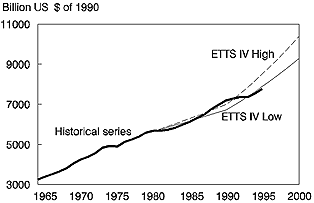
FIGURE 1.3.1 GDP in OECD Europe
"(f) to present the outlook for prices of
roundwood and forest products;
"(g) to present the outlook for international trade in roundwood and forest products;
"(h) to improve the quality of the database for long-term outlook studies."
In addition, the parent bodies considered that "the study should take into account the possible effects of present and likely future policies for other sectors which could affect forestry, notably for agriculture, the environment and regional development, as well as forest policy itself. Major issues for policy in the forest and forest products sector should also be identified and discussed.
"The study should cover supply and demand for cork as well as for wood-based forest products.2
"The study should also examine the effect of the demand for non-wood benefits of the forest on wood supply, as well as other interactions between the supply of wood and non-wood benefits of the forest.
"The study will cover Europe3, with other regions being considered as influences on the European situation, notably as suppliers of forest products to Europe.
"The study will be published in the mid-1990s, with a time horizon to around 2040, but with more detailed examination of the period to 2010.
"Wherever possible, past data and projections will be supplied on a country-by-country basis.
"The Committee noted that among the present and likely future policies for other sectors which could affect the forest and forest products sector were policies for increased regional economic integration. The possible effects of these
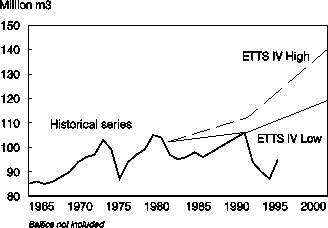
FIGURE 1.3.2 Total consumption of sawnwood
policies should be analysed and integrated into ETTS V" (ECE/TIM/49, paragraphs 47-56).
The study will not cover the outlook for the supply and demand of non-wood goods and services, important though they are: the nature of the problems, the data and the methodology
required are so different that it was considered
impossible to combine the two outlooks in a
single study. However, once ETTS V is
complete, the Timber Committee and the EFC
will launch a study with ambitions similar to
ETTS V on the outlook for non-wood goods and services.
(iii) Methodology
The methodology and structure of the study have been drawn up in consultation with the ETTS V core team, and adhere to the following basic principles: there is a pragmatic choice, with different basic methods in each sector as appropriate; the reasoning and assumptions used should be transparent so that readers are able to check and, in some cases, modify, the scenarios; and, to the extent possible, assumptions (for instance on GDP growth or prices for forest products) should be consistent across the whole study.
The study has been prepared in three phases: preparation of initial scenarios, using a variety of methods (econometric analysis, national forecasts, secretariat estimates); a consistency analysis, to adjust the initial (partial) scenarios in order to achieve base scenarios, which are internally consistent across countries and sectors. To avoid internal inconsistencies between parts of the study, the partial (initial) scenarios were then corrected to be in accordance with the base scenarios; examination of alternative scenarios to the base scenarios (sensitivity analysis), and the consequences of the former for the different parts of the sector, as well as of the study's major conclusions.
FIGURE 1.3.3
Total consumption of panels
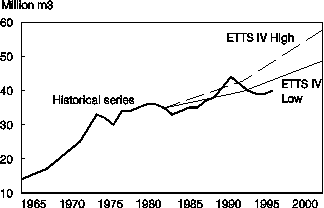
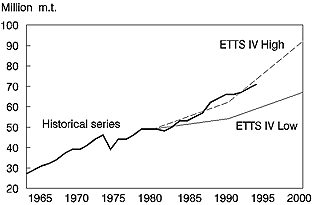
FIGURE 1.3.4 Consumption of paper and paperboard
As ETTS V is intended also to be a tool for analysts elsewhere, notably those examining the outlook for the forest and forest products sector at a national level, data are supplied on a country-by-country basis in the study or in the supporting documentation. Those interested in further information about sources, etc., or in receiving the data in a computer-readable form, are invited to contact the secretariat.
1.2 Overview of the European forest and forest products sector
Europe is a rich, densely populated continent with about 35 per cent forest cover. There is about 0.28 hectares of forest and other wooded land for every European, much less than the world average of 0.63 hectares per caput. Europe accounts for about 5 per cent of the world's forests. However, unlike those of many other regions, where deforestation is proceeding at a rapid pace, Europe's forests ceased to contract around the beginning of the twentieth century and have been expanding steadily since then (apart from times of war) in both area and growing stock. Over the 1980s, Europe's forest area expanded by about 1.9 million hectares. Again, unlike those of many other regions, almost all of Europe's forests are managed, and have been managed for a very long time (there is evidence for forest management - coppicing - from Somerset, in the UK, in the Stone Age). There is very little primary or "virgin" forest in Europe.
Because of the generally high level of economic development, consumption of forest products is high (although not as high as in North America). Consumption of sawnwood has been growing rather slowly and is more affected by cycles in its major market, residential construction, than a strong growth trend. Consumption of wood-based panels has also finished its post-war phase of rapid market development and penetration, and is growing slowly, although some products (e.g. MDF, OSB) are gaining market share at the expense of others. Consumption of paper and paperboard has been growing at roughly the same speed as GDP for the last 40 years, despite frequent fears that paper would be rendered unnecessary or uncompetitive by new techniques (electronics, packaging). About 37 per cent of the paper and paperboard consumed in Europe is recovered for re-use.
Fellings in Europe are about 420 million m3 o.b., about 70 per cent of net annual increment. Despite the fact that Europe harvests much less than the maximum biological potential of its forests, and thus has the physical potential to expand domestic removals considerably, it imports large volumes of forest products from other continents: its net imports were around 66 million m3 EQ in 1992, of which nearly half were in the form of pulp. Imports come from all major wood-producing regions. Europe (mainly the EU) and Japan are the dominating importers on world forest products markets.
1.3 Comparison of trends in the 1980s with the scenarios of ETTS IV
As ETTS V is the latest in a series, each of which draws heavily on the experience of earlier studies, it is desirable to examine systematically the scenarios of the earlier studies in light of subsequent events as an indication of changes in trend or of methodological weaknesses. The attached graphs show trends recorded in the 1980s, alongside the scenarios proposed by ETTS IV. For the demand scenarios, it is of interest to know whether any discrepancies are due to problems with the econometric analysis, or with the scenarios for the exogenous variables (essentially GDP, population and residential investment). The latter are, therefore, also shown alongside those for forest products.
It should be borne in mind that the ETTS IV scenarios, like those of ETTS V, concern long-term development, and were not intended to take into account cyclical fluctuations.
(i) GDP
During the first half of the 1980s the real trend in GDP growth for OECD Europe was rather below the 1.7 to 2.1 per cent rate forecast for ETTS IV, and rather above it in the second half of the decade. Thus the ETTS IV scenarios for GDP growth were roughly in line with reality over the 1980s as a whole. The contrast between the two halves of the decade reappears for other parameters.
(ii) Residential investment
The trends for residential investment, the main end-use sector for sawnwood and panels, vary widely between countries. ETTS IV proposed two scenarios: the "low" was for no growth, and the "high" for growth at half the rate of GDP. Of the five main western European economies, in 1990, two had residential investment above the forecast range (Germany and the UK), two were inside it (Italy and Spain), and one was below it (France). This confirms the importance of taking national factors into account. It is also noticeable, as for GDP, that trends in the first half of the decade were considerably lower than in the second. However, the early 1990s saw very weak conditions for residential investment, with consequences for consumption of sawnwood and panels.
(iii) Population
During the 1980s, population grew very much in accordance with the UN "medium variant". The population of Turkey grew at 2.3 per cent a year during the 1980s, slightly faster than the 2.2 per cent a year ETTS IV scenario, and, as forecast, by far the highest rate of population growth in Europe.
(vi) Consumption of forest products
Consumption of sawnwood was below the forecast range over the whole decade, although the divergence was greater in the first half than in the second, and a sharp drop occurred in the early 1990s. There was, however, a significant difference between the two major assortments. Consumption of coniferous sawnwood was near the forecast range throughout the decade and within it at the end of the decade. However, consumption of non-coniferous sawnwood was well below the forecast range throughout the decade. It is only possible to speculate on the causes for the lower-than-forecast consumption of non-coniferous sawnwood: general weaknesses in demand in two major markets (France and Italy), a reluctance by consumers to use sawnwood from tropical sources, and a statistical distortion due to the fact that increasingly hardwood manufactures (windows, doors and door frames, joinery) are imported rather than non-coniferous sawnwood itself (this would result in a drop in recorded imports of sawnwood). The choice of base year (three-year, rather than five-year average) may have also played a role.
Consumption of all wood-based panels was below the forecast range during the first half of the decade, above it in the second half, within it in 1990, and below it in the early 1990s.
Consumption of paper and paperboard was mostly within the range throughout the decade and above it at the end of the decade, following a similar pattern to GDP, the exogenous variable in the projections. This indicates that the elasticities used for paper consumption by ETTS IV were broadly satisfactory.
(v) Recovery of waste paper
FIGURE 1.3.5
Recovery rate of waste paper
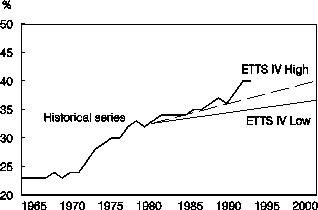
The continued strong growth in waste paper recovery has confirmed the ETTS IV scenarios: indeed the growth in the recovery rate was under-estimated by ETTS IV.
(vi) Removals of roundwood
The ETTS IV removals scenarios were prepared by national experts. During the 1980s, removals were along the lower edge of the ETTS IV projected range, which was for rather slow growth, and fell below it during the recession of the early 1990s. There are, however, big differences between countries and assortments. For the Nordic countries, largely dependent on the export market and very open to international competition, in most years real removals were below the ETTS IV scenarios, while for the EU, in the first half of the decade they were below the forecast and for the second half above it. Practically throughout the whole period, removals of logs were below the forecast levels, but those of small wood (pulpwood, but also fuelwood, pitprops and other industrial wood) were inside the range until 1990.
FIGURE 1.3.6
Total removals
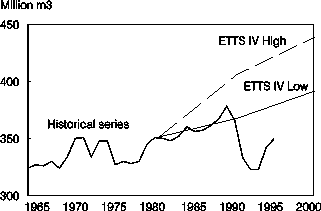
There were major differences at the national level between scenarios and real developments, which more or less cancel each other out at the European level. Removals in practically all the transition economies were below the forecasts, which is understandable given the special circumstances of the time, as well as in Italy, Finland and Turkey. In Belgium, the Netherlands, Norway, Portugal, Spain and the UK they were above the forecast range.
Notes
1
The European timber trends studies have been issued at the following dates: ETTS I in 1952, ETTS II in 1964, an "Interim Review" in 1969, ETTS III in 1976 and ETTS IV in 1986.2
Unfortunately, it has not been possible to carry out this part of the terms of reference.3
Including the three Baltic States.
