


Chapter 4 THE EUROPEAN FOREST RESOURCE
The central and most important objective of ETTS V is to analyse the outlook for the balance between supply and demand for roundwood and forest products in Europe. Given the long-term nature of forestry, whose cycles are much longer than those of the forest industries or the forest products markets, the most challenging part of this task is to examine the supply and demand balance for roundwood, and in particular for the roundwood provided by European forests. To achieve this goal, ETTS V must place the expected long-term developments for the European forest resource in the context of the expected developments for forest products and the demand for roundwood. This is done in chapter 11. The present chapter focuses on the wood supply outlook for the European forest in the light of present national forest policies, and describes broad outlines for the future of the European resource until the middle of the twenty-first century, on the basis of national forecasts to the year 2040.
This chapter, like the rest of ETTS V, only covers the wood-supply function of the European forest, and does not address the complex questions of the resource’s potential to supply European society's demand for other forest goods and services.
The forecasts in this chapter are based on national forecasts for forest area, growing stock, increment, fellings and removals, provided in response to an enquiry circulated in 1992. These forecasts have been collated, validated and processed by Mr. H. Pajuoja, whose services were made available by the Government of Finland. The secretariat takes this opportunity to thank Mr. Pajuoja and the Government of Finland for this valuable contribution to ETTS V.
This chapter mostly presents data for country groups or for Europe as a whole. Data by country are presented in the ETTS V working paper by Mr. Pajuoja issued as ECE/TIM/DP/4.1
After a brief description of the European forest resource around 1990, this chapter presents forecasts for the same resource, and discusses the nature of these forecasts and their sensitivity to different assumptions, such as policies, prices or demand for forest products.
4.2 The European forest resource around 1990
The European forest covers about 200 million hectares, of which 135 million hectares are "exploitable forest" and serve as the main source of wood, 16 million hectares "unexploitable forest" and 45 million hectares "other wooded land", including sparse forest and Mediterranean scrub land. Forests and other wooded land cover 35 per cent of Europe's land area, which is quite near the world average forest cover rate of 32 per cent.
Although Europe only accounts for about 5 per cent of the world's forest area, the European forest is very diverse, not only in its ecological conditions and natural site productivity, but in its history, ownership and management. There are wide differences between countries and within countries (although diversity within countries cannot be covered in ETTS V). For instance, forest cover, including "other wooded land", is negligible in a few countries, such as Iceland and Malta, and around 10 per cent in the Netherlands and the UK, but is 68 per cent in Sweden and 77 per cent in Finland.
Ecologically, European forests vary widely, from boreal forests near the tree line in northern Scandinavia to Mediterranean scrub (maquis or garrigue), from fast-growing eucalyptus to slow growing oak, from Alpine forest to riverine forests in central Europe, and so on.
Europe's exploitable forests contain about 20 thousand million m3 of wood2, of which nearly 5 thousand million m3 in the Nordic countries, and over 6 thousand million m3 in the EU (12). About 63 per cent of this is coniferous. Because of management choices (rotation length), as well as natural conditions, the growing stock per hectare also varies widely: in the Nordic countries it is on average 80-120 m3 per hectare, but in central Europe and Germany, it reaches nearly 300 m3 per hectare. The European average is 141 m3 per hectare. 85 per cent of Europe's forest area is "high forest", with the remainder coppice or coppice with standards.
The net annual increment of wood also varies around the European average of 4.5 m3 per hectare per year (exploitable forest only), from national averages of around 1 m3 per hectare per year in some Mediterranean countries to 7-8 m3 per hectare per year in countries such as Belgium, Denmark and Ireland. Of course the difference between the most and the least productive stands in any one country is even greater. In total, the net annual increment of Europe's forests is about 630 million m3 per year, of which about 190 million m3 in the Nordic countries and 215 million m3 in the EU (12). 65 per cent of Europe's net annual increment is in the EU (15) (i.e. the EU (12) plus Austria, Finland and Sweden).
European fellings are around 435 million m3 o.b., just under 70 per cent of net annual increment. In most countries the fellings/increment ratio stands at about the European average and below 100 per cent in all but a very few, southern countries: Albania, Cyprus and Greece. Portugal and parts of former Yugoslavia have a fellings/increment ratio of over 95 per cent. Thus, there is no doubt that Europe's present wood supply is well below its physical potential, with the exception of the above-mentioned countries.
It is difficult to obtain reliable data on change over time, partly because of the problems of distinguishing between real change and "change" due to improved measurement methods. However, according to the Forest Resource Assessment 1990, the European forest area increased by 1.9 million hectares between 1980 and 1990. Losses of forest land to other uses, notably urbanisation and transport infrastructure, were outweighed by the afforestation of former agricultural land and natural extension.
Just over half of the European forest is privately owned, belonging to farmers, small-scale forest owners, traditional large estates (now sometimes professionally managed on behalf of non-resident investors), and, especially in the Nordic countries, the forest industries. Publicly owned forest may belong to the state, regional entities (like the German Länder), municipalities, or various other bodies. In some countries, the non-state owned public forests are managed by the state forest service, but this is by no means universal.
In all European countries with a significant forest resource, there is a forest law aimed at ensuring that forests are managed on a sustainable basis, although, until recently, sustainability was measured essentially in terms of wood production. In general, all forest owners, private or public, are expected not to cut more than the site can produce on a permanent basis. The methods of implementing these forest laws vary widely according to the legal and political systems and the forest circumstances of each country. In general, forest owners are expected to manage their land according to a management plan agreed with an official body. The complexity of the requirements usually varies according to the size of the holding, as it is clearly unreasonable to expect detailed (and expensive) management plans from the owners of only a few hectares.
There are large differences between countries and, especially, owner groups, in the intensity of forest management and in the owners' management objectives, a fact which plays a major role in determining Europe's effective wood supply potential. Objectives other than maximising income (expressed as either wood production or financial return) are important and even dominant, for millions of private forest owners; many such owners seek recreation opportunities (e.g. hunting), landscape and protection from visual nuisance, nature conservation or a store of value (e.g. forest land inherited by urban dwellers from their rural-dwelling parents or grandparents). Often, managers of public forests, although they usually have more resources and skills, have an even harder task: reconciling the interests of all present and potential user groups, while not placing an intolerable burden on the public purse.4
The motivations and behaviour of private forest owners is not well understood, despite research in a few countries, notably the Nordic countries and France. In most countries, due to the absence of hard data, it is assumed that the volume of wood produced by medium- and small-scale forest owners will remain constant, despite evidence that the "average" forest owner is changing, becoming more urban, absentee and wealthy, and less agricultural. It is also widely assumed that their wood supply behaviour (except in the Nordic countries) is not affected by price (except possibly in the very short term), but is determined by external and individual events (such as the frequently quoted necessity to pay for a daughter's wedding). However, it appears that in some countries the motivation may be more complex, and may be aimed at maintaining a constant total income, leading to a negative correlation of wood supply with agricultural prices (i.e. if agricultural prices are high, the farm forester needs to sell less wood to obtain the same total income). It should also be pointed out that it is difficult to evaluate the price sensitivity of wood supply from private forests as there has not been a significant long-term change in real prices of roundwood in most countries: it is quite simply unknown how private forest owners, large or small, would react if faced with significantly higher or lower roundwood prices.
4.3 The outlook for the European forest resource
(i) Methodology
Long-term forecasts for wood supply and the forest resource are a confusing mixture of the highly predictable and the very uncertain. On the one hand, because of long forest rotations and the good knowledge in most of Europe of growing stock, growth rates, age classes and site productivity, the biological side is well known: indeed practically all the trees which will be harvested in the first quarter of the twenty-first century are already in the ground (some of them were planted between the wars or earlier). Furthermore, many of the major silvicultural decisions, notably choice of species, regeneration method and spacing (for plantations) will only have measurable consequences at the national, or even local, level in several decades.
On the other hand, the most important silvicultural decision of all, when and how much to cut, depends on a totally different set of mostly short-term factors, which are rather difficult to foresee, even for a few years into the future. These include demand for forest products, influencing demand for roundwood (with quality and location factors), present and perceived future prices for roundwood and harvesting costs, as well as the above-mentioned diversity of management objectives, some of which are exceedingly difficult to measure in economic terms.
Several approaches are used to project future wood supply at the national or regional level, such as: detailed modelling of the biological processes, concentrating on site productivity and age class structure; aggregation of management plans registered with the forest authority; and econometric models, incorporating a biological element and making assumptions about the response of forest owners to different price conditions. None of these methods taken alone can be expected to produce entirely reliable projections at the national, let alone international, level.
ETTS V has relied on the experience and judgement of national correspondents to make a synthesis of available national information and use their judgement when necessary. The national ETTS V corespondents were asked to make detailed forecasts for their countries, based on knowledge of the forest resource at present and assuming constant real prices for roundwood.5 The forecasts for removals, prepared by the correspondents, which are presented in detail in the working paper by Mr. Pajuoja, were then compared with the derived demand for roundwood, the results of which are shown in the consistency analysis described in chapter 11. In the great majority of cases, there was no need to modify the correspondent's base scenario. Where there was a discrepancy, adjustments were made in consultation with the national correspondent to ensure that the forecast level of removals was in accordance with the expected level of demand. When adjustments were necessary to the removals scenario, it was necessary also to modify national forecasts for growing stock to ensure internal consistency. It should be noted, therefore, that the data on removals, growing stock and increment in this chapter and other parts of ETTS V are not identical to those in the working paper, although they are derived from it and coincide exactly in the great majority of cases.
FIGURE 4.3.1
Removals by country group
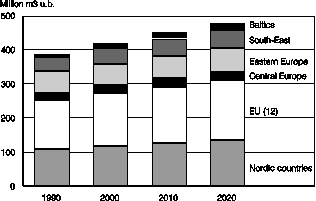
The forest scenarios in this chapter incorporate the removals levels of the Base Low scenario. However, there is only a difference of 6 million m3 in forecast removals for 2020 between the Base Low and Base High scenarios, so it appeared unduly confusing to present two forest scenarios with only marginal differences.
(ii) Assumptions underlying the scenarios
National correspondents were asked to provide information on the policy and other assumptions underlying their forecasts. Although their responses were by no means comprehensive (see working paper, pages 4 ff.), some remarks may be made.
In a number of countries, official (and in some cases long-standing), policies of forest expansion and improvement are expected to continue. This is the case for Denmark (which intends to double its forest area in 70-100 years), France, Hungary, Ireland, Spain and Turkey. The UK foresees the coming on stream of existing plantations, but despite the significant further expansion of area (an additional 350,000 hectares between 1990 and 2020) fellings are expected to increase faster than increment.
Several countries mentioned that environmental policies, in particular the need to give higher priority in forest management objectives to biodiversity conservation, would influence the level of removals and/or the classification of forest as "exploitable". References (often incomplete or not quantified) to this aspect were made by Bulgaria, Denmark, Finland (no major effect on harvest expected), France (more protection areas), Italy (fellings and area of exploitable forest expected to decline, partly because of "campaigns by ecological associations against harvesting"), Norway (large-scale restrictions on harvesting not anticipated), Poland (longer rotations, restrictions on clearcutting, but no significant change in harvest level), Sweden (reservation of forests and afforestation of agricultural land expected to cancel each other out), and Switzerland (more hardwood removals, slight increase of harvesting losses). No doubt other countries have made implicit assumptions on the incorporation of environmental objectives into forest management practice. It is not possible to quantify the global effect of environmental legislation, notably because there is no "baseline" scenario, i.e. a level of harvesting which would be achieved if there were no environmental restrictions at all: in European forest management conditions, even to estimate such a figure would be difficult and probably meaningless as the environmental and wood production aspects of forest management are inextricably interlinked at all levels.
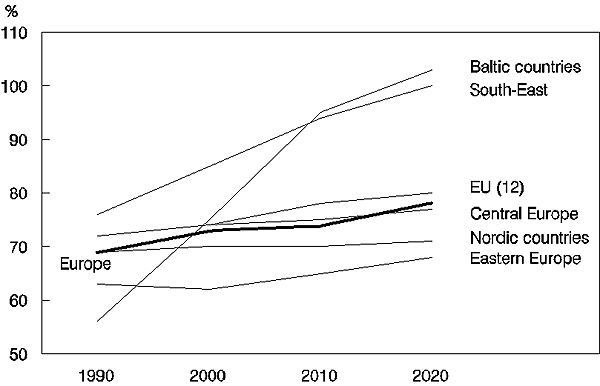
FIGURE 4.3.2
Ratio fellings/increment
Many countries mentioned the afforestation of agricultural land, including Austria (some agricultural land may be shifted to forests), Finland (goal of reducing arable land by 200,000 hectares by 2000, but no significant effect on timber production foreseen), France, Norway (if agricultural activity declines, there may be a negative effect on forestry as farmers are also forest owners), Poland (about 10 per cent of agricultural land will be afforested, but this will be a slow process), Slovakia (60,000 hectares of low yield agricultural land will be afforested, compensating for forest land shifted to other uses), Spain and Sweden (see above). From this list it appears that although afforestation of agricultural land is a major policy issue, the national correspondents do not expect it to change significantly the forest sector. Among the reasons advanced are:
- afforestation would only compensate for the loss of exploitable forest land to other uses, including nature conservation;
- any change in land-use patterns would take a long time to carry out and even longer to have a significant effect on wood supply. This implies, among other things, that any afforestation which does take place is not expected (by the ETTS V correspondents) to be highly intensive silviculture concentrating on rapid wood production and high yields, as this type of afforestation, in the conditions of some European countries, could well have significant effects within the time span of ETTS V.
Damage, e.g. from pollution or forest fires, was mentioned by several countries: Austria (no signs that forest damage effects increment), the Czech Republic (continued negative effect on forest ecosystem; decrease in increment attributed to lower stand density because of air pollution, game damage, more broadleaves and changes in age class structure; positive impact of NOx, CO2 and global warming taken into consideration), Finland (visible effects of acid rain, but no consequences for timber supply), France (no impact of forest damage on removal levels), Portugal (forest fire problem will not be solved), Slovakia (decrease in increment of coniferous species expected due to excessive air pollution and acid rain), Spain (fires), Sweden (effects of pollution and global change unknown).
The transition economies stated that the change in forest ownership patterns would bring about changes in the sector, but were unable in the present circumstances to describe, still less quantify, these effects.
Finally, many correspondents qualified their scenarios with remarks about uncertainty arising from future demand and prices for roundwood, as the price elasticity of roundwood supply is unknown; and they were not in a position to assess the future demand for roundwood and forest products.
With regard to the latter remark, it is of course one of the main functions of ETTS V to provide relevant information on future demand and prices of roundwood; it is hoped that this will enable national policy makers and scenario builders to review and, if necessary, revise their national outlook with an understanding of the outlook for the international situation.
(iii) Area, removals, growing stock and increment to 2020
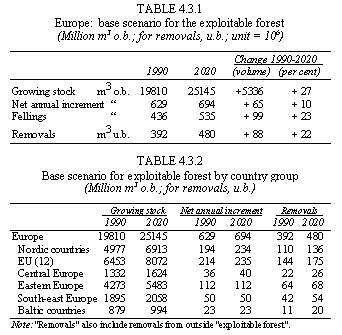
No major changes are expected in the area of "exploitable" forest in Europe: it is expected to expand by 3.3 per cent (4.7 million hectares) in the thirty years between 1990 and 2020. Many countries report small increases, but most of the expansion is accounted for by three countries: Spain (+ 1.7 million hectares, or over 25 per cent), France (+ 1 million hectares, or 7.4 per cent) and Poland (+ 0.4 million hectares, 4.7 per cent). The major exporting countries (Nordic countries and Austria) expect insignificant increases in forest area (+ 40,000 hectares in Austria). In both Spain and France, the expansion would be a continuation of long-existing forest expansion and improvement policies. In Poland, it might be a result of reduction of agricultural land area as a part of the transition process.
Removals are expected to rise by about 0.7 per cent a year to reach 480 million m3 in 2020, which is 88 million m3 more than in 1990. The largest increases in volume terms are for the EU (12) (+ 32 million m3) and the Nordic countries (+ 26 million m3). Thus, two thirds of the increase in European supply is expected to come from the enlarged EU, notably France (+ 13 million m3), Finland (+ 12), Sweden (+ 10), UK (+ 6) and Spain (+ 5). Outside of the enlarged EU, significant increases in removals are forecast for Turkey (+ 11 million m3) as well as Bulgaria (+ 2), Croatia (+ 3), Estonia (+ 4), Latvia (+ 3) and Lithuania (+ 3). In relative terms, the steepest increases are forecast by Ireland (+180 per cent over the next 30 years), Estonia (+129 per cent), Croatia (+95 per cent), UK (+ 93 per cent), Lithuania (+91 per cent), Latvia (+ 52 per cent), Bulgaria (+ 59 per cent) and Turkey (+ 52 per cent). Only in Albania are removals forecast to drop, by 1.6 million m3, as unplanned fellings are brought under control and rural fuelwood demand weakens.
FIGURE 4.3.3
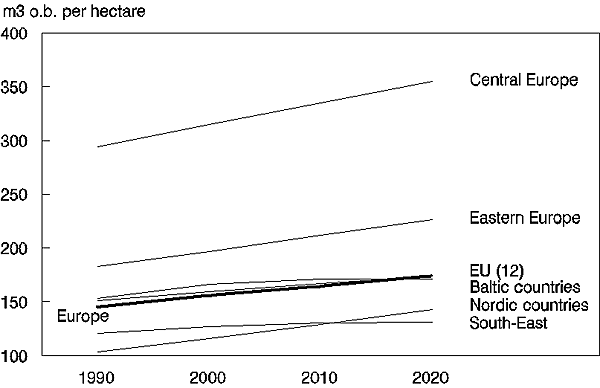
Growing stock
In an historical context, the forecast rise in European removals is a continuation of the post-war steady upward trend.
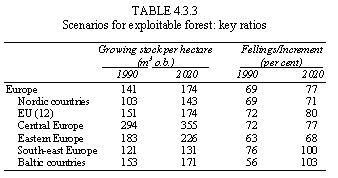
Fellings, which include removals under bark, bark, and harvesting and transport losses, are a better indicator than removals of the true drain in the forest growing stock. They may be compared to net annual increment to obtain a crude measure of sustainability of wood supply.6 In 1990, fellings were about 70 per cent of increment. This ratio is expected to rise to about 77 per cent for Europe in 2020. As drain is consistently well below increment, growing stock will rise by 5,335 million m3 over the 30 years (+27 per cent). Given the stable position for forest area, growing stock per hectare is also bound to rise, with the European average going from 141 m3 per hectare to 174 m3 per hectare. This trend will affect nearly all countries, including those where the average growing stock per hectare is already high. For instance growing stock per hectare will rise between 1990 and 2020 from 294 to 355 m3 in central Europe, and from 271 to 315 m3 per hectare in Germany. In summary, the European forest will continue to accumulate wood as the harvest will remain well below the biological potential, even though a larger proportion of the increment will in fact be utilised.
Do these data provide indications as to threats to the physical sustainability of wood supply in Europe? In a small number of European countries, fellings are above increment. This is the case in Albania, Cyprus and Greece, which have similar Mediterranean conditions, such as problems of fire and overgrazing and marginal economic viability of forest operations. In all three, growing stock is forecast to be less in 2020 than in 1990.
In Switzerland too, fellings are higher than increment and are expected to remain so; however, the Swiss situation differs considerably from those of the Mediterranean countries mentioned above, as there has been an excessive accumulation of growing stock to the extent that in some parts of the country the stability of mountain forests is threatened. The intention is to rejuvenate the forest by increasing the level of harvest. Here, too, there are economic problems, linked to the expense of forest operations in mountain regions.
In the Baltic countries in 1990, fellings were 56 per cent of increment, but they are forecast to rise to 103 per cent of increment in 2020, driven by both export and domestic demand. There is a feeling in some of the countries, based on preliminary results of new forest inventories, that the earlier increment data were in fact excessively cautious, and that considerably higher levels of removals are possible without damaging the resource, although this should, of course, be carefully monitored.
Finally, nothing is known about the present situation regarding the forests of the successor states of the former Yugoslavia, but it must be assumed that they are under threat from the direct damage inflicted by military operations, high fuelwood demand, lack of effective forest administration and the need to find sources of foreign exchange.
FIGURE 4.3.4
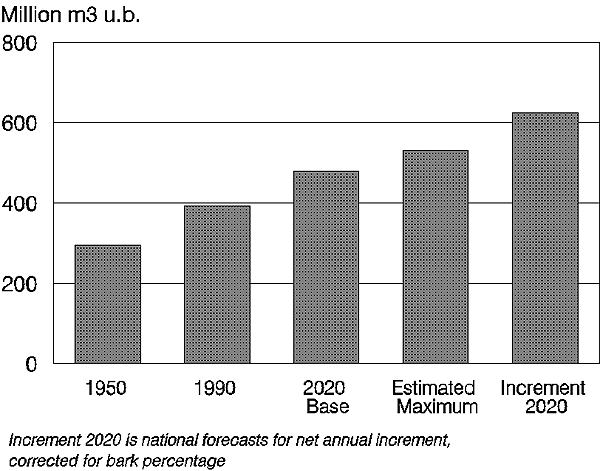
European removals and increment
(iv) Potential for increasing European wood supply
Can anything be said about the potential to increase European removals beyond the level of the base scenario (which is in any case expected to rise by nearly 190 million m3 over the 30 years)? Using annual increment in exploitable forests as a rough proxy for potential fellings, it appears that the maximum biological potential for removals in European forests in 2020 may be estimated at about 625 million m3 u.b.7, compared to the forecast level of 480 million m3 u.b. and the present level of 390 million m3 u.b.. In 1990, removals were about 175 million m3 below their maximum biological potential. By 2020, according to the forecasts, maximum potential removals would be 145 million m3 u.b. higher than the forecast: of this difference, about 75 million m3 would be in the Nordic countries and 35 million m3 in the EU (12).
In fact, most of the difference between the forecast level of removals and the level of net annual increment (corrected for bark) in 2020 is in only six countries - Austria, Finland, Germany, Romania, Spain and Sweden - which account between themselves for about 95 million m3 u.b., of which 40 million m3 u.b. would come from Finland and 20 million m3 u.b. from Sweden. These figures, of course, cover only possible extra cut from the exploitable forest (as forecast on existing assumptions), and take no account of any extra supply potential from improved silviculture or expanded forest area.8 They would also be in addition to the removals increases already included in the forecasts.
The existence of a physical potential to expand removals by nearly 150 million m3 per year over the forecast level must not be taken as an indication that this can or will happen. In order for removals to be above the level forecast, a number of conditions would have to be met, all of which apply both to private and public forest owners, including all of the following:
- the existence of effective demand for wood raw material, which is of course influenced by price;
- the "extra" raw material from European forests would have to be competitive on price, quality and security of supply with other sources of fibre, including residues, waste paper and imports from other regions (either raw material or products);
- the European forest owners would have to be technically able and willing to raise their harvests. This would imply that wood supply would have to be a major management objective for them, and that they could at least cover their costs (and preferably make a profit) with the income from wood sales.
It is worth noting, however, that of the six countries with the potential for significantly increased removals over the forecast level, three (Austria, Finland and Sweden) are the three major export-oriented forest countries in Europe; each would have the organisation, skills and capital reserves to carry out such an expansion, should market conditions call for it.9 The difference between forecast removals and the estimated maximum level in 2020 in these three countries taken together is 70 million m3 u.b., although it is certainly impossible that every single cubic metre of increment could be harvested, regardless of these countries’ resources. One may therefore estimate very roughly that in the right market conditions European removals could be expanded to 530 million m3 (i.e. the forecast level of 480 million m3 plus 50 million m3, from Austria, Finland and Sweden).
This important topic will be addressed in chapters 11 and 12, as it concerns the interaction between the different parts of the forest and forest products sector, and it can be seriously misleading to treat these questions from only one point of view.
The scenarios prepared by national correspondents show that for the period 1990 to 2020, European exploitable forest will expand slowly due to afforestation and natural extension, counterbalanced in part by withdrawals of forest land for other uses, including nature conservation. The level of removals necessary to satisfy the demand projected in the base scenarios is a steady but slow increase to a level of 480 million m3 u.b. in 2020. This is still well below the physical potential of the European forest, as estimated by the net annual increment. The fellings forecast for 2020 would be 77 per cent of increment, compared to 70 per cent in 1990. As a result, growing stock is expected to increase in absolute terms and per hectare, especially in a few central European countries.
There are a few exceptions to the general picture of sustainable growth. In a few countries, notably in south-east Europe, the forest resource is under threat from overgrazing, fuelwood demand and war, and fellings are above increment. During the time span of ETTS V, the fellings in the Baltic countries may also expand to exceed increment, although the latter may well have been estimated over prudently.
These scenarios are an aggregation of national forecasts, with some secretariat estimates. The assumptions on which they are based are outlined in section 4.3.ii above. In general, no major discontinuities are expected in forest policy, other policies or other circumstances which may influence the forest sector. They are based on a broad assumption of unchanged roundwood prices.
The scenarios for the resource presented in this chapter are consistent with the scenarios for demand to be presented in subsequent chapters. The outlook for the supply/demand balance (chapter 11) confirms the plausibility of the initial hypothesis of unchanged roundwood prices.
If there were a "wood shortage", due, for instance, to supply restrictions in other parts of the world, the scenarios indicate that European removals could be expanded, perhaps to 530 million m3, without depleting the forest resource. This is 140 million m3 more than the 1990 level of removals and 50 million m3 more than the forecast level for 2020. Such an increase beyond the national forecasts used in the base scenario would almost certainly be impossible without a significant rise in roundwood prices.
1
For a few countries, the data provided by national authorities and quoted in the working paper do not coincide exactly with those in this chapter, which have been adjusted in accordance with the methods described in chapter 11 to ensure complete internal consistency for ETTS V.2
The statistics in this section are taken from the base figures for the forecasts to be presented later. Therefore, they do not coincide exactly with the official data in the Forest Resource Assessment 1990, but are presented in the interests of consistency within ETTS V. In any case, the differences are minor.3
Estimates of area change are not available for the main part of the former USSR. Estimates, for the former USSR in regional and world totals include only Belarus and Ukraine.4
Until quite recently, state forest services in many countries were significant net contributors to the public budget: now this is becoming much rarer, as demands on the forest intensify and costs rise, while income from wood sales stagnates.5
Correspondents were also asked to provide an alternative scenario, using the assumption that roundwood prices would rise in real terms, but most were unable to do so or stated that the price level did not influence the level of removals. This alternative scenario was therefore abandoned.6
It is crude in particular because it does not take into account age class structure.7
That is, net annual increment of 690 million m3 o.b., corrected for 10 per cent bark.8
These would, however, only increase wood supply in the longer-term future.9
An indication of the present situation regarding relative costs and the commercial strength of these countries' forest industries is that all three at present harvest less than the maximum potential of their domestic forest resource and import wood raw material from elsewhere.
