


Chapter 7 RESIDUES, RECYCLING AND RE-USE
Since the publication of The Limits to Growth in 1972, society, including both decision makers and the general public, has become increasingly aware of the necessity of using all natural resources wisely and sparingly, by avoiding or reducing waste of all sorts in every part of the economy, and by preferring, whenever possible, renewable to non-renewable sources of energy and raw material. Wood has many advantages in this respect, given that forests are a renewable resource; wood processing residues can be used as raw material for other products; and forest products can often be recycled or re-used.
Furthermore, those residues or used products which cannot be recycled or re-used can almost always be burned as a source of energy.1 This, taken together with the fact that some products have an extremely long useful life2, means that forest products may be considered the archetype of a renewable, low waste (or no waste) raw material.
The objective of this chapter is to describe briefly, in quantitative terms the broad trends in the past for recycling, the recovery and use of wood residues and secondary fibre (waste paper), and the outlook for the future.
Unfortunately, the quality of information on the volumes and prices of residues and recycled material is in many cases rather weak, although it is improving. For this reason, the figures in this chapter should be considered orders of magnitude, rather than precise measurements.
The largest volume (and the best quality) of wood residues is generated in sawmilling from the edges and offcuts which inevitably arise during the sawing process. However, there are many other types of residues, including sawdust, peeler cores from veneer and plywood manufacture, shavings and the waste of re-sawing, moulding, furniture manufacture, etc., each of which has its own technical and economic characteristics. The presence of bark is harmful in many processes, and some residues are contaminated with glues, paints, etc., which often make them unusable as raw material for certain processes. However, there is a wide difference between processes as regards quality standards for raw materials, and what is unacceptable for one type of manufacturing process is acceptable, even desirable, for another.
Although at first, nearly a century ago, virgin fibre was preferred as raw material, user industries rapidly became aware of the advantages of using wood residues as raw material, which are: price, the possibility for cost saving in integrated operations, and the fact that the residues must be disposed of anyway.
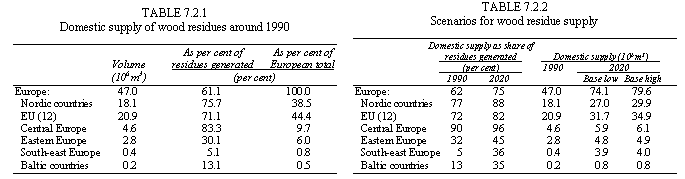
Progress in the technology of sorting, cleaning and treating residues has considerably widened the range of potential uses for such. As a result, the share of clean solid wood residues which has gone to the pulp or panel industries has steadily risen. In the early 1990s, about 47 million m3 of wood residues were used as raw material for pulp, particle board and fibreboard, rather more than the 43 million m3 used around 1980. In 1990, the volume of wood residues supplied and used was 12 per cent of the volume of removals (but 22 per cent of removals of small wood) and equivalent to nearly 70 per cent of the imports from other regions. By any standard, wood residues are an important part of Europe's wood supply.
FIGURE 7.2.1
Share of residues generated supplied as raw material
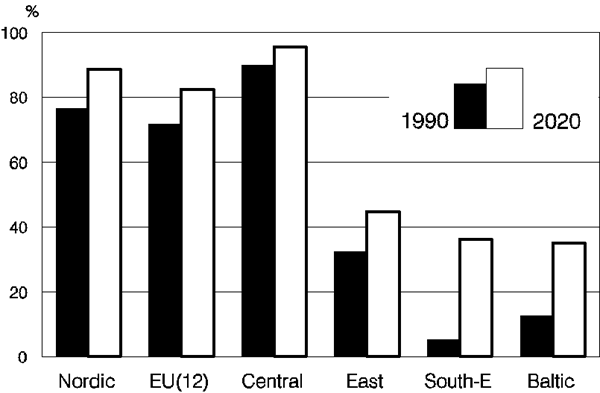
FIGURE 7.2.2
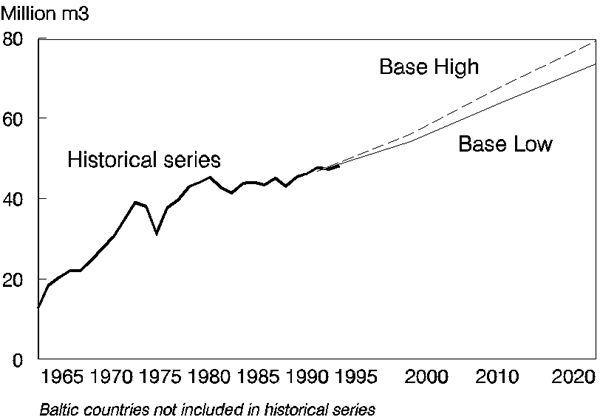
Europe: domestic supply of residues
There are significant regional differences in the pattern of wood residue supply: over 90 per cent of the wood residues in Europe are supplied and used in the enlarged EU. In the Nordic countries, the EU (12) and central Europe, over 70 per cent of the residues generated are used as raw material for pulp and panels. This is made possible by the existence in these countries of an advanced forest industry (supplier and consumer of residues), efficient market mechanisms to bring together sellers and buyers, as well as a good transport and communication infrastructure. The destination of those residues which are not used as raw material is not known: some are used for energy (see chapter 9, which estimates that 24 million m3 of primary processing residues are used for energy at present). There are also a certain number of specialised uses for wood and bark residues, notably in the horticultural field. The rest are disposed of by landfill or by other means.
What is the outlook for wood residue supply and use for raw material? It is likely that the waste or dumping of wood residues will become increasingly unacceptable and/or expensive in all countries, and that consuming industries will continue to seek this raw material source and to set up ever more efficient circuits to collect it. The potential maximum supply is limited by the level of production of sawnwood, plywood and other forest products (projected according to the methods presented in chapter 6). Domestic supply of residues for raw material has been estimated on the assumption that the percentage of residues generated which is used for raw material will rise, slowly in those countries where it is high at present, and faster elsewhere.
The percentage of residues which is used as raw material is expected to rise from 61 per cent in 1990 to about 75 per cent in 2020. The volume of domestic supply would then rise, from 47 million m3 in 1990 to 77 million m3 (Base Low scenario) or to 81 million m3 (Base High) in 2020, an average annual increase of about 1.7 per cent over the 30-year period. In the Base Low scenario, for 2020, domestic supply of residues is 16 per cent of removals (30 per cent of removals of smallwood) and 97 per cent of the wood equivalent of imports. In other words, the relative importance of residues in the raw material supply pattern of the European forest industries is expected to increase.
According to the scenarios, at present about 30 million m3 of the residues generated by the forest industries in Europe are not used as raw material for pulp or panels: of these, 25 million m3 are used for energy. In 2020, the sum of the volumes which are expected to be used as raw material and as energy (from chapter 9) is roughly equivalent to the estimate of residues generated. It may be deduced from this, despite the approximate nature of the figures, that there is no significant potential to find previously untapped sources of primary processing residues as they are all used already, either for raw material or for energy. If more residues are to be used for raw material than in the scenarios, this will reduce he availability of residues for energy, and vice versa.
The above discussion has concentrated on residues of primary processing, essentially sawmilling and plywood manufacture. Are there present or potential significant sources of residues other than these industries?
Harvesting residues (tops, branches, even stumps), were the subject of research in the mid 1970s, when there was concern about raw material supplies, especially in the Nordic countries. They present major problems of sorting (presence of bark) and cost, not to mention the long-term damage to certain types of forest sites which could result from the excessive removal of nutrients (which are concentrated in these parts of the tree). It is hard to imagine a significant increase in the use of harvesting residues when only 70 per cent of Europe's net annual increment is harvested, and there is apparently structural over-supply on pulpwood markets;
Secondary processing of forest products, including resawing, moulding, manufacture of prefabricated elements and houses, furniture, etc., also generates large volumes of residues, although they are often contaminated and/or arise in rather small units, thereby increasing collection costs. They are also often used to supply the energy needs of the generating enterprise. However, when these problems are overcome, secondary processing residues can be an attractive source of raw material.4 Nevertheless, the volumes involved are probably not large enough to make a major difference in the supply/demand balance at the regional or even country level.
7.3 Waste paper (secondary fibre)
FIGURE 7.3.1
Europe: recovery rates for waste paper
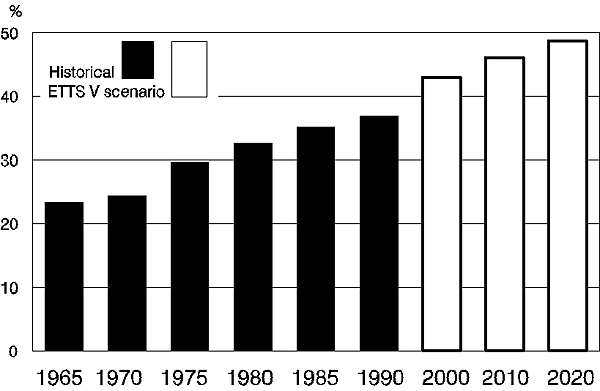
"Waste" paper, whether pre-consumer or post-consumer, has been a significant part of the raw material mix of the paper industry for many decades. It started to expand strongly, in absolute and relative terms, from about the mid-1970s, stimulated by the growing perception that there are indeed limits to growth and that waste, whether of energy or of raw material, must be avoided. This motivation was considerably strengthened by other circumstances of the time: higher prices for virgin fibre and fears of a coming wood shortage, as well as problems with landfill. These in turn stimulated technical development, notably in de-inking, and changes in consumer requirements and tastes. Both recovery rates and utilisation rates have risen strongly since that time.5
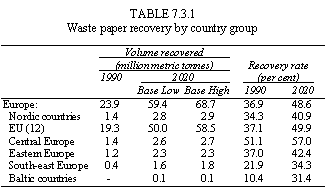
Around 1990, about 37 per cent of European consumption of paper and paperboard was recovered for reuse (i.e. not counting waste paper used as a source of energy), a large increase from the 28 per cent recovery rate of the 1970s, and the 32 per cent rate around 1980. Over a third of the fibre input to paper and paperboard production was waste paper. However, there are enormous differences between countries and regions in the pattern of waste paper recovery and use: recovery is high in the EU (especially the northern and western parts of the EU), the Nordic counties and central Europe, while to the east and south, recovery rates are much lower. A part of this difference may be due to statistical problems, but most of it is apparently real.
To have a strong waste paper sector, several conditions must be satisfied: a fairly urban, concentrated population, because of waste paper's low value-to-weight ratio (which makes waste paper recovery from scattered rural communities prohibitively expensive); a good infrastructure of organisation to arrange collection; a certain minimum "ecological" awareness, as the process ultimately depends on the good will of unpaid private citizens to separate and collect their used paper; and, a paper manufacturing sector which is able and willing to invest in de-inking and other waste paper processing facilities.
Naturally, the utilisation rate is strongly influenced by the structure of the industry, notably the size of the virgin pulp manufacturing sector. Even with very high recovery rates, industries which produce large volumes of virgin pulp but have relatively small markets (e.g. the Nordic countries) are certain to have low utilisation rates.
Over the last 5-10 years, municipal and national authorities have put in place policies to encourage waste paper recovery, including economic incentives of all types for collection and use, as well as other measures including minimum recycled content legislation. Public perceptions, encouraged by environmental NGOs, have strongly supported these developments in many countries. For these reasons, waste paper recovery has tended to be, in many areas, supply-driven, developing without close coordination with the needs of the market. As a result, the early 1990s saw a period of very low, and at times negative, waste paper prices as supply overwhelmed demand. This carried negative consequences not only for waste paper collectors and merchants, but also for pulp sellers and thereby for forest owners (this phenomenon coincided with and was partly caused by a period of cyclical downturn in the pulp markets).
Despite the low value-to-weight ratio, international trade in waste paper is quite significant. Countries which have high recovery rates, but not a corresponding industry to consume the material generated, may develop a structural surplus, which is relieved by exports. This has been the case of the USA, and in recent years, Germany (although both intend to build up their waste paper using industry). On the importing side, some wood-poor countries have based an industry or part of an industry on imported waste paper, which in the recent past has often been cheap to buy and process, and of very good technical quality as it is mostly long fibre material, with good strength qualities. However, as recycling becomes more widespread and intense, this situation is bound to change, as the fibres lose strength with each successive recycling. In addition, some exporting countries which are rich in virgin fibre but poor in waste paper, may import waste paper to satisfy regulations about minimum content of recycled fibre in their major markets. In some cases, this is facilitated by the possibility to use returning ships or trucks, thus reducing transport costs. In the early 1990s, by far the largest waste paper exporter was the USA, mostly to Asia, but also to Europe. European waste paper imports around 1990 were over 5 million m.t., but the net trade position was roughly neutral. The major importers in Europe are Italy and Spain, and the major exporter is Germany. The markets are subject to particularly violent cyclical fluctuations influenced by the interaction of pulp market cycles and the general supply side rigidities for waste paper
FIGURE 7.3.2
Waste paper recovery rates by country group
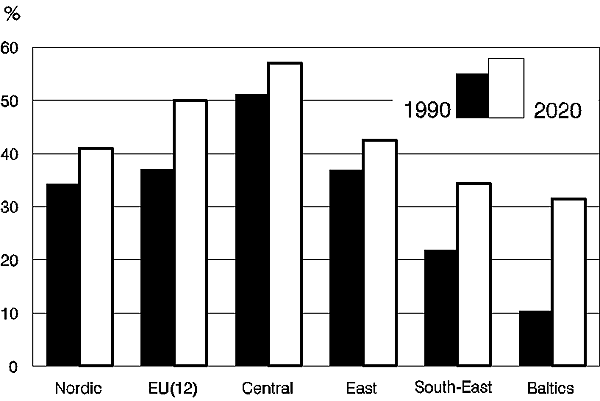
What is the outlook for waste paper recovery and use? In the secretariat's view, recovery rates will continue to rise steadily, until they reach a technical maximum, determined by the share of paper consumption which is either permanently stored (e.g. some books) or unrecoverable (e.g. sanitary papers). Growth in recovery rates will be quite fast in those countries where it is low at present, and the "leading" countries will continue to develop their systems, but at a slower rate. The reasons for this conclusion are as follows:
- demand for paper and paperboard is expected to grow, as presented in chapter 6, providing both a source of waste paper (which must be disposed of in any case), and an outlet for it;
- practical, political and economic pressures will all combine to continue to encourage municipal authorities to prefer recycling of paper (and other materials) to other means of disposal, notably landfill and incineration. This conviction will spread from the central-northern countries, where it is now well established, to the rest of Europe, which, in turn, will be able to profit from the experience of the former region;
FIGURE 7.3.3
Europe: volume of waste paper recovered
- because of the supply driven nature of waste paper markets and the fact that by definition the sources of waste paper are near to markets, waste paper will retain its price advantage over virgin fibre;
- manufacturers will actively seek to increase the waste paper content of their products, not only for cost reasons, but also for environmental reasons, and to improve their public image;
- consumers will prefer products with a waste paper content, even where the visual aspect is important.
The main obstacles to increasing the use of waste paper will be technical, such as use requirements (e.g. strength for very fast printing machines) and ability to clean mixed waste.
Some important questions are "How far can the process go?", or "What is the limit to waste paper recovery rates?" It is, of course, not possible to give a definitive answer to such complex questions for a period 25 years into the future. The secretariat has assumed that 60 per cent is a practical maximum at the country level.
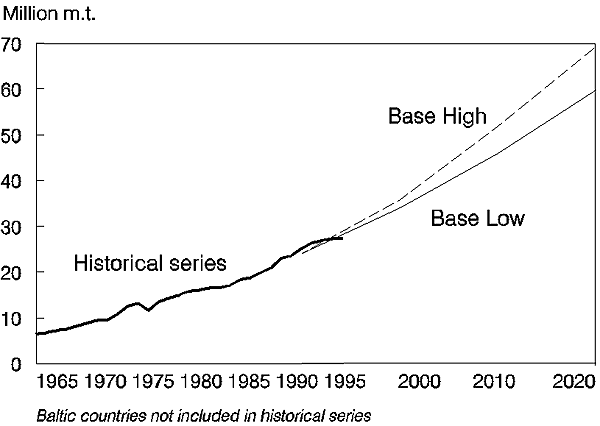
The combined effect of higher consumption of paper and paperboard and of higher recovery rates results in strong growth in the volume recovered, which is expected to double (for Europe as a whole) in the Base Low scenario and triple in the Base High scenario. This gives annual growth rates of over 3 per cent in both scenarios, by far the fastest growth of any parameter in the model. The EU (12) remains by far the largest source of waste paper supply, accounting for about 85 per cent of European supply.
1
See chapter 9.2
Wooden churches (stavkirke), built in the eleventh century are still in service in Norway, although this is an exceptional length of service.3
The traditional term "residues" is used because of its familiarity, although the same material is also referred to as "secondary raw material". In ETTS V the term "residues generated" refers to an estimate of the volume of wood raw material arising from the processes of sawing and manufacture of plywood and veneers. "Domestic supply" refers to that volume which is in fact used as raw material for pulp or wood-based panels. Residues which are "generated", but not part of "domestic supply" are burnt, put to other (e.g. horticultural) use, or simply dumped.4
This is true to such an extent that in Germany, more residues are used as raw material than are generated by the primary processing industries. This is because of the large volume supplied by the secondary industries.5
"Recovery rate" is the volume of waste paper recovered for use as raw material as a percentage of consumption of paper and paperboard. "Utilisation rate" is the volume of waste paper consumed as papermaking furnish as a percentage of total paper and paperboard production.
