


It is well known that energy is by far the most important use for wood in developing countries. It is less well known that energy is still, in volume terms, the single most important use for wood in Europe, as over 45 per cent of the volume of wood removed annually is used for energy. Such wood may be in the form of conventional fuelwood, residues of the wood processing industries (including the "black liquors" arising in chemical (sulphate) pulping), and used wood. This chapter presents the current situation and trends since the 1970s, the main factors likely to determine the outlook and two scenarios for wood energy use based on an enquiry to national correspondents.
The quality of statistical information on wood energy is worse than that in the more "industrialised" parts of the sector because of the decentralised, scattered nature of wood energy use and the fact that wood energy is often autoconsumed by forest owners or forest industries, who do not pay for their wood energy and therefore are not obliged to keep records. In view of the importance of this topic, over the past 15 years the secretariat has pressed national correspondents to prepare and submit estimates when hard data were lacking. The analysis in this chapter, as in the corresponding chapter of ETTS IV, would not have been possible without this contribution.
This chapter is based extensively on the work of Mr. G.A. Morin (France) acting as consultant to the secretariat, who has contributed to ECE/FAO work on wood and energy since the 1970s. The secretariat takes this opportunity to thank Mr. Morin for his valuable contribution.
9.2 The context: general energy trends and outlook
As mentioned in section 2.3.ii, the world energy economy in the mid-1990s is marked by slow demand growth in western economies (as energy consumption is not linked to GDP growth), ample supply of fossil fuels and low prices for all types of energy. The steep fall in energy prices in 1985-86 has brought them down to pre-1973 levels in real terms. There is a discussion by governments about taking the politically and economically difficult steps necessary to raise energy prices and thereby encourage the development and use of renewable energies. So far, however, there is little evidence of the political will to take effective decisions. There is, however, concern about the possible consequences of the expected strong growth in energy demand in developing countries, which are often dependent on fossil fuels, which, in turn, are of a polluting nature.
However, in the mid-1990s, despite the low energy prices, interest in renewable energy sources, including wood and other types of biomass, is still strong at the policy level for a number of reasons:
- the realisation that, in the very long term, an economy based on fossil fuels is not sustainable;
- concern about possible climate change due to a build up of CO2 and other greenhouse gases in the atmosphere, of which the largest contributor is the burning of fossil fuels;
- problems of waste disposal (discussed in chapter 7) have also stimulated interest in burning residues and waste of all kinds, including wood and paper, rather than putting them in landfills (although the recycling solution is preferred to the energy generation one);
- the changes in agricultural policy which have led to the setting aside of millions of hectares of former agricultural land have created an opportunity to increase significantly domestic supplies of biomass energy by the establishment of intensive, fast-growing energy plantations on this land. Considerable research has been carried out on the modalities of this, but so far, the extra contribution to national energy supplies has been marginal.
- the transition economies were to a large extent dependent on subsidised imports of energy, (mostly oil and gas) from the former Soviet Union: the economic problems of these countries, severely reducing disposable income and foreign currency reserves, have caused severe energy shortages in many of them: one of the solutions found has been wood energy use. Although the statistical basis for this assertion is not very firm, there is little doubt about the reality of the phenomenon, especially in the poorer rural areas.
The attitude of many governments seems to be that they wish to be prepared technically to introduce higher general energy prices and to implement programmes for the large-scale introduction of renewable energy sources, if this were to prove necessary.
Chapter 2 proposed a base policy scenario for the energy sector as follows: "Continued ample energy supply will continue to inhibit policy changes in the energy sector. There will be no major disruptions to supply and new energy taxes will not raise prices substantially". It also stressed the uncertainty in this sector: "another Chernobyl, or a political upheaval in a producing area which caused a more than temporary disruption of supplies could lead to radical policy changes in a rather short time".
9.3 Wood energy supply and use around 1990
An enquiry was carried out, requesting national corespondents to estimate the pattern of wood energy supply and use around 1990, as a base point for the scenarios to 2020. The same format and definitions were used for earlier enquiries carried out at five-year intervals to monitor medium-term developments in this respect.1 For several countries it was necessary to make estimates, at least for the fuelwood part of the enquiry, which is essential to construct the overall wood balance.
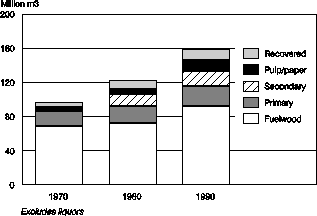
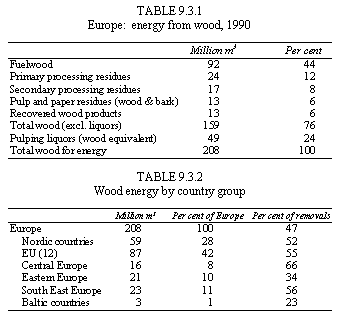
In 1990, according to the national and secretariat estimates, about 208 million m3 of wood were used as a source of energy, of which 159 million m3 were in the form of wood and 49 million m3 the wood equivalent of pulping liquors. This amounts to about 47 per cent of the volume of European removals2, making energy generation by far the largest end-use for wood in volume terms. This impressive figure is due to the fact that unlike the major raw material uses of wood (sawnwood, panels, etc.), energy generation can arise at every stage of processing, and after final use.
FIGURE 9.3.2
Europe: wood for energy by type of wood energy, 1990
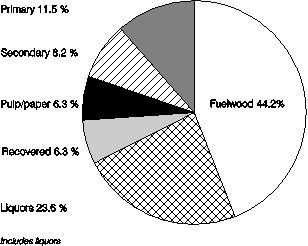
The main sources of wood energy are as follows:
FIGURE 9.3.3
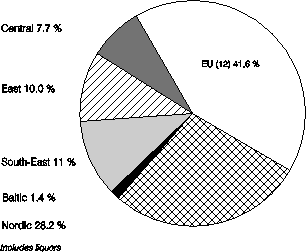
Europe: wood for energy by country group, 1990
- fuelwood (defined in ETTS V and other ECE/FAO work as wood from the forest used for energy). This may come from inventoried sources (stemwood in forest formations), or from non-inventoried sources, such as tops and branches, trees outside the forest, etc. It may be harvested commercially and marketed, enter "informal" circuits or be consumed by the forest owner himself;
- industry residues of all sorts including solid wood chips and offcuts, bark, sawdust, etc., whether clean or contaminated by paint and lacquer. Very often they are used to supply the energy needs of the producing plant, but are also sold or given to other consumers, such as the labour force of the mill. In this context, "primary" processing is sawmilling and panels, while "secondary" industry is joinery, furniture, wooden elements, etc. The wood and bark residues of the pulp and paper industry are shown separately.
- recovered wood is wood which is used for energy after it has carried out its initial function, which includes short-lived products, especially pallets and other packaging, as well as demolition waste;
- the so-called "black liquors," which are the lignin naturally occurring in wood, are dissolved out with the hemi-cellulose during sulphate pulping, and burnt in recovery boilers to provide process heat and to recover chemicals.
The main users of wood energy are: households (especially rural), mostly for heating; the forest industries, for their own energy needs; other industries; "intermediate users", such as district heating plants, communal buildings, etc.; manufacturers of pellets and briquettes; manufacturers of charcoal. In addition, there are some users which are of potential, rather than actual significance in most countries, such as electricity generation for the public grid, and the manufacture of synthetic liquid and gaseous fuels.
The data above show that the "traditional" type of wood energy source pattern, characterised essentially by local fuelwood use and rural autoconsumption is steadily being replaced by a pattern centred on the industrial use of wood energy: in the Nordic countries, fuelwood (in the restricted sense used in ETTS V) accounts for just over 20 per cent of wood energy and pulping liquors for 47 per cent, while in southeast Europe, fuelwood accounts for over 80 per cent of total wood energy. The importance of the chemical pulp industry in the Nordic countries is exceptional, but in the EU (12), fuelwood accounts for less than half of total wood energy, and processing residues (primary, secondary and pulp and paper, but not liquors) for over a quarter. In the EU (12), the generation of energy from recovered wood, previously an "invisible" form of wood energy, accounted for 10 per cent, even though only a few EU countries (Denmark, France and Germany) attempted to estimate it.
The partial data available for the pattern of consumption (for the ten countries listed in the note to table 9.3.3) indicate that households are still, by far, the main consumers of wood energy, accounting for about 65 per cent of wood energy consumption (excluding liquors). The forest industries are also major consumers, accounting for about 27 per cent. Recorded household wood energy consumption is particularly high in France, at least in part because of the high awareness at the policy level in that country of the multiple ways in which wood energy may be used in rural areas: it may be that other countries with a significant forest resource (and wood outside the forest) and a large rural population, also use rather large volumes of wood, much of which comes from non-inventoried sources, for energy in rural households. Finland, however, which is also a large, rural country with a major forest resource and a good statistical base, has a very different pattern of wood energy consumption: households only account for 39 per cent of wood energy consumption, and the forest industries for nearly 60 per cent.
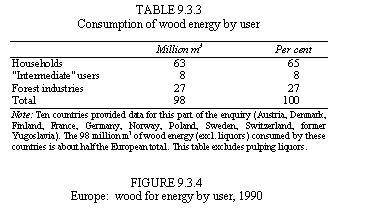
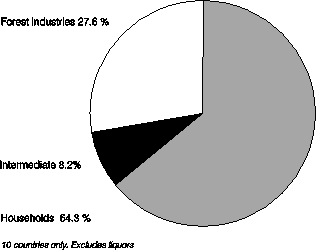
The third significant consumer of wood energy is what is known as the "intermediate" consumers, including especially district heating plants and communal buildings: In 1990, this sector accounted for 8 per cent of wood energy consumption in the ten responding countries, although this proportion was 21 per cent in Sweden and 34 per cent in Denmark. To run this type of unit on wood energy implies that several conditions are met:
- either there is an efficient market in wood for energy or the consumer has direct access to quite large wood resources (for instance a communally owned forest);
- the ready availability of the technical knowledge to install and run large wood burning boilers;
- either a tradition of this type of heating installation (which is radically different from traditional wood energy use due to the technology used and the scale of operations), or a culture which encourages, or at least permits individuals to test new solutions to providing energy at a reasonable cost to clients: in many countries, it requires much vision and initiative to favour an "unorthodox" solution like wood-fired district heating when conventional solutions based on oil or gas are easily available.
In general, the developments recorded since 1980 are in accordance with ETTS IV forecasts of steady but unspectacular growth, despite low energy prices.
9.4 The outlook for wood energy
The above brief overview has demonstrated both that wood energy is so important that it cannot be ignored and that the situation is complex and little understood. How, then, might one construct a quantified outlook for the long-term future? As was the case with ETTS IV, the only realistic solution was to carry out an enquiry with national correspondents, using the sum of their informed judgements to build a picture of the outlook for wood energy. Their detailed estimates will be presented in the secretariat working paper on scenarios and are summarised and commented on below.
In building an outlook, it is first necessary to list those factors which will determine the level of wood energy consumption in the future:
- the price and availability of other types of energy will, of course determine whether wood energy becomes more or less attractive economically;
FIGURE 9.4.1
Europe: growth in wood energy, 1990-2020
- the presence or absence of governmental support for wood energy (or measures to make competing fuels less attractive);
- the price of pulpwood, and, generally speaking the strength of demand from other sectors, which might compete with the energy sector for small-sized wood;
- policy on the setting aside of agricultural land, and in particular, whether the large-scale production of energy wood is given a major place in this policy field;
- regulations concerning boiler emissions, e.g. of volatile hydrocarbons (VOC) responsible for the "blue haze" sometimes due to wood burning: if very low levels of emissions are made mandatory, then many existing wood burning installations would have to be closed or replaced with more modern, larger scale technology;
- if the pattern and magnitude of wood energy supply were to remain similar to that of the 1990s, no completely new technologies or advanced research would be necessary: however, if there is to be a significant increase in the manufacture of synthetic fuels or in the establishment of energy plantations, then the existing research programmes would need to be expanded and accelerated.
Differing opinions are possible on all of the above, but the data and methodology available at present to ETTS V do not allow the "what if?" scenarios which would be necessary to answer specific policy questions. The scenarios below are the aggregated view of correspondents, who have each made assumptions (implicit or explicit, usually the former) on each of the above questions. It should also be borne in mind that estimation was necessary for some countries, although all the larger forest countries supplied some data, and that coverage is much better for fuelwood than for the other types of wood energy.
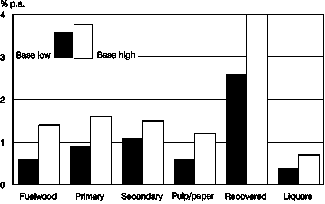
Correspondents expect wood energy supply and use3 to grow at around 1 per cent a year from 1990 to 2020, which is about the same speed as sawnwood consumption, but slower than that of panels or paper. This represents a volume increase over the 30 year period of 60-120 million m3, or 50-105 million m3 if only wood and bark are considered. A large part of this will come from reducing waste at all stages of both processing and the use of products with a significant wood element: the increase in "fuelwood" consumption (which represents the direct demand on the forest resource) is expected to be 18-46 million m3.
Above-average growth rates are expected for energy generation from recovered wood products, probably because awareness of the importance of this source is quite recent and there is significant potential for expansion. The use of energy from pulping liquors was expected by the correspondents (who did not have access to the ETTS V forecasts for pulp production) to grow rather slower than other types of wood energy.
FIGURE 9.4.2
Europe: scenarios for wood energy supply
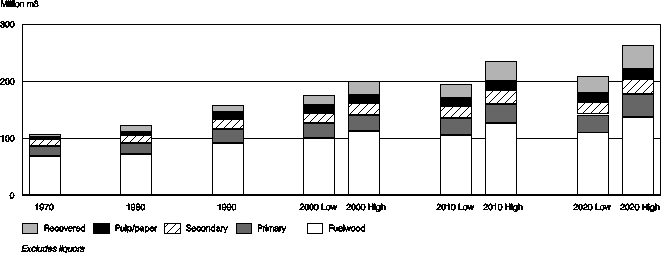
By country group, the fastest growth in wood energy consumption is expected by the correspondents from the EU (12), particularly in the field of processing residues and recovered wood products. This region is very sensitive to environmental issues and opportunities and has major industries and markets which give it the potential to put large volumes of wood to good use as a source of energy. Eastern Europe, on the other hand, expects practically no growth in wood energy supply and use, which appears surprising given the energy shortages in a number of these counties (due to the reduction in energy imports from the former Soviet Union), and the size of the forest resource and forest industry. One reason may be a concern lest energy wood demand threaten the raw material supply of the pulp and panels industries.
In 1990, wood's contribution to the total energy supply was estimated at around 3.3 per cent for Europe as a whole: less in heavily populated rich countries like Germany, and considerably more in those few countries with major forest industries, including Austria (13 per cent), Sweden (17 per cent) and Finland (19 per cent). Under the low scenario, this share is expected to decline slightly by 2000, while under the high scenario to increase marginally. No official scenarios by country are available for total energy consumption beyond 2020 and the estimates are only partial for that year.
9.5 Discussion of the scenarios
It appears from the scenarios that correspondents share the view expressed in chapter 2 that there will be no upheavals in the energy sector, no major energy price rises over the long term, and no heavy government support of renewable energy sources including wood, because of the economic and social costs of raising energy prices.
In short, they expect consumption of wood energy to develop in a similar fashion to consumption of other types of forest products, that is, in a steady, organic way. These demand scenarios appear perfectly reasonable in light of the conditions on energy markets in the mid 1990s and the policy assumptions in chapter 2. Furthermore, they appear plausible from the supply point of view:
- the scenarios for consumption of residues for energy expand at roughly the same speed as those for the production of products;
- the fastest expansion is forecast for a sector (recovered wood products), which has been little exploited up to now (except in the context of disposal of mixed waste), and where there is considerable, and so far unused, potential for wood energy supply;
- the increase in supply of fuelwood is possible on a sustainable basis within the overall roundwood supply scenarios described in chapter 4, as demonstrated by the consistency analysis to be presented in chapter 12.
However, in the energy sector, there is the possibility, as pointed out in chapter 2, of a radically different scenario, marked by higher energy prices and strong government stimulus to renewable energies, including wood, leading to considerably higher consumption of energy wood. What might be the consequences of such an alternative scenario for the use of wood as energy?
It is clear that in a high energy price scenario, practically no wastage of wood would be tolerated: larger amount s of residues, primary and secondary, would be used for energy, and there would be a very fast expansion in burning of recovered wood products. Wood burning district heating units and other intermediate scale installations would be widely installed.
This expansion in energy use of wood would, of course, affect other parts of the sector, in particular through the competition for wood between energy and raw material uses, at the pulpwood/fuelwood quality "borderline". In effect, the energy value of wood would put a floor under its price as raw material, probably raising costs of wood-processing and wood-using industries. This development would be in a context of lower growth of the economy as a whole, due to the higher energy price, and higher prices for more energy intensive materials, which include many competitors for forest products.
However, the scope for the type of incremental changes described above is also limited, and the contribution of wood to the general energy balance would certainly remain well below 5 per cent at the European level, unless even more radical changes were introduced. If, for whatever reason (for instance oil supply problems, abandonment of nuclear power, concern about global climate change), wood were called upon to increase its contribution to European energy supply to 10 per cent or more, there would necessarily be enormous changes in the structure of the sector.
In the first place, many millions of hectares of energy plantations would be necessary, managed for maximum biomass yield in the short term, possibly with less priority given to other management objectives, including conservation of biodiversity. In addition, wood would have to become an energy source for users other than rural households and the forest industries, which itself would have major consequences:
- the setting up of large-scale marketing circuits for wood energy;
- the large-scale conversion of wood into more user-friendly and transportable forms of energy, including pellets and briquettes, electricity, methanol and/or ethanol;
- the creation of a major wood energy sector, changing the balance of the forest and forest products sector as a whole. This would involve new installations, new companies (or the expansion of existing ones, especially pulp companies) and heavy investment in silviculture, research, plant, transport infrastructure, etc.
- the strong market for energy wood would certainly transform the economics of silviculture, encouraging thinnings and short rotations, and bringing back intensive forest management to areas which had been managed extensively, if at all, in the past.
The possibilities for conflict, in such a scenario, between the new wood energy sector and other interests, including landscape and biodiversity conservation organisations and the traditional forest industries, are obvious.
1
Earlier surveys were carried out around 1980 (Supplement 15 to volume XXXIV of the Timber Bulletin for Europe), 1985 (ETTS IV, chapters 18 and 19) and 1990 (Survey of medium-term trends for wood raw material, notably pulpwood and wood for energy, Timber Bulletin, volume XLII, No. 2).2
This percentage is an over-estimate, as unrecorded fuelwood removals are included in the wood energy figure, but not in the figure for removals. Nevertheless, the order of magnitude is not greatly different.3
International trade in wood energy is assumed to be negligible, now and in the future, notably because of its very unfavourable volume-to-value ratio, compared to other fuels.
