


Chapter 10 THE OUTLOOK FOR THE TRANSITION ECONOMIES
Probably the single most important change in Europe since ETTS IV, from a social, political and economic point of view, was the collapse of the socio-economic and political systems of the former centrally planned economies and the start of the transition to a market economy in central and eastern Europe. Naturally, the forest and forest products sector has not been exempt from profound structural change, notably in markets, policies, institutions and legal framework. These changes, inside and outside the sector of interest to ETTS V, are not yet complete and have taken very different forms in countries where the conformism of the earlier system always concealed greater divergences than were apparent to western observers.
This chapter briefly presents the main characteristics of the forest and forest products sector in the transition economies, and of the transition process itself, before presenting the main issues and areas of uncertainty, and quantified (if highly uncertain), scenarios for the outlook to 2020.
The chapter is based on an enquiry carried out with the national ETTS V correspondents, whose results were analysed by Mr. J. Eronen of Finland acting as consultant to the secretariat. The results of the enquiry are published in an ETTS V working paper by Mr. Eronen (ECE/TIM/DP/8). The secretariat takes this opportunity to express its appreciation of the major contribution by Mr. Eronen and by the correspondents who were asked to make estimates on difficult topics with very great uncertainty, and performed this necessary function with great judgement and responsibility.
10.2 The forest and forest products sector in the transition economies
The exploitable forests of the 15 European transition economies cover nearly 38 million hectares, stretching from the Baltic over the plains and mountains of central Europe and the Balkan peninsula, to the Adriatic and Black seas. In ETTS V, they are divided into three country groups: eastern Europe, transition economies of south-east Europe (i.e. excluding Turkey, Cyprus, Israel and Malta) and the Baltic States (which were not included in ETTS IV as at the time they formed part of the USSR). They are very diverse, ecologically, socially and economically, as appears clearly from table 10.2.1.
FIGURE 10.2.1
Countries in transition as a percentage of European total
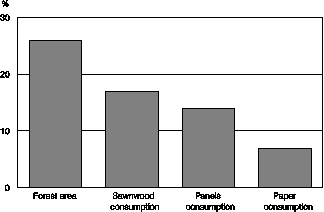
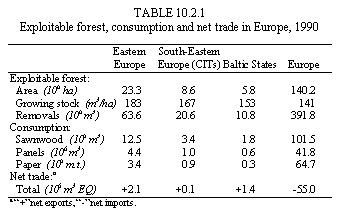
Together, the transition economies account for just over a quarter (26 per cent) of Europe's exploitable forest area. Some transition economies, notably Croatia, Estonia, Latvia, Slovakia, and Slovenia may be counted as forest rich, as they have forest cover over 40 per cent, well above the European average, and one, Hungary, is well below average (18 per cent). Poland, Romania, Slovakia and Slovenia, and above all the Czech Republic, have high levels of growing stock per hectare due to the conservative central European management style which has been applied in these areas for a very long period. Albania, on the other hand has a forest threatened by fuelwood gathering and over-grazing, and which has very low growing stock per hectare.
Although the transition economies account for a quarter of Europe's forest area, they account for 17 per cent of its sawnwood consumption, 14 per cent of panels consumption and only 7 per cent of paper consumption. This discrepancy is due to the much lower average standard of living in these countries, whose economies have been shaped by many decades of supply constraints and small disposable incomes. Furthermore, the data in table 10.2.1 apply to 1990, but in subsequent years, the economies of the transition economies have registered dramatic reductions, of 40 per cent or more, severely depressing the consumption of forest products.
Many transition economies are roughly self sufficient in forest products or used to import forest products or roundwood, mainly from the former Soviet Union, but a few are present or potential exporters to European markets. Since 1990, Romania and the successor states of the former Yugoslavia have more or less withdrawn from the export markets, but others, namely Estonia and Latvia, have strongly expanded their exports. Poland, the Czech Republic and Slovakia remain exporters. As a group, the transition economies are net exporters, of about 3.6 million m3 EQ, compared to total European net imports of 55 million m3 EQ.
In fact, almost the only common feature of this group of countries is the fact that they were all under a centrally planned system and are now moving towards a more market-oriented system. For the forest and forest products sector, the centrally planned system usually involved complete public ownership and management of forest land (Poland is a major exception), centralised decision taking on forest policy, under-capitalised and inefficient forest industries, low levels of consumption (even in forest-rich countries, due to the system induced rigidities and shortages), and "managed trade" through the Council for Mutual Economic Assistance (CMEA) system of international specialisation.
The level of forest management in the former centrally planned economies was generally good from a technical point of view, and characterised by practices which were modern in the biological and environmental fields, but otherwise conservative, economically inefficient and inflexible. Most of the countries had an explicit policy of high quality wood production, even though the costs incurred by the silvicultural practices chosen were sometimes excessive.
(i) General
It is not for ETTS V to analyse the wider social and economic issues arising from the transition process which are the subject of numerous publications.1 However, it is necessary to list briefly the major developments outside the forest and forest products sector which have influenced developments inside the sector. It is unfortunately also necessary to point out that the situation is in constant rapid change, and that the statistical basis is still weak.
Probably the most important factor is the sheer size of the fall in output in the transition economies. After a decade of virtual stagnation (the 1980s), output in the transition economies of eastern Europe fell on average by more than 20 per cent between 1989 and 1993. Recovery began in Poland in 1992, and was followed by other countries, although the first increase in output for the group as a whole, of about 4 per cent, was in 1994. If the 1994 growth rate is maintained, it would take until the end of the century to recover the activity level of 1989.
The process of transforming the economies and societies of the transition economies has proved to be extremely complex and frustrating. On the economic side, in order to reduce distortions and waste and achieve the flexibility and dynamism which go with a market economy, a number of major changes are under way: restitution and compensation for nationalisation of property and land in the 1940s and subsequently; re-establishment of individual rights as economic agents; removal (or substantial reduction) of state ownership and control of enterprises; removal of distortions due to administered prices; opening of economies to foreign competition and investment; convertibility of currencies; building up the institutions of a market economy, such as banking and insurance systems, commercial law, etc. There are very large differences between countries in the speed and manner in which these reforms are undertaken. The transition process has also led to higher unemployment and inflation, both of which have economic and social unsettling effects.
An aggravating factor has been the collapse of the international trading system regulated by the CMEA, which depended to a large extent on barter trade, distorted transfer prices and state direction of trade. In the forest sector and elsewhere, this system led to widespread economic distortion, even to whole industries in areas where they had no proper economic justification. Naturally, the dismantlement of the CMEA system was almost always fatal to these industries.
(ii) The forest and forest products sector
All the above affect the forest and forest products sector in the transition economies. Those issues which are of especial interest to the sector are briefly listed below.
The general drop in output, combined with severe unemployment in many countries, has led to very weak domestic markets for all forest products, as well as to reduced import demand from other transition economies. In particular, effective demand for housing has been weak, despite the strong latent demand due to the generally poor state of the housing stock.
Local firms have also been exposed to competition from western firms and firms in other transition economies. This low demand and increased competition have forced many forest industries and enterprises to close, as they were unable to compete because of the generally obsolete and inefficient industrial base. A few however have been able to thrive in the newly competitive situation, building on competitive strengths of location, quality of resource and low labour costs. Poland, Estonia and Latvia have all developed their exports of forest products during the transition process.
In general, lack of capital to replace or upgrade obsolete and frequently polluting equipment is a major problem in the sector, especially in the more capital intensive branches. Few western companies have been prepared to commit significant capital sums to the east European forest products industry.2
As regards the forest resource, a major issue is ownership: how much forest land should be privatised or restored to former owners and on what terms? Again the approach varies widely: the Czech Republic, Estonia, Hungary, Latvia and Poland have already, or are now in the process of restoring or privatising forest land, while in Albania, Lithuania and Romania, most forest land is likely to remain in public hands. Another question arises in those countries with large numbers of new private forest owners: how should the new owners be helped and regulated to ensure sustainable forest management?
To these questions should be added the problem of forest sector institutions which must be remodelled for the new circumstances and the legal framework which must also be revised (or has been already revised in several countries), as well as the lack of some skills necessary in a market economy, such as marketing, public relations, accounting, collection of statistics from private enterprises, etc.
10.4 The outlook for the forest and forest products sector in the transition economies
(i) Methodology
It is exceptionally difficult to prepare quantified scenarios for the transition economies, for two major reasons: the high degree of uncertainty about key parameters, most notably the general speed of economic recovery; and the impossibility of basing scenarios for the future, especially regarding forest products consumption, production and trade, on observed past trends and relationships. This is because the underlying factors and relationships have all been changed by the transition process itself, so that the assumption underlying most forecasting in this field (that the relationship observed in the past will be maintained in the future) is no longer valid. Furthermore, the differences between transition economies are so great as to make it imprudent to make simplifying generalisations about the group of countries as a whole.
The solution chosen, which is unsatisfactory from the point of view of forecasting theory, but probably the only one available in present circumstances, was to ask national correspondents to prepare outline scenarios for their countries. These were then checked, discussed with the national correspondents, and put into the "consistency analysis" data base. The scenarios presented below, therefore, rest on the expertise and experience of the national ETTS V correspondents. Furthermore, because the scenarios are based on expert judgement and not on a quantified chain of reasoning, it is not possible to ask "What if?" questions.
Nevertheless, the secretariat is convinced that the scenarios proposed in this chapter are both internally consistent and reasonable. Furthermore, as they are both transparent and quantified, it is quite possible to replace them with other scenarios, if opinions differ or events in the 1990s develop along different lines than those proposed. Indeed, it is desirable to monitor the developments for the transition economies in comparison with the scenarios, to modify the outlook if necessary.
Finally, it should be pointed out that for some countries, scenarios are based on work done by other agencies, notably the World Bank (Albania) and that for some of the successor states of the former Yugoslavia, no forecasts were received and the secretariat made prudent assumptions in order to achieve full geographical coverage.
The correspondents were invited to prepare two scenarios, one for slow recovery and one for faster recovery. However, almost all preferred to propose only one scenario, essentially for slow recovery, and did not consider it realistic to prepare a "high" scenario. In this chapter, therefore, only one scenario is presented (although for those countries which did provide two, the higher one is included in the Base High scenario for Europe as a whole).
(ii) Scenarios for the forest and forest products sector in the transition economies
According to the national ETTS V correspondents, the transition economies will recover from the economic depression of the first half of the 1990s, but rather slowly, so that the pre-transition levels of economic activity will not be recovered before about 2000. This cautious attitude underlies all the scenarios, and no correspondent proposed a scenario for the rapid recovery of pre-1989 levels and strong growth thereafter.
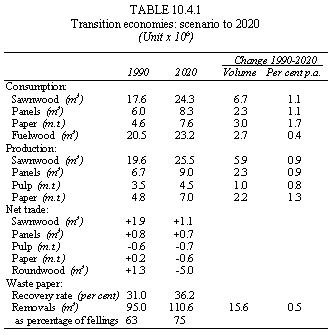
As a consequence, consumption and production of all forest products is expected to grow over the period 1990-2020, but rather slowly, typically at rates just over 1 per cent per year, similar to those for western Europe. The waste paper recovery rate is expected to rise from 31 per cent to 36 per cent.
It may be deduced from the consumption forecasts that the major end-use sector for sawnwood and panels (dwelling construction), is not expected to expand significantly, in view of the fact that public house-building programmes have been severely curtailed or cancelled and, in most cases, insufficient capital is available to individuals to finance their own construction activities.
The net trade position of the countries as a group is not expected to change significantly, although they might move slightly in the direction of net imports. There is one major exception, Poland, the largest economy of the transition economies: Poland's removals are rather close to the level (as measured in the 1990s) of annual increment and so are not expected to rise. However, the level of removals forecast is considerably below that required to satisfy the country's forecast demand for roundwood (as estimated on the basis of a 1.5 to 2.5 per cent per year rise in production and consumption). Polish imports of roundwood are therefore expected to rise very significantly, from a slight surplus to imports of 6 million m3, one of the highest in Europe.
Removals of the group as a whole are expected to rise by about 15 million m3 between 1990 and 2020. Fellings (i.e. removals, plus bark and harvesting losses) in 2020, at 124 million m3, would still be more than 40 million m3 less than annual increment. However, the picture differs considerably between countries and regions. In most countries of eastern Europe, fellings are expected to rise slightly and approach but not exceed the level of increment. A major exception is Romania, where removals in the past are said to have been regularly over the allowable cut: they are therefore not forecast to increase. The 15 million m3 of "available" increment in Romania (i.e. the difference between felling and increment) is therefore not really available for harvest, because of a policy decision based on previous experience of unauthorised excessive fellings, or alternatively because of the age structure of the forest.
FIGURE 10.4.1
Fellings as a percentage of net increment
(ETTS V base scenario)
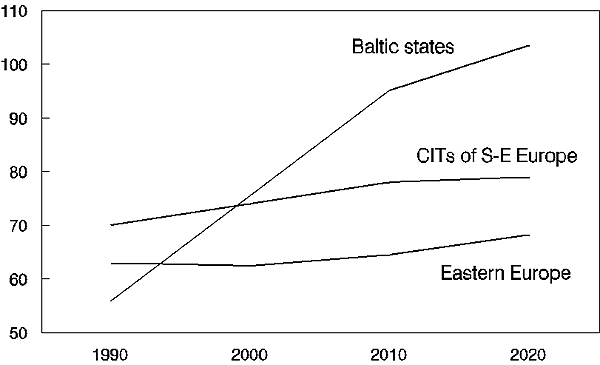
In the Czech Republic, Poland and Slovakia, net annual increment is expected to fall slightly, partly because of pollution damage, and partly, for Poland, because of age class structure. As all these countries expect removals to rise somewhat, the fellings/increment ratio would also rise, without, however, endangering the sustainability of wood supply. In Bulgaria, where there is a policy to develop the forest resource, chiefly by improving the productivity of degraded forests, both fellings and increment are forecast to grow, by 58 and 18 per cent respectively, thus using a greater part of the expanded wood production potential (60 per cent in 2020, compared to 45 per cent in 1990).
In the Baltic countries, removals are expected to grow by more than 80 per cent over the 30-year period, driven in particular by export demand for sawnwood. Fellings, which were about 50 per cent of increment in the early 1990s, are expected to exceed the estimated increment by 2020 in Estonia and Latvia. However, the authorities of the countries concerned feel that their increment has been under-estimated and that the forecast removals levels do not represent unsustainable use of the forest resource.
For the transition economies of south-east Europe, many of the "forecasts" are unfortunately only secretariat estimates, based on fragmentary information, and are therefore open to correction. However, it is not denied that one country in the group, Albania, has a serious problem of unsustainable use of the forest resource, which is subjected to uncontrolled cutting for fuelwood and industrial wood, and to over-grazing. Albanian removals are about twice the level which the forests could provide on a sustainable basis. A plan has been developed by the World Bank with the Albanian authorities to bring this situation under control, but it is too early as yet to judge its success. On the other hand, both Croatia and Slovenia expect a strong rise in fellings, by 100 and 25 per cent respectively over the next 30 years, but both would stay well below the level of increment.
The national correspondents' collective view of the outlook for the transition countries is one of slow, unspectacular progress and of generally sustainable forest sector management. This vision contrasts with many perceptions from outside the area, which see a future of expanding exports to western markets, based on low labour costs and unsustainable forest management. This simplistic view does no t take into account the more complex realities of the transition process: the strong commitment to prudent forest policies in the countries of the region and the predominant influence of domestic, not international factors.
Nevertheless, the uncertainty surrounding the forecasts and the subjective nature of the methodology mean that this part of ETTS V must be considered rather tentative, and subject to revision. It is recommended that developments over the next few years be systematically monitored in the light of these forecasts: new forecasts and assessments should be prepared, using improved data and, perhaps, methodology, if the trends measured in reality diverge significantly from those presented here.
1
For instance, the annual Economic Survey of Europe, prepared by the secretariat of the UN/ECE.2
One exception is the purchase of Poland's largest pulp mill by an American company.
