


Chapter 12 ALTERNATIVE SCENARIOS
The previous chapter presented the base scenarios, which may be considered the most likely outlook for the sector, given the assumptions set out in section 11.3.i. However, the base scenarios, like all scenarios, are founded on a chain of reasoning and defined assumptions, of which some are more uncertain, and some more important than others (in terms of impact on the sector). ETTS V has therefore produced a number of alternative scenarios, presenting what might occur under assumptions which differ from those in the base scenarios.
The alternative scenarios are of two sorts: quantitative, where the secretariat has felt justified in presenting figures for the same parameters as the base scenarios, using the same econometric methods and the consistency analysis structure; and qualitative, where the analytical tools available are not sufficient to produce quantified scenarios.
In the qualitative scenarios, the assumptions, interactions and consequences are described in non-quantified terms, although every attempt is made to indicate what might be the direction and magnitude of the changes in the key parameters.
There is a temptation to generate a large number of alternative scenarios in order to cover all conceivable eventualities.1 However, this would result in a lack of overall shape and direction of the analysis, confusing presentation and a lack of prioritisation of issues. The criteria for choice of scenario are: plausibility (only reasonably plausible scenarios are considered); significance (developments which would only have marginal consequences for the sector are not explored); and importance for policy making (especial attention is paid to issues on which governments are at present considering policy changes).
It is possible and even likely that various elements of the different scenarios will coexist, but for clarity of understanding and decision making, only one element of the base scenario is changed at a time: a choice between many composite scenarios is not helpful to decision makers, as they are never in a position to identify the possible consequences of any one policy decision. In fact, the alternative scenarios fall quite clearly into two groups:
- those addressing problems of uncertainty, so that decision makers may take the necessary protective measures to cover different eventualities;
- those addressing policy choices, so that decision makers may take their decisions with some idea of their likely long-term consequences.
No attempt has been made in the alternative scenarios to adjust the difference between derived and forecast demand for roundwood: as the forecast removals are supplied by national correspondents, there is no mechanism for modifying them to create alternative scenarios. For that reason, those alternative scenarios which are based on the consistency analysis concentrate on changes to the derived removals and to the other parts of the scenario deduced ultimately from the econometric scenarios. The derived removals may be seen as demand for European roundwood, given the conditions of the scenario under discussion. This demand may then be compared with countries' forecasts for removals, as an indication of the measures which may be necessary to meet the demand.
For ease of understanding, the quantitative scenarios are usually presented as variations from the Base Low scenario.
12.2 Prices of forest products
(i) Background
As mentioned above, prices are exogenous variables in the econometric analysis. Although the assumption of constant real prices in the long term is consistent with the other elements of the base scenarios, and appears reasonable to the secretariat, the possibility of upward or downward changes in price cannot be excluded.2
Factors which might drive real prices down in the long term include competition with other materials or forest products from other regions (fast-growing plantations), and technical progress reducing industries' costs.
Conversely, developments on world forest products markets (rising population, fast economic growth and supply shortages, as discussed above) could cause European forest products prices to rise. Failure to control costs (of processing, of distribution or of harvesting) would also lead to higher prices to end-users.
It is unlikely that prices would develop along the same lines for all products, so in theory the consequences of differential price rises should be explored: however, the complexities and arbitrariness of the choice of different rates of price change have led the authors of ETTS V not to attempt this, although the model structure is sufficiently detailed to carry out this analysis.
(ii) Assumptions for the alternative price scenarios
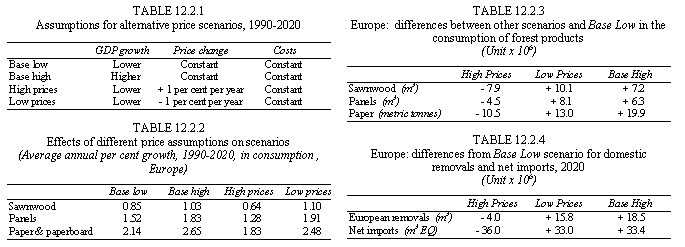
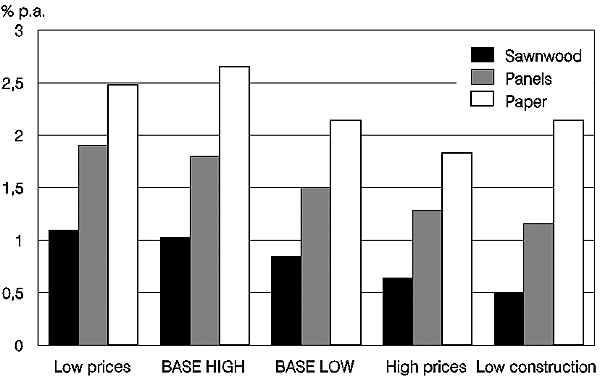
The econometric analysis presented in chapter 6 has shown that demand for forest products is indeed price elastic: thus higher prices cause lower levels of consumption and vice versa. The magnitude of the price elasticity naturally varies between countries and products. The effects on consumption growth of a change in prices is summarised in table 12.2.2, which shows the growth rate of European3 consumption under four different hypotheses, which are laid out in table 12.2.1.
(iii) Results and discussion
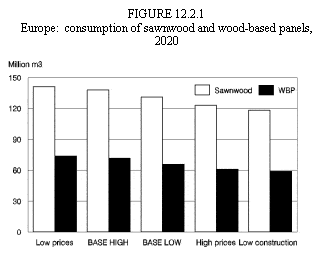
Table 12.2.3 compares the volume of consumption according to each of the scenarios with the levels for Base Low, taken as the reference scenario. Several conclusions may be drawn from table:
- European consumption of forest products is indeed strongly affected by price developments. For instance, consumption of paper and paperboard in 2020 would be over 20 per cent (23 million m.t.) higher if prices fell 1 per cent per year than if they rose 1 per cent per year (with all other assumptions unchanged);
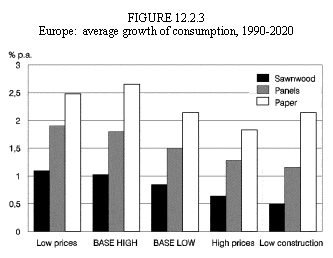
- the effect of higher economic growth, as expressed in the Base High scenario (which assumes constant prices, but higher GDP growth than in the Base Low scenario), is also significant, especially for the consumption of paper.
Changes in price would affect not only the size of the total market through the price elasticity of demand, but also the shares of different producers as the profit margin is changed when prices change, assuming costs do not change (the consequences of changes in costs are examined in the next section). In both base scenarios, European producers are expected to lose market share, although they raise the absolute levels of European production. If prices were to rise however, and costs to remain constant, margins would improve for European producers and the loss of market share be less marked: in the case of sawnwood, European producers would gain market share. Conversely, if prices fell, the loss in market share (reduction of self-sufficiency) would be more marked than in the base scenarios.
These changes in market share of European producers, according to different scenarios for forest products prices, combined with the differences in the size of the markets, would also effect the level of European removals and the volume of net imports. In both the Low Prices and the Base High scenario, European removals are nearly 35 million m3 (7 per cent) higher than in the Base Low scenario, but if product prices rise, then removals would be 36 million m3 lower. Net imports too would be 15-20 million m3 EQ higher in the Low Prices or Base High scenarios, while net imports would fall slightly if prices of forest products rose.
FIGURE 12.2.2
Europe: consumption of paper and paperboard, 2020
In summary, higher prices for forest products (with constant costs) would reduce the decline in Europe's self-sufficiency and tend to reduce the level of Europe's removals. Lower prices (again with constant costs) would significantly increase both European removals and imports from other regions.
(i) Background
The previous section analysed the sensitivity of scenarios to different assumptions for prices of forest products. The market share of different producers is, however, determined by other factors, especially their costs. The ETTS V models developed by Baudin, Brooks and Schwarzbauer make it possible for the first time in the framework of ETTS to analyse the impact of different assumptions about raw material costs on the distribution of production between European producers and net imports. Behind the model is the hypothesis that production will tend to be carried out where the profit margin is greatest. Given that technology in all sectors is increasingly similar in all modern plants and that capital markets are global, one major influence on profit margins (and the only one for which sufficient data were available) is the ratio between input prices (here the cost of wood raw material or pulp), and output prices (product prices). The analysis of trends for productivity and profitability in the forest industries (see section 6.4) confirms the importance of relative prices for profitability. Supply of products will tend to grow faster when the margin between raw material costs and product prices widens, and grow more slowly when it narrows.
(ii) Assumptions
The assumptions for the scenarios regarding costs are laid out in table 12.3.1. In the context of the ETTS V models4, "costs" are the costs of wood raw material, which is mostly roundwood (although there is some information on wood residues) for sawnwood and panels, and pulp for paper. As all of these are intimately linked, it is an acceptable simplification for policy purposes to consider the results of the High Costs scenario as the consequences of a steady growth of European roundwood prices, (and vice versa for the Low Costs scenario).
(iii) Results and discussion
As would be expected the table shows lower growth of production with higher raw material costs and vice versa. The scenarios for paper production are the most sensitive to the cost assumptions, those for sawnwood less so and those for panels are not at all sensitive. As for consumption, the scenarios are also sensitive to different assumptions concerning the rate of GDP growth, as expressed in the Base High scenario.
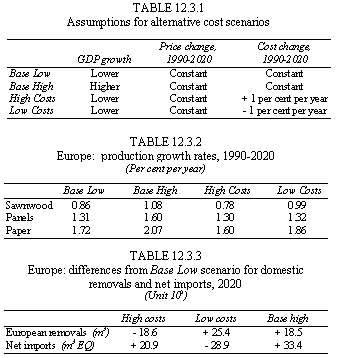
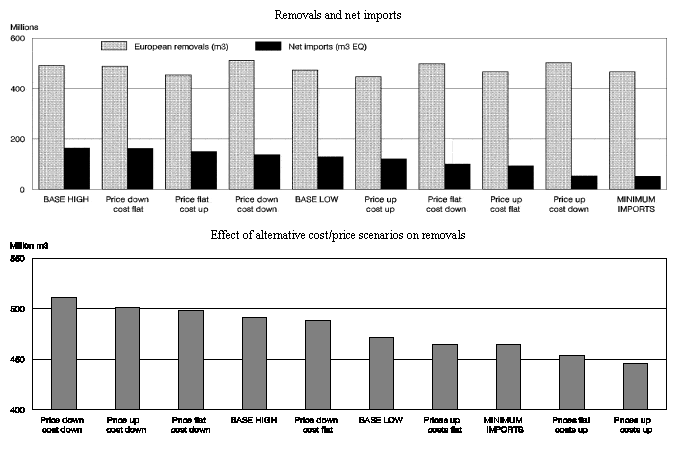
From the forest policy point of view, it is interesting to examine the sensitivity of the scenarios for European roundwood removals and for net imports to differing assumptions on new costs.
Table 12.3.3 confirms that there is a strong link between European raw material costs and the continent's self sufficiency in forest products. If wood and/or pulp costs in Europe were to rise by 1 per cent per year to 2020, with other parameters (including the total size of markets), unchanged, demand for European removals would be just under 20 million m3 (4 per cent) lower than in the Base Low scenario, and imports from other regions would be correspondingly higher. If, on the other hand, European wood costs fell by 1 per cent per year, demand for European roundwood would be 25 million m3 higher than in the Base Low scenario and net imports 29 million m3 lower. In fact, there would be a straight substitution between demand for domestic roundwood and net imports, mediated by changes in the price of European roundwood and residues.
(i) Background
Construction, especially residential construction, along with linked activities such as furniture, is the main-use sector for sawnwood and panels. In the base scenarios, the growth in residential investment is projected as a function of GDP, using elasticities derived from long time series (1964-91). However, the 1990s have seen a series of depressions in housing markets in most major European countries. These may be attributed to high real interest rates, reduction of public funding for housing (due, among other things, to public budget deficits), and the adequate state of the housing stock in many regions after several decades of investment (partly fuelled by government stimulus to private house-building, often through encouragement of mortgage lending). This latter stimulus has also been called into question on the grounds of social equity (house owners are not usually among the poorest elements in society) and limitations on public budgets. It seems prudent therefore to quantify the possible consequences for the forest sector if growth in residential investment is lower than in the base scenarios.
(ii) Assumptions
An alternative scenario entitled Low Construction has therefore been prepared, which assumes that residential investment will grow by one percentage point a year less than the rate projected in the Base Low scenario (see table 3.3.1 for the Base Low growth rate of residential investment in selected countries). All other assumptions are the same as the Base Low scenario.
(iii) Results and discussion
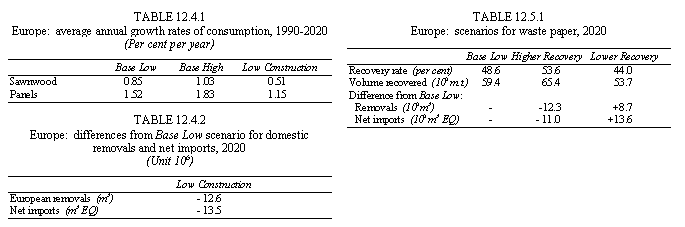
Tables 12.4.1 and 12.4.2 show clearly the importance of the construction market for the European forest sector. If construction activity were to grow slower than projected, so would markets for sawnwood and panels. Both European removals and imports from other regions would be about 13 million m3 lower than in the Base Low scenario.
(i) Background
The base scenarios assume quite marked increases in the recovery rates for waste paper: however,, there is both uncertainty about the technical limits for recovery, and a policy choice for governments as to the level of support they provide in order to increase recovery rates. Therefore, two alternative scenarios have been created: Higher Waste Paper Recovery and Lower Waste Paper Recovery.
(ii) Assumptions regarding recovery rates
If all governments in Europe were to give high priority to maximising the recycling of waste paper and other materials and take the necessary policy measures to achieve this end, those countries which are at present at low levels could reach the highest present levels by 2010, and the leading countries of today could probably push recovery rates beyond 60 per cent to 65 per cent, even 70 per cent of consumption. In the Higher Waste Paper Recovery scenario, this would lead to a European average of about 54 per cent by 2020 (as opposed to 48 per cent in the base scenarios). This would imply higher consumption of recovered fibre and lower consumption of virgin pulp (for the same levels of paper production) and thereby lower production and net imports of pulp.
Given the supply-driven nature of recovered fibre supply, which would, by definition, be strengthened in this scenario, higher levels of waste paper recovery would translate into downward pressure on prices of pulp and pulpwood. The raw material costs of the paper industries would be lowered (assuming that the technology to produce marketable products from lower quality raw material is developed). This trend would also encourage the location of the papermaking industries nearer the markets (which are by definition the location of recovered fibre supply) and further from the forests, not to mention industrial restructuring (acquisitions and mergers) as companies which are strong in virgin pulp move to acquire a reliable supply source of recovered fibre.
In the Lower Waste Paper Recovery scenario, the recovery rate is expected to continue to rise, but slower than in the Base Low scenario, as consumers are perhaps more reluctant to sort paper from other waste. The economics of waste collection in remote areas could be unfavourable, and other solutions for waste disposal could be preferred, such as incineration (which requires a minimum organic content, largely provided by paper). Countries which now have relatively low recovery rates are expected to "catch up" with the leaders, but environmental and economic pressures are expected to be weaker, leading to slower increases, and the technical and economic limits to recovery rates may prove to be lower: in this scenario, the technical limit to the recovery rate might turn out to be around 55 per cent, rather than 65 per cent in the Higher Waste Paper Recovery scenario.
(iii) Results and discussion
There is a direct and significant link between waste paper recycling and demand for European roundwood, as waste paper tends to replace virgin pulp. At the European level, in the Higher Waste Paper Recovery scenario, demand for European roundwood is 12 million m3 lower than in the Base Low scenario and net imports 11 million m3 EQ lower (all other assumptions unchanged). In the Lower Waste Paper Recovery scenario, on the other hand, European removals are nearly 9 million m3 higher than in the Base Low scenario and net imports nearly 14 million m3 EQ higher. The 10 percentage points of difference for the recovery rate between the Lower Waste Paper Recovery and the Higher Waste Paper Recovery scenarios in 2020 translate into a difference of 20 million m3 in demand for European roundwood and 25 million m3 EQ for imports from other regions.
(i) Background and assumptions
Chapter 2 pointed out that, although the base scenario assumption for energy is for no significant change in general energy price or policy, the possibility of an energy "shock" due either to a policy decision to favour high energy prices (e.g for environmental or climate change reasons) or to an unexpected supply breakdown (e.g. due to war or accident) cannot be ruled out. What would be the consequences for the sector of such a development?
Thus, the starting point for this scenario is a significant rise in the price of conventional, mostly non-renewable, forms of energy, accompanied by a series of policy measures to develop and encourage other sources, especially those which are renewable, as well as a carbon tax to penalise non-renewable energy sources.
(ii) Results and discussion
This scenario is qualitative as no method has been developed in the context of ETTS V to quantify demand for energy wood as a function of energy price.
The first consequence of a rise in the price of energy would be a sharp improvement in the competitive position of wood as a energy source (assuming that wood itself was not subjected to a carbon tax). If the energy price rose as a matter of deliberate official policy (as opposed to war or accident), it is also likely that this increase in the competitivity of wood energy would be accompanied by policy measures to stimulate its use. This would certainly lead to increased fuelwood harvests and even greater use of wood residues (from primary and secondary processing) as energy source, and thereby to competition with the pulpwood-using industries for material on the technical "margin" between energy and raw material uses. If the price rise was large enough or the political will to stimulate renewable energy very strong, "energy plantations" might become a serious option, leading to the conversion of large areas of former agricultural land to intensive wood production. It might even be considered desirable to establish, first on an experimental and later on an operational basis, large-scale plants producing liquid or gaseous fuels (methanol, ethanol, etc.) from wood. All of these factors would tend to increase European harvests.
However wood energy does not exist in a vacuum, and a significant energy price rise would profoundly modify the economy as a whole:
- overall economic growth would be slower, due to increased energy costs throughout the economy, with major consequences for demand for forest products;
- the cost structure of the sector, and of its competitors would be profoundly modified. For instance, energy intensive processes, such as mechanical pulping and gluing, would all become more expensive (relative to other operations), while the manufacture of aluminium and most plastics would also be negatively affected. Less energy intensive processes, including sawmilling, the consumption of recovered fibre, even perhaps chemical pulp5 would be favoured;
- the insulation standards of housing would be further improved, which can favour wood-based construction methods in those regions where these are well developed and marketed;
- transport (and therefore imports from distant regions) would become more expensive.
Although no quantified scenario is proposed, it is clear that in a high energy price scenario, the relative importance of energy as an end use for wood would increase. It is also possible that total consumption of non-energy forest products would be lower than projected in the Base Low scenario, and that sawnwood and products of recycled paper would be favoured at the expense of panels and of paper based on virgin pulp, as would European products at the expense of those imported from overseas. For these reasons, European forests might be more intensively managed than at present.
This scenario might, however, involve some difficult trade-offs in the field of environmental policy, notably with regard to the need to reconcile stimulus to renewable energy, e.g. by energy plantations, with the desire for biodiversity and landscape quality (neither of which are generally associated with energy plantations). In a high energy price scenario, the reduction in demand for the products of industrial wood might to some extent compensate the rise in demand for energy wood, leading to a small, if any, increase in total harvest, although the balance of the removals (i.e. between large- and small-size wood) would be radically changed. Such a development would represent a reversal of the trend of the last 50-80 years, when the large increase in consumption of industrial wood has been possible only because demand for energy wood dropped. This change in market preferences, from large-size to small size-wood, might well have major consequences for the profitability of some forest holdings, public or private, which have chosen silvicultural systems intended to produce large-size, high-value material.
12.7 Environmental policies, legislation and attitudes ("Deep Green Future")
(i) Background and assumptions
The base scenarios assume a further strengthening (compared to the present) of policies on environmental protection, biodiversity, waste management and sustainable development. However, there is pressure, in Nordic, north-western and central European countries for still stronger measures, including, for example:
- management of up to 20 per cent of the forest area exclusively for biodiversity conservation;
- afforestation of large areas (formerly agricultural) not for wood production but to recreate conditions and ecosystems existing before the initial disturbance by (modern) man;
- severe limitations on the number and size of clearcuts (and possibly on some mechanised harvesting systems);
- systematic replacement of mono-specific plantations with multi-species systems, and of exotic species by indigenous ones;
- refusal by wood consumers to use any wood from natural forests, leading to a disappearance of imports from many tropical regions, and extensive areas in North America and Russia;
- introduction of a carbon tax at high rates;
- stimulus to energy saving and renewable energy sources (in addition to the economic stimulus to energy saving resulting from the carbon tax);
- phasing out of nuclear power;
- reduction of emissions of all sorts;
- encouragement of agricultural practices which use land, capital and other inputs, notably fertilisers, in a less-intensive way;
- very high levels of recovery and re-use of all raw materials;
- widespread introduction of "green accounting" to measure environmental and other non-market goods and services;
- introduction of markets, or quasi-markets6, in hitherto non-marketed benefits, including those provided by the forest, such as biodiversity conservation, landscape, recreation, etc.;
- slower, if any, economic growth, as measured in the traditional way;
- allocation of priority to reducing unemployment and to limiting personal and regional inequalities;
These ideas and policies would, in this scenario, be applied initially in the north and north west of Europe, and in central Europe (i.e. those countries which are at present the most receptive to "green" ideas), but would spread quite rapidly south and eastward, through the influence of regional bodies, especially the EU, and by neighbouring countries’ examples. By 2010, in this scenario, most of these ideas would be accepted in principle (although probably not entirely applied in practice) all over Europe.
(ii) Results and discussion
What would be the consequences for the forest and forest products sector of this Deep Green Future7 scenario? It is not possible to quantify these fundamental changes, but a few ideas of possible consequences are set out below.
By the end of the first quarter of the twenty-first century, the European forest resource would be considerably larger in area and possibly in growing stock than in the 1990s, and managed (if at all) for higher biodiversity and recreation values, but have lower productivity and levels of removals. Trees and small forest areas would also take up a much more important part of non-forested rural landscapes. Costs of growing and harvesting wood would be much higher than at present. Forest management would become a much heavier burden on public budgets, unless markets in at present non-marketed benefits were widely introduced. Private forest owners, in particular, would find it hard to continue without extensive public support, and might be faced with the choice of selling (or donating?) their forest land to the state, or abandoning forest management (as it is understood today) completely. Possibly, some of these negative developments would be counteracted by government action to support regional and rural economies and prevent the depopulation and pauperisation of rural areas.
In this scenario, demand for energy wood of all types (fuelwood, residues of all industries, recovered wood products) would increase strongly. Energy and transport costs of all sectors would increase rapidly. This would give a comparative advantage to the forest sector, which has efficient access to the major renewable energy. Energy, in the form of wood fuel or of electricity, even liquid fuels, could become the major product (and source of revenue) of the forest sector, for external as well as internal consumption.
The outlook for forest products markets is difficult to estimate. On the one hand, in this scenario, consumer income, and thereby total demand for all materials, would be reduced and processing costs would be higher. In addition, economy of materials, as well as energy, would be encouraged. This would considerably lower demand for forest products. On the other hand, the forest sector, based on a renewable, recyclable, relatively low-energy, carbon-neutral raw material, would have a comparative advantage over many others. The answers to these questions are not simple and should be based on detailed life cycle analysis. In the secretariat's view, however, wood would continue to play an important role as a source of raw material in a Deep Green future as well, although probably the volumes concerned would be smaller and prices would be higher (though possibly not high enough to cover increased processing, transport and forest management costs).
Concerns about quality of forest management in other regions, expressed through certification schemes, and the cost of transport would combine to reduce significantly Europe's imports from other regions. In fact, Europe might aspire to self sufficiency, although official, compulsory trade measures would not be introduced because of pre-existing commitments to free trade.
The shortfall in imports would at least in part be compensated by high levels of recycling and re-use of forest products (at least equivalent to those in the Higher Waste Paper Recovery scenario), so the idea of a Europe which does not import forest products from other regions is not entirely unrealistic in this Deep Green scenario.
12.8 Reduced global availability of wood
(i) Background and assumptions
The possibility was discussed above of reduced global availability of wood, due to strong demand from developing countries and supply cutbacks in traditional supplying areas, tropical and non-tropical. Although this hypothesis was rejected for the base scenario because of the expected impact of substitution, "wood-free economic growth" and the coming on stream of high yielding, intensively managed tropical or temperate plantations, it certainly cannot be ruled out altogether, and so is the subject of an alternative scenario.
In this scenario, the principal feature would be stronger demand on global markets for forest products. This would result in higher prices, which would be reflected on European markets. This global tension would cause re-equilibrating mechanisms, namely: damping demand and encouraging substitution, and stimulating supply.
(ii) Results and discussion
Probably the single most marked effect of global tension on forest products markets would be slower growth in consumption and loss of market share to non-wood products, both attributable to the higher prices (see section 12.2 for a quantification of the consequences of higher forest products prices).
On the supply side, the main stimulus of interest to ETTS V would concern European sources, since by definition, in this scenario, supplementary non-European supply sources, such as fast-growing plantations, would not be sufficient to cover the increased demand (even when slowed by higher prices). In other words, European producers would be stimulated by the higher world market prices to gain (or regain) market share at the expense of imports. For this to happen, however, it is essential that European products become more competitive in terms of price and/or marketing skills. As it appears difficult to obtain a significant continent-wide marketing advantage, given the sophistication of the major "players" on increasingly globalised world markets, if Europe is to regain market share in a situation of global tensions and rising prices, the costs of European industries, especially those of raw materials, must not rise.
There are two other factors which would probably come into play in circumstances of a constrained global supply situation:
- waste paper recovery rates would probably be at higher levels, conceivably those in the Higher Waste Paper Recovery scenario;
- wood raw material imports from other regions would be unlikely to rise: for 2020 the Base Low scenario foresees 36 million m3 of net imports of wood raw material (double the 1990 figure): however, as pointed out in chapter 11, this figure is a residual of the consistency analysis calculation and is not an econometric projection. If there were shortages and sharp price rises on global forest products markets, it is hard to conceive of structural raw material imports to Europe increasing over the long term. For this reason, in the scenarios, raw material imports by the major importers (Finland and Sweden) have not been allowed to rise as they do in the Base Low scenario.
In fact, if global supply constraints were very marked, European exporting countries (actual or potential) could increase their exports to other regions.8 In conditions of economic scarcity of wood worldwide, traditional European exporters with their long experience and sophisticated skills would be well placed to compete, at least in the short and medium term, with producers located in regions with better growing conditions. Indeed they, along with North American companies, might well be in a position to control, by injections of know-how and capital, the emerging forest products suppliers.
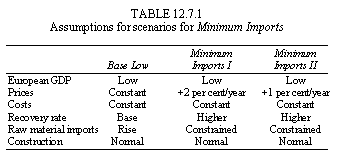
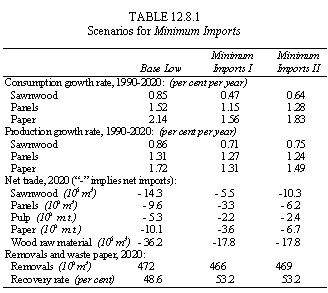
Two alternative scenarios have been constructed to illustrate how the European forest and forest products sector might react to tensions on global forest products markets and higher prices. The assumptions of the two alternative scenarios are compared to those of the Base Low scenario in table 12.8.1. These scenarios (Minimum Imports I and II) are unlike the other alternative scenarios which tried to answer "What if?" questions: the Minimum Imports scenarios attempt to illustrate those conditions which would have to be satisfied if Europe were to reduce its dependence on imports from other regions.
These scenarios suggest that the higher product prices which would accompany global constraints on wood supply, if accompanied by higher waste paper recovery rates and constant prices for European roundwood, would lead to lower consumption levels. Imports from other regions would remain around the 1990 level (and thus considerably lower than those in Base Low). Demand for European roundwood would, however, be roughly unchanged. This perhaps unexpected result (that global wood supply constraints would not necessarily lead to higher European removals) demonstrates the importance of constructing scenarios for the forest and forest products sector as a whole, and not for individual sub-sectors.
12.9 Uncertainty regarding economic growth
Chapter 3 presented a consensus rate of economic growth for western Europe, based on a number of projections current when ETTS V was being prepared around 1993. This consensus rate is the underlying assumption for the Base High scenario: the Base Low scenario assumes a rather lower rate. Projections using a rate above that for Base High are presented in the Baudin/Brooks working paper but not in ETTS V, as they were considered unrealistically high. For this reason, no scenario for economic growth lower than that in Base Low was prepared.9 However, the continuing slow growth of the mid 1990s, and the inability of west European governments to find the road to steady, inflation-free growth have led to economic forecasts (at end 1995) for 1996 and 1997 which are significantly below those used as a basis for the ETTS V projections for 1995-2000.
It was not possible to generate a new scenario of lower economic growth so shortly before the study was to be finalised; nor is it reasonable to alter projections for a 30-year period in the light of results for two years. Nevertheless, it must be borne in mind that the possibility exists that long-term economic growth could be lower even than the assumptions of the Base Low scenario. In that case, demand for products would be lower, as well as production. It is also likely that imports from other regions would be lower than in the Base Low scenario.
12.10 Discussion of the alternative scenarios
Although there are strong interactions between the different parts of the forest and forest products sector, most decision makers, public or private, have to take decisions or formulate policy only for a particular enterprise or department, and may find broad general scenarios of limited usefulness. For this reason, the section attempts to interpret in more detail the implications of the alternative scenarios in practice. To this end, it attempts to identify which of the scenarios concern uncertainty and which concern policy choices (inside or outside the sector) and which essentially concern the sector's success, or lack of it, in remaining competitive.
This section then analyses the different parts of the forest and forest products sector, giving a rough indication as to what elements, of uncertainty or of choice, are the most significant for each part of the forest and forest products sector.
Of the seven scenario concepts presented above, the following may be considered concerned essentially with uncertainty10 about developments which are practically impossible to influence at the level of the forest and forest products sector in Europe: rate of economic growth (Base High); rate of growth of construction activity (Low Construction); global wood supply constraints (Minimum Imports I and II); technical limits to recycling (High Recovery and Low Recovery).
The following concepts concern policy choices which will be made outside the sector: energy policy (High Energy Price); environmental policy (Deep Green Future); recycling policy (High Recovery and Low Recovery).
The last group, and perhaps the most important, concerns the ability of the "actors" in the sector to maintain or improve their competitivity in different market situations. For methodological reasons, in ETTS V, this concerns essentially prices and costs, but technical development and product marketing as well as public relations will all play a role. These scenarios are: High Prices and Low Prices (i.e. of forest products); High Costs and Low Costs, (which is equivalent, in ETTS V, to high or low prices for roundwood, residues and pulp).11
With respect to the cost and price aspects, while it is certain that individual actors will try their utmost to improve their competitivity and maximise their income, it is uncertain whether they will succeed in this objective. The interest of these scenarios is therefore to enable actors to set strategic goals and, perhaps most important, to demonstrate to the actors themselves how important it is to control costs and keep prices competitive with those of other forest products and with those of competing materials.
How sensitive is each part of the base scenario to changes in the assumptions? With the quantitative scenarios, it is possible to indicate not only the direction, but also, in general terms, the magnitude of the changes. For the qualitative scenarios, the direction of change is the best that can be hoped for.
The levels of consumption of forest products are clearly sensitive both to changes in prices of forest products and the level of activity in the economy as a whole, and in construction (the latter for sawnwood and panels only). The more general qualitative scenarios, notably the High Energy Price and the Deep Green Future scenarios would also influence consumption levels, probably reducing them significantly, and encouraging a shift in the emphasis of the sector from traditional consumption patterns towards wood-based energy uses. In the Minimum Imports scenarios, consumption would also be lower than in the base scenarios, through the influence of higher prices.
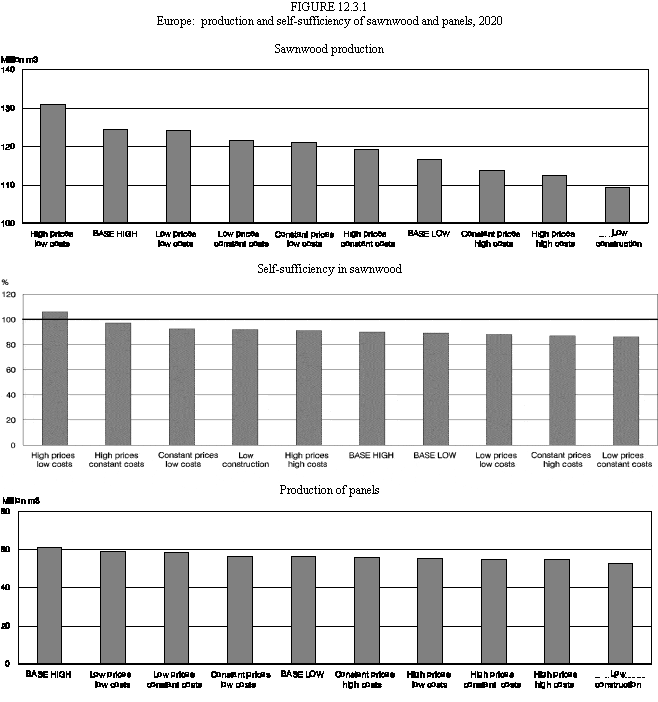
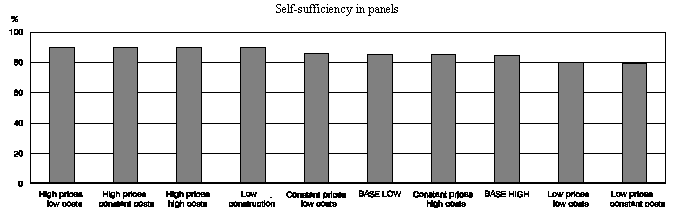
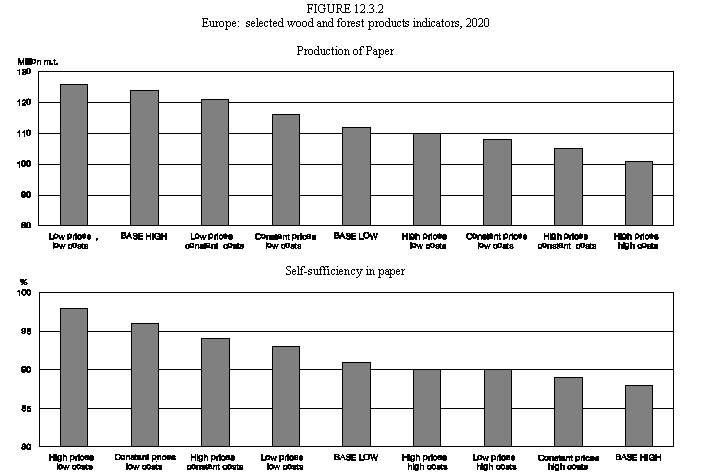
The situation with regard to production of forest products is more complex, as it is influenced both by the size of the market and the share of European producers. Thus, the same level of production, in absolute terms, could be achieved either as a smaller share of a larger market or as a larger share of a smaller market. The size of the market is determined by the consumption levels discussed above and the market share by the margin between input costs and products prices. The levels of production are shown in figures 12.3.2 and 12.3.3 along with the projected levels of self-sufficiency. It is noteworthy that the order of scenarios according to the two criteria (level of production and self-sufficiency) does not coincide.
Self sufficiency in sawnwood and in paper is sensitive to the margin between prices and costs: naturally, the highest levels of self sufficiency for these product groups are in the High Prices, Low Costs scenario, which provides the best level of profitability for the European industries, and in other scenarios where the margin develops favourably for the European industries. For wood-based panels, however, according to the econometric analysis, the levels of production are "driven" much more by market demand and are relatively insensitive to changes in the margin. Thus, for panels, the highest levels of self sufficiency are when the total consumption is lowest (i.e. when prices are high), although the absolute levels of production are low.
The absolute levels of production are, in most cases, more sensitive to the assumptions regarding the size of the market. Thus, the highest production levels for Europe, tend to be in the Low Price scenarios, which lead to fast growth in consumption, or in the Base High scenario, which assumes stronger economic growth, and not in those scenarios where higher product prices lead to smaller markets, even though self sufficiency may improve in the latter scenarios. Thus, in very general terms, lower prices of forest products would be expected to lead to higher levels of European production.12
The range between the highest and lowest scenarios for demand for European roundwood (i.e. total derived removals, Europe, 2020) is considerable: 65 million m3, or 14 per cent. The extremes of the range result from a combination of assumptions for costs and for prices, so it is interesting to explore separately the specific contributions of each of these factors.
It appears from figure 12.3.2 that the level of European removals is most sensitive to the cost level for the industries' raw material, notably the price of European roundwood. Thus, demand for roundwood from European forests would be 44 million higher if industry's costs fell by 1 per cent a year than if they rose by 1 per cent a year (assuming no changes in the product price element).
However, if constant raw material costs are assumed, the range between the highest and lowest scenarios is considerably smaller (31 million m3, or nearly 7 per cent of the level projected in Base Low). Thus, with constant levels of raw material costs, demand for roundwood from European forests would be higher than in the Base Low scenario: if GDP grew faster (Base High), if forest product prices fell, or if waste paper recovery were less than expected. It would be lower than in the Base Low scenario: if construction activity were low, if waste paper recovery were higher than expected, or if forest product prices rose.
Even the lowest forecast level of derived removals is 50 million m3 higher than in 1990. It should be noted that even the highest scenario is well below net annual increment and would still be accompanied by a continuing accumulation of growing stock.
Both Minimum Imports scenarios have rather little effect on the demand for European roundwood, as the adjustment necessary to reduce Europe's imports from other regions is concentrated, through the price mechanism, on market size (and higher recycling) rather than on the substitution of imports by European removals. Thus, if there were a world "wood shortage", European removals would probably have a larger share of a smaller market, leading to a roughly unchanged level of removals.
The consequences for the strength of demand for European roundwood of the Higher Energy Price and the Deep Green Future scenarios are very uncertain, as both contain counterbalancing forces whose net effect is impossible to quantify with the data and analytical tools at present available. In the Higher Energy Price scenario, the expected stronger demand for small-sized energy wood might be counterbalanced by slower economic growth and higher costs. In the Deep Green Future, the environmental advantages of wood and the demand for renewable energy might be counterbalanced by slower economic growth, higher costs, and restrictions on silviculture, including the classification of large areas as biodiversity conservation areas.
It is a noteworthy, and perhaps surprising, conclusion of ETTS V that the projections of demand for European roundwood are relatively insensitive to quite significant changes in the assumptions concerning economic growth, prices of forest products or waste paper recycling. One explanation is that the large changes in demand, upwards or downwards, are covered, according to the projections, and, with the assumptions stated, by imports from other regions rather than by European roundwood supply.
Europe's net imports from other regions are the most sensitive part of the projections to changes in assumptions. The highest level, under the Base High scenario, is three times that in the lowest (Minimum Imports) scenario.13 The same two factors as for roundwood demand combine to influence the scenarios for net imports, namely the size of market (in turn influenced by product prices and activity levels) and the margin for European industries (relation of product prices to raw material costs).
Net imports are high when GDP growth is faster, product prices are low, margins for European industries narrow (e.g. low prices/constant costs, constant prices/high costs) and waste paper recovery rates are low. Conversely, net imports are low when product prices are high, margins for European industries become wider (high prices/low or constant costs, constant prices/low costs), waste paper recovery rates are high and construction activity is low.
The balance between net imports and European derived removals varies strongly between scenarios. If consumption is high and/or the margins for European industries are low, net imports could be about equivalent to a third of European removals, compared to less than 15 per cent in 1990. If, on the other hand, consumption is low, margins are large and/or waste paper recovery is high, this ratio could fall to about 10 per cent. This would occur in the circumstances specified, not as a result of any protectionist action by European governments.
This chapter has demonstrated the complexity of the sector and the difficulty of mapping out any single line into the future. Nevertheless, it is possible to draw a few conclusions regarding the sector, derived from the scenarios in this chapter.
First, the developments of the prices and costs for forest products and for roundwood are more important for the future of the sector than is commonly stated in the policy discussions.
Second, the European forest and forest products sector, like most natural or social systems, has a number of self-regulating mechanisms which prevent it from entering destructively into a cycle of extreme trends and reactions. The most important of these are the price mechanism and the recovery of waste paper, which prevent an increase in demand for paper from being translated into an equivalent increase in demand for wood.
Third, some parts of the system are more stable than others: in particular, demand for European roundwood is much less volatile than demand for imports from other regions.
The conclusions to be drawn from these scenarios regarding future strategy will vary according to the position of each reader: public or private, industry, trade or forest manager, importer or exporter, large or small enterprise, etc. Some policy implications are examined in the next chapter.
1
And, incidentally, to protect the reputations of the study's authors!2
It must be repeated that ETTS V is only concerned with structural long-term trends: it is inevitable that prices of roundwood and of forest products will move both up and down according to market conditions, sometimes sharply. Short-term price movements cannot and should not be taken into account by long-term studies like ETTS V.3
Strictly speaking, as the econometric analysis only applies to the countries which had market economies before 1989, the variation only affects western Europe, as the projections for countries in transition are price inelastic with the methods used in ETTS V. Nevertheless, the European total is shown for comparison with other parts of the chapter.4
These models concentrate on the wood raw material aspects and do not dispose of long-term data series on other factors of production, such as labour, energy or capital.5
The manufacture of Kraft pulp, although a high-energy process, is self-sufficient in energy and uses a renewable source (lignin from the wood raw material).6
By this is meant systems by which forest owners are in some way paid directly for "producing" non-wood benefits such as biodiversity or landscape, as opposed to receiving a general compensation for higher costs.7
This scenario is, however, by no means as extreme as the proposals of the most radical green groups, which include refusal of modern technology (including medical technology), new (communal) ownership patterns (notably of land), total vegetarianism (because of an absolutist conception of animal rights) and extreme reluctance to accept any large-scale harvesting of wood, or indeed forest management of any sort.8
This has happened in recent years as Austria, Finland and Sweden have all profited from prevailing market conditions to create a place for themselves on Japanese forest products markets.9
The "projections" for 1990-95 were in fact based on real data for 1990-94 and official forecasts for 1995.10
Some concepts have elements of both uncertainty and policy choice, so they may appear in more than one category.11
The costs and prices scenarios may be combined in a rather large number of variations such as high prices, low costs, or low prices, constant costs and so on. Furthermore, different hypotheses could be made by product or by country, or with regard to the rate of change. While the econometric model could be used to explore all these possibilities, the results of such an exercise would be indigestible and hard to use at the policy level.12
An exception is the High Price, Low Cost scenario for sawnwood, but this projection may be distorted by an unrealistic elasticity for German sawn softwood exports, which tend to grow disproportionately if the margin widens.13
In this section, the projected net imports in original units (m3, m.t.) have been converted to m3 EQ using standard conversion factors, to simplify presentation and facilitate comparison with projections for removals. However, the projections themselves were calculated in the original units, so there has been minimum loss of accuracy due to wrong conversion factors during the generation of the projections.
