

The first ten chapters of ETTS V reviewed, sector by sector, structural trends and the long-term outlook. Chapter 11 reviewed these partial scenarios to create two base scenarios for the forest and forest products sector as a whole. Chapter 12 presented and discussed a number of alternative scenarios. The objectives of the present chapter are to present the main conclusions of the study, and to discuss the conclusions which may be drawn from the above about the sustainability of forest management in Europe.
13.2 Main conclusions of ETTS V
(i) Continued demand for forest products in Europe
ETTS V confirms that, for the next quarter century at least, given GDP growth rates of around 1-2 per cent a year, European demand for forest products will continue to grow, not fast but steadily. This is the case in all the scenarios considered, including one where forest products prices rise by 2 per cent in real terms a year. These scenarios also assume that there is no radical change in the technical competitivity of forest products relative to substitute materials.
(ii) Adequacy of European roundwood supply compared to expected demand
The higher levels of demand for forest products clearly imply higher consumption of raw material. Therefore, despite the expected increase in the contribution of recovered fibre, and in imports from other regions, the European forest will be required to increase the volume of wood it supplies. The study also shows that the European forest is well able to meet this challenge; Europe's harvest (removals) is expected, by national correspondents, to increase from 390 to around 480 million m3 a year in 2020. Furthermore, the biological potential exists to expand European removals further. The projected level of removals in 2020, although a third more than that of the early 1990s, is still only 70 per cent of the net annual increment. The realistic maximum sustainable level of removals in Europe in 2020, without depleting the resource, but also without special investment to increase its productivity, is estimated at about 530 million m3. The supplementary increase over the base scenario, if there were one, would come essentially from the three major exporting countries, Austria, Finland and Sweden.
However, in a very few countries, notably Albania and Greece, but also probably certain successor states of the former Yugoslavia, removals are now, and will remain, above increment: in those countries, which are affected by population and grazing pressure, fragile ecosystems and weak institutions, there is a real threat to the long-term sustainability of the forest ecosystem and of wood supply which requires firm action, led by the national government and supported by the international community.
(iii) Expansion of Europe's forest industries
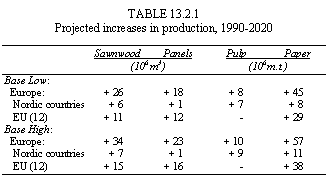
European production of forest products is projected to grow between 1990 and 2020, assuming constant real prices and costs, by 25-35 per cent for sawnwood, 20 per cent for wood-based panels, 30 per cent for pulp and around 50 per cent for paper. In addition, 35-45 million m.t. more waste paper would be recovered and processed. Most of the increase for panels and paper, and, to a lesser extent, sawmilling, would be in the EU (12), while practically all the increase for pulp would be in the Nordic countries.
Table 13.2.1 gives a rough idea of the additional processing capacity (i.e. not counting the essential replacement and improvement of existing capacity) which would be required in Europe over the next 30 years; however, it should be borne in mind that in some sectors, notably sawmilling, existing capacity is grossly under-used. This additional capacity would, at least in part, come from expansions of existing plants, rather than totally new, "green field", mills. Naturally, these projections for extra capacity are conditional on European industry being able to control its raw material costs and maintain its margins, while not allowing prices to rise.
(iv) Reduction of waste and increased recycling in the forest products sector
Already in the 1990s, very little wood or fibre is wasted: increasing volumes of processing residues are used as raw material or as an energy source while recovery rates for paper are both growing strongly and are higher than for almost all other materials. ETTS V expects both of these trends to continue, under strong economic and social pressure. An even larger share of wood residues than at present will be used as raw material, until there is very limited potential to recover any more; the waste paper recovery rate is expected to rise from 37 per cent to 49 per cent in 2020, with a doubling or tripling of the volume recovered. High levels of recycling and residue use make wood a very environmentally friendly raw material when grown in a sustainable fashion.
(v) Outlook for prices
ETTS V does not confirm the belief that demand growth and supply constraints will lead to a marked long-term rise in prices for roundwood and forest products, although this possibility cannot be ruled out completely. Any agency, national or international, or any individual, contemplating investment programmes to increase European wood supply should take as a starting point for their feasibility study an assumption of no change in forest products prices, and explore the effect on the economic viability of the project of higher or of lower prices.
(vi) Europe's imports from other regions and degree of self-sufficiency in forest products
Both base scenarios show an increase in Europe's net imports, as Europe's producers are expected to lose market share to suppliers from outside the region. Moreover, it is believed that the supply/demand outlook for the rest of the world is more balanced than generally thought, as demand growth will not be so fast as forecast in some studies and flexibility of supply, especially from fast-growing plantations, would be higher. However, if the supply/demand balance were to be tighter than expected, or if European governments wished to increase the self-sufficiency of Europe in forest products, it would be physically possible to supply a greater part of Europe's needs from domestic resources than projected in the base scenarios, thereby reducing the growth in net imports. (The alternative scenario Minimum Imports showed one way this could come about.)
However, an increase in Europe's self sufficiency would not happen unless a number of conditions were met, including the following:
- the wood from Europe's forests is competitive, in terms of price and quality, with the leading competitors on global markets (i.e. the specialised, intensively managed, production-oriented plantations with good growing conditions). This would probably imply that larger areas than at present of Europe's forest are managed intensively for wood production, and that these "production forests" would be in parts of Europe with good growth conditions.
- the industries to process this raw material are also competitive on a world scale, i.e. large units, with an adequate capital base and strict cost controls.
- public opinion accepts, in the interests of rural employment, economic growth and possibly in order to reduce pressure on natural forests in other regions, the environmental trade-offs which would of necessity be involved in a programme to increase Europe's real forest products potential beyond that in the base scenarios.
The above reasoning is not dependent on an assumption that governments institute protectionist measures to encourage the growth of their own forest industries or set up subsidy regimes to bring down the cost of domestic wood supplies. Such action would be against the spirit of the practically universal commitment to free trade manifested by the successful completion of the Uruguay Round and the setting up of the World Trade Organisation. As some of the leaders on global forest products markets, most notably the US and Canada, are major trading powers, the widespread use of protectionist measures in order to increase the self sufficiency of the European forest products sector is not really a plausible option.
(vii) Markets for sawnwood and panels
It is quite likely that the "sawnwood" and "panels" being manufactured and bought in 2020 will be rather different from those available today, chiefly because of technological innovation, aimed both at reducing manufacturing costs and at improving product quality and developing new uses and markets. There will be new production processes, new composite materials, new glues and surface treatments, etc. The levels of consumption of sawnwood and panels projected in the base scenarios are based on the assumption that prices for these products remain constant in real terms and that sawnwood and panels remain competitive from a technical and marketing point of view. If either of these conditions are not fulfilled, the size of markets for sawnwood and/or panels would be smaller than in the base scenarios or they would be substituted by other materials. Therefore, the process of innovation must continue and those responsible for the industry must take the necessary research and marketing steps to be prepared for it. This likely technical development also implies that the projections for individual products in ETTS V should be seen as indicative only, because of likely inter-product substitution and combination, and development of new products.
(viii) Transition economies
The forecasts for transition economies in chapter 10 are that demand will recover, but slowly, so that 1989 levels are recovered by 2000. Already for some countries, for instance those of the Visegrad group, this looks unduly pessimistic, although for others, notably in the Balkans, the gravity of the problems appears worse than originally realised. Given the rapid pace of change, it is especially important that these forecasts be reviewed regularly in the light of developments, and if necessary that new forecasts be prepared.
The market conditions of the early 1990s have caused shifts in the trade patterns of the transition economies, which have increased the exports by some of them of sawnwood to west European markets, helped by low costs and the effective absence at that time from these markets of Canada and Russia. The collapse of the domestic pulp industry in the transition economies has also "liberated" supplies of pulpwood which are being exported to the Nordic counties. Those countries with significant export potential (the Baltic countries, the Czech Republic, Slovakia, Poland, Slovenia) may well be able to build on these foundations and establish a niche for themselves on European markets for sawnwood and other products. However, the expansion of exports from these transition economies will be limited by the potential of the resource and by rising domestic demand, especially for construction materials.
As a group, the European transition economies are forecast to change from net exporters to net importers, because of paper imports, lower sawnwood exports and Poland's forecast requirements for significant volumes of wood raw material imports.
(ix) Change in area of European forest and afforestation of former agricultural land
The area of Europe's "exploitable" forest is expected to grow by just under 5 million hectares (about 3 per cent) between 1990 and 2020, of which 3.5 million hectares would take place in the EU (12) (an increase of 8 per cent), with no increase in the Nordic countries. Most of the expansion is accounted for by three countries: Spain and France, where forest expansion/improvement policies will continue, and Poland, where the area under agriculture is expected to shrink markedly due to the transition process. Practically no change is expected in unexploitable forest and other wooded land. This increase, especially that in the EU (12), is not negligible, but is by no means commensurate with the expected reduction in agricultural land due to changes in agricultural policy.
Thus, according to the expectations of ETTS V national correspondents, the change in agricultural policies will not result in large increases in the area of forest land managed for wood production. Indeed, experience over recent years has shown that forest established on former agricultural land is often managed for landscape, hunting or biodiversity reasons, not primarily for wood production. Furthermore, even if large areas were afforested for wood production, the effect on the production of industrial wood before 2020 could only be very limited.
(x) Wood and energy
In the early 1990s, over 200 million m3 of wood (equivalent to 47 per cent of European removals) was used as a source of energy in the form of conventional fuelwood, energy use of industrial residues and recovered wood and pulping liquors. Even assuming that real prices for energy stay at the low level of the 1990s, the consumption of wood for energy is expected to grow steadily to 2020, increasing by about 1.5 per cent a year. The use for energy of recovered wood products, such as used pallets or demolition wood, is expected to grow by 3-4 per cent a year. This trend is driven by the necessity to reduce further any waste of wood, by the likely increased cost of waste disposal, and the realisation by those who have access to a source of wood for energy that wood can be a convenient, economic and decentralised energy source. A significant rise in general energy prices is considered unlikely: if there were such an increase, wood energy would become much more important, large scale and industrialised, with specialised plantations and large-scale conversion and distribution systems, all of which are uneconomic at current energy prices.
(xi) Costs of forest management
The production levels of forest products projected for ETTS V and thereby the level of demand for European roundwood, are based on the assumption of constant raw material prices (i.e. roundwood and pulp). Some of the alternative scenarios in chapter 12 have shown that the consequence of higher raw material prices for European roundwood would be reduced demand. However:
- all forests, including those whose principal objective is wood production, will continue to be expected to meet high standards of biodiversity, landscape protection, and other protective functions, even if this increases costs;
- forest management costs (i.e. for stand establishment, thinning, final harvesting and general administration) appear to have been rising, notably because of the higher cost of labour;
- public budgets, at the national and local level, will continue to be limited, preventing an excessive recourse to public funds to fill operating deficits for forest mangers.
One of the greatest technical and economic challenges facing Europe's forest managers is how to control costs and thus maintain competitivity, while satisfying society's increased demands without placing excessive burdens on the public purse.
(xii) Contribution of the European forest to the global carbon balance
The 20 billion m3 of inventoried wood in Europe represent a major stock of carbon, to which should be added the carbon in non-inventoried parts of the tree, in forest soils and in other vegetation in forest ecosystems. Over 250 million m3 of wood are being added to this stock every year, making the European forest one of the most important carbon "sinks" in the global climate system. ETTS V shows that this situation is very likely to continue under all plausible scenarios in the first quarter of the twenty-first century, and even to intensify (i.e. without specific measures to increase the "carbon sink" function). Thus, Europe's forest will continue, in the medium to long term (30-year time horizon) to contribute to mitigating the trend of rising levels of CO2 in the atmosphere. This trend is, of course, independent of any special measures which might be taken to stimulate the carbon sink function of the European forest, for instance by establishing fast-growing plantations.
In the very long term, however, there is an opportunity to develop a strategy for the role of Europe's forests in the global carbon budget. Chapter 5 identified three broad scenarios: raise fellings until they coincide with increment, thus ending the European forests' role as a carbon sink, while contributing to the global carbon budget by substituting renewable for non-renewable raw materials; keep fellings well below increment, maintaining the sink function in the medium term, but threatening it in the long term through an over-mature forest age structure; and, raise both fellings and increment, for example, through increased forest area, increased areas for biodiversity conservation and intensified management for wood on the remaining areas, thus maintaining the sink function while increasing the contribution of wood and forest to the economic and social well-being of society.
(xiii) Uncertainty and monitoring
There are considerable uncertainties about the long-term outlook for the sector as a whole, which ETTS V has attempted first to identify and then to reduce to the extent possible, although, of course, they cannot be removed altogether. Policy makers should bear in mind this uncertainty, and incorporate it into their planning by testing their policies for sensitivity to different outcomes and by monitoring developments, notably in the areas which have been identified as critical, as well as by comparing real developments with the projections.
13.3 Sustainability of the forest and forest products sector in Europe
ETTS V is not intended as an authoritative assessment of the sustainability of European forest management: that is left to other "processes" notably those connected to the follow up of UNCED and the Helsinki Ministerial Conference. However, the sector-wide and continent-wide scope of ETTS V, its analysis of dynamic and structural rather than static and short-term aspects, and the fact that it is based, wherever possible, on objective and comparable data, enable it to provide information relative to such a judgement, with regard to some, but by no means all, of the parameters relevant to sustainability. These are examined below, using the six criteria identified by the Helsinki process to structure the discussion.
(i) Maintenance and appropriate enhancement of forest resources and their contribution to global carbon cycles
With regard to the most fundamental parameter of all, the physical survival of the forest (measured by forest area and volume of growing stock), the data and analysis in the study indicate that, in the great majority of European countries, there is no serious threat to sustainability. In most countries, both forest area and g rowing stock have been stable, or, in most cases, growing, over the last 25 years at least, and usually much longer; this is forecast to continue until at least 2020 in all plausible scenarios presented here, for Europe as a whole and for the great majority of individual countries.
The major exception to the above trend lies in the Balkans, where forecast removals are well above net annual increment in both Albania and Greece. Population pressure around urban areas, fuelwood demand, grazing, fires, and weak institutions are eroding forest area (rapidly in the case of Albania). The situation is probably similar in the southern successor states of the former Yugoslavia, particularly Bosnia and Herzegovina, where war and social and economic chaos must have harmed the forest as well as everything else, notably through fuelwood demand, fires and the direct damage due to military activity.1 Similar, though possibly less acute, problems may well affect other successor states of the former Yugoslavia, other Balkan countries, and other Mediterranean countries.
Given that the existence of the forest itself is not threatened in most countries, what of the sustainability of timber supply? The concept of "allowable cut" is a complex one and must take into account, at a national and local level, not only the total net annual increment, but its location, the age-class structure and the demands of non-wood management objectives, notably biodiversity conservation, and many other factors. Nevertheless, net annual increment may be considered a crude approximation for the sustainable long-term level of removals: if the level of removals is well below net annual increment, it is very likely that the forest resource is being managed sustainably from the wood supply point of view, especially if the forest estate approximates to a normal age-class structure. Chapter 4 shows that this condition is fulfilled in almost all European countries.
Only a very few countries (in addition to the above mentioned Balkan countries) show future removals at or near the level of net annual increment, and in some of these there is considerable uncertainty about both future roundwood demand and the real production capacity of the forest resource. The data for these countries in ETTS V show, however, that the forest authorities must carefully monitor the dynamics of the growth-drain balance, (and ensure that the data on which the calculation is founded are sound) to ensure that removals are not allowed to reach an unsustainable level.
The above analysis also has implications for the carbon storage function. The European forests are a major stock of carbon, and as increment exceeds removals, they are also a carbon "sink". This situation is expected to continue into the future, with ever larger volumes of carbon being stored in the European forest.
(ii) Maintenance of forest ecosystem health and vitality
ETTS V has not carried out original analysis on this aspect, but uses available information to evaluate the potential threat to wood supply from threats to the forests' health and vitality (see chapter 5).
Pollution, fire and game damage are all serious constraints on forest management over rather large parts of Europe. Pollution and fire may even, in certain circumstances, threaten the existence of certain forests. All three may prevent regeneration or alter the species composition and/or productivity. For all three, the fundamental solutions must be sought to a large extent outside the forest sector.
However, despite the undoubted gravity of each, and the threat they pose to sustainable forest management in certain areas, at present none is showing a strong tendency to expand: the number and area of fires fluctuate without a trend, the trend and significance of the time series for the annual forest condition surveys of defoliation is contested, and the statistical foundation for estimating the magnitude of game damage is lacking. It appears, therefore, although there is much uncertainty over this conclusion, that air pollution, fire and game damage do not threaten the overall wood supply capability of European forests, although they do severely restrict forest management options over quite large areas.
(iii) Maintenance and encouragement of productive functions (wood and non-wood)
It has been shown above that Europe's forests are expected to maintain their ability to supply wood on a sustainable basis for the foreseeable future. ETTS V also shows that there will continue to be a demand for the wood from European forests, and that this demand will continue to grow. Thus the productive function will remain very important for Europe's forests, and appears to be on a sustainable basis.
The FAO/ECE Forest Resource Assessment 1990 also showed that the great majority of Europe's forests are under some sort of management plan. ETTS V does not address the question of the sustainability of supply of non-wood products
(iv) Maintenance, conservation and appropriate enhancement of biological diversity in forest ecosystems
ETTS V does not address the question of biological diversity as such. However, it may be deduced from the outlook for wood supply (removals well below increment, weak markets, competitive pressures) that there is no need to exploit every hectare of forest in an intensive manner for wood production, especially for those sites with limited productive potential. This situation creates an opportunity for managing quite large areas with conservation of biological diversity as a major objective. However, on those areas which are managed primarily for wood production, especially those exposed to international competition, it will be very important to control forest management costs, which could make it difficult to absorb the extra costs due to conservation of biodiversity beyond an accepted minimum standard for all forests.
(v) Maintenance and appropriate enhancement of protective functions in forest management (notably soil and water)
ETTS V does not address the protective functions of forests in their own right. It is, however, clear that correspondents, when preparing their national forecasts for chapter 4, considered that the ability of their countries' forests to carry out their protective functions would not be reduced by the forecast intensity of forest management and harvesting.
(vi) Maintenance of other socio-economic functions and conditions
The forest and forest products sector makes a significant contribution to GDP and employment (especially rural employment) in many European countries. In a few, notably Finland and Sweden, it is a major contributor to GDP and the trade balance.
The conclusions of the base scenarios imply that this contribution would continue to expand, in absolute if not in relative terms, and that, with the exceptions and uncertainties noted above, the European forest and forest products sector is sustainable from the socio-economic point of view.
There is a question mark, however, over the economic sustainability of small private forest holdings, where, because of weak markets and high costs, net revenues are often said to be low (or sometimes non-existent). This view is consistently expressed, although the secretariat has no statistical information to confirm it.
The base scenarios imply that small forest owners will continue to be faced with rising costs and weak markets, not to mention added responsibilities in the field of environment, which could exacerbate their problems.
13.4 Implications for the coordination of policy making processes
One fundamental fact brought out by ETTS V is the complexity of interactions between different parts of the forest and forest products sector, and between that sector and others. One example is the inter-dependence of forest owners and managers and the forest industries who buy and consume the wood produced by the forest. If the European forest industries are not competitive, roundwood markets falter; yet if high European forest management costs lead to high roundwood prices, the industries' competitivity is threatened. Both forest products and roundwood are bought and sold in increasingly global markets.
Likewise, other sectors strongly influence the outlook for the forest and forest products sector. One example is environmental policies which encourage the recycling of waste paper and discourage disposal by landfill, thus increasing the volume of waste paper available to industries, with a "knock-on" effect on pulp and roundwood demand and prices. In fact, the interrelationship between prices for pulp and for waste paper needs further analysis, as well as price formation mechanisms on waste paper markets.
Another example is energy: the general energy price clearly influences the competitivity of wood energy. In addition, the acceptability of wood energy combustion, at the farm unit level, is constrained by the limits on emissions from combustion equipment. In some countries, older wood-burning stoves do not satisfy the more stringent emission limits introduced more recently. Another aspect is the price at which the public grid will accept co-generated electricity from forest industries. If this price is sufficiently high, electricity can become a profitable "by-product" for the forest industries.
A third example is rural development and the interaction of agricultural policy with forest policy. The structure and level of the instruments of agricultural policy influence the availability of land for forestry and the level of income of rural inhabitants. Forestry can only make its full contribution to rural development if considered together with other parts of the rural economy. There is increasing stress on the intimate links between forestry and agriculture in a managed rural landscape. The interactions are economic (joint incomes, seasonal work patterns), ecological (agroforestry systems, shelter belts, mosaic of habitats) and aesthetic (balance of forest and agricultural land in the rural landscape).
These linkages within the forest and forest product sector, and between it and other sectors are described in chapter 2 and the working paper on which that chapter is based. Yet it is still unfortunately common for forest policy making, or policy making for other sectors, to be based on a limited understanding of other parts of the forest and forest products sector, let alone major related sectors. ETTS V confirms the importance of developing a coordinated outlook for the future, explicitly considering interactions between sectors, along the lines laid out in chapter 2, and placing decision and policy making in this context.
13.5 Resilience of the forest, changes in management priorities and an opportunity for forest policy
Over millennia, the European forest has adapted to the changing needs of human society; at first the main demand was for fuel, agricultural land and simple wood products, but later, the importance of the protective function was explicitly realised in forest legislation, and demand grew for more sophisticated products and for services, such as recreation. More recently, the intrinsic value of the forest's own biological diversity has been better understood and given much higher management priority. From the natural or semi-natural2 forest which covered most of Europe two or three millennia ago to the present mosaic of forest types, managed to suit the diverse priorities of different societies and social groups, there has been enormous change. Management, too, which used to be local or traditional, or did not exist at all at certain periods, became much more scientific, long term and complex, but since the middle of the nineteenth century forest managers have always been acutely aware of the danger arising from the difference in time scale between society's demands and the slower time scale of forest growth and change. The long period of reduction in forest area, which started over 2,000 years ago, was reversed in the early years of the twentieth century, as societies, local and national, realised the importance of forests, understood better the threats to their existence and quality, and undertook long-term programmes of forest management, including restoration in some areas.
The history of European forests and forestry demonstrates the resilience of the resource, ecologically and socially, and the ability of societies, when properly informed and made aware of the possible consequences of contemporary trends, to take the necessary long-term policy measures in a spirit of responsibility to themselves and to future generations, even when forest degradation is quite far advanced. In most parts of Europe, there are no acute threats to the forest's existence at present, but the needs and priorities of society are changing rapidly - more rapidly than forest management theory and practice. Clashes of interest and simplistic analogies with the conditions of the tropical forest have obscured the more complex questions of how to achieve forest management in Europe which is sustainable from all points of view.
One consequence of the discussion about the objectives of forest management has been the tacit de-emphasis of the wood-production objective in the public debate, if not in the day-to-day priorities, and above all, the operating budgets, of forest owners and managers. However, ETTS V has confirmed that there is and will be a demand for wood from European forests, and that wood can be produced on a sustainable basis for the foreseeable future in Europe, alongside the non-wood benefits of the forest.
There are wide differences in the intensity of management between different regions and ownership groups. Some forests are intensely managed for wood production, for recreation or for biodiversity, or indeed, for a carefully balanced combination of all three. Yet other forests are managed, if at all, in an ad hoc or episodic manner through the lack of interest, skill or resources of the forest owner, and may have the potential of increasing their supply of wood or non-wood goods and services for their owners and for society as a whole.
The situation described above, of changing priorities and continuing demand for wood and for non-wood goods and services, represents a challenge and an opportunity for European forest policy. The challenge is to define and then to deliver the best possible combination of goods and services from the forest; the opportunity is that there is a potential, proven by ETTS V, to increase wood production and a likely possibility to increase supply of the other goods and services. Thus, intensifying management, in the light of careful determination of society's wishes for what the forest should provide, could increase the contribution of the forest to the sustainable development of the European continent.
ETTS V has presented a country-by-country, quantified vision of the outlook for the supply and demand for wood and forest products well into the twenty-first century, stressed interactions between different parts of the sector and with other parts of the economy, indicated areas of uncertainty, and provided alternative scenarios. It is now for those who have the responsibility to make policy and take decisions to use the analysis and scenarios of ETTS V, alongside other types of analysis, in developing their own long-term strategies.
1
Bosnia was one of the most forested parts of the former Yugoslavia and the centre of many wood-processing industries.2
The influence of pre-historic and early societies on the forest has often been under-estimated.
