

2. Alternative scenarios for the future of agrifood systems
Concurring factors combine to generate multiple future risks and challenges for agrifood systems and their expected performances. The interplay of the drivers presented in Chapter 1, possible changes in individual and collective behaviour, materialization of natural events, risks and uncertainties, and the influence of public strategies and policies, may lead to radically divergent futures, where the fundamental questions on sustainability of agrifood systems are met with diverse answers. Without any pretention to “defog” the medium- and long-term future per se – which is not predictable as such, given the uncertainty affecting all the drivers of agrifood systems – but just to clarify how the current and immediate future behaviour of public and private decision-makers could influence the medium- and long-term future, this part of the report explores four alternative scenarios and their possible implications for the future of agrifood systems.
Forward-looking exercises based on scenarios for alternative futures examine some key elements that contribute to shaping up and qualifying the respective narratives. The narratives of this report, which are set as retrospective storylines, are built by considering, inter alia:
- the internal consistency of narratives and the causal linkages that tie together the various drivers of agrifood systems and their outcomes (see Figure 1.1);
- “weak signals” of possible futures, that is, events or existing phenomena actually observed in the current reality that may reveal important features of possible medium- to long-term futures;
- medium-term achievements and “end-states” of different futures, cast in the outcome “space” of the aspirational “four betters” of the Organization (see Figure 2.3);4
- pathways to follow to reach medium-term achievements and long-term states (see Figure 2.2);
- “priority triggers” of development and related strategic policy options that can shift the future from one scenario to the other (see Chapter 3); and
- selected trade-offs among different objectives, to be addressed along development patterns by reconciling conflicting objectives and composing diverging interests through appropriate strategies and policies.
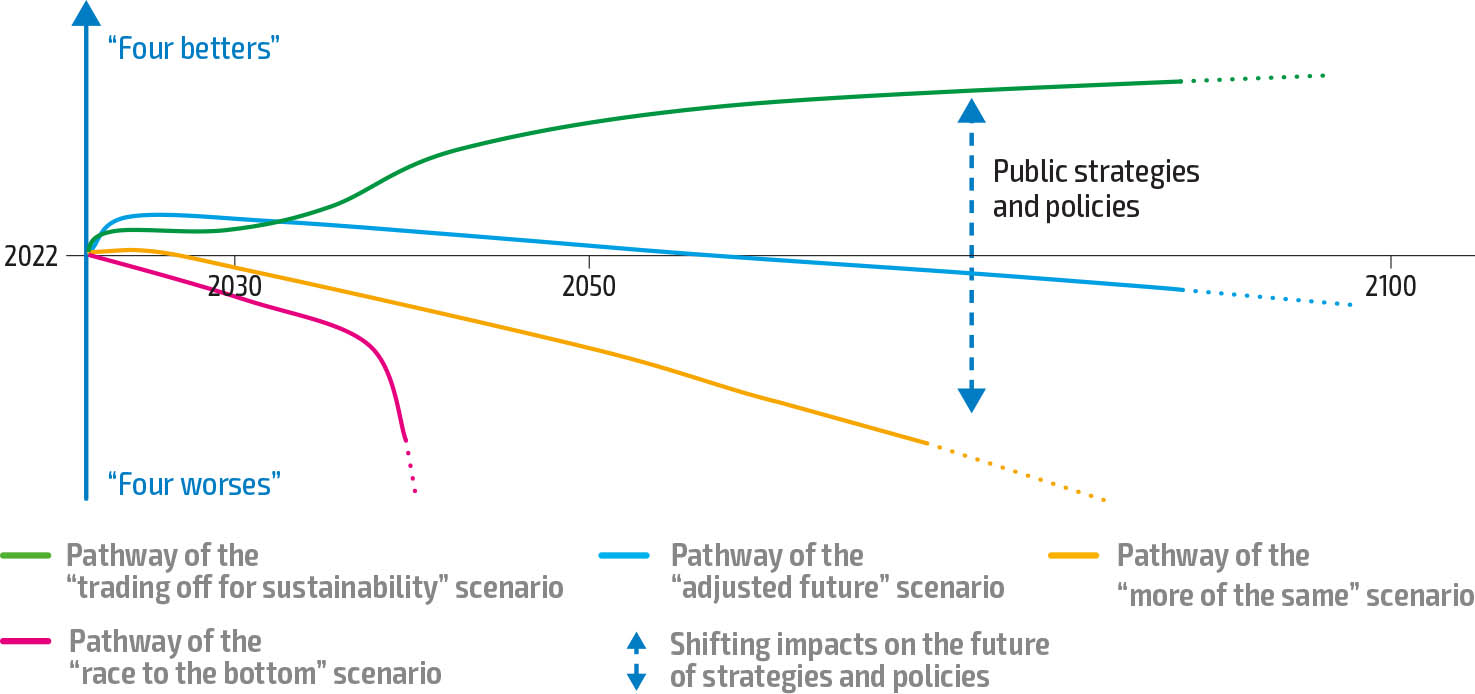
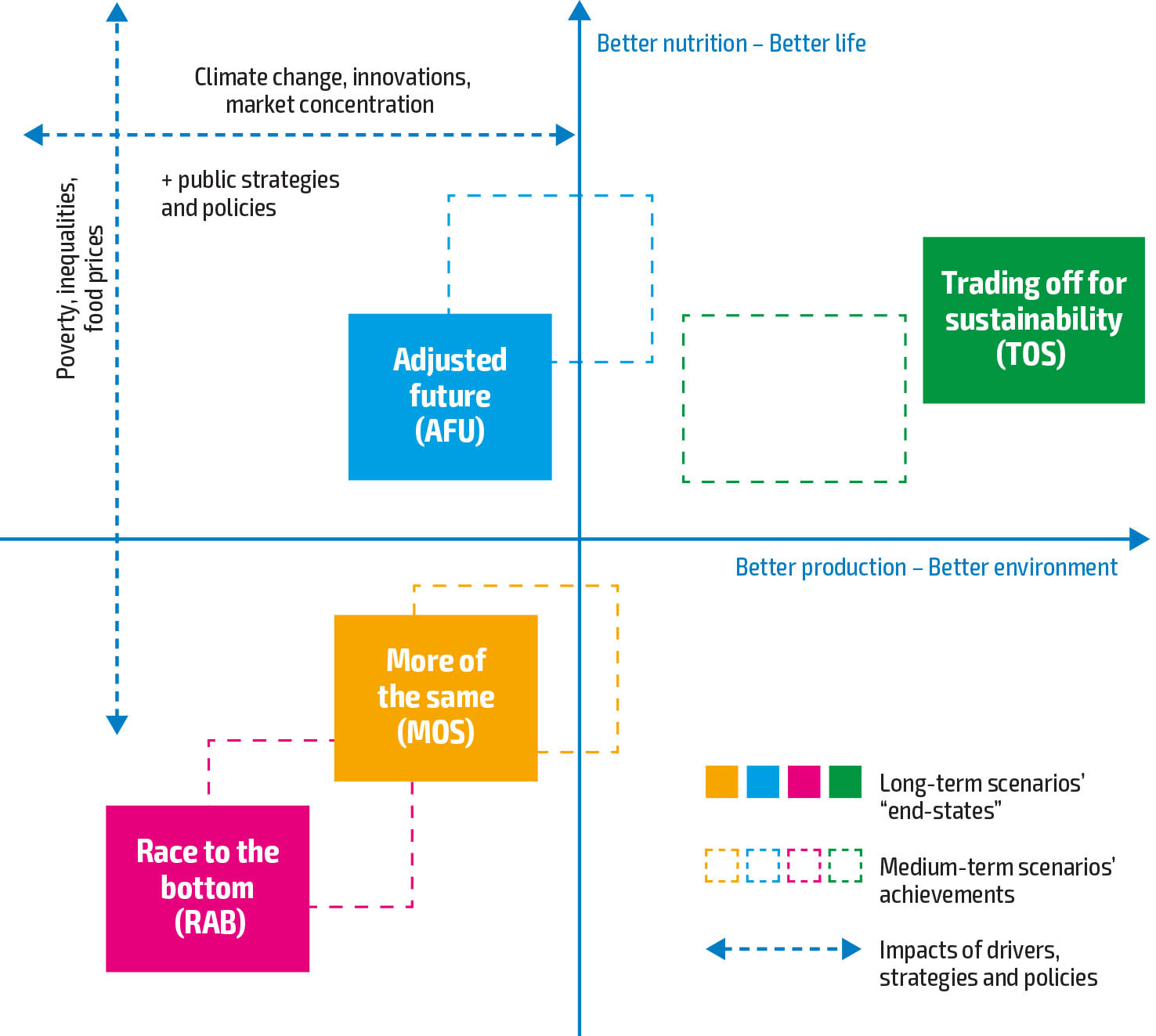
Source: Authors’ elaboration.
The summary narratives of the four scenarios, assumed to be paradigmatic of a multitude of possible futures are described in Table 2.3.5
| SCENARIOS | NARRATIVES |
|---|---|
| More of the same (MOS) Muddling through in reaction to events and crises while doing just enough to avoid systemic collapses, led to degradation of agrifood systems sustainability and to poor living conditions for a large number of people, thus increasing the long-run likelihood of systemic failures. | Ineffective development strategies and policies, economic imbalances across and within countries and skewed international trade, including persisting commodity dependency of many LICs, resulted in national and geopolitical grievances, deteriorating social and humanitarian outcomes, and a continuous environmental neglect throughout the 2020s and beyond. Agrifood systems kept struggling to satisfy an increased food demand as a result of the persistence of conventional agricultural practices that eroded the natural resources base. Dramatic crop yield improvements that materialized during the second half of the twentieth century turned out to be unsustainable in the long run. On the demand side, diets had been only marginally rebalanced to limit reliance on resource-intensive food, rich in animal products. Short-termism and the belief that it was possible to solve issues without questioning the prevailing development paradigm based on fossil energy and power concentration, drove most decisions in the majority of countries and at the global level. Key social and environmental trade-offs were left unaddressed, with no progress made on poverty and hunger eradication. Global corporations continued to prioritize shareholder profit as their primary bottom-line indicator and their fiscal elusion kept jeopardizing public budgets and actions. “Public-private partnerships” (PPPs), quite fashionable in the 2020s, could have had some potential for transformation, but were mostly ill-conceived and not monitored, so they mostly ended up becoming “green-washing or social-washing” devices. As a consequence, the 2030 Agenda and the “four betters” were substantially not achieved by 2030, and the few temporary successes were disproportionately distributed. During the subsequent decades, issues related to climate change, including weather extremes, economic downturns, conflicts and mass migrations, did not allow for any further progress, but rather, led to further degradation and high risks of systemic failures. |
| Adjusted future (AFU) Some moves towards sustainable agrifood systems were triggered in an attempt to achieve Agenda 2030 goals. Some improvements in terms of well-being were obtained, but the lack of overall sustainability and systemic resilience hampered their maintenance in the long run. | Efforts towards adjusting some drawbacks of the development paradigm prevailing in the 2020s ensured some successes in terms of access to basic services, food security and nutrition. Some civil society movements temporarily succeeded in pushing governments to engage in multilateral agreements aimed at addressing issues that required global governance, such as mass migrations and blatant inequalities across and within countries. Some governments, in a quite timid last-minute attempt to meet selected SDG targets, tried to tackle the most urgent economic, social and environmental trade-offs and adopted fiscal policies to fund social protection measures, as well as modest GHG emissions measures and trade regulations. Agrifood and socioeconomic and environmental systems at large could have benefited from such interventions. However, piecemeal approaches, conflicts of interest among public decision-makers subject to the pressure of private lobbies, did not allow for the achievement of more resource-efficient food production or for a substantial internalization of environmental externalities, or the implementation of disincentives for consumption of resource-intensive food. PPPs contributed in some instances to progress towards SDGs, but in several others, they revealed themselves to be only “green-washing or social-washing” devices, as was spotted by a few civil society movements, while systemic governance weaknesses persisted at all levels. Therefore, although some well-being-related SDG targets and “betters” had been achieved in the aftermath of 2030, agrifood and socioeconomic and environmental systems at large failed to transform and ensure maintenance of these achievements in the subsequent decades. |
| Race to the bottom (RAB) Gravely ill-incentivized decisions led the world to the worst version of itself after the collapse of substantial parts of socioeconomic, environmental and agrifood systems with costly and almost irreversible consequences for a very large number of people and ecosystems. | Societies had been progressively structured in separate layers where self-protected elite classes, i.e. groups of wealthy individuals with transnational interests, held a strong decisional power and largely influenced sovereign governments. To preserve their interests, various means, differently blend-ed depending on the institutional set-up of the different geostrategic blocks, had to be increasingly used in order to manipulate and control people, in-cluding ideological propaganda, the myth of good versus evil, the creation of external enemies, more traditional “command-control-punishment” instru-ments associated with pervasive social media restrictions and remote sur-veillance. Both agrifood technologies and consumer preferences had been increasingly shaped to satisfy the needs of business oligarchs. They not only disregarded natural resource conservation and climate change, but also maximized their surplus extraction from domestic and international agri-food value chains by ignoring diversification and resilience. In this context, PPPs became an element of deceptive narratives about development and played a mere “green-washing or social-washing” temporary function. In addition, the lack of social cohesion, citizens’ limited awareness, the increas-ing dependency of most sovereign countries on oligarchies had left ungov-erned global issues, such as climate change, pandemics, energy transition, big data generation and control, international capital flows and migrations. A series of consecutive economic crises, exacerbated inequalities and wide-spread poverty worldwide, and fuelled instability, civil wars and interna-tional conflicts. Ineffective or lacking multilateral cooperation at all levels along with diverging interests of leaders of geostrategic blocks engendered conflicts at a global scale, leading to the collapse of substantial parts of socio-economic, environmental and agrifood systems. Famine, forced mass dis-placements, degradation of natural resources, loss of biodiversity and eco-systems’ functions, and emergence of new pandemics, as well as nuclear and bacteriological contamination, were just signs of a world in complete disar-ray. By 2030, most SDG targets and the “four betters” were far from being achieved and by 2050, they had become a remote dream. |
| Trading off for sustainability (TOS) Awareness, education, social commitment, responsibility and participation triggered new power relationships and shifted the development paradigm in most countries. Short-term GDP growth and immediate final consumption were traded off for inclusiveness, resilience and sustainability of agrifood, socioeconomic and environmental systems. | New power relations, systems and actors emerged during the second half of the 2020s, thanks to civil society movements that progressively increased individual awareness and social commitment towards sustainable development at large. Distributed and participatory power and governance models gradually took over and complemented, or partially replaced, other power relationships based either on “command-control-punishment” mechanisms – typical of autocratic governments – or on the enormous influence of big transnational companies able to steer formally democratic sovereign governments. At world level, this brought about the reshaping of the institutional structures created in the aftermath of the Second World War and of the global development paradigm that ensued and prevailed in the last part of the twentieth century and during the first decades of the current century, based on narrowly defined GDP growth. As a result, multi-stakeholder national and global governance systems became much more effective in conducting global transformative processes. Thanks to these forces, before 2030, governments implemented strictly targeted social protection policies that significantly improved the quality of life of most vulnerable layers of societies. The immediate well-being of all the other citizens was traded off for longer term investments in sustainable production processes, energy transition, GHG reduction, and natural resource conservation and restoration. All this paid back before 2050, also thanks to some well-designed and closely monitored PPPs. Agrifood systems largely contributed to the overall socioeconomic and environmental transformation. Small and commercial farms and multinational corporations progressively adopted more sustainable technologies for food production, integrated multi-output energy and agrifood processing and generated remunerated environmental services. Concurrently, consumers, starting from those in HICs, shifted away from excessive consumption of energy- and natural resource-intensive animal products also because of increased food prices that fully reflected the “true costs of food”, including social and environmental ones. Paradoxes, disparities, uncertainties and challenges had not disappeared, but they played out differently because well-educated citizens had developed critical thinking, had become much less prone to manipulation, more aware of trade-offs that emerged in development processes, and readier to engage in addressing and solving them. Although, by 2030, the “four betters” had not yet materialized fully, solid bases had been built that led to their full achievement and maintenance in the subsequent decades. |
- 4. The “four betters” are defined in FAO Strategic Framework 2022–31: (i) better production: ensure sustainable consumption and production patterns, through efficient and inclusive food and agriculture supply chains at local, regional and global level, ensuring resilient and sustainable agrifood systems in a changing climate and environment; (ii) better nutrition: end hunger, achieve food security and improved nutrition in all its forms, including promoting nutritious food and increasing access to healthy diets; (iii) better environment: protect, restore and promote sustainable use of terrestrial and marine ecosystems and combat climate change (reduce, reuse, recycle and residual management) through more efficient, inclusive, resilient and sustainable agrifood systems; and (iv) better life: promote inclusive economic growth by reducing inequalities (urban/rural areas, rich/poor countries and men/women).
- 5. More detailed narratives are provided in the full report.