S. Kjær1 and J. Madsen2
Danish Environmental Protection Agency, Strandgade 29, 1401 Copenhagen, Denmark,
2Royal Veterinary and Agricultural University, Department of Animal Science and Health,
Grønnegaardsvej 2, DK-1870 Frederiksberg C., Denmark.
Denmark has a land area of 43,000 km2 of which 63% is used for agriculture, 12% covered with forests, and the remaining 24% include built up areas. Ninety percent of the agricultural land is cultivated intensively, while the remaining 10% is permanent grassland. Danish agriculture today is dominated by livestock production. In 1995, 83% of agricultural exports was derived from livestock products, with a value of approximately US$ 6 billion. Currently, of a total of 69 000 farms, 44 000 are involved in livestock production. In recent years, expansion of livestock production has occurred mainly in the pig sector. The average annual number of slaughters increased significantly from 14.5 million over the period 1980-84, to 19.5 million in 1995. Dairy production, however, has remained at the same level since the 1980's due to a milk quota system.
The dominance of livestock production began over a 100 years ago when a major change from grain production to livestock occurred in the country. The driving forces behind this change were: a fear that the soil would be depleted of nutrients with continuous grain production; a fall in grain prices in the world market because of cheaper transport; the innovation of the centrifuge for milk; increased education of farmers; formation of the co-operative movement; and a growing market in industrialised Great Britain. The Common Agricultural Policy (1973 - date) has also contributed to the intensive production system in Denmark. Farmers have responded well to incentives offered by guaranteed prices, investments have increased and the use of inputs like concentrate feeds, commercial fertilisers, pesticides and energy has also increased.
The use of large areas of land for agriculture has had a significant impact on the environment in Denmark. Draining of wetlands, homogenisation of land use and intensive farming have resulted in extensive loss of biodiversity, decline in nature types and semi-culture nature types, and contributed to deterioration of the Danish water environment. These and other problems arising from intensive agriculture with heavy emphasis on livestock production are discussed in this paper.
Intensive livestock production is based on high feed intake and results in a high level of excretion of nitrogen and phosphorous in urine and manure (Table 1).
Table 1. Average excretion of N and P from one-year-old dairy cows
and sows
in Denmark
Nitrogen, kg |
Phosphorous, kg | |
Sows, incl. 22 piglets |
25.7 |
7.1 |
Dairy cow, large breed |
128.0 |
23.0 |
Source: National Institute for Agricultural Science. 1997a. | ||
Consequently, intensive livestock production has led to high levels of nitrate leaching, as well as a significant flow of ammonia and phosphorous into the environment, all of which are major issues in environmental pollution arising from agriculture. The average amount of nitrogen leaching in plant breeder's fields is relatively low when compared with nitrate leaching from animal farms (Table 2).
Table 2.The nitrogen balance in different agricultural systems in Denmark
kg N / ha / year | |||||||||
Application of nitrogen |
Nitrogen leaching | ||||||||
Type of farm |
Group |
Mean |
Total |
Removed by harvest |
Net. |
mean |
min |
max |
n |
Plant breeders |
0 |
0 |
177 |
142 |
35 |
57 |
22 |
98 |
9 |
Animal farms |
0-1 |
0.6 |
230 |
119 |
111 |
77 |
33 |
144 |
8 |
|
1. One Livestock Unit (LU) is defined as the amount of manure produced annually by a cow of a large breed. Other species are expressed in terms of livestock units on the basis of a calculation of the nitrogen content in their manure. | |||||||||
In addition, agricultural production and livestock in particular, is also the source of ammonia evaporation. However, the environmental impact of nitrate leaching has not been uniform throughout the country and the degree of environmental damage varies both with the characteristics of the natural setting in different regions, and with the production system that dominates the region. In particular, the combination of sandy soil and intensive livestock production results in a high level of leaching to ground water. Unfortunately, this combination often occurs in regions where livestock has remained an important economic activity, and has led to a situation where the objectives of economic development and environmental protection are in conflict.
Besides nitrate and ammonia, problems with excessive phosphorous also arise in fields fertilised with animal manure derived from the livestock industry (Table 3). In plant breeder's fields, the total amount of P applied through fertiliser and manure was about equal to the amount of P utilised by the crops and removed at harvest. However, on cattle, pig and mixed farms there was excess application of P, most of which arose from high amounts of manure applied. Increasing livestock densities also result in more manure produced per hectare, and this in turn leads to excessive amounts of P being used in such farms (Table 3).
Table 3. Phosphorus balances for the cropped area on farms with different
agricultural
practices and different livestock densities, 1996
Farm type |
Livestock densities (LU/ha) | |||||||
Plant |
Cattle |
Pig |
Mixed |
0 |
0-.7 |
1.7-2.0 |
>2.0 | |
Commercial fertiliser (kg/ha) |
14.1 |
7.7 |
3.22 |
2.1 |
13.5 |
6.0 |
5.6 |
7.7 |
Source: National Environmental Research Institute | ||||||||
In the international arena, pollution from both nitrate leaching and ammonia evaporation arising from Danish agricultural production is of importance to the state of the marine environment in the Baltic and the North Sea. In addition, intensive agricultural production does not support wild life and biodiversity, which is important from an international perspective because of reduced biotops for migrating birds.
Water bodies - water courses (mainly streams), lakes, fjords, coastal waters and open marine waters, are an important part of the Danish landscape. In recent decades, the environmental condition of these areas has deteriorated in several aspects, as manifested by enhanced algae growth, periods of oxygen deficit and fish. This poor environmental condition is mainly attributed to enhanced nitrogen and phosphorous loading of the aquatic environment. The nitrate and phosphorous concentrations in water courses draining agricultural catchments are considerably higher than those of water courses draining natural catchments. Nitrate concentrations in groundwater exceeding the maximum admissible concentration of 50 mg/l have been detected in 13% of the ground water resources in three regions. This pattern is attributed to a combination of pure crop farms that use considerable amounts of commercial fertilisers, and soil conditions that favour nitrate accumulation.
The environmental action plans relevant to the livestock sector include:
The most important framework of the action programmes is the Action Plan on the Aquatic Environment of 1987, in which the objective to reduce nitrate leaching from agricultural soil by 50% was decided by Parliament. Following the decisions in Parliament, the measures to change agricultural practices in order to control nitrogen pollution have been strengthened continuously from 1987 to date. The Danish Nutrient Policy has concentrated on nitrate because it has been regarded as a serious threat to ground and surface water. The policy to control nitrate pollution is comprehensive and will, to some extent, help to change agricultural practices in order to reduce pollution from ammonia and phosphorous. In the following section, the Danish Nutrient Policy is referred to as the Danish Nitrate policy.
The most important element contained in the Danish Nitrate Policy is the regulation on good agricultural practices for nitrate management. The rationale is that resources available shall be used effectively and that the overall use of nitrogen fertiliser is limited to a sustainable level. The regulation is based on general rules following the concept of command and control, and every agricultural farm is included.
The storage capacity shall be sufficient to ensure that application of manure takes place in accordance with the provisions for field application, and that the utilisation efficiency of the nutrient content of the manure as stipulated by the authorities is observed. Normally, this corresponds to a capacity of nine months supply. From 1987 - 1997, the agricultural sector has invested about US$ 650 million in storage capacity. Government subsidies have contributed to about 25% of the total investment.
The harmony criteria are an expression of the maximum amount of livestock manure that may be applied per hectare annually and, hence, are also an expression of how much nitrogen may be applied per hectare annually. The amount is expressed in livestock units (LU). If the production of manure in a farm holding exceeds the quantities written, leasing agreements shall be made to ensure that excess manure can be disposed of to other properties.
The third condition for effective nutrient management is to keep nitrogen from leaching from the soil after harvest. On each farm during autumn, green cover must be maintained at a minimum level of 65% of the area. This requirement is primarily met by the cultivation of winter crops like wheat and barley. Furthermore, an additional 6% of the farm area must be planted with a catch crop following harvest and the carryover effect must be included in the planning of the nitrogen requirements of the subsequent crop.
The utilisation efficiency of nitrogen in animal manure is defined relative to commercial fertiliser nitrogen. For example, a utilisation efficiency of 60% means that 60% of the total nitrogen in the animal manure ex storage is equivalent to commercial fertiliser nitrogen in terms of the crop response to fertiliser addition. The rule has been introduced step-wise. In 1997/98 the requirement was 60% for pig slurry, and it will be increased to 70% by the end of 2003.
Normative values for crop nitrogen demand are developed for each crop as a function of climate and soil type. Normative values are determined based on a number of field experiments on crop response to nitrogen-addition. The optimum is the economically optimal application rate under the assumption of optimising the economic returns to farmers. Following a Government decision in 1998, the nitrogen norm will be reduced to 10% below the economically optimal application rate with effect from 1 August 1998. To monitor fertiliser use, there has been since 1993 an obligation for Danish farmers to draw up crop rotation and fertiliser plans and fertiliser accounts. From 1998, excessive fertiliser application can be penalised by administrative fines, corresponding to 1.5 and 3 US dollars for excess application of 0-30 kg/ha/year, and above 30 kg/ha/year respectively.
Besides the general regulations, there are a number of programmes based on financial incentives to attract farmers to adopt environmental-friendly production methods. These programmes include financial support for the conversion to organic farming, nature restoration projects like reforestation and re-establishment of wetlands.
In Denmark, there has been continuous development towards more efficient protein feeding of livestock. The use of protein per kg of pig and poultry produced has been reduced by breeding for faster growth of the animals and by adjusting the amino acid composition of the diet to the needs of the animals. From 1985 to 1990, the protein content of the diet fed to dairy cattle was reduced by 7 % nation-wide by introducing a new protein evaluation system in which the feed protein degradation in the rumen was monitored (Madsen, 1985; Hvelplund and Madsen, 1990).
Based on model calculations, the overall amount of nitrogen leaching for the whole nation has been reduced by 17% over the period 1989/90 to 1995/96. The highest reduction in nitrogen leaching (30%) was obtained in watersheds with clay soils and relatively low livestock densities in comparison with watersheds with sandy soils and relatively high livestock densities, where nitrogen leaching was only reduced by 9%.
The amount of commercial fertiliser applied from 1985-1996 was reduced considerably whereas the amount of applied manure was almost constant in this period (Table 4).
Table 4. The use of fertiliser and manure, livestock densities, and
recommended nitrogen for the entire agricultural area in Denmark
in 1985, 1995 and 1996
1985 |
1995 |
1996 | |
Commercial fertiliser (kg N x 106) |
392 |
310 |
285 |
1 Nitrogen input comprises commercial fertiliser, manure, fixation and deposition. | |||
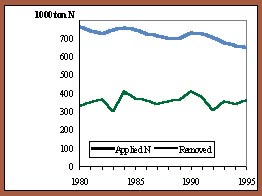
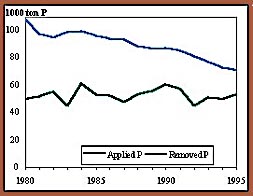
The introduction of the Danish Nutrient Policy has also been effective in regulating the nitrogen (Figure 1) and phosphorus (Figure 2) balances in the field
Figure 1. Field balance of nitrogen, 1980-1995 Figure 2. Field balance of phosphorous, 1980-1995 |
|
|
The major outcomes with regard to the environmental policy for intensive livestock production in Denmark can be summarised as follows:
Danish Institute of Agricultural Sciences. (1997a). Norm Values for Animal Manure. Report No. 736, 165pp.
Danish Institute of Agricultural Sciences. (1977b). Sustainable Agriculture - Report for the Research Programme: Sustainable Agriculture - Reduction of Fertiliser and Pesticide Use. Ministry of Food Agriculture and Fisheries, Structure Directorate, 140pp.
Hvelplund, T. & Madsen, J. (1990). A study of the quantitative nitrogen metabolism in the gastro-intestinal tract, and the resultant new protein evaluation system. The AAT-PBV system. DSc.-thesis. Institute of Animal Science, RVAU. Copenhagen, 215 pp.
Madsen, J. (1985). The basis for the proposed Nordic protein evaluation system for ruminants. The AAT-PBV system. Acta Agric Scand. Suppl. 25. 9-20.
National Environmental Research Institute. (1997). Agricultural Catchment Monitoring Sites, Technical Report No. 210, National Environmental Research Institute. 1997, 144 pp.
Statistics Denmark. Agricultural Statistics (1996). National Statistics, 310pp.
Regional Workshop on Area-Wide Integration of Crop-Livestock Activities, 18-20 June, 1998, FAO Regional Office, Bangkok Thailand.