3.1 Background
3.2 Livestock numbers and distribution
3.3 Cattle
3.4 Sheep and goats
3.5 Research and development activities
3.6 Selected bibliography
3.7 Major changes since 1977
In 1984, Guinea Bissau created a Ministry of Rural Development (Le Ministère du Développement Rural) comprising several "Directorates" one of which is the "General Directorate of Livestock Production". The latter consists of three departments: the Department of Animal Health (comprising nine veterinary sections subdivided into 13 veterinary stations, modern abattoirs and traditional slaughterhouses), the Department of Animal Production [Le Département de la production animale (including breeding stations)] and the Department of Veterinary Research (which includes the Central Laboratory and regional branches) (Tackier, 1985).
Table 1 contains data for human and animal populations of Guinea Bissau.
Table 1. Human and animal populations of Guinea Bissau, 1985.
|
Human population (1985) |
||
|
|
- number |
870 000 |
|
|
- density |
24/km² |
|
Animal population (1985) |
||
|
|
- cattle |
300 000 |
|
|
- sheep |
110 000 |
|
|
- goat |
230 000 |
Source: For human population: projections (+2.2%) from 1979 census.
Chardonnet (1983) mentions an earlier survey on tsetse distribution conducted by Pinto in 1951 which provides more information than the OAU/STRC map of 1977. However, it needs to be updated. According to this survey, G. palpalis is found in almost all of the coastal areas and on the islands off the estuaries. G. morsitans is widely distributed in southern Gabu and Bafata regions and in the regions north of Rio Cowbal. There are also pockets of infestation in the Oio region. The rest of the country has a lower tsetse density. G. longipalpis is found in most areas of the country and G. fused in the south.
Table 2 shows livestock distribution by region for 1980, when the most recent census was carried out.
Table 2. Livestock numbers and distribution in Guinea Bissau, 1980.
|
Regions |
Cattle |
% |
Sheep |
% |
Goats |
% |
|
Cacheu |
25 565 |
9.8 |
4 926 |
5.2 |
31 607 |
16.1 |
|
Bissau |
1 111 |
0.4 |
1 141 |
1.2 |
4 644 |
2.3 |
|
Oio |
34 060 |
13.1 |
12 619 |
13.4 |
47 912 |
24.5 |
|
Bafata |
74 283 |
28.6 |
45 669 |
48.3 |
58 650 |
30 |
|
Gabu |
105 225 |
40.4 |
28 145 |
29.7 |
36 507 |
18.6 |
|
Bolama |
1 718 |
0.7 |
549 |
0.6 |
3 956 |
2 |
|
Biombo |
7 376 |
3.6 |
122 |
0.1 |
2 771 |
1.4 |
|
Quinara |
2 996 |
1.1 |
741 |
0.8 |
4 049 |
2 |
|
Tombali |
5 914 |
2.3 |
699 |
0.7 |
5 333 |
2.7 |
|
Total |
258 248 |
100 |
94 614 |
100 |
195 429 |
100 |
Source: Ministerio do Desenvolvimento Rural (1985).
3.3.1 Breed characterisation
3.3.2 Diseases
3.3.3 Herd management and composition
The 300 000 head of cattle in Guinea Bissau described as "N'Dama" are not of the typical N'Dama type but represent a rather heterogeneous population. The "Livestock Department" still makes a distinction between Boenca or the typical N'Dama and Fulani based on phenotypes such as size, coat colour, shape of the horns etc. Manjaca breeds are currently very few and may be considered as extinct (FAO, 1985).
3.3.1.1 N'DAMA PRODUCTION PARAMETERS
Production parameters (FAO, 1985) for Bafata and Gabu sectors, where the cattle are mainly of the Foula type, are given below:
- Age at first calving: 4 years
- Weaning age: 10-12 months
- Fertility rate: 50%
- Age at culling: about 10 years
The relatively long calving intervals and in particular, an unbalanced nutritional regime, account for the low fertility rate. Furthermore, surveys conducted recently in the Gabu area suggest that the number of bulls available for servicing is insufficient. Apparently the normal practice, is to use the neighbour's bull for servicing purposes during free-ranging.
The calving season is mainly between September and November indicating that cows are serviced mainly in January and February. Tacher (1985) confirms these figures in his report for the World Bank and gives age at first calving of 4 years and 4 months, weaning age of 9 months and calving rate of 49.5%.
FAO (1985) gives a mortality rate of 28.2% for 0 to 1-year old Fulani N'Dama calves and of 16.85 between 1 and 2 years. Tacher (1985) gives a mortality rate of 15% for 0 to 1 year old calves and an overall mortality rate of 8% but does not make any distinction between breeds.
Fulani parameters of production (FAO, 1985) are:
- Birthweight: 10-12 kg- Carcass weight: about 90 kg
- Milk yield: 0.6 kg milked out daily during the rainy season (approximately one-third of total milk yield, the remaining two-third being consumed by the calf). At Bissora station, 120 kg of milk was obtained by hand-milking over a 150-day lactation period.
The disease status is based on a few animal disease surveys or clinical diagnoses rarely confirmed by pathological examinations (FAO, 1986).
The health status can be considered as relatively good because of the absence of deadly diseases such as Rinderpest and contagious bovine pleuropneumonia (CBPP). The last outbreak of rinderpest was reported in 1967. However, there is still the risk of an outbreak through contact with animals from neighbouring countries in search of pasture. In 1984/85 Guinea Bissau received FAO assistance under the "Livestock Health Production Project" which provided vaccines and equipment for a rinderpest vaccination campaign (FAO, 1985).
Black quarter causes heavy losses among 1 to 2-year-old calves. Other diseases include anthrax (all age groups), brucellosis (28.4% of animals in the Northeastern region are affected), pasteurellosis (affects mainly calves at the end of the rainy season), tetanus and tuberculosis (2% of carcasses examined) (Tackier, 1985). No data are availabe on the incidence of these diseases.
Trypanosomiasis is widespread. A survey of calves between the ages of 0 and 2 years indicated that more than two-thirds of the calves are infected at an average age of 43 days. T. vivax (64%) trypanosoma is the most widespread followed by T. congolensis (28%) and T. brucei (7%). There are isolated cases of other parasitic diseases such as babesiosis and anaplasmosis (Ansumane, 1986).
Several cases of multiple gastro-intestinal parasitism have been reported. Ascaridiosis, coccidiosis and strongylosis are common among 0-4 month old calves. Strongylosis is common among adults particularly during the rainy season.
Infection by ticks mangemites, and fleas are also common. The sporadic outbreaks of streptothricosis which pose no serious threat to Bos taurus have been reported (Tackier, 1985).
Tacher (1985) described herd management methods in Guinea Bissau. Livestock production is practiced extensively throughout the country. It is coexistent with rather than integrated into the agricultural system except in areas in which draught power is being developed. Forages are not cultivated and agricultural byproducts and forages are not conserved. Little use is made of household refuse and agro-industrial byproducts (except for the use of brewer's dregs and cotton seeds).
Sedentary livestock breeding and a type of transhumance livestock production are practiced in Guinea Bissau. This is well documented by Tacher (1985) who can be used as reference for further information. The development of draught power is relatively recent. There are currently between 2000 and 4000 pairs of work oxen. A work oxen development project is being implemented in Bafata and Gabu sectors. The project is funded by FED and FAC and trained 2960 pairs of bullocks between 1978 and 1984. The aim was to train and allocate 3000 pairs and provide health follow-up and control. The project's funding will soon come to an end (FAO, 1985).
Herd composition, based on the 1980 census, is presented in Table 3.
Table 3. Herd composition in Guinea Bissau, 1980.
|
Females |
|
Males |
|
|
Cows |
46.3 |
Bulls |
6.9 |
|
Heifers |
13.8 |
Steers |
4.2 |
|
Calves |
10.7 |
Young males |
9.4 |
|
|
|
Calves |
8.7 |
|
Total |
70.8 |
Total |
29.2 |
Source: Ministerio do Desenvolvimento Rural (1985).
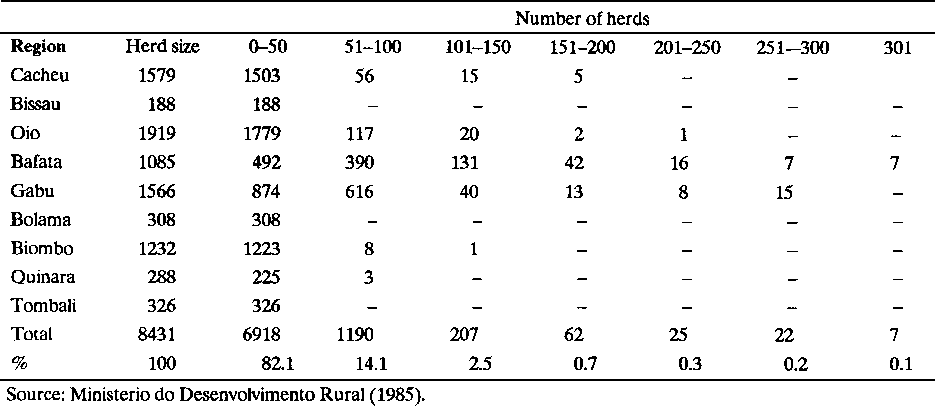
A study on herd size was carried out by the Ministerio do Desenvolvimento Rural in 1984. The results appear in Table 4.
Table 4. Cattle hem sizes in the nine regions of Guinea Bissau.
Average number of cattle per household is about 37. However, as is evident from Table 5, this varies considerably between regions.
Table 5. Number of cattle per household in Guinea Bissau.
|
Region |
Number of cattle |
Number of cattle per household |
|
Cacheu |
25 565 |
16.2 |
|
Bissau |
1 111 |
5.9 |
|
Oio |
34 060 |
17.7 |
|
Bafata |
74 283 |
68.4 |
|
Gabu |
105 225 |
67.1 |
|
Bolama |
1 718 |
5.5 |
|
Biombo |
9 376 |
7.6 |
|
Quinara |
2 996 |
13.1 |
|
Tombali |
5 845 |
17.9 |
Source: Ministerio do Desenvolvimento Rural (1985).
According to an FAO (1985) study, production parameters for sheep are: lambing rate 167%, mortality rate between 0 and 6 months 15-20%, and average adult weight 25 to 30 kg.
Fertility rate for goats is estimated at 25-300%, mortality rate for 0-6-month-old kids at 10-12% and average adult weight at 18-21 kg.
The two state ranches, both under the Director of Veterinary Services, continue their activities.
In 1985 the Bissora Station maintained about 150 N'Dama and 10 Gir and 5 N'Dama x Gir crossbreeds produced by artificial insemination of N'Dama cows. It aims to improve beef and milk production in the N'Dama. Crossbreeding with Zebu Nelore is also envisaged. The station, which received external funding from Switzerland, is also involved in the extension of draught power.
Bissau Station continues its activities aimed at improving milk production (Ly, 1985). Funding for the Pradis Station project is still being sought.
Data on the integrated rice and cotton (Bafata) and groundnut (Bafata) development projects and the Rice Seed Multiplication Project (Contuobel) are unavailable. However, the projects continue with their activities.
The following new development projects on livestock breeding were submitted at a CILSS meeting in 1986 (FAO, 1986):
· UNDP project to provide laboratory material, medicines and vaccines (implemented in 1985)· FAO livestock health protection project for a joint vaccination campaign against anthrax and blackquarter and strengthening of the livestock section
· Zone 1 (Biombo, Cacheu and Oio) integrated project: assistance to the livestock production section of this area and development of the use of work oxen (financed by
Sweden)· Zone 2 integrated project (Bafata and Gabu): this project has distributed an estimated
3000 pairs of work oxen· Financial assistance is provided by FED and FAC.
In 1985, an FAO mission visited the country to identify rural development projects with livestock production components. The following projects were endorsed:
· Assistance to Bissora livestock production station· Establishment of a livestock research centre at Bissora
· Establishment of small ruminants research site.
In Gabu, the following projects/studies were endorsed:
- Study of the traditional livestock production system- Campaign to prevent mortality of calves between 15 days and 4 months old
- Epizootiologic study of disease constraints in the country
- Socio-economic study of methods of improving animal production
- Improvement of livestock and meat marketing methods.
The projects have been submitted to donors by the government but there is no indication as to whether funding will be provided.
Ansumane B. 1986. Country Report: Guinea Bissau. Presented at the New Techniques for African Animal Trypanosomiasis Control Workshop held in Bamako, 9-11 December and organised by FAO.
Chardonnet P. 1983. Approche de l'élevage et de la pathologic bovine en Zone Est. Ministry of Rural Development.
Directorate of Livestock Productions. 1977. Annual Report, 1977.
FAO (Food and Agriculture Organization of the United Nations). 1985. Draft Report: Guinea Bissau. Programme international de coordination du développement laitier et programme international de développement du secteur des viandes. FAO, Rome, Italy.
FAO (Food and Agriculture Organization of the United Nations). 1986. Consultants' report on the improvement of animal health services in CILSS member countries. Vol II: Country reports and project proposals. Consultations held in Banjul, The Gambia, 23 27 June 1986. FAO, Rome, Italy.
Ly B. 1985. Report on a consultation mission on the marketing and breeding of trypanotolerant cattle. FAO Project GCP/RAF/190/ITA. Ouagadougou, Burkina Faso.
Ministerio do Desenvolvimento Rural, Direccao dos Servicos Pecuarios. 1985. Boletim de Pecuaria, Jan. 1985.
Tacher G. 1985. Etude sectorielle de l'élevage en Guinée Bissau effectuée pour le compte de la Banque Mondiale. IEMVT (Institut d'élevage et de médecine vétérinaire des pays tropicaux), Maisons-Alfort, France.
The figures given in this study for the human and animal populations are significantly higher than those presented in the previous study and are based on data for censuses carried out following the publication of Volume 2 of this study. They, therefore, better reflect the current situation in the country. One should, therefore, try to avoid making comparisons between the two series. In view of the renewed interest shown in animal husbandry during the past few years, the government is giving priority to this sector. Some development projects are in the pipeline. A comprehensive study of the sector was carried out in 1985 and funds are being sought for several projects which have already been identified.
These various activities should help determine the potential for livestock production in Guinea Bissau and encourage its future development.