9.1 Background
9.2 Livestock numbers and distribution
9.3 Cattle
9.4 Sheep and goats
9.5 Research and development activities
9.6 Selected bibliography
9.7 Major changes since 1977
Yamoussoukro became the capital of Côte d'Ivoire in 1983, replacing Abidjan.
The Ministry of Animal Production, created in 1966, was merged with the State Secretariat for Agriculture (Le Secrétariat d'Etat à l'Agriculture) in 1983 as the Ministry of Rural Development (le Ministère du Développement rural).
Following a re-organisation of the ministries in July 1986, two ministries, the Ministry of Agriculture and the Ministry of Water Resources and Forestry, were created from the Ministry of Agriculture, Water Resources and Forestry. The Ministry of Rural Development was restructured to create two ministries: the Ministry of Rural Development and the Ministry of Animal Production.
Data on human and animal populations of the country are given in Table 1.
Table 1. Human and animal populations of Côte d'Ivoire, 1985.
|
Human population (1985) | ||
|
|
- number |
10 187 000 |
|
|
- density |
31.77/km² |
|
Animal population (1985) | ||
|
|
- cattle |
922 000 |
|
|
- sheep |
1 032 000 |
|
|
- goats |
748 000 |
Sources: For human population: data for 1983, projections (+4.1%) based on 1975 census figures, Ministry of Economy and Finance. For cattle, sheep and goat populations: the Directorate for Livestock Production in the Ministry of Rural Development (MDR), 1985; Animal Production Development Company (SODEPRA) (1985) and Sarniguet (1986).
A recent study on tsetse distribution in Ivory Coast Northern Savannah region was carried out by FAO and GTZ in 1979/80. According to the survey, the riverine species G. palpalis, G. palpalis gambiensis and G. tachinoides and the savanna species G. morsitans submorsitans and G. longipalpis are found throughout the study area. G. fusca, G. medicorum, G. palicera pallicera and G. palpalis are found in the south of the study area (UNDP-FAO/GTZ, 1982).
Livestock numbers in each region in 1982 are given in Table 2.
In 1985, the national herd was estimated at 922 000 cattle out of which, 605 000 cattle are found in the sedentary traditional system, farms and ranches and 317 000 in the transhumant system.
The Northern region accounts for an estimated 86% of the cattle population, the Southern region for 10% and South Forest region for 4%.
Table 2. Livestock numbers and distribution, 1985.
|
|
Numbers |
% | |
|
North Zone | |||
|
|
- Transhumant |
317 000 |
|
|
|
- Sedentary |
455 900 |
|
|
|
- Farms and ranches |
23 800 |
|
|
Subtotal for North |
796 700 |
86.5 | |
|
Centre Zone | |||
|
|
- Humpless cattle under traditional system |
90 500 |
Management |
|
|
- Humpless cattle on farms and ranches |
4 500 |
|
|
|
- Subtotal for Centre Zone |
95 000 |
10.3 |
|
West, South-east and South-west Zones | |||
|
|
- Humpless cattle under traditional system |
20 000 |
Management |
|
|
- Humpless cattle on farms and ranches |
9 500 |
|
|
Subtotal for South Forest Zone |
29 500 |
3.2 | |
|
Subtotal for farms and ranches |
37 800 |
4.0 | |
|
Rounded total | |||
|
- Sedentary |
605 000 |
65.8 | |
|
- Transhumant |
317 000 |
34.2 | |
|
Total cattle number |
922 000 |
100.0 | |
Source: Sarniguet (1986).
Cattle numbers and distribution for 1985 by livestock production systems in Northern region are given in Table 3.
Table 3. Cattle numbers and distribution in the Northern Departments, 1985.
|
Department |
Sedentary livestock |
Transhumant livestock |
Work oxen |
Stations and ranches |
Total cattle |
|
Touba |
9 700 |
- |
500 |
- |
10 200 |
|
Biankouma |
6 300 |
- |
- |
3 000 |
9 300 |
|
Seguela |
3 600 |
- |
400 |
12 600 |
16 600 |
|
Mankono |
5 900 |
- |
500 |
- |
6 400 |
|
Odienne |
25 900 |
1 400 |
2 000 |
- |
29 300 |
|
Boundiali |
50 000 |
69 200 |
12 700 |
2 300 |
134 200 |
|
Khorogo |
125 500 |
152 000 |
12 400 |
200 |
290 100 |
|
Ferkessedougou |
76 900 |
65 300 |
9 300 |
5 700 |
157 200 |
|
Bouna |
113 900 |
27 200 |
400 |
- |
141 500 |
|
Total |
417 700 |
315 100 |
38 200 |
23 800 |
794 800 |
Source: Sarniguet (1986).
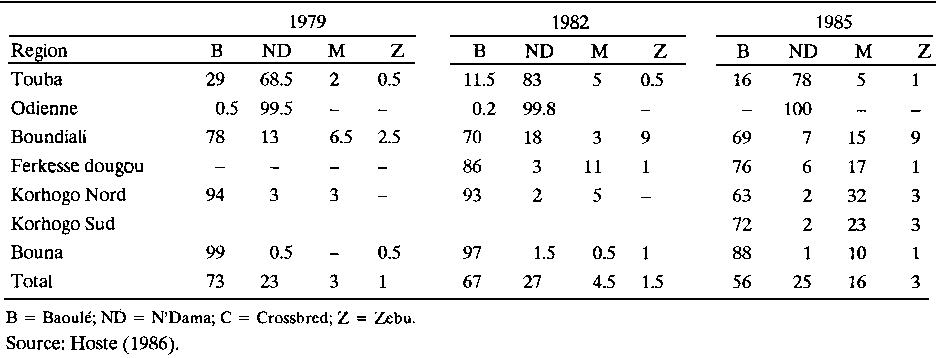
Cattle distribution by breed in the Northern regions for the years 1979,1982 and 1985 are shown in Table 4. The figures give an indication of the extent of zebu x Humpless crossbreeding operations in the northern part of the country.
The Table shows a significant decline in the number of Baoulé from 73% of the cattle population in the north in 1979 to 56% in 1985. This indicates an annual decrease of 4.5% per year. At this rate, if no conservation measures are taken, the percentage will drop to 20% within the next 20 years and the breed will become extinct within the next 40 years.
Table 4. Cattle number and distribution by breed in the northern region, 1985 (%)
9.3.1 Breed characterisation
9.3.2 Diseases
9.3.3 Herd management and composition
In 1985, the trypanotolerant cattle population of Côte d'Ivoire was an estimated 672 000 head comprising 138 000 N'Dama, 350 000 Baoulé, 1000 Lagune and 183 000 zebu x humpless crossbreds.
9.3.1.1 BAOULE PRODUCTION TRAITS
Landais and Poivey (1981) quoted a mortality rate of 18.3% for 0-1-year-old calves under village conditions, including 4.2% dying before they are a month old and following a sample survey in 65 pens operated by SODEPRA Nord 1.3% for calves dying within three days of birth. Godet et al (1981) estimate milk yield at between 130 and 150 kg for a 210-day lactation period (standard deviation 122 days). Hoste et al (1983) give a milk yield of 400 kg (coefficient of variation 22%) for a 210-day lactation period for cows at CRZ Bouake.
Khorogo CRZ studied average daily weight gain under village conditions for various ages in Affouvassou, Centre region. The results are shown in Table 5.
Table 5. Average daily weight gain (g/d) for calves in Affouvassou.
|
|
Age (months) |
|||||||
|
1 |
2 |
3 |
4 |
5 |
6 |
6-12 |
Cumul |
|
|
ADG (g/d) |
203 |
137 |
107 |
110 |
127 |
180 |
76 |
110 |
|
Numbers |
32 |
32 |
32 |
32 |
32 |
32 |
32 |
31 |
Source: CRZ, Khorogo (1980).
9.3.1.2 N'DAMA PRODUCTION TRAITS
In its technical annual report (SODEPRA, 1984), the Animal Production Development Company gives various data for reproduction parameters and mortality rate for N'Dama. Parameters collected under village conditions are given in Table 6 and those for ranches or breeding stations in Table 7. Numbers and standard deviations are not given and these figures should, therefore, be taken just as examples.
Table 6. N'Dama reproduction traits and mortality rate under village conditions (1984 data).
|
|
SODEPRA-North |
SODEPRA-Centre | |
|
Fecundity rate (%) |
48 |
48.3 | |
|
Mortality rate (%) | |||
|
|
- Overall |
- |
3.3 |
|
|
- 0-1-year-old calves |
10.2 |
- |
|
|
- Adults |
3 |
- |
Source: SODEPRA (1984).
Table 7. N'Dama reproduction traits and mortality rate ranch-reared, 1984.
|
|
Marahoué |
Abokouamekro |
Sipilou | |
|
Fertility rate (%) |
60.3 |
53.3 |
47 | |
|
Fecundity rate (%) |
64.6 |
55.9 |
47.6 | |
|
Mortality rate | ||||
|
|
- Overall |
7.3 |
15.1 |
11.1 |
|
|
- Calves |
7 |
26 |
10.1 |
|
Females | ||||
|
|
- Heifers |
8.12 |
12.8 |
8.6 |
|
|
- Breeding heifers |
2.96 |
12.8 |
7.7 |
|
|
- Cows |
4.94 |
7.2 |
17.3 |
|
Males | ||||
|
|
- Male calves |
8.4 |
12.8 |
15.5 |
|
|
- Steers |
9 |
12.8 |
15.5 |
|
|
- Bulls |
5.6 |
7.2 |
8.7 |
Source: SODEPRA (1984).
Godet et al (1981) give the following estimates for N'Dama milk yield under traditional management: average milk yield of between 200 and 220 kg for a lactation period of 210 days (standard deviation 122 days). Hoste et al (1983) gave a milk yield of 475 kg for CRZ, Bouake (coefficient of variation of 22%) for a 210-day lactation period.
Data collected by SODEPRA (SODEPRA, 1984) for growth rate for calves raised on ranch or breeding stations are given in Table 8.
A feedlot trial was conducted under breeding station conditions to determine the potential for fattening N'Dama calves (Janssens, 1986). A total of 60 two-year-old N'Dama steers were given a supplementary feed of cotton seeds, molasses and licking powder for 6 months. Initial weight was 178 ± 8 kg and weight at the end of six maintained months was 225 ± 15 kg. Average weight gain during the 6-month trial period was therefore 260 g/d.
Table 8. Growth rate for N'Dama calves under ranch or station conditions.
|
1. Data collected on Marahoué ranch |
|||||||
|
Average weight (kg) at 9 months in breeding herd |
|||||||
|
|
- Males |
|
|
|
|
|
103.3 kg |
|
|
- Females |
|
|
|
|
|
99.4 kg |
|
Average weight (kg) at 9 months in ranch herd |
|||||||
|
|
- Males |
|
|
|
|
|
98.3 kg |
|
|
- Females |
|
|
|
|
|
95 kg |
|
2. Data collected on Noroningue Station |
|||||||
|
Age class |
Birth |
3m |
6m |
18m |
12m |
24m |
|
|
n= |
21 |
23 |
39 |
42 |
56 |
40 |
|
|
Weight (kg) |
19.5 |
64 |
108 |
156 |
212 |
230 |
|
Source: SODEPRA (1984).
9.3.1.2.1 Index of productivity
Table 9 summarises estimates of the main production traits required to build up a productivity index based on the total weight of 1-year-old calves per 100 kg of cow raised per year. The index is based on data for beef production collected under ranch conditions with average trypanosomiasis risk.
Table 9. N'Dama productivity estimates for beef production under ranch or station conditions with average trypanosomiasis risk.
|
Adult females viability (%) |
92.8 |
|
Calving rate |
60.3 |
|
Calf viability to 1 year (%) |
74 |
|
Calf weight at 1 year (kg) |
127 |
|
Productivity index per cow per year (kg) |
58.7 |
|
Cow weight (kg) |
250 (a) |
|
Productivity index per 100-kg cow maintained per annum (kg) |
23.5 |
(a) Estimate
Source: Index calculated by authors.
9.3.1.3 MERE
No recent data are available on the Méré.
9.3.1.4 LAGUNE
No special studies on the Lagune breed have been carried out during the past 10 years.
9.3.1.5 ZEBU
Bonnet (1983-84) gave an estimated fertility rate of 55%, mortality rate for 0-1-year-old calves of 8% and an abortion rate of 4%. These figures were obtained from a survey of 3500 head of zebu from sedentary herds (Rombaut, personal communication).
The disease status in Côte d'Ivoire is described in detail by Touré (1986). Rinderpest is a constant threat and between 1983 and 1985 there were outbreaks of the disease in Ferkessedougou, Djeriba, Niellé, Sanhala, Khorogo and Sinématiali regions. In 1984, seven cases of contagious bovine pleuropneumonia were reported. There were outbreaks of anthrax and blackquarter in the north-east and north-west of the country in 1984. Bovine brucellosis, pasteurellosis and tuberculosis remain major problems. There have been no recent reports of foot-and-mouth disease and vaccination against this disease is not given.
Apart from trypanosomiasis, on which available data are sparse, few parasitic epidemiology studies have been conducted although it is agreed that parasitic diseases are widespread. Douati (1984) mentions a survey on animal diseases conducted by SODEPRA on village humpless cattle in northern Côte d'Ivoire which gives an infestation rate of 13% for 0 to 2 year-old calves. The Tsetse Eradication Project gives a mean infestation rate of 25% in this region for zebu calves.
Landais (1983) analysed the sex composition of nine herds comprising 1407 head in Khorogo region. He reported that 24.6% were males and 75.5% were females. There were few males over two years and even fewer bulls. In 1983, the Marahoué herd consisted females, 20.1% males and 9.1% calves.
The number of draught animals in 1983 was estimated at over 34 000 in the cotton-producing region of which 27 700 were trained by SODEPRA Nord. In 1985, this scheme handled an estimated 38 200 head of draught animals (Sarniguet, 1986).
9.4.1 Breed characterisation
9.4.2 Diseases
9.4.3 Herd management
9.4.1.1 SHEEP
Major efforts have been made to improve and develop small ruminant production in Côte d'Ivoire and recent data on production traits have been collected.
9.4.1.1.1 Performance traits
Bassewitz (1983) gives reproduction parameters and mortality rate for West African dwarf sheep under improved village conditions and under pastoral management. These two animal husbandry systems are more specific to the north of the country. In the first type of system the sheep are given supplementary feed (see section on "Herd composition and management"). The data are presented in Table 10.
Disset (1986) gives the reproduction traits and mortality rates obtained under villae conditions. He gives a fertility rate of 106%, a lamb mortality rate of 3.7%, an adult mortality of 2.4% and an overall mortality rate of 6% (these figures are underestimates as some animals are born and die without being included in the survey).
Table 10. Reproduction traits of West African dwarf sheep under improved village and pastoral management conditions (weighted arithmetic means: 1980/81).
|
|
Improved village conditions |
Pastoral conditions | |
|
Number of lambings surveyed |
207 |
362 | |
|
Fertility rate (%) |
122 |
151 | |
|
Prolificity rate (%) |
107 |
109 | |
|
Mortality rate (%) |
|
| |
|
|
- Global |
21 |
24 |
|
|
- Males |
16 |
30 |
|
|
- Females |
25 |
19 |
Source: Bassewitz (1983).
Data on the reproductive performance and mortality rate of West African dwarf sheep under ranch or breeding station conditions are given in Table 11.
Table 11. Reproductive traits and mortality rate of West African dwarf sheep under ranch or breeding station conditions.
|
|
(*) 1 |
2 |
3 |
4 |
5 |
6 | |
|
Fertility rate (%) |
80 |
121 |
138 |
144 |
200 |
142 | |
|
Prolificity rate (%) |
113 |
109 |
|
132 |
124 |
| |
|
Mortality rate (%) | |||||||
|
|
- Global |
10 |
|
28.1 |
7.0 |
|
7.5 |
|
|
- Young |
|
15.6 |
13.8 |
11.4 |
21.4 |
7.9 |
|
|
- Adults |
|
6.8 |
|
1.5 |
11 |
2.7 |
Sources:(*)
1: CRZ, Bouaké (1982).
2: Herds managed by SODEPRA-Nord (SODEPRA, 1984).
3: Badikaha Semen Farm (SODEPRA, 1984).
4: National Sheep Breeding Centre (Disset, 1986).
5: Sud Forestier Project (SODEPRA, 1984).
6: Toumadi Sheep Production Scheme (Disset and Rombaut, 1986).
Table 12 contains data on the growth parameter of lambs raised under ranch or station conditions presented by SODEPRA in its technical activities report for 1984.
Table 12. Growth parameter of lambs raised under ranch or breeding station conditions.
|
Data collected at the National Sheep Breeding Centre | |||
|
Birthweight of | |||
|
|
- Single litter males |
2.08 | |
|
|
- Twin litter males |
1.9 | |
|
|
- Male average |
2.1 | |
|
|
- Single litter females |
2.03 | |
|
|
- Twin litter females |
1.74 | |
|
|
- Female average |
1.90 | |
|
|
- Male and female average |
1.96 | |
|
|
- Weight at 80 days | ||
|
|
|
- of males |
10.95 |
|
|
|
- of females |
9.86 |
|
|
|
- average |
10.41 |
|
Average daily weight gain (g/d) |
106 | ||
|
Weight(kg) | |||
|
|
- of males |
19.84 | |
|
|
- of females |
16.79 | |
|
|
- average |
18.13 | |
|
Data collected at the Sud-est Forestier project | |||
|
Birthweight (kg) | |||
|
|
- of males |
1.9 | |
|
|
- of females |
1.8 | |
|
Weight at 3 months |
11.3 | ||
Source: SODEPRA (1984).
Disset and Rombaut (1986) give information on lamb growth at Sodepalm Sheep Farm, Toumodi. These data are given in Table 13.
Table 13. Growth parameters for sheep on SODEPALM Sheep Farm, Toumodi.
|
Birthweight (kg) | |
|
- Single-litter lambs |
2.47 |
|
- Twin-litter lambs |
2.16 |
|
Weaning weight (kg) | |
|
- Single-litter lambs |
14.9 |
|
- Twin-litter lambs |
13.85 |
Source: Disset and Rombaut (1986).
Daily weight gain for male lambs of single-and twin litter births by age class are given in Table 14. Data were collected at Sodepalm Sheep Farm, Toumodi.
Table 14. Daily weight gain (DWG) of lambs by age class (g/d).
|
|
Ages |
||||
|
0-30 d |
30-90 d |
90-120 d |
120-180 d |
205 d |
|
|
Single-litter birth |
173.4 |
105 |
100 |
98 |
|
|
Twin-litter birth |
142 |
90 |
87 |
|
99 |
Source: Sodepalm (1983-1984).
9.4.1.1.2 Productivity index
Table 15 summarises estimates of the main production traits required to calculate a productivity index giving the total weight of S-month-old lambs produced per 10 kg of ewe maintained per year. This index is calculated from data collected at the National Sheep Breeding Centre.
Table 15. Productivity estimates.
|
Ewe viability (%) |
95 (a) |
|
Lambing rate (%) |
137.5 |
|
Lamb viability to one year (%) |
95 |
|
Lamb weight at 5 months (kg) |
14 (a) |
|
Productivity index per ewe per year (kg) |
18.7 |
|
Ewe weight (kg) |
25 (a) |
|
Productivity index per 10 kg of ewe maintained per year |
7.5 |
(a) Estimates. Source: Index calculated by authors.
9.4.1.2 GOATS
This aspect of livestock production has been more or less neglected and no recent data could be obtained.
Peste des petite ruminants is the most serious viral disease. In 1984, there were three outbreaks involving 577 cases, of which 547 were fatal. A total of 21 731 doses of vaccine were injected to small ruminants.
Sheep pasteurellosis is controlled with a limited rate of coverage (1126 immunisations in 1984). The same applies for sheep pox and anthrax (Touré, 1986).
Nervous dysfunctions due to nutritional deficiencies are reported under intensive farming conditions. Recently, cases of adenocarcinoma of the pituary mucosa, a disease with a rapidly evolving morbidity rate were reported for the first time (Rombaut, personal communication).
In his 1983 document, Bassewitz gives a detailed description of flock management in northern Ivory Coast. New data contained in the report are summarised below. Bassewitz (1983) classifies flock management under four systems: urban production system, Fulani pastoral production system, improved traditional management system and the free-range system. Urban livestock production is the most intensive of the traditional livestock production systems but involves only 5% of the sheep population. The animals, mainly Sahelian x West African dwarf crossbreeds, freely graze by the roadside and on refuse during the day, returning at nightfall to be locked up in mud huts. They are given a regular supplementary feed of corn, corn bran and cooking salt. This type of animal husbandry system is practiced more for prestige purposes and as an investment rather than for commercial reasons.
Pastoral management became important following the sedentarisation of the Fulani in Côte d'Ivoire in 1972. An estimated 25% of the sheep population in the North are managed under this semi-sedentary husbandry system. Flocks are herded during the day by the owner's children and kept in an enclosure made up of thorn branches at night. This is a typical Sahelian practice introduced by the nomadic Fulanis. Flocks are generally large and are given little or no supplementary feed. However, traditional health care is provided. Flocks are raised for commercial purposes.
Almost 70% of the sheep in the north of the country are managed under the improved traditional management system. This system is practiced mainly by the Senoufo in the north and northeast. Its main features are night penning, organised distribution of supplements, health care and herding by hired herdsmen or family members.
The free-range system is of minor importance in the north but widely practiced in the Guinea savanna and forest region. The animals, which are considered as an investment, live as commensals are given no health care while being allowed to roam the village grazing by the roadside and on household refuse. Consequently, they cause considerable damage to crops, resulting in conflicts between farming and pastoral communities.
9.5.1 Research centres
9.5.2 Multiplication herds
9.5.3 Development activities
As a result of the cabinet reshuffling in July 1986, the Department of Education and Scientific Research was divided up into four ministries: the Ministry of National Education, responsible for Higher Secondary Education; the Ministry of Technical and Professional Training; the Ministry of Primary Education and the Ministry of Scientific Research. Within this Ministry, animal husbandry activities are carried out mainly by the Centre de recherche zootechnique (CRZ) de Minankro, Bouaké. In 1986, the centre, which is the Livestock Production Department of the Institut des Savanes (IDESSA), maintained 200 N'Dama, 430 Baoulé and 80 crossbreds of various combinations. The National Artificial Insemination Centre (CNIA) and the Central Laboratory for Animal Nutrition (LANCENA), which are structures of the Ministry of Livestock Production, conduct studies on animal husbandry under field or laboratory conditions. CNIA is under the Bingerville Animal Pathology Laboratory which carries out diagnostic work and produces vaccines. LANCENA (06 BP 353) is situated within the Ecole Nationale Superieure d'Agronomie at Abobo in the outskirts of Abidjan. It controls the quality of animal feed produced in Côte d'Ivoire and carries out analyses and research on the nutritive value of feedstuff and digestibility of local products.
The National Sheep Centre (CNO) at Béoumi on Lake Koussou develops and improves livestock production techniques and material. It also conducts studies on the nutritional aspect of sheep production, improvement of pastures and selection of forages most suitable for sheep production. It also serves as a control base for rams in the National Programme for the Genetic Selection of West African Dwarf Sheep. The programme is partly financed by FAC.
SODEPRA, in collaboration with the International Livestock Centre for Africa (ILCA) and the International Laboratory for Research on Animal Diseases (ILRAD), carries out research on the productivity and health of trypanotolerant cattle and small ruminants at Tengrela and Boundiali within the framework of the African Trypanotolerant Livestock Network (ILCA, 1986). A small ecological laboratory has also been set up at Korhogo, as part of the Tsetse Eradication Project being implemented with the collaboration of Germany (GTZ), to determine the effect of insecticides on the fauna of regions in which the programme is being conducted. In 1986, the study programme of the project was concerned with testing new techniques for the control of G. morsitans, studying the effect of chemical attractants on G. tachinoides and the behaviour of G. longipalpis and G. palpalis palpalis (Douati, 1986).
Major livestock multiplication activities are still carried out by the Société de développement des productions animales (SODEPRA) through its three N'Dama ranches described in Table 16.
SODEPRA is also responsible for "Commercial Cattle Operations" which aim to develop various crossbreds to meet the demand for improved animals in Côte d'Ivoire. This project is being implemented in Noroningue and Panya stations and is presented in Table 17.
Table 16. SODEPRA ranches on which N'Dama cattle are bred.
|
Name |
Abokouamékro |
Sipilou |
La Marahoué |
|
Location |
Near Yamoussoukro 120 km south of Bouaké |
Near Biankouma north-west of Man |
North-east of Ségéla |
|
Organisation responsible |
SODEPRA |
SODEPRA |
SODEPRA |
|
Size |
12 000 ha |
12 000 ha |
99 160 ha of which 65 960 are usable |
|
Breeds and numbers |
3000 N'Dama (end 1984) |
3465 N'Dama (end 1984) |
12 212 N'Dama (in 1985) |
|
Starting year |
1962 |
1964 |
1975 |
|
Objectives |
Selection and multiplication of the N'Dama breed |
|
|
|
External aid |
|
|
FED |
Source: Shaw (1985).
Table 17. Commercial cattle operations.
|
Name |
Panya Station |
Noroningue Station |
|
Location |
Near Boundiali |
North of Ferkessedougou |
|
Organisation responsible |
SODEPRA |
SODEPRA |
|
Size |
9000 ha |
1200 ha |
|
Breeds and numbers |
2283 in 1984 of which 432 zebu, 282 N'Dama, 15 Ndamaze and 1554 Ndamaze. |
394 Ndamance and 332 N'Dama in 1984 |
|
Objectives |
Ndamaze production (N'Dama x Zebu Gobra crossbreds) |
Ndamance production (N'Dama x Abondance crossbreds) Ndasie production (cross between N'Dama and Fleckvieh) BSIE and own |
|
External aid |
BSIE and own resources |
resources |
Source: De Rochemontiex (1984); Shaw (1985).
The Ministry of Animal Production is also in charge of the following livestock centres:
· Bingerville Livestock Centre in the southern region near Abidjan works mainly with poultry and also provides training for producers.· Bingerville Animal Pathology Laboratory recently set up an artificial insemination Centre for the collection and freezing of cattle semen and the collection and packaging of ram semen. An insemination programme funded by the Belgian and Ivoirian governments was initiated in 1986. The project aims to inseminate 25 000 sheep and
5000 head of cattle over a three-year period.· The National Sheep Centre whose objectives are: to develop and improve breeding techniques, provide training for herders and specialised technicians, conduct selection of the West African dwarf breed and supply producers with efficient breeding stock. In
1984, CNO had a flock of 2060 sheep and currently operates in association with six private breeders selected as selection and multiplication breeders under the selection programme (SODEPRA, 1984).· The Oil Palm Development Company (Palm Industrie) maintains over 7000 head of cattle on five plantations located in the coastal area. In 1984, the herds consisted of 1000 Baoulé and crossbreds on the Ehania plantation, 3000 N'Dama at Fresco, 800 N'Dama at Bolo, 1500 N'Dama in December 1986.
· The Société de développement des palmiers à huile (SODEPALM) has a sheep production programme at Toumodi. In 1986, the station had 5324 sheep. The programme was launched in 1979, with joint funding jointly by FAC and CCCE. External aid will cease in December 1986.
Livestock development activities are still carried out mainly by SODEPRA.
SODEPRA-nord (training of livestock producers in the Northern region) covers seven areas: Touba, Odienne, Boundiali, Ferkessedougou, Bouna and Korhogo north and south.
The programme involves 417 700 head of sedentary and 315 100 head of transhumant cattle, 38 200 draught oxen and 23 800 head of cattle raised on ranches or breeding stations. External aid is provided by France (CCCE and FAC), Germany (GTZ), Belgium (AGCD), (SODEPRA, 1985; Sarniguet, 1986). Since 1984, SODEPRA has also carried out the "Operation of Zebu Training in the North" and "Operation of Sheep Production in the North".
The project to provide Training and Development of Breeding farms in the Central Region covers five departments: Bouaké, Katiola, Boundoukou, Dimbokro and Yamoussoukro. In 1984 the project involved 54 252 head of cattle and 29 730 sheep. In 1985, funds were provided by ADB for a four-year period.
SODEPRA is also responsible for the Ferkessedougou Commercial Feedlot Centre which has fattened an estimated 7966 head of cattle. The project also trained 38 000 draught oxen in collaboration with Ivorian Textiles Company (CIDT).
SODEPRA is also responsible for Badikaha Semen Farm, located 50 km southeast of Khorogo. The farm has an area of 6732 ha and in 1982 maintained 1327 head of N'Dama, Ndamance and Baoulé. It will be the main multiplication centre for Ndamance breeding stock from Noroningue.
Recently, three other development projects were implemented:
· The project to develop livestock production in the forest areas of the South-eastern region, began in 1981, and is based in Abidjan. It is funded by CCCE.· The project to develop livestock production in the forest area of the Western Region, based in Gagnoa, was launched in 1984 and is funded by ADB.
· The project to develop livestock production in the forest areas of Ouest Region, based at Man, was launched in 1983. It is funded by the Government of Belgium.
These three projects focus primarily on the development of intensive mixed farming and short-cycle livestock breed.
No recent data are available for the Bandana Valley Development Project operated by SODEPRA.
A National Sheep Selection Programme was launched in 1983. It is managed by the Ministry of Animal Production and funded by FAC. The programme aims to improve the conformation and sale weight of West African dwarf sheep (Humbert, 1984).
Finally, an important meeting was organised jointly by the government and FAO in 1986 in Bouaké. The meeting followed a series of consultations in the field to define a strategy and a plan of action for livestock development for the years 1986-2000. Several development projects were identified during the meeting. The following involve cattle and small ruminant production:
· Establishment of dairy teaching farms· Establishment of dairy production belts
· Providing assistance in the production of veterinary vaccines
· Animal Trypanosomiasis Control Project in Côte d'Ivoire
· Mobile veterinary diagnosis units
· Extensive semi-industrial improved feeding operations
· Pilot improved feeding and finishing operation in conjunction with animal traction in cotton-producing areas
· Mini-ranch operations
· Baoulé Selection and Multiplication Centre Project.
Funds are being sought for the various projects.
Bassewitz H G. 1983. Perspectives d'amélioration de l'élevage ovin villageois en zone soudanaise de l'Afrique de l'Ouest, examinées par l'exemple de la Côte d'Ivoire.
CRZ de Bouake. 1981. Contribution à l'étude des troupeaux villageois sédentaires du Nord Ivoirien: analyse de la mortalité des veaux entre la naissance et un an.
CRZ de Khorogo. 1980. Contribution à l'étude de la production laitière et de la traite en elevage sédentaire village d'Affouvassou.
De Rochemonteix. 1984. Elevage naisseurs de Panya-Noroningue. Rapport annuel (annual report) 1984.
Disset R. 1984. La promotion de l'élevage ovin en région du centre. Mission Report. CEL. POV 309, July 1984.
Disset R. 1986. Elevage ovin: la production ovine et caprine en Côte d'Ivoire. Ministère du Développement Rural, Abidjan, Côte d'Ivoire.
Disset R and Rombaut D. 1986. Evaluation de l'élevage ovin de la SODEPALM à Toumoudi (Projet Manioc/ovin). FAO (Food and Agriculture Organization of the United Nations), Rome, Italy.
Douati A. 1985. Country report: Côte d'Ivoire. Presented at the first meeting to coordinate the activities in West Africa of the Programme for the Control of African Animal Trypanosomiasis and Related Development held in Bobo-Dioulasso, Burkina Faso. FAO (Food and Agriculture Organization of the United Nations), Ouagadougou, Burkina Faso.
Douati A. 1986. Programme d'activité et budget prévisionnel pour la campagne 1986. Projet "Lutte antiglossinaire". Ministère du Developpement rural.
FAO (Food and Agriculture Organization of the United Nations). 1986. Stratégie et plan d'action pour le Développement de l'élevage en Côte d'Ivoire. FAO (Food and Agriculture Organization of the United Nations), Rome, Italy.
Godet G, Landais E, Poivey J P, Agabriel J and Mawudo W. 1981. La traite et la production laitière dans les troupeau villageois sédentaire au nord de la Côte d'Ivoire. Revue d'élevage et de médecine vétérinaire des pays tropicaux 34(1):63 71.
Hoste C. 1986. Genetic improvement of ruminants in Côte d'Ivoire. FAO project GCP/RAF/190/ITA. Ouagadougou, Burkina Faso.
Hoste C, Cloe L, Deslandes P and Poivey J P. 1983. A study of milk production of suckling N'Dama and Baoulé cows in Côte d'Ivoire and growth of their calves. Revue d'élevage et de médecine vétérinaire des pays tropicaux 36(2):197-207.
Humbert J M. 1984. Le programme national de sélection ovine de Côte d'Ivoire. Report presented at the "Journées techniques de reflexion sur l'élevage et la protection des petite ruminants au Togo." FAO (Food and Agriculture Organization of the United Nations), Ouagadougou, Burkina Faso.
ILCA (International Livestock Centre for Africa). 1986. The ILCA/ILRAD Trypanotolerance Network Situation Report, December 1985. Proceedings of a network meeting. ILCA, Nairobi, Kenya/ILCA, Addis Ababa, Ethiopia. 98 pp.
Janssens L. 1984. Encadrement et promotion des fermes d'élevage dans le centre de la Côte d'Ivoire. Final report.
Landais E. 1983. Analyse des systèmes d'élevage bovin sédentaire du Nord de la Côte d'Ivoire. Vol. II. Données zootechniques et conclusions générales. IEMVT (Institut d'élevage et de médecine vétérinaire des pays tropicaux), Maisons Alfort, France. 759 pp.
MDR (Ministère du développement rural). 1984. Direction de l'Elevage, 1984. Rapport d'activités.
Sarniguet J. 1986. Stratégie et plan d'action pour le Développement de l'élevage. Consultant's Technical Report on the economic aspect of livestock production.
SEDES (Société d'études et de développement des productions animales). 1985. Opération d'encadrement des éleveurs du nord de la Côte d'Ivoire. Etude de faisabilité de la troisième phase de l'opération 1986-1990. Rapport définitif. SEDES, Paris, France.
Shaw A. 1985. Consultation Mission on the marketing and breeding of trypanotolerant cattle. FAO project GCP/RAF/190/ITA. Ouagadougou, Burkina Faso.
SODEPRA (Société de développement des productions animales). 1984. Rapport des activités techniques. Ministère du Développement Rural. Abidjan, Côte d'Ivoire.
Touré S M. 1986. Santé animale et Médecine vétérinaire préventive en Côte d'Ivoire. Milan actuel 1985 et prévisions de politique sanitaire. FAO project GCP/RAF/191/ITA. Ouagadougou, Burkina Faso.
UNDP-FAO/GTZ (United Nations Development Programme-Food and Agriculture Organization of the United Nations/German Agency for Technical Cooperation). 1982. Etude de l'infestation glossinaire en Côte d'Ivoire. Cartographie de la répartition des glossines. Côte d'Ivoire, Ministère de la production animale, Abidjan, Côte d'Ivoire.
In 1986, Côte d'Ivoire with FAO assistance developed a strategy and plan of action for national livestock development. During that period various studies on all sectors and animal species were published. The increase in the zebu population which numbered 107 000 head in 1977 should be noted. In 1986, it was estimated at 250 000 head. The percentage of Baoulé in the trypanotolerant population, compared to N'Dama, has decreased significantly due to a lack of interest in the breed and crossbreeding with European breeds. The largest N'Dama ranch in West Africa, with 12 000 head of N'Dama, is located in Côte d'Ivoire. A dairy programme using N'Dama x Abondance crossbreds is currently being implemented in the vicinity of some large towns.
Côte d'Ivoire has made major efforts to improve and develop its small ruminant production. A major event in the subregion was the implementation of a National Sheep Selection Programme in 1983 which has produced significant results. Improved West African dwarf breeding rams may soon be on the international market.