Abstract
Introduction
Choice between oxen and cows for work
Effects of work on physiology and metabolism
The effect of work on the health of draught animals
The effect of work on food intake
The effect of work on digestion
The effect of work on bodyweight change
The effect of work on the productivity of draught cows
The Husbandry of Draught Animals
Seasonal use of draught animals
Duration of work
Housing
Health care of draught animals
Feeding draught animals
Sustainable systems
Future research needs
Résumé
References
R. W. Matthewman*, J. T. Dijkman* and Ercole Zerbini**
(* Centre for Tropical Veterinary Medicine, University of Edinburgh, Easter Bush, Roslin, Midlothian, EH25 9RG, Scotland**International Livestock Centre for Africa, Addis Ababa, Ethiopia.)
This paper reviews research findings relevant to draught animal husbandry and management, and highlights the differences in use of oxen and cows for draught. Topics considered include the choice between cows and oxen and effects of work on physiology, metabolism, health, food intake, digestion, bodyweight change and lactation and reproductive physiology in draught cows.
The husbandry and management of draught animals are considered and methods are described which could be adjusted for different draught animal-powered farming systems. Aspects covered include duration of work housing, health care and feeding of draught animals. In considering these aspects of husbandry, attention is focused on the need to optimise the use of farm resources in the search for sustainable farming methods.
A summary of topics deserving more research is given. It is suggested that farming systems research in close cooperation with the local communities is required to determine ways of producing adequate food for draught animals and the establishment of sustainable farming systems.
Draught animals are economically important, but their maintenance involves both risk and capital expenditure to the owner. Their outputs include livestock products as well as increased crop yields and transport facilities. Because of their importance and the demands made upon them, draught animals deserve good care and attention. This will help reduce the risk of loss and make them a more acceptable and reliable innovation. Draught cows in particular require high levels of husbandry input if their overall productivity is not to suffer.
Considerable research has been done on technical aspects of draught animal use such as nutritional requirements, work output and the design of implements. Husbandry aspects and constraints to the adoption, integration and sustained use of draught animals in farming systems have received less attention. Similarly, draught cows and the effect of work on their production have been considered only recently.
This paper reviews research findings relevant to draught animal husbandry. The husbandry of male and female draught animals is considered and suggestions are made for further research.
Oxen are often the preferred draught animals in tropical farming systems, but cows are used where land and food resources for ruminants are scarce. Where pressure on land is high, large animals tend to be excluded in favour of smaller female animals. Bangladesh is a good example of this interrelationship, where up to 50% of draught animals are cows (Matthewman and Foulds 1988). Other situations exist where high pressure on land has reduced food resources for ruminants, such as in Kano State, Nigeria and the Kenyan and Ethiopian Highlands. In Zimbabwe Tembo (1989) has described how land population pressure and poor exploitation of the available draught oxen has become critical to crop production. It is under such conditions that cows can help to meet the demand for draught power.
Parts of the world where cows are used to provide draught power include Bangladesh Indonesia, Pakistan, Philippines, Thailand, Sri Lanka, Poland, Senegal, Egypt, Zambia, Zimbabwe, Guadaloup (Plate 1) and others (Nourrissat 1965: Rollinson and Nell 1973; Kumaratileke and Buvanendron 1979; Akhtar 1981; Lhoste 1983; Ranjan 1983; Sasimowski et al. 1984; Rep. Zam. 1985; Barton 1987 and Matthewman 1987 and 1988).
An advantage of using cows for work is that male animals can be slaughtered at a more optimum time. Also, draught cows, when they produce milk and calves, are capable of using food energy more efficiently than oxen. In addition the total number of animals needed to maintain the 'draught herd' is significantly lower than when oxen are used (Smith 1981). Disadvantages are that cows cannot work in late pregnancy and their work output may be lower than that of bigger oxen. The nutrient requirements for work may interfere with growth, lactation and the reproductive cycle, because it is often difficult to provide enough high quality food to meet the demands of these functions.
The use of cows almost presupposes conditions of scarce or declining resources and here research is needed to find methods of stopping the downward spiral of resource availability on small farms. Where conditions are approaching those where under other circumstance cows are used, on-farm research is needed to determine the feasibility of and constraints on the introduction of the use of cows.
Exercise and work have many effects on physiological and metabolic functions. The consequences include short-term stress, increased metabolic rate (short-term), increased energy and nutrient requirements and changes in the ratio of blood metabolites characterised by a drain on blood glucose and acetate, the depletion of glycogen reserves and the stimulation of free fatty acid mobilisation. The replacement of body stores after work is associated with short-term increase in metabolic rate. It has been shown that the metabolic rate of animals after work remains high until reserves of glycogen and energy yielding metabolites such as free fatty acids and tryglycerides have been replaced (Lawrence et al. 1989). Nutrient requirements will be increased as a result. When animals work they become fitter. This involves increased cardiovascular rate, increased muscle tone, changes in lean to body fat ratio, effects on digestive function and reduced long-term metabolic rate. As they become fitter and better co-ordinated they use less energy, which can partly offset the increased metabolic rate discussed above.
Different types of draught animals will respond in different ways to the effects of work. Research can help farmers and extension staff devise husbandry practices to allow draught animals to meet the demands of work and overcome some of the adverse effects.
Draught cattle suffer the normal health problems of other cattle (Kehoe and Chan 1987; Kenyon et al. 1989). Work also may have direct effects on health, some beneficial and some detrimental; however, little published informal on exists about these direct effects.
Stress, caused by poor husbandry or overwork, can pre-dispose to other health problems (Munzinger 1982). In untrained animals, stress is characterised by increased body temperature, increased respiration rate, fatigue and energy expenditure to maintain homeostasis. Starkey (1981) describes how the balance between parasite and host may break down if the host is overworked or underfed. Munzinger (1982) distinguishes two types of ailments, those resulting directly from work such as wounds, sprains, tendonitis and inflamed hooves, and those resulting from increased susceptibility induced by work and for which natural premunity or tolerance can quickly disappear under stress, such as trypanosomiasis and tick-borne disease.
A discussion of stress related to draught animals is given by Wells (1986) who describes the stages of the syndrome as - alarm, resistance and exhaust on - which can result in a depressed immune response. Stress apparently gives rise to increased susceptibility to normally a virulent bacteria, the activation of latent viruses and a poor response to vaccines. If protein nutrition is deficient, this can suppress immunoglobulin production. Wells considers stress to have been the cause of increased incidence of haemorrhagic septicaemia in Asian cattle and buffaloes at the beginning of the rainy season. The same stressors are thought to predispose to trypanosomiasis (T. evansi) in working buffalo in north Vietnam (Wells, 1986). In West Africa where zebu draught cattle are often used at the fringes of tsetse belts, similar problems may occur. Starkey (1982) discusses the health problems of trypanotolerant N'Dama draught cattle in Sierra Leone, which also can reduce or lose their tolerance under stress.
Further research is needed to indicate the exact parameters which cause stress, but in the majority of cases proper preventive health measures and the maintenance of a reasonable physical state of the animals should reduce to a minimum health problems precipitated work.
Evidence from Nepal (Pearson, personal communication) has suggested that work precipitates latent helminth infections in draught buffaloes, which reduced their work output significantly, but preliminary research in Edinburgh (Sewell, personal communication) has not demonstrated a causal link between work and susceptibility to helminths in sheep exercised on treadmills.
On roughage diets, intake is related to the amount of digesta in the reticulo-rumen and the rate of passage through the tract. For diets containing more concentrate, intake is limited by other factors including thermostatic and chemostatic regulation. Ruminants can adjust intake to meet requirements in a similar way to monogastric animals, provided the physical and chemical properties of the food do not impose limitations (Forbes 1983). Hence the animal's current Physiological state plays a part in determining food intake Work increases food intake in horses and rats (Weston 1985), and it might be supposed that work also increases food intake in ruminants. This has been investigated by a number of researchers.
No increase in intake was demonstrated by Henning (1987) who exercised sheep on treadmills, Barton (1987) in Bangladesh who worked bullocks over a seven week period and Lawrence (1985) in Costa Rica who found that intake in oxen was virtually the same when they worked as when they were idle. The animals in these trials must therefore have lost weight.
Ffoulkes (1986), however, found a positive effect of work on food intake in an experiment using 16 female buffaloes fed a diet of a 1:1 mix of coarsely-chopped rice straw and natural pasture grass, amounting to an increased energy intake of 9.8 MJME/d. Winugroho (1988) in Indonesia found a increase in food intake (25%) in mature female buffaloes fed a 50:50 diet of ad libitum chopped fresh road-side grass/rice straw. Bamualim et al. (1987) and Bamualim and Ffoulkes (1988) in further experiments reported no effect of work on food intake. Bakrie et al. (1988), using 6 steers fitted with rumen cannulae, were unable to show an increase as a result of work. Again, animals which did not eat more must have lost weight.
The nutrient demands of lactating cows permit these animals to eat 35-50% more than non-lactating animals of the same weight and on the same diet (ARC 1980). This factor could be exploited if cows are used for draught purposes.
Since the animals in all these experiments were fed on poor quality diets, it would be interesting to see if the same results are obtained when animals are fed on higher quality diets.
Ffoulkes (1986), Ffoulkes et al. (1987) and Winugroho (1988) reported increases in digestibility in working buffaloes (13%, 6% and 12 % respectively). Light exercise may be beneficial causing greater mixing of the rumen contents which may enhance microbial fermentation. Higher levels of work might have more detrimental effects, caused by a shift in blood supply from the gut to muscles and peripheral tissues.
Other authors (Kibet and Hansen 1985; Weston 1985; Astatke et al. 1986) have discussed the effects of exercise on digestion and have found either no effect or negative effects. Negative effects may be associated with other factors such as restricted dietary regimes in these trials.
Although most research suggests that work does not increase Sagest on or food intake in draught animals, it remains to be fully determined whether this is the case. In practice, efforts will have to be directed to the optimalisation of the dietary regime, within the resources available, to ensure the maintenance of the animals in a good physical state.
Astatke et al. 1986 found that both food-restricted animals and animals fed to 100% of requirement lost weight (between 4 - 17%) when working for five h/d over 23 weeks. Winugroho (1988) found that working female buffaloes lost weight (18 kg when working 6 hours per day for 39 days) compared to non-working animals. In a subsequent trial (Winugroho et al. 1989) reported weight losses of 19, 9 and 5 kg for female swamp buffaloes on different dietary regimes compared to gains of 19, 20 and 7 kg for control animals in the same groups.
Ffoulkes (1986) measured reduced weight gains and slight weight losses in working (W) and non-working (C), non-pregnant buffaloes measured over 120 days and fed either on 100% (M) or restricted (R) diets of rice straw and grass. Weight changes for CR, CM, WR and WM were +110g/d +326g/d -6g/d and +79g/d.
Matthewman et al. (1989) found that lactating, pregnant cows which were exercised for 3 hours a day for 3 weeks either lost weight or did not gain weight as quickly as control animals. Weight gains after the exercise were higher than before exercise or during exercise. This might be explained by replacement of gut-fill. Increases in serum-free fatty acid and serum beta hydroxy butyrate levels were recorded indicating mobilisation of body tissue reserves during exercise.
Observations at the CTVM have indicated that well-fed animals increased in body weight at the start of a working period as fat was being replaced by muscle tissue.
The loss of weight should not necessarily be regarded as a bad consequence. If the animals are able to regain their weight within a reasonable period 'working off their beck' could well improve their overall efficiency. However, this only applies to animals which are in relatively good condition at the start of the working period
a) Lactation
Glucose has been identified as a nutrient which may act as a constraint on work or other productive functions in ruminants (Len, 1985). Glucose is not usually an end-product of digestion in ruminants and little glucose is absorbed from the gut. Sugars ingested into the rumen are quickly broken down by microbes and ruminants derive most of their glucose from precursors such as propionate and amino acids. Propionate production is encouraged by feeding diets with a greater proportion of concentrate, rather than roughage diets which promote acetate as the end product of fermentation. Leng (1985) suggests that glucose availability may constrain work, particularly in growing animals or productive females. This may be true despite the animal's ability to synthesise glucose at differential rates according to productive function.
Glucose is essential for lactose synthesis and for certain other functions. The rate of milk secretion is related to the osmotic properties of lactose and is proportional to the rate of secret on of lactose (Rook and Hopwood 1970; Rook and Wood 1959).
A number of authors have stated that if cows are well-fed work will have no effect on milk yield Research on European dual purpose breeds showed no drop in milk yield in cows in good condition (Krautforst 1947).
Rajapurohit (1979) noted that in Egypt work had ill effects on neither the milk yield or health of working cows. Munzinger (1982) states that in Senegal the weight development of Djakore calves whose mothers were used for draught power production and received a working ration, was significantly better than that of calves whose mothers did not work - and presumably did not receive a 'working ration'. The most plausible explanation of this is that the farmers took greater care of their working animals.
Little study has been made of the effect of work on lactation in working cows or female buffaloes. Evidence suggests that when cows work, daily milk yields decline and milk composition is affected Research carried out in Edinburgh (Matthewman et al. 1989; Matthewman et al. 1990) has shown that exercise affects both milk yield and composition. Twelve lactating and pregnant cows walked approximately 9 km/d for 3 weeks (maximum 15 to 17 hours per week or 45 to 51 hours over 3 weeks) and at average speeds of 2.9 km/in. Milk yield was depressed by 7 to 14%. Animals were fed to requirement on diets of known composition. The decline was associated with milk composition changes, which indicated that the decline was not due simply to an energy deficit, but also to the supply of specific nutrients. Milk fat yield (g/d) was not affected by exercise, but lactose and milk protein declined by the same proportion as milk yield. Milk fat concentration (g/100g milk) therefore increased, but milk protein and lactose concentrations remained the same.
The above results for milk yield agree with those of Rizwan-ul-Muqtadir et al. (1975) who found that work caused a 14% drop in milk yield in buffaloes fed a ration containing 13% pop given according to requirement. They ploughed 3 hours a day at speeds of between 2.1 and 2.9 km/h. Other authors (Jabber 1980; Kibria 1982; Goe 1983) have reported that exercise affects milk yield but do not specify levels of reduction.
Barton (1987) found that over a 5 week working period, cows in Bangladesh in the second month of first lactation lost between 23 and 40% of the milk yield These animals ploughed for 2 or 3 hours a day (maximum of 19 hours per week or 95 hours over 5 weeks) at average speeds of 2.2 km/h. They were fed ad libitum alkali-treated or untreated rice straw with 1 kg fresh grass and 300g concentrate. Tornede (1939) in Germany working with cows ploughing in pairs, reported that ploughing for up to 8 hours a day could cause up to an 80% fall in milk yield. It has to be mentioned however, that the actual length of the working period and time of feeding could seriously influence the intake and time left to eat and ruminate.
Although milk yield declines during exercise, yields have been shown to return to previous levels when animals are rested for 2 days after 5 days of exercise (Matthewman et al. 1989).
Diet may influence the response to exercise. Cows in Edinburgh were fed diets of different composition to provide different glucose precursor to determine whether glucose availability constrains lactation in working cows. The diets either provided high levels of propionate (from barley), amino acids from
undegradable protein (fish meal) or starch digested in the small intestine (from ground maize). It was found that diets which promoted high levels of rumen fermentation supported lactation better than other diets. Such diets would be recommended for working cows. Recent research at ILCA suggests that working crossbred cows receiving concentrate supplements show better milk production persistency then non- supplemented animals. Barton (1987) found that cows fed alkali-treated rice straw had a lower reduction in milk yield than cows fed untreated straw. Ffoulkes (1986) however, recommended providing nut nutrients which are non-fermentable and digested in the small intestine, to reduce weight loss in female draught buffaloes.
b) Reproductive Physiology
The effects of work on reproduction in draught cows have been little researched, though numerous reports have been published which offer speculation as to the effects. Work carried out in early lactation could delay return to oestrus and reduced blood sugar levels resulting from work could affect implantation if work was carried out around this time (Macfarlane, personal communication). Bamualim et al. (1987) reported preliminary observations on the effect of work on ovarian activity in 16 non-pregnant swamp buffaloes which worked 2 h/day for 5 days a week for 12 weeks. The animals were offered fresh chopped rice straw and grass (1:1) ad libitum with a salt supplement. Blood samples for plasma progesterone assay were taken as a measure of ovarian activity. This was categorised as negative, doubtful or positive. Of the 8 non-working cows, 6 were positive, 1 doubtful and 1 negative, compared with 2 positive, 2 doubtful and 4 negative in the working group in the last 4 weeks of the experiment. This indicated an important negative effect on ovarian activity due to work.
Weight losses resulting from work may be associated with reduced reproductive efficiency. Teleni et al. (1989) concluded that a loss of approximately 17% of liveweight was detrimental to reproductive function. These animals were in good condition and lower levels of loss might have detrimental effects in animals in poorer condition.
A study conducted by ILCA (Agyemang et al. 1985) on the effect of work on productive and reproductive performance of crossbred dairy cows in the Ethiopian highlands indicates that work had no significant cant effect on milk production, lactation length, days open, calving interval and services per conception when animals received adequate feeding and only worked for short periods.
Much draught animal husbandry and management is the same as for other animals, but there are special features which include the following:
· draught animals have to be able to work when they might be least able to do so (i.e. at the end of dry season)· husbandry practices (e.g. vaccinations, mating of draught cows) will have to be timed in conjunction with work requirements
· work can cause stress and predispose to further health problems
· draught animals are therefore more vulnerable to illness
· veterinary care will be required at specific times
· some specific health hazards of work
· good foot care is required
· draught animals need to be easily handled and used to human beings
· draught animal husbandry requires a greater labour input (for feeding, cut and carry)
· draught cow nutrition is more complex than for oxen
· draught animals may suffer heat stress.
A regular routine of work should be maintained outside the cultivation period. Draught animals should be used for carting in the dry season, rather then regrouping them with the grazing herds as is common in West Africa. This will keep them trained and reduce stress at the start of the new growing season. Draught cows have the advantage that if they are regularly milked' this contact will help to keep them tractable. Farmers, however, might consider the maintenance of such a routine an unnecessary demand on their time and effort. The positive impact of increased effort on family income needs to be demonstrated.
The amount of work expected from an animal should be determined by the food input, the condition of the animal and stage of lactation and pregnancy in females. If necessary, animals should not be worked every day, but the more work that an animal performs, the more efficient it is. Starkey (1981) found that well-fed oxen could work 4-5 hours per day for 5 days a week. Little is known about whether heat affects work output, but the preferred time to work is in the cooler parts of the day (7-11 am; 5-7 pm). If condition is being lost, the work load must be reduced or significant supplementary feeds must be given. In temperate regions animals can work for 6-8 hours per day, presumably as a result of cooler conditions and better food inputs. It might be possible to extend the working period in the tropics if animals are fed higher quality diets and when greater advantage is taken of the cool parts of the day, thereby reducing the problems encountered as a result of heat stress.
Lawrence (1986) has described the methodology for calculating the amount of work and the duration of work that could be expected from an ox on particular diets if the animal is not to lose weight.
Because of their value, draught animals offer one of the best ways of introducing improved animal husbandry methods to local farmers. A simple shelter or lean-to would provide the necessary protection from rain. Shelters should have a sloping floor to allow run-off to keep them dry and clean, and dung should be removed daily to reduce the problem of flies. Good hygiene is essential and more harm than good can be caused by allowing houses or shelters to become dirty. Houses should be periodically disinfected and clean bedding provided. Troughs for food and water should be provided.
Pearson (1986) makes the important point that little benefit will be gained from better feeding, training and improved harnessing and implement design if health is neglected. Care is required to prevent stress and subsequent loss of health to ensure the animal can carry out timely work.
Draught animal husbandry should be as stress-free as possible. If animals are handled frequently, stress caused by contact with human beings will be negligible. Animals should be groomed (washed and brushed) and inspected daily for wounds, skin infections, signs of harness-rubbing and ticks. Hooves should be inspected and trimmed as necessary.
Prior to the main cultivation season, attention should be given to health and condition to ensure that animals will be able to complete the work necessary. Since stress can arise because of poor nutrition, attention at this time to building up body condition is important.
Good vaccines are available against rinderpest, anthrax, black quarter, contagious bovine pleuro-pneumonia, haemorrhagic septicaemia, pasteurellosis and tetanus, and drugs are available for protection against trypanosomiasis. It should be borne in mind that vaccinations should be given at a time that work stress does not interfere with the immune response. Animals should be tested for tuberculosis, brucellosis, trypanosomes, piroplasmosis, Johne's disease and helminths. Cattle can be sprayed strategically against ticks using handsprays or washing. Routine drenching against roundworms and flukes is recommended, particularly where animals are working in wetter areas.
Ectoparasites such as lice can be treated with insecticides. Brushes should also be treated to stop the spread of mange. Ringworm, which is more common in younger animals, can be treated with tincture of iodine daily on the lesions. Wounds and scratches can predispose to other infections such as streptothricosis and should be washed and disinfected. Healing ointment will help protect the wound and keep flies off.
Proper nose rings should be used rather than rope to reduce irritation and laceration of the nasal septum. Horn injuries from tight ropes end neck and shoulder injuries from harnesses can easily be avoided by careful attention to harnessing methods. Ropes and harnesses should be disinfected regularly. Attention should be given to the possible dangers end causes of lameness in the locality where animals work or graze. Stones and earth can become stuck in the hoof, as well as thorns and other sharp objects. Strains and sprains need complete rest.
The nutrient requirements of draught animals have been described by Mathers (1982), Lawrence (1985), Pearson (1986) and Teleni and Hogan (1989). The main energy metabolites which supply working muscles are acetate, free fatty acids and glucose. Acetate is the main energy substrate for resting muscle, but when animals work, free fatty acids become more important and glucose utilisation is increased (Bird, Chandler and Bell 1981; Pethick 1984). Other sources of energy for muscular work include glycerol and the glycogen present in body tissues. In mature oxen, requirements for work would only compete with maintenance for metabolites, but in lactating and/or pregnant cattle greater competition for metabolites could occur. Energy requirements depend on maintenance energy required (MJ ME/d), which is related to body weight (MAFF 1975), and also to rate of growth, type of work, other productive outputs (ea. conceptus and milk) and environmental conditions.
At normal levels of work cattle usually expend between 150% (Barton 1987) and 175% (Starkey 1981) of maintenance energy expenditure. While energy demands for work can be substantial, work appears to have little effect on urinary nitrogen excretion and the demand for protein for increased muscle metabolism for work is considered to be negligible. There is no evidence that work significantly affects vitamin requirements, but it has been demonstrated that work can reduce blood levels of minerals such as magnesium and phosphorus (Agarwal et al. 1982; Pearson end Archibald 1989). Mineral supplements can help to improve productivity in all classes of livestock. In cattle in West Java, Winugroho (1989) reported a 90% increase in liveweight gain in weaners, 28% in lactating cows and 76% in working cattle fed a mineral supplement compared with un-supplemented animals. In hot climates animals may need extra salt to replace that lost in sweat A calcium supplement such as dicalcium phosphate is also recommended to help bone development.
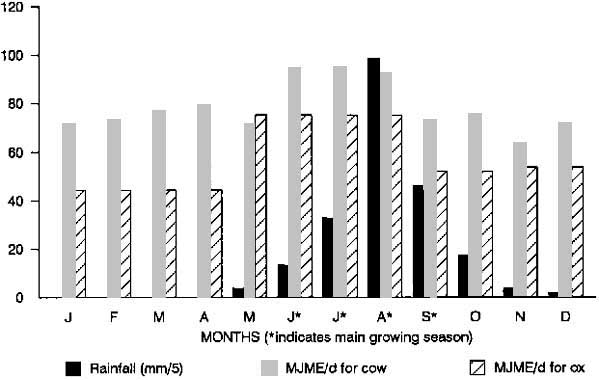
If an ox is not growing it will need to eat enough food to meet maintenance and the requirement for work. For a 400 kg ox working at 1.75 times maintenance this would be approximately 76 MJME/d. For a 400 kg pregnant (3 months) cow doing the same work and producing 3 litres of milk a day, the energy requirement would be approximately 95 MJME/d (see Fig. 1).
Natural vegetation will provide such requirements only at certain times of the year. Work done in the Ethiopian highlands indicates that the energy content of dry roughages range from 6 to 7 MJME/kg. In addition most mature dry and green forages are found deficient in phosphorus and sodium (Bediye and Sileshi 1989). The types of food available for draught animals in West Africa include natural pasture (young, mature, senescent or standing hay), browse and tree leaves, fruits of trees (e.g. Acacia albida and A. tortilis pods) crop residues, agro-industrial by-products, concentrates from crops such as cotton and groundnuts, grain millings, bloodmeal, fishmeal, cereal grains, urea, molasses, salt and mineral supplements. Conserved roughages such as hay and silage are not commonly used in many parts of the tropics. Hence, application of new techniques and research findings to conserve part of the abundance of natural forage during particular periods of the year needs further attention (for example, roughage treatment with alkalis such as sodium hydroxide or ammonium hydroxide derived from urea to improve the nutritive value of poor quality roughages.)
Draught animals are most called upon at the beginning of the wet season when food resources are poor. Strategic 'work flushing' one month before the start of this period would reduce the problems normally encountered.
The timing of feeding during the day and the number of feeds when animals are working should allow the animal to consume as much food as possible. The better the quality the diet, the better the intake.
It is important to weigh animals regularly so that food provision can be adjusted to requirements. Weighbands which measure the heart girth are a good alternative to weighing, but should be calibrated for the particular breed. Condition score is a useful way of gauging the animal's nutritional status.
Application of the knowledge gained to an African farmers' situation will often be obstructed by a lack of resources. With reference to the prevailing climatic conditions, one could' however, draw up a husbandry calendar based on the food energy requirements. Routinisation of draught animal husbandry will simplify draught animal use in the farming operation and will insure that the appropriate measures are carried out at the right time. An example of this is shown in Fig. 1.
|
|
J |
F |
M |
A |
M |
J |
J |
A |
S |
O |
N |
D |
|
Work flush cows + oxen |
|
|
* |
* |
|
|
|
|
|
|
|
|
|
Mating period |
|
|
|
* |
* |
|
|
|
|
|
|
|
|
Pregnancy diagnose |
|
|
|
|
|
|
|
|
* |
* |
|
|
|
Calving period |
* |
* |
|
|
|
|
|
|
|
|
|
|
|
Wean calf |
|
|
|
|
|
|
|
* |
* |
|
|
|
|
Supplement cows |
|
|
|
|
|
|
|
|
* |
* |
* |
* |
|
Supplement calf |
|
|
|
|
|
|
|
* |
* |
* |
* |
* |
|
Deworming |
|
|
|
* |
* |
|
|
|
|
|
|
|
|
Dipping/spraying |
|
|
|
* |
* |
* |
* |
* |
* |
* |
* |
* |
|
Vaccinations |
* |
* |
|
|
|
|
|
|
|
* |
* |
* |
|
Check hoofs |
|
|
* |
* |
* |
* |
* |
* |
* |
|
|
|
|
Weigh/record |
* |
* |
* |
* |
* |
* |
* |
* |
* |
* |
* |
* |
|
Conserve surp. forage |
|
|
|
|
|
|
* |
* |
* |
* |
|
|
* N.B.: seasonal rainfall area
To ensure the best use of scarce research funds, the needs of farmers and farming communities must be determined. The sustainability of systems depends on the balance of inputs end outputs. The power and manure draught animals provide reduce the need for oil-powered machines and fertiliser. In this respect considerable gain can be derived from keeping draught animals on the farm all year round and operating a cut and carry system of feeding. The net input of nutrients and the resulting benefits from dung to productive farmland by cut and carrying fodder can be considerable. If draught animals graze on non-farm land, the benefit would be lost.
As ruminants, draught animals are able to convert otherwise non-utilisable food resources into animal products. In addition, the reduction of the human workload allows more time for other farm activities, such as cut and carrying fodder. Research into the more effective use of animals for these roles deserves a high priority.
Although the introduction of animal traction has in most instances led to improved agricultural production, the actual increase has often arisen from an extension of the cultivated area rather than significantly higher production per ha. It must be stressed that the introduction of draught animal power can only be justified if long term methods can be devised which optimise the use of the available resources, rather than short term maximalisation of production. The use of fallow land for cut and carry purposes or, as in the case of Nigeria, a better use of the fadamas should be researched.
In farming systems where draught power has been employed for a number of years, similar paths will have to be followed to relieve the increasing pressure on the environment Further research into the optimalisation of the productivity and efficiency of the draught cow under different sustainable systems will have to be encouraged.
In areas where draught animals are used, farmers should be encouraged to make the greatest possible use of their animals for farm work and transport. The more work that draught animals do, the greater the efficiency of use of the inputs required to support them. Extension programmes backed by sound on-farm research are required to determine ways of optimising the value of draught animals to the farmers who own them. Only when farmers see the benefits of their increased work Load will they accept and apply new husbandry strategies.
The relationship between work, stress and ill health requires further elucidation, with attention given to the strategic requirements of draught animals to allow them to provide draught power at the crucial times in the farming calendar.
The requirements of male draught animals and oxen are relatively straightforward. Work could double the maintenance energy requirement and food consumption must be high enough to meet these requirements if the animal is not to lose weight. Farming systems research is therefore required to determine ways of producing adequate food for draught animals on the farm and to determine types of locally-available supplements which might provide an adequate diet.
The nutritional requirements of female draught animals are more complicated and research is required to determine the types of local food which can best support lactation and pregnancy as well as work. The complementary roles of diets which promote rumen fermentation and those which promote digestion in the small intestine deserve attention.
The effect that work and exercise have on voluntary food intake, rate of passage and digestion is at present not clear. This topic requires more clarification.
In West Africa there is increasing pressure on land for cultivation and other human activities and this places increased pressure on food resources for draught animals. Although oxen are the preferred draught animal, there is much evidence that smaller draught animals, such as small breeds and cows, can carry out the same farm work as larger oxen. Research into the potential use of cows for cultivation and transport is required.
Only when we can find sustainable long-term solutions in cooperation with the farming communities will people be prepared to overlook the short term benefits of ecological destructive farming methods. The real challenge lies in the application of the knowledge gained to the establishment of sustainable farming environments.
Cette communication examine les résultats obtenus des recherches sur l'exploitation et la conduite des animaux de trait, et met en évidence les différences qui existent entre les boeufs et les vaches utilisés pour la traction. Parmi les thèmes abordés figurent le raisonnement du choix entre les vaches et les boeufs pour la culture attelée et les effets du travail sur la physiologie, le métabolisme, l'état sanitaire, l'ingestion alimentaire, la digestion, les variations pondérales et la physiologie de la reproduction et de la lactation chez les femelles utilisées pour la culture attelée.
Les modes d'exploitation et de conduite des animaux de trait sont examinés, de même que les méthodes susceptibles d'être adaptées à divers systèmes de production fondés sur la culture attelée. Les facteurs considérés sont: le temps de travail, le logement, le suivi sanitaire et l'alimentation des animaux de trait. Une attention particulière est accordée à la nécessité d'optimiser l'utilisation des ressources de l'exploitation agricole dans l'optique d'une agriculture viable.
Les questions nécessitant des études plus approfondies sont récapitulées. Des recherches sur les systèmes devront être effectuées en collaboration étroite avec les communautés locales afin d'identifier les moyens à mettre en oeuvre pour produire suffisamment d'aliments pour les animaux de trait et mettre en place des systèmes de production reproductibles.
Agarwal, S.P., Singh, N., Agarwal, V.K. and Dwaraknath, P.K. 1982. Effects of exercise on serum electrolytes and their relationship in entire, castrated and vasectomised male buffaloes. Indian Veterinary Journal 9, 181-184.
Agyemany, K., Abiye Sotatke, Anderson, F.M. and Woldeab, W. M. 1985. Early indications of effect of work on reproductive performance of crossbred dairy cows in the Ethiopian Highlands. Highland Programme Working Document International Livestock Centre for Africa, Addis Ababa, Ethiopia.
Akhtar, A.S. 1981. Draught animal power as a source of renewable energy in Pakistan. Asian Livestock, 6 (2), 13.
ARC 1980. The nutrient requirements of ruminant livestock. Commonwealth Agricultural Bureaux, Farnham Royal, UK.
Astatke, A., Reed, J.D. and Butterworth, M.H. 1986. The effect of diet restriction on work performance and weight loss of local Zebu and Friesian × Boran crossbred oxen. ILCA Bulletin 23, ILCA, Addis Ababa, Ethiopia.
Bakrie, B., Murray, R.M. end Hogan, J.P. 1988. The effect of work on intake and rumen fluid volatile fatty acid and NH3 concentration of steers fed Rhodes grass hay. Draught Animal Power Project Bulletin 7, December, 1988, James Cook University, Townsville, Australia, 9-13.
Bamualim, A., Ffoulkes, D. and Fletcher, I.C. 1987. Preliminary observations on the effect of work on intake, digestion, growth and ovarian activity of swamp buffalo cows. Draught Animal Power Project Bulletin 3, August 1987, James Cook University, Townsville, Australia, 6-10.
Bamualim, A. end Ffoulkes, D. 1988. Effect of work and level of food intake on nutritional parameters and body weight change of swamp buffalo cows. Draught Animal Power Project Bulletin 7, James Cook University, Townsville, Australia, 2-8.
Barton, D. (1987). Draught power supply, nutrition and the work output of draught animals in Bangladesh. A report prepared for the Ford Foundation, Djaka, Bangladesh.
Bediye, S. and Sileshi, Z. 1989. Feeding value of some Ethiopian feedstuffs. IAR Proceedings 2nd National Livestock Improvement Conference held 24-26 February 1987. Addis Ababa, Ethiopia. pp. 111-113.
Bird, A.R., Chandler, K.D. and Bell, A.W. 1981. Effects of exercise and plane of nutrition on nutrient utilisation by the hind limb of sheep. Australian Journal of Biological Science 34 541-550.
Ffoulkes, D. 1986. Studies on working Buffalo - current research on nutritional aspects. Balai Penelitian Ternakliawi, Bogor. Draught Animal News, 6, CTVM, University of Edinburgh.
Ffoulkes, D., Bamualim, A. and Panggabean, T. 1987. Utilisation of fibrous feeds by working buffaloes. In Dixon, R. (ed.) The utilisation of fibrous agricultural residues as animal feeds. Melbourne, University of Melbourne Printing Service.
Forbes, J.M. 1983. Models for the prediction of food intake and energy balance in dairy cows. Livestock Production Science 10, 149-157.
Goe, M.R. 1983. Current status of research on animal traction. World Animal Review 45, 2-17.
Henning, P.H. 1987. The effect of increased energy demand through walking exercise on intake and ruminal characteristics of sheep fed a roughage diet. Journal of Agricultural Science, Cambridge 109, 53-59.
Hoffmann, D. and Dalgliesh, R.J. 1985. A multidisciplinary approach to health and disease in draught ruminants. In Copland, J.W. (ed.) Draught Animal Power for Production: proceedings of an international workshop held at James Cook University, 10-16 July 1985. Canberra: ACIAR Proceedings No. 10, 134-139.
Jabbar, M.A. 1980. Draught power shortage and mechanisation of tillage in Bangladesh. Bengal Journal of Agricultural Economy 3, 1-26.
Kehoe, M.M. and Chan, L.C. 1987. Buffalo draught power on oil palm estates. The Incorporated Society of Planters, Kuala Lumpur, Malaysia.
Kenyon, S., Fauzi, S., Burton, R. and Darsana, R. 1989. Health in Draught Animals: An example from West Java, Indonesia. In Hoffman, D., Nari, J. & Petheram, R. (ed.) Draught animals in rural development. Canberra; ACIAR Proceedings 27, 212-215.
Kibet, P.K.F. and Hansen, R.M. 1985. The effect of walking while grazing on rumen digestion. East African Agricultural and Forestry Journal 51, 30-35.
Kibria, Q.C. 1982. Draught animal power for crop production and use of cows. Maximum production from minimum land Proceedings of the third seminar held at Mymensyngh, Bangladesh.
Krautforst, J.W. 1947. Influence of work balanced by food on the efficiency of cows. Animal Breeding Abstracts 16, 115, 1948.
Kumaratileke, W.L.J.S. and Buvanendron, V. 1979. A survey of production characteristics of indigenous buffaloes in Sri Lanka Ceylon Veterinary Journal 27, 10-13.
Lawrence, P.R. 1985. A review of the nutrient requirements of draught oxen. In Copland J. (ed.) Draught Animal Power for Production. Canberra: ACIAR Proceedings 10, 59-68.
Lawrence, P.R. 1986. Nutrition of working animals. In: An introduction to working animals. Ed J. Lindsay Falvey. MPW, Melbourne, Australia.
Lawrence, P.R., Buck, S.F. and Campbell, I. 1989. The metabolic rate of oxen after work. Proceedings of the Nutrition Society, 48, 153A.
Leng, R.A. 1985. Muscle metabolism and nutrition in working ruminants. Canberra: ACIAR Proceedings No. 10, Copland (ed.).
Lhoste, P. 1983. Développement de la traction animale et évolution des systèmes pastoraux au Sine Saloum, Senegal (1970-80). Rev. Elev. Med. Vet. Pays. Trop. 36, 291-300.
MAFF, 1975. Energy allowances and feeding systems for ruminants. Technical Bulletin 33, Ministry of Agriculture, Fisheries and Food, HMSO, London.
Mathers, J.C. 1982. Nutrition of draught animals. Paper presented at the FAO expert consultation on appropriate use of animal energy in agriculture in Africa and Asia FAO, Rome.
Mathers, J.C., Pearson, R.A., Sneddon, C.J., Matthewman, R.W. and Smith, A J. 1985. The use of draught cows in agricultural systems with particular reference to their nutritional needs. In Smith, A.J. (ed.) Milk production in developing countries. University of Edinburgh Press, Edinburgh.
Matthewman, R.W. 1987. Role and potential of draught cows in tropical farming systems: A review. Tropical Animal Health and Production 19, 215-222.
Matthewman, R.W. 1988. Draught animals and the role and future potential of draught cows in African farming systems. In Stone, J.C. (ed.) The exploitation of animals in Africa Proceedings of a colloquium at the University of Aberdeen, March 1987, 101-112.
Matthewman, R.W., Merrit, J.B., Oldham, J.D., Phillips, P. and Smith, A J. 1989. Effects of exercise on lactational performance in cattle. Proceedings of the Nutritional Society, 48, 92A.
Matthewman, R.W., Smith, A.J., Pearson, R.A., Phillips, P. and Oldham, J.D. 1990. The effect of sustained exercise on milk yield, milk composition and blood metabolite concentrations in crossbred Hereford × Friesian cattle. In preparation.
Matthewman, R.W. end Foulds, A.B. 1988. Draught animal power in Bangladesh: A review of literature. CTVM Miscellaneous Report, University of Edinburgh.
Munzinger, P. 1982. Animal traction in Africa. Deutsche Gesellschaft für Technische Zusammenarbeit (GTZ), Eschborn, W. Germany.
Nourrissat, P. 1965. Etudes et traveaux sur la traction bovine en Senegal. Agronomie Tropical (Paris) 20, 823-853.
Pearson, R.A. 1986. Feeding and management of draught animals: a review. Indian Journal of Animal Production Management 2, 48-49.
Pearson, R.A. and Archibald, R.A. 1989. Biochemical and haematological changes associated with short periods of work in draught oxen. Animal Production 48, 375-384.
Pethick, D.W. 1984. Energy metabolism in skeletal muscle. In Baker et al. (ed.) Ruminant physiology: concepts and consequences. University of Western Australia, Perth, 277-287.
Rajapurohit, A.R. 1979, Cross-breeding of Indian cattle: An evaluation. In Economics and Political Weekly, A Sameeksha Trust Publication.
Ranjan, S.K. 1983. Carabaos in the Philippines: Priorities for research and development. World Animal Review 46, 26-36.
Rep. Zam. 1985. Draught animal power. Investment Plan Task Force, Planning Division, MAWD, Lusaka, Zambia.
Rizwan-ul-Muqtadir, R.A.G., Ahmad, M. and Ahmad, Z. 1975. Draught power and its effect on milk yield and milk composition in lactating buffaloes during the winter season. Pakistan Journal of Agricultural Science 12, 93-98.
Rollinson, D.H.L and Nell, A.J. 1973. The present and future situation of working cattle and buffaloes in Indonesia.
UNDP/FAO Project INS/72/009. FAO, Rome. Rook, J.A.F. and Hopwood, J.B. 1970. The effects of intravenous infusions of insulin and sodium succinate on milk secretion in the goat. Journal of Dairy Research 37, 193-198.
Rook, J.A.F. and Wood, M. 1959. Potassium and lactose in milk in relation to the physiology of milk secretion. Nature, London, 184, 647-648.
Sasimowski, E, Slomka Z. and Halewicz, Anna. 1984. The use of dairy cows for draught purposes in Silesian Poland. Draught Animal News 2, CTVM, University of Edinburgh.
Smith, A.J. 1981 The role of draught animals in agricultural systems in developing countries. In Vegetable Productivity (Ed C.R.W. Spedding) 247-262. London, Macmillan.
Starkey, P.R. 1981. Farming with work oxen in Sierra Leone. Report of the Sierra Leone Work Oxen Project. Ministry of Agriculture, Tower Hill, Freetown.
Starkey, P.R. 1982. N'Dama cattle as draught animals in Sierra Leone. World Animal Review 42,19-26.
Teleni, E. end Hogan, J.P. 1989. Nutrition of draught animals. In Hoffmann et al. (ed.) Draught animals in rural development. ACIAR Proceedings 27, 118-133.
Teleni, E, Boniface, A. N., Sutherland, S. and Entwistle, K.W. 1989. The effect of depletion of body reserve nutrients on reproduction in Bos indicus cattle. Draught Animal Power Project Bulletin, 8, 10. August, 1989. James Cook University, Townsville, Australia.
Tembo, S. 1989. Draught animal power research in Zimbabwe: Current constraints and research opportunities. In Hoffmann et al. (ed.) Draught animals in rural development. Canberra: ACIAR Proceedings 27, 61-68.
Tornede, H. 1939. The problem of work performance of dairy cows with special reference to hill cattle. Zuchtungskunde 14, 308-333. Animal Breeding Abstracts 8, 230. 1940.
Wells, E.G. 1986. Health of working animals. In An introduction to working animals. Ed. J. Lindsay Falvey. MPW, Melbourne, Australia.
Weston, R.H. 1985. Some considerations of voluntary food consumption and digestion in relation to work. Canberra ACIAR Proceedings No. 10.
Winugroho, M. 1988. The effect of work durations on voluntary food intake and digestibility, liveweights and physiology of buffaloes fed a grass: rice straw diet. Paper presented at the Congress of the Sixth Federation of Asian Veterinary Associations (FAVA), October 16-19,1988, Depasar, Bali.
Winugroho, M. 1989. Mineral supplementation to working buffalo and cattle grazed on field grasses in Subang, West Java. Draught Animal Power Project Bulletin 9, 19. August, 1989. James Cook University, Townsville, Australia.
Winugroho, M., Juwarini, E and Teleni, E 1989. The effect of work on liveweight losses in buffaloes of different body conditions. Draught Animal Power Project Bulletin 8, 9. April, 1989. James Cook University, Townsville, Australia.