


Abstract
Background
Expected farm-level impacts of animal traction
Labour and cost savings
Increase in output.
Higher monetary returns
Socio-economic issues
The cultural environment
Farm size structures
Cropping patterns
Institutional support
Economic viability of animal traction
Conclusion and recommendations
Résumé
References
D.O.A. Phillip and O. A. Ogunbile*
(* Institute for Agricultural Research, Ahmadu Bello University Zaria, Nigeria)
Nigeria's inability to sustain tractorized agriculture means that a favourable environment for animal traction is forming.
The paper investigates the possible impact of draught animals at farm level as far as labour- and cost-saving, increase in output and higher financial returns are concerned. It further describes the socio-economic and cultural issues connected with the adoption of animal traction in Nigeria.
The influence of farm size, cropping patterns and institutional support on the economic viability of animal traction is highlighted. In conclusion, recommendations for future collaborative and interdisciplinary research are put forward.
The status of animal traction (AT) in Nigeria has generally not been consistent. AT was initially introduced into the country to boost the production of cash crops in the northern parts where the technology was (and is still) relatively suited.
The development of tractors in Europe and America and the boom in Nigeria's oil sector appeared to have tempted the country to attempt a 'technological jump' by which the AT option became neglected in favour of tractors.
In most of the states in Nigeria, tractor services were made available through state and private tractor hire units (Table 1).
As a matter of deliberate policy, the demand for tractor services was encouraged and sustained by states through sizeable subsidies on hire rates (Table 2).
The inability to sustain the foreign exchange requirements for importing the tractors and their spares, especially following the collapse of the world oil market in the early 1980s, has led to an increasing fleet of unserviceable tractors at both private and state tractor hire units. Many states have recently taken the bold step of phasing out their tractor hire units. (Phillip 1988).
On-farm labour services have become difficult to hire, or indeed obtain, in Nigeria's rural areas. The period following the mid-1970s has witnessed considerable pressure on rural labour supply, largely because of the rural - urban drift of youth, in search of better wages in the expanding high-income service sector (Oyejide 1986). The increase in the enrolment of children for primary education has also partly contributed to the squeeze on rural labour supply (Philip et al. 1990). The resultant effect has been a rise in rural wage rates since the early 1970s (Table 3).
With the inability to sustain the initial momentum for a tractorized agriculture and the apparent limitation of manual labour, it is hardly surprising, then, that a favourable environment is again returning for AT research, development and adoption in Nigeria.
The role of AT in the Nigerian farming systems can be expressed in physical and/or monetary terms. However, ail the parameters by which the potential impacts of AT are expressed should ultimately provide indications of welfare improvement for adopting farmers and/or society.
Labour has for long been identified as the major limiting resource within farming systems in Nigeria. Labour demand is especially high during the periods marking farming operations such as land preparation, weeding and harvesting, which require a high degree of timeliness (Table 4). Thus, any technological option which reduces the manual labour requirements for on-farm operations deserves attention. Table 5 provides some indications in this direction.
Table 1. Seasonal Labour and animal traction time constraints limit the number of farmers benefiting from tractor hire services in three districts of Kaduna State.
|
|
Number of farmers under | |
|
Year |
State Tractor hire Units |
Private Tractor Hire Units |
|
1980 |
482 |
89 |
|
1981 |
696 |
122 |
|
1982 |
1116 |
101 |
|
1983 |
1554 |
128 |
|
1984 |
1512 |
96 |
|
1985 |
1987 |
166 |
|
1986 |
2301 |
165 |
Source: Phillip and Ezeh (1988).
Table 2. Rates charged to farmers for tractor services in Zaria district (1986), N/hr.
|
Farming |
State Tractor Hire Units |
Private Tractor Hire Units |
|
Ploughing |
8.00 |
20.00-35.00 |
|
Harrowing |
8.00 |
20.00-35.00 |
|
Ridging |
8.00 |
15.00-25.00 |
Source: Phillip and Ezeh (1988).
Table 3. Rural wage rates, 1970-1985, N/day.
|
Year |
Wage Rates |
Wage Rate Index 1970 = 100 |
|
1970 |
0.60 |
100 |
|
1971 |
1.06 |
177 |
|
1972 |
1.52 |
253 |
|
1973 |
1.98 |
230 |
|
1974 |
2.44 |
407 |
|
1975 |
2.90 |
483 |
|
1976 |
3.36 |
560 |
|
1977 |
3.82 |
637 |
|
1978 |
4.28 |
713 |
|
1979 |
5.20 |
867 |
|
1980 |
5.40 |
900 |
|
1981 |
5.60 |
934 |
|
1982 |
6.00 |
1000 |
|
1983 |
6.50 |
1083 |
|
1984 |
7.80 |
1300 |
|
1985 |
8.20 |
1367 |
Sources: 1970-82: Oyejide (1986); 1983-85 Authors' scattered point estimates.
Table 4. Labour requirements (h/ha) by operation for selected enterprises, Funtua Districts.
|
Operation |
Sorghum |
Cotton |
Rice |
Sorghum/Groundnut |
|
Land clearing and preparation |
115.3 |
131.5 |
245.5 |
164.3 |
|
Planting |
28.1 |
41.2 |
28.0 |
94.0 |
|
Ridging and weeding |
263.7 |
207.1 |
224.1 |
378.0 |
|
Fertiliser application |
20.2 |
26.9 |
46.4 |
19.1 |
|
Chemical application |
3.2 |
n.a. |
8.8 |
1.9 |
|
Harvesting |
110.7 |
138.0 |
80.2 |
314.3 |
|
Threshing |
75.2 |
8.4 |
61.7 |
n.a. |
|
Input transportation |
9.2 |
15.0 |
n.a. |
82.1 |
|
Output transportation |
21.5 |
81.9 |
26.1 |
37.9 |
|
Total |
647.0 |
650.0 |
720.4 |
1091.6 |
Source: Slade (1980). n.a. = not available
As noted by Spencer (1988), the AT option increases in potential as the farm wage bill becomes an increasing component of the total cost of production. We should however, caution that the overall effect of AT on a farmer's cost structure will have to be determined relative to his mode of access to the technology. As will be shown later in this paper, the farm cost structure, within the context of AT, will depend on whether a farmer hires, purchases or inherits equipment and/or work animals.
Whatever the mode of access, however, a key justification for the adoption of AT is that the savings in labour costs should at least equal the costs of using the technology.
Total crop output can be increased by attempting to increase the yield per ha and/or the area cultivated. The options pursued by any country will have to be determined relative to its ecological circumstances. The economic environment further conditions these options. It might be plausible to pursue both yield and area increases in Nigeria since less than 50 % of the country's cultivable land of nearly 72 million ha is currently utilised.
Table 5. Labour requirements (h/ha) for sole crop enterprises under alternative levels of management.
|
Crop |
Level of cultivation |
Level of management |
Labour requirement |
|
Sorghum |
Hand |
Traditional |
241 |
|
Improved |
401 |
||
|
Oxen |
Traditional |
199 |
|
|
Improved |
337 |
||
|
Cotton |
Hand |
Traditional |
384 |
|
Improved |
517 |
||
|
Oxen |
Traditional |
276 |
|
|
Improved |
430 |
||
|
Maize |
Hand |
Improved |
526 |
|
Oxen |
Improved |
354 |
Source: Ogunbile et al. (1989)
The yield-increasing effect of mechanization appears to be inconsistent (Barratt et al. 1982; Pingali et al. 1987).
However, evidence shows that AT can result in an expansion of the area cultivated and, therefore, in an increase in total output, even for a given yield level.
This argument is illustrated in Figure 1, using -the concept of the production possibility frontier (PPF), for the hypothetical case in which Nigeria produces only two crops. PPF1 is the set of output combinations using manual labour, while PPF2 depicts the maximum output combinations under AT. Both PPFs assume that land constrains production not in terms of natural availability, but in terms of possible total area opened up for fanning. The AT option, as shown, helps to relax the constraints imposed on land by the use of hand tools and manual labour only.
Farmers are likely to adopt a technology if they are certain of positive net monetary returns over their costs. Results obtained under varying technical and parametric conditions in the northern part of Nigeria suggests potential monetary benefits from the adoption of AT at farm level (Phillip et al. 1988; Table 6).
In addition to potential monetary gains from on-farm adoption of AT, owning farmers have indicated additional revenue from hiring out the technology and from eventual resale of the spent animals (Table 7). The latter benefits provide further justification for farm level ownership of the AT technology by those who can afford it within the relevant zones of Nigeria.
Figure 1. Production possibility frontiers (PPF) with hand tools and animal traction.
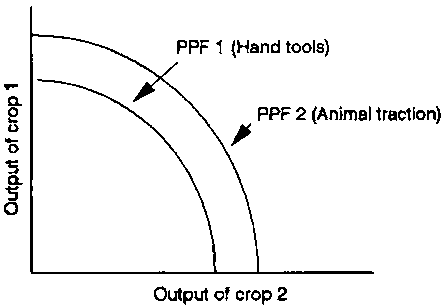
Table 6. Costs and returns (h/ha) for maize and sorghum using hoe and oxen for ridging.
|
|
Maize |
Sorghum |
||
|
Hoe |
Oxen |
Hoe |
Oxen |
|
|
Output kg/ha |
2400 |
2720 |
1491 |
1688 |
|
Value (N/ha) |
840 |
955 |
521 |
590 |
|
Production Costs (N/ha): |
||||
|
Other inputs |
67 |
112 |
52 |
97 |
|
Labour |
341 |
314 |
310 |
229 |
|
Total Cost |
408 |
426 |
362 |
326 |
|
Returns (N/ha) |
431 |
528 |
159 |
264 |
Source: Ogunbile et al. (1989)
The environment in northern Nigeria is relatively favourable to the adoption of AT within the existing farming systems. There are salient issues at stake for research, development and increased utilization of the technology in this zone, some of which are raised below.
Prospects of monetary gains are necessary, but sometimes insufficient reason for the adoption of a technology such as AT. There are social and cultural factors within the production environment which come into play in the overall decision process.
a) Animal Keeping TraditionThe animal-keeping tradition in terms of cattle in Nigeria is mostly associated with the pastoral Fulanis. A dichotomy appears to have emerged between these keepers of cattle who often do not settle for crop farming, and traditional farmers who do not have a cattle-keeping tradition. More recent research has indicated the existence of individuals between these two extremes, namely, semi-nomads, mixed farmers, etc.
The essential point of concern is that agropastoralists with an animal-keeping tradition will be better in management practices such as feeding, early detection, diagnosis and probable treatment of health problems, as well as housing. Also training both the animals and the handlers may be easier and shorter.
b) Family Characteristics
These include the size of the household, sex and age distribution of members. The relation- ships of these variables to suitable measures of AT adoption are of potential research interest.
The implications for children's education of intensive AT in Nigeria should also be a subject for further research. It is probable that fewer persons will be required on the farm if certain farming operations can be adapted to AT. This in turn will mean that more school age children can be released for schooling without parental hindrance. On the other hand, if more land is brought under cultivation through AT without commensurate options for subsequent farming operations, the resulting manual labour requirements could affect the willingness to release children for schooling The argument here is in recognition that on-farm labour requirements are still met mainly by family sources (Famure and Phillip 1988).
c) Relative Preference for the Available Animals
Animals which are potentially adaptable for traction in Nigeria include oxen (male cattle), horses, donkeys and camels. However, these animals differ markedly in terms of the traction activities they are made to perform. Most of the ridging is presently done with oxen, while most transport and haulage is done by donkeys and camels. The horses are mostly employed for transport, sporting activities, and recently for turning sugar cane crushing machines in parts of northern Nigeria.
Table 7. Revenue from hiring out animal traction technology and resale of oxen (N/annum), Kaduna State, 1988.
|
|
No. of animals |
Hire revenue |
Animal cost price |
Animal resale price |
|
001 |
2 |
990 |
1100 |
2400 |
|
002 |
2 |
500 |
1200 |
2600 |
|
003 |
2 |
1000 |
1200 |
1600 |
|
004 |
2 |
450 |
1400 |
2500 |
|
005 |
3 |
80 |
1100 |
2000 |
|
006 |
3 |
1200 |
2300 |
3300 |
Source: Field Survey
In response to the increasing population in Nigeria, the demand for beef is likely to be on the rise. Since this spells competition between beef and on-farm requirements for oxen, the need arises to initiate and intensify research into the innovative use of other large animals. This will mean increased employment of donkeys which are closest to cattle in number in Nigeria for ridging and subsequent operations. Similarly, the prospects for the utilization of female animals for on-farm work deserves further investigation. The present gender preference has contributed to the under-utilization of the available large animals in Nigeria.
The technical relationship between farm size and the method adopted for land cultivation in Nigeria is still unclear. However, casual observations suggest that for various yet undetermined reasons, the use of hand tools, AT and tractors co- exist and will probably continue to do so in Nigeria into the foreseeable future (Table 8).
One would naturally expect the level of technology adopted for cultivation to be specifically related to farm size. A hand tools - AT - tractor continuum would appear reasonable to pursue in response to increase in farm size.
The potential challenge for research will perhaps be the determination of the 'threshold' farm size at which to switch to the next method of cultivation. In the upper panel of Figure 2, for example, a farmer previously using hand tools will switch to AT beyond A1 ha, and to tractors beyond A2 ha.
The unit cost reduction effect of this argument is further depicted in the lower panel of Figure 2. It is stressed that unless cultivation methods are selected relative to farm sizes, unit costs may not be readily reduced at farm levels.
The dominant cropping pattern in northern Nigeria is mixed cropping, which entails the planting of two or more crops in a piece of land at the same time. This feature, which is depicted in part in Table 9, is underlined by strong socio-economic rationales, such as the desire for higher and stable income and output (Norman 1971; Abalu 1976).
As AT gets intensified in Nigeria, there will arise problems of adaptation of this technology to mixed cropping. The real conflict will be between shifting from mixed cropping to sole cropping given the existing implements, or modifying the existing implements to allow their use under both sole and mixed cropping conditions.
Table 8. Predicted percentage distribution of farmers among alternative cultivation methods of northern Nigeria.
|
Year |
Hand tools |
Tractor |
Animal Traction |
|
1989 |
39.70 |
21.19 |
39.11 |
|
1990 |
35.50 |
22.93 |
41.57 |
|
1991 |
32.32 |
24.29 |
43.39 |
|
|
. |
. |
. |
|
|
. |
. |
. |
|
|
. |
. |
. |
|
|
. |
. |
. |
|
|
. |
. |
. |
|
|
. |
. |
. |
|
1998 |
23.87 |
28.04 |
48.09 |
|
1990 |
23.54 |
28.19 |
48.27 |
|
2000 |
23.29 |
28.31 |
48.40 |
Source: Phillip et al. (1990)
Figure 2. Potential among choice of cultivation method, farm size and unit cost.

Table 9. Total labour requirements (h/ha) by crop enterprise.
|
Enterprise |
Labour requirement |
|
Sorghum |
476 |
|
Cotton |
461 |
|
Rice |
478 |
|
Millet/Sorghum |
583 |
|
Cotton/Cowpea |
880 |
|
Sorghum/Groundnut |
900 |
|
Sorghum/Rice |
970 |
|
Sorghum/Groundnut/Cowpea |
959 |
Source: Slade (1980)
The latter choice appears instructive, given the dominance of and the socio-economic justifications for mixed cropping in Nigeria.
Let us briefly examine some of the issues at stake. Intercropping alters the biology of crops. Crops in a mixture may differ in terms of being prostrates, semi-erect or fully erect. These and other features manifest in higher total labour requirements per ha, since crops in a mixture often call for certain unique management practices. As shown in Table 10, the total labour requirements per ha tends to increase more or less linearly with the number of crops in the mixture. Thus, since mixed cropping also implies a higher wage bill per ha, there might exist some potential for AT, provided the technology can be adapted to this cropping pattern.
Institutional support for AT research, development and adoption in Nigeria has been generally weak. Recently however, attempts have been made to improve upon this situation, especially in many northern Nigerian states. Most northern Nigerian States' Development Projects (ADPS) now have an AT division.
Institutional support for AT will be defined broadly in this paper to cover the following:
(a) The need for private and public investment in research towards the development of adaptable equipment and animals;(b) The need for favourable credit teens for the purchase of this technology by farmers or their organisations;
(c) The need for extension services to facilitate the introduction of the technology to previously unfamiliar areas;
(d) The need to encourage, perhaps, with credit support, private and/or group ownership of technology, for hiring to farmers. This option essentially separates ownership and usage of the technology and helps to shield users from fixed cost problems; and
(e) The need for credit and basic training for village-level blacksmiths who have usually been very reliable and available for the fabrication and repairs of implements and their spares.
Recent attempts have been made to provide indications of monetary benefits from the adoption of AT at the farm level in West Africa. The models employed have included variants of linear programming (Phillip et al. 1988), cash flow analysis (Ndiame 1988; Bell and Kemp 1988), gross margin analysis (Ogungbile et al. 1989) and benefit-cost criteria (Barratt et al. 1982).
Available results have generally pointed in the direction of potential economic benefits from AT. However, these results are still subject to further verification, especially since the underlying field and analytical techniques have often simplified a few key practical issues. Some of these issues are raised below.
(a) Partial versus Full Animal TractionAT has been defined to include the use of animal power for cultivation (e.g., ridging and weeding), transportation and processing. Thus we would naturally expect the outcome of economic analysis to differ between using animal power for selective and for all adaptable farming operations. In a labour-scarce farming system, the economic gains may be threatened if the additional land ridged by a farmer using animal power cannot be subsequently managed using commensurate techniques. That is, the resulting 'labour shifting' effect has implications for assessing, indeed, the realisation of the economic impacts of AT.
Assessment of labour costs toward the economic analysis of animal analysis of AT is still a practical problem in many farming systems in Nigeria. Family labour is seldom paid any cash wages, although it receives other forms of remuneration, according to such qualitative factors as the sex and age of the worker; type of farming operation performed; nature of the farmland (upland versus lowland); and even the distance of the farm from home. Wages are paid either per unit of time (e.g. daily) or on contract basis for a given parcel of land. Again, the value of a contract will depend on the nature of the farming operation, the distance of the farmland from home, etc.
Therefore the economic analysis of AT is often burdened with labour measurement problems unless post- ridging operations can be largely adapted to the technology, which in turn will minimise the incidence of labour shifting.
(b) Animal Traction as a Component Technology
AT is no more than an integral component, and therefore cannot usually be pursued independently of the other components of the on-farm technology package. In order to derive maximum economic benefits from AT, it must be adopted along with improved seeds, fertilisers, optimum plant spacing and population, etc. The empirical evidence vis-à-vis the yield effects of AT is united. This again complicates the analysis of the full economic impact of AT.
(c) Ownership Structure of Animal Traction Technology
Probably the most important determinant of the choice of model for the economic analysis of AT is the ownership structure prevailing for the technology in an area.
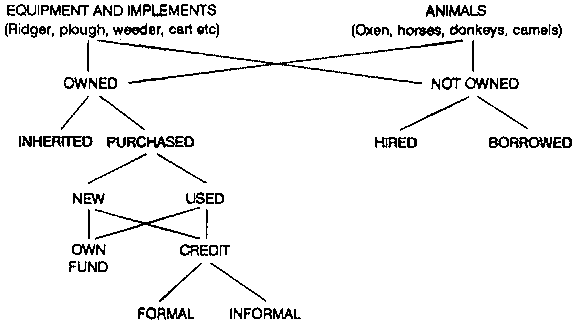
Figure 3 illustrates this point. It is clear that the cost structure facing a farmer and hence the monetary returns to AT depends on how he obtains his equipment and animals. The farmer who hires equipment and/or animals simply faces the variable cost of hiring. Another farmer who purchases his equipment and/or animals faces both fixed and variable costs.
The situation is even more complicated when the equipment and/or animals are purchased using formal credit, in which case, the terms of repaying the credit become an important component of the analytical framework. Still, the set of equipment in Figure 3 may be purchased in succession rather than simultaneously, which introduces dynamic considerations into the economic analysis. These and other scenarios have important implications for the cost structure, profit outlook and, indeed, choice of analytical model.
Improper choice of an analytical model, especially when accompanied by a convenient set of assumptions, will tend to overstate the potential economic benefits of a technology such as AT. This implication is drawn in relation to the other issues chat we raised earlier.
Figure 3. Potential ownership structure of AT Technology in Nigeria.
This paper has attempted to outline potential gains from AT in Nigeria. We have a number of social and economic issues, for discussion and for local (and possibly regional) research response.
In the context of the general theme of this workshop, we will commend especially the following issues to further investigation, towards a more meaningful conclusion about the social and economic impacts of AT at farm level in Nigeria:
(a) The relationship between demographic features of households and the relevant indicators of AT adoption;(b) Innovative uses of animals in Nigeria (male and female cattle, donkeys, camels and horses), given the growing competitive use of oxen for beef and farm activities.
(c) Adaptation of implements to both sole and mixed cropping systems;
(d) Determination of the relationship between cultivation methods (hoe, tractor) and farm size structures;
(e) Economic modelling of AT to assess its potential monetary benefits;
(f) Need for multi-purpose or separate component implements for key on-farm operations, to minimise the problems of labour shifting and consequent loss of potential economic gains.
In conclusion, collaborative research is implied throughout the above discussion. There are agronomic, economic, engineering, sociological, institutional and even policy issues raised.
Future research efforts in the field of AT will need to recognise and actualise this fact, toward relevant assessment of the economic and social impact of AT in Nigeria, indeed across the West African Sub-region.
L'incapacité du Nigéria à maintenir l'effort de tractorisation de l'agriculture crée un contexte favorable à l'adoption de la traction animale. Cette communication examine l'incidence éventuelle de la culture attelée sur les économies de travail et d'argent et sur l'augmentation de la production et de la rentabilité en milieu paysan. Elle traite ensuite des questions socio-économiques et culturelles liées à l'implantation de la traction animale au Nigéria. L'effet de la taille de l'exploitation, du système de culture et de l'appui institutionnel sur la viabilité économique de la traction animale est mis en relief. La communication se termine par des recommandations sur la mise en place de programmes de recherche concertée et interdisciplinaire.
Abalu, G.O.I. 1976. A note on crop mixture under indigenous conditions in northern Nigeria. Journal of Development Studies 12.
Barratt, V., Lassiter, G., Wilcock, D., and Crawford, E. 1982. Animal traction in Eastern Upper Volta: A technical, economic and institutional analysis. International Development Paper 4. Department of Agricultural Economics, Michigan State University, East Lasing, Michigan, USA, 118p.
Bell, R.D. and Kemp, D.C. 1988. An assessment of some aspects of work oxen use in Sierra Leone. 330-324. In Starkey, P. and Ndiame, F.(ed.) Animal power in farming systems. Proceedings of a work shop held in 19-26 September 1986 in Freetown, Sierra Leone. German Appropriate Technology Exchange (GATE) GTZ, Eschborn, Federal Republic of Germany.
Famure, O.D. and Phillip, D.O.A. 1988. Family labour employment and land use in subsistence arid agriculture in Nigeria. Nigerian Journal of Rural and Community Development, 2, 1.
Ndiame, F. 1988. Animal traction in Lower Casamance: technical aspects and socio-economic implications. 253-262. In Starkey, P. and Ndiame, F.(ed.) Animal power in farming systems. Proceedings of workshop held 19-26 September in Freetown, Sierra Leone. German Appropriate Technology Exchange (GATE) GTZ, Eschborn, Federal Republic of Germany, 303 p.
Norman, D.W. 1974. Rationalizing mixed cropping under indigenous conditions: the example of northern Nigeria, Journal of Development Studies 11.
Ogungbile, A.O., Kaul, R.N. and Phillip, D.O.A. 1989. Research Studies on Animal Traction in northern Nigeria. Paper presented at the Animal Traction research protocol planning workshop, held 8-15 May 1989 at the International Livestock Centre for Africa (ILCA), Addis Ababa, Ethiopia.
Oyedipe, T.A. (1986). The effects of trade and exchange rate policies on agriculture in Nigeria. Research Report 55, International Food Policy Research Institute, Washington D.C., USA.
Pingali, P.L., Bigot, Y. and Binswanger, H.P. 1987. Agricultural mechanisation and the evolution of farming systems in Sub-Saharan Africa. World Bank Association with Johns Hopkins Press, Baltimore, USA, 216 p.
Phillip, D.O.A. 1988. The demand for tractor services by farmers in Kaduna State: estimates and policy options. Savanna, 9, 10.
Phillip, D.O.A., Ezeh, C.C. no date. Operations of tractor hiring units in Nigeria: Lessons from Kaduna State. Nigerian Journal of Agricultural Extension 5, 1 (in press).
Phillip, D.O.A., Abalu, G.O.I. and Ingawa, S.A. (1988). Economic implications of animal power at the small-scale level in the Savannah zone of northern Nigeria: a linear programming simulation of farmer circumstances. 225-232. In Starkey, P. and Ndiame (eds) Animal power in farming systems. Proceedings of a workshop held 19-26 September, 1986 in Freetown, Sierra Leone. German Appropriate Technology Exchange (GATE), GTZ, Eschborn, Federal Republic of Germany. 363 p.
Phillip, D.O.A., Abalu, G.O.I., Aganga, A.A. and Aduku, A.O. 1990. Animal traction technology in northern Nigeria: a survey of constraints and a model of prospects. 370-375. In Starkey, P. and Faye, A. (ed.) Animal traction for agricultural development. Proceedings of workshop held 7-12 July 1988, Saly, Senegal. Published for the ILCA West African Animal Traction Network Traction Network by the Technical Centre for Agricultural and Rural Cooperation (CTA), Ede-Wageningen, The Netherlands. 479 p.
Slade, R.H. 1980. The monitoring end evaluation of the Funtua, Gusau and Gombe Agricultural Development Projects. A three part preliminary report.
Spencer, D.S.C. 1988. Farming systems in West Africa from an animal traction perspective. 91-96. In Starkey P. and Ndiame, F. (eds) Animal Power in farming systems. Proceedings of a workshop held 19-26 September 1986 in Freetown, Sierra Leone. German Appropriate Technology Exchange (GATE), GTZ, Eschborne, Federal Republic of Germany. 363 p.
