1 What is digital publishing?
Digital publishing refers to the production of knowledge products for delivery via responsive digital channels, adapting to users’ knowledge consumption habits and thereby increasing the uptake of publications while printing less.
2 What are the objectives of FAO’s digital publishing approach?
This approach seeks to increase the impact of FAO publications through:
- content that is easier to access, more engaging and more discoverable; and
- better metrics, where uptake can be monitored in real time and leveraged to ensure future publications remain adapted to users’ needs.
Ideally, this approach is built in from the beginning of the publishing process, to ensure that the final product is fit for purpose: we call this digital-first.
Not everything lends itself to a digital-first approach, however, such as the complex clearance processes that form part of the flagship production workflow.
For this reason, we foresee two different models, described in more detail in 3 Two types of digital publications. Note that while a PDF is technically a digital format, we use the term “digital publication” in these guidelines to refer to responsive HTML formats.
3 Two types of digital publications
These guidelines cover two types of digital publications:
- Digital-first publications are conceived as digital from the outset.
- Converted digital publications are developed from an existing publication in PDF format: the content is identical to that of the original PDF version.
In consistency with FAO's digital transformation, digital-first publications are encouraged. Regardless, sometimes a PDF (and possibly a converted digital publication) will be the preferred choice for practical or budgetary reasons (see 4 Do I always have to produce a digital publication?).
Note that digital publications are not to be confused with interactive stories.a
4 Do I always have to produce a digital publication?
The added value of developing an HTML-based publication is its effectiveness in reaching multiple audiences. It allows for interactivity and uses a responsive format so that readers can easily access the content on different devices, including phones.
When choosing the format for your publication – and evaluating the cost and time involved – you should always consider your objectives, your audience’s needs and the specificities of your content. For instance, if your audience is small, not generally able to load digital content, or not used to accessing digital content, a digital publication may not be appropriate.
Many FAO publications are part of a series, which are characterized by consistency, especially in terms of formats and user experience. When producing a digital publication as part of a series, reflect carefully on the sustainability of this decision and make sure you can secure the budget to produce the entire series.
While digital publishing may initially appear challenging and will certainly require a change in the way you do things, it is a worthwhile investment of effort to improve the dissemination of FAO’s knowledge.
5 Creating a digital-first publication
This involves a thoughtful and tailored approach that leverages the strengths of digital platforms. Every element – from the structure to the content – should resonate with digital audiences. The emphasis is on brevity, clarity and interactivity.
This section outlines the key principles and steps involved in producing these publications.
5.1 Key features
Digital-first publications are designed to meet the specific needs of digital audiences through the following features:
- Concise content: Text is succinct, clear, and structured in manageable bite-sized sections.
- Engaging titles: Titles are brief and self-explanatory, conveying the essence of the content.
- Technical summaries: For technical documents, concise summaries are included at the start of each chapter to improve the reader’s comprehension.
- Interactive features: Videos, animations, hyperlinks and other dynamic elements are often included to enhance engagement.
- Appealing visual design: High-quality visuals play a central role in ensuring a clean and accessible design.
5.2 Production strategy
There are different avenues available for producing digital publications. For flagship publications, OCCP usually handles the digital production. OCCP has some availability to handle other digital publishing projects on behalf of authoring teams, depending on calendar and workload. Get in touch well in advance – ideally 10 months ahead of the planned publication date – if you would like to request support and a quote.
In 2024, OCCP also signed several long-term agreements (LTAs) to facilitate the outsourcing of digital publishing tasks directly by authoring divisions.
As for any other publishing project, producing a digital publication requires a clear definition of audience, objectives, budget and timeline. This information should be inserted as early as possible in the Publications Workflow System (PWS).
5.2.1 OCCP-led path
In this approach, OCCP plays an active role in the production process, integrating the project into the OCCP editorial calendar. OCCP’s digital coordinator oversees digital production, maintaining constant communication with the designer and developer (and the external service provider, if applicable) and the authoring division. This collaboration spans from receiving the manuscript to delivering it online in HTML format.
OCCP supervises the entire PWS process, including the copyright and language checks (step 5), and handles any contractual matters related to external service providers.
5.2.2 Division-led path
In this case, the authoring division directly manages the entire production process, with OCCP maintaining an oversight role. The division is responsible for putting together the production team (hiring external providers where necessary), including a designer, developer, proofreader and project manager.
The selection of external service providers can be handled through a set of LTAs, managed by OCCP. The providers are divided into two lots, covering full web development or simple content population of an existing template. OCCP also maintains a roster of editorial consultants. Contact PWS-Support@fao.org if needed.
The standard operating procedures for the LTAs can be found here.
5.3 Production process
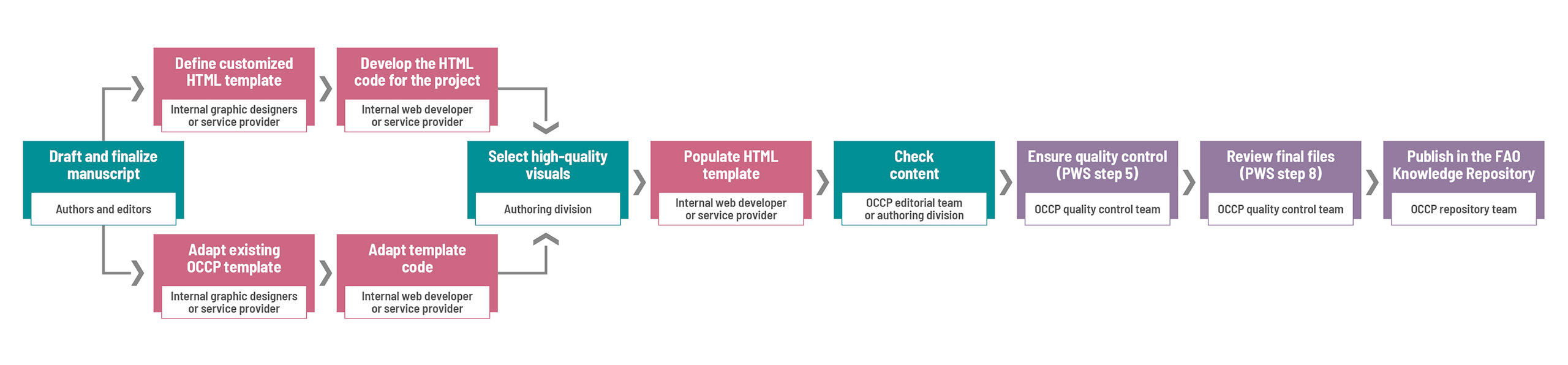
The production process follows a collaborative and systematic approach.
5.3.1 Digital-first writing
Authors and editors draft and finalize a manuscript in Word format. The writing style prioritizes clarity, conciseness, alignment with digital-friendly structures, and the other elements mentioned in 5.1 Key features. It should comply with FAOSTYLE.
5.3.2 Customized HTML mock-up
Graphic designers or external service providers define a customized HTML template by presenting an agreed number of design mock-up proposals. This phase involves developing a strong visual identity to enhance user experience and a logical structure to facilitate navigation.
5.3.3 Template development
If the work is done internally, the mock-up is shared with a web developer who is responsible for coding the project. The web developer and the designers work together to determine the most suitable graphic and technical solutions for the HTML digital product. If the work is outsourced to a service provider, these roles must be clearly defined in the terms of reference (TOR) of the work. It is also possible to use an existing template, which can be adapted to fit the needs of the project (in terms of colour palette, landing page, table of contents and related navigation).
5.3.4 Selection of visuals
The authoring division selects high-quality visuals (photographs or illustrations) and shares them with the graphic designer or service provider. The subject must be appropriate for the message the image intends to convey. People should feature as much as possible in visuals, respecting the requisite ethnic, gender, geographical and political balance.
5.3.5 Content population
This phase involves populating the HTML template with the complete text and visual elements of the manuscript. External service providers often handle this step; in this case, the Word manuscript or InDesign package needs to be provided to them.
5.3.6 Digital check
A proofreader ensures that the content of the manuscript is properly incorporated into the digital publication and that all the links and navigation function correctly. Up to three rounds of review and corrections may be required to finalize the publication.
5.3.7 Quality control
In the case of digital-first publications, quality control (step 5 of the PWS) does not follow the usual process, as text is submitted in manuscript (Word) form rather than PDF form.
5.3.7.1 OCCP-led path
This step is handled by OCCP when the project is OCCP-led. The in-house editor/proofreader carefully reviews the text, while the designer works on developing the visual identity in compliance with FAO guidelines. During this stage, any copyright- or logo-related matters are addressed by the technical office. OCCP colleagues ensure that any necessary edits to the text or changes to the visual assets are made, and the record is moved to step 9 for publishing.
The HTML package is prepared following PWS publishing requirements and submitted as a ZIP file named with the job number in the PWS record. This ZIP file contains all related HTML files.
5.3.7.2 Division-led path
When the process is division-led, the above-mentioned steps still apply, but OCCP will play the standard role of providing clearance for the publication. The manuscript will be used for the language check at step 5, while the layout check will be based on a mock-up of the homepage and internal pages of the digital publication.
Copyright- and logo-related queries should be addressed following the standard PWS procedure. Any feedback provided by OCCP should be addressed by the technical unit and checked again at step 8 of the PWS. The final digital publication must be uploaded at step 7 for review by OCCP at step 8, including checks of the HTML code, the final layout, responsiveness and accessibility criteria. The review involves different roles and may require several working days. Additional feedback may be provided at this step.
5.3.8 Online release
Once finalized, the files of the HTML digital publication are sent for publishing through the PWS. The final HTML package is stored by OCCP in SharePoint.
5.4 Timing
The time it takes to produce a digital-first publication depends on the length of the publication and whether there are different language versions.
The table below indicates the average timing for a medium-sized publication (100–200 pages) in one language. Producing additional language versions requires between 10 and 15 days for each additional language.
5.5 Cost
The cost of a digital-first publication ranges from approximately USD 4 000 to USD 6 000, depending on the project's complexity and the number of language versions. For OCCP-led projects, OCCP will provide an estimated cost at the beginning of the process. The authoring division will need to commit the required budget by providing a budget code before the work can be initiated. Note that the estimated cost is subject to change; once the work is concluded, a final cost will be provided.
The cost of producing additional language versions depends on the length of the publication. The content population cost is based on the number of pages, and the digital check needs to be performed by language editors. For Arabic language versions, an additional cost is applied as the template will need to be adapted to right-to-left.
5.6 PDF version of digital-first publications
Upon specific request from the technical offices, a PDF version may be created in addition to the digital publication: cost and time are defined on a case-by-case basis, depending on the length and complexity of the publication.
6 Converting a PDF into a digital publication
Digital publications may also be developed from existing PDF documents. The PDF's design and structure are used as a basis for creating a corresponding HTML version optimized for the web.
6.1 HTML conversion process
The process of converting a PDF into an HTML digital publication begins after the PDF version has been finalized and fully cleared, reaching step 9 of the PWS. The conversion process includes the following steps.
6.1.1 Design and HTML mock-up
Depending on the path agreed upon, either OCCP or divisional designers create a mock-up of the homepage and internal pages for the HTML template, ensuring consistency with the visual identity of the PDF. If authoring units choose to outsource the design and development of the digital publication to an external service provider, consultation with OCCP’s design team is required during the process.
6.1.2 Template development or adaptation
The mock-up is shared with a web developer who is responsible for coding the project. The web developer and the designers work together to determine the most suitable graphic and technical solutions for the HTML digital product.
6.1.3 Content population
This phase involves populating the HTML template with the full text and visual elements of the PDF. External service providers often handle this step; in this case, the InDesign package needs to be provided to them by OCCP or the authoring division.
6.1.4 Digital check
A proofreader ensures that the content of the PDF is properly incorporated into the digital publication and that all the links and navigation function correctly. Up to three rounds of review and corrections may be required to finalize the publication.
6.1.5 Online release
Once finalized, the files of the HTML digital publication are sent for publishing through the PWS. It may be published simultaneously with the PDF version; or, if the PDF has already been published, the record will be republished, adding the HTML version. The final HTML package is stored by OCCP in SharePoint.
6.2 Timing
The time it takes to produce a converted digital publication depends on the length of the publication and whether there are different language versions.
The table below indicates the average timing for a medium-sized publication (100–200 pages) in one language. Producing additional language versions requires between 10 and 15 days for each additional language.
6.3 Costs
The cost of converting a PDF into an HTML digital publication ranges from approximately USD 3 000 to USD 4 000, depending on the project's complexity and the number of language versions.
For OCCP-led projects, OCCP will provide an estimated cost at the beginning of the process. The authoring division will need to commit the required budget by providing a budget code before the work can be initiated. Note that the estimated cost is subject to change; once the work is concluded, a final cost will be provided.
The cost of producing additional language versions depends on the length of the publication. The content population cost is based on the number of pages, and the digital check needs to be performed by language editors. For Arabic language versions, an additional cost is applied as the template will need to be adapted to right-to-left.
7 OCCP standard template
OCCP has developed a standardized HTML template specifically designed for technical publications.
The standardized template can be used for both digital-first publications and converted digital publications.b Using this template will save time and money, as you will not have to carry out the design, mock-up and web development steps of the process. Adapting an existing OCCP template usually falls in the range of USD 1 000 to USD 3 000.
8 Accessibility
All digital publications must ensure compliance with accessibility standards (see Accessible publishing). This includes providing descriptions (alt text) for non-text elements, which should be prepared by the technical division (or a service provider) and checked and revised by OCCP and/or the technical division. Note that this step has an additional cost, which is included in the cost estimate shared with the division for OCCP-led projects. Detailed guidance and examples can be found here.
9 Downloadable data sets
It is good practice to include downloadable data sets for relevant graphic elements. These are of use to academics, technical experts, data journalists and others. The data sets are assigned a digital object identifier (DOI) and their uptake can be tracked. This entails some preparatory work, which involves the creation of an Excel file and an image file (ideally JPG) for each graphic, as well as an XML document that lists all the graphics in the publication with an assigned DOI. More detailed guidance is available here.
10 Measuring impact
It is important to monitor metrics after the online release to assess whether the digital publication has achieved its objectives, in comparison with the PDF version (if applicable), and to inform decisions on future publishing projects.
11 Support
If you would like to produce a digital publication (whether digital-first or converted from a PDF), send your request to PWS-support@fao.org. OCCP will discuss with you whether it can be produced internally (at a cost) or whether you may produce it within your division (using consultants or service providers).