Background
Economic importance of small ruminants in SSA
Population growth and meat production of small ruminants in SSA
References for chapter I
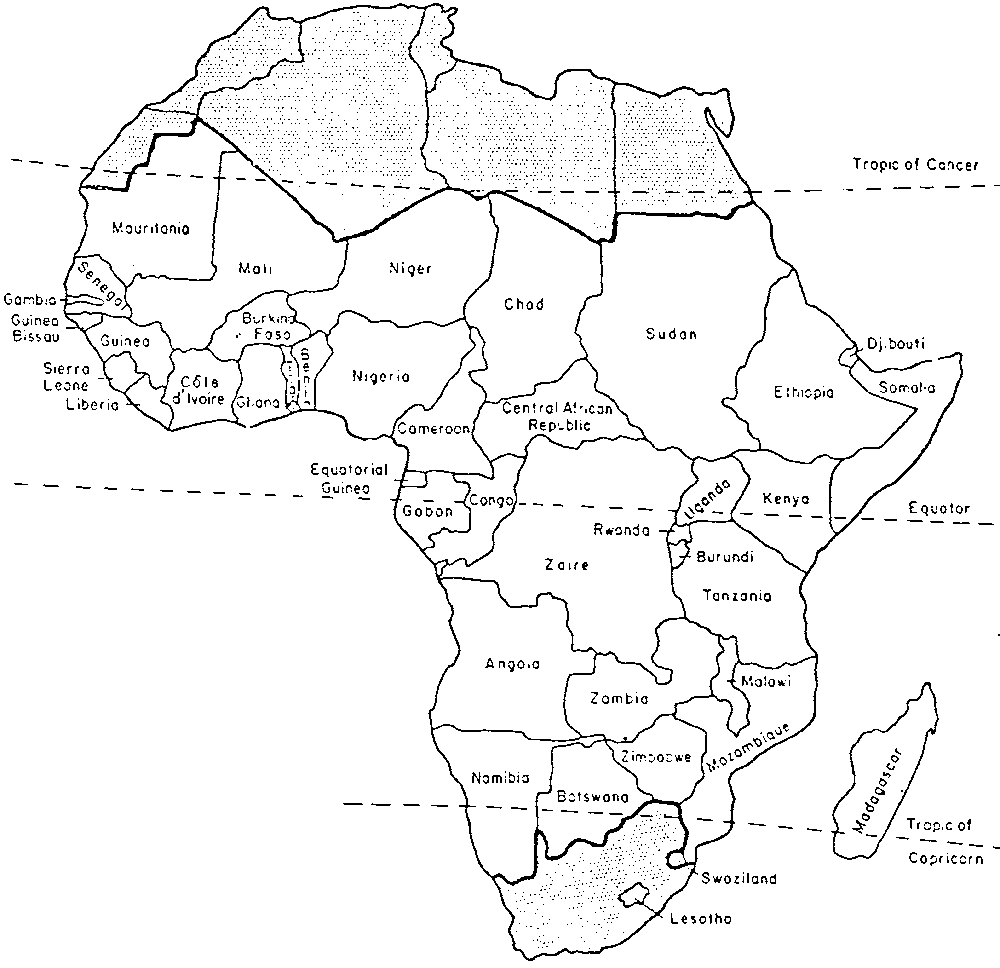
Sub-Saharan Africa (SSA) lies almost entirely between the tropic of Cancer and the tropic of Capricorn and embraces African countries below the southern Sahara desert (Fig. 1.1). It is a vast region with a total area estimated at 21.6 million km2, a human population of more than 578.316 million in 1993 (FAO, 1993) and a livestock biomass of 202.8 million tropical livestock units in 1992 (FAO, 1993).
SSA is the poorest part of the world as a World Bank report (World Bank, 1981) quoted in Eicher and Baker (1982) shows that 22 of the 36 countries with per caput income of $370 or less (low-income countries) are found in the region. According to ILCA (1987), per caput GDP which grew at 1.3 per cent per annum (p.a.) in the 1960's slowed down to 0.7 per cent in the 1970's and fell in the 1980's. This same source indicates that the gross domestic saving rate went down by a third over the 1970s and the ratio of foreign debt service payments to export earnings went up by about 50 per cent in the 1980's.
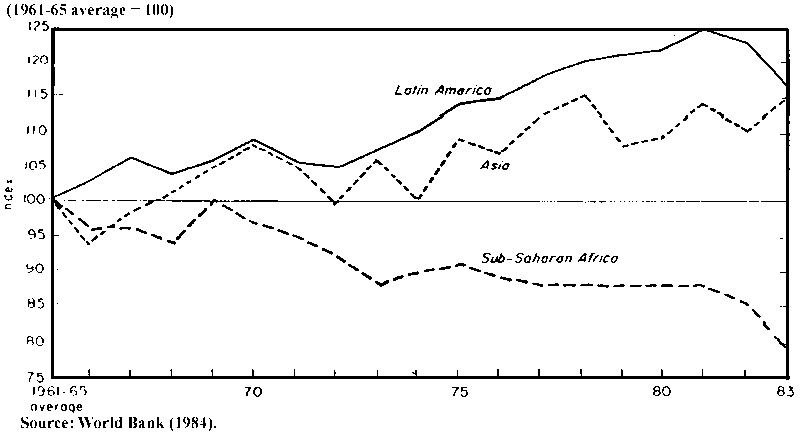
Declining per caput food production (Fig 1.2) coupled with inadequate calorie intake usually prevails. In most sub-Saharan African countries, this intake falls below minimal nutritional standards. During the period 1982-84, food production was 8 per cent lower than a decade earlier in 31 out of 39 countries.
Ironically, SSA faces a demand problem as the growth in agriculture and food productivity utterly lags behind that of human population and its increasing food need. The population grew from 2.05 per cent p.a. in the mid-fifties to 2.74 per cent in the late seventies, reached the highest rate of any of the developing regions in early eighties (Christensen et al., 1981), is now rising at more than 3 per cent p.a. and is projected to reach 1,294 million in 2025, almost equivalent to China's projected population for the same year (Winrock International, 1992). Certainly, the United Nations' earlier prediction (U.N., 1987) remains valid, which revealed that SSA is the only developing region where population growth rates will not stop increasing throughout the 1980s and will he the world highest in year 2000 (Fig. 1.3). The low per caput food production coupled with the poor calorie intake and the ever burgeoning human population in most countries of the region has led to what many observers call an "agrarian crisis" or "Africa's food crisis". TAC/CGIAR (1987) refers to it as a "source of considerable alarm."
Poor performance of the livestock sector during most of the last two decades has contributed to the crisis. According to Sandford (1987), the commodity output of livestock in SSA accounts for 25 per cent of total food production. For 1983, FAO (1984) estimated the contributions of livestock to the SSA's overall calorie and protein intakes to he about 8 and 13 per cent, respectively. These figures fall below the world average which amounts to 16 per cent for calories and 23 per cent for protein in 1983. Though it is true that four out of every five people in most of SSA work in agriculture (World Bank, 1982) and that these are the people who suffer the most from poverty and food crisis, efforts have not always been aimed at identifying their true priorities and how they generate income for their subsistence. For example, small ruminants represent one of the major assets contributing to income generation and animal protein supply of resource-poor rural households and yet they have long been neglected.
The importance of small ruminants for meat and milk production in the tropics is well established (Devendra and Burns 1970; Williamson and Payne, 1974; Haas and Horst, 1979; Matthewman, 1977; Gatenby, 1986). In contrast to cattle which are normally concentrated and remain in the hands of a restricted number of producers, almost every low income rural household invariably owns small ruminants. In the dry areas of Northern Nigeria, fewer than 20 per cent of farmers own cattle (ILCA, 1980). In Côte d'Ivoire, Barry (1985) reported that, on the average, fewer than four cattle are found on the farm where there are ten sheep/goats. This ownership pattern characterizes the legacy of SSA's rural economy as capital constraints limit access to cattle among poor households whilst small ruminants are well suited for their financial and labour resource capabilities.
Small ruminants are a source of food and financial security for the rural poor. According to FAO (1983) quoted in Von Kaufmann et al. (1986), more than 50 per cent of milk produced for human consumption is from sheep and goats in Niger and Somalia. Thirty five per cent of the total Nigerian meat supply are thought to come from small ruminants (Bayer, 1982) and almost 30 per cent of the total meat consumed in the semiarid zone are from small ruminants (Wilson, 1982). Little (1982) found that in pastoral production systems in Kenya, goats are usually the only source of milk available for households in the dry season when troth sheep and cattle have migrated. In Teso (Northern region of Uganda) farmers' revenue from goats is higher than that from other agricultural products with the exception of the cotton and cattle where these are part of the households activities (Kyeyune-Sendage, 1970).
Because of their small size, sheep and goats provide more convenient sources of meat than cattle as shown by Sarniguet et al. quoted in Bayer (1982) who found that small ruminant meat contributes three times more than beef to the total meat consumed in rural areas of Northern Nigeria. It is generally more suitable to slaughter a sheep or a goat to feed community members engaged in communally private field work than a large animal such as a cow. Likewise, while a 10 to 15 kg small ruminant carcass is easily handled by a rural household for either home consumption and/or sale without means of preservation, slaughtering even a steer (when it is available) for the same purposes is generally unpractical and uneconomical and is therefore a rare event.
Where access to cash is limited and livestock marketing is not organized, small ruminants are directly exchanged for grain. Little (1982) observed that in remote areas of Kenya, up to 40 per cent of local grain needs may he met by direct exchange of goats and sheep during the dry season. Small ruminants are often slaughtered in honour of a special guest, a visiting friend or relative, for festivities and religious rituals. In particular, sheep is the only animal consumed during the Id El Kebir or Tabaski festivals 1. Sale of Tabaski rams (and to a lesser extent rams slaughtered for baptism) amounted to 9 trillion FCFA, an equivalent of US$30 million in Senegal in 1986 (Abassa and Diop, 1988).
1 Id El Kebir festivals are also known as Tabaski festivals in West Africa.
Small ruminants are also kept by poor rural households for ready cash income to meet immediate needs such as acquiring agricultural inputs, paying school fees and purchasing larger animals such as cattle. In Uganda, a landlord may sell some part of his land to landless people in exchange for goats (Okello, 1985). In time of cash crisis, rural households find it easier to find a buyer for a goat or a sheep than a bovine. More importantly, small ruminants play a key role in stock association building between non-household members in rural areas. Little (1982) reported that destitute pastoralists in Kenya may call upon stock associates for food assistance or for rebuilding their herds after calamities. This is also true of farmers in the humid area of Senegal (Faugère et al., 1988) and in Uganda (Okello, 1985), where small ruminants serve as a means to cement family relationship or social links which are extremely important for assistance in time of crisis.
From what precedes, one can no longer overlook the importance of small ruminants in the economy of SSA in general and in that of the low income families in particular. That sheep and goats allow poorer households to maintain their subsistence, calls for an urgent need to recognize, as Gatenby (1986) put it, that "if the aim of a development project is to raise the living standard of the poorer sectors of the community, it is much more likely to do so if it concentrates on production from small ruminants".
Small ruminants are raised in all the ecological zones of SSA. These zones are grouped on the basis of the number of plant growing days per year (Jahnke, 1982). These are the arid zone (less than 90 days), the semi-arid zone (90-180 days), the suhhumid zone (180-270 days) and humid zone(270-365 days). The highlands include semi-arid, sub-humid and humid areas where the mean daily temperature is less than 20°C during the growing period. TAC/CGIAR (1987) estimated at 221 million the number of small ruminants in SSA with 35.95 per cent in the arid zone, 24.6 per cent in the semi-arid zone, 15.45 per cent in the sub-humid zone, 8.8 per cent in the humid zone and 15.2 per cent in the highlands (Table 1.1).
The data presented in Table 1.2 reveal that from 1977 to 1992, SSA's small ruminant population grew at an average annual growth rate of less than 1 per cent and that, over the same period, this performance compares poorly with that of Africa (1.23 per cent), Asia (1.7 per cent), all developing countries (1.44 per cent) and the world (1.01 per cent). In 1982-1992, growth in SSA was 0.77, 1.45, 1.14 and 1.58 per cent p.a. below that in Africa, Asia, all developing countries and the world. Further, the growth was unstable as the number of sheep and goats rose by 2.38 per cent in 1977-1982, -0.17 per cent in 1982-1987, about 0.4 per cent in 1987-1992 and 0.1 per cent in 1982-1992. This, together with available data from literature, particularly from ILCA (1987) according to which small ruminant population growth was 2.5 per cent p.a. from 1963 to 1970 and 0.6 per cent p.a. from 1970 to 1975, seem to indicate that the unsteady pattern mentioned above is a permanent feature of small ruminants' population growth in the region. There is also indications that the picture is one of a continuously decreasing growth throughout the 1980s and that this could he extended at least to the first half of 1990s. Finally it is worth noting that except in Latin America, growth in SSA was the world's poorest over the decade 1982-1992 as the region's performance was 0.77, 1.45, 1.14 and 0.58 per cent p.a. below that of Africa, Asia, developing countries and the world, respectively (Table 1.2). That such picture could worsen the food crisis in the region appears to he indisputable.
Another factor that could have contributed to the worsening of the food crisis in SSA is the poor output of meat per head of small ruminant, a situation that may indicate that the region has trouble deriving enough meat from its depressed small ruminant population. This is illustrated in table 1.3 which shows that SSA is the only developing region where growth of meat output per animal has been negative over the decade 1982-1992. The table also shows that it is also in SSA that the world poorest meat output per animal in troth 1982 and 1992 is found. In 1992 the region's performance was 21.0, 31.5, 39.6, 31.3 and 39.5 kg/TLU below that of Africa as a whole, Asia, Latin America, all developing countries and the world, respectively. Certainly, this poor performance has contributed a great deal to the poor and declining total meat output shown in table 1.4. In fact, such output declined at an average annual rate of about 1 per cent over the decade 1982-1992, which compares poorly with the positive growth of Africa (1.37 per cent), Asia (4.14 per cent), Latin America (0.56 per cent), all developing countries (3.21 per cent) and the world (2.18 per cent). Worst still, the decline seemed to occur at an increasing rate as it jumped from 0.58 per cent p.a. in 1982-1987 to 2.43 per cent p.a. in 1987-1992, indicating that there could he no prospect for acceptable productivity in 1990s if nothing is done to reverse the ongoing trend.
Among the reasons for the above overall poor to mediocre performance are reproductive losses and morbidity. The term reproductive losses in the fullest sense, refers to losses from birth up to first breeding of the offspring (Restall et al., 1976). Such losses are widely recognized as the most important constraint to increased small ruminant production (Dennis, 1974; Willingham et al., 1986; Kelly, 1986). In Africa, it is thought that at least 59 per cent of potential lambs and kids are lost through fertilization failure, embryo and foetal death, stillbirth and mortality from birth to weaning (Charray et al., 1980). Unfortunately, because the related losses have not been compiled in SSA, their overall effect on small ruminant development is unknown. The present review intends to determine the magnitude and causes of reproductive losses in sheep and goats in SSA in order to identify recommendation domains or areas in need of interventions.
The review encompasses 5 chapters which, apart from the introduction, successively covers reproductive performance, prenatal losses, post-natal losses, general conclusions and recommendations.
Figure 1.1. Sub-Saharan Africa.
Figure 1.2 Index of Per Capita Food Production, 1961-65 to 1983.
Figure 1.3 Population growth rate in sub-Saharan Africa, Asia and Latin America (1960-2000).
Table 1.1. Distribution of sheep and goats by zone in SSA
|
Zone |
% of total population in SSA |
|
|
Sheep |
Goats |
|
|
Arid |
33.7 |
38.2 |
|
Semi-arid |
22.9 |
26.3 |
|
Sub-humid |
14.4 |
16.5 |
|
Humid |
8.3 |
9.4 |
|
Highlands |
20.7 |
9.6 |
|
Total per cent |
100 |
100 |
|
Total No 1 |
(98.4) |
(122.6) |
1 In million
Source: ILCA (1987).
Table 1.2. Small Ruminant Population and Annual Changes
|
Location |
Stocks (1000 heads) |
Average Annual Growth Rate (%) |
|||||||
|
1977 |
1982 |
1987 |
1992 |
1977-92 |
1982-92 |
1977-82 |
1982-87 |
1987-92 |
|
|
Africa |
231,892 |
255,579 |
266,156 |
278,620 |
1.23 |
0.87 |
1.96 |
0.81 |
0.92 |
|
SSA |
185,975 |
209,151 |
207,353 |
211,320 |
0.86 |
0.1 |
2.38 |
-0.17 |
0.38 |
|
Latin America |
140,782 |
146,713 |
145,243 |
144,383 |
0.17 |
-0.16 |
0.83 |
-0 2 |
-0.12 |
|
Asia |
535,143 |
590,892 |
605,465 |
689,458 |
1.7 |
1.55 |
2 |
0 49 |
2.63 |
|
Developing Countries |
994,059 |
1,033,890 |
1,065,086 |
1,169,456 |
1.44 |
1.24 |
1.83 |
0.6 |
1.89 |
|
World |
1,473,433 |
1,600,063 |
1,636,442 |
1,712,544 |
1.01 |
0.68 |
1.66 |
0.45 |
0.91 |
Source: Adapted from FAO (1979; 1982; 1989; 1992).
Table 1.3. Small Ruminant Meat Production per Head
|
Location |
1982 |
1992 |
||||
|
TLU* ('000) |
Meat (MT) |
Meat/TLU (Kg) |
TLU ('000) |
Meat (MT) |
Meat/TLU (Kg) |
|
|
Africa |
7,971.1 |
935 |
117.3 |
89,822.1 |
1,094 |
121.8 |
|
SSA |
6,117.1 |
660 |
107.9 |
6,083.1 |
613 |
100. |
|
Latin America |
22,095 |
2,824 |
127.8 |
31,734.9 |
4,198 |
132.3 |
|
Asia |
2,897 |
384 |
132.6 |
3,026.9 |
425 |
140.4 |
|
Developing Countries |
34,356.9 |
4,370 |
127.2 |
45,382.3 |
5,995 |
132.1 |
|
World |
57,046.9 |
7,928 |
138.9 |
70,339.6 |
9,864 |
140.3 |
* TLU: tropical livestock unit; one TLU is equivalent to 250 kg body weight. Each sheep and goat represents 0.1 TLU.Source: Adapted from FAO (1984; 1992).
Table 1.4. Total Small Ruminant Meat Production and Annual Changes: 1977-1992
|
Location |
Indigenous Sheep and Goat Meat (1000 MT) |
Average Annual Changes (%) |
|||||||
|
1977 |
1982 |
1987 |
1992 |
1977-92 |
1982-92 |
1977-82 |
1982-87 |
1987-92 |
|
|
Africa |
788 |
972 |
1,016 |
1,114 |
2.33 |
1.37 |
4.29 |
0.89 |
1.86 |
|
SSA |
581 |
721 |
742 |
656 |
0.81 |
-0.94 |
4.41 |
0.58 |
-2.43 |
|
Latin America |
2,433 |
2,724 |
3,186 |
4,087 |
3.52 |
4.14 |
2.29 |
3.18 |
5.11 |
|
Asia |
394 |
384 |
404 |
406 |
0.2 |
0.56 |
-0.51 |
1.02 |
0.1 |
|
Developing Countries |
3,776 |
4,291 |
4,833 |
5,883 |
|
3.21 |
2.59 |
2.41 |
4.01 |
|
World |
7,411 |
7,983 |
8,785 |
9,902 |
1.95 |
2.18 |
1.5 |
1.93 |
2.42 |
Source: Adapted from FAO (1979; 1984; 1989; 1992).
Abassa, K.P. and P.H. Diop. 1988. Quantitative aspects of livestock losses and waste in West Africa. Document presented at the Seminar on Livestock Development Policies and Programmes for Livestock Development Planners in the West-African MULPOC Region. 1-6 February 1988. Ouagadougou, Burkina Faso.
Barry, M.B. 1985. A strategy for the intensification of production systems using small ruminants in Côte d'Ivoire. In: Wilson R.T. and Bourzat D. (eds). Small ruminants in African Agriculture. Proceedings of a conference held at ILCA, Addis Ababa, Ethiopia.
Bayer, W. 1982. Small ruminant production in the sub-humid zone: review of literature. ILCA Subhumid Programme, Kaduna, Nigeria. Research Reports 1982/83.
Charray, J., Coulomb J., Haumesser J. B., Planchenault D. and P. L. Pugliese. 1980. Les petits ruminants d'Afrique Centrale et d'Afrique de l'Ouest. Synthèse des connaissances actuelles. Maisons-Alfort, Cedex, France.
Christensen, C., Dommen A., Horenstein N., Pryor S., Riley P., Shapouri S. and S. Steiner, 1981. Food problems and prospects in sub-Saharan Africa. The decade of the 1980s. United States Department of Agriculture. Economic Research Service. Foreign Agricultural Research Report No. 166.
Dennis, S.M. 1974. Perinatal lamb mortality in Western Australia. I. General procedures and results. Aust. Vet. J. 50: 443-449.
Devendra, C. and M. Burns 1970. Goat production in the tropics. Techn. Commun. No. 19 of the C.A.B. Commonwealth Agric. Bureaux, farnham Royal, Bucks, England.
Eicher, C.K., and D.C. Baker. 1982. Research on Agricultural Development in Sub-Saharan Africa: A critical survey - MSU. International Development paper No. 1. Department of Agricultural Economics, Michigan State University, East Lansing, Michigan, U.S.A.
FAO. 1977-1992. Production Yearbooks, Volumes 31 through 46. Rome, Italy.
FAO. 1990. Quarterly Bulletin of Statistics, Vol. 3. Rome, Italy.
FAO. 1991. Production Computer Printout. Preliminary estimates. Statistic Division. Rome, Italy.
Faugere, O. Faugere B., Docks C. and C. Perrot. 1988. L'élevage traditionnel des petits ruminants dans la zone de Kolda (Haute Casamance). Référence technico-économique. Programme de Pathologie et Productivité des Petits Ruminants en milieu traditionnel. Document de travail No. 1/Kolda, Senegal.
Gatenby, R. 1986. Sheep production in the tropics and subtropics. Tropical Agricultural Series. Longman. London and New York.
Haas, H.H. de and P. Horst. 1979. The significance of goat production in covering protein requirements. Animal Research and Development 9:41-76.
ILCA. 1980. Economic trends. Small Ruminants. Bulletin 7. International Livestock Centre for Africa, Addis Ababa, Ethiopia.
ILCA. 1987. ILCA's strategy and long-term plan. Addis Ababa, Ethiopia.
Jahnke, H.E. 1982. Livestock production systems and livestock development in tropical Africa. Kieler Wissenschaftsverlag Vauk, Kiel, Germany (FR).
Kelly, R.W. 1986. Reproductive wastage in sheep. Journal of Agriculture 1(1): 22-26.
Kyeyune-Sendage, A.L. 1970. Progress report on the crossbreeding programme between the Boer (Africander) and the East African Dwarf goats at Serere Research Station. Serere, Uganda.
Little, P. 1982. Risk aversion, economic diversification and goat production: some comments on the role of goats in African pastoral production systems. Proceedings of the Third International Conference on Goat Production and disease. Tucson, Arizona, U.S.A.
Matthewman, R.W. 1977. Small livestock production in two villages in the forest and derived savanna zones of south Western Nigeria. AES Res. Bull. No. 1, Department of Agriculture. Extension services. University of Ibadan, Nigeria.
Okello, K.L. 1985. A survey of the productivity and functions of goats in Uganda. In: Wilson R.T. and Bourzat D. (eds), Small ruminant in African Agriculture. Proceedings of a Conference held at ILCA, Addis Ababa, Ethiopia.
Restall, B.J., Brown G.H., Blockey M. de B., Cahill L. and R. Kearins. 1976. Assessment of reproductive wastage in sheep. I. Fertilization failure and early embryonic survival. Australian Journal of Experimental Agriculture and Animal Husbandry 16(78): 329-335.
Sandford, S. 1987. Livestock and food production in sub-Saharan Africa. ILCA, Addis Ababa, Ethiopia.
TAC/CGIAR. 1987. CGIAR priorities and future strategies. TAC Secretariat, FAO, Rome.
U.N. 1977. World Population trends and policies, Monitoring Report Vol. 1, New York, U.S.A.
Von Kaufmann, R.R., Wilson R.T. and L. Reynolds. 1986. The economic role of small ruminants in agricultural communities and land use systems in Africa. In: "Compte rendu du séminaire sur la coordination de la recherche pour le développement des petits ruminants en Afrique." Montpellier, France.
Williamson, G. and Payne W.J.A. 1974. An introduction to animal husbandry in the tropics 2nd ed. Tropical Agriculture Series, London: Longman.
Willingham, T., Shelton M. and P. Thompson. 1986. An assessment of reproductive wastage in sheep. Theriogenology 26(2): 1979-188.
Wilson, R.T. 1982. Husbandry, nutrition and productivity of goats and sheep in tropical Africa. In: Gatenby R.M. and T rail J.C.M. (eds). Small ruminant breed productivity in Africa. Proceedings of a seminar held at ILCA, Addis Ababa, Ethiopia.
World Bank. 1982. Accelerated development in sub-Saharan Africa. Washington D.C., U.S.A.
World Bank. 1984. Towards sustained development in sub-Saharan Africa. Washington D.C., U.S.A.