1.1. Rice in West Africa
1.2. Creation and Early History of WARDA
1.3. WARDA's and CGIAR's Response to 1986 Mid-Term External Review
1.4. WARDA To-day
1.1.1. Rice in West Africa as Compared to Rice in Africa and in the World
1.1.2. Rice Production in West African Countries
1.1.3. Rice Consumption and Imports
1.1.4. Rice Production Systems and Constraints to Production
The overall rice situation in West Africa is complex, dynamic and contradictory. It is complex because rice is grown in a wide variety of ecosystems which have many characteristics that are peculiar to the region. It is dynamic because the consumption of rice continues to grow faster than anywhere else in the world (5% per annum), and faster than that of any other food staple in the region, yet the surpluses produced in any of these rice ecosystems to meet domestic demand are critically influenced by government policies, which are subject to abrupt changes. It is contradictory because the region's ecological potential for rainfed and irrigated rice production is high and yet one third of the rice consumed in the region is imported, costing more than half a billion dollars a year in scarce foreign exchange.
This section illustrates the rice situation in West Africa in terms of production, consumption, imports and rice ecosystems.
The contribution of West Africa to world rice production remains at a very modest level: 2% for the area cropped to rice and 1% for production (Table 1.1).
During the 1961-90 period, rice yields increased more rapidly in the rest of the world than in West Africa, whereas the reverse was true for the area cropped to rice.
West Africa now accounts for 43% of rice production in all of Africa (59% of rice production in Africa South of the Sahara), and the difference in average yields between West Africa and Africa as a whole has narrowed in recent years.
If the share of West Africa in world rice production is low, this is not the case for its role in international markets. After a steady increase from the mid-seventies, West Africa now accounts for 15% of the world and 61% of the African gross imports. The figures for West Africa correspond to net imports, since there is no export from the region.
The area cultivated to rice in West Africa as a whole has increased by 87% over the past 30 years, with an acceleration in the increase during the second half of the period (Table 1.1).
Initially, the average yield was uniformly low, about 1 t/ha for all countries, reflecting the important share of traditional upland rice systems in production. The average yield remained nearly stable until the late eighties when it increased to 1.5 t/ha.
Table 1.1: Rice Areas, Production, Yields and Imports in the World, in Africa and in West Africa for Three Reference Periods
|
|
Areas 106 ha |
Production 106 tonnes (Paddy) |
Yields t/ha |
Imports 106 tonnes (Milled rice) |
|||||||||
|
1961-1964 |
1971-1974 |
1988-1990 |
1961-1964 |
1971-1974 |
1988-1990 |
1961-1964 |
1971-1974 |
1988-1990 |
1961-1964 |
1971-1974 |
1987-1989 |
||
|
World |
122.89 |
134.17 |
146.68 |
252.18 |
312.17 |
508.89 |
2.05 |
2.33 |
3.47 |
6.92 |
9.31 |
12.58 |
|
|
Africa |
3.15 |
4.09 |
5.66 |
5.53 |
7.19 |
11.06 |
1.76 |
1.76 |
1.95 |
0.60 |
1.02 |
3.01 |
|
|
West Africa |
1.67 |
1.99 |
3.12 |
1.63 |
2.09 |
4.79 |
0.98 |
1.05 |
1.53 |
0.31 |
0.53 |
1.84 |
|
|
West Africa in % of: |
|||||||||||||
|
|
World |
1.4 |
1.5 |
2.1 |
0.6 |
0.7 |
0.9 |
47.8 |
45.1 |
44.1 |
4.4 |
5.7 |
14.6 |
|
Africa |
53.0 |
48.6 |
55.1 |
29.5 |
29.1 |
43.3 |
55.7 |
59.7 |
78.5 |
51.7 |
52.0 |
61.1 |
|
Sources: FAO yearbooks; OSIRIZ Statistical yearbook, 1991.
The average growth rate in yield was 1.5% during the period 1970-90. This increase in yield occurred in all West African countries but was more marked in those countries where irrigated rice systems predominate (Mauritania, Chad, Burkina Faso, Senegal).
In terms of production one country, Nigeria, has shown a considerable increase to a level of 2 million tonnes, which now represents 41% of the total West African production. Seven other countries have production in the range between 100,000 and 650,000 tonnes.
For the region as a whole, production increased three times during this 30-year period, the increase being more influenced by the expansion in area (87%) than by the increase in yield (56%).
In 1961, only six countries out of 17 had a per capita rice consumption between 50 and 100 kg/year. Six other countries had an average consumption per capita of less than 10 kg/year, and five countries between 10 and 50 kg/year (Table 1.2).
Currently, per capita consumption of rice exceeds 50 kg in eight countries, and in four of these countries (Guinea-Bissau, Liberia, Gambia and Sierra Leone), per capita consumption is greater than 100 kg. In no country in West Africa is per capita consumption less than 10 kg.
For the whole of West Africa, the average per capita rice consumption has increased from 12 kg/year in 1961 to 27 kg/year in 1990, an increase of 125% with an annual growth rate of nearly 3% (Table 1.2).
This increase is much greater than those observed for other staple food crops in the region, notably coarse grains and roots and tubers. As a result, the share of rice in total dietary caloric intake has steadily increased in all of the West African countries, from an average of around 12% in 1961 to 20% in 1989.
The strong preference for rice in West Africa is due to a combination of factors: the increase in urban populations, the demand for convenience foods, the high opportunity cost of women's labour, a low relative price of imported rice, and the spread of rice consumption to all income groups. Recent studies by IFPRI in Burkina Faso, Gambia and Mali have found that rice is no longer a luxury food but has become a major source of calories for the urban poor.
The population of West Africa has grown from 85 million in 1961 to 193 million in 1990. The result of the population increase (127% or a 2.9% growth rate) combined with the increase in per capita consumption of rice (125% or a 2.8% growth rate) has been growth in total consumption during this period by a factor of five, with an average growth rate of 5.9% for the period 1970-89. Production having increased by a factor of three, the gap has been filled by imports which now represent about one-third of the rice consumed in the region (about 22% in 1961).
Table 1.2: Consumption of Rice in West African Countries
|
Countries |
Per capita consumption of rice (kg/year) |
Share of rice in total dietary caloric intake |
||||||
|
1961 |
1980 |
1989 |
Total caloric intake per day (%)* |
Annual growth rate (%) |
||||
|
1961 |
1980 |
1989 |
1961-1980 |
1961-1989 |
||||
|
Benin |
1 |
6 |
16 |
0.6 |
2.8 |
6.0 |
8.1 |
8.4 |
|
Burkina Faso |
6 |
9 |
14 |
3.2 |
4.5 |
5.1 |
1.7 |
1.6 |
|
Cameroon |
2 |
7 |
12 |
1.0 |
3.1 |
4.8 |
6.3 |
5.9 |
|
Chad |
5 |
3 |
11 |
2.1 |
1.6 |
5.8 |
-1.6 |
3.6 |
|
Côte d'Ivoire |
31 |
69 |
83 |
12.8 |
21.0 |
25.2 |
2.6 |
2.4 |
|
Gambia |
82 |
86 |
116 |
29.8 |
34.3 |
39.4 |
0.7 |
1.0 |
|
Ghana |
10 |
10 |
11 |
3.7 |
4.0 |
3.8 |
0.3 |
0.1 |
|
Guinea |
44 |
64 |
68 |
18.2 |
25.3 |
27.9 |
1.8 |
1.5 |
|
Guinea Bissau |
70 |
90 |
144 |
34.4 |
39.6 |
49.4 |
0.7 |
1.3 |
|
Liberia |
92 |
136 |
136 |
34.6 |
45.0 |
45.6 |
1.4 |
1.0 |
|
Mali |
16 |
29 |
27 |
7.4 |
14.0 |
10.3 |
3.4 |
1.2 |
|
Mauritania |
11 |
39 |
78 |
4.8 |
15.5 |
24.4 |
6.4 |
6.0 |
|
Niger |
3 |
9 |
18 |
1.2 |
3.5 |
6.4 |
5.8 |
6.1 |
|
Nigeria |
2 |
12 |
15 |
1.1 |
4.7 |
5.7 |
8.0 |
6.1 |
|
Senegal |
52 |
79 |
68 |
20.2 |
97.7 |
24.3 |
1.7 |
0.7 |
|
Sierra Leone |
82 |
126 |
101 |
36.0 |
47.1 |
43.3 |
1.4 |
0.7 |
|
Togo |
10 |
12 |
18 |
4.0 |
4.9 |
7.1 |
1.1 |
2.1 |
|
All WARDA States |
12 |
24 |
27 |
12.4 |
17.9 |
19.9 |
2.0 |
1.7 |
Sources: * WARDA - computed from FAO AGROSTAT's Food Balance Sheets; and Rice Trends in sub-Saharan Africa - A synthesis of Statistics on Rice, Production, Trade and Consumption, WARDA 1992.
Economic studies carried out in the late seventies by WARDA, and more recently by other institutions, suggest that in most of West Africa rice can be produced at prices that are competitive at the farm gate. However, the high cost of transportation to the major consuming centres, combined with inefficiency in processing and marketing by the private sector, but especially by state monopolies, have increased retail prices to the point that locally produced rice has been unable to compete with cheap imports in the cities. This has been particularly true for urban centres located on the coast near points of importation.
The challenge for the West African countries is to set a course for achieving food security. Their three broad options are: to stimulate rice production through imposing barriers to cheap imports (at the cost of raising food prices for the urban poor); to encourage the development of acceptable substitutes for rice based on traditional staples such as roots and tubers or coarse grains; or to continue relying on rice imports at an ever rising level (bearing in mind that international rice prices are likely to go up if the industrialized countries move away from subsidies to production and/or exports).
There is no generally accepted answer to the above challenge, and diverse approaches are being adopted by different countries. A sector study to be carried out by WARDA with funding from the African Development Bank can be expected to shed some additional light on the factors to be taken into account by policy makers.
According to WARDA's estimates, rainfed upland rice accounts for 57% of the area cropped to rice in West Africa, rainfed rice on hydromorphic soils and in the lowlands for 20%, irrigated rice in the humid lowlands for 5%, irrigated rice in the Sahel for 5%, and mangrove rice for 7%. In addition, deepwater and floating rice account for 6%. The prevalence of upland rice explains to a large extent the traditionally low average yield of rice in West Africa.
All rice production systems have their specific constraints - physical, chemical and biological - which have been listed and prioritized by WARDA. These constraints are particularly severe in the upland rice systems. However, evidence from small production systems in West Africa and from large-scale systems in South America has shown that it is possible to alleviate these constraints through the adoption of technology generated through research. When the ecological environment is not too unfavourable, even the upland rice systems can substantially increase their output and profit. However, this is only possible when production systems are stabilized. This is far from being the general rule in West Africa where in large areas of the humid and transition zones, population pressure is still low and shifting cultivation systems predominate.
Furthermore, an enabling socio-economic and policy environment is necessary to create the conditions which will permit farmers to adopt new practices and production technologies. As long as the traditional upland, lowland and mangrove rice growers remain subsistence farmers, the scope for them to apply research findings will remain very limited. Only when these farmers have access to markets and are able to receive an attractive return, will they develop a real interest in adopting new technologies that involve increased use of external inputs. A policy environment favouring rice production creates a new situation. The technology must be ready when the change in the policy environment occurs. Such a policy change has already come about in Nigeria, which imposed a total ban on rice imports in 1986. Similar action could be taken in other West African countries, especially if they face the prospect of rising import prices for rice as subsidies are phased out in exporting countries.
The research challenge will then be to develop remunerative technologies that will increase land and labour productivity while preserving the agricultural resource base. Many West African upland environments are ecologically extremely vulnerable. Therefore the urgency and difficulty of the task in these areas should not be underestimated.
With a few notable exceptions, the national programmes in West Africa do not have the capacity to undertake more than a fraction of the necessary research without international support. Trained scientists are scarce, with only 19 working full-time on rice in the region. Operational funds are also extremely limited in the NARS so that, in many cases, little can be done without external resources.
1.2.1. Creation of WARDA
1.2.2. Early History
1.2.3. The CGIAR Involvement
At an international conference held in Monrovia, Liberia, in September 1969, West African Countries decided to form an association to improve the prospects for increased rice production in the region. A conference of plenipotentiaries representing governments of West African States was held in Dakar, Senegal, in September 1970 at which eleven countries1 were represented. The Conference established WARDA as an intergovernmental Association to be located at Monrovia, Liberia. The 11 countries that participated in the 1970 Dakar Conference were original members of the Association. Since the founding meeting, six countries2 have joined, bringing the present membership to 17. WARDA's formal mandate, which remains unchanged since the Association's original constitution of 1970 is given in Appendix VI.
1Gambia, Ghana, Côte d'Ivoire, Liberia, Mali, Mauritania, Niger, Senegal, Sierra Leone, Togo and Burkina Faso2Benin, Chad, Guinea, Guinea Bissau, Nigeria and Cameroon
At its founding, the Association's formal governing organs consisted of a Governing Council of ministerial representatives from each Member State, and a Scientific and Technical Committee of regional representatives with an advisory function whose members were selected by the Governing Council. The Association was managed by an Executive and a Deputy Executive Secretary selected from the region by the Council. WARDA's first Executive Secretary took office in December 1971, and a draft research plan was submitted to an extraordinary meeting of the Governing Council in Mali in May 1971. The professional staff were selected by the Executive Secretary, primarily from within the region.
WARDA's Research Programme during its initial five years consisted of an extensive programme of Coordinated Trials and a series of special research projects in varietal improvement, agronomy, soil fertility management, and plant protection. The special projects were conducted by multi-disciplinary teams in the upland, mangrove swamp, Sahel (under irrigation), and deepwater and floating rice environments.
The Development Programme consisted of five elements: agronomy and extension, economics and finance, rural engineering, rice processing and storage, and statistics. Related activities included a seed laboratory, nursery farm and plant quarantine unit.
The Training Programme provided short and long-term training for scientists and technicians from WARDA Member States. There was also a series of technical training courses in rice production for extension specialists and technicians in the region.
WARDA's Communications and Documentation Unit produced regular and special publications to meet the region's rice information needs and that of its collaborators and donors. The unit also operated a library, and cooperated with other international centres and FAO on information exchange.
The funding for WARDA's activities was provided from various sources including: an administrative budget provided by the Member States; contributions in kind from Member States (for example Liberia provided the headquarters); direct contributions from several bilateral donors; and multilateral funds through the CGIAR.
The CGIAR funds supported the Coordinated Trials, germplasm storage, seed laboratory, plant quarantine and nurseries. UNDP and bilateral donor funds financed the special projects on varietal improvements, soil fertility and soil management and plant protection, as well as the development, training and communication and documentation activities.
The CGIAR involvement with WARDA began in 1974 when it funded the programme for conducting the Regional Coordinated Variety Trials in West Africa which had been started in 1973 with bilateral support. A Steering Committee was established in 1974 at TAC's request to be responsible for the CGIAR-supported programme of WARDA. The Steering Committee met briefly in 1974 but decided it could not fulfill its complete mandate and was disbanded.
When WARDA was established, the basic concept seemed to be that technology developed elsewhere - particularly by IRRI but also by IITA and IRAT - was available and needed only to be adapted to West African countries. Thus, WARDA was seen as a kind of relay station for Asian technology and for technology developed elsewhere. The research needed would be verifying or adaptive in nature, and would require close coordination and cooperation with other rice research institutes. The WARDA programme, decentralized in nature, would operate within the framework of a regional network, using the national research programmes of the Member States as key parts in the network to ensure complementarity and avoid duplication. Also, the Coordinated Trials to test technology were to be linked very closely to activities of the CGIAR Centres.
Thus, the concept of the Coordinated Trials was to test and utilize, to the maximum, technology from whatever source and to establish working linkages between the countries in the network. The trials, comprising varietal evaluation, fertilizer use, and crop protection, were laid out using a common methodology.
The Coordinated Trials were conducted until late 1984 and were closed in favour of greater inter-centre cooperation through the International Rice Testing Programme (IRTP) in 1985 when IRTP-Africa was established as a joint project of IRRI, IITA, WARDA and the national rice systems in Africa. IRTP had been established by IRRI in the 1970's, and was redesignated the International Network for Genetic Evaluation of Rice (INGER) in 1989.
In 1986, a Mid-Term External Review was conducted of WARDA to assess the status of WARDA's programme and management. In response to the recommendations of the Review and the discussions at the 1986 CGIAR Mid-Term Meeting, WARDA became a fully-fledged CGIAR institution in 1987 to conduct research on rice improvement and rice-based farming systems in West Africa, and underwent a major transformation. WARDA's and CGIAR's response to the 1986 Review is described in the next section.
WARDA's last External Review was a Mid-Term Review conducted in April 1986. The Review Panel concluded that "the need to increase rice production in West Africa - the primary purpose for which WARDA was created - is greater today than ever. It further concludes that a strong, sustained research programme is needed to meet this need". After reporting a number of weaknesses in WARDA, the Panel recommended that the CGIAR collaborate with WARDA's Member States in establishing an alternative organization called the West Africa Rice Research Institute (WARRI) to serve as the vehicle for CGIAR rice research programme in West Africa.
On considering the Panel's Report at its Mid-Term Meeting in May 1986, the CGIAR endorsed a continued rice research programme in West Africa. Rather than taking steps to set up a new organization, it established a negotiating mission to continue efforts to resolve those outstanding issues of governance, management and research effectiveness which had increasingly jeopardized the relationship of WARDA with the CGIAR. A number of these issues had earlier been highlighted by the First External Review in 1978 and the Second External Review in 1983.
At the Annual CGIAR Meeting of November 1986, the CGIAR Chair reported the success of the negotiating mission and announced the explicit agreements on governance and management which had been reached with WARDA's Governing Council. The Group agreed that these agreements removed the remaining barriers to continued CGIAR support. The discussions at the Annual Meeting focused on issues of governance and management but they took place against the background of a broad consensus on the nature and scope of the rice research programme the CGIAR was willing to support in West Africa. This consensus was based in large part on the recommendations of the 1983 External Review as further elaborated in the rice research programme proposed by the 1986 Mid-Term Review Panel for WARRI.
WARDA's actions in response to the 1986 Mid-Term External Review and the 1986 CGIAR Annual Meeting are tabulated in Appendix VIII. The main points are summarized below, together with the comments of the Panel.
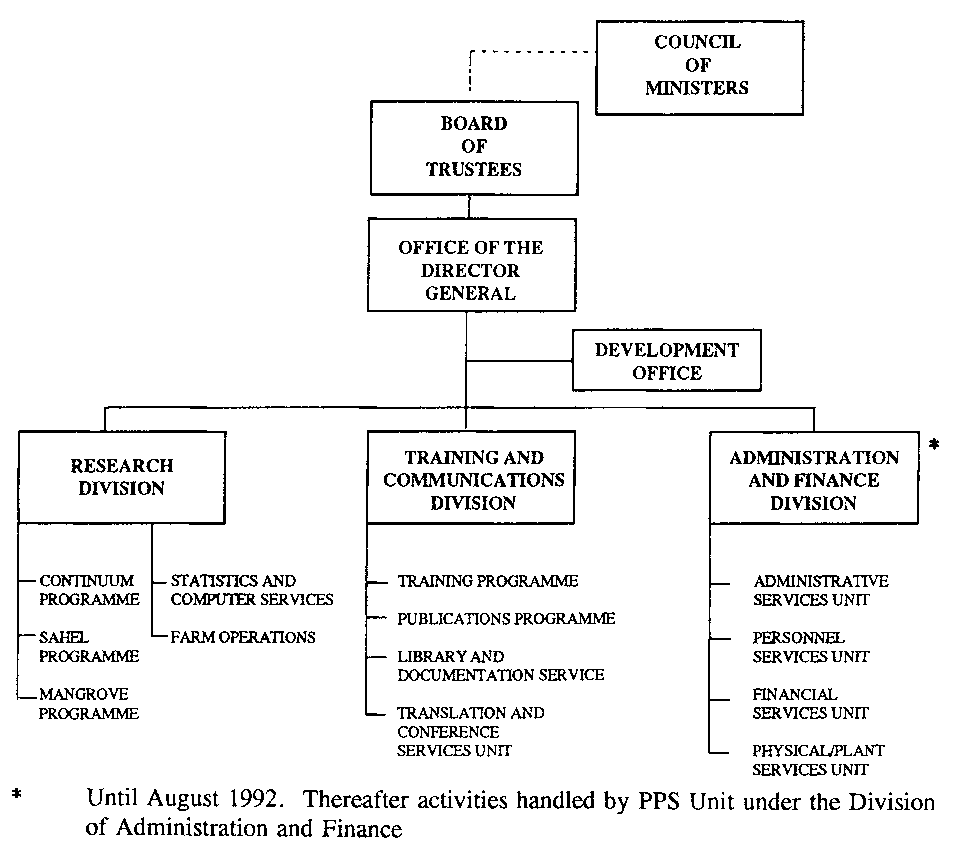
Governance and Management: Managerial responsibility was shifted from the Council of Ministers to an autonomous Board of Trustees chosen by a Nominating Committee on the basis of individual capacities equally from the region and world-wide. The Council of Ministers appoints the Director General on the recommendation of the Board.
Planning and Budgeting: WARDA's strategy for the decade 1990-2000 and the Medium-Term Plan (MTP) for the period 1990-1994 were approved in 1988 and 1989 respectively. In submitting annual, integrated programmes and budgets, annual in-house and Board reviews, external audits and reports, WARDA conforms to standard CGIAR requirements.
Strategy and Priorities: WARDA's strategy focuses on research, training and communications and support for NARS: top research priority has been assigned to the upland/inland swamp continuum, followed by irrigated Sahel and mangrove environments.
Research Orientation: Research is focused on technology generation emphasizing germplasm improvement, crop and resources management, and socio-economic and policy constraints.
Staffing: Professional staff are recruited competitively, all with the exception of the Director General on a global basis, and selected by management in consultation with the Board as appropriate.
Physical Facilities: The first phase of the Main Research Centre and Headquarters (i.e., Phase 1A) has recently been completed. A description is given below in Section 1.4.1.
Inter-Centre Cooperation: WARDA operates on the basis of comparative advantage in working with IARC's and other research centres. There is a Memorandum of Understanding (MOU) between IITA, IRRI and WARDA signed in September-October 1991 by their respective Directors General, for collaboration on germplasm exchange and cropping systems research. The terms of the MOU provided for the transfer of rice breeding activities in West Africa from IITA to WARDA, and for WARDA to assume responsibility for rice improvement in the region, focused on three major ecosystems: the upland/inland swamp continuum (which includes the inland valley ecosystem), the irrigated Sahel, and the mangrove swamp. The MOU also provides for IITA to collaborate with WARDA to ensure full integration of its soil and water management expertise in WARDA's rice production research for the inland valley ecosystems and other hydromorphic land types. It has cooperative activities with other centres and programmes including CIAT, CIRAD, ICIPE, IIMI, Rockefeller Foundation and research institutions and universities in advanced countries.
Support of NARS: WARDA conceptualizes the rice research infrastructure in West Africa as an integrated and interdependent system and cooperates to strengthen NARS capabilities through a wide range of mechanisms including formal working groups, thematic task forces, jointly planned and conducted group training, and a Selective Dissemination of Information (SDI) project.
Based on the findings described in Chapters 2 and 3, the Panel believes that WARDA has successfully implemented the CGIAR recommendations on governance and management and research restructuring. It further believes that these actions bring to completion the implementation of solutions to issues raised by the 1986 Mid-Term External Review.
1.4.1. Headquarters and Other Sites
1.4.2. Financial Situation
1.4.3. Staffing
International rice improvement research activities are undertaken at three CGIAR Centres - IRRI, WARDA, and CIAT. The organization of rice research in the CGIAR System is briefly described in Appendix VII. This section focuses on WARDA as it is to-day in terms of its physical location, financial situation and staffing.
In 1987 the CGIAR endorsed the decision of WARDA's Board of Trustees to establish Headquarters in Côte d'Ivoire. A site selection report recommended the location of the site at M'bé, near Bouaké.
The plans for moving to Bouaké from Liberia were completed in March 1988, premises were obtained in the city's Kennedy district (Kennedy 1) and work began on their rehabilitation. The Executive Committee of the Board in April 1988 endorsed plans to create temporary, prefabricated laboratories and offices on the site at M'bé.
The move to Côte d'Ivoire was underway in May 1988 and WARDA began work at its new temporary headquarters. A second building in the Kennedy district, the Annexe, was acquired, rehabilitated and occupied by the Finance and Documentation Units in June. By this time 15 members of staff had been transferred. A third building (Kennedy 2) was acquired later in the year when it became vacant next door to Kennedy 1.
In approving WARDA's Medium-Term Plan 1990-94, TAC and the CGIAR endorsed the construction of a new Main Research Centre and Headquarters at M'bé. The total capital development programme comprises three phases: phase one for the construction of research facilities, phase two for training and communications facilities, and phase three for an administration block. Due to funding constraints, work has been undertaken only for a reduced research phase (Phase 1A) which includes laboratories and office, a reduced farm building complex, and land development on the 700 hectares research farm. Construction on this phase began in January 1991, and the contractor handed over the building to WARDA in February 1992. This was followed by the installation of laboratory equipment and furniture for occupancy in May 1992. WARDA's training and communications division has also been moved to provisional facilities at M'bé.
WARDA plans to complete the research phase (Phase 1B), and the rest of the capital development programme, as funding is secured. Phase 1B includes the remainder of research building and service facilities; Phase 2 includes the training, communications and documentation building, and an initial group of hostels; Phase 3 includes the administration building, conference and catering facilities.
The M'bé research facilities are located within WARDA's priority rice growing environment - the upland/inland swamp continuum, which is the largest rice growing environment in West Africa. From an ecological viewpoint, M'bé is located in the transition zone between the humid forest and the guinea savanna, with average annual rainfall of about 1200 mm distributed in a bimodal pattern over a period of some eight months. WARDA also has access to three off-station sites in Côte d'Ivoire, two in the humid forest zone and one in the savanna.
The upland/inland swamp continuum is a landscape concept that refers to a sequence of land types and associated ecosystems located along the slope of the local topography. The ecosystems vary from the upland to hydromorphic to lowland swamp conditions. The varietal improvement programme for the upland and upland/hydromorphic conditions is located at M'bé, whereas the programme for the lowland/hydromorphic and lowland swamp and irrigated conditions is based at IITA, Nigeria.
In addition to the upland/inland swamp continuum environment, WARDA also works on two other rice growing environments - the irrigated Sahel and the mangrove swamp. The irrigated Sahel because of its proximity to the desert and the production of rice from large irrigated areas managed under government development projects, represents a markedly different environment. The Sahel Programme is based in Senegal at two contrasting sites: N'Diaye, near the coast, with relatively mild climate, and Fanaye, further inland, which experiences harsher conditions with greater diurnal and seasonal temperature fluctuations and lower rainfall.
The mangrove swamp areas are located mostly along coastal estuaries. After mangrove trees have been removed, swamps become viable rice environments during the rainy season. The Mangrove Swamp Programme has been based at the national Rice Research Station at Rokupr, Sierra Leone since its inception in 1971. In May 1991 the Programme was transformed into a network of collaborating national programmes. WARDA staff are scheduled to be withdrawn from Rokupr by mid-1993.
The level of operating funds available to WARDA throughout the 1990s has been significantly less than that projected in the MTP approved in 1989. This situation is common to all CGIAR Centres but it has been especially difficult for WARDA because the levelling of overall CGIAR funding coincided with WARDA's planned period of rapid growth following its transformation (described in Section 1.3 above). Due to CGIAR funding constraints the resources available to WARDA in 1990 (and subsequent years) were in large part determined by the level of expenditures in 1989, which were artificially low due to the reduced activities during that transition period between the move from Liberia and the initiation of planned activities in Côte d'Ivoire. Many staff members had resigned or had been separated and had not yet been replaced, and programme activities were at a minimum.
Financial conditions resulted in downward adjustment from MTP projected levels of programme and supporting staff throughout 1990-93 despite a World Bank contribution to core funding that proportionately is above the CGIAR average (CGIAR Financial Report, Annex II, Table 11-7, May 15, 1992).
Core operating expenditures for 1992 were approximately US$ 8 million compared with an MTP estimate of US$ 11 million (WARDA Programme of Work and Budget, 1993, Table 1). US$ 6 million of the 1992 estimated budget was financed by CGIAR core support with most of the remainder from restricted grants by ADB and UNDP.
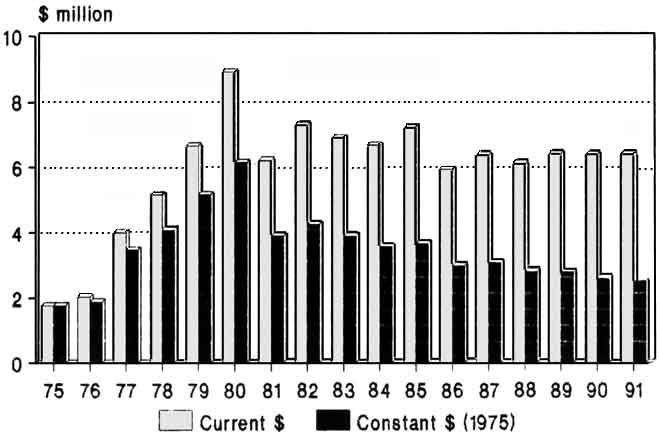
Member State contributions have fallen considerably below the levels provided to the old WARDA, and are much below the target agreed upon by the Council of Ministers, i.e., 5% of operating funds. In order to avoid deficit financing it has been management's practice to budget for Member States' contributions only in the year after they are received. Data on Member State funding from 1973 through 1991 are shown in Table 1.3.
Table 1.3: Member States Funding 1973-91
|
YEAR |
CURRENT |
1973 |
|
1973 |
821 |
821 |
|
1974 |
499 |
466 |
|
1975 |
450 |
393 |
|
1976 |
484 |
395 |
|
1977 |
590 |
450 |
|
1978 |
1,254 |
894 |
|
1979 |
1,354 |
902 |
|
1980 |
3,783 |
2,356 |
|
1981 |
1,808 |
1,052 |
|
1982 |
1,338 |
728 |
|
1983 |
1,003 |
510 |
|
1984 |
1,120 |
532 |
|
1985 |
1,475 |
655 |
|
1986 |
598 |
248 |
|
1987 |
1,063 |
412 |
|
1988 |
296 |
107 |
|
1989 |
|
|
|
1990 |
55 |
20 |
|
1991 |
88 |
31 |
|
TOTAL |
18,079 |
10,974 |
In constant dollar terms WARDA core funding has followed a downward trend throughout the 1980s and 1990s despite a plan that anticipated substantial growth following the reorganization of the late 1980s (Figure 1.1).
Further compounding the current operating income situation is a US$ 2.8 million shortfall in financing for the new facilities at M'bé. Funding has been managed through an overdraft arrangement with Citibank. Fortunately, firm pledges and actual allocation of funds to enable repayment of the loan and related interest expense during the next three years have been obtained from several donors.
The estimated core operating budget for 1993 is decreased from US$ 8 to US$ 7.4 million (WARDA Programme of Work and Budget, 1993, Table 1). This has required a number of difficult programmatic and staffing adjustments.
WARDA's ability to accommodate the difficult funding circumstances of recent years while continuing to make progress toward the goals outlined in the MTP is laudable and has been due to a number of factors. Included are:
· a conservative approach to budgeting (i.e., the use of a 250:1 conversion rate of the CFA to the US dollar, delay in accounting for Member States' pledges until the year after receipt);· commitment to fiscal integrity (i.e., management adherence to a Board directive that operating budget deficits not be incurred);
· efficient management; and
· a high level of commitment by WARDA employees.
As 1993 begins, WARDA's financial condition remains precarious and requires a sustained staff and management effort to control costs and an increased management commitment to fund-raising from all sources. The attractiveness of the new facilities at M'bé and the accomplishments under the existing MTP, despite the difficult circumstances of the past three years, should contribute to the success of such efforts.
With a total staff of 249 at 31 December 1992, 19 of whom recruited internationally and 230 recruited locally/regionally, WARDA is the smallest of the rural based Centres in the CGIAR System. In 1992 it represented roughly 2.1% of total staff in the CGIAR Centres and 1.9% of their international staff.
Table 1.4. shows the evolution of WARDA staff since 1987, the last full year of the old WARDA. Total staff decreased in 1988, prior to the headquarters move to Bouaké. It increased by 32%, from 188 to 249, over the last four years with the build up of the programme. It will decrease in 1993 with the ending of the Mangrove Programme.
Figure 1.1: WARDA CORE FUNDING 1975-1991
Table 1.4: WARDA Staffing - 1987 - 1993
|
|
1987 ACTUAL |
1988 ACTUAL |
1989 ACTUAL |
1990 ACTUAL |
1991 ACTUAL |
1992 MTP |
1992 ACTUAL |
1993 PLAN |
|
International Staff |
25 |
24 |
26 |
23 |
19 |
36 |
19 |
16 |
|
Local Staff |
171 |
164 |
195 |
197 |
197 |
299 |
230 |
182 |
|
TOTAL STAFF |
196 |
188 |
221 |
220 |
216 |
335 |
242 |
198 |
|
International staff as % of total staff |
13% |
13% |
12% |
10% |
9% |
11% |
8% |
8% |
- Actuals for each year are at end of year- 1992 MTP figures are the positions estimated essential in MTP
- Figures for 1993 are estimates for end of year
- A separate category for international positions, i.e., funded core positions subject to worldwide competitive recruitment, was only introduced in 1988 for Director positions and 1990 for general programme staff. Hence figure for 1987 to 1989 are estimates based on functions similar to those later classified as international
- International positions do not include Post-Doctoral Scientists, Donor-Supported Experts, Research Associates or Center-based collaborating Scientists.
Although total staff increased in recent years, WARDA had to limit its growth, especially that of international staff, well below its MTP because of the funding difficulties. Local staffing in 1992 was 23% below the MTP. International staffing was 47% below MTP, compared to an average shortfall of only 17% for all CGIAR Centres. The impact of limited funding on international staffing has thus been much more severe in WARDA than in the other CGIAR Centres and it has hit while the Centre had not yet reached its full operational size. Table 1.5 shows the difference between 1992 actual and planned staffing figures for international and local staff by programme.
The number of WARDA's international staff has actually decreased from 25 to 19 over the last five years and it is scheduled to decrease further, to 16, in 1993 (Table 1.4). In 1992, WARDA's international staff represented a lower proportion of its total staff (8%) than envisaged in its MTP (11%). Compared to other CGIAR Centres, the proportion of international staff is lower than in the smaller (i.e., less than 1,000 total staff) rural based CGIAR Centres and it is about the same as in the bigger (i.e., above 1,000 total staff) rural based Centres. WARDA's international staff is thus proportionally lower than in comparable CGIAR Centres.
The distribution of WARDA's international positions by organizational units or by programmes (see WARDA's organization chart Figure 1.2. and see Table 1.6.) is well within the ranges of the other CGIAR Centres. Slightly above two-thirds of these positions (13 of 19 or 68%) are in the Research Division (Research + Research Support programmes) while there are three (16%) such positions in the Training and Communications Division (Institution Building programme), two in the Finance and Administration Division and one is occupied by the Director General.
Overall, Research and Research Support represent 78% of total staff while Institution Building represents 5% and Finance and Administration 16%. While the latter may seem high, it is not excessively so for a small international organization. Nevertheless, in view of the funding situation, and in order to safeguard its research programmes, WARDA is in the process of reclassifying two international positions into local/regional positions, one in Research Support and one in Training and Communications. In addition, the Association has also reduced the salaries of 11 general services positions. These actions, dictated by the funding situation and taken in the Association's best immediate interest, are resulting in the departure of several high quality staff. They are also reducing staffing in the support functions to dangerously low levels in an institution which has worked hard and has succeeded in overcoming past difficulties.
The distribution of WARDA's international positions by discipline, actual at end of 1992, planned in the current MTP for 1992, and estimated for the end of 1993, is given in Table 1.7.
The distribution of staff, local and international, by geographical location is indicated in Table 1.8. Most of the staff (58%) are located at Headquarters. Staff in Nigeria, Senegal and Sierra Leone represent respectively 9%, 10% and 23% of the total. There are no more WARDA staff in Liberia. International staff are mostly based at Headquarters (15 of the 19 or 79%).
Overall, WARDA staff are a group of new (two year tenure or less for the most part), competent, hard working and dedicated professionals. Hence, the two major issues with respect to staffing in WARDA are (a) the need to avoid any further staff cuts in the support functions so as to maintain the level of excellence and soundness in financial, administrative and personnel management, and (b) the determination as to whether scientific staffing has fallen below the critical mass to conduct effective and sustainable research and whether the necessary research disciplines are appropriately represented among the staff. The latter issue will be examined later in the course of this report.
Issues relating to personnel management are examined in Chapter 3.
Table 1.5: WARDA Staffing - Actual vs Plan - by Programme and Category of Staff as of 31 December 1992
|
PROGRAMME/CATEGORY |
1992 MTP |
1992 ACTUAL |
ACT./MTP % |
MALE/ FEMALE |
|
|
INTERNATIONALLY HIRED STAFF |
|
|
|
|
|
|
RESEARCH |
21 |
10 |
48 |
10/0 |
|
|
|
Continuum |
13 |
7 |
54 |
7/0 |
|
Sahel |
5 |
2 |
40 |
2/0 |
|
|
Mangrove |
3 |
1 |
33 |
1/0 |
|
|
RESEARCH SUPPORT |
|
|
|
|
|
|
Coord./Farm oper. |
3 |
3 |
100 |
3/0 |
|
|
INSTITUTION BUILDING |
|
|
|
|
|
|
Train./Communic./Lib./Doc. |
7 |
3 |
43 |
2/1 |
|
|
ADMINISTRATION & MANAGEMENT |
|
|
|
|
|
|
DG/Int.coop./Admin./Finance |
5 |
3 |
60 |
3/0 |
|
|
TOTAL INTERNATIONAL STAFF |
36 |
19 |
53 |
18/1 |
|
|
LOCALLY HIRED STAFF |
|
|
|
|
|
|
RESEARCH |
216 |
155 |
72 |
143/12 |
|
|
|
Continuum |
123 |
76 |
62 |
67/8 |
|
Sahel |
54 |
22 |
41 |
18/4 |
|
|
Mangrove |
39 |
57 |
146 |
57/0 |
|
|
RESEARCH SUPPORT |
|
|
|
|
|
|
Coord./Farm oper. |
5 |
27 |
540 |
27/0 |
|
|
INSTITUTION BUILDING |
|
|
|
|
|
|
Train./Communic./Lib./Doc. |
34 |
10 |
29 |
6/4 |
|
|
ADMINISTRATION & MANAGEMENT |
|
|
|
|
|
|
DG/Int.coop./Admin./Finance |
44 |
38 |
86 |
30/8 |
|
|
TOTAL LOCAL STAFF |
299 |
230 |
77 |
206/24 |
|
|
TOTAL WARDA |
335 |
249 |
74 |
224/25 |
|
|
Post-Doctoral Scientists |
8 |
2 |
25 |
2/0 |
|
|
Center-Based Collaborating |
|
|
|
|
|
|
Scientists |
0 |
2 |
- |
2/0 |
|
|
Donor-Supported Experts |
0 |
1 |
- |
1/0 |
|
|
Research Associates |
0 |
2 |
- |
2/0 |
|
Figure 1.2: WARDA's Organizational Chart
Table 1.6: WARDA Staff by Programme - 1992
|
Staff Category |
Research and Research Support |
Institution Building |
Management and Administration |
Total |
|||||
|
No. |
% |
No. |
% |
No. |
% |
No. |
% |
||
|
Total WARDA Staff |
195 |
78 |
13 |
5 |
41 |
16 |
249 |
100 |
|
|
|
- Local Staff |
182 |
79 |
10 |
4 |
38 |
17 |
230 |
100 |
|
- International Staff |
13 |
68 |
3 |
16 |
3 |
16 |
19 |
100 |
|
|
Post Doctoral Fellows and Donor-Supported Experts |
5 |
- |
- |
- |
- |
- |
5 |
- |
|
|
International Staff as % of total staff |
|||||||||
|
|
- Average for all CGIAR Centres |
|
75 |
|
13 |
|
12 |
|
100 |
|
- Lowest-Highest % of all Centres |
|
56-86 |
|
5-33 |
|
7-22 |
|
- |
|
Table 1.7: WARDA - International Positions by Discipline - 1992
|
DISCIPLINE |
1992 |
1992 |
1993 |
|
|
MTP |
ACTUAL |
PLAN |
||
|
RESEARCH MANAGEMENT |
5 |
3 |
3 |
|
|
|
Director General |
1 |
1 |
1 |
|
Director Administration & Finance |
1 |
1* |
1 |
|
|
Financial Controller |
1 |
1 |
1 |
|
|
Physical Plant Services Officer |
1 |
0 |
0 |
|
|
Special Ass. International Coop. |
1 |
0 |
0 |
|
|
RESEARCH |
21 |
10 |
9 |
|
|
|
Cropping Systems Agronomist |
2 |
1* |
1 |
|
Soils Agronomist |
3 |
1 |
1 |
|
|
Weed Scientist |
1 |
0 |
0 |
|
|
Economist |
1 |
1 |
1 |
|
|
Soil Water Engineer |
2 |
0 |
0 |
|
|
Physiologist |
2 |
1 |
1 |
|
|
Breeder |
5 |
3 |
3 |
|
|
Entomologist |
2 |
2 |
1 |
|
|
Pathologist |
1 |
1 |
1 |
|
|
Germplasm Specialist |
1 |
0 |
0 |
|
|
Socio-economist |
1 |
0 |
0 |
|
|
RESEARCH SUPPORT |
3 |
3 |
2 |
|
|
|
Director of Research |
1 |
1 |
1 |
|
Biometrician |
1 |
1 |
0 |
|
|
Farm Manager |
1 |
1 |
1 |
|
|
INSTITUTION BUILDING |
7 |
3 |
2 |
|
|
|
Director Training and Communications |
1 |
1 |
1 |
|
Trainer |
2 |
0 |
0 |
|
|
Publications Head |
1 |
0 |
0 |
|
|
Writer/Editor/Translator |
1 |
0 |
0 |
|
|
Documentalist |
1 |
1 |
1 |
|
|
Interpreter/Translator |
1 |
1 |
0 |
|
|
TOTAL |
36 |
19 |
16 |
|
(1) Positions considered essential in MTP
(2) At 31 December 1992
(3) Estimates at end 1993
*Vacant at 31 December 1992
Table 1.8: WARDA Staff by Location - 1992
|
Location |
International Staff |
Local Staff |
Total |
|||
|
No. |
% |
No. |
% |
No. |
% |
|
|
Côte d'Ivoire |
15 |
79 |
130 |
57 |
145 |
58 |
|
Nigeria |
1 |
5 |
21 |
9 |
22 |
9 |
|
Senegal |
2 |
11 |
22 |
10 |
24 |
10 |
|
Sierra Leone |
1 |
5 |
57 |
25 |
58 |
23 |
|
Total |
19 |
100 |
230 |
100 |
249 |
100 |