Cassava in food crop and livestock production systems
Cassava in food systems during crisis
Importance of cassava in future food systems
Implications for cassava use in livestock feed
Conclusion
F.I. Nweke and H.C. Ezumah
Farming systems can be broadly defined to include the food system as a subset in the overall context of production of food and shelter materials. The food system may also be defined to include crop and livestock production systems as a subset when it is considered as a continuum of activities starting from production through processing and distribution to utilization of crop and livestock products for food. The importance of the latter definition is underscored by the decision, in 1987, to award the first General Foods World Food Prize, as follows:
The concept of the total food chain lies at the heart of the General Foods World Food Prize, for each link in that chain plays a vital role. Every aspect of the production, processing and distribution of food needs to be considered, including farming, the agricultural sciences, food sciences and technology, nutrition, economics, technology transfer, governmental policies, transportation and distribution and education [General Foods 1987].
The General Foods' definition is adopted in this paper and livestock production systems as subsets of food systems. This paper will describe the role of cassava in the food crop product/on systems of tropical Africa. We will also explore the degree to which tropical African countries can meet their cassava needs for human consumption and generate a surplus for use in livestock feeds.
In collaboration with international Center for Tropical Agriculture (CIAT), Colombia, the Overseas Development Natural Resources Institute (ODNRI), and national agricultural research systems (NARS) in Africa, IITA has embarked on a continent-wide survey of cassava in Africa. The survey is called the Collaborative Study of Cassava in Africa (COSCA) and it is initially concentrated in six countries namely, Côte d'Ivoire, Ghana, Nigeria, Tanzania, Uganda, and Zaire, selected partly on the basis of the importance of cassava in the farming and food systems of the countries. The survey data were analyzed on the basis of production projections using time series data provided by USDA as well as other secondary data.
The interrelationships between crop-based production systems and livestock-based systems are illustrated in figure l, which shows a complex eastern Nigeria system, in which the family household is the major source of labor used for food crop and livestock production.
In this food crop system, cassava is commonly intercropped with early maturing annuals such as maize, and vegetables like okro, egusi and bitter leaf. The crops intercropped with cassava in different parts of Africa very with regions of growth and food preferences. In Zaire, the intercrop may be dominated by grain legumes such as groundnuts and phaseolus beans, while in Sierra Leone, The Gambia, Liberia, and Guinea, rice is the dominant intercrop. Protected trees like Parkia, and nonwoody perennials such as plantains and bananas, are also frequently grown in patches or as individual stands in cassava fields. While cassava and associated crops are the main food crops, trees provide fuelwood and construction materials.
Dry cassava peels are fed to goats and sheep, and pigs eat the tubers. In some countries, cassava leaves are consumed by humans and also fed to animals, or used as poultry rations. These animals provide the household with eggs and meat for consumption and the market. Animal wastes are incorporated with household refuse as mulch and used for soil enrichment or are carted directly into herds, especially those close to homes.
Some existing cassava cropping patterns modified to incorporate only two crops are illustrated in figure 2. Pattern 2 is common in Zaire and some countries in West Africa while pattern 4 is dominant in West Africa. Subsidiary crops associated with these patterns may be fruits and leafy vegetables. Patterns 1 and 3 are further modifications of the traditional, complex crop mixture systems to nearly monocrop pattern (1) and a completely monocrop pattern (3). Soybean may be intercropped with cassava as in patterns 1, 2 or 4. Cassava is highly compatible as an intercrop with these annuals because of its slow initial growth, especially between planting and six to eight weeks of growth. The annuals which grow faster during the initial growth phases rarely compete adversely with cassava and have been shown to smother weeds. The advantage of soybeans, a relatively new crop in cassava growing areas of Africa, is that it will supply the deficient protein component to a predominantly cassava diet in both human food and animal feeds.
Figure 2: Cassava cropping patterns and alternative patterns for humid southern Nigeria
The role of cassava in food systems will depend on what happens to real income. Cassava is a crisis crop. In times of war, drought or low national incomes, cassava consumption increases relative to alternative food staples such as yam, maize, rice, and wheat.
Cassava in certain forms is a low income consumers' staple. Although an individual may not increase the quantity of cassava consumed in a year, as national income declines, annual average cassava consumption per person increases because more people begin to substitute cassava for more expensive alternative food staples.
Between 1973 and 1985, the annual compound population growth rates varied from 2.7% in Ghana to 4.3% in Côte d'Ivoire while the per capita GNP was -3.1% for Ghana and -1.1% for Côte d'Ivoire (table 1).
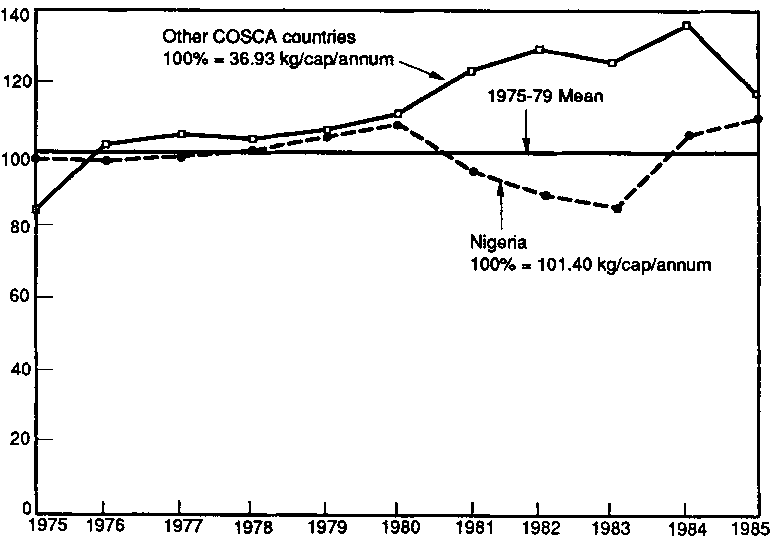
Available consumption figures that per capita consumption of cassava was increasing in the COSCA countries during the same period (figure 2, table 2). The weighted annual average per capita consumption of cassava increased by 5.66 kg from 49.01 kg during 1976-80 to 54.67 kg during 198185, representing an increase of 12 percent.
In Nigeria, the annual average per capita consumption of cassava appears to have declined by 6% from 103.24 kg during 1976-80 to 96.55 kg during 1981-85. National incomes did not decline at a rapid rate before 1980. In addition, during 1979-83 the rate of food grains import was high. The Nigerian naira was overvalued so that the consumer price for the imported food grains was therefore highly subsidized. During 1980-83, there was a high incidence of cassava mealybug, and during 1985-88 there was a serious outbreak of cassava mosaic and bacterial blight, which caused considerable scarcity of cassava in Nigeria.
In 1985, the importation of food grains was banned and by 1986 the Nigerian currency was devalued so that although the ban on importation may not have been entirely effective, the consumer price subsidy resulting from the over-valued exchange rate was removed. Annual per capita consumption of cassava therefore increased in 1984 and 1985 beyond the 1976-80 average (table 2).
Table 1. Population totals (1985) and growth rates (1973-1985), and GNP per capita (1985) and growth rat. (1973-85) for COSCA countries
|
Country |
Population |
GNP per capita |
||
|
Total 1985 (000s) |
Growth rate 1973-85 (%) |
1985 (US$) |
Growth 1973-85 rate (%) |
|
|
Côte d'Ivoire |
10 072 |
4.3 |
620 |
-1.1 |
|
Ghana |
12 710 |
2.7 |
390 |
-3.1 |
|
Nigeria |
99 669 |
2.8 |
760 |
-2.5 |
|
Tanzania |
22 242 |
3.4 |
270 |
-1.6 |
|
Uganda |
15 474 |
3.1 |
- |
- |
|
Zaire |
30 557 |
3.0 |
400 |
-2.6 |
Source: World Bank Atlas
Table 2. Average annual per capita consumption of cassava (kg) during 1976-80 and 1981-85 in COSCA countries
|
Country |
1976-80 |
1981-85 |
Change |
% change | |
|
Côte d'Ivoire |
7.39 |
9.19 |
+ 1.80 |
+24 | |
|
Ghana |
18.72 |
24.62 |
+5.90 |
+32 | |
|
Nigeria |
103.24 |
96.55 |
-6.69 |
-6 | |
|
Tanzania |
50.08 |
56.10 |
+6.02 |
+12 | |
|
Uganda |
16.14 |
20.46 |
+4.32 |
+27 | |
|
Zaire |
107.48 |
125.52 |
+17.04 |
+16 | |
|
|
Mean (weighted) |
49.01 |
54.67 |
+5.66 |
+12 |
The foreign debt burden and terms of trade, which are, at present, not in favor of primary products, suggest that the downward trend in real income in tropical Africa will continue for sometime. Cassava is therefore, likely to assume greater importance in the food system of the region in the future.
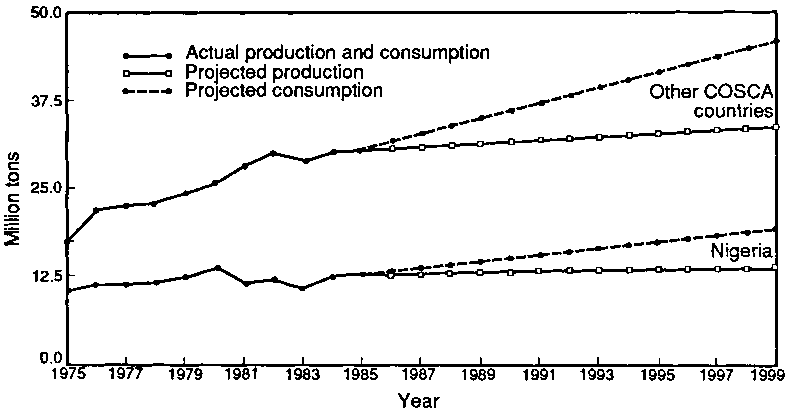
To determine the future importance of cassava in the food system of tropical Africa, we projected total production and consumption in COSCA countries to the year 2000, assuming that the 1975-85 cassava crop production trend would be maintained, and that the 1975-85 annual compound population growth rates would also remain. We also assumed an income elasticity of demand of 0. 5%.
Income elasticity of demand for cassava has not been estimated in a systematic way. The Food and Agriculture Organization (FAO) assumes -1% for most tropical African countries while the International Food Policy Research Institute (IFPRI) assumes 0% for all tropical African countries. Available estimates for southeastern Nigeria is 0.5°/0. Iterated projections show that there are no significant differences in projections on the bases of the three elasticities. In the current situation when incomes are declining, population growth rate is the predominant determinant of cassava consumption in COSCA countries.
On the basis of these assumptions, the production of cassava in a country N in year 1 was estimated as:
PN [t] = PN [1985][1+GN]T
where:
PN [1985] = 1985 production trend estimate [MT] in country N.
GN = annual compound rate of growth (%) of production during 1975-85 in country N, and
T = time interval between 1985 and t [years].
PN [1985] is estimated as:
log PN [1985] = a + bT
where:
T = time interval [10 years] between 1975 and 1985.
The consumption of cassava in country N in year T was estimated as:
CN [t] = CN [1985][1+(LN+IN - EN)]T
where:
CN [1985] = 1985 consumption trend estimate [MT] for country N.
LN = annual compound rate of growth [%] of population during 1975-85 in country N.
IN = annual compound rate of growth [%] of GNP per person during 1975-85 in country N.
EN = income elasticity of demand [%] for cassava in country N. and
T = time interval between 1985 and t [years].
CN [1985] is estimated as:
log CN [1985] = a +bT
where:
T = time interval [10 years] between 1975 and 1985.
Without population projections, it is not possible to estimate future consumption on a per person basis. Yet the negative rates of growth in real income and income elasticity of demand of less than unity suggest that per capita consumption of cassava will be higher in the year 2000 than in 1985 (figures 3 and 4).
By the year 2000, COSCA countries as a whole would generate a deficit of consumption needs over production of about 19 million metric tons or about 30 percent of the consumption needs. The level of the deficit varies from 10 percent in Uganda to 35 percent in Côte d'Ivoire and Ghana. The largest producing countries, Nigeria and Zaire, have average and above average levels of deficits respectively (table 3).
Table 3. Estimates of deficits of consumption needs over production of cassava (000 MT) by year 2000 in COSCA countries
|
Country |
Production |
Consumption |
Deficit |
Deficit as % of consumption needs | |
|
Côte d'Ivoire |
1 613 |
2 479 |
866 |
35 | |
|
Ghana |
3 250 |
3 786 |
536 |
14 | |
|
Nigeria |
13 235 |
18 556 |
5 321 |
29 | |
|
Tanzania |
7 646 |
11 785 |
4 139 |
35 | |
|
Uganda |
3 729 |
4 161 |
432 |
10 | |
|
Zaire |
15 904 |
23 689 |
7 785 |
33 | |
|
|
Total |
45 377 |
64 456 |
19 079 |
30 |
Source: Based on USDA data
The assumption that the 1975-85 rate of production will continue to the year 2000 is perhaps the most subjective of all the assumptions behind the projections. It implies that substitutions in resource allocation will not take place. However, increased demand for cassava will raise its market value relative to alternative food staples. It is likely that resources will be reallocated away from relatively high cost alternative food staples to cassava and the deficits will be reduced.
Production costs are lower for cassava than for alternative food staples. Available farm management data indicate that labor constitutes 80 percent or more of production costs in smallholder cropping systems in Nigeria. Cost of production per metric ton (MT) is lower for cassava when compared with alternative food staples (table 4).
However, cassava also has a low market value. On per unit calorie basis, the market value of cassava is very low compared with alternative food staples (table 5). Market value determines the level of cassava production. Cassava receives an inferior allocation of land and labor where it competes for these resources with alternative food staples except in times of crises.
Table 4. Labor requirements for production of various food crops In Nigeria
|
Crop |
Man-days/ha |
Man-days/MT |
Man-days/Mcal |
|
Cassava |
183 |
21 |
21 |
|
Yam |
325 |
45 |
69 |
|
Maize |
90 |
121 |
36 |
|
Rice |
215 |
145 |
60 |
Table 5. Purchase prices per thousand calories and grams protein from cassava, yam and cocoyam In southeastern Nigeria, 1984-85
|
Crop |
|
|
|
cassava |
0.10 |
10 |
|
Yam |
0.77 |
45 |
|
Cocoyam |
0.89 |
50 |
In the Zaki-Biam area of Benue State of Nigeria where the cassava yield is almost four times the national average of about 8.0 MT per ha, land area allocation to cassava was less than 2.0 percent of yam land (table 6).
In contrast, in the Ezza area of Anambra State also in Nigeria where the cassava yield is less than national average, land area allocation to cassava is 60 percent of yam land. The market value for yam is 80 percent higher in Zaki-Biam and only 1 percent higher than cassava in the Ezza area (table 6).
Table 6. Yield (t/ha) and area (ha) per household for cassava and yam and net revenue (yam/cassava) ratio in predominantly yam producing areas of southeastern Nigeria, 1984-85 crop season
|
Parameter |
Crop |
Zaki-Biam |
Ezza |
|
Yield/ha |
Cassava |
31.00 |
7.56 |
|
Yam |
42.84 |
10.40 |
|
|
Area/household |
Cassava |
0.37 |
1.52 |
|
Yam |
2.10 |
2.52 |
|
|
Net revenue ratio |
Yam/cassava |
1.80 |
1.01 |
The extent of the allocation of resources from alternative food staples to cassava to generate surplus production over consumption needs for use in livestock feed will depend on the market value of cassava. A high demand for livestock products will raise the market value of cassava in livestock feed. However, a high demand for livestock products will be realized only if real incomes improve. Unfortunately, when this happens, consumers will also reallocate consumer resources away from cassava to alternative food staples unless cassava is transformed into products such as gari which are attractive to high income consumers.
It appears that the crisis value of cassava is not only its boon but also its bane. When national crises occur, such as rapidly expanding population and declining national incomes, cassava production expands. As soon as the crisis situation is resolved, cassava production declines, giving way to alternative food staples.
When real incomes rise to the extent that consumers will begin to afford it, they will also start to substitute more livestock products for food grains in the diets. Then the potential for generating surplus cassava for livestock feed will shift to technical factors.

 /1000 calories