Session Guide: Case study: planning agricultural research in Mughal sultanate (parts A and B)
Planning agricultural research in Mughal sultanate (case study, part A)
Planning agricultural research in Mughal sultanate (case study, part B)
|
DATE |
|
|
TIME |
|
|
FORMAT |
Individual reading, small group discussions, and plenary session |
|
TRAINER |
|
|
OBJECTIVES |
|
This case study should provide an experience in planning research programmes for an evolving organization. Planning has to be done with limited data. |
|
REQUIRED READING |
|
Case study: Planning agricultural research in Mughal Sultanate (Case A) |
|
SPECIAL EQUIPMENT AND AIDS |
|
Overhead projector and chalkboard |
The case study is presented in two parts. Part A is for distribution to participants. Part B is not to be distributed at least until the case has been discussed.
Part A provides the background to Mughal agriculture and poses the basic problem of 'How does one plan with limited (or even no) data?' The organization of the national Agricultural Research Authority (NARA) is evolving: responsibilities are not properly delineated; professional staff is extremely limited; and budgetary support is uncertain. The country is bestowed with diverse agro-ecological conditions, offering a very high potential for agricultural growth. Recent trends indicate an increase in high-value, income-elastic crops, while areas under low-value, traditional crops, and export crops like cotton and coffee, are decreasing.
Problem identification is the beginning of the case analysis. Where is the problem: is it in the organization of research in Mughal Sultanate, or in research planning? What should be the direction of research, and what should be the priorities? What should be the research programme? Discussion should address these problems, searching for an indication of what the technical adviser should do and how he or she should proceed.
Case B describes how the problems were approached. Recognizing not only the potential of the diverse agro-ecological zones but also resource constraints, priority setting was essential. The first step was to generate as much information as possible from scientists working in NARA. The class discussion could focus on what information should be generated with respect to crops; livestock; forage and range; agricultural economics and statistics; soil science; plant protection; farm mechanization; etc. Note that these correspond to the technical divisions in NARA. The next step is to develop a conceptual framework for setting priorities at national and regional levels. Taking crop production as an illustration, a scheme based on Case B could be evolved through class discussion. Similar conceptual frameworks could be developed for livestock and other activities. Priorities have first to be evolved for commodities in each ecological region, and then on specific research within a particular commodity. For example, in some areas, screening of varieties may be of paramount importance, while plant protection may deserve high attention in other areas. The resource person should take advantage of the forms presented in the Appendixes to the Cases in guiding the discussion. Objectives of research in each field could be clearly defined at this stage.
The overall aim is to systematize the research effort of NARA so that it is well organized, easy to monitor and creates a sense of commitment. Towards this goal, a workshop methodology was used, in which even those outside NARA participated. This also enabled participation of the extension agency, which was part of the regional rural development projects (RDPs), which themselves were independent of each other.
Ask participants what the outputs of such a workshop would be. As Case B describes, the workshop helped in identifying research areas and finalizing research projects. Priorities were assigned between and within the commodity groups, considering the potential and specific problems of ecological zones. Preference was given to projects which were interdisciplinary in nature and envisaged inter-organizational collaboration. Prioritization led to identification of constraints relating to scientific staff as well as to the organization of research programmes.
The organization of the research programme, as it evolved, involved commodity coordinators, disciplinary research coordinators, and project leaders. Case B describes the responsibilities of these coordinators. It should be noted that the organization faced problems of coordination, which were accentuated with the appointment of a research coordinator with responsibility to organize, manage, monitor and evaluate research. At this stage, it may be useful to discuss the best way of organizing a research programme. Note that the organizational issues will be discussed in detail in a subsequent module.
What is the usefulness of a national workshop? If made an annual feature, it could be a forum for:
· identification of target problems;
· evaluation of results;
· assignment of responsibilities for future research programmes;
· joint planning of research, which would enhance commitment and ensure cooperation; and
· joint review in a healthy spirit of competition.
Although the workshop methodology was successful in setting up research priorities (Appendix 3 in Case B) and organizing the research programme, its actual implementation was difficult. Ask 'Why was it so?' The obvious answer would be that programme planning had no linkage with funding. Research planning was not synchronized with availability of resources. Infrastructure support for research was inadequate and trained staff limited. Thus, the workshop methodology could be seen as merely having helped to 'generate a comprehensive list of research projects.' Was this true?
As suggested earlier, participants should individually read Case A, and then discuss it in small groups, which should then be followed by a plenary session.
Agriculture in Mughal sultanate
Agricultural research
The research and development project
Follow-up action
Case study - Part A - Appendix A1
Case study - Part A - Appendix A2
Case study - Part A - Appendix A3
At last, Dr Shiva Kumar received the communication he had been waiting for. It was a short and somewhat cryptic internal memorandum from Dr Md. Yakima Zabari, DG, National Agricultural Research Authority (NARA), Mughal Sultanate. While the communication itself was not very important, it was the mandate it gave to Dr Kumar which mattered the most. Dr Kumar recalled his last meeting with the DG, who had told him that
"... lack of coordination among ARS, TEA and the bilateral donors had led to duplication and waste of limited resources. The National Research Council was unable to carry out its responsibility to coordinate research on a national basis. The Council was only advisory, had no power to implement its recommendations, and lacked financial control. This was the genesis for setting up NARA ..."
The DG then dwelt upon how NARA was established and how its organization had evolved. He went on to observe that
"... agricultural research has to play a vital role in improving agricultural production in the country. In NARA, we have an organization responsible for planning, organizing, managing, implementing and communicating agricultural research at the national level. NARA has a mission and a mandate, but we have not been able to develop operational strategies to pursue this mission. It is incumbent on all concerned to streamline all activities to achieve better results in terms of funds and manpower, keeping in view the diverse agro-climatic environment of the country."
The DG subsequently requested Dr Kumar to evaluate all research work done in the country and to formulate the future research programme which would serve as a guideline for NARA. As Chief Technical Adviser of the FAO-executed project on Agricultural research and development, Dr Kumar knew that this was an important task confronting NARA.
The request from the DG was well within the scope of the FAO project. The FAO project aimed at building on experience to date to establish a viable Mughal agricultural research and development organization, designed to solve farmers' problems in the major agro-ecological regions of the country, with major emphasis on developing Mughal human resources in applied agricultural research technology.
Dr Kumar suggested to the DG that the latter might wish to put down his thoughts in an internal note so that they could be appropriately pursued. Dr Kumar knew that such a communication was not necessary, but he wanted to be sure that that was what the DG had indeed wanted. He was sure that he would probably end up annoying some people unless he exercised caution and discretion.
With several years of experience, Dr Kumar knew well that an official mandate was necessary for him to even initiate this exercise. From all he had observed, there was tremendous potential in Mughal agriculture.
The dam across the Marisa built during the heyday of Queen Zeenat bears mute testimony to importance of agriculture in the Mughal economy. The centuries-old system of terraces, particularly in the Southern and Central Highlands, is a unique feature of Mughal agriculture. This man-made asset had been cleverly designed, solidly executed and carefully maintained. It had served to control erosion, harvest maximum run-off and retain highly fertile soil. However, the terrace system has in recent times been maintained less well, and many marginal terraces are even being abandoned for want of labour. A massive outflow of labour (estimated at 40% of the total male labour force), predominantly from the rural areas, has curtailed the supply of agriculture labour. Consequently, the cost of agricultural labour has gone up considerably. The migrant labour is mainly working in oil-producing countries, such as Al Arabia and Gulistan states. Their remittances contribute nearly 40% of all goods and services produced domestically. Notwithstanding this, the government accords a high priority to agriculture and is determined to attain self-sufficiency in basic staples by 2001.
Even today, agriculture is the most important sector of the Mughal economy. It employs about 75% of the resident labour force and contributes nearly 40% of GDP.
Land resources
The area of the country is about 20 million ha. About 1.5 million ha of this land is cultivable, and 2.0 million ha is marginal agricultural land, which is cultivated when rainfall is favourable and grazed otherwise. Some non-agricultural lands with light vegetation are also used as rangelands.
Climate and agro-ecological zones
The land has been blest with a rare combination of climate, topography, soil and hydrology, with tropical, subtropical and temperate climatic conditions. Soils range from best agricultural sandy loam to arid sandy soil (Appendix A 1). The country is ecologically so diverse that almost all types of crop can be grown. Climatic conditions vary widely, even over small distances, within a region, because of mountainous topography and the influence of the sea. Precipitation varies from a low of 50 mm/year in the coastal lowland and eastern escarpments to a high of 1 200 mm/year in the southern uplands. Agriculture is mostly rain-fed, with nearly 80% of the cultivated land dependent solely on rainfall. About 7.5% of the cultivable area receives one or more irrigations by spate flood flow. A similar proportion of the cultivable area receives irrigation year-round from wells, streams or springs.
Agricultural production
The farming systems of the country integrate livestock and arable farming, although their relative importance varies among the ecological zones. Forestry is in effect non-existent, and the rangelands are highly degraded. Fruit and vegetable production have played a limited role in the past, but interest in them is steadily growing as a result of a ban on their import since 1983. Similarly, enterprises relating to white meat, eggs and milk production are expected to grow steadily. Harnessing of spate irrigation in the tropical lowlands, exploitation of groundwater in all ecological zones, and development of irrigation from the Marib dam in the eastern plateau are bound to increase agricultural production.
Despite mechanization (primarily tractors), animals dominate in terraced agriculture. Nearly 85% of the farms use animal traction. Tractors have been introduced in response to labour scarcity. There is a free market for import of tractors, which has resulted in overcapitalization. Back-up service is poor and spare parts are scarce. The use of tractors has also damaged the terraces. The majority of farmers use farmyard manure to increase land productivity, but use of chemical fertilizers is increasing steadily.
The traditional cereal crop is sorghum, which occupies 50% of the arable area. Its cultivation extends to all ecological zones. The local varieties are exceptionally good in productivity and adaptation. The highland varieties of sorghum are of long duration (180 days) and the early maturing lowland varieties produce better quality fodder. Consumer preference for grain quality is pronounced, and the available improved varieties have not been able to overcome that. Millet, grown more for fodder, even on the sand dunes, commands a greater price than sorghum, maize or wheat. The opportunity to make rapid progress in wheat is greater than in sorghum or millet. Wheat is projected to account for 45% of total cereal consumption in 1991. Consumption of maize is likely to increase significantly. These trends underscore the need to give greater attention to research on wheat and maize than might be indicated on the basis of the areas currently sown to these crops.
Among the tropical fruits, banana, papaya and citrus are projected to register a steep growth in production and consumption, nearly doubling in the next decade. A similar trend is evident in vegetables, particularly potatoes, in the highlands, and okra and onion in the lowlands. It is probable that the country will be a net exporter of bananas, onion and okra in the next five years.
Agriculture statistics collection is extremely weak. However, it has been estimated that the average annual rate of growth of agricultural production during the 1970s was 4%, but with large between-year variations. Two major trends are discernible for this period. The first is the substantial growth in production of high-value, income-elastic crops (kat, fruits and vegetables) in response to a growing domestic demand and high export potential to neighbouring countries. Simultaneously, production of low-value, traditional crops (sorghum and millet) has been declining. The second major trend is a decline in production of export crops, especially cotton and coffee. During the 1970s, annual cotton production declined from about 20 000 t to 6 000 t. Coffee production has remained stationary, at 3 500 t/year, in competition with more lucrative kat production.
Livestock
Livestock production has remained more-or-less stationary, except for poultry products. According to the first agricultural census, there are an estimated 8 800 head of cattle, 5 million chickens, 3 million sheep, 2 million goats, 500 000 camels and 9 000 donkeys in the country. Animals are mainly fed on crop by-products. Sheep and goats are reared on the country's extensive rangelands.
In spite of a favourable climate, agriculture is characterized by low productivity of land and labour. Lack of suitable technology has been a major constraint.
Since land and water resources - particularly water - are limited, any major thrust in production growth has to come from intensification of agriculture rather than from area expansion. Without continuous research, agriculture will continue to stagnate and land productivity will remain low. Given the country's natural agroclimatic diversity, with five distinctly different agro-ecological zones (AEZs), agricultural research has to cover an unusually wide range of crops and problems. Agricultural research is therefore crucial in providing technological innovations suitable to local agro-ecological, economic and socio-cultural conditions. Hence the need for a properly organized NARS.
Status of agricultural research
Agricultural research started in 1970, when FAO/UNDP formulated three agricultural projects to serve the rain-fed highlands (Ibia), the supplemental irrigation of middle land (Tajrish), and Vadi irrigated lowland in Tisa (Zadar).
In 1972, the lowland project at Zadar became a research department within the newly established Tisa Development Authority (TDA). In the same year, a research and training station for Tajrish and Ibia provinces was established to replace the highland projects. The FAO/UNDP Agricultural Research and Training Project (1973-78) laid the foundations of an agriculture research organization through the procurement of land for experimental purposes; establishment of the necessary laboratories for soil and water analyses, and for plant protection; recruitment of staff to carry out research of direct interest to farmers; and a training programme for junior extension agents in the Southern Upland Development Project.
Foreign assistance provided the bulk of financing and manpower for agricultural research (Appendix A2). Bilateral projects with a research component were:
· Range and Livestock Improvement Project in Diaharam (funded by the Netherlands);· Plant Protection Project in the Sandà catchment (funded by the Federal Republic of Germany);
· Forestry and Agricultural Research Improvement Project in Risaba (funded by the United Kingdom);
· Mughal/ODA Forestry Project (funded by the United Kingdom); and
· USAID/HITS Horticulture Project in Sannar (funded by the USA).
Agricultural research was also initiated under several bilaterally supported RDPs located in various areas.
For a decade, multi-institutional involvement in research resulted in waste of effort and facilities owing to duplication of work and absence of countrywide planning and coordination. Although some research was being conducted, it was ad hoc and even duplicated. Most of the research results were not even disseminated.
National Agricultural Research Authority
In order to overcome this diffused state of affairs, in 1993 the government established by decree a semi-autonomous institution, NARA. It was established within the Ministry of Agriculture and Fisheries (MAF), with responsibility for:
· planning, coordinating, and implementing all applied agricultural research;· building up a cadre of scientists who could assume full responsibility for research without undue reliance on expatriates; and
· forging links with other institutions engaged in agricultural research, education and extension.
Some research activities which until then had remained under the control of the TDA Experiment Station at Saurimo and a bilateral project on range management and livestock (Diaharam) were brought under the control of NARA.
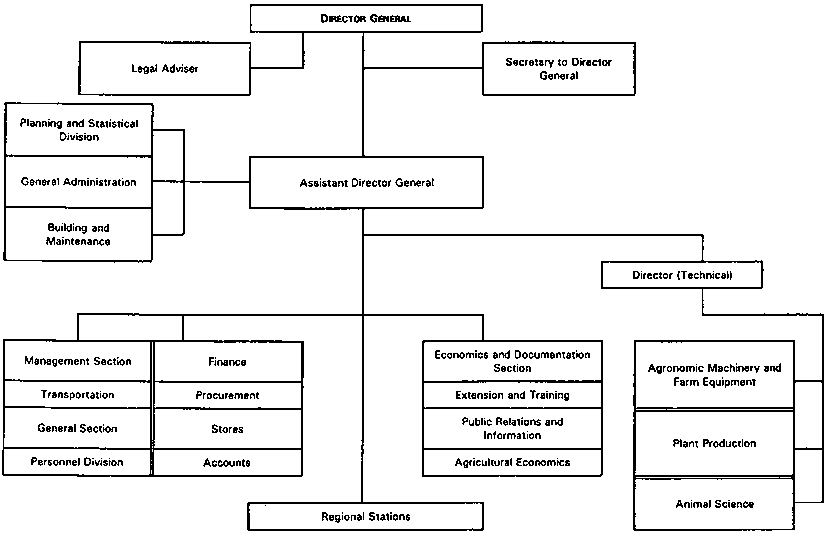
The chief executive of NARA was the DG, who was accorded the rank of a Deputy Minister (see Appendix A3). Management policy for NARA was laid down by the Board of Directors, headed by the Minister of Agriculture (Chair) and, as its members, the DG, DG of the Directorate of Agricultural Affairs (MAF), the Dean of the Faculty of Agriculture of the University of Sannar, and a representative of the Central Planning Organization. The Board of Directors was expected to meet monthly.
In the early years, the government had set up a Research Coordination Committee (RCC), consisting of the DG (Chair), two Deputy DGs, and three regional directors, all of NARA. RCC was charged with the responsibility for taking major decisions (within the policy guidelines laid down by the Board) and to oversee the implementation of the programmes. RCC was backstopped by the National Agricultural Research Council (NARC), whose membership included RCC members, commodity coordinators, representatives from agricultural extension, and representatives from other agricultural research organizations (including expatriate experts). RCC and NARC periodically reviewed ongoing programmes and approved work plans. However, their effectiveness was impaired by:
· the lack of a national authority, comparable to NARA, for agricultural extension;
· the Mughal scientists being away on training programmes;
· non-designation of national commodity coordinators; and
· absence of research establishments outside NARA.
In practice, RCC and NARC became watered down to staff committees of NARA and addressed routine matters relating to programmes and budgeting.
During the first phase of its activities, NARA was to establish regional research stations in Tisa, the southern uplands and the central highlands. Two additional stations were to be developed in the Eastern Region and northern highlands during the next phase. The phasing was based on considerations of the availability of resources, particularly of trained scientists.
In addition, NARA was to develop organizational capabilities before expanding its activities. Hence, the emphasis on strengthening the Jabid, Tajrish, Ibia, Diaharam and Saurimo research stations. While these research stations were being strengthened, NARA was to concentrate its efforts on selected priority areas to achieve results and impact. It was recognized that, as the government sanctioned more RDPs, demands on research systems would increase progressively, as NARA would have to carry out most urgent research activities for these regions.
NARA was temporarily located at Tajrish. It was soon to move to Diaharam at its permanent headquarters, which would also house the central research station, containing the main laboratory for soil and water research, plant protection, seed testing and food and nutritional analyses.
The FAO-executed project on Agricultural Research and Development became operational in 1984, soon after the DG of NARA and the Chief Technical Adviser joined. However, the latter retired in 1985 and the post remained vacant for almost 10 months. The next incumbent, Dr Kumar, arrived in March 1986 in Tajrish, where NARA was then located. He had a long experience in agricultural research institution building, having worked in India, Nigeria and Al Arabia. He observed that while there was some research was going on, by and large, research had not been initiated on most important commodities. The researchers set their own priorities and initiated projects as they liked, without regard to needs in the national context.
Many experiments were being conducted without any definite linkage with the project. Programme and project planning was glaringly absent. Scientists were acting in a vacuum. There was no direction. Research activities of NARA had very little linkage with extension activities. There was an acute shortage of qualified and experienced personnel. Only two ongoing bilateral projects on agricultural research were absorbed by NARA; many research projects still remained outside the control of NARA, for which NARA had merely a coordinating role. The dispersed state of agricultural research had not been consolidated through establishment of NARA. To top it all, financial support from the government was ad hoc, which prevented any meaningful planning.
After receiving the memorandum from the DG, Dr Kumar started discussing the research activities with various people, both within NARA and outside. He soon realized that people were reluctant to talk to him for fear that he might take their power away. This was expected. Authentic data were not available which could be used in planning for future research activities. Further, no agro-economic, socio-economic or farming systems studies were available. Even though NARA was a research organization, it did not have a statistical unit for interpreting experimental results.
Dr Kumar realized that the main constraint was the large number of commodities that needed to be covered. This coupled with the great range of agroclimatic conditions resulted in a research package that required resources in excess of the current staff and facilities. At the same time, there were extremely pressing needs for agro-economic research on comparative advantage and research priority. The challenge for NARA, therefore, was to recognize the major production constraints in the probable crop combinations and to support development activities by influencing the choice of appropriate healthy planting material of suitable cultivars. The ability of NARA to meet this challenge was constrained by resource availability.
Looking to the future, Dr Kumar recognized that:
(i) The number of scientists available in NARA was far below what was needed to effectively carry out the existing and proposed research programmes. While NARA continued to concentrate its efforts on expanding research activities, lack of qualified and experienced researchers would become the most serious bottleneck. Even though expatriates were used extensively, serious gaps remained. Now that the expatriates were leaving the country, availability of trained scientists was going to be a major constraint. Even those who were already working for NARA needed training in research methods. The scientists returning from abroad also needed to gain research experience before they could assume full responsibility for new research programmes.Within the country, there was no institution to impart regular training in agriculture at the various levels needed. A faculty of agriculture was proposed, to be established in the University at Sannar. In the meantime, scientists had to be trained abroad which could be pursued under the FAO/UNDP project.
(ii) Availability of technical support staff was a problem. Salaries of the scientific staff were low in comparison with those in the university. This was a particularly strong disincentive when trying to attract those graduating from agricultural schools to work at NARA as technical support staff. Agriculture schools were located in the Southern Highlands Region (Ibia) and Tisa Region (Saurimo), and the graduates did not like to work in other regions. In addition, the number graduating from these schools was insufficient to meet the growing demands of the country. An agricultural school was definitely needed in the Tajrish area to meet the growing demand for technical staff to staff the regional research stations in the Central and Northern Highlands and Eastern Regions.
(iii) Research and extension had virtually no linkage. There was no national approach to extension, to match the national research organization. Consequently, there was inadequate flow of technological recommendations from the research stations to farmers. Extension activities were mainly being conducted under the RDPs financed by the regional and international aid agencies. There was a large concentration of extension staff in the Tisa Region and the southern uplands: areas where the greatest potential for increasing production existed. In the Tisa Region, agricultural extension was one of several TDA objectives, whereas in the Tajrish and Ibia governorates, extension services were undertaken by the Southern Upland Rural Development Project (SURDP). The research farms at Tajrish and Zadar were being used as area training centres for extension agents. In the Central Highlands, extension was the responsibility of the Central Highland Rural Development Authority (CHRDA). The RDPs were independent and differed from each other in their set-up and approach to extension work. Even though there was no institutional relationship and coordination between research and extension, some informal links had developed. NARA scientists in the regional research stations had established informal arrangements with extension staff of the RDP in that region.
(iv) Although NARA had made a promising start, it was just the beginning. To be successful in the long run in planning, coordinating and implementing effective research programmes, NARA needed substantial and continuous support. Planning was the first step, and had to be initiated immediately to ensure that research activities were consistent with agricultural priorities, farmers needs and economic conditions.
(v) The multiplicity of commodities that needed attention, the diversity of ecological zones, the strength of RDPs in rapidly popularizing improved technologies, emerging entrepreneurship in agriculture and the high priority that the government accorded to agriculture - all these constituted a challenge to NARA to prioritize its research, guided by the changing profile of the agricultural mix of commodities, and to exploit the opportunities for development where they existed. The development of spate irrigation in the tropical lowlands, of underground water all over the country, and of the canal system of the Marib dam were all significant developments, but more immediate were concerns such as range management, livestock development and forestry. In this highly dynamic milieu, and faced with shortages of human, physical and fiscal resources, NARA might consider according higher priorities to other commodities in other ecological zones.
Over time, Dr Kumar was convinced that it was necessary to determine priorities in the light of extremely scarce research staff and limited financial resources. Principles governing future agricultural research had to be agreed upon to tap the immense potential that existed. The country has the advantage of a naturally good agroclimate, which could be exploited to meet domestic and neighbouring countries' requirements.
While Dr Kumar was sure of what needed to be done, he did not know how and, from where to begin.
MAIN FEATURES OF AGROCLIMATIC ZONES IN MUGHAL SULTANATE
|
|
Agroclimatic Zones |
||||
|
The Coastal Lowland (Tihama) |
The Southern Uplands |
The Central Highlands |
The Northern Highlands |
The Eastern Region |
|
|
General description |
Covers a bend 400 km long and 30 to 60 km wide along the Red Sea coast; from sea level to 200m. |
East of the Tihama; elevation from 200 to 1500 m. Landscape is rugged and cut by deep wadis. |
Comprise the middle reaches of the central mountain range; elevation over 1500m. |
Constitute the upper reaches of the central mountain chains. |
Slopes gently towards the desert in the east. Vegetation mainly desert shrubs. |
|
Climatic conditions |
Tropical: high temperature and humidity. |
Variable RH and temperature: RH higher in the foothills; subtropical in the middle heights. |
Nearly temperate. |
Semi-arid, with altitudes over 1500 m. |
Arid zone. |
|
Cultivable area |
The Tihama has 5 major wadis and 1 2 smaller; cultivated area ca. 23 500 ha. |
ca. 550 000 ha, mostly on man-made terraces. |
ca. 600 000 ha. |
ca. 130 000 ha. |
ca. 25 000 ha on wadis flowing east from the highlands to the desert. |
|
Annual rainfall and irrigation |
Rainfall scare (50 to 200 mm); agriculture depends mainly on flood discharge of the wadis and groundwater. |
Variable. Taiz (1375 m) is typical: average rainfall 600 mm. |
Rainfall varies a lot: average 300 mm; up to 1200 mm in south. Mostly rain-fed cultivation; open-well irrigation increasing on the central plains. |
Rainfall from 200 to 400 mm. |
Scanty. |
|
Main crops |
Sorghum, millet and cotton, with tobacco, maize, sesame, fruit (papaya, date, banana and citrus) and vegetables also grown. |
In the foothills with higher RH: mostly sorghum, maize, banana, papaya, citrus and vegetables (tomato, onions, okra and radish). In Taiz: mainly sorghum, kat, coffee, fruit and vegetables. |
Wheat, barley, alfalfa, sorghum, grape, kat, coffee, fig, stone fruits and vegetables. |
Sorghum, wheat and pasture. |
Sorghum and millet. |
|
Livestock |
Minor, although region has ca. 10% of national herd of cattle, sheep and goats. |
Important livestock area, with 30% of national herds of cattle, sheep and goats. |
The main livestock-raising region: ca. 35% of all cattle, sheep and goats |
ca. 15% of all animals. |
ca. 10% of national herd. |
RESEARCH-RELATED BILATERAL PROJECTS, MUGHAL SULTANATE, 1979-83
|
Project title |
Source of assistance |
Main geographic area of activity |
Concluded |
Activity continued to |
|
Potato Improvement (Seed Potato Multiplication Projects) |
the Netherlands |
Dhamar |
1977 |
Continued |
|
Plant Protection |
Germany |
Sandà |
1974 |
Continued |
|
Agricultural Development (Betna) |
China |
Batana, Sandà |
1975 |
Continued |
|
Agricultural Research and Forestry (Dhamar) |
United Kingdom |
Central Highlands |
1977 |
Continued |
|
Reduction of Harvest Losses (Southern Uplands) |
UNDP |
Southern Uplands |
1976 |
1977 |
|
Soil Conservation and Forestry Development |
Germany |
Havaz, Sandà |
1985 |
Continued |
|
Fodder Improvement |
UNDP |
Sandur, Taiz, Tihama |
- |
- |
|
Wadi Al Jawf Development |
- |
AI-Jawf |
1985 |
Continued |
|
Application of Modern Irrigation Techniques |
- |
- |
|
|
|
Rural Development - Southern Upland |
WB/IFAD/Abu Dhabi |
Southern Uplands |
1976 |
1986 |
|
Rural Development - Radaa |
the Netherlands |
Radaa |
1976 |
Continued |
|
Rural Development - All Boun |
Germany |
Al Boun |
1982 |
1985 |
|
Rural Development - Khowlan |
Islamic Bank |
Khowlan |
1977 |
1985 |
|
Rural Development - Mahwit |
Germany |
Mahwit |
1978 |
Continued |
|
Rural Development - Saadah |
Local |
Saadah |
1983 |
1986 |
|
Rural Development for Central Highlands |
WB/IFAD/AFD |
Dhamar |
1985 |
Continued |
|
Rural Development for Central Highlands |
TDA WB/IFAD/Kuwait |
Zabid |
1973 |
1985 |
|
Rural Development for Rima's |
TDA WB/IFAD/Kuwait |
Rima's |
1979 |
1984 |
|
Rural Development for Mower |
IFAD/Kuwait/WB/ EEC |
Mower |
1983 |
1986 |
|
Sorghum and Millet Improvement |
USAID |
Senna's |
1976 |
1983 |
|
Agricultural Services Project |
FAO/UNDP |
Hadedah |
1975 |
1982 |
|
Horticulture Improvement and Training |
USAID |
Senna's |
1976 |
Continued |
|
Forestry Development Plantation |
FAO/UNDP |
Senna's |
1985 |
1990 |
Note: NARA's mandate for countrywide research was authorized by the Ministry of Agriculture In 1983, and therefore most of these projects relate to research pre-dating NARA.
Organization of the National Agricultural Research Authority
In-house review
Formulation of projects
National workshop
Organizational changes
Institutionalization of research workshops
Research programme at NARA
Divergent opinions
Case study - Part B - Appendix B1
Case study - Part B - Appendix B2
Case Study - Part B - Appendix B3
Case study - Part B - Appendix B4
Dr Kumar quickly realized that his best option was to talk to more people - researchers, extension staff and farmers - who could tell him the most about past research experiences and current problems.
It became obvious to him that the growers' problems for each commodity in each AEZ would have to be identified and prioritized. Prioritization would have to be empirical: based entirely on experience and observations of researchers, extension staff, progressive farmers and state and central agricultural officials. This exercise had to be carried out at regional level since each region had a different set of problems.
To begin with, Dr Kumar identified research leaders in different programme areas and forwarded a questionnaire to them. He was keen to put together whatever information was available. Six separate forms were prepared for the six main agricultural activity areas (see Appendix B1). The aim was to update the list of commodities, which would be required in fixing priorities.
Dr Kumar was aware that researchers on their own would not set priorities which truly reflected field-level problems. Farmers would be in the best situation to suggest priorities. Extension workers who were in close contact with farmers were also suitable in this context. He therefore involved some progressive farmers and extension staff in this exercise.
There was no national agriculture extension structure. There was a Director General of Extension, but his activities were limited to externally funded RDPs. These projects were regional in nature and were entirely independent of each other. Agricultural extension was one of the activities included in the RDPs, but with no linkage to research. NARA had already sited research stations in some of the regions, and the scientists in these stations and the extension staff in the RDPs in these areas had established informal links.
After collecting the background information, Dr Kumar organized a meeting in 1986 to carry out a comprehensive in-house review of all research and extension work and to fix commodity-specific priorities for each AEZ. Scientists from all over the country participated in this review, including some from outside NARA. Agricultural extension specialists from the RDPs were also invited to the in-house review, and they not only participated in the review but also even presented some papers dealing with field-level problems. The ensuing discussion enabled identification of research subject areas.
Broad directions
The broad directions which emerged from the review indicated that NARA should:
· study the agricultural production system to determine the factors limiting production, and to guide the research programme toward solving problems related to existing agricultural systems in the various regions of the country;· conduct research to improve productivity of the prevailing crops through introduction of high yielding varieties (HYVs) and through plant breeding, with the aim of combining higher yields with pest, disease and drought resistance;
· conduct studies on agricultural techniques and disease treatments for each crop and determine the most suitable ones for increasing the yield of crops in each region;
· conduct research studies on animal health through breeding and reproduction, as well as animal nutrition and addressing veterinary studies and improvement of animal health;
· pay attention to rangeland, forestry research and soil conservation;
· carry out economic studies related to yield, cultivation and marketing of crops, and methods of obtaining the highest returns to growers;
· pay increased attention to mechanization in view of the increasing shortages of labour; and
· focus on research into soil and water salinity in irrigated areas and find methods to limit salinity accumulation in the soil.
Principal considerations
The in-house review emphasized that research efforts in NARA should be governed by the following considerations:
(i) applied, problem-oriented research;(ii) concentration on problems that would give the quickest return at the lowest cost;
(iii) seek simple, effective and low-cost methods that the farmer can afford; and
(iv) emphasize preservation of the resource base, e.g., through terraced agriculture, coping with the agricultural labour shortage, and efficient management of scarce resources such as water.
Subsequently, NARA scientists began using a standard format when formulating projects. In this way, both research projects and the scientists involved in them could be evaluated. Dr Kumar recalls having spent quite some time with the scientists in helping them prepare project proposals. The overall objective of project planning was to orient NARA's research activities towards generating high-input, high-output and economically sound technologies in conformity with the existing farming systems.
In 1987, the first national workshop on agricultural research was held to identify, organize and coordinate research programmes and projects. It was attended by all agricultural scientists, extension personnel and officials from the state and central governments. The NARA scientists presented their research proposals to the workshop. While identifying the research problems in each crop, efforts were made to critically examine the cultivars used; crop management technology, including nursery sowing time, seed rate and planting method; plant population; fertilizer requirements; irrigation requirements; disease, insect pest and weed control; harvesting and storage; post-harvest handling; mechanization; economic feasibility of the new technology; etc. Research projects were carefully considered, deliberated on and finalized, keeping in view the country's agricultural interests.
While the NARA scientists were initially grudging about this participative methodology and peer review, they soon developed confidence. Together with other participants, they decided on priorities between and within the commodity groups, and gave preference to projects which were interdisciplinary and envisaged inter-institutional/inter-organizational collaboration. Priorities differed from commodity to commodity within an AEZ (see the conceptual framework in Appendixes B2.1 and B2.2, and outcomes in Appendixes B2.3 and B2.4). Interdisciplinary teams were organized, and responsibilities assigned such that every researcher was involved in three to four projects. Each project was time bound, and would be reviewed at the end of its term. A directory of national agricultural research projects and their priorities was subsequently published by NARA. The whole exercise reflected NARA's desire to organize itself with concern for solving farmers' problems.
Prioritization of research projects focused attention on the shortage of scientific staff. At that time, 84 citizens were abroad for masters and doctoral degrees. They would not be enough to staff all the prioritized research projects. It was estimated that, over the next decade, requirements for trained staff would increase fourfold. External financial support, coupled with expert assistance, would also be necessary.
As discussions were going on to fix research priorities, the organization of NARA was also evolving. Six national commodity coordinators and four discipline research coordinators were appointed. The national commodity coordinators represented the nodes of contact for the personnel in various organizational units. They were responsible for
(i) evolving research programmes in the context of priorities established so as to address the applied research problems which were most topical and had a bearing on enhancing the production and productivity of the respective commodities;(ii) mobilizing interdisciplinary teams and supervising their research work;
(iii) receiving annual reports from scientists;
(iv) exercising financial control;
(v) handling administrative matters relating to research; and
(vi) maintaining good communication with heads of departments and directors of the regional research stations.
The commodity coordinators were expected to carry out their duties without jeopardizing the line of authority in the organization. While in some cases the heads of the divisions were appointed as commodity coordinators, in other cases the senior scientists in a division were entrusted with this responsibility. However, finance was always handled by the head of the department.
Project leaders were also designated for each project. Generally, these appointments were based on seniority. Later on, the post of a research coordinator was created in NARA. His responsibilities were to organize, manage, monitor and evaluate all research within NARA. He had under him scientists in seven commodity groups and three supporting disciplines. A group on forestry was also envisaged.
Dr Kumar was quite elated by the achievements of the in-house review and the first national workshop. Given the scanty information base, the scarcity of resources and limited time available to NARA, this procedure of finding research priorities was probably the best that he could do. However, the procedure needed to be further developed by including economic principles and non-commodity research in the priority-setting process. Nevertheless, he described them as two milestones of success in the path of progress of agricultural research. His views were shared by the senior staff of NARA. The participatory mechanism of the national workshop had been well received.
The second national workshop was organized in June 1988, to review the research work done during 1987 and consider research proposals for 1988-89. It was obvious that the national commodity workshops would henceforth be the forum for:
· identification of target problems for debate on evaluation of results; and· assignment of responsibilities for the implementation of research programmes.
Joint planning of research was expected to enhance the commitment of cooperators, while the joint review of results was expected to promote a healthy spirit of competition. The progress of ongoing research programmes at the regional level would be reviewed in the quarterly meetings between NARA and RDP staff.
The current agricultural research programme at NARA emphasizes field crops, horticulture, livestock and forestry (Appendix B3). Field crops chosen for research are cereals (sorghum, maize, millet, wheat and barley), grain legumes (common bean, faba bean, lentil, cowpea and pigeon pea), and industrial and oil crops. Vegetable crops include onion, tomato, potato, carrot, okra, watermelon, cucumber and green beans. Important fruits crops include banana, citrus, date palm, guava, mango, papaya, grape, apple, peach and plum.
The main objectives of field crops research is to improve grain yields through introduction of better varieties and improved agricultural techniques, including sowing date, plant population, fertilizers and control of pests and diseases.
The livestock research programme started with the objective of developing livestock production primarily in the Central Highlands, Tisa and the Southern Uplands. It would identify, describe and study the performance of cattle, sheep and goat breeds, and improve livestock nutrition.
In addition to these activities, a forestry research programme was being developed for implementation during the Third Five-Year Plan (1987-91).
While there was appreciation for the participative manner in which research priorities were set, opinions differed on the utility of this exercise. Prioritization was done with regard to farmers' problems, based on the perception of the researchers and extension personnel. While these priorities identified first generation problems, second generation problems were not visualized. The main output of the in-house review and the first national workshop was a comprehensive list of projects to be pursued, but they could not be implemented because of lack of the necessary support.
To begin with, research planning had not been synchronized with resource availability. This has rendered the whole exercise of prioritization rather academic. Since government funding of NARA is not on the basis of a firm research programme, it does not matter how many research projects NARA actually conducts. NARA receives lump sum grants from the government after protracted negotiations and long after the beginning of the fiscal year (Appendix B4). Funds are released every quarter and there is no knowing how much will be released from quarter to quarter. Even the NARA budget does not take into account the research programme for a given year and its requirements. There is no financial planning with regard to individual research projects. While several projects are enthusiastically initiated at the beginning of the fiscal year, many of them are abandoned later for want of funds. There are times when funds are not available for normal maintenance feed rations and scientists cannot conduct experiments because animals are not on a uniform plane of nutrition. Verification trials cannot be conducted in distant and remote areas since scientists lack transport. Experiments are given up because supplies are not available in time. For example, the seed potatoes were delivered to the Ibia research station in April, when they were to have been planted by the middle of February at the latest.
Farmers are required to give away part of their land for verification trials, but they cannot be given compensation, since there is no provision for it in the NARA budget. Naturally, farmers are reluctant to agree to verification trials on their farms.
Availability of trained scientific staff is another constraining factor in implementing the priorities. NARA has not been able to recruit many new researchers. In 1988, NARA could recruit only 12 new scientists, against the requirement for 32 scientists. In consequence, research programmes are staffed inadequately. For example, the research programme on cereals is being conducted by 12 scientists. Their efforts are supported by scientists belonging to three discipline-based areas who are also involved in research work on other commodities. Though training has been organized well, the constrained availability of trained scientific staff will impose limits on NARA's future research activities.
Infrastructure support for research remains to be developed. NARA has moved to its permanent headquarters in Diaharam; there is, however, a shortage of farm land and equipment. Only recently NARA has been able to import farm equipment. Laboratories are not equipped. Equipment is still arriving. In view of the fact that scientists are not being provided the required support and facilities, it is considered fruitless to try to either monitor their performance or to evaluate their research work. Personnel policies have yet to be developed and the lines of authority are not properly delineated.
Many scientists feel that the prioritization exercise has not served any important purpose apart from providing an inventory of research projects. At present NARA is executing only a very small number of projects out of this list, and this is only possible because NARA is receiving considerable support through the FAO-operated project. Since the FAO project will be over soon, the fate of NARA lies under a question mark. While the existence of NARA is not doubted, it is generally accepted that NARA's research programme will be curtailed substantially. Besides, the priorities as defined now may not be relevant in future. There may be changes in the environment, consumer preferences and market conditions.
In view of these uncertainties, one wonders how useful the exercise on prioritization has been.
Form I Relevant for (i) Sorghum, maize, millet and grain legumes; (ii) Wheat and barley; (iii) Fruits and coffee; (iv) Vegetables; and (v) Industrial crops.
PART A To be completed for each crop separately by each Commodity Leader/Coordinator in collaboration with other scientists.
A1. Name of the commodity
A2. Status of commodity; economic importance (area, production, yields, consumption)
A3. Specific problems experienced by growers and consumers.
A4. Action taken to solve problems:
A4.1 Before formation of NARAA4.1.1 Objectives and Targets
A4.1.2 AchievementsA4.2 After formation of NARA (to date)
A4.2.1 Objectives and TargetsA4.2.2 Progress and Achievements (by Region and by Season) such as:
Cultivars in use - development; seed/plant multiplication; extent of usage by farmers.
Agronomic techniques - sowing/planting method, plant population or seed rate, fertilizer and irrigation requirements, weed control.
Economically important insect pests and diseases and their control.
Post-harvest handling and marketing;
Literature prepared for (a) growers and/or (b) researchers.
National personnel trained (should indicate clearly work done by other agencies, if any)
A4.2.3 Specific technology, techniques or materials passed on to extension.
A5. Constraints or bottlenecks experienced:
A5.1 By researchers
A5.2 By farmers
A5.3 By extension officers
PART B (Proposal for the next Five-Year Plan)
- To be completed for each crop separately by each Commodity Leader/Coordinator in collaboration with other scientists,
and
- also to be completed separately, but for all commodities together, by each Regional Director for the respective Experiment Station(s) and Region, in collaboration with others.
B1. Proposed specific area of research, with proper justification:
(a) projects to continue
(b) projects to be withdrawn or completed, and
(c) new projects, with specific objectives and targets.
B2. Any suggestions on strategy for research in particular areas or disciplines
B3. Projections on development of laboratories, stations, experiment stations and NARA, including
(a) organization, set-up,
(b) human resources requirements, and
(c) other facilities (equipment, land, etc.).
B4. Suggestions on future collaboration with other agencies involved in agriculture.
Form II Relevant for (i) Livestock, and (ii) Forage/rangeland.
PART A
- to be completed for each crop separately by each Commodity Leader/Coordinator, in collaboration with other scientists,
and
- also to be completed separately, but for all commodities together, by each Regional Director for the respective Experiment Station(s) and Region, in collaboration with others.
A1. Name of the commodity.
A2. Status of commodity; economic importance (area, production, yields, consumption).
A3. Specific problems experienced by growers and consumers.
A4. Action taken to solve problems:
A4.1 Before formation of NARA:A4.1.1 Objectives and targets, and
A4.1.2 Achievements.A4.2 After formation of NARA:
A4.2.1 Objectives and targets,
A4.2.2 Progress and achievements (should indicate clearly any work by other agencies)- Breeds, species available, breeding, introductions
- Feed, nutrition (livestock)
- Reproduction (livestock)
- Diseases
- Management of livestock and rangeland
- Fodder development
- Marketing
- Literature for (i) growers and (ii) researchers
- National personnel trainedA4.2.3 Specific techniques, superior livestock raised, and passed on to extension.
PART B (Proposal for the next Five-Year Plan)
- To be completed for each crop separately by each Commodity Leader/Coordinator in collaboration with other scientists,
and
- also to be completed separately, but for all commodities together, by each Regional Director for the respective Experiment Station(s) and Region, in collaboration with others.
B1. Proposed specific area of research, with proper justification:
(a) projects to continue
(b) projects to be withdrawn or completed, and
(c) new projects, with specific objectives and targets.
B2. Any suggestions on strategy for research in particular areas or disciplines
B3. Projections on development of laboratories, stations, experiment stations and NARA, including
(a) organization, set-up,
(b) human resources requirements, and
(c) other facilities (equipment, land, etc.).
B4. Suggestions on future collaboration with other agencies involved in agriculture.
Form III Relevant for agricultural economics and farming systems research.
PART A To be completed by each Commodity Leader/Coordinator, in collaboration with other scientists.
A1. Name of the research sphere
A2. Current status.
A3. Specific problems experienced by growers and consumers.
A4. Action taken to solve problems:
A4.1 Before formation of NARA:A4.1.1 Objectives and targets, and
A4.1.2 Achievements.A4.2. After formation of NARA:
A4.2.1 Objectives and targets,
A4.2.2 Progress and achievements (Should indicate clearly any work by other agencies)- production economics
- marketing and agricultural prices
- agricultural statistics
- economic evaluation of new technology packages
- farming systems
- literature prepared for (i) growers and (ii) researchers
- national personnel trainedA4.2.3 Specific techniques and information passed on to extension.
A5. Constraints and bottlenecks experienced:
5.1 by researchers,
5.2 by farmers, and
5.3 by extension officers.
PART B Part B to be completed separately by each Regional Director for their respective Region, in collaboration with relevant officials.
B1. Proposed specific area of research, with full justification:
(a) Projects to continue.
(b) Projects to be withdrawn or completed.
(c) New projects, with specific objectives and targets.
B2. Any suggestion on strategy of research in particular areas or disciplines?
B3. Projections on development of laboratories, stations, experiment stations or NARA, including
(a) Organization and set-up,
(b) Human resources requirements, and
(c) Other facilities (equipment, land, etc.).
B4. Suggestions on future collaboration with other agencies involved in agriculture.
B5. Projections of national production and consumption, and proposed targets, bearing in mind (i) improved technology currently available, in all fields; and (ii) to be made available through research during the next Five-Year Plan towards achieving the goal of self-sufficiency. Significant actions required in extension activities to achieve the projected targets.
Form IV - Relevant for soil science.
PART A To be completed by Head of Soils Unit, in collaboration with national scientists and expert counterparts (if any).
A1. Name of discipline.
A2. Special problems experienced by growers or researchers.
A3. Action taken to solve problems.
A3.1 Before formation of NARA (i.e., before 1983):A3.1.1 Objectives and targets, and
A3.1.2 Achievements.A3.2 After formation of NARA (from 1983 to date):
A3.2.1 Objectives and targets, and
A3.2.2 Progress and achievements (Should indicate clearly work by other agencies)- soil fertility
- soil survey and land classification
- soil chemistry and analysis
- irrigation water quality
- microbiology
- literature prepared for (i) growers and (ii) researchers
- national personnel trained A3.2.3 Specific technology and information passed on to extension.
A4. Constraints and bottlenecks experienced:
A4.1 by researchers,
A4.2 by farmers, and
A4.3 by extension workers.
PART B (Proposal for the next Five-Year Plan)
- To be completed for each crop separately by each Commodity Leader/Coordinator in collaboration with other scientists,
and
- also to be completed separately, but for all commodities together, by each Regional Director for the respective Experiment Station(s) and Region, in collaboration with others.
B1. Proposed specific area of research, with proper justification:
(a) projects to continue
(b) projects to be withdrawn or completed, and
(c) new projects, with specific objectives and targets.
B2. Any suggestions on strategy for research in particular areas or disciplines
B3. Projections on development of laboratories, stations, experiment stations and NARA, including
(a) organization, set-up,
(b) human resources requirements, and
(c) other facilities (equipment, land, etc.).
B4. Suggestions on future collaboration with other agencies involved in agriculture.
Form V - Relevant to Plant Protection.
PART A To be completed by the Head of Plant Protection, in collaboration with other scientists.
A1. Disciplinary area (annual crops; perennial crops; post-harvest).
A2. Special problems experienced by growers and researchers.
A3. Action taken to solve problems.
A3.1 Before formation of NARA (before 1983):A3.1.1 Objectives and targets, and
A3.1.2 Achievements and constraints.A3.2 After formation of NARA (from 1983 to date):
A3.2.1 Objectives and targets, and
A3.2.2 Progress and achievements (Should indicate clearly work by other agencies)
A3.2.3 Specific technology and information passed on to extension.
A4. Constraints and bottlenecks experienced:
A4.1 by researchers,
A4.2 by farmers, and
A4.3 by extension workers.
PART B (Proposal for the next Five-Year Plan)
- To be completed for each crop separately by each Commodity Leader/Coordinator in collaboration with other scientists,
and
- also to be completed separately, but for all commodities together, by each Regional Director for the respective Experiment Station(s) and Region, in collaboration with others.
B1. Proposed specific area of research, with proper justification:
(a) projects to continue
(b) projects to be withdrawn or completed, and
(c) new projects, with specific objectives and targets.
B2. Any suggestions on strategy for research in particular areas or disciplines
B3. Projections on development of laboratories, stations, experiment stations and NARA, including
(a) organization, set-up,
(b) human resources requirements, and
(c) other facilities (equipment, land, etc.).
B4. Suggestions on future collaboration with other agencies involved in agriculture.
Form VI Relevant to Mechanization.
Parts A and B to be completed by officer-in-charge, in collaboration with other officials. Part B to be completed separately by each Regional Director for the respective Experimental Station(s), in collaboration with other officials.
A1. Name of the discipline.
A2. Special problems experienced by growers and researchers.
A3. Action taken to solve problems.
A3.1 Before formation of NARA (before 1983):A3.1.1 Objectives and targets, and
A3.1.2 Achievements and constraints.A3.2 After formation of NARA (from 1983 to date):
A3.2.1 Objectives and targets, and
A3.2.2 Progress and achievements (Should indicate clearly work by other agencies)- evaluation of implements for specific agricultural operations, including (a) indigenous tools, and (b) introductions;
- mechanization practices for crop cultivation;
- design and modification of implements and tools;
- repair and maintenance of tools, implements, vehicles, etc; and
- literature prepared for (i) growers and (ii) researchers.
A3.2.3 Specific technology and information passed on to extension.
A4. Constraints and bottlenecks experienced:
A4.1 by researchers,
A4.2 by farmers, and
A4.3 by extension workers.
PART B (Proposal for the next Five-Year Plan)
- To be completed for each crop separately by each Commodity Leader/Coordinator in collaboration with other scientists,
and
- also to be completed separately, but for all commodities together, by each Regional Director for the respective Experiment Station(s) and Region, in collaboration with others.
B1. Proposed specific area of research, with proper justification:
(a) projects to continue
(b) projects to be withdrawn or completed, and
(c) new projects, with specific objectives and targets.
B2. Any suggestions on strategy for research in particular areas or disciplines
B3. Projections on development of laboratories, stations, experiment stations and NARA, including
(a) organization, set-up,
(b) human resources requirements, and
(c) other facilities (equipment, land, etc.).
B4. Suggestions on future collaboration with other agencies involved in agriculture.
Case study - Part B - Appendix B2.1
Form 1. Priorities for commodities in each agro-ecological zone
FOR AGRO-ECOLOGICAL ZONE: .........................
A. CROP PRIORITIES
1. .............................................
2. .............................................
3. .............................................
4. .............................................
B. LIVESTOCK PRIORITIES
1. .............................................
2. .............................................
3. .............................................
|
NOTES - The priorities are to be indicated in order of their importance and usefulness, with 1 as first priority: i.e., 1 has priority over 2, and 2 has priority over 3, and so on. - The parameters for estimating priorities should include: · area of production |
Case study - Part B - Appendix B2.2
Form 2 Research priorities by commodity and agro-ecological zone
(Example for an annual crop)
|
Activity priority |
Research Activities and Disciplines Involved |
Research Priority | |
|
|
A. VARIETAL SELECTION AND BREEDING |
| |
|
|
involving |
1 | |
|
|
|
· collecting material (landraces; old varieties; commercial cultivars; etc.) |
|
|
|
|
· evaluation |
|
|
|
|
· selection |
|
|
|
|
· breeding |
|
|
|
B AGRONOMIC TECHNIQUES |
| |
|
2 |
|
· intercropping |
|
|
1 |
|
· sowing methods |
|
|
5 |
|
· sowing date |
|
|
3 |
|
· seed rate |
|
|
4 |
|
· plant population |
|
|
6 |
|
· fertilization |
|
|
|
|
· irrigation |
|
|
|
|
· weed control |
|
|
|
|
· etc. |
|
|
|
C PLANT PROTECTION |
| |
|
2 |
|
· insects |
|
|
1 |
|
· diseases |
|
|
|
|
· deficiencies |
|
|
|
D POST-HARVEST TECHNOLOGY |
| |
|
|
E MECHANIZATION |
| |
|
|
F AGRICULTURAL ECONOMICS |
| |
Notes:
Research Activities and Disciplines Involved list all the disciplines involved in research.
Research priorities list the priorities of research by discipline.
Activity priorities list the priority of activities in each discipline.
Case study - Part B - Appendix B2.3
Priority of Commodity Groups for each AEZ of the Mughal Sultanate
|
COMMODITY GROUP |
AGRO-ECOLOGICAL ZONE | ||||
|
|
Southern |
Tisa |
Central |
Northern |
Eastern |
|
Cereals |
1 |
1 |
1 |
1 |
1 |
|
Vegetables |
2 |
2 |
3 |
4 |
2 |
|
Fruits |
3 |
4 |
4 |
3 + coffee |
3 |
|
Livestock |
X |
X |
X |
X |
X |
|
Grain legumes |
4 |
6 |
2 |
2 |
- |
|
Fodder crops |
5 |
5 |
5 |
5 |
4 |
|
Industrial crops |
- |
3 |
6 |
- |
- |
|
Forestry |
X |
X |
X |
X |
X |
Notes: Figures indicate priority in each AEZ. The lower the number, the higher the priority, 'x' denotes 'important, but priority not yet defined.'Source: Adapted from Agricultural Research in the Mughal Sultanate: Problems, Research Activities, Evaluation, and Future Programmes (1987-1991), Vols. 1 and 2. NARA, Tajrish, September 1986.
Case study - Part B - Appendix B2.4
Priority of Individual Commodities by AEZ
|
|
AEZ | ||||||
|
Commodity |
Southern Uplands |
Tisa region |
Central Highlands |
Northern Highlands |
Eastern Region | ||
|
A. CEREALS | |||||||
|
Sorghum |
1 |
1 |
3 |
3 |
3 | ||
|
Wheat |
4 |
4 |
1 |
1 |
1 | ||
|
Maize |
2 |
2 |
2 |
2 |
2 | ||
|
Barley |
4 |
- |
4 |
1 |
3 | ||
|
Millet |
3 |
3 |
- |
- |
- | ||
|
B. GRAIN LEGUMES | |||||||
|
Faba bean |
1 |
|
1 |
1 |
| ||
|
Phaseolus bean |
2 |
1 |
4 |
4 |
- | ||
|
Chick-pea |
- |
- |
3 |
3 |
- | ||
|
Cowpea |
3 |
2 |
- |
- |
- | ||
|
Lentil |
- |
- |
2 |
2 |
- | ||
|
Mung bean |
- |
3 |
- |
- |
- | ||
|
C. VEGETABLES | |||||||
|
Tomato |
3 |
1 |
3 |
2 |
| ||
|
Onion |
2 |
2 |
2 |
1 |
3 | ||
|
Potato |
1 |
- |
1 |
3 |
- | ||
|
Cabbage |
- |
- |
6 |
5 |
- | ||
|
Cauliflower |
- |
- |
6 |
5 |
- | ||
|
Carrot |
5 |
- |
4 |
4 |
- | ||
|
Radish |
- |
- |
- |
- |
- | ||
|
Watermelon |
- |
4 |
- |
6 |
1 | ||
|
Okra |
4 |
3 |
- |
- |
4 | ||
|
Eggplant |
6 |
- |
- |
- |
5 | ||
|
French beans |
6 |
6 |
- |
- |
5 | ||
|
Peas |
- |
- |
- |
- |
- | ||
|
Garlic |
- |
- |
- |
- |
- | ||
|
Sweet melon |
- |
- |
- |
- |
2 | ||
|
Cucumber |
4 |
5 |
- |
- |
2 | ||
|
D. FRUITS | |||||||
|
Banana |
1 |
1 |
|
- |
- | ||
|
Citrus |
2 |
- |
- |
- |
1 | ||
|
Date palm |
7 |
- |
- |
- |
2 | ||
|
Guava |
6 |
5 |
- |
- |
3 | ||
|
Papaya |
5 |
3 |
- |
- |
- | ||
|
Coffee |
3 |
- |
X |
X |
- | ||
|
Grape |
9 |
- |
1 |
1 |
- | ||
|
'Peach |
- |
- |
2 |
3 |
- | ||
|
Apple |
- |
- |
3 |
5 |
- | ||
|
Apricot |
- |
- |
4 |
6 |
- | ||
|
Pear |
- |
- |
5 |
- |
- | ||
|
Cherry |
8 |
- |
6 |
- |
- | ||
|
Pomegranate |
8 |
- |
- |
2 |
- | ||
|
Hg |
- |
- |
- |
2 |
- | ||
|
Walnut |
- |
- |
- |
4 |
- | ||
|
Almond |
4 |
- |
- |
- |
- | ||
|
Mango |
- |
4 |
- |
- |
5 | ||
|
Custard apple |
|
- |
- |
- |
4 | ||
|
E. INDUSTRIAL AND OIL CROPS | |||||||
|
Cotton |
1 |
- |
- |
- |
- | ||
|
Sesame |
2 |
- |
- |
- |
- | ||
|
Soybean |
4 |
2 |
- |
- |
- | ||
|
Sunflower |
5 |
1 |
- |
- |
- | ||
|
Groundnut |
3 |
- |
- |
- |
- | ||
|
Tobacco |
6 |
- |
- |
- |
- | ||
|
F. FORAGE CROPS | |||||||
|
Various species |
X |
X |
X |
X |
X | ||
|
G. LIVESTOCK | |||||||
|
Sheep |
2 |
2 |
1 |
1 |
1 | ||
|
Cattle |
3 |
1 |
2 |
2 |
3 | ||
|
Goats |
1 |
3 |
3 |
3 |
2 | ||
|
Poultry |
X |
X |
X |
X |
X | ||
|
H. FORESTRY | |||||||
|
All aspects |
X |
X |
X |
X |
X | ||
Notes: Figures indicate priority in each AEZ. The lower the number, the higher the priority, 'x' denotes 'important, but priority not yet defined.'Source: Adapted from Agricultural Research in the Mughal Sultanate: Problems, Research Activities, Evaluation, and Future Programmes (1987-1991), Vols. 1 and 2. NARA, Tajrish, September 1986.
Prioritization of Research by Commodities and Disciplines
|
TROPICAL LOWLAND (TIHAMA) |
SOUTHERN UPLAND |
CENTRAL NORTHERN UPLAND |
EASTERN |
|
1. Crops |
I. Crops |
I. Crops |
I. Livestock |
|
1. Cereals |
1. Cereals |
1. Cereals |
Sheep and goats |
|
Sorghum |
Sorghum |
Wheat |
|
|
Millet |
Maize |
Sorghum |
|
|
Maize |
Millet |
Barley |
|
|
|
Wheat |
Maize |
|
|
2. Vegetables |
2. Vegetables |
2. Fruits |
|
|
Tomato |
Potato |
Grape, peach, apple, apricot |
|
|
Onion |
Onion |
|
|
|
3. Tropical Fruits |
3. Fruits |
3. Vegetables |
|
|
Banana |
Banana |
Potato, onion, tomato and others |
|
|
Date palm |
Citrus |
|
|
|
Papaya |
Coffee |
|
|
|
Mango |
Mango |
|
|
|
|
Papaya |
|
|
|
4. Industrial crops |
4. Grain legumes |
4. Grain legumes |
|
|
Cotton |
Faba bean |
Lentil, chick-pea, faba bean, soybean, common bean |
|
|
Sesame |
Common bean |
|
|
|
Tobacco |
Cowpea |
|
|
|
5. Fodders |
5. Fodders |
5. Fodders |
|
|
Annuals, perennials, and range grasses |
Annuals, perennials, and range grasses |
Annuals, perennials, range grasses |
|
|
6. Grain legumes | |||
|
Common pea, cowpea, mung bean |
|
|
|
|
II. Livestock |
II. Livestock |
II. Livestock |
II. Crops |
|
Cattle, sheep, goats |
Goat, sheep, cattle |
Sheep, cattle, goats |
Wheat, Barley |
|
|
|
|
Fodder |
NARA BUDGET
|
Year |
Operating grant from government |
Actual expenditure |
Expenditure on scientific work'" |
Administrative support and overheads (2) |
|
1984 |
14301174 |
14315666 |
11875230 |
2440436 |
|
1985 |
16269571 |
18309928 |
14865884 |
3444044 |
|
1986 |
19011618 |
20356323 |
16496206 |
3860117 |
|
1987 |
20500985 |
22808587 |
18322069 |
4486518 |
|
1988 |
24822481 |
25151004 |
21065083 |
4085921 |
|
1989 |
28444000 |
31876773 |
26403035 |
5473738 (3) |
Notes:
(1) Includes (i) salaries of scientists, technicians, assistants; (ii) Daily subsistence allowance (DSA) and fuel costs for staff travel; (iii) laboratory supplies; and (iv) inputs required for agricultural experiments.(2) Includes salaries for the administrative staff.
(3) Expected expenditure for the period September-December 1989 is included.
This training manual has been prepared as basic reference material to help national research trainers structure and conduct training courses on research management at the institute level. It is intended primarily for managers of agricultural research institutes in developing countries and for institutions of higher education interested in presenting in-service training courses on research management. The manual consists of ten modules, each addressing major management functions including motivation, leadership, direction, priority setting, communications and delegation. The four structural functions of management - planning, organization, monitoring and control, and evaluation - are covered in individual modules. The manual has been designed to support participatory learning through case-studies, group exercises and presentations by the participants.