2.1. CIFOR's Mission: Poverty Alleviation and Environmental Protection
2.2. Forest-Related Needs Implied by CIFOR's Mission
2.3. Overcoming Constraints to Meeting Forest-Related Needs
2.4. Contributions of CIFOR's Programme to Overcoming Constraints
2.5. CIFOR's Current Projects: Summary and Assessment
2.6. Linking CIFOR's Research Programme Activities to its Mission: One Possible Option
CIFOR's research is carried out by 26 internationally recruited scientists, a significant number of post-doctoral researchers, their collaborators, partners and support staff. The research involves 126 activities grouped into 10 projects that are focused on: (1) products - sustainable use and development of non-timber forest products; (2) forest management oriented themes - multiple resource management of natural forests, plantation forestry on degraded or low potential sites; (3) assessment process themes - assessing the sustainability of forest management, and underlying causes of deforestation, forest degradation, and poverty in forest margins; and (4) cross-cutting themes such as local livelihoods, community based management and devolution, and conservation of biodiversity and genetic resources.
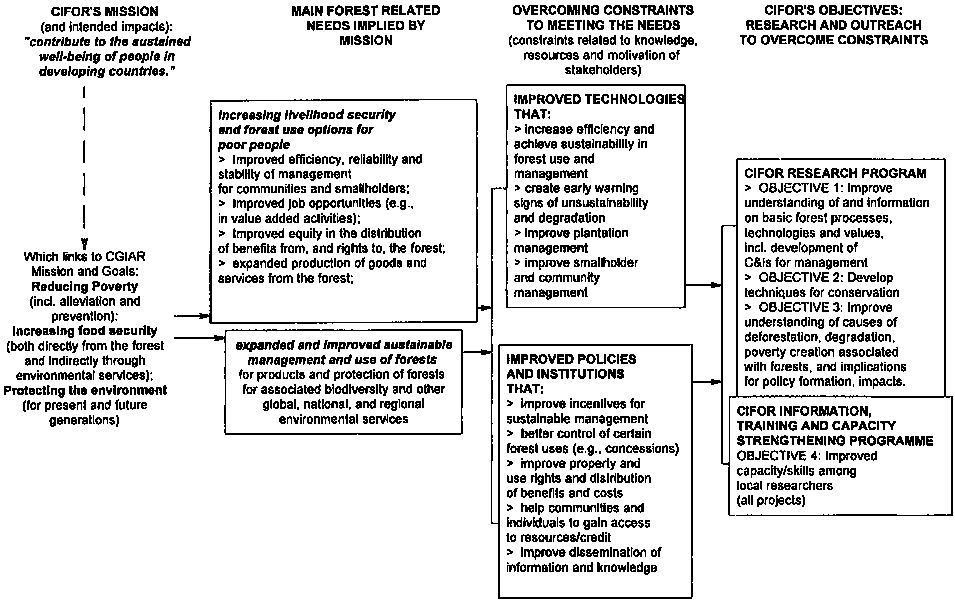
Although the substance of CIFOR's mission statement is in line with the CGIAR's Mission, the links between the ten projects and CIFOR's mission and objectives are not made explicit in the CIFOR Strategic Plan and its MTP. Since a clear understanding of these links is an essential first step in a strategic review of the Centre and its work, the Panel developed the overview of linkages indicated in Figure 2.1, based on its interpretation of CIFOR documentation and discussions with staff and management. The resulting perspective develops links between CIFOR's mission and the goals of the CGIAR (poverty alleviation, environmental protection and food security), the forest-related needs implied by the mission and goals, the constraints on meeting those needs, the technological and policy interventions required to overcome the constraints, and finally CIFOR's programme (research and outreach) and objectives. Looking at CIFOR's research programme in the context of this framework, the Panel concludes that, at the strategic level at least, CIFOR's research programme is focused on the relevant and priority themes or topics needed to address its mission, which is to:
contribute to the sustained well-being of people in developing countries, particularly in the tropics, through collaborative strategic and applied research and related activities in forest systems and forestry, and by promoting the transfer of appropriate new technologies and the adoption of new methods of social organisation, for national development.
(Column 1, Figure 2.1)
CIFOR's mission statement does not refer explicitly to the CGIAR's overarching goals of poverty alleviation, food security, and environmental protection. However, these goals are perfectly consistent with CIFOR's mission and strategy. The links are made, implicitly at least, in CIFOR's Strategy and its MTP.
Throughout the development community, major emphasis is given to poverty alleviation.
Widely used definitions of "poverty alleviation" focus on the alleviation of existing poverty - making currently poor people better off through such research impacts as productivity enhancement coupled with resource conserving technologies that support production increases and cost reductions over time. CIFOR's programme expands this interpretation to include consideration of means of poverty prevention - poverty for future generations and future poverty for those who currently are living in adequate conditions. Further, CIFOR recognizes explicitly the need to include consideration of equity and income distribution in its planning.
(Panel perception of project involvement indicated by numbers in parentheses)
Many of CIFOR's activities relate implicitly and in some cases explicitly to the objective of increasing the well-being of currently poor people. Its work related to forest-based communities, tenure, employment creation, plantation management, NTFPs, etc. deal directly or indirectly with this theme. At the same time, CIFOR's research on sustainable forest management - protection and enhancement of the forest resource base on which currently non-poor populations also depend - is essential to avoid future impoverishment of existing non-poor or non-marginal populations. 1
1 We have seen this kind of poverty creation happen through the ages. "Boom and bust" cycles are not unique to mineral extraction. There are many examples of timber and NTFP booms that left people unemployed, impoverished, and disenfranchised because the forest resource was depleted. Sustainability is not much of concern on the forest frontier when forest is abundant. There are other issues related to ecologically unsound uses of forests that demonstrate equally the issues that arise when sustainable poverty prevention is not an explicit goal.
In a similar vein, research of CIFOR is focused on biodiversity conservation (environmental protection) and some global change issues related to avoiding conditions that will lead to poverty for future generations. This can result from negative global change due to forest use that leads to lack of opportunity access, increased atmospheric warming and, possibly, to poverty and misery for future generations. CIFOR also sees opportunities for forests to contribute to alleviation of the negative impacts resulting from other sectors and activities, e.g., through forest sequestration of gases released by industrial activities. This work still is at a preliminary stage and should perhaps be a focus of discussions in future priority setting.
In sum, this broader interpretation of poverty issues provides a logical, and indeed necessary, link between CIFOR's mission and the goals of the CGIAR related to poverty alleviation plus natural resources and environmental protection and enhancement.
(Column 2, Figure 2.1)
Effective contributions of forests to poverty reduction and prevention depend on improving the access of poor people to opportunities for sustainable incomes and outputs that they can derive from forests and trees in plantations and other land use systems. CIFOR recognizes that it is not conservation vs. development, but rather conservation with development. This in turn relates to CIFOR's work related to: (1) improving the sustainable productivity of forests, (2) increasing the numbers and types of products and services provided by them, (3) improving the efficiency with which they are managed and used, (4) expanding the productive employment that can be derived from the forest, (5) improving the equity in forest use and the distribution of outputs from them, (6) protecting the forests and their biodiversity not only for present generations but also for future ones, and (7) policy issues underlying all of these. These themes are indicated under two broad headings in column 2 of Figure 2.1, with one theme addressing mainly (but by no means only) the poverty alleviation and food security goals, and the other addressing mainly (but by no means only) the sustainability goal. The two define in a sense the parallel forest-related processes that lead to impacts on people and their well-being over time.
(Column 3, Figure 2.1)
Improvements in forest management and use indicated above will only be achieved by overcoming knowledge, motivation, and resource access constraints for those who need to act - the people who are CIFOR's target groups and clients. Interpreting CIFOR's strategic plan and MTP, one can see that overcoming the constraints to action on the part of the target groups ultimately requires that the target groups have adequate knowledge of what to do and how to do it; sufficient motivation to do what needs to be done; and adequate access to resources and the means to do it. These are in fact the standard constraints to overcome in any field where change is needed. They are implied in CIFOR's four strategic objectives. The underlying philosophy is that people have to take action to make positive change, and they need the right knowledge, resource access, and motivation to act.
Meeting these requirements for overcoming constraints to action involves two basic types of means: (1) technology improvements (related to improved efficiency, sustainability, productivity, and product expansion, and social as well as biotechnical technologies); and (2) improved policies and institutions (related to improved information dissemination for knowledge spread, changes in the distribution of benefits from forests, creation of incentives to manage sustainably, improved access to resources by forest dwellers, and job creation). These are indicated in Column 3 of Figure 2.1. The challenge that CIFOR recognizes is to make its research, information, and capacity strengthening activities contribute in the most effective and efficient way possible to creating and enhancing these means for overcoming knowledge, motivation, and resource constraints.
(Column 4, Figure 2.1)
CIFOR has four main strategic objectives listed in its MTP and Strategic Plan:
> Understanding the biophysical and socio-economic environments of present and potential forest systems and forestry, and their functional relationships (overcoming the basic knowledge constraint to both technology and policy advancements).> Creating the potential for sustainable improved productivity of forest systems for the benefit of people in developing countries (creating the needed hard and soft technologies).
> Providing analysis, information and advice to assist in making policy decisions about forests and land use (creating the basis for improved policies).
> Increasing national forestry research capacity (to expand the ability of countries to address their own particular knowledge, resource, and motivational constraints).
CIFOR's four objectives are listed in Column 4 of Figure 2.1 under the two major programmatic headings of research and outreach activities (information, training, and capacity strengthening). Through meeting these objectives, CIFOR contributes towards removing the constraints to meeting the needs implied by its mission and the goals of the CGIAR.
In the context of the overall framework developed in the previous four sections, the Panel reviewed CIFOR's current projects (Appendix V), including a number of their activities in the field. A list of the ten projects and their objectives is provided in Table 2.1, along with information on the intended outputs from each project. The final column in the table provides the Panel's assessment of priorities and relevance of research, and the outputs and quality of the research. Detailed assessment of each project is not included, since the purpose of this EPMR is to develop a strategic assessment of the various dimensions of the research program in the broader context of CIFOR's mission, its role within the CGIAR, and its future direction in addressing its own and the System's missions and goals.
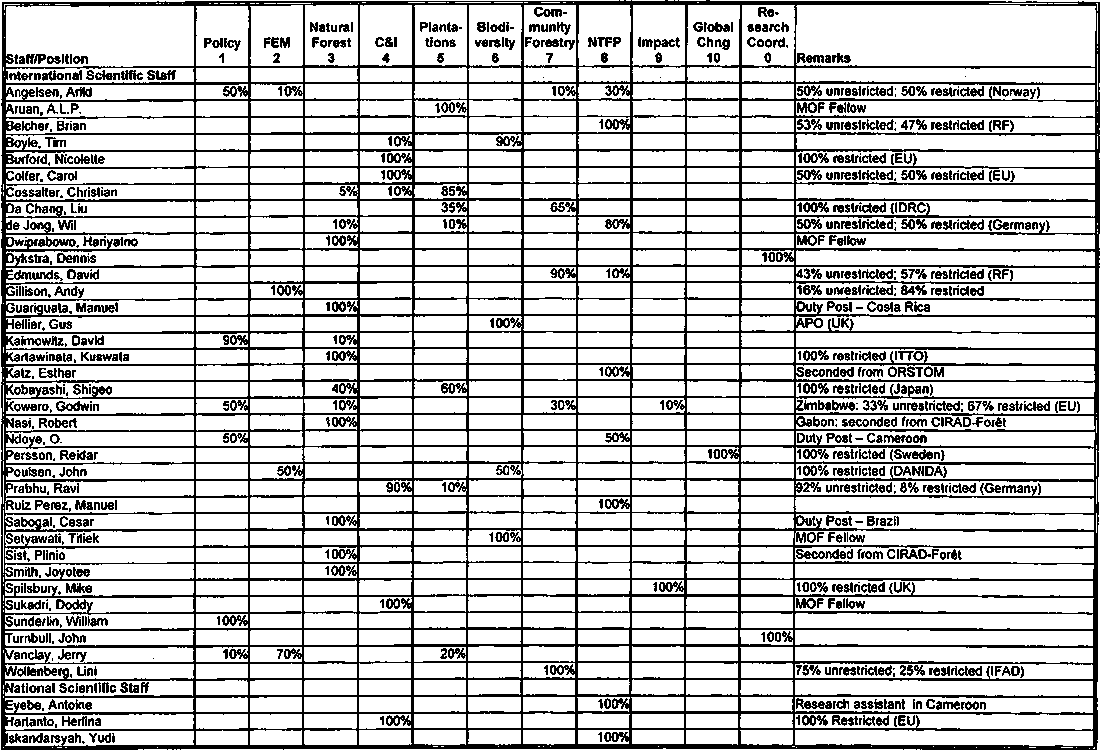
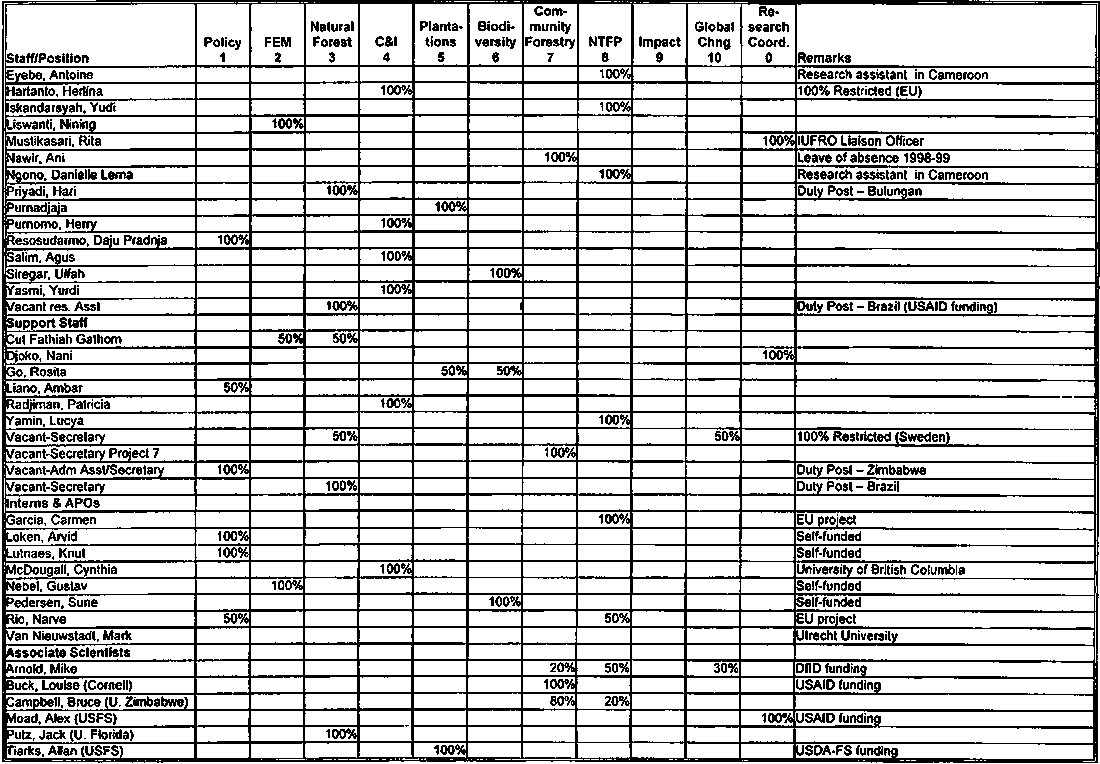
The current ten project structure is a flexible one, as would be expected, given the highly integrative and collegial structure being sought by the BoT and the DG. As such, while the ten projects exist as separate entities and have their own strategy papers, sets of activities, and internal organizational arrangements, their activities could be better integrated in many cases, and the researchers involved in the projects are not in the majority of cases responsible to only one project. Thus. out of the internationally recruited scientific staff that are not on secondment to CIFOR or on 100 percent restricted project funding from a given country/organization, almost two thirds are assigned to two or more projects (see Tables 2.2 and 2.3).
The Panel found that in the case of CIFOR research projects:
> The formal responsibility and accountability of each senior scientist within a project is to DDG/Research, not to the project leader; (as such, the project leader's line authority and responsibility, just as in the case of any other senior scientists, is limited to the junior scientists and other staff working directly on his or her activities, or "tasks" within the project).> Each project is viewed as being the intellectual home for people with a similar problem focus and related funding bases. Each Project Leader in principle acts as an intellectual leader, a monitor of the activities within his or her project, a task leader for his or her own research activities, a synthesizer of information relevant to the project, a central node for budget preparation and presentation, and the keeper of the institutional memory of the project. The project leader is appointed by Management.
> Each project is expected to encourage cross-project interaction; indeed, many senior scientists are formally involved in several projects and others have intellectual interests in several projects.
> Each project is expected to develop its own strategic focus and its own strategic plan; indeed, 7 out of 10 have advanced drafts or formal strategies in place at the time of the EPMR.
> Quality and nature of each strategy paper are somewhat varied, but in general they provide a good vision of the intentions and intellectual underpinnings of each of the projects.
Table 2.1 CIFOR Projects: Objectives, Intended Outputs, and Panel Assessment
|
PROJECT |
OBJECTIVES |
INTENDED OUTPUTS |
PANEL ASSESSMENT |
|
Project 1. Underlying Causes of Deforestation, Forest Degradation, and Poverty in Forest Margins |
> understand underlying causes of forest change > develop means to improve prediction of policy impacts on forests and people in forest margins > formulation of more appropriate policies |
> information, case study and synthesis documents > workshops, seminars, in-service training of collaborators > improve local institutional research capacity |
priorities and relevance: project activities are relevant, timely and of high priority to policy makers in tropical countries; they also generate useful international public goods. CIFOR's emphasis on impartiality and neutrality in policy discussions (rather than advocacy) is sound. Policy research on watershed management, and on externalities associated with deforestation and degradation, could be promising areas for future research if no competitors are found with higher comparative advantage. outputs and quality: project outputs emphasize a pragmatic, problem-oriented approach that has appeal for policy makers. The publication record is excellent. It is too early to assess impact of research outputs, but the various mechanisms being used for dissemination of outputs, including the Internet, are commendable. The panel's overall assessment is positive. |
|
Project 2. Forest Ecosystem Management |
> understand forest ecosystem functions and relation to humans > devise sustainable, productive and equitable management options |
> models at various temporal and spatial scales > standardized procedures to evaluate forest goods and services > generalized decision support systems for use in resolving land use conflicts > survey techniques for diagnosis and inventory of forest ecosystems |
priorities and relevance: project activities are relevant for CIFOR and for systemwide programs such as ASB and SGRP. Need to further strengthen linkages with other relevant international initiatives (e.g., CBD-SBSTTA and DIVERSITAS). outputs and quality: notable products include the PFA proforma method and associated computer package for data management incorporating a variety of site characteristics; development of models and new software (e.g. DOMAIN); and development of an operational model of FLORES (Forest Land Oriented Resource Envisioning System), although the value/usability of FLORES is not clear. The rapid biodiversity assessment tool using "plant functional attributes" is promising, but needs to be further refined and tested under a variety of ecological situations. Ecosystem management with community participation is still an evolving theme, through the FLORES model. |
|
Project 3. Multiple Resource Management of Natural Forests |
> improve silvicultural practices for natural and secondary tropical forests in order to: a) contribute to sustainable, simultaneous production of both goods and services, and b) quantify environmental services and other benefits from reduced impact forest harvesting and management |
> technologies to help achieve ITTO Target 2000 > guidelines > policies and incentives to encourage loggers to use RIL techniques > software to improve efficiency of planned harvesting > publications > guidelines for management of secondary forests for multiple outputs (goods and services) |
priorities and relevance: work on secondary forest management is highly relevant and long overdue, and CIFOR's broad perspective (that includes degraded forests), is very useful. Work on reduced impact logging is also relevant, and is appreciated by partner countries. Comparative analysis across countries helps generate international public goods. outputs and quality: the project has produced a large number of useful publications, synthesis documents and guidelines. The work is of high quality, and the multidisciplinary approach used by the project is commendable, and addresses important issues. About a third of the publications are in refereed journals. |
|
Project 4. Assessing the Sustainability of Forest Management: Developing Criteria and Indicators |
> contribute to the development and evaluation of technologies to determine whether forests are being managed on a sustainable basis. More specifically: > C&I objectivity, relevance, and cost-effectiveness > C&I related to socioeconomic impacts > C&I for community forests (with project 7) > C&I related to biodiversity conservation (with project 6) > C&I related to plantations (with project 5) > improve utility of C&I as decision support tools |
(same as under objectives) plus > guidelines on decision support methods for evaluation of sustainability of forest mgt., based on qualitative models of the interactions of C&Is; > generalized methods and technologies for developing performance thresholds for key indicators |
priorities and relevance: the primary emphasis has appropriately been on the forest management unit level but also seeking to link with national and regional levels. CIFORs role as an objective, non-partisan international organization, and its comparative approach, are well appreciated. The international public goods nature of the work is readily accepted. outputs and quality: the first phase of the project, completed in 1996, has had substantial impact at the national and international levels (e.g., at intersessional meetings of the Intergovernmental Panel on Forests (IPF)). The main part of the socioeconomic and biophysical instruments will be completed in 1999, after which it would be possible to assess their quality, adequacy and impact. The inputs thus far have been of high quality; and the field testing undertaken in the initial phase has been intensive and rigorous. Upon project completion, attention would need to be given to appropriate dissemination of the agreed criteria and indicators. |
|
Project 5. Plantation Forestry on Degraded or Low Potential Sites |
> identify and analyze priority constraints on sustainable, productive tree planting > develop technological and incentive options for enhancing sustainability and productivity of small-scale plantations on degraded and low-potential sites in the tropics |
> guidelines for smallholder involvement in plantation management > technologies to improve plantations on low potential sites > increased awareness of and access to existing growth data > develop C&Is (with project 4) |
priorities and relevance: project activities are varied and diverse - partly in response to donor interests. The emphasis on "small scale" plantations on degraded/low potential sites in the tropics is appropriate; and the project activities are relevant for addressing the needs of smallholders. The comparative study across geographical regions is well conceived and could lead to useful generalizations, but site selection should have attempted more systematically to cover various combinations of climatic and edaphic situations. outputs and quality: a few publications by CIFOR staff (conference proceedings, research papers and an edited book) have been completed; information systems have been created (TROPIS) and disseminated (PLANTGRO); and additional technologies and models are expected in due course. The inclusion of mixed plantation forestry models would be useful. |
|
Project 6. Conservation of Biodiversity and Genetic Resources |
> understanding the interactions of landscape scale processes that reduce biological diversity, > understanding micro-scale processes (gene flow, inbreeding, pollination, seed predation, recruitment mortality rations, genetic drift, etc.) > understanding both in order to: a) determine impacts of major threats to in situ conservation of forest biodiversity, and b) develop tools to measure and monitor biodiversity |
> tools for measuring and monitoring diversity (including molecular markers, computer software, GIS and remote sensing applications) > management prescriptions for managed and protected areas that reduce damage to biodiversity |
priorities and relevance: the project's strategy document presents a comprehensive and convincing conceptual framework for work on this broad topic of genetic and ecosystem biodiversity. It provides a good rationale for the activities being undertaken. All these activities have high relevance for the international community, and lie within CIFOR's mandate and comparative advantage. outputs and quality: the publications record is impressive, and computer software produced is being widely used. A wide range of tools, ranging from molecular to remote sensing techniques and GIS is being developed. It is too soon for this research to have had much direct impact (the impact pathway for the project is long), but the potential for indirect impact is great. By 2000, spatial and process models are expected to have been developed and validated on the ground. Detailed handbooks and training manuals will then need to be developed. |
|
Project 7. Local Livelihoods, Community Based-Management and Devolution |
> analyze impacts of devolution of forest governance on livelihoods > indicate direction for improving policy effectiveness > determine methods for implementing adaptive forest management |
(same as objectives) plus > rapid measurement techniques for forest-based income and assessment of income opportunities compatible with conservation; > scenarios describing the impacts of different policy options; > methods for modeling the people-forest interface |
priorities and relevance: the project is central to CIFOR's goal of improving the livelihood of forest-dependent poor local people. Outputs will include country-specific case studies as well as synthesis documents of wider applicability. The issues being addressed are relevant and appropriate. outputs and quality: despite a slow beginning, the project has now put together a coherent vision for integrating its diverse activities. Outputs have included seminars, workshops and in-house publications (which are of high quality); refereed publications are expected in the near future. Additional inputs from biophysical scientists would have improved the project management aspects of the project. |
|
Project 8. Sustainable Use and Development of Non-Timber Forest Products |
> identify global trends and patterns in the utilization of non-timber forest products > develop theories and models that permit improved projections of future trends in NTFP utilization > develop projections of likely changes in forests and biodiversity which will result from increased utilization of NTFPs; > provide improved estimates of the number of people in tropical developing countries who depend on NTFPs, and determine the nature of this dependency and how it is changing |
> theories and models > procedures for assessing potentials for NTFP under different conditions > estimates of impacts of NTFP on forests and biodiversity > estimates of number of people who depend on NTFPs, and characteristics of such people > options for improved institutional arrangements for NTFP development |
priorities and relevance: the project's activities are relevant and of high priority. In the future, even more emphasis on smallholder forest management technologies would be useful for drawing attention to this aspect throughout CIFOR's research agenda, although it is already included in three locations of this project. outputs and quality: the initial program development phase was somewhat long (some earlier activities had been undertaken on an opportunistic basis). The project has assembled a sizeable interdisciplinary team which has produced an impressive set of high quality outputs (books, refereed articles, workshops etc.) which have made a substantial contribution to the scientific community engaged in research on forest products. The various outputs are being assembled into a set of integrative synthesis documents. |
|
Project 9. Research Impacts, Priorities and capacity evaluation |
> develop methodologies and use them to conduct studies and evaluations relating to: - research impact assessment - priority setting for, and evaluation of, NRM research - forestry-related research capacity assessments |
> improved research and research management capacities > new and more efficient products and services for access to and dissemination of scientific information > cooperative information sharing and training programs > established world-wide standards on forestry information services > new methods for strategic priority setting > baseline research capacity data for NFRSs |
priorities and relevance: the methodologies being developed by the project are relevant and needed. However, the methodologies being developed for research prioritization and capacity evaluation are complex, and this may limit their wide application by national institutions (although they are being used by regional organizations). The collaborative approach being adopted is appropriate. It has not yet been used to identify partners, but it identifies current interactions and supports strategies to develop partnerships. outputs and quality: the project's activities have thus far been largely conceptual, but have been undertaken in consultation with CIFOR staff and national scientists in the SADC region. It would be useful to consider ways of simplifying the proposed model for evaluating research capacity, and to give increased attention to developing research prioritization methods that would be useful for national and regional collaborators as well as for CIFOR's own research program. |
|
Project 10. Policies, Technologies and Global Changes |
> maintain a comprehensive overview of the state of the world's tropical forests and of international institutions addressing their development and conservation; > analyze major global trends in the patterns and structure of international supply and demand (in the broadest sense, including all goods and services that societies derive from tropical forests) |
> policy analyses for use in international policy debates and in setting the global context within which CIFOR research is undertaken > synthesis of CIFOR's collective understanding of: a) the causes of deforestation and forest degradation and potential policies to deal with these causes; b) the role of forests in well-being of forest dependent communities; and c) socio-economic and demographic transitions that shape demands on the forest; > direct communication with key opinion leaders and donor agencies |
priorities and relevance: the project has direct relevance to CIFOR, and it complements the work of the other 9 projects. It has contributed directly to the work of several global initiatives being undertaken by IPF, IFF and WFC. The project should develop a strategy and accompanying mechanisms for effective outreach to policy makers. It could be considered more as an outreach activity, with the current research-related activities brought closer to the work being done in project 1. CIFOR also needs to revisit its comparative advantage and role in broad trend analysis work. outputs and quality: a number of publications have been produced. The project has made notable contributions to the work of the IPF during its four sessions in 1995-1997; which has been acknowledged by the appointment of CIFOR on the Inter-Agency Task Force of IFF. The project has also benefited from the contributions (and the relevance and quality) of other projects within CIFOR. Increased attention to these links is expected in the future, since CIFOR has comparative advantages in intellectual and operating resources. |
Table 2.2 Allocation of Research Division Staff among Projects
Table 2.3 Cross-Project Research Collaboration
The projects shown in the columns receive collaborative contributions from the projects shown in the rows. Projects 9 and 10 are not shown because they work across all projects.
|
Project |
1 |
2 |
3 |
4 |
5 |
6 |
7 |
8 |
|
1 |
|
|
|
|
|
|
|
|
|
2 |
|
|
|
|
|
|
|
|
|
3 |
|
|
|
|
|
|
|
|
|
4 |
|
|
|
|
|
|
|
|
|
5 |
|
|
|
|
|
|
|
|
|
6 |
|
|
|
|
|
|
|
|
|
7 |
|
|
|
|
|
|
|
|
|
8 |
|
|
|
|
|
|
|
|
Key:
|
|
Little or no formal collaboration |
|
|
Modest levels of collaboration |
|
|
Extensive collaboration |
|
|
Diagonal (represents projects' internal activities) |
Based on these features of CIFOR's projects, the Panel's overall assessment of the current research program is that the research activities managed by the ten projects are addressing important topics and producing useful outputs. At the same time, the Panel believes that CIFOR could, through adjustments within, rationalization and/or consolidation of projects and their activities:
> improve the focus and effectiveness of activities in some projects in terms of impacts; and make shifts at the margin in the topics addressed. (Suggestions with regard to specific topics are provided in Table 2.1).> improve the understanding among its researchers and donors concerning how CIFOR's work relates to its mission and to impacts in terms of achieving that mission; and
> expand the opportunities for generating international public goods with significant spillovers in countries beyond those in which CIFOR works;
The Panel believes that CIFOR could improve its effectiveness by addressing the points above. More specifically, it believes that a reoriented program structure for research in CIFOR would serve it well, one that focuses more explicitly and operationally on the outputs that will produce positive impacts in terms of CIFOR's mission. The Panel recognizes that there is no perfect program structure for research as complex and varied as that being addressed by CIFOR; and it also recognizes that the choice of structure should be made by CIFOR only after considerable assessment and internal discussion of the pros and cons of various options.
As such the Panel recommends that:
CIFOR should evolve its current grouping of research activities into a framework that links more closely and clearly its research activities and their outputs to CIFOR's mission and to the broad thematic needs implied by it.
In other words, CIFOR should become more output and impact focused in all its research activities. The Panel stresses that the outputs have to be linked explicitly to CIFOR's potentials for impacts in terms of its mission and the goals of the CGIAR. Ultimately, CIFOR needs to set priorities on the basis of its potential impacts in terms of its mission. However, such impacts come through its outputs, which, in turn, are what it can control and for which it can be held accountable.
The Panel recognizes that the strategic planning exercises currently underway for each of the ten projects in CIFOR are moving the Center a long way in the direction suggested. However, at the present time, the comprehensiveness of the projects' strategic plans are highly variable. Furthermore, these strategic plans need to be consolidated and made compatible at the Center level with the overall vision and strategy of CIFOR to ensure that they, collectively, fully address its mission in the future. Although the project strategic plans have logical framework analysis that may be demonstrated to be closely related to an institutional logical framework, there is no clear portrayal of this relationship yet, nor of the means of prioritizing among projects.
If CIFOR decides to implement the above recommendation, then the question remains as to how best it should group its research activities. The Panel accepts CIFOR's current ten project arrangement as one of a number of reasonable possibilities; however, there are others. The Panel does not want to recommend a specific way of grouping CIFOR's research activities; thus, what is presented below are merely the Panel's ideas on what it considers to be a useful model out of many that might be used.
Table 2.4 provides a framework that illustrates one overall conceptualization of a possible grouping of research activities based on an organizing (as distinct from structural) framework that CIFOR might consider along with several others of its choice. Some illustrative examples of how specific CIFOR research thrusts (activities or combinations of like activities) would fit within this framework are shown in the cells of the table. The structural implications of such a framework are discussed in Chapter 4.
Table 2.4 A Research Organizing Framework for CIFOR in Pursuit of Its Mission (a)
|
INFORMAL INTER-DISCIPLINARY CLUSTERS OF SCIENTISTS (b) |
MISSION-FOCUSED THEMATIC PROJECTS |
|
|
Theme 1: Increasing livelihood security and forest use and management options for poor rural peoples - poverty alleviation and food security focus |
Theme 2: Improving the management of forests for their global, national, and regional environmental services and goods - environmental protection and urban poverty alleviation focus |
|
|
The clusters primarily are collegial groupings of CIFOR scientists seeking common problem solving research approaches. A given researcher may feel comfortable in more than one cluster They provide a convenient, albeit informal means for intellectual interaction and for fostering multidisciplinarity or interdisciplinarity in research and in the development of project ideas and proposals. Further, they provide a vehicle or forum for interaction across projects of scientists involved in common methods development and in doing research to create the knowledge needed to focus more effectively on project themes. Such cross-cutting research might include: research on extra-sectoral influences on forests that produces knowledge of use in addressing the themes of two or more of the output-oriented projects; research on methods for biodiversity assessment, C&I development, household survey methods, and so forth. CIFOR is bound to be involved in such basic knowledge creation in cases where outside suppliers are not producing, or cannot produce what is needed to address effectively the thematic oriented research that should be CIFOR's main focus in addressing its Mission and the goals of the CGIAR. |
Possible research activities (including some of CIFOR's current activities): > local forest management decision making processes under common property and other forms of tenure; > NTFP barriers, options and opportunities > overcoming local smallholder constraints related to knowledge, motivation and resource access; > development and testing of C&I > income generation and incentives > local community devolution options and processes > species and plantations for local community improvement; > understanding smallholder forest management systems and opportunities for improvement; > community or smallholder management of secondary forests with minimum input technologies; > integrated management of forests for NTFP as well as timber products; > understanding forest disturbance impacts on local human welfare > alternative forest rights/management devolution options and impacts > influence of national forest tenure laws on settlement patterns and forest use |
Possible research activities (including some of CIFOR's current activities): > ASB, forest protection, and rural forest margin community dynamics; > impacts of settlement on deforestation: local community options to reduce the negative impacts; > local management in relation to provision of global environmental services from forests; > reduced impact logging technologies and implications; > efficient and profitable sustainable secondary forest management; > understanding secondary forest dynamics; > plantation outputs in relation to natural forest utilization and degradation. Plantation C&I. > understanding forest disturbance impacts in terms of global value changes; > biodiversity conservation under locally developed management systems; > international conventions and their effectiveness in relation to national forest management; > options for international payment programmes for forest carbon sequestration (e.g., JI experience) > protected areas policies; |
(a) Cell entries are merely illustrative examples of current activities, but are not necessarily indicative of the results of future priority setting for CIFOR.(b) To some extent, these groupings might become problem-focused in the same way that the current ten projects are today. Since the cluster would be built around the intellectual/science issue interests of the researchers, it is entirely possible that a researcher might affiliate him or herself with more than one cluster.
In keeping with the recognition and operating philosophy of CIFOR, it is fully recognized that most activities contribute to better understanding related to both mission-focused project themes. Yet, as CIFOR recognizes in its current structure, activities need to be assigned to one project or another for administrative purposes. In this sense, it does not matter whether there are two, three, or ten projects. In almost all cases one will be able to point to overlaps. The key is not whether an activity is assigned to one mission-oriented project leader or another. Whatever the activity, what matters is that it is focused on how it ultimately can contribute positive impacts in terms of one or more of the forest-related needs implied by the mission.
Some will be quick to point out that certain activities are mainly oriented toward creating requisite knowledge for moving ahead with the activities that are more directly related to accomplishing the mission. They are not associated directly with one or the other of the mission-focused projects shown in Table 2.4, but rather with both equally. They produce basic knowledge or methods needed for both. Such activities as C&I work, some policy research, some of the biodiversity work, fall into this. These kinds of activities still need to be assigned to projects. The Panel suggests that, through discussion between Project Leaders and through the interventions of RESCO, activities somewhat arbitrarily might be assigned to one or another of the mission-focused projects in terms of an administrative home. We suggest this, since creation of separate projects to handle them could (a) isolate the scientists involved more from the rest of the CIFOR researchers; and (b) take their focus off the fact that ultimately, as strategic or applied researchers, they need to focus on how they will contribute to positive impacts on achievement of the mission. Intellectually, or in terms of research substance, their main focus might be guided through the informal clusters of scientists explained in the body of Column 1 of the table.
The envisioned conceptual research organizing framework indicated in Table 2.4 consists of a number of mission-focused thematic projects. The Panel would envision anywhere from two to five of such projects, depending on how much CIFOR would wish to break down the two basic themes illustrated in Columns 2 and 3, and what kinds of cross-cutting Projects might be designed. Thus, if CIFOR wanted more than two projects for administrative purposes, one could envision - as one of many breakdowns, and using CIFOR's present projects/activities as a starting point - the establishment, for example, of five projects with themes as indicated in Table 2.5
Regardless of how many projects are established, planning each activity within a project would involve making explicit links between its intended outputs and CIFOR's mission and goals. CIFOR already is well on the way to conceptualizing this process at the project level in its Project Development Process model that is being initiated for all projects.
There are other options for logical groupings of CIFOR's research that it also should consider, after it debates the pros and cons of each. The Panel stresses that what is suggested above is only its view of a promising direction to move in reorienting CIFOR research to focus more directly and continuously on outputs and positive impacts in terms of achieving CIFOR's mission.
Table 2.5 An Alternative Research Organizing Framework for CIFOR in Pursuit of Its Mission (a)
|
INFORMAL INTER-DISCIPLINARY CLUSTERS OF SCIENTISTS (b) |
MISSION-FOCUSED PROJECTS |
|
|
Mission Theme 1: Increasing livelihood security and forest use and management options for poor rural people - poverty alleviation and food security focus |
Mission Theme 2: Improving the management of forests for their global, regional, and national environmental services and goods - environmental protection and urban poverty alleviation focus |
|
|
The clusters primarily are collegial groupings of CIFOR scientists seeking common problem solving research approaches. A given researcher may feel comfortable in more than one cluster. They provide a convenient, albeit informal means for intellectual interaction and for fostering multidisciplinarity or interdisciplinarity in research and in the development of project ideas and proposals Further, they provide a vehicle or forum for interaction across projects of scientists involved in common methods development and in doing research to create the knowledge needed to focus more effectively on project themes. Such cross-cutting research might include: research on extra-sectoral influences on forests that produces knowledge of use in addressing the themes of two or more of the output-oriented projects: research on methods for biodiversity assessment, C&I development, household survey methods, and so forth. CIFOR is bound to be involved in such basic knowledge creation in cases where outside suppliers are not producing, or cannot produce what is needed to address effectively the thematic oriented research that should be CIFOR's main focus in addressing its Mission and the goals of the CGIAR |
> Project A: Strengthening forest management and use rights and activities for local communities and smallholders (including identifiable activities related to devolution of rights, trends in NTFP management and use, NTFP modernization and domestication, C&I for community forestry, valuation studies, people-forest interface models, micro policy planning methods for community management, tenure issues, and so forth). > Project B: Forest ecosystem management (including identifiable activities related to management of natural and secondary tropical forests, management of dryland forests, measuring impacts of disturbances on forests, smallholder secondary forest management, valuation studies, development of C&I for FEM, silvicultural research) > Project C: Plantation forestry on degraded or low-potential sites - with close ties to Project A (Project C includes identifiable activities related to Imperata grasslands and forestry, rehabilitation of degraded forests, development of TROPIS and adaptation of other plantation models, C&I for plantations, pathogens in plantations, tree farming, plantations and global forest resource requirements, modelling plantations of mixed species) |
> Project D: Conservation and management of biodiversity and genetic resources (including research activities related to impacts of various types of influences (disturbances) on biodiversity, modelling impacts, mangrove biodiversity, reduced Impact logging and management of forests, development of benchmark sites, etc.) > Project E: Policy studies related to public and private management and use of forests, (including research activities on extra-sectoral influences on forest management and use, deforestation sources and causes, global environmental values related research policy implications of various forms of forest management under different political and social conditions, policy research on forests and climate change, data requirements for policy analysis and decisions, etc.) |
(a) Cell entries are merely illustrative examples of current activities, but are not necessarily indicative of the results of future priority setting for CIFOR.(b) To some extent, these groupings might become problem-focused in the same way that the current ten projects are today. Since the clusters would be built around the intellectual/science issue interests of the researchers, it is entirely possible that a researcher might affiliate him or herself with more than one cluster.
CIFOR is making steady progress in refining its vision of the major issues and opportunities that it will address in the future, and towards a strategy for implementing such a vision in the context described above. Indeed, the long process it followed to produce a strong strategic plan has paid off. The Panel is satisfied that CIFOR has picked, out of the many hundreds of topics brought before it, a set of researchable issues and topics that includes key elements in addressing major world issues related to forests and their contributions to improvement in the human condition. At the same time, in the evolutionary process consciously followed by CIFOR, changes in research topics and directions have become part of the culture and the expectations of staff.
The Panel considers that there is a timely opportunity for CIFOR to make its research process more effective, to sharpen the focus of its research, and to focus more clearly on how each of CIFOR's research activities contributes to its mission and the global priorities for increasing the contributions of forests to poverty alleviation, food security, and environmental protection and enhancement.
Ultimately, the success of CIFOR's research - with success measured in terms of impacts on achieving its mission and contributing to the goals of the CGIAR - will depend on how well it picks its priorities and addresses them in the context of its comparative advantage as a producer of international public goods. Success will be judged to a large extent on the basis of how well it articulates and plans for the ultimate impacts of its work, controls the quality of its research and relates its work to the priorities of its clients and partners as well as the broader international community. Given the importance of these items, we turn in the next chapter to a discussion of priority setting, impact assessment, and issues of quality and relevance of research.