4.1. The Executive Function
4.2. Resource Management Function
4.3. Management of Research
This Chapter reviews the managerial functions and concomitant policies and procedures in CIFOR. It looks first at the executive function - the workings of the BoT and senior management; it then reviews the resource management functions; and concludes with some observations and suggestions related to the management of research.
In a period of five years, CIFOR's BoT and management have established CIFOR; have worked with CGIAR members, including donors and governments to develop the institution and attracted funding that, cumulatively, totals in excess of US$ 40 million; employed more than 120 staff; and initiated research into a variety of important issues that will impact on millions of people. This is no small feat, and CIFOR is to be congratulated.
In reading the material that follows, then, it should be understood that the Panel, in making its recommendations and suggestions, is fully cognizant of the successes to date and very complimentary of how that progress has been achieved in a cost-effective manner. The Panel sees its role as one of 'raising the bar'; i.e., suggesting changes to the policies and procedures that, once implemented, will more closely align the managerial functions with CIFOR's changing needs occasioned by growth and increased complexity.
4.1.1. The Board and Governance
4.1.2. Senior Management Leadership
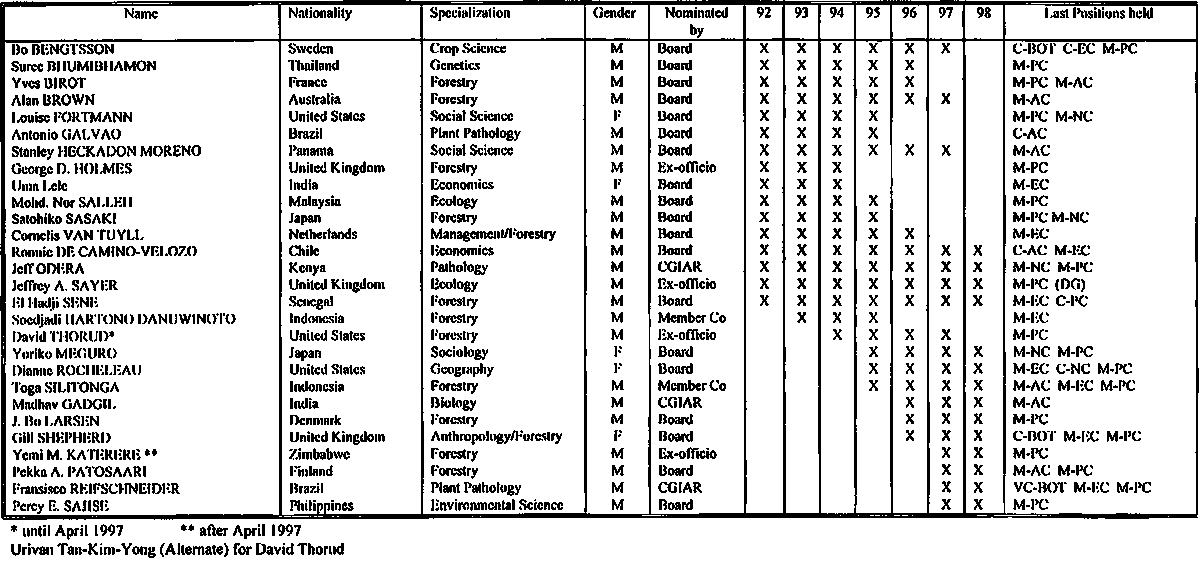
The governance function for CIFOR rests with the BoT - comprising 14 individuals chosen for their particular specialist scientific and technical skills. Three members (the Director-General, the Chairman of the Board of ICRAF, and the Representative of the Government of Indonesia) are ex-officio members and the remaining 11 members are appointed initially for a three-year term, with the possibility of a second three-year term upon satisfactory completion of their first term, and the continued relevance of their particular competencies to CIFOR's mandate. Three of the Trustees are female, and eight are nationals of developing countries. Table 4.1 summarizes the composition of CIFOR's BoT from its inception until now.
Trustees are nominated and elected to office on the basis of their individual competencies, their scientific reputations and technical abilities and their ability to add value to CIFOR's governance function. The resultant level of collective competency in CIFOR's areas of scientific research is both deep and broad - reflective of a careful and deliberative nominations process.
CGIAR members look to the BoT to:
· provide the overall directions and governance of the Centre's activities, including strategic vision and fiduciary oversight;· assist in interfacing with governments, with the donor community, the CGIAR system and its many components, and to
· monitor the DG's performance as he implements the Centre's vision.
Table 4.1 CENTER FOR INTERNATIONAL FORESTRY RESEARCH (CIFOR) - BOARD COMPOSITION (1992 - 1998)
CIFOR's Board meets once a year - typically during the first quarter of the year. At these annual meetings it reviews and approves the Centre's mission, Objectives, Strategies, and Work Programme and Administrative Budget for the current year; it receives and acts on the recommendations of Board committees in respect of nominations for trustee vacancies, audited financial statements covering the year just ended 1, and addresses such other matters as may be placed on the Board's agenda. It carries out its roles and responsibilities using a committee structure comprising:
1 CIFOR's Financial year is January 01 - December 31.· the Executive Committee (EXCO)
· the Audit Committee (AC);
· the Nominations Committee (NC); and
· the Programme Committee (PC).
EXCO meets twice a year - once in the September/October period, and once just
prior to the full Board meeting each Spring. The Audit, Nominating, and Program
committees also meet formally once each year - just prior to the meeting of
the full Board.
BoT and Committee Effectiveness: The Panel did not have the opportunity to attend a BoT meeting within the timeframe of this review. Some members of the Panel did attend a meeting of the Executive Committee of the BoT just prior to the initial phase of the Review, and one member attended the 1997 BoT meeting in a different capacity. Between them, members of the Panel have met, or spoken with, ten of the Trustees during this review. The Panel has had access to all BoT documents and Minutes of meetings and has reviewed them extensively. As noted in (2) below, some additional documentation of the debate and discussion that captures the issues and conclusions reached, and why, would be helpful. 2
2 Most likely necessitating a transcription of the discussion from which these more extensive Minutes could be prepared.
At CIFOR's inception in 1992 the BoT was constituted first to formulate a research plan, and then select and appoint a DG. As a result, the original 'founding' Trustees, who were initially appointed by the CGIAR members, effectively managed the Centre in the early days and some were very familiar with the CGIAR procedures and the donor community. By April, 1998, all the 'founding' Trustees will have rotated off the Board in accord with the bylaws. A review of the qualifications and experience of the current, and incoming slate of Trustees suggests that CIFOR has focused on recruiting a wide scientific representation of appropriate disciplines. It would seem. however, that few, if any members of the 1998 BoT have past experience in the CGIAR System, nor will the private sector have representation, and the Board may lack depth in key management, and financial areas that are required of an international centre with a US$ 12 million budget.
Typically, the focus of a board's governance attention tends to be reflective of its composition By way of an example of how CIFOR's Board composition impacts on the exercise of its governance, the Panel noted first, that the Program Committee consisted of between 9 and 10 of the 14 members, and second that the BoT tends not to focus a lot of its attention on the financial or managerial aspects of CIFOR's operations. This tendency is illustrated by the following examples:
(i) while the EXCO receives interim financial statements in October, the only financial data concerning CIFOR's operations that is received by the BoT on a regular basis 3 is the Audited Financial Statements at year-end, and the upcoming year's Budget data;3 Management explained that it had previously offered to provide financial data on a more regular basis but that Trustees had declined it. On a positive note, Management has recently developed a 'Board-Only' website within CIFOR's general website to provide access to important financial and other control data to interested Trustees.(ii) in a recent presentation to EXCO of the proposed Management Information System (MIS), no Trustee asked about the development or operating costs of the proposal;
(iii) the FY98 Budget will be placed before the BoT for its review and approval in April 1998 - some four months into the year for which the budget approval is sought 4; and
4 Parenthetically, the Panel would have expected to see evidence of a Continuing Resolution, or its equivalent, by the Board to permit CIFOR to continue operating legally in 1998 in the absence of an approved budget. It did not.(iv) the BoT has not asked either the Internal or External Auditors for any additional material either by way of explanation or as a cross-check on management's activities.
A comprehensive knowledge of the CGIAR System - its composition, structure, modus operandi, and key constituencies is essential if CIFOR is to take full advantage of its place in the CGIAR system. Being relatively new, and focusing on topics that are themselves relatively new to the CGIAR System, staff and management has limited experience of the system and the other CGIAR Centres. BoT-level familiarity with the CGIAR System is important. By way of example, Trustees knowledgeable about the CGIAR System will be familiar with the BoT's responsibility for commissioning and overseeing Centre Commissioned External Reviews (CCERs), and with the manner in which these reviews feed into the overall external review process for CGIAR-supported centres.
Finally, the BoT must become much more familiar with the financial affairs of the Centre so that each Trustee can effectively carry out his/her fiduciary responsibilities and that the Centre's Directors' and Officers' Liability Insurance coverage is not compromised by lack of appropriate BoT focus on those issues that are exclusively the purview of a Board. CIFOR's financial reporting capabilities are adequate and are available to Trustees: it remains the Trustee's individual responsibility to avail of these capabilities. In this context the Panel commends management for introducing, in January 1998, a "BoT-only" web page that will enable Trustees to get immediate access to Minutes of meetings (available now), and, shortly, the financial data about CIFOR's operations. To date, little use has been made of this facility.
The Panel believes that the BoT has a broader, and more inclusive governance role to play than it has played heretofore. With 'maturity' setting in, a substantial, and growing budget, and the need to be more closely involved with the private sector, the Panel recommends that:
the BoT should seek Trustees who, between them, have broad managerial and financial competencies, and familiarity with the CGIAR System and with the private sector.
CIFOR has indicated that it is already looking at strengthening the BoT in the manner recommended above It is actively considering temporarily expanding the membership from the current 14 Trustees to 16 or 17 to quickly introduce these additional skills onto the Board. In order to reduce its overall size back down to a preferred numerical strength of 14, CIFOR would then leave vacant those post-1998 rotations off the board until the preferred size was again reached. The Panel concurs with this approach.
Resource Management and Priority-Setting: A primary function of the PC is to review, on behalf of the BoT, the Centre's annual Programme of Work and Budget (PWB) submission. The minutes of the PC, and of the BoT meetings were reviewed, but the Panel did not see an articulation of how the PC evaluated and ranked the projects in the light of research mandate. Absent a formally prioritized work programme, it was not surprising to the Panel that the Board affirmed 5 management's position that, in the event of a subsequent, unanticipated cut in funding, 'across-the-board' reductions would be initiated, rather than selective cuts in those projects or activities of relatively lower priority. Additionally, the PC and BoT need to be intimately involved in evaluating the financial and managerial dimensions of the PWB, and in reviewing progress during the year - not only in financial terms, but also in programmatic content and project management terms.
5 Minutes of the Eighth meeting of the Executive Committee dated 4/24/96
Whilst recognizing the realities of centre-donor relations and the short-term impact of funding variations on research priorities, the Panel nevertheless believes that the current approach to priority-setting can be strengthened by making explicit the linkages to mission and objectives as suggested in chapters 2 and 3 above; by prioritizing the activities to be accomplished, and articulating those work program activities that, in the event of budgetary additions or shortfalls, would be added, or dropped/curtailed as necessary to meet the available funding, and why.
The Panel believes that the approach suggested in the previous chapters will facilitate this priorities-setting and resource allocation discussion within the BoT and the PC, but believes that there are yet significant time constraints to undertaking a thorough review of the type suggested that are uniquely imposed on the CIFOR BoT by the current practice of meeting only once per year, and that well into the year. The priority-setting exercise needs to be de-linked, time-wise, from the budget-approval process so that the BoT/PC can thoroughly examine the relationships between mission, strategy, objectives, projects and activities, and the priorities that the BoT believes should emerge therefrom. A review of CIFOR's work program, at the degree of thoroughness suggested, can take a well-qualified PC some three or four days of discussion and analysis, from which management can then quantify the decisions and submit them to the BoT for review and approval at some later date.
The Panel notes, parenthetically, that other CG centres find that two or more BoT, or some combination of BoT/PC meetings each year are necessary to adequately cover this agenda, and suggests that the BoT meet at least twice each year. One model, for example, might involve an initial meeting - held towards the latter part of the year - to review and approve the upcoming year's work program and associated budget. Output from that meeting would also provide guidance to the DG as to where the BoT would like added review/analyses of any aspects of the work program so that, at the second meeting - to be held in (say) May/June of the following calendar year - the BoT would fully review the mission, its strategic options for the upcoming planning period, its research agenda, and priorities for resource allocation.
This May/June meeting would, in turn, drive the preparation of the next budget preparation cycle for the following year, et seq.
Management has posited that having two BoT meetings each year would (a) cost more; and (b) place greater-than-acceptable demands on Trustees' time. With respect to (a), the Panel notes the arguments, but believes the opportunity costs of not meeting sufficiently often to provide adequate strategic direction and fulfil its legally-mandated governance functions greatly outweigh the estimated incremental costs (approx. US$ 60,000) incurred. The argument (b) is more worrisome to the Panel. If Trustees cannot (1) appreciate the need for them to devote adequate time for governance; and/or (2), are unable to devote sufficient time to carry out their role appropriately, then they may want to reconsider their ability to add value to CIFOR's governance function.
The evolving nature of CIFOR's scientific program suggests that the scientific competencies required at the Board level are also constantly changing. Current by-laws provide for CIFOR's Trustees to be appointed initially for a three-year term, with the option of being re-appointment for a second three-year term. The Panel believes that CIFOR would benefit from added flexibility if the BoT were able to shift the scientific competencies of the Board in line with the evolving work program. Typically, it takes a minimum of 12 months - particularly with only one BoT meeting a year - for a newly-appointed Trustee to 'get up to speed' on the Centre's work program, budget, and the key interpersonal issues that are an integral part of every board, and begin to contribute to the board's deliberations. Realistically, a Trustee should then have at least two years to make the contributions expected of him/her. It is the subsequent three-year second term appointment that may prove inappropriate, however. In a rapidly-changing scientific environment, it may be that the Board could benefit from one, or possibly two more years of the trustee's board membership, but not three.
To give CIFOR added flexibility in the terms of appointment, the Panel suggests that the BoT consider appointing all Trustees for an initial three-year term, followed, as deemed appropriate in each case, by a succession of one-year terms up to a maximum continuous board membership term of six years. Nominees for Board positions would be advised that all 'term-expiring' Trustees would, as a matter of policy, need to be re-nominated and that subsequent terms are neither guaranteed or expected.
CIFOR is managed by a competent team comprising the DG, two DDGs, a Chief Scientist, and an Assistant Director-General (ADG). The DG was appointed in March 1993 not long after the centre came into existence. Following his own appointment, the DG subsequently appointed the Deputy Director-General, Research and the Deputy Director-General, Finance and Administration; a Chief Scientist, and an Assistant Director-General.
The DG uses two management committees as his primary tools to manage the institution, to test ideas, and implement decisions, the Management Group (MG), and the Research Co-ordination Committee (RESCO). The MG comprises the DG, the DDG Research, the DDG-Finance & Administration, the Chief Scientist, the ADG, the Directors of External Relations, Communications, and Information Services, and representatives of both the internationally recruited, and nationally recruited staff. Its terms of reference require that it consider substantive research, management, financial, and administrative issues and it is the main decision-making body in CIFOR. It meets weekly and is chaired by the DG. The RESCO comprises the Project Leaders, or their representatives, the DDG-Research, the Chief Scientist, and the ADG. It meets every two weeks and is concerned with those management issues that:
· help formulate research agendas that reflect established research goals and maximize CIFOR impact;· impact upon the human and financial resources available for research and their allocation across CIFOR projects and activities;
· assist in developing a research portfolio that operationalizes the research agenda while emphasizing comparative advantage, accountability, and transparency;
· promote an impact and evaluation culture at CIFOR; and
· encourage effective monitoring and performance appraisal.
Other committees and/or advisory groups address matters related to development
(fund-raising); information technology; national staff employment issues; community
relations; safety; public relations; and library services. While the overall
responsibility for the Centre's operations lies with the DG, he has delegated
to the two DDGs much of the day-to-day operations of the Centre.
In establishing the senior management team and committee structure, the DG has consistently sought to implement a structure that is seen to be non-hierarchical, to back that structure with an 'open-door' policy; and then to encourage actively a collaborative team leadership concept that would maximize staff's ability to contribute to CIFOR's mandate.
Staff are uniformly positive in their recognition of the management team's proven ability to carry out the Centre's mandate and pursue its vision. The Panel also noted that the general atmosphere at the Centre is one of a dedication to the tasks that will enable CIFOR to achieve its mission and 'make a difference' in the lives of the poor. Some staff noted that, at times, senior management made decisions - particularly with respect to staff evaluations - that seemed to be at odds with the conclusions that the immediate staff supervisors (typically project leaders with direct quality responsibility) would have made, if asked.
Management's decision to recruit scientific staff on short-term contracts initially (albeit renewable contracts) has had a somewhat negative impact on management's efforts at building a co-operative, team-oriented research atmosphere. The issue is, in part, one of incentives. A scientist, knowing that he/she has possibly only three-four years at CIFOR, may feel the need to use that time to undertake work for which he/she has clear ownership. Another concomitant effect of the short term employment contracting policy is that institutional memory issues need to be carefully considered, and they are discussed further below. Management has advised that recent appointments, and all future appointments will be 'continuing' after a one-year probationary period, and subject to the terms, if any, of the funding arrangements.
4.2.1. Human Resource Management
4.2.2. Financial and Administrative Resource Management
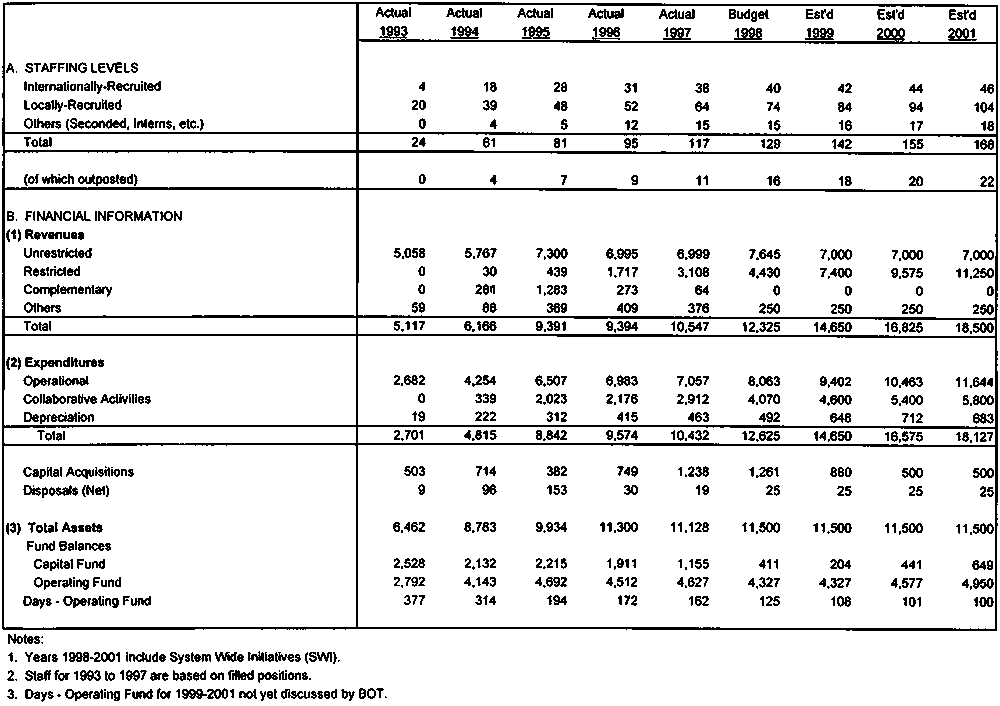
CIFOR's 'assets' - its human resources, facilities, and financial resources are briefly summarized in Table 4.1 entitled CIFOR at a Glance.
Responsibility for Human Resource Management (HRM) lies with the DDG-Finance and Administration. He is assisted by one internationally recruited HR specialist and two local support staff. The HR specialist develops Centre policies for approval by management and the BoT as appropriate. She hires local staff, counsels IRS staff on personal, and personnel-related issues and is responsible for induction of new staff and families into CIFOR.
CIFOR's current staffing is as summarized in Table 4.2, and is more thoroughly detailed in Appendix VI. It should be noted, however, that 46% of the total staff complement are female as are 25% of the IRS staff 6. These ratios compare favourably with those of other centres in the CGIAR system as detailed in a recently-published CGIAR report on gender issues 7, and reflects strong management and BoT support for diversity.
6 Compared to the CG average of 16%7 CGIAR Gender Program - Working Paper No. 15 dated October 1997 refers
HRM Policies and Procedures: CIFOR's personnel policies and practices are essentially similar to those used at other CGIAR centres and appear to be adequate. As with some other centres, spouse employment in jobs outside of CIFOR is difficult to arrange and, given the relatively small size of CIFOR, employment opportunities on campus are very limited.
Another 'domestic' issue is the lack of secondary education facilities in Bogor - necessitating IRS staff with teenage children either living in Jakarta and dealing with long commutes (up to four hours each day), or having the children undertake that commute if the family elects to stay in Bogor. Completion, at some future date, of a ring road system will alleviate some of the time problem. Spouses of some staff have also commented about the adverse impact on the family life of travel schedules 8
8 The timing of the April '98 BoT meeting in Tokyo over two national holidays, and school holidays, was not lost on staff or spouses, and some compensatory leave policy initiatives in such instances would do much for morale, and is typical in most organizations.
CIFOR has in place the usual array of nationally - and internationally - recruited staff benefits, grievance procedures, and protections against harassment and/or other inappropriate behaviours. In our meeting with staff at all levels, there is general agreement that the employment conditions and HR activities are excellent and the resultant atmosphere is conducive to the efficient conduct of research
Senior staff level turnover at CIFOR is becoming an issue as staff are recruited to work elsewhere and as families have difficulty with the quality of life in Bogor. The Panel suggests that F&A prepare a Succession Planning Paper for review and approval that would examine likely staff departures over the next three years and provide:
· a clear picture of the recruitment task ahead (by scientific discipline);· an explanation of how CIFOR's institutional memory will be maintained;
· an overview of how CIFOR plans to replace each senior management position as they become vacant; and
· what management training plans are proposed during this period.
By way of explanation, CIFOR has an employment policy that limits the total time a scientist may spend at CIFOR to no more than 10 years. However for very good reasons having to do with the initial phase of CIFOR's operations, many of the senior staff were recruited on much shorter contracts. The Panel notes the potential for a substantial number of these scientists to be leaving CIFOR at the conclusion of their terms and suggests the above action to ensure a smooth transition, and the maintenance of key institutional memories.
National staff located in Bogor are being adversely impacted by the very steep local currency devaluations vis-a-vis the US dollar. Local mortgage rates have more than doubled in the past nine months and the price of rice, the basic food staple, has doubled during this same period. For its part, CIFOR has reacted positively and responsibly: it granted an interim salary adjustment to local staff last August and has subsequently further adjusted local salaries by a total of 30% through March 1, 1998. This prompt action by CIFOR's management was much appreciated by staff 9, and has been essentially cost neutral.
9 CIFOR's prompt response in this area contrasts with other employers in both Bogor and Jakarta who have not responded so promptly, or at all.
As CIFOR, a 'centre-without-walls', begins to outpost more staff, HRM's capacity to manage these outposted staff - and assure their continued close linkages with headquarters will be tested. The issue of outposting is addressed in Chapter III above, and HRM must support these initiatives with the necessary policies and procedures quickly, recognizing that such policies typically are costly, but essential.
The Panel noted the great value that CIFOR had derived from having a senior Indonesian national as Director of External Relations to promote CIFOR's image and develop its network of contacts during the early years of the Centre's establishment. However, attributing Internationally Recruited Staff status to this position seemed inconsistent with the Centre's policy of restricting IRS positions to people recruited through international competition. Since the skills required for this position are not " international" in nature, it would be appropriate to fill the position with a senior NRS appointment. The Panel also noted that many of the responsibilities of the post were those that are normally performed by the host-country nominated BoT member.
Performance Evaluation: All CIFOR staff are formally evaluated each year. Support staff are evaluated initially by their immediate Supervisor and the resultant evaluation is checked for quality and consistency by the Human Resource Manager. Scientific staff (totalling some 25 staff in all) are evaluated annually by the DDG-R. Scientific staff also report functionally to the Chief Scientist on scientific matters, and the Panel finds it odd that the Chief Scientist has no input 10 to the annual evaluation process. Furthermore, the annual performance evaluation process has been purposely de-linked from salary adjustments in CIFOR on a one year experimental basis. Whatever the benefits of such an approach may be, the Panel notes that some staff feel that salary increases are given somewhat arbitrarily since, absent a link to something measurable such as job performance, increases are seen to be the result of personality-related issues or are, in some other way, capricious.
10 except for one scientist working directly for the SC.
Clearly staff's perceptions of equity in regard to salary evaluations and adjustments are just as critical as the realities, and the Panel recommends that:
CIFOR should carefully consider re-establishing the link between performance evaluations and salary increases.
Management will shortly use external consultants to re-evaluate the present experiment.
With respect to training of its staff, CIFOR has set aside budgetary resources for both local and international staff. Local staff are uniformly positive - saying that training opportunities are adequately provided and openly encouraged. About half of the scientific staff have undertaken training at CIFOR's expense.
An overview of CIFOR's financial performance since its inception is given in Table 4.2.
CIFOR divides its operational expenditures and budgets into five categories, including Collaborative Research. The other categories relate to personnel costs, supplies and services, travel and depreciation. The collaborative research category relates to those expenses (often incurred outside of Bogor) for work done by contracted individuals, other research organizations and/or universities. Collaborative funds represent the scientific staff's discretionary budget for carrying out the agreed work program.
The Collaborative research budget has remained relatively steady over the past
few years at 29-32% of the total budget. While, at first glance, this may seem
low for a centre whose claim is to be a 'centre without walls', management defends
the proportion as being about right and is reflective of the centre's funding
patterns where fully 50% of donor funds are restricted to specific projects.
Funding and Budget Preparation: A look ahead suggests that CIFOR is expecting to grow, within the next three years to a US$ 16 million centre from the current US$ 12 million. Of the expected revenue, the proportion of restricted funding is growing rapidly - from 36% today to over 50% in 1999 and thereafter. This shift in funding sources has implications for management in terms of overhead recoveries, in terms of restricting the Centre's freedom to fund projects from its own unrestricted budget, and also in terms of the real 'costs' of servicing the increased accounting and reporting requirements typically required by restricted donors.
While elsewhere the Panel notes the current difficulties with priority setting and resource allocation, it reviewed the budget preparation processes and found them to be satisfactory. Currently, the usefulness of the reports on budget-vs-actual expenditures at the project and activity level is a problem for Project Leaders, as discussed elsewhere but steps are being formulated to address this deficiency within the context of CIFOR's SUN accounting system. The CGIAR budget preparation guidelines are being followed.
Financial Integrity: Panel members reviewed recent Audit Reports, Management Letters and the financial reports prepared by management and met separately with CIFOR's Internal, and External Auditors. Based on the information provided the Panel, it can confirm that, in its judgement, and in the eyes of both the External and Internal Auditors, donors can be assured that the financial controls and associated checks and balances in place at CIFOR are adequate and that there are no issues of financial impropriety or other matters that would give cause for concern.
In the absence of its own internal audit capability, CIFOR has used the firm of Coopers & Lybrand (Jakarta) as its Internal Auditors and the firm of Price Waterhouse (Jakarta) as its External Auditors. Both are doing a satisfactory job for CIFOR. With the upcoming merger of these two world-wide accounting firms, the question has been raised as to whether CIFOR should now contract with a different firm for either the internal, or external audit work to avoid any conflict of interest situation. The Panel is not concerned with the possibility of the one firm undertaking both audit functions: all the major international accounting firms have experience in carrying out these dual roles in other companies and countries - and typically uses different Partners in different areas of the firm with a 'firewall' between the two in-house activities. National accounting/auditing standards accept such arrangements as being ethical, and other CGIAR centres have this situation and it works. Of course, prudence dictates that CIFOR management ensure that normal firm practices in such situations are followed.
CIFOR currently has some 162 days of operating funds available 11 an amount that is in excess of the CGIAR suggested norm of 90 days. Management aims to reduce this to 100 days within 2 years. Management has an investment policy that is consistent with CGIAR guidelines that essentially revolves around keeping the majority of its funds in dollar-denominated securities of adequate 'rating' so as not to put any funds at risk in terms of either currency fluctuations or the quality of the securities purchased. No trading is permitted for purposes of currency exchange rate speculation. Signing authority is vested in no less than two of the Senior management team acting together.
11 As at 12/31/97
The recent dramatic shifts in the dollar-rupiah exchange rate have not impacted adversely on CIFOR's budget and indeed may lead to some savings in the short term. As the full effects of the shift in the exchange rate move through the local economy, CIFOR may yet see shifts in inflation rates that fall outside the budgeted levels, and the strength of the US$ vis-a-vis other 'hard' currencies may further reduce the level of funding available to CIFOR. Indeed, local inflation is increasing rapidly and management is continually reviewing the situation and will be briefing the Board on the budgetary, social, and programmatic implications of the exchange rate issue.
Administration and Facilities: The construction of CIFOR's physical plant and facilities is now nearing completion. The land, and the major offices, research facilities, guest housing, the DG's house, two tennis courts, and most of the landscaping and internal driveway areas have been generously donated by GOI. A portion of the office complex is being occupied by ICRAF's Indonesian activities under a cost reimbursement formula agreed by the parties. The quality of finish and standards of construction appear to be excellent - although some significant modifications were made, at CIFOR's expense, as construction progressed to ensure an appropriate level of accommodations for all staff. There is adequate expansion space available in the new complex to handle programmatic growth for some years at least.
For its part, CIFOR plans to add, at its own expense, a swimming pool and an indoor recreation complex to encourage social interactions between IRS and NRS and particularly between both these groups and visiting scientists.
The Centre is well supplied with computing equipment, with the necessary back-up power supplies and with other technology required to efficiently run its activities and support its staff. The DDG-Finance and Administration has had the Internal Auditor conduct a number of studies of the administrative functions at CIFOR, and the results confirm that the Centre is well managed and adequately protected against normal disruptions to its day-to-day activities.
4.3.1. CIFOR's Organization Structure
4.3.2. Research Management within CIFOR
4.3.3. Alternative Management Approaches
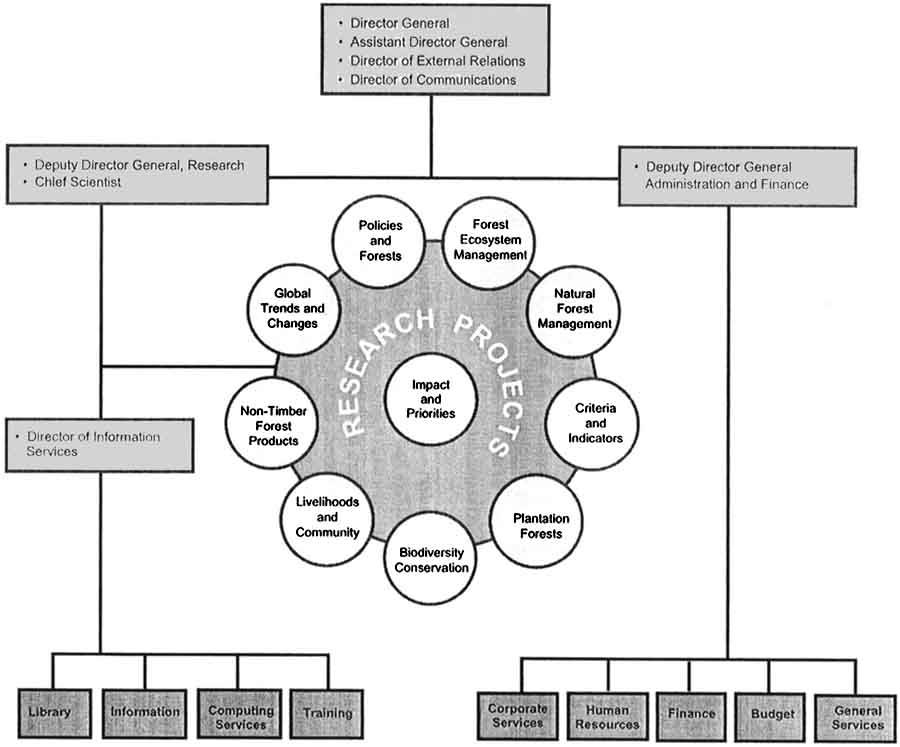
CIFOR's current organization structure is shown in Figure 4.1.
To quote CIFOR, the management structure is intentionally:
'...flat and non-hierarchical - scientists are deployed for specific research activities in interdisciplinary teams whose expertise cuts across the range of specializations required for each individual research problem. To promote teamwork, most research activity involves scientists from two or more disciplines working under the direction of a project leader who has overall responsibility for co-ordinating the research and ensuring that its goals are achieved. Task Managers are responsible for the funds allocated to specific activities. In all projects, research teams include collaborating partners from outside CIFOR who add essential disciplinary, local, or regional expertise... '
There are, however, a number of layers of management within the current structure, and a number of committees, two of which are of primary importance to the research management functions at CIFOR. These are the Management Group (MG), and the Research Co-ordination Committee (RESCO).
The present ten research projects comprising the total research programme at CIFOR are each managed by a Project Leader who is responsible for vision and planning, execution and facilitation, and administrative activities in respect of the project 12
12 from The minutes of the Research Committee meeting.
As noted in Chapter III above, individual project strategies are being developed
in accordance with agreed guidelines and are then reviewed by RESCO at the beginning
of the PWB cycle in terms of compliance with the BoT-approved Medium Term Plan
(MTP) for the Centre. Specific tasks, or activities within a project are also
reviewed and approved by RESCO during the year as necessary. A more detailed
commentary on these procedures is contained in Chapters 2 and 3 above.
Role of the Project Leader: The Panel was particularly concerned to note the extent to which current Project Leaders had little desire for the project leadership mantle.
The reasons for this derive from the fact that, first, there is a clear policy within CIFOR that project leadership, when conferred, carries no pecuniary, or organizational 13 benefits; second, the DG and some staff have clearly expressed a preference for a 'self-directed team leadership' concept that carries with it overtones of leadership rotation, and the concomitant lack of leadership continuity for those being led; third, diffuse responsibility (within the team) for 'outputs' of the research; and fourth, under CIFOR's current management approach, Project Leaders have little authority over staffing or budgets to carry out the responsibilities inherent in the leadership function. An appointment as Project Leader also carries with the appointment a 'tax' on the individual's research time of between 15% and 25%. Indeed more than half of the current Project Leaders state that they would prefer not to have the added burden of leadership given the current management milieu.
13 Specifically there is no increment in salary or benefits, nor is there any formal recognition or job reclassification resulting from taking on a leadership role. Indeed, under the present team leadership concepts, staff of lower ranking could be 'leading' more senior staff.
Figure 4.1 ORGANIZATION STRUCTURE
Project Leaders currently report to different 'supervisors' depending on the issue at hand: they report to the DDG-Research for budgetary and performance appraisal matters on their own activities; to the Chief Scientist for matters of scientific suasion, and ultimately to the DG himself in those cases where the DG chooses, as he often does, to discuss any issue with the Project Leader or researcher directly. The DG also approves all salary increases.
Project Progress Reporting: The Panel notes that CIFOR's management information system, and its project reporting-related financial systems could be more helpful to Project Leaders in assisting them in carrying out the administrative component of their leadership roles. The current lack of connectivity between the MIS and the project 'budget-vs-actual' financial data is a continuing source of irritation. The Panel noted that a number of Project Leaders find it necessary to keep their own financial records pertaining to the project - a sure indication that the formal system is not meeting needs, and suggests that management look for some creative solutions that, for example, may involve locally-recruited, professional Program Assistants 14 who could maintain appropriate records, perform other 'administrivia', and otherwise relieve project leaders of this burden. There are cost-neutral solutions to these issues.
14 Such staff would typically report directly to the Project Leader, and report functionally to F&A to ensure consistence of approach.
When taken together with the comments made above in respect of staff performance evaluation, the Panel concludes that opportunities exist to improve the management of CIFOR's research activities at this time.
In Chapter 2 above, an alternative organizing framework for grouping activities into projects is suggested for management's consideration. In whatever form the new organization structure evolves, certain elements remain the sine qua non of good management practices. While team participatory concepts are, of course, laudable, nevertheless there must be an underlying foundation that includes: (a) clear lines of authority, accountability, and responsibility; (b) appropriately accurate, timely, and relevant financial data; and (c) a workload and reporting relationship balance that permits each position incumbent to function efficiently and effectively. The 1995 ICER expressed concerns about the lack of these fundamentals - and some deficiencies still exist today. Additionally, intellectual and administrative leadership is so essential to achieving research competency that Project Leaders must be recruited (from within or externally) with the requisite scientific and managerial skills, and be rewarded accordingly. Finally, at the end of the day, CIFOR is measured by the quality, relevance, and cost effectiveness of its outputs, and it must therefore control the achievement of those outputs within a managerial structure that enables CIFOR to prioritize, allocate, and control the many human and financial inputs required to achieve them.
The Panel has not concluded that there is one, or indeed a 'right' organizational structure for CIFOR - in part because it is quite beyond its mandate to review fully all the facets of such a recommendation. It does, however, envisage certain key elements in any structure developed that will likely be necessary to meet the criteria in the above paragraph.
First, projects would remain the basic managerial unit for research work done in CIFOR. Activities are the basic building blocks of work that would comprise a project. The actual number of projects (whether there are 10, five, or two) in the CIFOR research work program should be determined by how (indeed whether) each activity in the project relates to the themes discussed in Chapter 2, and therefore their suitability for inclusion in CIFOR's work program. Projects represent an aggregation of common-threaded activities that are being managed by a Project Leader.
Second, Project Leaders would be responsible for designing the activities comprising his/her project, selecting all inputs (including staff), controlling costs and quality, and evaluating staff, and would be held accountable for results. Project Leaders would report to a DDG-R, and these leaders would be the only reports to that position. Research support activities and outreach activities might more suitably report through another DDG position to the DG.
Much work remains to be done in fleshing out the most appropriate structure for CIFOR in the years ahead, and the Panel recommends that:
management should develop and implement an organizational arrangement that:(a) filters all potential, and present, projects and their component activities through an organizing framework such as that outlined in Chapter 2 to ensure consistency with CIFOR's mission and strategic objectives; and(b) maintains the essential underpinnings of good management processes.