


Forty-one persons from more than twenty institutions participated in this meeting on the African Nutrition Database Initiative (ANDI) and the Key Indicator Data System (KIDS). The key objectives of the meeting were to evaluate the functioning of ANDI after one year of operation and to examine the proposed structure and functioning of the FIVIMS KIDS and to propose next steps in its development.
ANDI - was initiated in 1997 and is accessible at www.africanutrition.net. It fills an important gap in providing a set of nutrition and related data for easy user access on the web with data quality assurance by the participating agencies: World Bank, UNESCO, UNICEF and FAO. Publicly accessible WHO data is also available via the ANDI website. ANDI has provided invaluable lessons as an experiment in inter-agency data sharing. Restrictions on downloading of data sets will be eliminated before the end of the second year of the pilot phase.
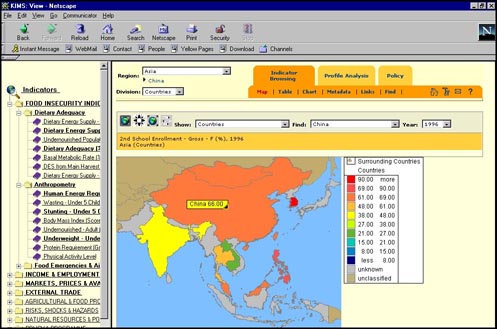
KIDS - The Inter-Agency Working Group on FIVIMS has produced a general framework for the creation of a shared global database on food insecurity and nutrition indicators. A prototype KIDS has been developed for the Asia region under a Japanese trust fund project. It includes mapping features, basic analytical functions, graphics, and linkages to existing regional and national databases and websites. A project proposal for the further development of the Global KIDS will be tabled for discussion at the 5th meeting of the Inter-Agency Working Group on FIVIMS.
The meeting concluded that ANDI should continue its current role until KIDS is operational, that KIDS should build on the ANDI experiment regarding the institutional and technical arrangements in data sharing, that KIDS should be developed in close collaboration with efforts such as the PRSP, UNDAF/CCA and PARIS 21, and that close attention should be paid to guaranteeing data quality.
