


2.1 The Acoustic Method and its Limitations
2.2 The Small Pelagic Fish Resources
Acoustic surveys combined with trawling for identification of the acoustic registrations provide data on distribution, abundance and species composition of the small pelagic resources. For the surveys in Somalia, it is assumed that the survey grid totally encompasses the pelagic stocks in the region during the first coverage, while parts of the fish community might have migrated out of the survey area during the last survey. No serious loss of acoustic data due the weather conditions has occurred.
Acoustic surveys are less suitable for the evaluation of demersal species. This is mainly because the density level of the demersal stocks is much lower than for the small pelagic stocks, making the relative sampling error and variance much higher. Therefore, little emphasis is put on the acoustic results concerning demersal stocks. They will be more thoroughly covered in the trawl-survey section.
Acoustic abundance estimation of fish is based on the principle that the intensity of the echoes reflected from the fish in the sea is linearly proportional to the density of fish in situ. By an electronic instrument, called echo integrator, the echoes received over fixed intervals of the vessels survey track are made representative for indices of fish abundance within these intervals. Apart from being density dependent, these indices are also dependent on the type of species and the size of the fish. To convert these indices of density into absolute densities one has therefore to apply both species dependent and size dependent correction factors. Information on these factors is usually acquired through calibration procedures on fish in situ or through experiments on fish in cages. Absolute densities are converted into absolute abundances by multiplying the densities of fish by the area of the fish distribution.
In spite of its relatively simple basic principles, the acoustic method has several limitations which always should be kept in mind when interpreting the results from acoustic surveys and applying them for fishery development purposes. Of the limiting factors the main are:
a) Underrepresentation of bottom dwelling fishes. Fish that stay close to the bottom, especially rays and flat fishes, are detected as part of the bottom and will not be distinguished by the echo integrator. In addition, due to a so called dead-zone, the fish immediately off the bottom are not fully represented in the estimates. All this leads to a certain Underrepresentation of demersal fish, especially those living very close to the bottom.All these limitation factors, when applicable, lower the precision of the acoustic estimate.b) Screening effect from plankton. Plankton is also detected by the acoustic system, and it is the task of the scientist on basis of the characters of the echo-traces and composition in the trawl catches to separate the density indices into plankton and fish. Various methods are available, both special acoustic/electronic setups and procedures for reading the echo-traces. But in areas with dense concentrations of plankton combined with scattered and low densities of fish, a correct separation of the echo-indices into fish and plankton is difficult. In such cases the plankton can represent up to several hundred times the amount of fish recordings, and assessing the fish abundance has more the character of qualified guesses than estimates. This factor does not seriously affect the total estimates if it concerns small areas only, but it might be significant in those regions where low densities of fish are found over large areas and will thus sum up to considerable total abundances.
c) Disproportional sampling in multispecies fish communities. Ideally, when several species are present in the same area one should distribute the indices of total density recorded by the acoustic system into indices of species densities and convert these indices into absolute abundance estimates by applying species and size dependent conversion factors on the indices. When the behavioural pattern of the mixing species (i.e. schooling pattern, depth preferences, day/night behaviour etc.) are quite similar, it is an ardous, if not impossible task to separate the species on basis of the echo traces. The species composition in the trawl catches are used as assistance in splitting the total estimates down to species or species group levels. But the catchability of the trawl is highly species and size dependent, and the distribution in the catches are not directly representative of the distribution in situ. In areas where the fish biomass is mainly made up of same few dominating species or species groups, the estimation of abundance is less complicated than in cases where a multitude of species contribute to the total abundance. In the last case the estimates suffer from low precision, both on the total and on the group/species level.
In acoustic surveys, separate estimates of pelagic and demersal fish are usually made to provide ‘ useful information to two different fisheries, i.e. the demersal and the small pelagic. A total estimate is less useful. The separation into these two categories is usually relatively easy, based on the echotraces and the information from the trawl catches. The small pelagic fish usually form distinct aggregations which can be easily separated. At times, however, the same species can be present in high abundances both in the pelagic and in the demersal community. In such cases even the separation into pelagic and demersal becomes difficult.
d) Lack of information on the acoustic properties of tropical fish species. As already mentioned, the conversion factor applied on the indices of abundance, to convert them into absolute abundances, are species dependent. Acquisition of the basic information leading to these factors is an ardous task, and for most tropical species this work is at present in its most initial phase or not really started at all. In lack of detailed information on the dominating species, one often has to apply values from similar and better known species from temperate waters. In addition, when dealing with multispecies occurrences of fish, it is almost impossible to calculate the various conversion factors to use in the estimates and a rough effective overall factor has to be applied.
The suitability of the waters of N-E Somalia for acoustic surveys
The pelagic fish community in the region is made up of relatively few species, mainly concentrated in high densities. The demersal community is characterized by a higher number of species. The demersal biomass has also a more scattered distribution, with only very few dense patches. The occurrence of plankton did not constitute a serious problem for acoustic research. As a general conclusion, acoustic surveys can easily be applied to the stocks of small pelagic fish found in Somali waters, but this method is less suitable for the demersal stocks.
2.2.1 Distribution and relative abundance during the surveys
2.2.2 Results from earlier surveys
2.2.3 Estimates of yield of the small pelagic resources
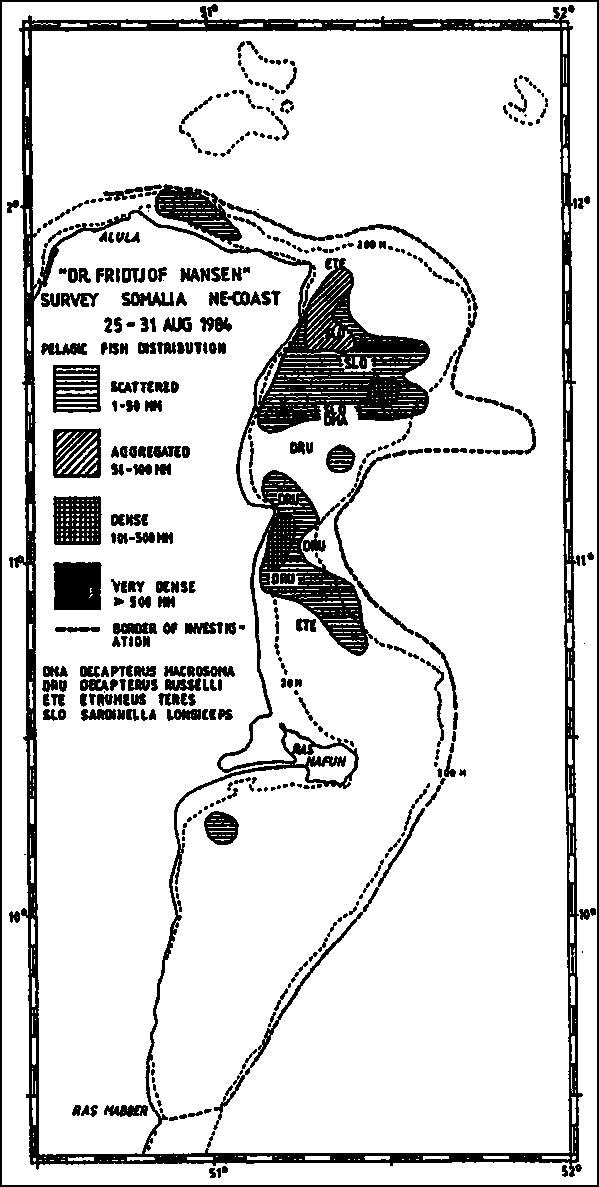
The small pelagic resources in the investigated waters consist mainly of Sardinella longiceps and scads (Decapterus russelli and D. macrosoma). Present but of lesser importance are Dussumieria acuta, Trachurus indicus, Scomber japonicus and Etrumeus teres.
Figures 2 a, b show the distributions of small pelagic fish from the two surveys. The distributions are given in four density levels: scattered, gathered, dense and very dense, which roughly correspond to 14- 140 tonnes/nm2, 140-280 t/nm2, 280-1400 t/nm2 and > 1400 t/nm2 respectively. The actual integrator readouts that these levels correspond to are not the same in both surveys as new sounders and integrator were installed between the two surveys. But the absolute density levels given in the figures are to correspond.
Practically all pelagic fish were caught north of Ras Hafun during both surveys. The total pelagic biomass was estimated to 245 and 113 thousand tonnes from the first and second survey respectively. Thus the last estimate is less than 50% of the first. As there were no fishing activity on the small pelagic fish in the area, the sudden drop in biomass can not be ascribed to fishing mortality. It is more likely that the fish had migrated out of the investigational area.
Figure 2. Distribution of small pelagic fish. a) 1. survey.
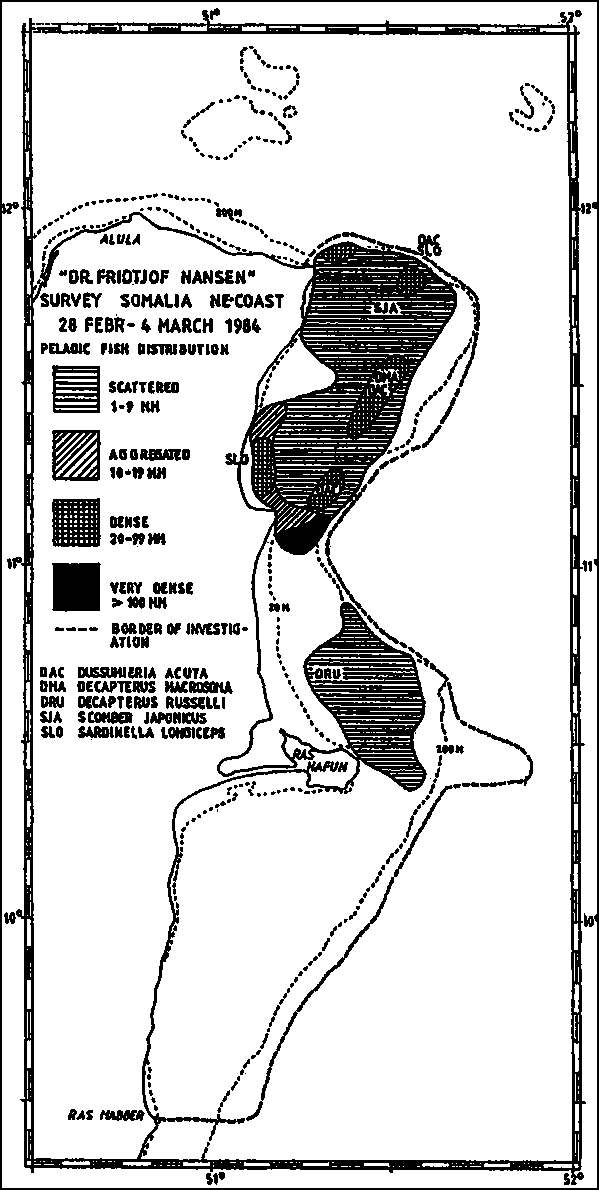
Figure 2. Distribution of small pelagic fish. b) 2. survey.
During a survey off the coast of South- Yemen, which took place after the last survey in Somalia, considerable resources of small pelagic fish were located in a scattered pattern off the shelf in the outskirts of the upwelling system. This was fish which probably had migrated offshore to avoid exposure to the oxygen-depleted upwelled water closer to the shore. The same phenomenon could be valid for the pelagic fish community off NE- Somalia and would explain the drastic drop in biomass between the two surveys. Unfortunately this probability was not anticipated in the planning of the survey, and the total survey time available did not allow the offshore area to be surveyed.
The estimated 245 thousand tonnes from the first survey is therefore probably more representative for the total standing pelagic stock in the area.
An idea of the overall fish productivity can be expressed by the mean density of fish in an area. If the total biomass of 245 000 tonnes is representative for the shelf from Alula to Ras Mabber, an area of about 2070 nm, the mean density is 67 t/nm2. Considering however only the area between Alula and Ras Hafun, where all pelagic fish were located during both surveys, the mean density becomes 118 t/nm2.
The following list gives, for comparison, densities from other regions surveyed by the R/V Dr. F. Nansen with the same method as applied in Somalia:
|
t/nm2 |
|
|
|
100 - 110 |
: |
West Sahara, Senegal, Guinea |
|
100 |
: |
Oman, upwelling region only |
|
75 |
: |
Mauritania |
|
60 - 80 |
: |
Ivory Coast, Ghana |
|
30 - 40 |
: |
Tanzania, Mozambique |
|
25 |
: |
Burma, Bangladesh |
|
18 |
: |
Kenya, Thailand, Malaysia |
The density distribution pattern of the small pelagic fish is shown in Table 2. About 26 and 34% of the total pelagic biomass is found in “scattered” to “aggregated” concentrations during the first and second coverage respectively. These are density levels probably to scattered for commercial fishing. The “dense” and “very dense” aggregations found could constitute targets for fishing, although success would certainly be dependant upon the fishing techniques applied. Successful purse seining would be more dependent upon the microstructure of the aggregations, that is the school size distribution, while successful pelagic trawling would be more dependent upon high mean densities and concentrations in horisontal layers of the schools or of evenly distributed fish. Successful purse-seining in the area would also mean to cope with the heavy current and difficult weather conditions occurring in the area, a topic that will not be covered in this report.
Table 2 Distribution of biomass on density levels (% of total biomass)
|
Density |
Equivalent range |
SURVEY I |
SURVEY II |
||
|
(t/nm2) |
1000t |
% |
1000t |
% |
|
|
Scattered |
3-150 |
49 |
20 |
17 |
15 |
|
Slightly gathered |
150-300 |
15 |
6 |
22 |
19 |
|
Dense |
300-1500 |
81 |
33 |
38 |
34 |
|
Very dense |
>1500 |
101 |
41 |
36 |
32 |
The dominating species in the high-density aggregations are Sardinella longiceps. The scads (Decapterus spp.), rainbow sardine (Dussumieria acuta) and round herring (Etrumeus teres) were also caught in relation to fairly high acoustic densities, while Indian horse mackerel (Trachurus indicus) was caught accidentally at low densities in the bottom trawl only.
The R.V. “Dr. Fridtjof Nansen” has carried out 5 acoustic surveys in Somali waters in the period 1975-76. The biomass estimates of small pelagic fish for the whole east coast was during these surveys estimated as follows (thousand tonnes):
|
Cruise 1 and 2 |
Feb-Mar ‘75 |
: |
240 |
|
Cruise 3 |
Aug-Sep ‘75 |
: |
390 |
|
Cruise 4 |
Jan ‘76 |
: |
1090 |
|
Cruise 5 |
Apr ‘76 |
: |
510 |
|
Cruise 6 |
Oct-Nov ‘76 |
: |
790 |
The results from the Arabian Sea Survey Programme (1975-76) suffer from limitations due to the very extensive programme which envisaged a survey of the whole region from Pakistan to Somalia in five coverages. Sampling intensity, both acoustically and in terms of fishing stations, had to be sacrificed to the wide area coverage.
Due to the open sampling track in the 1975-76 surveys, which was laid out before the real importance of the region in terms of fishery resources was known, it is possible that aggregations which are limited in extent, but strong in density, have been missed by the sampling track. On the other hand small pelagic fish of no commercial value, such as cardinal fish (Synagrops sp.), have frequently been included in the pelagic estimates. This fish accounts for substantial parts of the old estimates, and applies especially to the estimate from survey number four, referred to above.
In order to make the old estimates comparable to to the more recent ones, we have recalculated the old estimates to include only pelagic fish between Ras Mabber and Ras Asir, and excluded all identified registrations of the cardinal fish. These revised estimates are (thousand tonnes):
|
Cruise 1 and 2 |
Feb-Mar ‘75 |
: |
210 |
|
Cruise 3 |
Aug-Sep ‘75 |
: |
20 |
|
Cruise 4 |
Jan ‘76 |
: |
260 |
|
Cruise 5 |
Apr ‘76 |
: |
160 |
|
Cruise 6 |
Oct-Nov ‘76 |
: |
510 |
When detailed knowledge a species biological parameters is lacking, estimates of the maximum sustainable yield (MSY) have usually been calculated according to the simple formula:
MSY = 0.5 MB0
where M is the natural mortality and B0 is the unexploited virgin biomass. Recent investigations have shown that in addition to the natural mortality the age at recruitment to the fishery, the age at first maturity and the fish’s growth rate are important parameters when assessing the MSY. The above equation can lead to serious overestimates if a species is long-lived, or recruits early to the fishery (Beddington & Cooke, 1983). For a first assessment of the yield from the resources in Somali waters we will use the functions developed by Beddington & Cooke. As little is known about the biology of small pelagic fishes in Somali waters, the parameters for the functions have to be taken from neighbouring regions, from similar species or just general assumptions have to be made. Consequently the assessed MSY has only indicative value.
Investigations from other areas of the Indian Ocean provide the following K values (Pauly, 1978):
|
Sardinella longiceps |
0.4 - 0.6 |
|
Sardinella gibbosa |
1.1 |
|
Decapterus russelli |
1.1 |
The above yields are based on the production level of 1983-84 and are valid only if the stocks maintain such production level. Variations in the ecological system may induce long term changes in the fish production and species composition.
