


Ruth M. Gatenby
The research process
Objectives of research
The state of research on small ruminants in Africa
Nutrition
Diseases
Breeding
Why research fails
Until the last decade small ruminants in Africa have received relatively little attention from research workers. Recently more attention has been paid to small ruminants as their advantages are becoming understood - their ability to produce meat and milk even in hostile environments, their resistance to many diseases of cattle, and the ease of marketing of their products.
Research on small ruminants can be classified into basic and applied research. In the basic approach an in-depth study is carried out in a narrow field. In applied research a complete system is analysed, and much of the field work carried out by ILCA falls into this category. The final objective of both approaches is to improve the system of production. For successful outcome, a flow of ideas between the scientists working on both approaches is essential; this flow takes the form of scientific literature, conferences and scientific visits. Applied research can generally be undertaken only in the locality of the system whereas basic research may best be done in a place with appropriate facilities away from the small ruminants. One of the advantages of ILCA and other research centres in Africa is that they provide facilities for basic research as well as being ideally suited to applied research. Thus the two approaches can progress in parallel, with good contact between scientists undertaking each type of research.
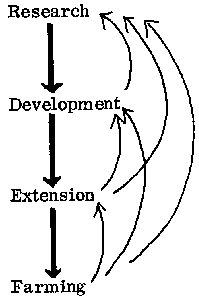
All types of agricultural research are undertaken with the objective of improving the standard of farming. Research can rarely be put directly into practice in the field but innovations "discovered" by research workers must be put into appropriate packages, a process called development, and then distributed to farmers via extension workers. This whole process is shown in Figure 1. In addition to the primary flow of information downwards from research to farming, there are also secondary flows upwards between all levels. In other words, research, development and extension all need feedback to function properly.
In putting research into practice all 4 steps shown in Figure 1 are equally important. Too often extension receives scant attention. To he successful, an extension or advisory worker must be accepted by the farmers, but he must also be respected by the scientists. In most less developed countries the social gap between scientist and peasant farmer is very wide; progress cannot take place unless the extension worker can bridge this gap. Thus extension is often the weakest link in the chain, and recognition of the importance of extension by agricultural scientists is essential.
Figure 1. The flow of information in agricultural research. Arrows indicate exchange of ideas.
The first step in applied research is the understanding of the present system. This may be called "static" research, and involves finding out how the system operates, what are the outputs and inputs, and how the system under study interrelates with other systems. The second step is to see how the system responds to a change in circumstances; perhaps another input is added (a better source of feed, veterinary care or a new breed of animals), one input may be reduced (less land), or there may be more demand for an output (better marketing faculties). These responses may be called the "dynamic" characteristics of the systems, and once they are known attention can 'he given to solving specific problems that limit the functioning of the system. At the problem-solving stage there is likely to be the greatest input from basic research.
In the development of new systems care must be taken to ensure that they are appropriate and stable; present traditional systems have evolved slowly and have been tested ecologically over centuries. Even though we may want to change systems rapidly we cannot afford to give unsound schemes for the advisory staff to propagate because this will merely ruin the livelihood of the farmers and give rise to distrust which will make future extension even more difficult.
The objective of research is to increase the productivity of sheep and goats. This increase in production most often takes the form of an increased quantity, but it may also be an improved quality of product or alternatively a new product may be introduced. To a small farmer the security value of owning small ruminants may 'be as important as their tangible production; small ruminants are a low risk investment which keeps its value. In a drought sheep and goats can be eaten whereas even if a farmer had cash there is no guarantee that he could buy food, and after the drought small ruminants have the capacity to multiply again.
The national objective for research on small ruminants may be to increase their production of exportable products and thus reduce the balance of payments deficit. From the point of view of an international development agency the aim may be to improve the standard of living of the poorest sector of the community. These objectives are all subtlely different, and each one must be considered.
In addition it must be remembered that small ruminants are only part of the ecosystem. It would be foolish to think of increasing the productivity of sheep and goats to the detriment of say crop production and cattle production. It is the output of small ruminants per unit input that must be considered, bearing in mind to measure productivity over a long period to ensure that the resource base is not diminished.
By the time present research findings are put into practice, say in 2000, the economic and social climate may have changed. Almost certainly there will be little or no cereal available for ruminants because of the demand of the increased human population for food. The area of grazing land is diminishing as cropping spreads to marginal areas, and the production per hectare of grazing land is said to be falling too as a result of overgrazing. However better uses of some food resources such as straw and industrial and vegetable by-products should have developed. A better understanding of animal requirements should mean that better nutrition is given to those animals which will use it most efficiently. All persons involved with animal production are more likely to have received more education than their present-day counterparts and will be more aware of management practices to minimise disease problems and to make better use of available feeds. There will probably be a swing to production for sale rather than home consumption as urban and export markets become more important.
A considerable quantity of knowledge about small ruminants in Africa is being collected by research workers in both national and international institutions. Our understanding of production systems is obviously far from complete but we should know enough to be able to proceed from static research to dynamic research in some areas. There is a tendency for research workers to become so involved in elucidating points of detail that the objective of research is forgotten, and the time when attention should be given to solving specific problems which limit production may be long passed. Even when the research approach has progressed beyond the static approach, and basic information about the system may continue to be collected as a by-product.
Let us consider briefly some research findings in Africa. Africa has a greater meat/milk consumption ratio than any other continent and 27% of this meat comes from sheep and goats. However meat is still a luxury for the majority of the population and is eaten only on special occasions. In a continent with primitive storage facilities the small individual size of sheep and goat is an advantage because meat from them comes in family-size packs. Any animal can be eaten for meat. In a system designed to produce meat as the main product most meat is produced from young males and culled females. However other classes of animal are eaten if the need arises, and sick animals may be slaughtered at point of death.
The growth curve of small ruminants is sigmoid with the point of inflexion occurring at a few weeks of age. The maximum liveweight attained (i. e. adult liveweight) is determined primarily by genotype, whereas the rate of weight gain is more under the influence of environmental factors. Typical growth rates from 0 to 8 months of sheep under traditional husbandry in semi-arid areas are between 50 and 100 g/day (Wilson, 1980). As the animals get older so their rate of liveweight gain decreases under traditional systems. It is however possible to increase the growth rate of animals destined for slaughter by improved nutrition, a process known as finishing. Brinckman (1981) reports liveweight gains of up to 250 g/day for sheep in Africa. In an experiment in the Sudan, El Mag and Mukhtar (1975) fattened 1 year old rams for 70 days on different levels of locally-available concentrate. Liveweight gain, killing out percentage and food conversion ratio all improved with increasing proportion of concentrate in the diet, and they concluded that if finishing is to take place it should be done quickly. In practice the availability of concentrate food and infrastructure prevent finishing being widespread in Africa.
Meat quality is not well-defined in Africa, except where carcass grading takes place in an organisation such as the Kenya Meat Commission. Some objective assessment may be made on the basis of fat content (the fat tails of sheep are a delicacy in parts of East Africa) and flavour. People in different parts of the world have very different flavour preferences: Arabs like meat from entire males, whereas people in other areas prefer meat from castrates or females. In Yemen, meat from East Africa is much preferred compared with meat from Australia or New Zealand which is said to have an unpleasant flavour. Whether this is due to the origin of the meat or its subsequent freezing is unclear. Tenderness, a quality prized in developed countries, is of little importance in most of Africa where cooking methods have adapted to deal with tough meat.
Milk for human consumption is a relatively minor product from small ruminants in most of Africa. Goats are more frequently used for milk production than sheep which are milked in parts of Somalia, Sudan and the arid regions of West Africa. There is little literature on quantitative aspects of milk production but yields are probably less than 1 kg/day. Goat milk is said to be more easily digestible than cow milk, and sheep milk has a much higher content of total solids than cow milk - a factor which gives it a premium price. Most communities boil milk before use thus minimizing the risk of diseases such as brucellosis. Controlled fermentation produces yoghurt which may be dried and stored in oil. Cheese too keeps for several months and ghee which contains little or no water may be stored for years in sealed containers.
The advantages of milk production over meat production are that milk is produced every day and the efficiency of utilization of nutrients to produce milk is high. Factors limiting the adoption of milk production by small ruminants include the established milk supply from cows whereas the milk yield of meat breeds of small ruminants is low and they have milk let-down problems. In addition lactose intolerance is widespread in many parts of Africa so that the demand for fresh milk is low.
Wool sheep are found mostly in the drier and cooler areas of Africa. Wool is obtained when the sheep are shown or slaughtered, and a specialized marketing structure or local industry is needed. Problems occur if wool contains much vegetable matter, and environmentally associated conditions such as blowfly strike, canary colouration and lumpy wool disease can be serious. Mohair and cashmere production from goats is negligible except in some highland areas. On the other hand sheep and goat hair is used throughout Africa in the production of felts, carpets, ropes and bags. Skins are a useful by-product of meat production. The production of good quality leather depends both on the treatment of the animals and the treatment of skins. Sheep and goats each produce about 30 m of intestines which with proper treatment can be used for surgical thread, sports' racquets, etc. Manure is another important product. Much more research attention should be given to these "minor" products of small ruminants which are so important in the economy of the small farmer.
In summary, considerable effort is being put into studying the use of small ruminants for meat production in Africa. Enough knowledge has been gathered to allow effort to be diverted into developments in response to particular needs such as finishing. In contrast, relatively little attention has been given to other products such as milk, skins and manure, and a strong case can be made for diverting more research effort here.
As a broad generalization the major factors limiting the productivity of small ruminants in Africa appear to be poor nutrition in the semi-arid areas and disease in more humid areas. Drinking water may appear to be more critical than nutrition in some dry areas, and water and food are obviously closely related. Marketing too is a big problem and socio-economic limitations may override technical problems. The characteristics of the breeds of animal available in Africa are not primary limiting factors except where nutritional, disease and marketing problems have been eased.
Poor nutrition is identified as one of the most serious factors limiting small ruminant productivity throughout Africa but especially in arid and semi-arid areas. Even when there appears to be an adequate quantity of vegetation available its nutrient content in terms of metablisable energy, digestible protein and minerals may be poor. In semi-arid areas the main problem occurs in the dry season and strategies to ameliorate the problem can be divided into those which attempt to improve nutrition in the dry season and these which attempt to improve nutrition throughout the year.
Possibilities for the dry season include:
- limit numbers of animals. For communal grazing areas this depends on a good social structure in the community. Restrictions imposed by governments are rarely successful. Widespread veterinary treatment can aggravate the problem, but improvement of marketing opportunities to increase offtake should be encouraged.- grow species of grass and legumes which retain their nutritive value into the dry season. Stylosanthes is successfully used in this way in tropical
Australia.- grow shrubs and trees. Many palatable trees (such as Prosopis spp. And Acacia spp.) retain their leaves into the dry season and so can be lopped for fodder.
- conserve fodder as hay or silage. These are not widespread practices. To make good silage a watertight and airtight silo is required. Hay making relies on sub-drying, and if hay is made towards the end of the wet season its quality can be reduced by leaching of nutrients. Both practices demand labour when it is also needed for harvesting crops. So in reality grass is left as "standing hay".
- use crop and industrial byproducts. Considerable quantities of cereal straw, husk, oil-seed residues, vegetable waste and cotton coffee, cocoa, groundnut and sugar residues are produced in less developed countries. Some residues are well-utilized, some are beginning to be utilized but a lot are wasted. Their feeding value must be appreciated and practical problems such as transport and method of feeding must be tackled.
- use supplements. Where one specific nutrient is lacking a supplement can have a dramatic effect on productivity. For instance urea, minerals and molasses give non-protein nitrogen, specific minerals and energy, respectively.
- bring in fodder from other areas. This is likely to be impracticable for most of Africa but is practiced when droughts occur in the semi-arid parts of Australia for instance.
- export animals to other areas. Traditional movements of animals out of arid areas in the dry season are known as nomadism or transhumance. Trucking of animals introduces enormous problems where basic facilities such as roads are poor. In addition, animals moved to a more humid area are susceptible to disease and may not thrive.
Better feed supply throughout the year may be achieved through growing species of grass with a higher nutritive value; growing legumes; growing fodder crops; controlled grazing; the use of fertilizer and the integration of small ruminants with plantations of coconuts, oil palm, rubber, tea and trees for wood production. The success of these practices depends on their economics. Besides investigating their technical feasibility, research workers must devise packages which are suitable for different parts of Africa.
Diseases of small ruminants seriously limit their productivity especially in humid and sub-humid zones. The effects of disease interact with malnutrition in that an undernourished animal is less resistant to disease, yet disease control is more justifiable in economic terms when animals are well-nourished. The seriousness of diseases can be measured according to the loss in production they cause, the cost of their control or the effect they would have if no preventive measures were taken.
Internal parasites are a major cause of low productivity of small ruminants. Helminths (Haemonchus, Ostertagia, Trichostrongylus, Bunostomum) can cause clinical symptoms such as diarrhoea, but more important lead to reduced growth rates and fertility. The effect of helminths is most serious towards the end of the wet season. Fascioliasis occurs throughout Africa as is seen from slaughter house records of live infections. Its life cycle depends on a snail and the disease is probably picked up by animals at watering places or in marshy areas. Dictyocauliasis or parasitic bronchitis causes unthrifitness of young animals, particularly in highland regions.
Peste des petits ruminants (PPR) is endemic in West Africa. It is a disease which mimics rinderpest (to which small ruminants are not susceptible) causing fever, mucosal erosions, diarrhoea and often death. Ticks cause serious economic loss by skin damage resulting in poor hide quality. Theileriosis in sheep and goats is usually the benign form, but heartwater is a problem in the southern half of Africa. Other diseases constraining the productivity of village flocks are pasteurellosis causing pneumonia, contagious caprine pleuropneumonia (CCPP), sarcoptic mange, hydatid cysts on lungs and liver, anthrax, brucellosis, foot and mouth disease, rift valley fever, bluetongue, trypanosomiasis, sheep and goat pox and clostridial diseases. Details of these diseases are given by BVA (1976) and ILCA (1979a).
Attempts to improve the productivity of sheep and goats earlier this century in Africa concentrated on the importation of exotic breeds, and indigenous sheep were "improved" by crossbreeding. This approach was unsatisfactory except in a few areas such as the highlands of Kenya. One of the main reasons for failure was the poor quality food available for sheep and goats. Disease, too, caused problems with imported stock. In particular, importation of animals into the tsetse belt resulted in high mortality. Some environments in Africa are much more harsh than others and there may seem to be a place for stratification of the sheep and goat industries. Stratification depends on moving breeding females from a poor environment to a better one where they are mated with faster growing sires to give offspring for meat production. Stratification may have several tiers. At present the small ruminant industry is not sufficiently structured for such an exploitation, and there appears to be little possibility of exploiting hybrid vigour. However, it is possible that such a structure may be developed in the future.
The small size of most sheep and goats in Africa has sometimes been attributed to inbreeding. The amount of inbreeding in a flock depends on how much movement of animals there is between flocks. Inbreeding is minimised by communal grazing, by a deliberate policy to swap animals (swapping breeding animals takes place in Nigeria), by transfer of animals between relatives and friends, and by financial transactions involving small ruminants. It therefore seems unlikely that inbreeding is a major cause of small adult size; adaptation to a harsh environment and poor nutrition are probably more important causes.
Millions of dollars of research fundings are put into Africa each year, yet the improvement in productivity seems very small. There are numerous reasons why research fails and some of these (the ones that the research worker can do something about) are:
- the objectives of research are poorly defined. Too much emphasis is put on "improving SHEEP for MEAT production" or "improving GOATS for MILK production-" without appreciating wider issues. All the time the farmer and his motives must be considered.- individual research workers or research teams become so involved in their specialized fields that they do not notice when it is time to take the acquired knowledge and put it to use.
- a research worker becomes isolated from other research workers so that he may lose sight of his research objectives and his motivation may be low. Poor communication between scientists working the same field can result in duplication of research and waste of effort. Scientific meetings reduce this isolation, and visits of research staff to universities and other institutions where research goals are discussed are valuable.
- research scientists are not integrated into the local community. The locals think the scientists are different and may resent their higher salaries. Scientists on the other hand may think the locals are ignorant.
- scientists squabble with one another and the goal of the research team turns from successful completion of the project to individual glory. Some critical discussion within a group is needed to stimulate ideas, but feelings of isolation, insecurity and non-appreciation are not constructive. It is largely the duty of the director of research or project leader to see his staff remain in an emotional environment where they can function satisfactorily as scientists.
- research reports are unsatisfactory. They may be badly written, fail to report important details and get wound up in irrelevant facts. Failures are rarely reported, so that no-one learns from them. Even when satisfactory reports are produced, their distribution is poor.
