A . T . NgwaInstitute of Animal Research
P.O. Box 1457
Yaounde
Cameroonand
J. Hardouin
Institute of Tropical Medicine
Nationalestraat 155
B-2000 Antwerp
Belgium
Summary
Resume
Introduction
Weaning techniques
Conclusions
References
In central Mali small ruminants are mainly owned by low-income families who rarely provide good management to their stock. During the day animals roam in single or composite flocks and at night they are tethered or enclosed, irrespective of sex or age groups, in locally made pens. This results in malnutrition, in a rapid spread of disease, in cases of missing animals and above all in indiscriminate mating. To overcome some of these problems various traditional methods of weaning are used including application of dung on the dam's mammary glands, immobilizing the tongue of the nursing kid/lamb and using thorns to produce pain to the dam during suckling. Though crude, these methods are efficient in weaning and, if improved, could lead to productivity increases.
Au Mali central les petits ruminants sont élevés par des propriétaires à bas revenu qui ne peuvent fournir une bonne conduite d'élevage pour leur troupeau. Pendant le jour les animaux divaguent en troupeaux simples ou communs et à la tombée du jour sont attachés ou enfermés, sans tenir compte ni du sexe ni du groupe d'âge, dans des enclos traditionnels. Le résultat est une mauvaise alimentation des animaux, une dispersion trop rapide des maladies, la difficulté à repérer un animal manquant et par-dessus tout une lutte non contrôlée. Pour résoudre ces problèmes, certaines méthodes traditionnelles de sevrage sont utilisées: application de fumier sur les mamelles, immobilisation de la langue de l'agneau allaitant et utilisation d'épineux pour rendre la tétée douloureuse. Bien que dures, ces méthodes se sont avérées efficaces pour le sevrage et peuvent permettre, après amélioration, d'augmenter la productivité.
In central Mali small ruminants represent 22.2% of the total ruminant biomass (Wilson, 1986) thus being an important resource not only in the livestock sector but also in the country's overall economy. Small-scale farmers and pastoralists, the major small ruminant owners, have few opportunities to provide good management to their livestock. Animals are turned loose in the morning and, on their return from pasture, they are tethered around the living quarters or put into pens constructed of thorns or with mud walls. Unlike in modern systems where adult males, adult females and young animals are kept separately, the smallholder maintains his animals in a single flock. In most cases a group of farmers make an agreement to employ a single herdsman who combines all the individual flocks in the morning and takes them out for grazing in a single large flock. At sunset he returns the animals to the village where they are separated into individual flocks and moved to their respective pens.
The consequences of these practices are that animals are underfed, that diseases spread at a high speed (Traoré, 1985), animals get lost and cases of indiscriminate breeding occur. Cases of premature pregnancies are very common and lactating females often go into very early gestation. This wears down the dams resulting in birth of weak kids or lambs whose chances of survival are limited. One solution to these problems would be weaning the young to let dams build up some energy reserves before the next kidding or lambing season. This would also help to provide milk from lactating does for family consumption. In commercial enterprises, weaning is done simply by separating the young from their mothers for a few days. At the level of the traditional pastoralist, this is not possible because he lacks appropriate infrastructure. All his animals go out together to graze because pastures are the only feed resource. Animals cannot be subdivided into separate groups as this would involve additional labour. Faced with all these problems, traditional pastoralists and agropastoralists have developed methods of weaning without necessarily separating kids or lambs from their mothers.
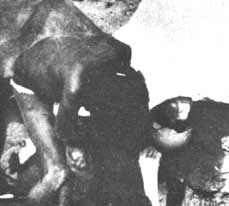
The first step involves the use of soft animal faeces. A layer of faeces is placed on the dam's teats (Figure 1) and the smell normally prevents the kid or the lamb from suckling. This is done at least twice a day for a period of 3 d or more depending on the persistence of the young. If the young ignores the smell and continues, the faeces of a kid or lamb still suckling colostrum is used, the reason being that this kind of faeces has a more repulsive smell. If this practice fails to induce weaning, the next one involves the use of a small piece of cloth which is tied around the teats of the mammary glands to create a mechanical barrier between the mouth of the young and the teats. This method does not always prevent suckling, kids being more persistent than lambs.
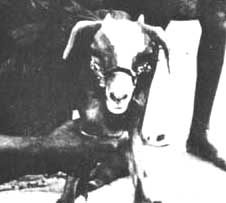
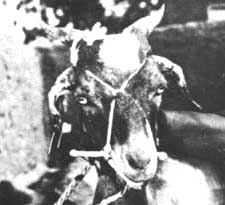
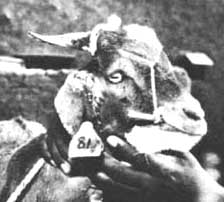
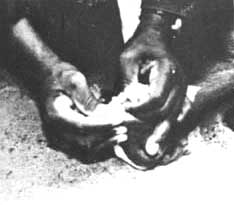
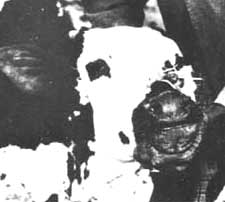
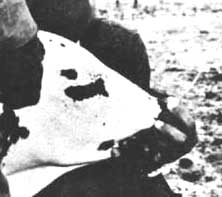
The next step involves two similar operations performed on the kid itself, the first being the use of a woven rope made from cloth tissue 80 mm diameter. The rope is placed between the tongue and the palate and then tied on the upper jaw with the two ends attached to the horns (Figure 2). This hinders suckling but grazing is still possible as the mobility of the tongue is not completely inhibited. Some breeders prefer to replace the woven rope with a piece of smooth wood, 100 mm long and 5 mm diameter, which is placed and tied in a manner similar to the rope (Figures 3 and 4). The edges of the piece of wood being round and large, the rope used to tie them to the horns cannot fall if the knots work loose. Other pastoralists avoid this method which appears to be too cumbersome for the kid and prefer to use a sharpened piece of stick 25-30 mm long or thorns of Balanites aegyptiaca which penetrate the palate of the kid (Figure 5). The thorn is placed in a slanting position so that each time the animal tries to suckle it exerts pressure on the stick thus producing enormous pain. Again this method does not prevent the animal from grazing. If all these methods fail, the final and most drastic measure is to cut the tip off the kid's tongue.
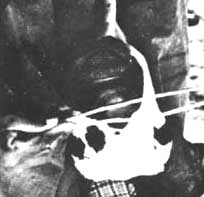
In the case of calves, three operations are possible. One is the use of a strong rope placed between the tongue and the palate, as for small ruminants. Here, however, the rope on the upper jaw is furnished with Balanites aegyptica thorns (Figure 6) so that each time the calf wants to suckle, the thorns prick the mother's udder. The dam reacts automatically either by withdrawing herself or by chasing her calf away. Another method uses a piece of solid wood, 150 mm long and 10 mm diameter, with sharp and round ends, the sharp end being forced into the nasal cartilage making it emerge vertically (Figure 7). The rounded end remains inside the nostril and at the level of the skin where the piece of wood is exposed, a piece of rope is tied around the stick to prevent movement. The sharp end performs the same function as the thorns described earlier but also produces pain to the calf during suckling. Instead of solid wood, some pastoralists prefer a fork with two branches placed horizontally such that one branch is forced through the membrane that separates the nostrils (Figure 8), provoking considerable pain each time suckling takes place.
Figure 1. Dung spread on the teats to deter suckling.
Figure 2. Woven rope placed between tongue and palate.
Figure 3. A modification of the rope technique using a piece of wood.
Figure 4. Side view of Figure 3.
Figure 5. Balanites thorn inserted into the palate.
Figure 6. A modification of Figure 5 using rope and Balanites thorn.
Figure 7. A piece of wood forced into the nasal cartilage.
Figure 8. A modification of the nasal cartilage technique using a forked stick.
All the methods described are put into practice by the herd owner who has no possibility of transferring the animal to be weaned to another herd. Herd owners must first come to an agreement which, in most cases, is not easy to reach. Kids persist more than lambs in suckling but this depends very much on the behaviour of the dam towards its progeny: some females quickly forget about their offspring but others continue to seek ways to nurse their young thus making the weaning process more difficult.
Traditional weaning practices may often appear crude but work more or less well in practice, mainly by causing excessive pain. Improvement of traditional practices to render them more effective and less painful could lead to increased livestock output.
Traoré A. 1985. Causes de mortalité avant le sevrage chez les ovins et caprins du système agropastoral du Mali central. In: R T Wilson and D Bourzat (eds.), Small ruminants in African agriculture. International Livestock Centre for Africa, Addis Ababa, Ethiopia.
Wilson R T. 1986. Livestock production in central Mali: Long-term studies on cattle and small ruminants in the agropastoral system. ILCA Research Report No. 14. International Livestock Centre for Africa, Addis Ababa, Ethiopia.
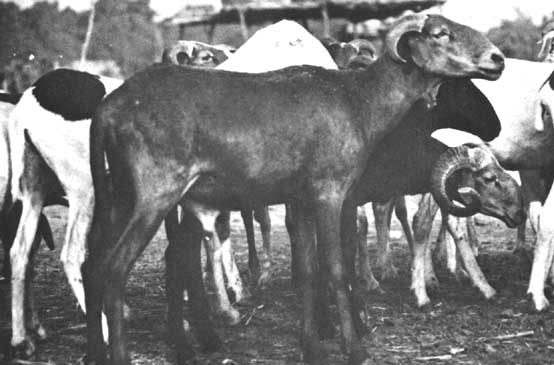
Toronke sheep of Banamba type in central Mali