7.1. Introduction
7.2. Plan Preparation
7.3. Decision-Making and Resource Allocation
7.4. Internal Review Processes
7.5. Progamme Organization
7.6. Project-Based Management
7.7. Leadership, Culture and Teamwork
7.8. Headquarters and Country Operations
Research Management
As in other scientific institutions, research management is the responsibility of research directors, programme and project leaders, and scientists, supported by administrative staff. Since 1989, CIAT has deliberately moved from 'programme' management to 'project-based' management of research, and has introduced major changes in the way the research agenda is set, the plans are prepared and implemented, and the administrative systems and organizations mechanisms are used for research management. At the same time, as noted elsewhere in the report, the Centre has weathered serious funding shortfalls, compounded by a leadership crisis.
These crises have inevitably taken a toll on the effectiveness with which research has been managed, and the well being of the individual scientists and other staff. Although the Centre is now emerging from this difficult phase, and is already headed in the right strategic direction, a concerted effort by senior managers would be needed in the immediate future to improve further the internal environment for research. Various aspects of the systems and processes used by CIAT to manage its research effectively and efficiently are discussed below. These include research planning, priority setting and resource allocation, research organization and project-based management, leadership and culture, and interaction between headquarters and outposted staff.
CIAT's redrafted Strategic Plan of 1991 was well received; and continues to give direction to the Centre's research programmes. It emphasizes the need for a strong commodity and resource management programmes perspective. It envisages a gradual increase in resource management research (RMR) to about 40% of the research budget; and increased integration of germplasm and NRM research, with strengthened linkages between CIAT and other institutions.
While the 1991 Strategic Plan remains in effect, the Medium-Term Plan (MTP) to operationalize the strategy has undergone several iterations during the past 4 years. CIAT's latest MTP, covering the period 1993-98, is based on TAC's Systemwide review of Priorities and Strategies undertaken in 1991-92; and radically cuts the previous MTP (for 1992-96) by about 20%. The Board, while recognizing the overall funding constraints, decided in 1992 to keep the strategy unchanged; and asked Management to accelerate implementation to 2-3 years from the earlier 5-7.
Management's response to the Board's decision on the Medium-Term Plan was to prepare an 'Action Plan' which, after two major revisions, received Board approval in November 1993. This Action Plan was largely put together in late 1993 by two Task forces led by senior managers (and was based on rather limited consultation with programme leaders). It recognizes the severe funding crisis faced by the Centre, and proposes steps to improve internal efficiencies and reduce operating costs (including personnel). It also proposes the introduction of a matrix organization and project-based management system to ensure efficiency accountability and provide for the sharing of competencies where they may have fallen below critical mass. This Action Plan has been under implementation since February 1994; it provides the basis for the 'Funding Request for 1995' submitted in August 1994 for TAC approval.
The essential logic of this proposal was that, since the Board had decided to retain the Strategy while accelerating its implementation and the cuts in budget and staff were unavoidable, it made sense for CIAT to retain a skeletal structure of commodity and NRM programmes and to provide a flexible organization and project-based management structure enabling the Centre to "re-grow" as funding increased. This would be mainly through additional complementary resources. The Board and Management recognized the danger of CIAT in time becoming donor driven or losing direction and focus (which could then undermine donor confidence and reduce funding over the longer term). But it considered this risk manageable, provided the Centre kept a close watch over the kinds of research it undertook.
The key issue is: Did CIAT try to do too much too fast by expanding programmes in the face of a reduced budget, thus straining the organization beyond its capacity? The Panel believes that while the skeletal approach to downsizing was a reasonable and responsible approach at the time, it has been taken to its limit and any further downsizing would require the Centre to make a thorough review of its programmes.
Centrewide decision-making and resource allocation is undertaken by the Director General and his top management team of two Deputy and two Associate directors. This team also meets regularly as a Directors' Committee chaired by the DG to review institution-level issues, and the concerned directors follow up as appropriate. In addition, there is a system of 13 Standing Committees and Working Groups, prominent among which are the Programme and Operations Committee, and the Scientific Resources Committee, both chaired by the DDG-R. This Committee structure is supplemented by various formal and informal means of decision making at the level of the Directors, Programme leaders and Unit/Section heads, in which individual scientists and other staff are involved. Decisions regarding the relative priorities and resource allocations to programmes are guided by the 1991 Strategic Plan document and subsequent medium-term action plans. On an annual basis, resources are allocated according to the TAC-approved Funding Request, which includes details of the proposed projects, each with a summary budget. The Centre also continuously monitors the interests of the donor community, and adjusts its resource allocation to projects and other initiatives, as appropriate.
Currently, not all Committees are functioning effectively and on a regular basis, and that despite the elaborate mechanisms for encouraging broad-based participation, decision making in CIAT is rather centralized. The Centre is still undergoing substantial changes in leadership, funding and organization, and there is still some uncertainty regarding future programme priorities, so broad-based participation is difficult but important. It is expected that once the new DG takes office later this year, and the proposed systems for setting priorities and project budgeting become firmly established in the next few years, the Centre would move toward a more decentralized mode of decision-making and the basis for resource allocation would become more transparent.
In the meantime, the Panel urges that the Programme and Operations Committee and the Scientific Resources Committee be used as intended, and that these Committees meet regularly with a pre-announced agenda and minutes of previous meetings, so that their advisory, planning and integrative functions are further emphasized. This would help ensure that both scientific excellence and relevant research would receive due attention in planning and priority setting, as per CIAT's mandate. It would also help devolve appropriate decision making from the managers to the scientists, and would make the planning process more participative and transparent.
This section describes the processes used by CIAT for project development and assessment, and internal and external reviews of programme activity.
CIAT proposes to use Projects and Project Areas (some 33 at present) as the basis for priority setting (of activities) and fund allocation in future. A draft procedure for project evaluation has been prepared also covering proposals with budgets larger than US$ 100,000 intended to go to donors. CIAT has prepared a comprehensive guide to project identification, design, approval and administration. CIAT has excellent facilities for preparing project documents. The DG would initiate approaches to the donors by handling projects of less than US$ 100,000 with the DDG (R) and the DG.
The Research Programmes hold Annual Review and planning workshops lasting for one week involving senior and scientific/supervisory staff within the Programme, staff from related Units and the DDG-R. Reviews do not always involve all outposted staff. In future, CIAT proposes that the process will concentrate on project reviews, priority-setting and annual work plans. NARS collaborators are sometimes invited to these reviews. Because of the EPMR an Annual Centre Review was not held in 1994. However, individual programmes carried out annual reviews as normal. Programme reports are extensive reviews of activities usually produced annually and distributed to collaborators, donors and other interested parties.
All research publication drafts are sent to the DDG-R who appoints 3 internal referees to advise on acceptability or otherwise. The Panel suggests that the CIAT Publications Committee be strengthened. The SRG Leaders advise on the annual Outstanding Research Publication Award and the Programme and Operations Committee advise on the Outstanding Senior Scientist Award.
CIAT conducted internal reviews of its programmes and units with advice from outside consultants during the reporting period. CIAT's Rice Programme was also reviewed by the TAC-commissioned Inter-Centre Review of Rice in 1992. In 1995 CIAT will institute internally commissioned external reviews (ICER) on a continuing basis beginning with Resource Management Programmes in June 1995. These ICERs will be conducted by up to three external panellists. CIAT will conduct an internal review of Germplasm Development in November 1995.
A CG systemwide review of CGIAR Centre Genebank Operations will be held during 1995. Several workshops with external contributions and reviewers will be held during 1995 to determine priorities, prepare documents and funding proposals for CIAT-led CGIAR systemwide and Inter-Centre initiatives.
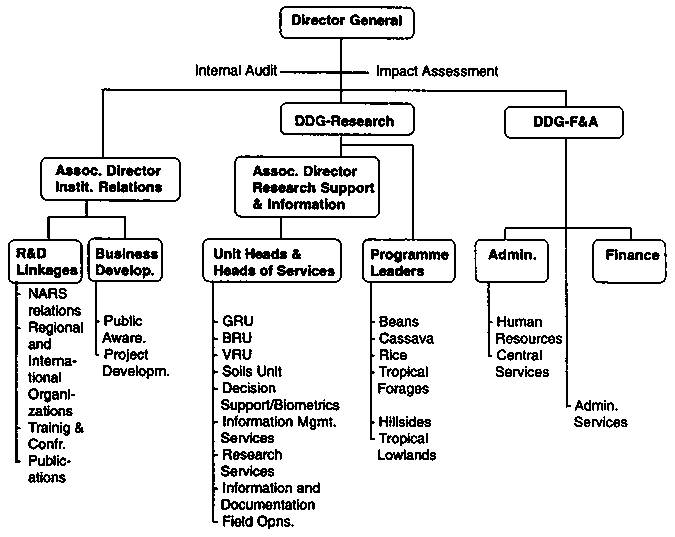
CIAT's structural organization chart describes reporting responsibilities and relationships. Traditionally core research has been conducted within Programmes and the work of Programmes is supported by Research Units and Services. The Panel notes that currently some similar services (especially information services) are distributed throughout the organization, that the position now titled Associate Director, Resource Management Research could be more effectively used, and that service units that directly support research would be more effective if housed organizationally within the research area. The Panel therefore advances the following recommendation:
10. The Panel recommends adoption of the organizational structure depicted in Figure 7.1., of which the main elements are:· Establishment of a position of Associate Director for Research Support and Information Services in place of the existing post of Associate Director for Natural Resources Management;· The research support units and the units handling information systems and services should report to the new Associate Director.
The Panel believes that this approach to programme organization emphasizes the primacy of research and is a more efficient use of existing human resources. This recommendation does not require additional staff. We believe that CIATs natural resources management programmes can be better integrated into the overall institutional direction of CIAT by having programme leaders report directly to the Deputy Director General for Research, and that a coordinated approach to information services and programme support will enhance performance in all programmes.
There has been considerable confusion within CIAT about the new 'matrix' organization. The scheme was originally intended as a structure for organizing project-based research and providing mechanisms for communications and the generation of project ideas across programme lines. It included the creation of SRGs to encourage the development and implementation of projects between previously autonomous, essentially independent programmes. The plan proposed empowering scientists and scientific teams, instead it generated uncertainty about authority and reporting relationships. Because the plan was developed with limited scientists' input or participation it was viewed with suspicion, and even alarm.
One of the key elements feeding the confusion was the role of SRGs. The organization chart, distributed at the time of their inception, appeared to give SRGs management responsibilities in conflict with those of the programmes by showing units as reporting to SRG Heads. In the ensuing confusion some SRGs were inactive, some were both active and productive, while still others began to establish plans for both developing and managing projects. Subsequently the Board clarified this issue by adopting a policy expressly prohibiting SRGs from managing projects. One SRG (Land Management) continues to manage projects, including the GIS Unit. Chapter 3.4 of this Report addresses this discrepancy.
By reducing the potential power of these new disciplinary clusters the Board created a "soft" rather than a hard matrix, making it less a management tool and more a conceptual scheme useful for communications and illustrative of the cross discipline nature of research within CIAT. The Panel believes that Board action in this regard was appropriate and helped CIAT retain the capacity to form competency groups across programme lines without creating a climate of competition and uncertainty.
However, the use of SRGs as the "soft" dimension is still a source of confusion partly because their role and functions are still evolving, and there is overlap with the Research Units. To overcome this, the Panel puts forward the following recommendation:
11. The Panel recommends the use of the matrix depicted in Figure 7.2., to describe the conceptual interaction between competency groups (which include both SRGs and Units) that provide input and the research programmes that are essentially responsible for output. All research projects should continue to be implemented within Programmes or Units.
Figure 7.1. Proposed CIAT Organizational Chart
Figure 7.2. The Proposed Soft-Matrix Organization for CIAT
7.6.1. Use of Projects for Research Management
7.6.2. Use of Projects for Financial Management
7.6.3. Recommendation on Project-Based Management
Consonant with CIATs concern to improve management of research and control of resources, the Centre introduced a system of project-based management in mid-1994. Until then, all research was organized in six programmes and a restricted number of research or service units. While units functioned more or less on a project basis already, the programme subdivisions were not as clear-cut.
CIAT defines a project as: "A specific set of activities or tasks that receive a fixed amount of money in a determined period of time to meet the proposed objective. An undertaking that has a beginning and an end and is carried out to meet an established goal within cost, schedule and quality guidelines." This definition of a project involves elements of both research management and financial management.
From the perspective of research management projects provide important advantages: 1) Goals are clearly defined, 2) Progress may be measured and evaluated, 3) An identifiable timeframe enables CIAT to make decisions about the continuation or change in direction of a project in a timely fashion, and 4) Reporting to donors can be clearer and more specific.
While project management has been relatively easy to implement when considering projects under development and funded with complementary funding, its application to core programme activities has been more problematic and has resulted in attempts to define projects that range from very small to quite large. Indeed, there appears to be considerable confusion among senior staff as to what appropriately constitutes a 'project' and has led to various schemes and changing configurations.
The Panel believes that project based management is important for modern research management as it provides important insight into ongoing research during various stages. Describing CIAT's research activities on a project basis provides a convenient method for measuring performance and progress. However spending too much time in the preparation of small projects rather than on larger, more comprehensive projects of a collaborative nature would be counter productive and an inefficient use of scientists' time. The process of document preparation for reviews should not become overly burdensome.
The Panel also notes that while project based management is intended to increase accountability and improve the Centres competitive position with donors, unfortunately it appears to have increased competition within and among programmes within CIAT. These somewhat opposing tendencies and practices, while understandable, need to be carefully balanced by a longer-term Centrewide perspective guided by strategic rather than tactical (short-term) considerations. This argument further reinforces the need for the programme dimension of research management to be further strengthened, even as the project-based Action Plan gets implemented.
Project-based management also offers some important advantages for financial management. Costs may be disaggregated and related specifically to project benefits. In launching the financial side of project-based management, the unspent portion of the 1994 budget was translated into project form in August of that year, while the full 1995 budget was presented as a collection of projects from the outset. Approximately 90 separate projects were identified, assembled into some 22 clusters of related activities. In recognition of the frequent commingling of core and complementary resources in many projects, budgets and financial reports will hereafter include both sources of funds. (A second set of documents will dissect the figures for reporting separately to the CGIAR on core, and to donors of complementary funds on their individual project segments.)
As an essential component of the process, the concept of full costing was also introduced toward the end of 1994. This involved identifying actual costs of laboratory services, space, utilities, station field usage, depreciation, and other items previously budgeted and accounted for as discrete costs. At present, the salary and benefits of senior and local staff are accounted for as budgeted, but consideration is being given to a more precise system of control. As more experience is gained with cost accounting, and as the Centre moves closer to zero-based planning, other measures of attributable cost can probably be developed. This will maximize the potential for accurate budgeting and reporting of direct as opposed to indirect (or overhead) costs. Currently (i.e. for 1994), unallocated costs amount to US$ 6.6 million or 20% of the total budget. They include expenditures related to the Board, the offices of the DG and DDGs, the library and documentation service, communications/public affairs, financial and personnel services, the physical plant, and some aspects of research support.
In recent years, CIAT has asked donors for complementary fund to contribute 20% of direct costs for research at headquarters to cover overhead expenditures but has averaged a recovery rate of 15%. When full project costing has been implemented, it should be possible to identify and fully justify an overhead rate for inclusion in all project proposals (both core and complementary).
The last EMR emphasized the need for extensive staff consultation in budgeting. Under a system of project planning, this becomes still more important and must clearly extend to the level of individual Project Managers. It does not appear that this has been done uniformly. The Panel therefore puts forward the following recommendation:
12. The Panel recommends that management engage scientific staff in project definition and ensure that all programme heads and project leaders are fully aware of all aspects of project management and budgeting.
Throughout its history, CIAT has embraced certain basic values that have become guiding principles. In their most rudimentary form these are: a concern for human dignity and welfare, and a conviction that research is essential to solving problems of world hunger. To achieve the twin goals of excellence and relevance CIAT management identified more specific characteristics that defined the CIAT culture just prior to the 1989 External Management Review. These were: "participatory management and extensive communication; delegation that implies trust, responsibility, and fairness; flexibility without a strong hierarchical overlay; and motivation based on respect for the individual." While an external cultural audit conducted at that time revealed less than unanimous agreement that all of those characteristics were present at CIAT, it also confirmed a strong endorsement by a majority of CIAT employees that most of the goals were being met.
In the five years since the last External Review, CIAT has experienced a steady erosion of its revenue, loss of its Director General, a lay-off of some 34% of its support staff, continual struggle to maintain critical mass in key areas, and a series of reorganizations. While it would be fair to say that the CIAT culture suffered during this period, it is also fair to say that the commitment to the goals of excellence and relevance remain today, as strong as ever.
New stresses were generated by the kidnapping last October of one of CIAT's staff while he was on his way to work. This incident had not yet been resolved at the time of this report. The way this situation is resolved will have an important impact not only on the individual and his family, but also on the ability of CIAT to recruit and retain staff.
In the early stages of the five year period under review the then Director General provided the leadership that led to the introduction of resource management research, and the strengthening of scientific competencies. With the reduction in funding, he began the process of downsizing.
Repeated crises in funding led to the need to take quick and often dramatic action involving difficult reductions. Both time pressures and the inevitable controversy surrounding painful decisions created an atmosphere of crisis management and a top down, authoritarian management style that has alienated a least some of the scientific staff. In the staff survey that was conducted as part of this review respondents complained about the perceived size and bureaucracy of the Research Management structure and lack of communication between Centre management and its senior research staff. The introduction of SRGs, project management and new management structures, all would have been facilitated by greater explanation to or input from scientific staff. This would have resulted in better clarity of roles and responsibilities and made for relations of greater trust and cordiality among both management and scientific staff.
With the appointment of the Interim Director General the situation has stabilized but much remains to be done to reclaim the collegiality that most staff feel is fundamental to the CIAT culture and that must be exhibited by all senior management staff. The Panel puts forward the following recommendation:
13. The Panel recommends that, in its consideration of candidates to fill the position of Director General, the Board carefully consider the importance of a leadership style that will reintegrate the CIAT community and encourage participation in decision-making processes by programme leaders and scientists.
Nearly a quarter of CIAT senior staff are outposted to country operations. Of these 44% are in Africa with the others equally distributed between South America, Central America, the Caribbean and South East Asia. This proportion has not changed over the last five years but there is an enhanced awareness of the importance of CIAT's role in support of NARS networks. This also resulted in an ongoing change in the balance of activities within the Programmes at Headquarters, with more emphasis on collaborative work with NARS, including research into mechanisms for technology transfer and on generating natural resource management methodologies; and on developing and adapting new upstream technologies. CIAT Headquarters staff also develop germplasm for distribution by the outposted staff and directly to NARS. This service should remain an important function of the Headquarters because of the CIAT germplasm collections.
As NARS capability increases, the functions of the CIAT outposted staff will evolve into new relationships. CIAT needs to be sensitive to these changing needs. Both the task and the way it is done will change over time with more emphasis on decentralized activity away from the Headquarters buildings but backed up by the Headquarters support system. The closer working relationship with the NARS and a shared vision of joint goals will result in a more focused institutional strengthening.
Close interaction between Headquarters and Country Operations is thus fundamental to the CIAT mission. At all levels CIAT staff seek to develop a partnership rather than a dependency relationship. The style of interaction on a personal level is a very important factor in determining this outcome and there is a need for comprehensive briefing on this issue before staff are outposted. The more frequent the contacts and transparent the relationships between Headquarters and country operations the more likely they are to have a sustainable outcome. This is especially important at the Senior Management level.