


by
B.W. Oduor
Fisheries Department, Nairobi
1. INTRODUCTION
Kenya's marine fish landings are almost all from the 12,000 artisanal fishermen operating 4,000 small boats with gillnets, hooks and lines, shark nets, beach seines and traps within the inshore areas. Factors of marketing (inavailability of dealers), communication (roads) and administration have influenced siting of landing beaches most of which have been provided with handling facilities by the Fisheries Department. These are the points for collecting fish landing data. The major fishing areas are the Kiunga coastline and Lamu islands in the north; Tana River mouth, Ngwana Bay and Malindi area including the offshore North Kenya Bank and Shimoni, Vanga, Funzi Island and coral reef areas in the southern border.
In addition to the types of boats, gears and the monsoon weather pattern, social and economic factors affect fish landings. Religious fastings, holidays, festivities (no fishing) and diversion of fishing boats into more lucrative tourist transportation and mangrove pole cutting and transport are some of these. Demersal fish species predominate over pelagic species in the catches.
Major landing areas, points and staff are:
| Fishing areas | Supervising station | Collection stations | No. of statistics staff (F.S.& Fisheries Assts.) |
| North coast Lamu, Kiunga islands (reef area) | Lamu | 5 | 19 |
| Ngwana Bay | Malindi | 8 | 11 |
| Malindi & NCF Co-operative Fish market Coral Reef area | |||
| Mombasa | Mombasa | 3 | 12 |
| Island creeks | |||
| Commercial markets | |||
| Old Harbour | |||
| Vipingo, Mtwapa, | |||
| South Coast | Shimoni | 5 | 10 |
| Coral Reef Area Co-operatives (5) |
2. COLLECTION OF KENYA FISHERIES DATA
Kenya's marine fish data are collected from established fish landing points most of which have landing facilities (bandas) at purchase points built by the Fisheries Department. Five fishermen co-operative societies which buy and sell fish are also sources of data although they do not handle all the products.
The Departmental staff at these beaches record daily the fish weight according to species, pelagic, demersal, Crustacea, molluscs and sharks. Monthly records are then submitted to the supervising station where monthly totals are prepared and submitted to Mombasa for the whole coast and annual figures are compiled.
| YEAR | TOTAL | MARINE | % | VALUE |
| 1977 | 40452 | 4046 | 10.0 | 13.6 |
| 1978 | 46394 | 4634 | 10.0 | 21.2 |
| 1979 | 50413 | 3915 | 7.8 | 18.9 |
| 1980 | 48218 | 5336 | 11.1 | 30.1 |
| 1981 | 57352 | 5967 | 10.4 | 36.8 |
| 1982 | 81133 | 7116 | 8.8 | 50.8 |
| Species | 1966 | 1977 | 1978 | 1979 |
| Albacore | 70.3 | 125.3 | 59.4 | 19.2 |
| Bigeye | 72.9 | 683.9 | 1282.0 | 22.5 |
| Blue fin | N/A | N/A | 77.6 | N/A |
| Yellow fin | 363.6 | 1782.7 | 2379.6 | 184.2 |
| Blue marlin | 12.1 | 32.2 | 83.1 | 14.1 |
| Red marlin | 7.2 | 16.9 | 35.3 | 4.0 |
| White marlin | 4.7 | 77.0 | 91.4 | 16.2 |
| Sail fish | 18.4 | 20.4 | 37.4 | 4.7 |
| Skipjack | N/A | 25.8 | 1.2 | N/A |
| Swordfish | 16.5 | 24.7 | 88.9 | 6.5 |
| Marku shark | 23.2 | 44.8 | 94.1 | 6.4 |
| Others | 25.3 | 46.6 | 214.6 | 4.5 |
| Totals | 214.2 | 2880.3 | 4444.6 | 282.3 |
The landed marine fish and other products are distributed by traders licenced annually and in 1984 as follows:
Fish Processing Licence (No.82). Filleting, freezing, distribution and sales. (There are no canning or fishmeal processors in Kenya).
Crustacea Licence (No. 142). Distribution and sale and export of crustacea.
Aquarium Fish (No. 55). Capture and export of live aquarium fish.
Oysters (No. 4). Collection, grinding of shells or grit.
Marine shells (No. 276). Collection, wholesale retail and export.
Beche-de-mer (No. 3). Collection processing and export. This product has no local market.
2.1. Weaknesses in the data collection methods
Although the present system of compiling fish landing records provides good information, particularly in areas where co-operatives are active, there are serious problems which call for improvements.
There are incomplete coverage of a number of landing beaches and markets not manned by department staff. No estimates are made for these areas. The format does not show effort data.
Certain days of the year; weekends, public holidays are not recorded by staff. The estimated catch is not weighted to other factors.
It is a licencing condition for the comercial fishing vessels to provide data but little data is usually received due to no response.
The statistics staff are little trained and are infrequently supervised. Catch estimates are accepted without prior checking to evaluate the quality of results obtained against other statistical magnitudes.
2.2. FAOS's participation in the improvement of Kenya's marine fisheries data collection
To achieve the governments objective of best utilisation of the marine resources, reliable and detailed data are essential. The FAO has assisted to:
assess the quality of existing data collection method
select suitable methodology and sampling techniques to revise the system.
The FAO and departmental staff therefore conducted aerial surveys to provide background information on the existing artisanal sector: fishing boats, fishing activities, gears, ports/landing beaches, processing and marketing habits. This to obtain general information about fishing grounds and seasons. This information was used to prepare a sampling frame for the coastal artisanal fisheries.
The coastline was divided into strata and sub-strata. The estimated total number of big gears, canoes and dhows seen during the aerial survey 21–23 Nov. 1981 for the different areas were as shown below:
| Administrative district (Coastline) | Stratum | Substrata | No.of beach seine | No. of. uzio | Other | Canoes | Dhows | |
| Lamu | (244 kms) | 1 | 1–4 | 14 | 8 | 3 | 303 | 225 |
| Malindi | (213 kms) | 2 | 5–8 | 20 | 38 | 3 | 321 | 85 |
| Mombasa | (97 kms) | 3 | 9–10 | 13 | 95 | 8 | 538 | 77 |
| Kwale | (147 kms) | 4 | 11–12 | 16 | 125 | 8 | 674 | 107 |
| Total | (897 kms) | 63 | 266 | 22 | 1836 | 494 | ||
General sampling frame of minor Area Units May 1981
| Important fishing site/market | Total fishing boats | Canoes | Total | Dhows sail | Engine |
| Grand total | 3585 | 2020 | 1565 | 1466 | 99 |
| LAMU-TANA (North Coast) | 466 | 16 | 450 | 450 | |
| Ishiakani | 9 | 9 | 9 | ||
| Kiunga | 30 | 30 | 30 | ||
| Mwambore | 4 | 4 | 4 | ||
| Mangai | 18 | 18 | 18 | ||
| Kipini | 67 | 67 | 67 | ||
| Faza | 162 | 162 | 162 | ||
| Matondoni | 52 | 52 | 52 | ||
| Shella | 29 | 29 | 29 | ||
| Dunduri | 7 | 7 | 7 | ||
| Lamu | 47 | 47 | 47 | ||
| Kipini | 32 | 16 | 16 | 16 | |
| MALINDI | 394 | 200 | 194 | 184 | 10 |
| Malindi Market | 111 | 61 | 50 | 47 | 3 |
| Ngomeni | 47 | 27 | 20 | 17 | 3 |
| Watamu | 42 | 26 | 16 | 15 | 1 |
| Kilifi | 51 | 13 | 38 | 37 | 1 |
| Takanngu | 21 | 3 | 18 | 16 | 2 |
| Mtwapa | 59 | 47 | 12 | 12 | |
| Gogoni | |||||
| Mayunyu | 20 | 10 | 10 | 10 | |
| Uyombo | 6 | 6 | |||
| Moa | 7 | 7 | |||
| Bukeke | 30 | 30 | 30 | ||
| MOMBASA | 1672 | 1596 | 76 | 41 | 35 |
| Marina | 126 | 126 | |||
| Serena | 11 | 11 | |||
| Utange | 16 | 8 | 8 | 4 | 4 |
| Bamburi | 16 | 8 | 8 | 4 | 4 |
| Old Port | 220 | 187 | 33 | 13 | 20 |
| Likoni | 36 | 31 | 5 | 5 | |
| Shelly Beach | 18 | 18 | |||
| Mtongwe | 21 | 18 | 3 | 3 | |
| Port Reitz | 251 | 247 | 4 | 3 | 1 |
| Miritini | 104 | 100 | 4 | 4 | |
| Tsunza | 240 | 240 | |||
| Mwamdudu | 129 | 129 | |||
| Kiteje | 97 | 97 | |||
| Jomiu | 89 | 89 | |||
| Jomku Juu | 214 | 214 | |||
| Tudor | 74 | 61 | 13 | 5 | 8 |
| KWALE (South Coast) | 1053 | 208 | 847 | 791 | 54 |
| Tiwi | 38 | 38 | |||
| Diani | 231 | 103 | 128 | 113 | 15 |
| Msambweni | 357 | 18 | 339 | 337 | 2 |
| Shimoni | 208 | 11 | 197 | 165 | 32 |
| Majoreni | 85 | 1 | 84 | 83 | 1 |
| Vanga | 134 | 37 | 97 | 93 | 4 |
Fishing vessels operating offshore 1981
| Vessels | Gear | Length (m) | Hp | Crew max/min | Capacity(t) hold/freeze | ||
| Aegina | Beam trawl | 79 | 1500 | 80 | 60 | 250 | 0.6 |
| Alpha Challenger | " | 25 | 650 | 32 | 28 | 20 | 1.5 |
| Kuvuna 369 | " | 16 | 240 | 15 | 9 | 8 | 1.0 |
| Kuvuna 888 | " | 16 | 240 | 15 | 9 | 8 | 1.0 |
| Kuvuna 818 | Fish carrier | 21 | 280 | 9 | 7 | 8 | - |
| Funguo | Long line | 44 | 75 | 28 | 28 | 175 | 10.0 |
| Uchumui | " | 44 | 750 | 28 | 28 | 175 | 10.0 |
| Liwatoni I | Set net | 12 | 88 | 5 | 5 | 3 | - |
| Liwatoni 2 | " | 12 | 88 | 5 | 5 | 3 | - |
| Liwatoni 3 | " | 12 | 18 | 5 | 5 | 3 | - |
| Liwatoni 4 | " | 12 | 18 | 5 | 5 | 3 | - |
| Liwatoni 5 | " | 12 | 18 | 5 | 5 | 3 | - |
| Ujuzi (research) | Stern trawl | 24 | 350 | 16 | 16 | 7 | 1.5 |
| Shakwe (research) | " | 12 | 320 | 15 | 15 | 35 | 16.0 |
2.3. Commercial fishing units
The 14 vessels were all based in Mombasa and were generally unwilling for trade reasons, to supply catch data. For the validation of their catches, statistical criteria as ratio of fish and prawn in the catches and the expression of total yearly gross revenue per unit GRT were used together with other external sources of information (Fisheries department files).
Some Commercial catches (=Landings) for 1980 in tonnes:
| Fishing Vessels | Total | Fish | Prawns |
| M.V. Kusi | 39.94 | ||
| Alpha Challenger Alpha Commander Aegina | 179.00 | 125.00 | 54.00 |
| M.V. Kuvuna 369 | 68.15 | 43.52 | 24.63 |
| M.V. Kuvuna 888 | 77.45 | 53.12 | 24.33 |
| Total | 364.55 | 241.68 | 122.87 |
From the validation, it was noted that the landings given by the vessels, (only 45% responded even after elaborate arrangements) were 6–10 times less than the actual landings. From unofficial records two longlines (non respondents) landed 1000 tonnes year.
3. REVISION OF THE MARINE FISHERIES STATISTICAL SYSTEM
A revised system has been presented as well as the methodological and sampling aspects of the proposed system (artisanal). The artisanal classification codes should cover all phases of the industry: catching, processing and utilisation. However, particular attention will be given to the primary phase of the fishing industry i.e. marine capture.
The proposed revised system will consist of:
Aerial Frame Survey (census method) designed to provide distribution and concentration pattern of fishing boats their activities and type.
Area Frame Survey (water/road approach) to provide detailed information of number, distribution and size of fishing sites, number of fishing units and their components. Migratory pattern of boats and general information about processing and marketing, and habits of fishermen.
The results of the survey will be used, among other things for preparation of required sampling frames based on lists and maps.
Revision of the current catch assessement survey will aim at providing reliable estimates of survey magnitudes and their sampling errors.
4. INCREASING KENYA'S MARINE FISH CATCHES
The government aims at utilising all the available exploitable marine fisheries to provide food for the growing population, to create employment and incomes to the rural population and to earn foreign exchange from exports. Yet for the past six years marine landings have levelled at 5,000 tonnes annually constituting only 10% of total landings. And yet again, the target landings in the present development plan is 20,000 tonnes per year by 1988. Is this possible?
In order to achieve the objectives of current development plan, present programmes of making storage facilities available, boatbuilding, gear improvement, extension services must be very actively but stepwise followed but essentially in these suggested areas:
Artisanal fisheries emphasis to exploit inshore and irregular bottom areas should include traps, lines and fads.
Offshore fishery to be expanded by utilising medium size commercial vessels presently operating at the Kenya Coast. These vessels have various advantages over the large ones.
The exploitation of deep sea fisheries requires larger and more expensive vessels. Here, an open policy should be fostered to encourage fishing in the richer open areas.
5. CONCLUSION AND RECOMMENDATIONS
From the foregoing presentation showing the present system of collecting Kenya's data for marine fish landings and the weaknesses of the system. The attempts beeing made in collaboration with FAO to improve the system recommend that:
Collaboration with FAO should continue to the stage of implementation and testing of a new improved method of collecting data.
To realise the targets in fish catches during the present plan period i.e. 20,000 tonnes by 1988 it is important not only to strongly implement the present fisheries development programmes; but also to consider a new policy for exploiting deep sea fisheries and other territorial waters of the West Indian Ocean by vessels registered in Kenya and landing their catches in Kenya.
6. REFERENCES
1. Coppola, S.R. 1981. Aerial Frame Survey along the coast of Kenya (artisanal sector). Kenya Work Report No. 10. FAO, Rome.
2. Republic of Kenya 5th Development Plan for the period 1984 – 1988. Government Printer, Nairobi.
by
James Siwo Mbuga
IDA-World Bank Fisheries Project
South Nyanza District
1. INTRODUCTION
Fishing gears and methods play a major role in the development of our fisheries resources. The type of equipment used in harvesting our fishery resources go a long way in determining whether we engage in subsistence or commercial fishing operations.
For some obvious reasons, our artisanal fishermen have hardly developed their fishing ventures from that state of a subsistence nature to a commercial status. Main factors that have overridden commercial endeavours in our fishery industry include: limited fish stocks in our narrow continental shelf, lack of technological development and lack of sufficient investment capital funds. The crustacea fishery has remained lucrative but has resulted in rapid decline of especially prawn stocks, now being overfished in Ungwana Bay.
North Kenya Bank which has fairly large seasonal shoals has got rough bottom punctuated with coral peaks that make ordinary bottom trawling expensive and dangerous. The Kenya coast, running 650 km in zigzag and 450 km straight, is an open coastline providing only limited sheltered creeks, estuaries and bays. Appendix I gives the names.
Areas around the islands usually form fertile fishing grounds as the Lamu archipelago on the North Coast and the Kisite/Mpunguti archipelago on the South Coast. The trawlers, longliners and carrier vessels which have hitherto been deployed in exploiting our marine fishery resources are listed in Appendix II. Ungwana Bay which has been a fertile fishing ground has virtually been depleted of prawn stocks. Seasonally the Bay sustains a fleet of commercial shrimpers or prawn trawlers which usually take large quantities of by-catch usually thrown overboard as trash fish. Ungwana Bay also provides lucrative fishery for the artisanal passive gear fishermen who have been pushed back within the 10 meters depth fishing zone by the trawlers. However, active gears such as drift nets, trolls and other line fishery survive in the trawling grounds. Dodori, Wange, Kilifi and Majoreni creeks are also trawlable by smaller vessels that can fish down to 5 meters depth. Creeks, bays and muddy shorelines are heavily cropped with usio and lema (barricade) and weir traps all the year round. The reef line which is a distant continuous white foam-line at high tide is a noteworthy habitat for crustaceans, molluscs and a large variety of commercial and ornamental bony fishes. The reef break-water line is where most of the detritus feeders live, as it is here where the tides deposit their heavier sediments within the reef line, demarcating the limit of our continental shelf. Our fishermen harvest the shoaling species by seine and cast nets known as juyas and kimiyas respectively. Other miscellaneous marine fisheries include oyester and beche-de-mer both of which are harvested by hand picking. Lobsters are harvested by skin and aqualung divers.
2. THE MARINE WEATHER REGIME (KENYA COAST)
The Kenya marine weather regime can be divided into four distinct annual seasons which form the fishing calendar in the year:
Each of the four seasons has got a distinct effect on our fishing pattern. The Northeast Monsoons comes with the Somalian Stream, a current which creates an upwelling in the upper reaches of the North Kenya Banks, subsequently creating a lavish fishing ground along the North Coast. The Somalian Stream counteracts the Equatorial Counter Current and the turbulence thereoff enhances primary productivity and thereby forming a fertile fishing ground. The Northeast Monsoon is succeeded by the Matilai/Maleleji (calm weather), this period sea allows lucrative fishing all over the coast. Pelagic fishery is more effectively exploited during this period when non-powered boats can venture into the open waters. When the long rains come, starting from May through August, the sea becomes more turbulent than during the Northeast Monsoon and the majority of fishermen lay down their tools. Inshore fishing operations, however, persist in bays, creeks and around the islands.
It has, however, been established that large schools of migratory pelagic stocks abound in the offshore waters of Kenya during the Southwest Monsoon (Kusi) period. Such large shoals include tuna, skipjack, caranx, sardinellas, mackerels, marlins, sailfish and swordfish.
Towards the end of the year, another calm period (Matilai) occurs in the months of September and October. A similar fishery to that in March-April occurs all over the coast.
3. CONVENTIONAL FISHING GEARS AND METHODS
Since the advent of inshore trawling started by the Japanese in our waters in 1968 a fleet of shrimpers (Appendix II) has been gradually expanding, and all the trawlers converge at Ungwana Bay which has remained the only commercially trawlable ground. Apart from M/V “Kusi” which has used more sophiscated trawl gears, all the rest have used simple stern trawls. M/V “Kusi” can, however, operate giant beam trawls, mid-water or pelagic trawls and different stern trawls.
The Kenya Fishing Industries has successfully operated two 350 tonnes tuna long liners which have been landing commercial quantities of tuna, marlin, skipjack and shark. The two long liners, M/V “Uchumi” and M/V “Ufunguo”, have ventured both the fishing grounds within and beyond our 200 n. mile Exclusive Economic Zone.
Perhaps the most successful commercial fishing company is Wanainchi Marine Products which has for a long time deployed the M/V “Kuvunas” on a lucrative beam trawl shrimping at Ungwana Bay. This company also introduced successfully an attraction-lamp ring net fishery for sardines in the South Coast.
The Kenya Cold Storage has a long history of shrimping with M/V “Shokas”, “Alpa Challenger” and “Alpha,Commando”. Lately the Kenya Cold Storage has successfully deployed M/T“Aegina”, a big multi-gear boat measuring 82 meters L.O.A., on shrimping and fish trawling with unique bottom and para-pelagic gears designed by Greek fishing experts.
Other fishing companies which have undertaken trawl fishery include; Samaki Industries, Kenya Fishing Industries, Kenya Inshore Fisheries, Ocean Fish Farming, and Kilada Fishing Company.
All in all, the Kenyan commercial fishing sector has for a long time attracted a lot of ambitious interest despite our limited resources. The main reason is a ready market for sea food in our tourist beach and upcountry hotels spread out in the game parks and at other tourist attraction centres.
4. THE ARTISANAL FISHERY
Our artisanal fishermen employ five distinct fishing craft types as may suit the various fisheries and weather vagaries. The following are the fishing vessels used in our marine waters:
Dhows and ngalawas are made to suit rough weather and open offshore fishing expenditions. They are mainly equipped with shark net, drift net, other set gillnets and line gears. The hori or dug-out and the canoes are mainly deployed in the operation of active gears such as kimiya, juya, (beach seine and cast nets), drift longlines and inshore passive gears such as jarife (set gillnets), and lema (fish pot) and Musio (barricade trap).
The table below shows the different fishing gears and species of fish landed from different fishing grounds during the four seasons of the year.
AREA: KIUNGA - LAMU AREA (NORTH COAST)
1st regime: Northeast Monsoon (Kasikazini), Nov-Feb.
| 1st regime: Northeast Monsoon (Kasikazini), Nov-Feb. | |
| Gears: | Fish caught: |
| Juya, kimiya, seine and cast nets. | Rabbitfish, scavengers, parrotfish, goatfish, blackskin blackskin, snappers, surgeonfish, mackerel, sardines. |
| Line fishery. | Scavengers, caranx, barracuda, rockcod, bonito, tuna, marlin, sailfish, sharks. |
| Gillnet of 2 1/2", 3", 4", and 4 1/2 meshed stretched, and shark nets. | Mullet, rabbitfish, mtumbuu, scavengers, caranx, rockcod, bonito, tuna, kingfish, marlin, rays, barracuda, songoro, lobster, tazanda, fute, sharks. |
| Usio, lema and weir traps. | Rabbitfish, rays and skates, silverfish, tazanda, mashepwa, lobster. |
| Lobster pots, drivers (SKM). | Lobster. |
| 2nd regime: Calm Sea (Metilai/Maleleji), Mar-Apr. | |
| Most fishermen repair their traps, but later use usio, lema, msipi or lines and gillnets of jarife. | Carches landed are quite similar to those landed during Kasikazi, but grunter, mullet, caranx, chana, crabs, kibasa, and fute are caught by usio, Gillnet catch: kingfish, caranx, sharks, mackerel, bonito, rays, kambisi, marlin, lobster, fume. |
| 3rd regime: Southwest Monsoon (Kusi), May-Aug. | |
| Minimal fishing with all gears except malemas are used occasionally. The juva land big catches as the rough waters wash ashore large schools of certain species. | Flash booms of rabbitfish, blackskin and scavegers occasionally experienced. |
| 4th regime: Calm Sea (Matilai/Maleleji), Sep-Oct. | |
| Same gears as in March and April. | During this period flash booms of caranx, blue parrotfish, kangaja, bonito, kingfish and sharks are landed. |
AREA: VANGA - MAJORENI AREA (SOUTH COAST)
1st regime: Northeast Monsoon (Kasikazi), Nov-Feb.
| Cast nets and beach seines. | Good landings of prawn and mixed fish. |
| Malema (weir), line (msipi), beach seine juya. | Rabbitfish, mullet, una or bangara, tazanda, snappers, rockcod, puju, karazanga, kangaja, surgeonfish. |
| 2nd regime: Calm Sea (Matilai), Mar-Apr. | |
| Mainly trap gear. Gear under repair. Usio or barricade. | Barracuda, grunter, mullet caranx, crab, kihasa, sana, fute. |
| Gillnet. | Kingfish, rays, kambisi, marlin, sailfish, scavenger, lobster, catfish. |
| Line fishery. | Scavenger, nyamvi, kungu, sali-sali, rockcod, caranx, snapper, mafatundu, ngare-ngare, barracuda, fume. |
| Weir, malema. | Rabbitfish, pono, scavenger, squid, mkundaji, rockcod, crab. |
| 3rd regime: Southwest Monsoon (Kusi), May-Aug. | |
| Cast nets and beach seine. | Prawns, sardines, silverfish, vidua, una, msusa. |
| Weir trap, malema. | Rabbitfish, scavenger, octopus (pweza), tembo, mkundaji, lobster. |
| Line fishery (msipi). | Scavenger, snapper (koana), ngarengare, mafwa, tundu. |
| Gillnet. | Skates and rays, songoro, wingfish, mullet, papa, caranx, tazanda, sole, fume. |
| Bottom longline (dhulumati). | Sharks, rockcod, caranx, songoro, kambisi. |
| 4th regime: Calm Sea (Matilai/Maleleji), Sep-Oct. | |
| Seine nets, beach and cast, juya and kimiya. | Scavenger, rabbitfish, una or mackerel, msusa, kidau. |
| Line fishery (msipi). | Scavenger, nyamvi, kunga, mrongo, red snapper, parrotfish. |
AREA: SHIMONI (SOUTH COAST)
1st regime: North East Monsoon (Kazikazi), Nov-Feb.
| Weit trap, lema. | Scavenger, rabbitfish, pono, mkundaji, parrotfish, lobster, kangaja, rockcod, fute mileha. |
| Line fishery. | Scavenger, caranx, rockcod, sharks, kimbasi, marlin, kingfish, mackerel, songoro, fulisi, rays, mrongo, kungu, sele-sele. |
| Beach seine and cast nets. | Mackerel, virongwe, misusa, sardines, prawns and mixed. |
| Barricade, usio. | Mullet, grunter, lobster, kipepeo, virongwe, garanx, kinwa, uchi, mninga. |
| 2nd regime: Calm Sea (Matilai), Mar-Apr. | |
| Similar gears as those used during Northeast Monsoon. | Catches are also similar to those of Northeast Monsoon, but more catches are landed. |
| 3rd regime: Southwest Monsoon (Kusi) May-Aug. | |
| Barricade trap,. usio. | Grunter, fute, blackskin, mullet, runguu or perch, mixed fish. |
| Gillnet, jarife. | Kingfish, sharks, rays, songoro, lobster, mackerel, pungu, caranx, marlin, queenfish, jodari, milkfish, tengesi, fume. |
| Line fishery (msipi). | Caranx, kingfish, skates and rays, kingu, snapper, and mixed. |
| Beach seine and cast nets. | Virongwe, caranx, chea, misusa, scavenger, mkundaji, unicorn or puju, matiko, vidau, flatfish or wayu. |
| 4th regime: Calm Sea (Matilai), Sep-Oct. | |
| Weir, malema. | Rabbitfish, scavenger, puju, parrotfish, fute, rockcod, vita-tange, kangaja or moonfish. |
The weather regimes are arranged as follows to cover one fishing calendar year:
| 1st regime: | Northeast Monsoon (Kasikazi), November–February |
| 2nd regime: | Calm Sea (Matilai/Maleleji), March–April |
| 3rd regime: | Southwest Monsoon (Kusi), May–August |
| 4th regime: | Calm Sea (Matilai/Maleleji, September–October |
KEY
The above table has got some Kiswahili (local language) words for our climate seasons and for local names of fish and for traditional fishing gears which the writer could not translate into English common or scientific names.
| Kiswahili | English |
| Kasikazi | Northeast Monsoon |
| Matilai/Maleleji | Calm Sea weather |
| Kusi | Southwest Monsoon |
| Juya | Beach seine |
| Kimiya | Cast or seine net |
| Usio | Barricade, weir |
| Ema | Fish basket |
| Tata | Weir |
| Jarife | Gillnet |
| Dhulumuti | Bottom longline |
The Kenya marine fishing gears can be classified as follows in order of economic importance:
GT - Trap Gear - Usio, Ema and Tatas.
GN - Gillnets - Shark nets, that is polymide (Jarife) Ply 21,24, 36x56MD x 144MX 152 mm. This group includes drift nets. -Other gillnets for smaller species, 2",3",4", and 4 1/2".
GL - Longlines, drift longlines, bottom longlines, troll lines (especially for sports fishing), pole and line and hand lines. This includes tuna longline.
GS - Seine Gear - Beach seines, cast nets and surrounding nets.
GM - Trawl Gear - Shrimp trawls, fish trawls. These are capital intensive gears.
5. FISHING GEAR DEVELOPMENT
The author has designed, made and tested certain fishing gears as shown in Appendix III.
As mentioned in the introduction, there is need to upgrade our fishing gears and methods so that we can increase our production and at the same time improve the earnings of our artisanal fishermen.
It was noted that the purely traditional trap gears (GT) are the most effective, and seasonally they land huge catches of the migratory species. Barricades and and weirs (usio and tatta) are made of dried split bamboo sticks or thin mangrove branches in the leader line and wings while the traps are usually constructed of dry cocnut leaves. Fish and lobster baskets are made of coconut leaves.
The gillnet fishery or the jarife (GN) is second to trap fishery and is similarly widespread all along the coast.
Line fishery or msipi (GL) is the simplest and cheapest of certain types other than the tuna longline and troll line. Apart from subsistence and commercial line fishery, we have a widespread sport fishing along our attractive coastline. The rich tourists operate many types of line gears and sophisticated tackles on board the luxurious and elegant sport fishing launches. Sport fishing is a good foreign earner to our country and can be further developed. A number of fishing clubs exist along the coast to provide the necessary facilities for the sport fishery.
The seine gears (juya and kimiya) are both employed to land catches of shoaling inshore species. The beach seines and the cast net gears like the barricade traps catch a lot of inshore prawns. Beach seines, cast nets and drive-in nets are also operated on or around the sand banks where big catches are usually taken with the fluctuation of tides.
Some research has been done by the author on fishing gear development. Emphasis was made on less capital intensive gears that can be afforded by the artisanal fishermen or by the fishermen's co-operative societies. The following gears were tested:
5.1. Trammel net
Experiments carried out with trammel nets showed very promising results according to catchability as compared with other net gears. The type shown as D1 in Appendix III was found more suitable than type D3. Both gears were found to be capable of harvesting a wide range of species and age groups up to the largest size that could be enmeshed/entangled by the outer net.
This type of gear was found most suitable for capturing lobsters and crabs but could also capture other inshore species. Its more effective use was, however, limited to clear waters because it entangles a lot of detritus rubbish that lower its effectiveness.
Trammel nets have become a very popular gear among fishermen although the nets are not readily available to fishermen because they are not in the local market. It is recommended that gear workshops should be set at major co-operative centers such as Shimoni, Mombasa, Malindi, Lamu and Kiunga where fishermen can be taught to make such gears on their own.
5.2. Set net
With much help from Mr. Arne Steffensen of DANIDA/Kenya Fisheries Development Programme, the author designed and made a set net (D2, Appendix III). The gear was tested at Port Reit at spot adjacent to the Navy Base.
This gear was excitingly found to be quite effective. Considering that the gear was tested within the port area, which is polluted and thereby probably supports scanty fish stocks, it was concluded that this gear can be very suitable for commercial fishing in other typical fish trap gear areas such as creeks, estuaries and bays shown in Appendix I. Since one unit of such gear would cost about K.shs. 80,000/100,000, it is recommended that the fishermen's co-operative societies of the fishing and fish trading companies would viably invest in deploying such gears. It should be noted that this gear is a replica, the barricade/weir trap but has a much higher catchability.
5.3. Beach seine
A modern beach seine was also made and tested (D6, Appendix II). With the help from Mr. Tadayuki Kitanosono, a Japanese fishing gear technologist, the seine was designed, constructed and tested.
This type of gear is suitable for artisanal fishermen all over the coast. It is designed in a way that its resistance against hydrodynamic forces is much less than that of a similar traditional gear while its effeciency is also greater. It is also cheaper in material cost for its size. Estimated price is K.shs. 20,000.
5.4. Prawn trap
This gear was also designed, made and tested with the help of Mr. Arne Steffensen. Its high effeciency in catching inshore prawns and other species makes it a very suitable gear for local fishermen (D4, Appendix III). The price is estimated at K. shs. 15,000.
5.5. “V”door for inshore trawling
The gear shown in D5 in Appendix III is a trawl door designed, made and tested by the author and was found suitable for our rough fishing grounds.
6. CONCLUSION
The Kenya marine fisheries production has remained low for many years. The main reason for this is that we lack sufficient capital and technology to introduce more effective fishing gears and methods. A serious view should be taken in designing more effective methods to formulate management and development policies for our marine fishery.
Our fishermen need bigger crafts and better fishing equipment to enable them to exploit more fully the inshore, offshore and deep-sea fishery resources.
The coming Naivasha Wildlife and Fisheries Training Institute will play a major role in producing a new generation of enlightened trained fishermen who may increase the fish production.
APPENDIX I
The following is a list of bays, creeks and estuaries along the Kenya coast which comprise most of the inshore fishing grounds:
| CREEKS AND ESTUARIES | BAYS |
| 1. Matondoni (Mkunumbi) | 1. Kiunga |
| 2. Dodori (Wange) | 2. Ungwana |
| 3. Ndunumi | 3.Uyembo |
| 4. Magogoni | 4. Kilifi Manarani |
| 5. Kipini | 5. Kipungani |
| 6. Tana River estuary | 6. Malindi Sabaki |
| 7. Kilifi estuary | 7. Gasi |
| 8. Kinyeole-Mkonde wa Simiti estuary | 8. Shimoni/Pemba Channel |
| 9. Ngomeni | |
| 10. Kilifi Mnarani | |
| 11. Sabaki/Athi River estuary | |
| 12. Mtwapa - Shimo-la Tewa | |
| 13. Kwa Jomvu - Mwache river estuary | |
| 14. Gasi | |
| 15. Shirasi | |
| 16. Kiwambale estuary | |
| 17. Majoreni | |
| 18. Mgoa/Vanga |
APPENDIX II
| Length | Tonnes | HP | ||
| R.V. “Shakwe” | 72 ft | 61 | 320 | Fisheries Department |
| M.V. “Kusi” | 40.5 m | 352 | 1400 | Kenya Fishing Industries |
| M.V. “Liwatoni 1” | 30 ft | Kenya Fishing Industries | ||
| M.V. “Kuvuna 369” | 60 ft | Wananchi Marine Products | ||
| M.T. “Kuvuna 818” | 72 ft | Wananchi Marine Products | ||
| M.V. “Kuvuna 888” | 21 m | 80 | 825 | Wananchi Marine Products |
| “Alfa Challenger” | 29 m | 165 | 825 | Kenya Cold Storage (1964) Ltd |
| “Alfa Commander” | 29 m | 165 | 825 | Kenya Cold Storage (1964) Ltd |
| “Shoka” | 18 m | 50 | 350 | Kenya Cold Storage (1964) Ltd |
| “Shoka Ndogo” | 12 m | 35 | 115 | Kenya Cold Storage (1964) Ltd |
| M.T. “Funguo” | 44 m | 275 | 1400 | Kenya Fishing Industries |
| M.T. “Uchumi” | 44 m | 275 | 1400 | Kenya Fishing Industries |
| M.T. “Aegina” | 82 m | 2200 | 2700 | Kenya Cold Storage (1964) Ltd |
| M.V. “Ujuzi” | 72 ft | 61 | 320 | Ocean Fish Farming |
| M.T. “Ushirikali” | North Coast Fishermen Co-op. | |||
| M.V. “Ushirika” | North Coast Fishermen Co-op. | |||
| M.T. “Sulisuli” (carrier) | Samaki Industries | |||
| M.T. “Baruti” (carrier) | Kenya Cold Storage (1964) Ltd | |||
| M.V. “Liwatoni II” | Kenya Fishing Industries | |||
| M.V. “Liwatoni III” | Kenya Fishing Industries | |||
| M.V. “Liwatoni IV” | Kenya Fishing Industries | |||
| R.V. “Lemuru” | Ocean Fish Farming | |||
| M.V. “Georgia” | ||||
| M.V. “Kongomile I” | ||||
| M.V. “Kongomile II” | ||||
| M.V. “kongomile III” |
APPENDIX III
PLAN FOR TRAMMEL NET
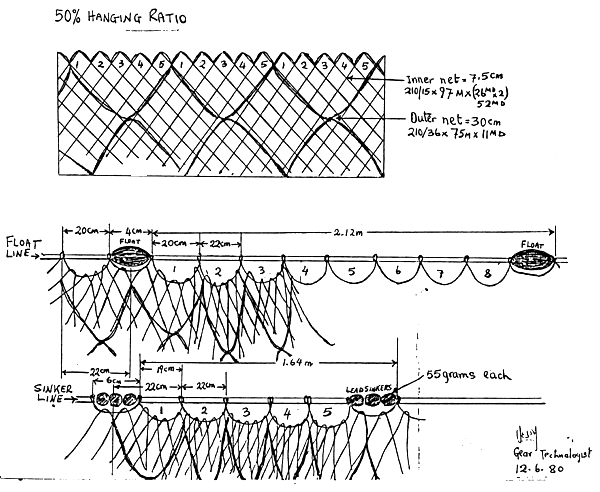
Figure Dl
SET NET 1.12.80
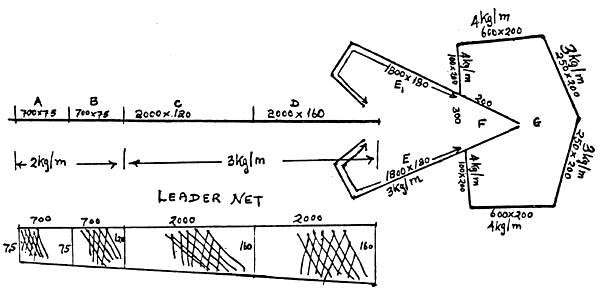
SPECIFICATIONS
Figure D2
TRAMMEL NET DESIGN
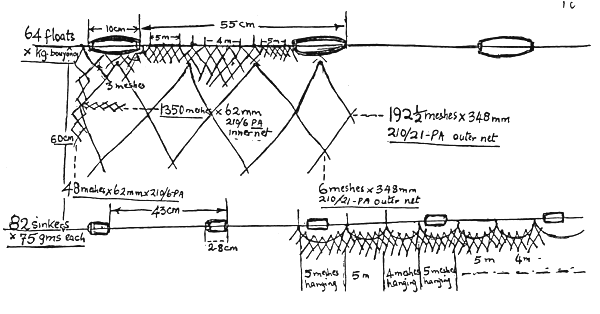
Figure D3
PRAWN TRAP 20.3.82
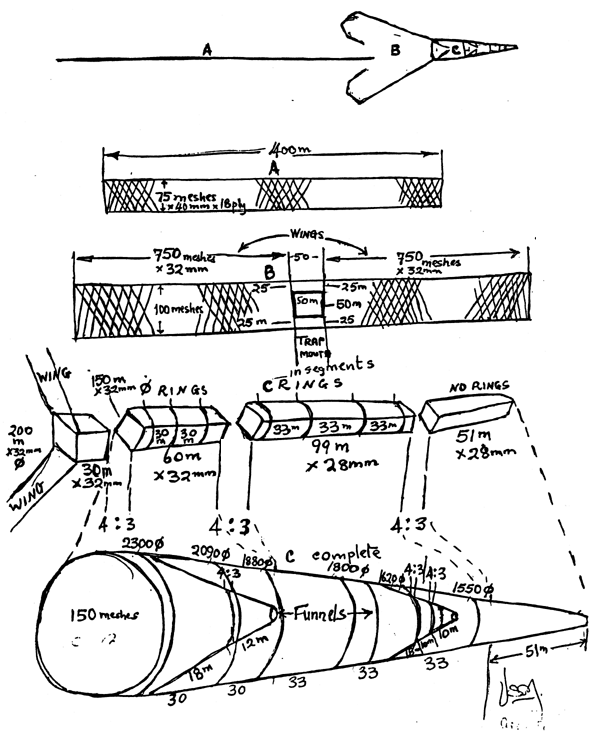
Figure D4
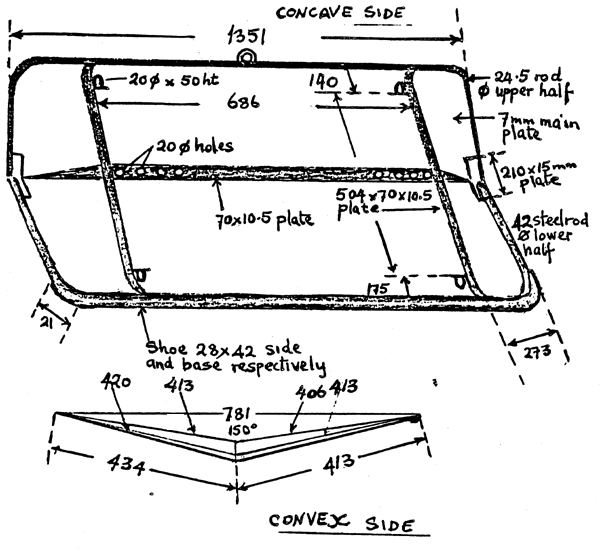
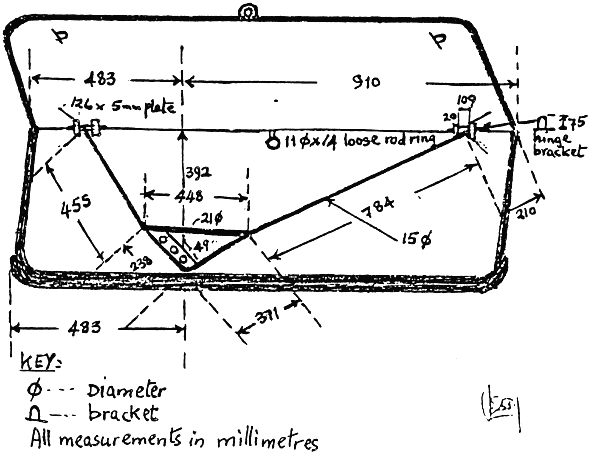
Figure D5
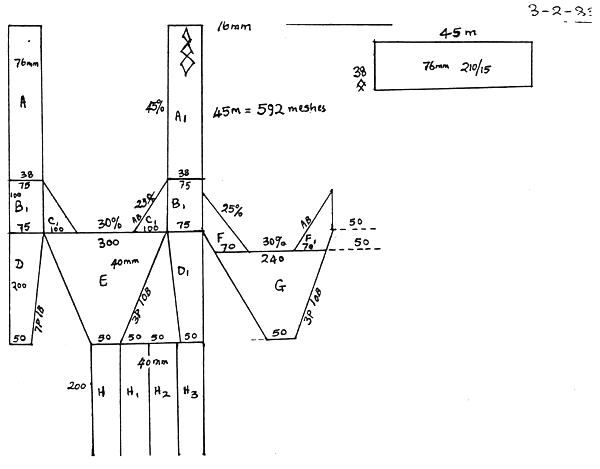
Figure D6
