prepared by
Paul Starkey1 and Adama Faye2
1Network Technical Adviser and 2Chairman of Network Steering Committee
Background
The West Africa Animal Traction Network is an open, informal and active network that is attempting to improve the exchange of information relating to animal traction in the region. Previous activities have included the workshop "Animal traction in a farming systems perspective" held in Togo in 1985 and the workshop "Animal power in farming systems" held in Sierra Leone in 1986.
Objectives
The principal objective of the 1988 workshop was to bring together a wide range of people of various disciplines who were involved in work relating to the introduction, diversification or intensification of the use of animal power in West Africa in order to stimulate the exchange of information and experiences.
Workshop theme
The overall theme of the workshop was "Animal Traction for Agricultural Development in West Africa". Four broad and interrelated subthemes had been selected to encourage contributions from a wide range of disciplines:
· Animal power for production.
· The impact of animal traction.
· Constraints to the use of animal traction.
· The profitability of animal traction.
Organizational details
The workshop was held from 7-12 July 1988 at the Palm Beach Hotel, Saly, Senegal. Initial workshop planning had been undertaken by the Network Steering Committee, which had delegated responsibility for detailed planning and workshop correspondence to the nominated Steering Committee Representative (Adama Faye) and the Network Technical Adviser (Paul Starkey). The local workshop committee comprising researchers from the host institution, the Institut Sénégalais de Recherches Agricoles (ISRA), organized the field visits, the workshop secretariat and local infrastructural support. Day-to-day implementation of the workshop programme was undertaken jointly by members of the Network Steering Committee and the Local Committee, with the assistance of some support staff of ISRA and the local office of the International Development Research Centre (IDRC).
French and English were the official languages of the workshop and there was simultaneous translation for all plenary sessions. Whenever possible workshop notices, documents and communications were made available in both English and French, but when time and resources prevented this they were circulated in whichever language they were prepared.
Host organization and donor support
The workshop was hosted by the Institut Sénégalais de Recherches Agricoles (ISRA), which provided the local organizing team and the equipment for the secretariat. Additional financial and/or organizational support was provided by a number of organizations including:
· GTZ (Deutsche Gesellschaft für Technische Zusammenarbeit, the official aid agency of the Federal Republic of Germany);· International Development Research Centre (IDRC) of Canada;
· Technical Centre for Agricultural and Rural Cooperation (CTA), based in The Netherlands;
· German Appropriate Technology Exchange (GATE), a specialized division of GTZ;
· International Livestock Centre for Africa (ILCA) based in Ethiopia;
· Environment and Development in the Third World (ENDA) based in Senegal.
The majority of participants were sponsored by their own organizations, including national ministries, research institutions and development projects, or by the various aid agencies supporting these organizations. Participants unable to obtain local support were sponsored by one of the agencies financing the workshop (GTZ, IDRC, CTA, GATE, ILCA or ENDA).
Participants
Workshop announcements had been sent to about 350 organizations implicated in the development of animal traction, and from these about 140 people expressed an interest in attending the workshop. This number was considered excessive and so was reduced to about 100 after the organizers discouraged the participation of more than one person from the same programme and insisted that all participants prepare a paper. Several people had to withdraw at the last moment due to local problems or transport difficulties and in the end 77 people from 24 countries participated. Most (60) were senior staff of organizations working with animal traction in Africa, and they included agricultural engineers, veterinarians, agronomists, animal scientists, forestry specialists, soil scientists, economists and social scientists. Others (11) were undertaking research and development work on animal traction outside Africa, and some (6) were representatives of interested aid agencies and other networks. The number of participants who preferred communicating in English (40) was approximately equal to the number who preferred French (37).
Workshop programme
In determining the programme the Network Steering Committee and workshop organizers had taken into account the views expressed by participants of the previous workshop as well as the constraints imposed by the time available. The outline programme originally proposed was maintained (see panel), with slight modifications based on the local circumstances and the wishes of the participants.
Opening ceremony and keynote address
During the opening ceremony, the Representative of the Steering Committee, M. Adama Faye, introduced the West Africa Animal Traction Network and its Steering Committee and presented a brief history of the network. On behalf of the host organization, M. N. Mbaye, Assistant Director General of ISRA, welcomed the participants. In formally opening the workshop, M. Mahawa Mbodj, the representative of the Minister of Rural Development, outlined how animal traction had evolved in Senegal, and stressed its present importance in terms of national development policies.
|
Workshop programme (Coffee breaks about 1030-1100 and 1530-1600; lunch about 1245-1400) Wednesday 6 July Arrival of most participants and transport from Dakar Airport to Saly. Thursday 7 July 0830 1030 1400 1930 Friday 8 July 0830 1400 1730 Saturday 9 July 0630 Work on proposals for future of network (for selected committee members). 1830 2000 Sunday 10 July 0900 Working session on the future of the network (for all committee members, representatives of donors and partner organizations and selected participants). 2000 2100 Monday 11 July 0830 1630 Tuesday 12 July 0900 1000 Closing statements. 1030 1300 Visit to Dakar, with option to visit SISMAR implement factory at Pout on the way. |
The Network Technical Adviser, Mr. Paul Starkey, gave the keynote address on the workshop theme of "Animal Traction for Agricultural Development in West Africa". This involved reviewing animal traction from the perspective of the four workshop subthemes of production, impact, constraints and profitability, highlighting topics of particular interest, value or controversy that might be valuable areas for group discussion. The address was illustrated with many slides of animal traction use in Africa and elsewhere. During the discussion that followed, the relative importance of economic, social and technical constraints to animal traction was debated, there being controversy over the assertion that most constraints were overcome whenever animal traction was really profitable. Discussion also covered the role of women in animal traction, the problems of presenting project experience objectively and the advantages and disadvantages of equipment production by blacksmiths.
Open networking session
All participants were given a brief opportunity to introduce themselves, their work, their interests and their organization. The session was intended to give participants an overview of activities taking place within the network and elsewhere and to stimulate many useful contacts during subsequent coffee-breaks. A summary of some of the announcements made is provided in the section of these proceedings entitled "Networking announcements".
Papers circulated and presented
Almost all participants had prepared papers based on their experiences. A total of 59 communications were received, 31 papers written in English and 28 in French. Most of the papers were reproduced and circulated during the workshop (involving 80,000 pages of photocopying). Edited versions of all papers submitted are to be found in Part 2 of these proceedings.
Due to limits of time, and opinions expressed at previous workshops, there was no formal presentation of any of the papers submitted. However nine participants were given an opportunity to briefly present the major themes contained in their written communications. The papers that were presented in plenary session were selected on the basis of the degree to which they might stimulate discussion on the workshop theme and subthemes. The need to have a balance between the different disciplines and ecological zones represented also influenced the choice of the papers presented. Those papers selected were:
Bah, M. S. Social constraints on the adoption and expansion of work oxen in Sierra Leone.
Bordet, D La traction animale dans les systèmes de production: effects dynamiques.
Dibbits, H. J. and Sindazi M. Historical and present constraints to the use of animal traction in Zambia
El Himdy, B. Traction animale au Maroc: approche à la rentabilité dans les petites exploitations (cas du Tadla).
Goe, M. R. Overcoming constraints to animal traction through a collaborative research network.
Jones, A. Socioeconomic constraints to the use of animal traction for rainfed rice production in inland valleys in Western Gambia.
Lhoste, P. La gestion de la carrière des bovins de trait: élément important de la rentabilité de l'utilisation de la traction bovine
Loewen-Rudgers, L., Rempel, E., Harder, J. and Klassen Harder, K Constraints to the adoption of animal traction weeding technology in the Mbeya region of Tanzania.
Sidibé, C. Impact de la culture attelée dans la zone d'intervention de l'Opération Haute Vallée du Niger: cas des "Fermiers Pilotes".
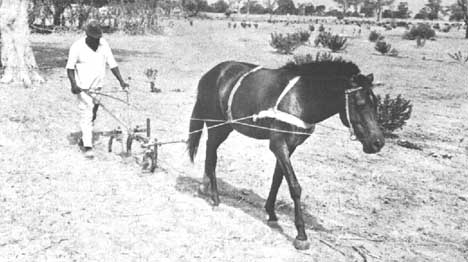
Horse being used for tine-tillage during a workshop field visit. (Photo: Paul Starkey)
These presentations were intended to stimulate the subsequent discussions in small groups, and due to time-slippage during the plenary sessions, there was generally only sufficient time for points of clarification. There was some discussion of the relatively recent farmer-credit and blacksmith-support scheme in Mali, described by M. Sidibé, and whether farmer-blacksmiths themselves could make implements of appropriate quality. There was also discussion, stimulated by the presentation of M. El Himdy of Morocco, concerning the ability of animal traction and tractorization to closely co-exist in Sub-Saharan Africa. It was apparent from questions asked relating to economic data presented that the workshop participants had no commonly accepted standards for defining the profitability of animal traction, and that there were differences of opinion concerning ways of accounting for the value of family labour.
Presentation of the Senegalese experience
M. Havard presented a slide show, with taped commentary, prepared by M. Niang and himself, which highlighted ISRA's role in the evolution of animal traction in Senegal in the past quarter century. M. Sène presented research data on soil tillage trials. MM. Fall, Ndiamé and Sonko presented information on the utilization, constraints, impact and profitability of draft oxen in Lower Casamance, in the southwest of the country. The presentations were based on the following papers:
Niang M. et Havard, M. La culture attelée au Sénégal: les recherches sur la traction bovine: texte du diaporama
Fall, Alioune. Adoption et principales contraintes à la diffusion des matériels de traction animale en Basse-Casamance.
Ndiamé, F. Rôle de la mécanisation dans l'intensification de l'agriculture en Basse-Casamance.
Sène, M. La travail à la dent en traction bovine pour une meilleure infiltration des eaux des premières pluies sur sols gravillonnaires en bordure de plateaux: Centre de Recherche de Kaymor.
Sonko, L. Etude de la traction animale en Basse-Casamance: La disponabilité des animaux de trait dans les exploitations agricoles et les contraintes structurelles.
During the discussion that followed, interest was expressed in the research on tine-tillage, its advantages and its problems. This was later discussed in more detail during a special evening meeting. It was recognised that the provision of agricultural credit had been extremely important in allowing farmers to buy animal traction equipment, and that the present lack of credit severely restricted farmers' ability to invest or reinvest in equipment. It was noted that some of the research "successes" shown in the ISRA slide presentation had not actually been adopted by farmers.
Field visit
A central element of the workshop was the field visit and subsequent discussions. Participants were initially given a basic choice between villages using mainly horses and donkeys, villages using mainly oxen, or villages employing animals for water-raising and grinding. The further division of participants into nine small groups was made on the basis of language ability and ensuring a mix of nationalities and disciplines in each group. Eight small groups of 5-8 people visited individual villages, met farmers and depending on the village visited, saw farmers using horses, donkeys and oxen for tine-tillage, seeding and weeding. One larger group of 16 people visited two villages with animal-powered water-lifting and grinding systems and the urban workshop of the blacksmith who fabricated the installations.
Discussion of the field visits
The day after the field trip, the same small groups that had visited the different villages met again to discuss what they had seen and learnt from the visits. They used as a framework for discussions the four workshop themes of constraints, production, profitability and impact. The following day the groups presented their findings to the plenary session, and these were then discussed.
The lessons of individuals and groups were very varied, and depended greatly on people's previous experiences. Most visitors to Senegal were particularly impressed by the extent to which single horses and donkeys were being used for seeding and weeding (even participants who visited villages where only bovines were employed had been able to observe several hundred equines in use in the fields along the route). Another striking observation for many visitors was the technique of very early weeding: some farmers performed inter-row weeding even before the crops had germinated, weeding the undisturbed soil between the rows of soil disturbed by the earlier passage of the seeder. Many people commented on the very widespread use of animal-drawn carts with pneumatic tyres.
Selected group observations
Constraints
· Environmental constraints included short growing season, severe dry season and animal diseases.· Many farmers considered lack of credit to purchase new implements and fertilizers to be a serious constraint (much equipment was seen to be very old, and little fertilizer was used even in the cotton-growing areas).
· Several farmers reported that difficulty in obtaining animal traction equipment and spares represented a major constraint. Several visitors considered that while limited equipment was indeed a real constraint for individual farmers, it was not actually a primary constraint. Since equipment was seen to be widely available in the towns, the limited distribution and availability might be attributable to the limited purchasing power of farmers, which might in turn be viewed as a secondary effect of limited credit and low farm income.
· Land seemed to be becoming a limiting factor in some areas, and this limited the availability of animal feed and total farm income.
· Some farmers considered the feeding of their work animals to be a constraint, and requested information on how to improve animal nutrition. In one village where seeds of forage cowpeas had once been supplied by research-development workers, farmers requested new supplies of seeds.
Production
· Animal traction appeared to have increased overall production by allowing larger areas to be cultivated.· The use of animal-drawn seeders and weeders appeared to improve timeliness of operations and thereby overall production.
· Groundnuts were very widely grown as a monocrop. Groundnut hay was being conserved, marketed and used as animal feed, but was mainly given to animals used for transport.
· In many instances animal dung was being returned to the soil, but this was not universal, and could usefully be increased.
· Meat was an important product of draft cattle, and animals were often being sold and replaced after two years to make maximum benefit of liveweight gains.
· In some villages female cattle were being used for work, and between one 95th and one third of the draft bovines were cows. Draft cows were considered valuable for the calves that they produced, rather than for their milk production.
Impact
· Animal traction was widely perceived as easing labour bottlenecks and reducing human drudgery.· In some villages, animal traction was seen to be having a positive impact on women, who were using draft animals in their fields. In other villages the women seemed to have little access to draft animals which were all owned by men. Children were very widely used to work with draft animals.
· Widespread destumping and monocropping had increased the efficiency of animal traction use, but both water and wind-erosion seemed to be increasing problems.
· Social obligations such as funerals could seriously disrupt farming operations (and workshop field visits!).
· Animal-powered grinding mills could reduce women's drudgery, by lessening physical pounding or travel to an urban mill. However these advantages were reduced by the need for very dry grain, the intermediate quality of the flour, the social problems of communal milling and the practical problems of obtaining an animal for the short time needed for personal milling.
· It was not clear whether the use of animals for grinding or waterlifting adversely affected their performance for field operations, but this was an area of concern for the women and men in the villages involved.
Profitability
· All groups found it extremely difficult to assess the profitability of animal traction. Most groups observed that persistence of animal traction and its spread suggested animal traction was profitable. Several people observed that uncertain and erratic producer prices and lack of institutional credit adversely affected profitability.· The installation of animal-powered mills or irrigation systems requires relatively high capital costs that are difficult to recover in the target villages, where family incomes are low. Since the financial profitability of animal-powered systems may be insufficient to justify the full capital investment, a broader interpretation of profitability may be appropriate since there may be social benefits for the community. For this reason investment in such installations may have to be viewed as part of a wider, macro-infrastructure (along with rural roads, bridges and water supplies) for which individual villages are not expected to pay the full cost.
General
· Farmers were choosing between horses, donkeys, zebu cattle and N'Dama cattle according to the prevailing disease constraints and soil conditions.· Farmers generally preferred lighter implements, even in villages where strong oxen and heavier implements such as the Ariana and polyculteur were found.
· Many implements in use were poorly adjusted or badly constructed, but nevertheless they were regularly used. Visitors considered that in other countries such equipment would have broken or been abandoned due to operation constraints, and the sustained use of such equipment in the villages might imply relatively favourable soil, environmental and socioeconomic conditions.
· Horses and donkeys were always used singly, with breast harnesses, while oxen and cows were always yoked in pairs.
· Some of the villages visited did not seem to be very typical of rural Senegal. Concentrated research-development actions had reduced village self-dependency and reduced the spontaneity of discussions. There therefore appeared to be a danger in continuing research-development in a limited number of villages.
Specialized presentations and working sessions
During the workshop, several sessions were arranged in the evenings to allow interested participants to discuss more specialized issues. These included:
Collaborative animal-powered gears programme.
Participants from several countries and organizations discussed and planned a three-year programme of collaborative testing of animal-powered systems for water-raising, milling, sawing, threshing, ice-production, oil-extraction, electricity generation and crop drying. It was agreed that, as a result of the discussion, a multi-country request would be presented to the Science and Technology for Development Programme of the European Economic Community for sponsorship. Among the countries likely to participate would be Bangladesh, Belgium, Botswana, Germany, Morocco, Nigeria, United Kingdom and Zambia. Further planning will be coordinated by the University of Warwick.
Animal-powered tillage of dry soils
An open meeting was held for those concerned with tine-tillage implements and systems for cultivating soils in the semi-arid zones, prior to the main rains. Among those attending were researchers from CEEMAT, CIRAD, ICRISAT, Mali, Morocco, Niger, Senegal and Zambia. Several slides were shown of implements being tested, and re search results were discussed. It was recognized that a primary problem was to obtain sufficient cultivation to allow water infiltration and control of weeds using a draft power appropriate to the animals (oxen or donkeys). Several programmes had been unaware of how much similar research was being undertaken in this field, and they agreed to exchange experiences and collaborate more effectively in future.
Animal-gear project, animal training, traditional water-raising systems and artisanal cooperation
Different groups met to see and discuss slide presentations and videos of the GATE animal-powered gear project, the DRSPR-Mali training programme and a scheme to establish animal-powered water-lifting systems in Mauritania using artisans from Morocco.
Future of the network
Although the network has existed since 1985, it did not have any statutes or full-time staff. A key objective of this workshop was to determine the future role and function of the network. During special working sessions arranged from the second day onwards, members of the existing Steering Committee prepared working documents in cooperation with the coordinator of the West Africa Farming Systems Research Network (WAFSRN-RESPAO) and representatives of aid agencies, international research centres and other interested participants. During the workshop, committee members prepared a project proposal designed to formally establish the network and at the same time fund the position of full-time coordinator and a range of network activities. However following discussion with possible collaborating organizations and funding agencies on the morning of 10 July, it was decided the plan was too ambitious. At best it would take a very long time to raise the funds and implement the programme, and at worst might never be funded. It was therefore decided to prepare only basic network statutes that would formally establish the network, but which would not restrict future options. It was suggested that the network might be able to proceed in the same way as WAFSRN, first establishing an agreement between the network representatives and an international organization such as SAFGRAD/OAU, and then recruiting a full-time network coordinator under the auspices of the international organization. Thus network statutes were drafted and presented to a plenary workshop session on the penultimate day. Following discussion, these statutes (see subsequent pages) were accepted in principle, to provide a basis for future network activities and negotiations with collaborating and funding organizations.
Representatives of CIRAD participating in a workshop plenary session.
New committee
All members of the existing network committee stood down, and nominations were received for a new committee comprising six West African members. An election was held during the final plenary session of the penultimate day and the following people were elected (the first four of which had been members of the previous committee):
Adama FAYE (Senegal), K. APETOFIA (Togo), Bai KANU (Sierra Leone), Dramane ZERBO (Mali), Dayo PHILLIP (Nigeria) and Jabel SOWE (The Gambia). The Committee nominated Adama FAYE to continue to act as Committee Representative and recommended that Paul STARKEY should continue to act as the Network Technical Adviser for a further period of two years. These decisions were put to the workshop plenary session on the final day, and were accepted unanimously. The Committee Representative and Technical Adviser were given a mandate to negotiate with collaborating institutions and aid agencies in order to obtain support for future network activities and the recruitment of a network coordinator. The committee invited Michael GOE (ILCA) to accept one of the committee positions reserved for a representative of an international research centre, and recommended that if negotiations with OAU/SAFGRAD proved fruitful, SAFGRAD should be asked to fill the other reserved committee position.
Final day
In the final plenary session, recommendations were proposed concerning the future of the network and topics for further research emphasis. Evaluation forms were completed by all participants present. An analysis of the feedback provided by participants and their assessments of the various workshop components follows in a subsequent section of these porceedings. The workshop was closed with expressions of thanks to the host institution, the organizing team, the various donor agencies and to all participants.
Following the short final session, transport was arranged to allow participants to visit Dakar and the implement factory of SISMAR (Société Industrielle Sahélienne de Mécaniques de Matériels Agricoles et de Représentations) at Pout. SISMAR is one of the largest manufacturers of animal traction implements in Africa, and among its product range are the Super-Eco Seeder, the Houe Sine and Houe Asine toolbars, mouldboard plows and several carts.
Workshop recommendations
Role of animal traction
Animal traction is playing a significant role in many farming systems in the region. It is likely to become increasingly important in the coming years.
Animal traction in perspective
While more attention and greater resources should be given to the study of animal traction in the region, the technology should not be considered in isolation but in a farming systems perspective. In this way enthusiasm for animal-power can be combined with the economic realism of the farmers.
Animal traction and erosion
Animal traction programmes should be aware of the problems of environmental degradation, and should attempt to ensure animal traction technology is combined with positive environmental practices.
Harnessing
Poorly made or fitted yokes and harnesses that are cruel to the animal and frustrating for the operator are still commonly seen. Programmes should ensure that the yokes and harnesses employed are technically efficient and comfortable for the animals. Further research studies are required to establish appropriate standards of harness efficiency and comfort.
Equipment production
Most countries in West Africa have workshops capable of producing animal traction equipment, and there is over-capacity in the region as a whole. Despite this, much manufactured animal traction equipment is being imported into the region, and customs tariffs and the policies of governments and aid agencies may inadvertently encourage this. Many implement-producing workshops are experiencing severe constraints in terms of personnel, capital finance, supply of inputs and local infrastructure. There is great scope for workshops to share their experiences, to cooperate in the ordering of raw materials and to collaborate in supplying the equipment needs of the region. The West Africa Animal Traction Network should endeavour to convene a meeting of animal-traction implement producers of the region, and other interested organizations to investigate the possibility of greater technical and/or economic cooperation. In this the network might usefully cooperate with the agricultural engineering network ACEMA (Association Euro-Africaine des Centres de Mécanisation Agricole).
Animal utilization and animal-powered machines
The farming calendar in the region is such that draft animals are under-utilized if employed solely for crop cultivation. Animals that are regularly used for work are generally better trained and maintained than those that are used for short periods. The use of animal-drawn carts and/or stationary animal-powered systems for water-lifting or crop processing may provide significant social benefits and lead to more efficient and more economical use of draft animals, and to higher standards of animal management.
Social implications
Animal traction programmes should take increasing notice of the various social effects of animal traction adoption, and should strive to ensure that animal traction benefits all members of the community, male and female, young and old.
Animal health and husbandry and feed resources
Inadequate nutrition can be a major constraint to the effective use of draft animals. Animal traction programmes should not restrict their research to the production of more feed, but should consider whether the type of animal(s) being employed is appropriate for the available resources and how existing feed resources could be better conserved and used.
Information exchange
This workshop has clearly highlighted the fact that animal traction programmes in the region have much to benefit from sharing their experiences. The West Africa Animal Traction Network should continue to stimulate such information exchange through similar activities. A Network Secretariat should be established and a full-time Network Coordinator appointed to increase the flow of information through correspondence, publications, meetings, study tours and workshops. The Network should encourage those animal traction programmes that have much experience to take a definite lead in establishing collaborative animal traction research in the region, and through this assist the less developed programmes.
Conclusions
The principal objective of the workshop had been to bring together a wide range of people of various disciplines who were involved in animal traction research, development and extension in order to stimulate the exchange of information and experiences. The workshop certainly succeeded in this objective and the animated discussions during coffee-breaks and meals suggested that informal information exchange was as least as important as that which occurred during formal workshop sessions.
People involved in research, development and extension were able to exchange experiences and learn of similar work being carried out in neighbouring countries. Through the announcements and permanent exhibitions, participants were made aware of resource materials that could help them in their work. Participants from national programmes were able to discuss opportunities for collaboration, support and training with resource organizations and with other national programmes. Several meetings were held for those interested in special topics, and of particular note were those relating to tine tillage and animal-powered gears which are likely to lead to specific collaboration in the coming months and years.
A secondary objective had been to formally establish the network, and this was achieved through the adoption of statutes. A new committee was elected and delegated responsibility to its Representative (Steering Committee Chairman) and Technical Adviser to liaise with possible donor and partner organizations to establish a permanent secretariat with a full-time coordinator.
From the participants comments during the workshop and in their evaluation responses, many participants considered that they had gained greatly in insight and understanding from personal field visit observations, from talking with farmers and colleagues and from the multidisciplinary group discussions. It is impossible to quantify such an output, but by providing such opportunities, it is possible that the workshop will prove to have had a significant and long-term impact on several animal traction programmes in Africa.
Finally, the workshop stimulated research and development workers to put many of their experiences on paper. The publication and circulation of these papers in this volume of workshop proceedings should provide an interesting resource document on animal traction which should stimulate other people to share their experiences in the future, so furthering the aims of the network.