by
M. C. Klaij and P. G. Serafini
International Crops Research Institute for the Semi-Arid Tropics Sahelian Centre (ICRISAT-ISC), Niamey, Republic of Niger
Abstract
Pearl millet (Pennisetum glaucum) is a major staple crop in semi-arid West Africa. In Niger, the millet-growing area has doubled during the past 25 years, but Average grain yields have dropped to 300 kg ha-1. Difficult soil conditions, low rainfall and short growing season are severe constraints to millet production.
A series of long-term field experiments have been conducted at the ICRISAT Sahelian Centre to evaluate the effects of tillage, fertilization, maintenance of crop residues and crop management practices on the establishment, yield and water use of pearl millet. Some results of the trials are presented. They suggest that phosphate fertilizer was the most important factor increasing millet and cowpea yields. Maintaining crop residues on the fields enhanced the effectiveness of fertilizers and tillage. Primary tillage improved crop establishment and yields, particularly in combination with fertilizers. Ridging seems to be the most promising primary tillage technique. Animal-powered intercultivation is agronomically effective if accompanied by handhoe weeding within rows. It reduces the overall labour requirements of weeding, the principal labour bottleneck in the present system.
The effects of timing and tillage method on cowpea-millet rotations were also studied. Cowpea rotation had a positive effect on millet yield. The timing of tillage had no effect on millet yield, suggesting that end-of-season cultivation using draft animals may be appropriate.
It is concluded that animal traction can help overcome limited and untimely cultural practices and complement the use of other improved inputs. Animal power offers Sahelian farmers the only alternative for mechanizing tillage and weeding operations for the foreseeable future.
Introduction
Pearl millet (Pennisetum glaucum) is a major staple cereal crop grown on 14 million hectares of the semi-arid Sahelian and Sudanian ecological zones in West Africa. The crop is generally grown in association with other crops by subsistence farmers using manual labour for all cropping operations. Chemical fertilizers are rarely applied. Cash inputs for crop husbandry are limited to the occasional hiring of labour. Seasonal labour shortages are most severe in the critical planting and weeding periods.
During the past 25 years, the millet-growing area in the Republic of Niger has doubled to 3.2 million hectares, while average grain yields have dropped from 480 kg ha-1 to 300 kg ha-1 Up to this time, the increases in millet production that have been needed to feed a rapidly growing population have come entirely from expanding the area under cultivation. The decline in yields suggests that:
· production has expanded into increasingly marginal areas;
· fallow periods have become too short to allow natural restoration of fertility (Norman, 1982);
· technological change has not yet had an impact on food production (Spencer, 1985).
If future food needs are to be met without further degrading the limited agricultural re source base, it seems mandatory to use techniques that give sustainable yield increases but which do not depend on further extensification. Experience at the ICRISAT Sahelian Centre (ISC) leads us to believe that yield increases are technically feasible if the principal limiting agronomic factors of inherently low soil fertility, limited and untimely cultural practices and the occurrence of drought periods can be overcome (Fussell, Serafini, Bationo and Klaij, 1987). The use of animal traction will contribute to overcoming the second constraint and will complement the use of other improved inputs (Bansal, Klaij and Serafini, 1988). For the foreseeable future, animal power offers Sahelian farmers the only alternative for mechanizing tillage and weeding operations.
The paper presents the results of field experiments at the ISC which addressed these agronomic constraints. The discussion first focuses on the effects of added fertilizer, tillage, and crop management practices on the establishment, yield, and water use of pearl millet. Then a preliminary evaluation is presented of the effects of combining promising techniques from several agronomic experiments. These relationships have been studied on a field scale to facilitate the monitoring of labour inputs. The use of animal traction to mechanize tillage and weeding operations is one of the techniques that is considered.
Environmental constraints
At the ISC, the average annual rainfall is 560 mm and the average growing season lasts 94 days (Sivakumar, 1987). The short growing season imposes severe time constraints on the proper execution of tillage, planting and crop operations. The lack of power for tillage and weeding aggravates this situation. In addition, soils on which millet is grown, predominantly Alfisols, become very hard in the dry season, making tillage difficult or impossible. These soils are generally phosphorus deficient, low in organic matter, and have bulk densities that limit root development. Runoff may result from crusting, high bulk densities or impermeable layers in the soil profile that impede the infiltration of rainfall. The practice of removing and/or heavily grazing crop residues tends to exhaust the innate soil fertility and leaves the soil surface exposed to the erosive forces of wind and water.
The effects of tillage and residues
On the sandy soils (sand fraction 90%) at the ISC, the reductions in bulk density and the soil surface modifications that result from tillage do not have an important impact on infiltration capacities, which are inherently very high at over 100 mm h-1 (ICRISAT, 1985). However reduced bulk density due to tillage results in enhanced rooting. This in turn leads to greater access to soil moisture (Klaij and Hoogmoed, 1987) and increased fertilizer uptake, and so to more secure and higher yields. These effects are more pronounced where rainfall is limited. Similar results have been reported from other research in West Africa (Charreau and Nicou, 1971; Chopart, 1983). The same research demonstrated the crucial role organic matter has in maintaining soil fertility for sustained crop production (Pier), 1987).
In other parts of the world on similar soils, soil surface modifications, such as ridging, have been shown to reduce soil losses due to wind erosion by as much as 85% (Fryrear, 1984). Furthermore, modest amounts of crop residue left on the soil surface (as little as 600 kg ha-1) have led to reductions in soil erosion losses by as much as 57% (Fryrear, 1985).
Experimental trials at ISC
A number of experiments addressing the relationships between soil and crop management factors were conducted at the ISC. The contrasting levels of tillage, fertilization and crop residue treatments were the same in all experiments.
Tillage, fertilizer and crop residue effects
A long-term experiment has been undertaken to evaluate the effects of primary tillage, fertilization and the maintenance of crop residues. The tillage treatments were carried out immediately after the first rainfall in May or June that exceeded 8 mm. This is possible because the high rates of internal drainage that are typical of very sandy soils result in the soil coming to field capacity rapidly after rainfall. The treatments comprised.
Table 1: Effect of fertilizer and primary tillage and also of maintaining crop residues on dry matter yield (kg ha-1) of pearl milleta
|
Treatmentb |
Fertilizer 0b |
Fertilizer 1b |
||||
|
Residue removed |
Residue maintained |
Mean |
Residue removed |
Residue maintained |
Mean |
|
|
Plowing |
2460 |
4160 |
3310 |
5480 |
5680 |
4440 |
|
Ridging |
1970 |
2800 |
2380 |
4690 |
5860 |
3830 |
|
Zero-till |
2220 |
3270 |
2740 |
4720 |
5430 |
3910 |
|
Meanc |
2210 |
3410 |
2810 |
4960 |
5560 |
5310 |
Notes:
a) ISC averages over the 1985-87 rainy seasonsb) Fertilizer 0: no fertilizer added, Fertilizer 1:17 kg P ha-1 and 40 kg N ha-1.
Randomized block replicated 4 times in a split-split plot: sub-sub plot size 60 m2c) SE for comparing means are:
±223 for fertilization; ±108 for tillage; ±88 for residue; ±298 for their interaction
Tillage
Plowing to a depth of 15 cm;Ridging without prior tillage (spacing 75 cm, ridge height 15 cm);
Control treatment without primary tillage..
Fertilizer
Application of 17 kg P ha-1 before cultivation and 40 kg N ha-1 in a split dose 2-3, and 4-6 weeks after sowing;Control with no fertilizer application at all.
Crop residues
Maintaining millet stover left on the surface or partially incorporated by plowing or ridging;
Millet stover removed.
A uniform stand of millet (13,000 hills ha-1) was planted in rows, 75 cm apart. Crop growth, water use, organic matter, and soil pH were monitored. The experiment was located on sloping land (34%) that is surrounded by bush-fallow which provides effective protection from wind erosion. As a result, plant stands were close to 100% of the hills sown in all years. Management effects will be discussed in terms of dry matter production (Table 1).
There was an important interaction between tillage, fertilizer addition and maintaining crop residues. In the absence of added fertilizer, crop residues increased dry matter production considerably, particularly after incorporation of the residue by plowing. In the case of ridging and zero-tillage, crop residues also increased dry matter yields also but at a lower level.
Apparently, reduced soil bulk density enhanced crop root growth and the plowed-in residues decomposed faster, releasing more nutrients compared to the other tillage treatments. In the presence of added fertilizer, yield differences were much smaller. Crop residues did not increase yield in case of plowing, probably because of the availability to the crop of well-incorporated phosphate fertilizer. Maintaining residues in conjunction with ridging tended to improve productivity more than the plowed and zero-tillage situations.
While the effect of primary tillage were relatively small, soil bulk densities, typically ranging between 1.55 and 1.76 t m-3 prior to tillage (soil porosity 34-42%) were reduced to 1.22 t m-3 (soil porosity 54%). Between 1985 and 1986, maintaining crop residues increased soil organic matter from 0.26% to 0.29% (SE = ± 0.006) while the pH-KCl increased from 4.98 to 5.16 (SE = ± 0.06). In this case, the beneficial effects of maintaining crop residues are most likely to come from changes to soil chemical and biological processes. During crop establishment, typical maximum soil temperatures at a depth of 5 cm reached 42°C and were only moderately reduced, by 1-2°C, by the sparse residue cover on the soil surface. Nonetheless, this small difference could affect seedling survival. The average seasonal crop water use, ranging from 300 mm to 350 mm, increased only slightly (10 mm to 35 mm) on high input plots. However, water use efficiency improved considerably with intensified management because of the important yield gains that accompanied increased water use.
Table 2: Effect of weeding method on millet yield and dry-matter productiona
|
Treatment |
Yield (kg ha-1) |
||||
|
Millet grain |
Millet dry matter |
Weed dry matter |
Total dry matter |
||
|
No weeding |
100 |
470 |
3250 |
3720 |
|
|
Inter-row cultivation on. |
330 |
1400 |
2640 |
4040 |
|
|
Inter-row cultivation and hand weeding |
850 |
3020 |
710 |
3730 |
|
|
Hand weeding only |
950 |
3690 |
270 |
3960 |
|
|
|
SE |
± 48 |
± 150 |
± 100 |
± 190 |
|
|
CV (%) |
42 |
34 |
32 |
24 |
Note
a) ISC: 1987 rainy season. Plot size 10 x 3 m.
Timing of tillage and crop rotation
In another soil management experiment, the effects of the timing and choice of primary tillage method were evaluated together with the presence or absence of a leguminous crop rotation. Continuous millet and cowpea-millet rotation were compared. The tillage treatments (plowing, ridging and zero-tillage) were the same as the previous experiment. Tillage was either carried out at the end of the previous cropping season or at the beginning of the new season. A blanket application of phosphate fertilizer (17 kg ha-1 was given before planting. The two crops were sown the same day, cowpea at 32,000 hills ha-1 and mil let at 13,000 hills ha-1. A uniform millet crop was planted on all plots in the second year.
There was a positive residual effect of the cowpea rotation on the yield of the millet that followed. This effect was more pronounced when primary tillage was practiced, regardless of the type or timing. The cowpea rotation increased the average millet grain yield from 480 to 650 kg ha-1 (SE = ± 20). Primary tillage increased grain yields from 450 kg ha-1 on zero-tillage plots to 630 kg ha-1 (SE = ± 30) on treatments that received primary tillage. The timing of tillage had no effect on millet yield, nor was there an interaction between the timing and type of primary tillage. This may be important as traction animals will generally be in better condition for work immediately after the end of the rainy season than at the start of the rains (after the long dry season).
Weed management
In traditional millet production systems weeding is done largely with a hand-hoe. The quality of manual weeding is potentially high. However, weeding effectively limits the area that can be cropped because of its enormous requirement for labour.. The mechanization of weeding operations using animal traction (AT) reduces human labour requirements and increases the timeliness with which weeding operations can be carried out. However, animal-traction weeding leaves weeds within the row untouched.
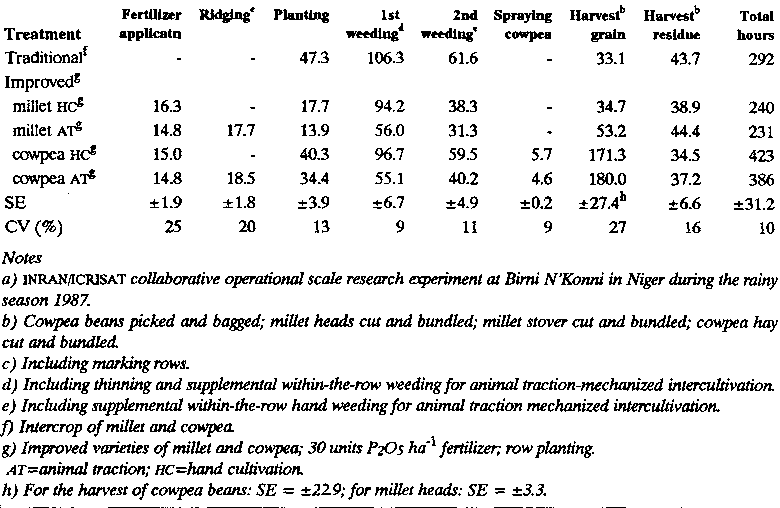
Table 3: Labour time requirements (person-hours ha-1) of field operations for five cropping systemsa
An experiment was undertaken to compare the agronomic effectiveness of various ways of weeding. The following weeding treatments were applied:
two mechanical inter-row weedings, using an adjustable cultivator pulled by a single donkey;
the same treatment with additional within-the-row hand weeding;
traditional hand-hoe weeding (twice);
a control with no weed control.
The weeding treatments were applied to either ridged or no-tillage plots. Phosphate fertilizer (17 kg ha-1 was broadcast before tillage. Weed samples were taken within and between the rows, and their dry-matter was subsequently determined. Millet establishment was good and the population remained stable throughout the season. Plant height at 40 days after seeding was used as a measure of early crop growth. Plant height was 0.72 m where there was no primary tillage, 0.83 m with ridging (SE = ± 0.016), 0.67 m without weed control, 0.79 m with mechanical weeding but without within-the-row hand-hoe weeding, 0.78 m with mechanical and within-the-row hand-hoe weeding, and 0.88 m with high quality traditional hand-hoe weeding (SE = ± 0.022).
Ridging increased crop dry matter from 1920 kg ha-1 to 2370 kg ha-1 (SE = ± 110) but grain yields were similar with and without primary tillage (see Table 2). It is evident that mechanical weeding alone does not provide adequate weed control. Mechanical weeding without within-the-row weed control yielded 330 kg ha-1 of grain while the addition of within-the-row hand-hoe weeding yielded 850 kg ha-1 High quality traditional hand-hoe weeding suppressed weeds most effectively and had a grain yield of 950 kg ha-1
It is interesting to note that the total drymatter production of crop and weeds is relatively stable across treatments at about 3860 kg ha-1 indicating clear competition between crop and weeds. In the case of intercultivation without weeding within the row, the within-row weed growth was greater than in the non-weeded plots. This more vigorous compensatory weed growth was felt to account for the poor performance of mechanical weeding alone. At the same time, the results indicate that animal-traction weed control is effective if it is supplemented by within-row hand-hoe weeding.
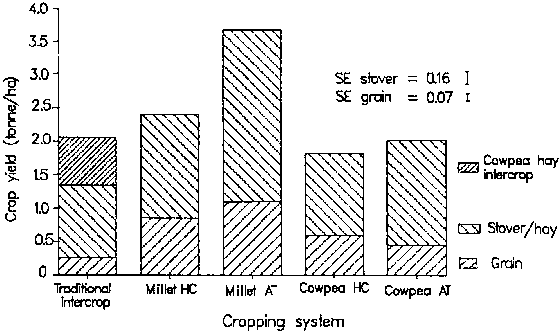
Fig. 1: Crop yield components of a traditional system and of two "improved" systems, each with animal traction for tillage and weeding (AT) and without (HC). Results from Birni N'Konni Niger in 1987 rainy season..
Operational scale research
The year 1987 saw the first season of collaborative operational-scale experiments at Birni N'Konni, Niger. This involved both INRAN (Institut national de recherches agronomiques du Niger) and ICRISAT. "Improved" cultural practices were combined into groups or "packages." The improved practices included phosphate fertilization and monocropping with improved varieties of pearl millet and cowpea. Hand labour and the use of animal traction for ridging and weeding were part of the improved cultural practices. A "traditional" treatment was also compared, and this included the local millet cultivar with cowpeas as an intercrop and this did not receive phosphate fertilizer.
All these treatments were severely tested because the first planting rain arrived 35 days later than normal. Furthermore the total rainfall was only 240 mm, well below normal. Despite the highly deficient rainfall, fertilization increased the pure stand millet grain yield to 850 kg ha-1 compared to 260 kg ha-1 of grain in the traditional system of mixed cropping of millet and cowpea without added P. The yield of stover was also higher (1550 kg ha-1 compared with 1080 kg ha-1). The pure stand of cowpea yielded 600 kg ha-1 of grain and 1230 kg ha-1 of hay while the traditional system yielded 10 kg ha-1 of cowpea grain and 710 kg ha-1 of hay (Fig. 1).
Planting on ridges and mechanized inter-row weeding with animal traction increased yields of millet grain (by 160 kg ha-1), millet stover (by 1000 kg ha-1) and of cowpea hay (by 340 kg ha-1). On the other hand, yields of cowpea grain were reduced by 130 kg ha-1 with the use of animal traction. It was felt that the more vigorous vegetative growth associated with the animal-powered tillage and weeding system resulted in lower seed-set.
Mechanization of inter-row weeding reduced the time spent on the first weeding (including manual thinning) by 42% (to 56 person-hours ha-1) and the second weeding by 37% (to 36 hours ha-1. The human labour requirements of treatments for the entire season were:
|
Millet, traditional |
292 hours ha-1 |
|
Millet, hand-cultivated |
240 hours ha-1 |
|
Millet, animal traction |
231 hours ha-1 |
|
Cowpea, hand-cultivated |
423 hours ha-1 |
|
Cowpea, animal traction |
386 hours ha-1 |
Table 3 provides a breakdown of the times required for each operation. The higher labour use figures for intensified Cowpea production were directly associated with their higher yields, since Cowpea pods are difficult to harvest by hand. Cowpea grain harvest required 175 hours ha-1.
Conclusion
The single most important factor increasing millet and cowpea yields was phosphate fertilizer. The maintenance of crop residues on the field enhanced the effectiveness of fertilizers and of primary tillage, and also improved the soil environment. Primary tillage, regardless of when it was carried out, improved crop establishment and yields, particularly in combination with fertilizers. Ridging seems to be the most promising primary tillage technique. It is known to consume less time and energy than plowing and was as effective in this series of experiments. It is also a practice that has been adopted by farmers using animal traction elsewhere in West Africa. Animal-powered intercultivation is agronomically effective and reduces the overall labour requirement of weeding if it is combined with hand-hoe weeding within the row. Such a reduction is very important since hand-weeding is generally considered to be the principal labour bottleneck in the present system.
Résumé
Dans les zones semi-arides de l'Afrique occidentale, la brièveté de la saison de maturation végétale impose des contraintes de temps importantes sur les méthodes qui sont aussi affectées par des conditions pédologiques difficiles et une pluviométrie basse. L'ICRlSAT a effectué des expériences sous conditions réelles pour évaluer les effets des engrais chimiques, du labour et de différentes méthodes de gestion culturales sur la mise en place, la production et le conditionnement hydrique du millet. Le labour accroît l'humectation des sols et le niveau de pénétration des engrais. Le buttage réduit les effets de l'érosion éolienne. L'importante interaction de ces techniques contribue à l'amélioration de l'environnement hydrique. D'autres essais ont servi a évaluer diverses méthodes, plans d'exécution des labours et rotation des légumineuses. La rotation du niébé favorise une augmentation des rendements du millet. Le type de plan d'exécution des labours n'a pas d'effet remarquable sur la production de millet, et aucune interaction ne fut remarquée entre le plan et le type de labour. La traction animale peut aussi jouer un rôle important dans le contrôle des adventices en réduisant les temps de main-d'œuvre et en assouplissant le calendrier cultural. Les essais ont montré que le meilleur niveau de désherbage par TA doit s'accompagner d'un désherbage manuel entre les sillons. Sur l'ensemble de la saison, le système de culture traditionnelle du millet requiert 292 heures-homme ha-1; 240 heures-homme ha-1 pour le système associant engrais et culture manuelle du millet; et 231 heures-homme ha-1 pour le millet cultivé en traction animale. La culture manuelle du niébé nécessita 423 heures-homme ha-1 et 386 heures-homme ha-1 en traction animale. L'utilisation de la traction animale permet de résoudre les limites et les problèmes relatifs aux opérations culturales et à leur calendrier, tout en étant un complément utile aux autres intrants. La traction animale représente en effet la seule alternative de mécanisation actuellement ouverte aux fermiers de la zone sahélienne pour les labours et le désherbage.
References
Bansal R. K, Klaij M. C. and Serafini P. G. 1988. Animal traction in improved farming systems for the semiarid tropics: the ICRISAT experience from India and West Africa. pp. 139-147 in: P. H. Starkey and F. Ndiamé (eds), Animal power in farming systems. Proceedings of networkshop held 17-26 September 1986 in Freetown, Sierra Leone. Vieweg for German Appropriate Technology Exchange, GTZ, Eschborn, Federal Republic of Germany. 363p. (E/F).
Charreau C. and Nicou R. 1971. L'amélioration du profil cultural dans les sols sableux et sablo-argileux de la zone tropicale sèche ouest-africaine et ses incidences agronomiques. Agronomie Tropicale. 26: 209-255; 531-565; 903-978; 1138-1247. (F).
Chopart J. L 1983. Etude du système racinaire du mil (Pennisetum typhoides) dans un sol sableux du Sénégal. IRAT-CNRA Bambey, Institut Sénégalais de Recherches Agricoles (ISRA), Dakar, Senegal. (mimeo, non public). (F).
Fryrear D. W. 1984. Soil ridges, clods and wind erosion. Transactions of the ASAE 27 (2): 445-448. (E).
Fryrear D. W. 1°85. Soil cover and wind erosion. Transactions of the ASAE 28 (3): 781-784. (E).
Fussell L K, Serafini P. G., Bationo A. and Klaij M. C. 1°87. Management practices to increase yield and yield stability of millet in Africa. pp.255-268 in: Proceedings of the International Pearl Millet Workshop held 7-11 April 1986, ICRISAT Centre, India. International Crops Research Institute for the Semi-Arid Tropics (ICRISAT), Patancheru, India. (E).
ICRISAT 1985. Annual Report 1984. International Crops Research Institute for the Semi-Arid Tropics (ICRISAT), Patancheru, India. (E).
Klaij M. C. and Hoogmoed W. B. 1987. Crop response to tillage practices in a Sahelian soil. In: Soil, water and crop management systems for rainfed agriculture in the Sudano-Sahelian zone. Proceedings of workshop held 11-16 Jan 1987, Niamey, Niger. International Crops Research Institute for the Semi-Arid Tropics (ICRISAT), Patancheru, India. (in press). (E).
Norman D. W. 1982. Socio-economic considerations in sorghum farming systems. In: Sorghum in the eighties. International Crops Research Institute for the Semi-Arid Tropics (ICRISAT), Patancheru India. (E).
Pieri C. 1987. Food crop fertilization and soil fertility the IRAT experience. pp. 74-109 in: H. W. Ohm and J. G. Nagy (eds), Appropriate technologies for farmers in semi-arid West Africa. University of Purdue, West Lafayette, Indiana, USA. (E).
Sivakumar M. V. K 1987. Agroclimatic aspects of rainfed agriculture in the Sudano-Sahelian zone. In: Soil, water and crop management systems for rainfed agriculture in the Sudano-Sahelian zone. Proceedings of workshop held 11-16 Jan 1987, Niamey, Niger. International Crops Research Institute for the Semi-Arid Tropics (ICRISAT), Patancheru, India. (in press). (E).
Spencer D. S. C. 1985. A research strategy for small farm development in sub Sahara Africa. pp. 308-325 in: H. W. Ohm and J. G. Nagy (eds), Appropriate technologies for farmers in semi-arid West Africa. University of Purdue, West Lafayette, Indiana, USA. (E).