by
Samuel Ogweno Onyango
Project Co-ordinator, Animal Draft Power Development Project, Department of Agricultural Engineering, University of Nairobi Kenya
Abstract
With increasing costs of motorization, tractor use is no longer an opinion for small-scale farmers in Kenya. The Animal Draft Power Development Project survey indicated that although draft oxen are widespread, they are inefficiently used in farming. Animal traction implements available are limited in use to land preparation. Strategies to optimize draft animal power include: training for animals and farmers, alternative harnessing techniques, and the development of additional implements. Extension work is greatly needed to promote animal-powered secondary tillage operations, to encourage the use of collar harnesses and to make use of donkeys in crop cultivation. A suitable package is currently being developed to bring plows, harrows, planters, cultivators and carts to the farmers. Draft animal power remains the mainstay of agricultural production in Kenya.
Background
Draft animals in Kenya include oxen, donkeys and, to a more limited extent, camels. Oxen and donkeys are well distributed throughout the country. Use of oxen for cultivation was unknown in Kenya until after World War I when it was introduced by European settlers from South Africa. This was in spite of the fact that neighbouring Ethiopia had been using draft animals for cultivation for many centuries before. The technology was selectively adopted mainly by people who visited the farms of the European settlers. However the process of adoption was interrupted by the introduction of tractors shortly after World War II. After independence in 1963, the Tractor Hire Service of the Ministry of Agriculture offered tractors for hire at fairly cheap rates. From the late sixties until mid-seventies tractors were very popular and draft animal cultivation was viewed as a backward technology. Socio-economic factors have however, reversed the trend. Changes in the land tenure system, decline in international commodity prices, uncertain credit schemes and conditional credit and buying schemes by the marketing boards reduced the potential for smallholder tractor use. This was coupled with the ever increasing costs of fuel, agricultural machinery and spare parts which pushed the tractor option out of the reach of the small-and medium-scale Kenyan farmers. This called for reconsideration of other strategies and animal traction was acknowledged as a viable option. The Ministry of Agriculture (MOA) drafted a programme of utilization of AT as early as 1970.
Present methods of use
Recent studies conducted by the Department of Agricultural Engineering of the University of Nairobi (Dibbits, 1985) indicate the following:
· Oxen are used for plowing. A team of four is common, but some farmers use as many as six oxen.· The oxen are usually obtained from local small herds and farmers use whatever animals they own, with no selection for suitability to draft work.
· Cows are not utilized for work, even when they are not producing any milk.
· There is no standard system of training of the draft animals.
· All the farmers covered in the study had only one implement: the "Victory" mouldboard plow. This is employed to achieve a harrowing effect by cross-plowing, and it is also used for covering seed and fertilizer at time of planting.
· Farmers hardly ever use their draft animals outside the plowing season.
· The traditional oxen yoke is used for harnessing oxen.
· Donkeys are not used for any cultivation work are employed as pack animals for transporting water, fire wood, materials and goods. Some also pull carts using a "sack cloth harness".
These results suggest that while draft animals are useful to farmers, there is considerable underutilization of draft animal power. The draft oxen are only used for 120-150 hours per year. This is equivalent to four to five hours per day for one month in a year, with no work for the animals for the rest of the year. Donkeys on the other hand, although not used for cultivation, are used for transport daily for an average of 5 hours.
Strategies for profitable production with animal traction
New strategies have been developed to improve the exploitation of draft animal power and the following areas were considered;
· selection and training of draft animals;
· harnessing of draft animals;
· training of farmers;
· design and development of suitable animal drawn implements;
· establishment of re' able support services;
· increased use of donkeys for cultivation.
Selection and training of draft animals
The Animal Draft Power Development Project (ADPDP), in conjunction with the Ministry of Agriculture, periodically organizes short courses for extension officers and interested farmers in which the selection and practical training of draft animals is taught. Emphasis is laid on good animal nutrition and health as preconditions of good output. Similar courses are arranged for groups of farmers in farmers training centres. Regular plowing competitions are also organized to encourage good techniques of draft animal training and handling and to demonstrate how skilful plowing gives better results. Breeding of draft animals just like breeding of beef and dairy animals is considered important (Pathak and Gill, 1984) but no attempt has been made in this direction in Kenya. This is partly due to the dual nature of farmers' interest in draft animals: farmers look upon their animals as savings and thus feel free to sell them at any time without any consideration for the time invested in the training for draft work. In spite of this, the ADPDP considers that the selection and breeding of draft animals may have long-term benefits for animal traction in Kenya.
Harnessing of draft animals
The ADPDP carried out studies to estimate the power efficiency of the traditional oxen yoke. It was found to be relatively inefficient due to a high pulling point (large hitch angle) which results in a small horizontal draft component despite a high pulling effort by the animal. Furthermore, the traditional yoke has a small contact area with the neck of the animal and this results in yoke sores, especially during peak seasons of work (Dibbits, 1984). It was against this background that work started on improving harnessing systems with a view of fitting the harness to suit the animal and at the same time making it as power effective as possible.
The collar harness
As a tentative improvement, the collar harness was adapted for donkeys and for oxen with a provision for a wide range of adjustments for the size of the animal. After testing for several months the following were considered as strong points for the harness:
· Low pulling point (slightly above the shoulder of the animal) allows the animal to pull more effectively.· The well-padded shoulder cushions and neck pads of the harness distribute the working pressures over a large surface area so reducing stress intensity.
· Absence of relative motion or rubbing between the harness and the body of the animal eliminates harness sores or wounds.
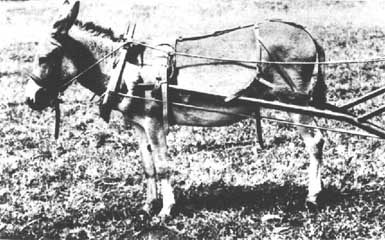
The collar harness was also found to be very suitable for donkeys (Fig. 1). Further tests were conducted to compare the collar harness with the oxen yoke. It was observed that the draft required for a given task was nearly halved. A pair of oxen using the collar harness could do the same work as two pairs using the traditional yoke. A pair of donkeys working with the collar harness could do the same work faster than physically heavier oxen with either collar harness or traditional yoke (unpublished data of Onyango, 1987). The reasons for this difference are still being investigated. Another strong point for the harness is the use of a single animal for cultivation, especially in activities like ridging, harrowing and weeding between row crops.
Demonstrations were conducted during farmers' field days, in agricultural shows and in various farmers' training centres in 1985 to introduce the harness to the local farmers. The response was very encouraging. In the same year about 300 pairs of collar harnesses were bought by local farmers despite the fact that the collars cost about four times the cost of an ox yoke. Demand has since been going up each year. The project has demonstrated donkey plowing in various animal plowing competitions and it appeared that one or two pairs of well-trained donkeys fitted with collar harnesses can plow as well as a pair of oxen and often the donkeys can do a better job faster. This has significantly changed the attitude of many farmers towards donkeys.
Two major problems for the collar harness have been its high cost and the lack of any large-scale production initiatives by local firms. Efforts are therefore being concentrated on addressing these problems and promoting the virtues of the collar harness.
The ox yoke
The ox yoke has also been improved by adapting it more to the anatomy of the draft oxen. This was done by shaping the contacting parts of the yoke to conform with the neck profile of the draft animal, providing a larger contact surface. After shaping, the curves were cushioned using canvas stuffed with tail hair. The larger contact surface of the yoke ensures that the stresses induced during work are distributed over a large area thus minimizing their intensity. Oxen using the improved yoke were free from yoke sores or scars even in peak periods of work (Dibbits, 1984).
Training farmers
The involvement of farmers is crucial if the objectives of the ADPD project are to be achieved. The target group has been those farmers who already own draft animals, but who are not using them, or who are using them improperly or inadequately. Creating awareness is achieved through animal traction demonstrations during the institutional open days, farmers' field days, plowing competitions and agricultural shows. Cooperation with field extension officers and various interested non-governmental organizations and volunteer agencies has been instrumental in relaying the message. Rather than attempting to impose ideas on uninterested farmers, it has been found better to let farmers understand the principles of animal traction and then let them make decisions and take initiatives. However particular attention is being given to pastoral tribes who are beginning to adapt themselves to settled life and crop cultivation. The use of animal traction in such cases is a part of the integrated approach to assisting such communities.
Development of animal-drawn equipment
The profitability of using animal traction can be greatly increased by investing in a whole package of suitable animal-drawn equipment. In most parts of Kenya, annual cropping is the norm and it is common practice to use animals only for land preparation. Subsequent operations only use manual labour, mainly because appropriate equipment for animal-powered operations are lacking (Meijer, 1985). A farmer using animal traction should be able to mechanize most of the farm activities and so justify the keeping of draft animals. Secondary tillage operations like harrowing, planting and weeding of row crops should be carried out using animal power, and this can only be done when the farmer has access to the necessary equipment. Transport on the farm is another important activity that needs to employ animal power fully. The Department of Agricultural Engineering in conjunction with the Ministry of Agriculture is working on a suitable package of animal-drawn equipment to enable the farmers to use draft animal power more profitably. The package includes plows, harrows, planters, cultivators and carts. The cooperation of light-engineering industries is being enlisted to mass-produce such equipment to ensure a reliable supply. The use of draft animals to drive mills is also being considered as an area where the animals could be used on a daily basis, thus increasing the profitability of their employment. Traditionally oxen have been used in the South Nyanza district to drive sugar cane crushers which extract cane juice for the small-scale manufacture of brown sugar. This technology can be improved and extended to the use of draft animals for driving grain mills, or water pumps for shallow wells (Busquets, 1986).
Support services
Absence of reliable support services can be a major constraint to profitable employment of draft animals. The farmers employing draft animals need to be assured of a reliable source of harnesses and other animal traction equipment. The repair services need to be available at village level. Efforts have been directed to establish production units, and a supply network equipped with the relevant repair skills.
Use of donkeys for cultivation
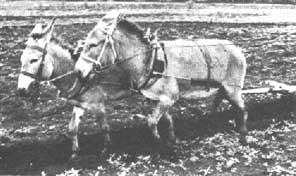
Cultural beliefs, traditional prejudice and lack of suitable harnessing has denied the donkey an active role in crop cultivation. Having worked with donkeys since 1984 (see Fig. 2), the ADPDP strongly recommends the use of these animals for draft work for the following reasons:
· Donkeys are easy to train and once trained do not need to be retrained after a break of use.· They are easier to handle and are more resilient than oxen.
· They can work for more hours per day without loss of condition provided they are well fed.
· Donkeys in Kenya hardly carry any ticks and are therefore largely free from tickborne diseases.
· They can survive with less grazing than oxen.
· They are usually more willing to work than oxen and can walk straight and keep furrows straight while plowing.
· Trained donkeys require only one person to control them.
Conclusion
For profitable employment of animal traction, the technology must be diversified over a wide range of farming activities. It needs to be planned to get maximal benefits from keeping and maintaining draft animals. This led to the integrated approach advocated by the ADPDP.
With good selection, training, nutrition and health care and a reliable support service, draft animals can significantly increase the productivity of the small- and medium-scale farms. The farmer obviously has the final say in choosing what to adopt and extension efforts must bear this in mind. Notwithstanding the large-scale use of motor power in farming and transport, animal traction remains the mainstay of agricultural production in Kenya.
Résumé
L'augmentation sans cesse croissante des coûts rend la motorisation inadaptée aux besoins des petites exploitations agricoles du Kenya. L'enquête menée par le Projet de développement de la traction animale révèle que même si les boeufs de trait sont très répandus, ils sont largement sous-employés. Les équipements de culture attelée disponibles se limitent aux opérations de préparation du sol. Les stratégies proposées pour l'optimisation de la traction animale incluent: formation des paysans, dressage des animaux, amélioration des techniques d'attelage, développement des équipements agricoles appropriés. Des efforts importants de vulgarisation sont nécessaires pour stimuler les opérations de labour secondaire, l'utilisation du collier et de la puissance de trait des ânes. Une chaîne d'équipements est actuellement développée (charrue, herse, planteur, cultivateur, charrette). La traction animale demeure le principal pilier de la production agricole au Kenya.
References
Busquets E. 1986. The power gear makes it worthwhile to keep draught animals. GATE Questions, Answers, Information (GTZ) 4/86:13-16. (E).
Dibbits H.J. 1984. Proper harnessing kg to better use of draught animals. Kenya Farmer (November) 6-9. (E).
Dibbits HJ. 1985. Animal draft power development project: progress report No.1. Department of Agricultural Engineering, University of Nairobi, Kenya. (unpublished). 36p. (E).
Meijer RA 1985. The development of ok-drawn farming equipment in Kenya. Landbouwtechnick Thesis, Department of Agricultural Engineering, Wageningen, The Netherlands. 102p. (E).
Pathak B.S. and Gill B.S. 1984. Management and utilization of cattle for work. pp. 8-20 in: Animal energy in agriculture in Africa and Asia. Animal Production and Health Paper 42, Food and Agriculture Organization of the United Nations (FAO), Rome, Italy. 143p. (E/F).