Climate and ecology
Population and livestock numbers
Crop and livestock production
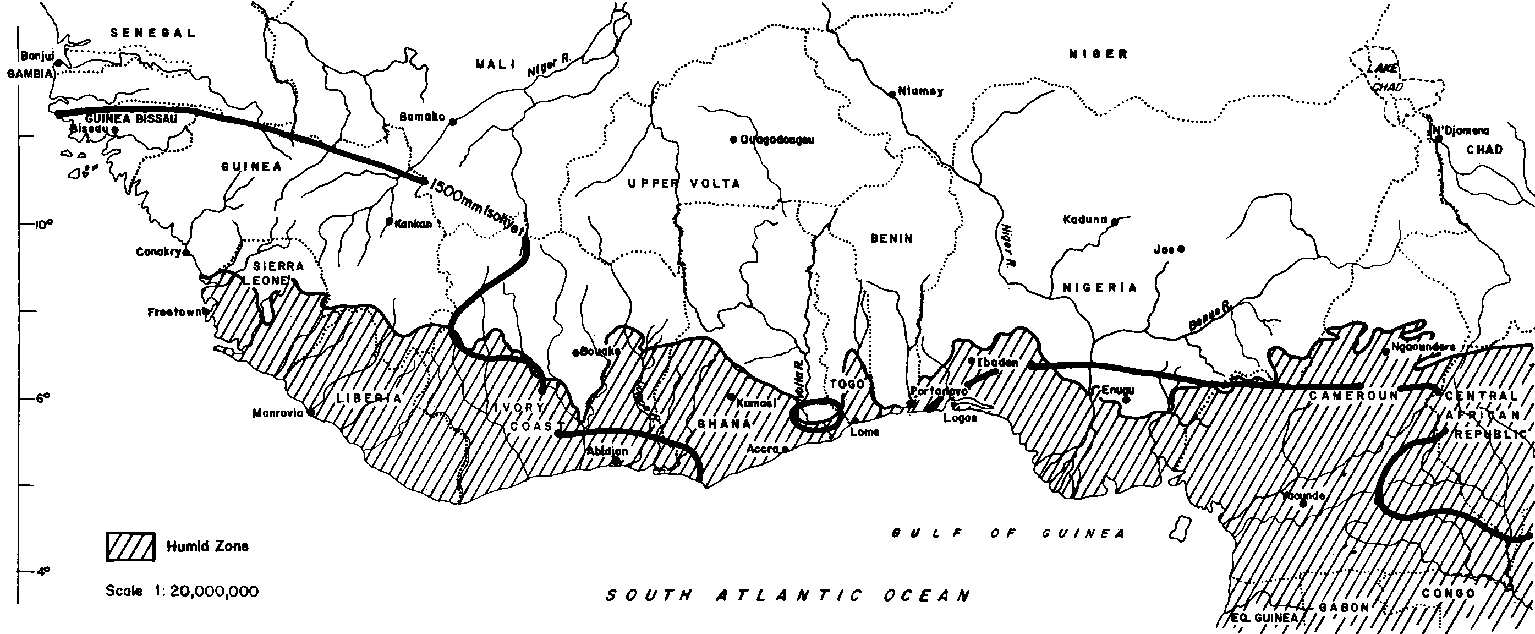
The ecological zones of tropical Africa have been named and defined in various ways by a number of scientists. For the purposes of this report, the humid zone has been defined as the low-lying, forested areas of West and Central Africa with an annual rainfall averaging between 1 250 and 1 800 mm. The area included by this definition is about 2 million km2 as shown in Figure 1. The rainy season is slightly bimodal, with one dry season of less than five months between January and May and a second unreliable dry period in July and August. Temperatures range from 27° to 32°C and the relative humidity averages 80 to 90%.
The area is covered by tropical rain forest, and has been described as 'lowland forest' by Crowder and Chheda (1977), 'zone Guinéene' by le Houérou (1977) and 'secteur Guinéen forestier' by Boudet (1975a). It is bordered by a transition region between forest and savanna areas which is primarily a fire subclimax of the forest zone. This region has been called 'derived savanna' by Crowder and Chheda (1977), 'zone sud Soudano-Guinéene' by le Houérou (1977) and 'secteur préforestier' by Boudet (1975a).
Figure 1. The humid zone of West and Central Africa
Source: Derived by C de Haan from a map prepared by A Blair Rains.
The total human population of the zone is estimated at 75 million. Population densities are generally high relative to those of the savanna belt to the north, but there are considerable variations within the humid zone. Eastern Nigeria is the most densely populated area, with over 150 inhabitants per km² and densities approaching 400/km² in some districts. High population densities are also found in the Central and Ashanti Regions of Ghana, with about 58 to 77 inhabitants per km². By contrast, the western areas of Ghana and Ivory Coast are relatively thinly populated, with less than 20 inhabitants per km².
As the entire region is infested with tsetse flies which carry trypanosomiasis, livestock production is generally limited to those species and dwarf breeds which are tolerant of the disease. Estimated sheep and goat populations in Ivory Coast, Ghana, Togo and Nigeria are given in Table 1, broken down into the humid and non-humid zones. More detailed figures are given in the Appendix. It is estimated that there are just over 10 million sheep and goats in the humid zones of the four countries covered by the survey, with over 8 million in Nigeria. Overall, goats outnumber sheep by a ratio of 2.5 to 1, though this ratio is derived from the fact that goats outnumber sheep by about 3 to 1 in Nigeria, which accounts for the largest total number, while sheep actually slightly outnumber goats in the other three countries. Ratios of one goat to four sheep were encountered in some local areas, while the reverse was found in others, though little information is available concerning the reasoning behind local preferences. In some areas more religious and ceremonial importance is attached to goats, in others to sheep. Preferences expressed informally mainly concerned the fact that goats are more prolific but sheep are more docile.
Annual population estimates over the past several years, as given in the Appendix, suggest that national sheep and goat populations have remained fairly static in Ivory Coast, Togo and Nigeria but have risen in Ghana. The distribution of small ruminants between the humid and non-humid zones does not appear to have shifted to any considerable extent in recent years.
In considering these figures, it should be borne in mind that they were collected in different ways in each of the countries, at different seasons and in different years. They also suffer from the usual defects of large-scale data collection operations. The figures given here probably reflect the real situation within a range of accuracy of ± 20 to 30%.
Table 1. Sheep and goat populations in the humid and non-humid zones of Ivory Coast, Ghana, Togo and Nigeria, 1973a ('000)
|
|
Goats |
Sheep |
Total | |
|
Ivory Coast |
|
|
| |
|
|
humid zone |
426 |
533 |
959 |
|
|
non-humid zone |
139 |
170 |
309 |
|
|
total |
565 |
703 |
1 268 |
|
Ghana |
|
|
| |
|
|
humid zone |
246 |
344 |
590 |
|
|
non-humid zone |
496 |
529 |
1 025 |
|
|
total |
742 |
873 |
1 615 |
|
Togo |
|
|
| |
|
|
humid zone |
304 |
342 |
646 |
|
|
non-humid zone |
335 |
316 |
651 |
|
|
total |
639 |
658 |
1 297 |
|
Nigeria |
|
|
| |
|
|
humid zone |
6 634 |
1 886 |
8 520 |
|
|
non-humid zone |
15 698 |
5 732 |
21 430 |
|
|
total |
22 332 |
7 618 |
29 950 |
|
Four countries |
|
|
| |
|
|
humid zone |
7 610 |
3 105 |
10 715 |
|
|
non-humid zone |
16 668 |
6 747 |
23 415 |
|
|
total |
24 278 |
9 852 |
34 130 |
a. The humid zone figures for Togo and Nigeria have been estimated by applying the 1971 proportions for Togo and the 1966 proportions for Nigeria to the national figures for 1973. The total small ruminant population of the humid zone of West Africa is often estimated at 25 million. Assuming population densities in other countries are similar to those recorded here, this would seem a reasonable estimate.Source: Compiled by authors.
Crop production in the humid zone focusses on root crops, such as yam and cassava, for subsistence needs and tree crops which are important as a source of cash income. The production system until recently has been described as 'shifting cultivation' where a plot is cleared and cultivated for a few years, followed by a period of natural fallow of 7 to 15 years when cultivation is shifted to a new area. Increases in production have consisted of expansion, rather than intensification: people from existing villages have set out to clear virgin forest and establish new settlements. Because of these movements, most of the villages in the region are of relatively recent origin.
With increasing population and the expansion of areas devoted to cash crops, the land available for subsistence cultivation is declining, with the resultant threat of declining food production. Already, large quantities of food, including meat, milk and fish, are imported into Ghana and Nigeria, largely for consumption in the urban areas, and there is a danger that the shortfall in national food production will increase unless agriculture can be intensified without loss of soil fertility. However, the general response to dwindling land resources has been simply to reduce the fallow periods (Upton, 1967; Lagemann, 1977). In eastern Nigeria, by contrast, there are indications of increased diversification, multistorey cropping which combines tree, grain and root crops, better water control and fertilization. More detailed descriptions of these trends are found in Anthonio and Ijere (1973) and Lagemann (1977).
Data on livestock holdings tend to be unreliable. Chickens are common throughout the zone, found in 60 to 70% of rural households. Sheep and goats appear to be less widely distributed: they are found in 25% of the farm households in Ivory Coast, 20 to 30% in western Nigeria and up to 50% in eastern Nigeria. In some areas the distribution of small ruminants appears to have become more skewed over time: the Yoruba cocoa farming survey carried out in western Nigeria in 1951 found that 74% of rural households kept goats and 49% kept sheep, while less than half these proportions were found in a 1972 study of Western State, which indicated that the wealthiest 10% of households owned 45% of all the goats and 56% of the sheep (Galletti et al., 1972; see Appendix). This observation, that small ruminants are kept by a declining proportion of households, has been confirmed by several village-level surveys, notably Upton (1967 and in Oluwasanmi et al., 1966) and Matthewman (1977). Substantial variations are also found between villages in the proportion of households owning sheep and goats and the size of household flocks: a recent study of three villages in eastern Nigeria suggests that these differences may be related to population pressure (Lagemann, 1977). Data from the ILCA survey should help clarify the role of small ruminant production in the humid zone and the distribution of livestock holdings among rural households.
Information on the size of household flocks suggests averages of four to five small ruminants in Ivory Coast and two to three in Nigeria (see Appendix), but these averages are somewhat misleading. A cross-tabulation of data from Ivory Coast on farm and flock size suggests a strong positive correlation, i.e. farmers with larger holdings also keep larger flocks (see Appendix). However, the ILCA survey has not indicated a similar correlation in western Nigeria.
Three main production systems are found - the traditional village system, modified forms of the traditional system and commercial production. The traditional village system is by far the most common throughout the zone. Oyenuga (1967) describes traditional sheep and goat production as a low labour input and a low priority adjunct to the traditional arable and cash crop farming'. Small ruminants are not herded or grazed systematically, but are allowed to roam freely over the compounds, roads and uncultivated areas to browse and scavenge. During the growing season, they are generally tethered during the day to protect the crops, and they usually return to the household compounds in the evenings where they spend the night. They are fed household refuse when available, such as cassava, plantain and yam peels, but no other form of improved feeding is practised. The animals receive no veterinary care, and mating is not controlled.
Deliberate production practices are limited to culling and sales, and flock structure data collected by Rombaut and van Vlaenderen (1976) and Matthewman (1977) suggest that males and older females are regularly sold or consumed. Emergency selling of diseased stock also occurs. The timing of offtake is generally determined by cash needs and the occurrence of festivities when meat is consumed, rather than according to a deliberate strategy to maximize production.
It is generally felt that traditional sheep and goat production in the humid zone is limited primarily by the incidence of endemic diseases, as well as the occurrence of epidemics, depending on the size of village flocks. The traditional village production system is characterized by a state of low-level equilibrium.
Throughout the humid zone there are also instances where the traditional system has been modified or improved. Notably in eastern Nigeria, goats and sheep are commonly tethered, feed is cut and brought to them (e.g. the fronds of Aspila africana and Ariva bateri) and their manure is collected and spread on the fields to maintain soil fertility (Oluwasanmi et al., 1966; Upton, 1967; Mecha, 1975; Lagemann, 1977).
A few instances of commercial sheep production were observed in the humid zone and no commercial goat production, but large-scale commercial production may assume economic significance in the future, either as a full-time or a part-time undertaking. Commercial sheep production in Ivory Coast, Ghana, Togo and Nigeria has evolved in a few cases from modified village production. Farmers who have improved their husbandry practices have found their flocks increasing to such an extent that they have moved their animals from the villages and established farms specializing in livestock production, where goats, cattle, pigs and poultry are also usually kept.
On almost all these commercial farms, grazing forms the bulk of the feed supply, and rotational grazing is widely practised. The animals are generally housed at night, and purchased or cut feed is offered in the evening. Veterinary services are provided, and, in some cases, farms are staffed by personnel trained in agricultural institutes.
Some of the major production problems which have been encountered on these commercial farms include:
a. initial high mortality rates, especially when foundation stock are introduced from various parts of the country without adequate quarantine measures;b. inadequate training in commercial farm management, resulting in overstocking of established pastures and deterioration of grazing.
c. high capital inputs due to the construction of overly elaborate farm buildings when less expensive structures erected from local materials would be adequate; and
d. irregular supply of supplementary feeds and veterinary drugs and occasional problems in obtaining professional advice.