


J. CobbinaHumid Zone Programme
International Livestock Centre for Africa (ILCA)
PMB 5320, Ibadan, Nigeria
Abstract
Introduction
Environmental and soils characteristics
Use, management and productivity
Potential for improved management of Vertisols using cattle
Conclusions
References
Vertisols, because of their high montmorillonite clay content, are difficult to till using hoes. Because many of the peasant farmers in Ghana till the land with simple hand implements, such as hoes and cutlasses, large areas of Vertisols remain uncultivated and unproductive. There is a need to develop simple, low-cost technologies to bring these soils into production. Soil characteristics, uses, management and productivity of Vertisols in Ghana are described, and the potential for improved management using draught oxen is discussed. The recommendation is made that the broadbed-and-furrow technology be adapted to improve productivity. Crop residues supplemented with leucaena and gliricidia fodder could be used for oxen feed.
In Ghana, Vertisols are found the Accra, Ho-Keta, and Winneba plains (Figure 1). Although Ghana has only small areas of Vertisols (about 168 000 ha) compared to the total area in sub-Saharan Africa, interest in their development dates back to the mid-1940s. Early visits to the country by experts who made recommendations on their use (Hutchinson and Pearson, 1947; Clark and Hutchinson, 1949) were followed by detailed soil surveys (Vine, 1950; Brammer, 1955) which emphasised the suitability of the soils for rice, sugarcane and irrigated cotton.
Figure 1. Vertisol locations in southern Ghana.

To generate information for agricultural development, the Ministry of Agriculture, with assistance from FAO, established the Agricultural Research Station at Kpong (ARS-Kpong) in 1954. The administration of the station was transferred to the University of Ghana in 1958.
Although ARS-Kpong worked out a scheme for tilling Vertisols using heavy machinery and mouldboard ploughs, peasant farmers still shun these soils, apparently because they are difficult to cultivate with hand implements (hoes and cutlasses), and mechanised methods are too expensive for farmers who have little or no access to credit. As a result, the productive potential of Vertisols in Ghana has still not been realised.
Climate
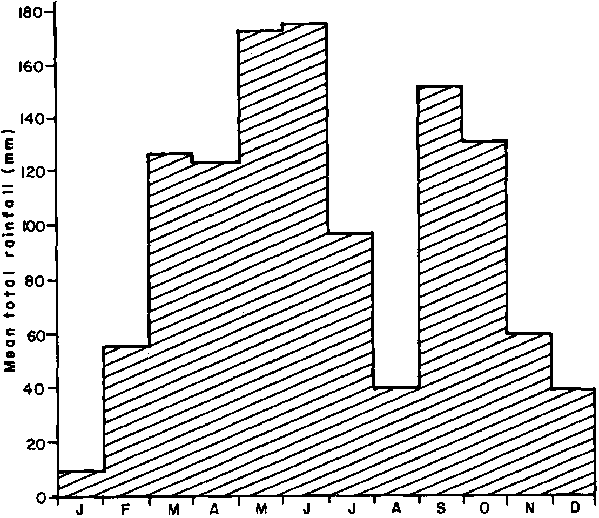
In Ghana, Vertisols occur in the subhumid climatic zone. Mean annual temperature is stable around 31°C. Mean annual rainfall is about 1100 mm, with monthly rainfalls ranging from 10 mm in January to 170 mm in June (Figure 2). The rainfall is bimodal with the long rainy season peak in May/June and the short season peak in September/October.
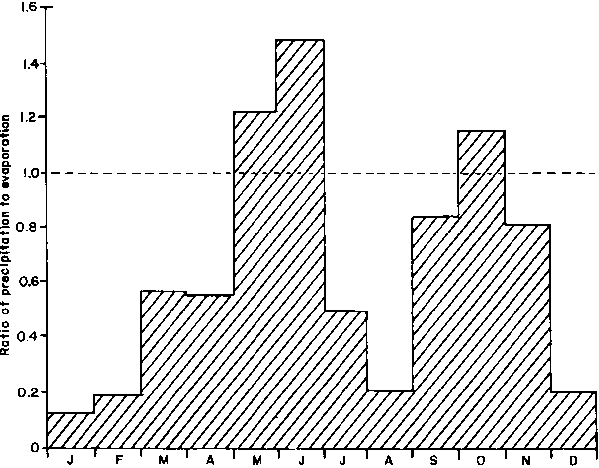
The total annual evaporative losses from a free water surface can be as high as 1800 mm (Brammer, 1967). The ratio of precipitation to evaporation ranges from a low of 0.1 in January to about 1.5 in June (Figure 3). Precipitation exceeds evaporation for only about 3 months a year.
Vegetation
The Vertisols of Ghana are covered with open (tussocky) medium grassland and scattered fire-resistant trees or coppiced shoots, particularly on the very deep soil types. Vetiveria fulvibarbis, in frequent association with Brachiaria falcifera and occasional species of Schizachyriam semiberne and Euclasta sandylotricha are dominant. Numerous other grass species including Andropogon and Ctenium spp. occur. Two legumes commonly found are Tephrosia elegans and Casia mimosoides. The most common trees are Combretum ghasalense, Millettia thonningii, and Boahinnia thonningii (Kowal, 1963).
Figure 2. Mean monthly rainfall at the University of Ghana, Agricultural Research Station, Kpong, 1955-1981.
Soil characteristics
Brammer (1959) classified the Vertisols of Ghana into four groups according to location of the soil in the toposequence:
· Normal black clays: deep soils developed in situ over basic rock associated with· Immature black clays: shallow soils extensively developed in basic gneiss and associated with steep slopes and upper parts of the topography.
· Black Vleisols: deep soils developed in material associated with depressed sites subject to seasonally poor drainage.
· Black Vleisols with brown subsoils: deep soils in which the normal black clay surface layer passes into yellow or olive-brown clays which continue to the base of the profile. They are associated with flat topography and high rainfall.
Figure 3. Mean monthly ratios of precipitation to evaporation at the University of Ghana, Agricultural Research Station, Kpong. flatland or with middle to lower slopes of gently undulating topography.
The Vertisols occupy an entire topographic range from summits to valley bottoms without being developed into catenary associations. Soil depth may range from a few to 180 em or more. The soils generally lack distinct horizons in the profile with only the "A" and "C" horizons being discernible.
The profiles may contain spherical, hard, dark-coloured ironstone concretions. There may also be small, black, brittle manganese oxide and white to medium-gray irregular calcium carbonate concretions. Occasionally quartz gravel or pebbles occur as a stone line.
The clay content of the soils is high (Table 1). The clay mineral is composed of 40 to 60% montmorillonite and less than 20% kaolinite (Bampoe-Addo et al, 1968). The high montmorillonite content influences the moisture characteristics of the soils. The coefficient of expansion and contraction *on wetting and drying is high with resultant cracking. Dramatic volume changes (about 30%) occur on wetting or drying (Kowal, 1963). The soil consistency is plastic to sticky when moist to wet, and very hard when dry. Internal drainage and aeration are very poor due to massive structure and compactness. Estimated available moisture is 10-20% (Kowal, 1963) and is a direct effect of the high water adsorption capacity of the clay minerals. Permeability is also very slow, about 0.1 cm h-1 with a 25 cm head of water (FAD-UN, 1963).
Table 1. Physical and chemical properties of a mature tropical black clay.
Source: Brammer (1955).
The chemical characteristics of a mature Vertisol in Ghana are presented in Table 1. The pH of the soils ranges from near neutral in the surface horizons to alkaline in the subsoil. Cation exchange capacities (CEC) are high about (20 to 40 meq/100 g soil) reflecting the high montmorillonite content. The exchangeable Ca and Mg contents are also high. This may be due to a relatively low loss of soluble cations through leaching. The exchangeable Na content is low in surface horizons (about 0.5%) but increases substantially with depth. Exchangeable Mn is virtually absent in all horizons. Free CaCO3 ranges from traces in surface horizons to 18% in deeper layers. Available P content (Truog) is very low in surface layers and decreases with depth. This may be due to adsorption onto free CaCO3 particles which are abundant in deeper horizons. The organic C content of surface soils is low, reflecting the feet that organic matter is added mainly through the roots of the sparse grass vegetation. The low organic C content is, in turn, responsible for the low total N content.
The characteristic properties of the Vertisols of Ghana qualify them to be classified as Pellusterts, Pelluderts, and Chromusterts (Soil Survey Staff, 1975) or as Pellic and Chromic Vertisols (FAO/Unesco, 1974)
Although the Vertisols are characterised by a high nutrient status and can withstand intensive and prolonged cultivation, their physical characteristics and poor drainage have inhibited their use by peasant farmers. The Vertisols in Ghana are therefore mainly used as grazing lands by Fulani cattle herdsmen. The peasant farmers restrict cropping to lands around homesteads. Crops grown include pepper (Capsicum sp.), tomatoes, okra (Hibiscus esculentum), maize and cassava (Manihot esculenta Crantz). In addition to these crops, ARS-Kpong has conducted studies into the productivity of cowpea, soya bean, cotton, rubber (Hevea brasiliensis), cocoa, citrus (Citrus sinensis [L] Osb.), pawpaw (Carica papaya L.), oilpalm Elaeis guineensis), pineapple and sorghum (Sorghum bicolor) on Vertisols (ARS-Kpong, 1986). Cropping and livestock rearing enterprises on these lands are highly segregated.
Crop production
Because of the poor physical properties of Vertisols a properly prepared seedbed that enhances drainage is necessary for high productivity. Under the traditional farming system, tillage is done with simple implements such as hoes and cutlasses which cannot be used to till to any great depth on heavy soils such as Vertisols. The improved system of land tillage developed by ARS-Kpong is not suitable for peasant farmers, because it involves the use of heavy machinery and hence is capital intensive. As a result peasant farmers crop only flat land. However, cropping on a modified form of cambered bed, known as a broadland (Hill, 1961), increased yields of maize and groundnut (Arachis hypogaea) by about 100% (Table 2).
Livestock production
After a dramatic drop in 1977, cattle populations in Ghana steadily increased over the period 1978 to 1985, from about 750 000 to well over 1 million (Euwsi, 1986). Seventy-five percent of the cattle are concentrated in northern Ghana (Table 3). Of the 25% in the southern areas, 80% are found in the four regions where Vertisols are located. Although the actual figures for cattle raised strictly on natural grassland supported by Vertisols may be lower, the proportions indicate the relative value of Vertisols in cattle production in Ghana.
Table 2. Comparison of land productivity under broadland and traditional system of land management on Vertisols in Ghana.
|
Crops |
Yield (kg ha-1) |
|
|
Broadland |
Flatland |
|
|
Maizea |
|
|
|
(1st season) |
2100 |
1000 |
|
(2nd season) |
1400 |
700 |
|
Groundnutb |
700 |
400 |
a. 125 kg ha-1 triple superphosphate was applied at planting with supplementary irrigation.
b. 250 kg ha-1 triple superphosphate was applied at planting.Source: Kowal (1963).
Although the cattle population has increased substantially over the past several years, the productivity of individual animals remains low. This may be attributed in part to climatic effects and lack of genetic improvement of the stock.
Table 3. Cattle population in the various regions of Ghana.
|
Region |
Population (x1000) |
Percentage of total |
|
Ashanti |
13.0 |
1.2 |
|
Brong Ahafo |
34.3 |
3.2 |
|
Centrala |
4.1 |
0.4 |
|
Easterna |
30.5 |
2.9 |
|
Greater Accraa |
72.7 |
6.8 |
|
Northern |
355.9 |
33.4 |
|
Upper |
453.6 |
42.6 |
|
Voltaa |
96.5 |
9.1 |
|
Western |
4.2 |
0.4 |
|
Total |
1064.8 |
|
a. Administrative regions within which Vertisols are located.Source: Ministry of Agriculture, Ghana (1985).
Generally, in the savannah areas the total biomass and the nutritive value of the natural grassland declines sharply during the dry season (January to March), which reduces animal growth rates. In a study conducted at the University of Ghana Agricultural Research Station at Nungua (Accra plains), where some Vertisols are present, liveweight gain during the dry season from January to March was about 20% of that during the second rainy season, from September to November (Larsen and Amaning-Kwarteng, 1976). Supplementary feeding with dried cassava peels mixed with urea and molasses during dry periods increased liveweight gain by 200% compared to animals which only grazed on Vertisols.
Crossbreeding to improve the genetic make-up of local animals also enhanced their capability to use natural grassland as well as supplements. In another study at University of Ghana ARS, Nungua (Cameron, 1970), Santa Gertrudis-West African Shorthorn crossbreds performed better than the local West African Shorthorn, even when grazing native pasture (Table 4). In general, crossbreeding increases birth weight, weaning weight, and pre-, and post-weaning liveweight gains (Kahoun, 1972; Ngere and Cameron, 1972; Arthur, 1985). Recent crossbreeding work at ARS-Kpong (Arthur, 1985) indicates that introducing exotic blood into N'Dama cattle significantly improves their performance compared with pure local breeds (Table 5).
Although cattle herding is a major occupation on Vertisols on the Accra, Ho-Keta and Winneba plains, mixed farming is uncommon. The low crop yields on peasant farms and the generally low growth rate of livestock during the dry season could both be improved by integrating the two farming systems. Draught oxen could be used to prepare raised seedbeds, which could improve drainage and hence increase crop yields at reduced cost. The crop residues could in turn be fed to the animals to raise their productivity. The following section discusses the potential for adapting a low-cost technology developed by ILCA in Ethiopia to till and improve crop yield on Vertisols in Ghana.
Table 4. Response of local and crossbred cattle to three feeding regimes over an 18-week period on Vertisols in Ghana.
|
Breed |
Type of feed |
Total liveweight gain (kg) |
|
N'Dama |
Pasture alone |
15.7 |
|
|
1.4 kg suppl/day |
10.7 |
|
|
Suppl. ad lib. |
11.8 |
|
West African Shorthorn |
Pasture alone |
17.5 |
|
|
1.4 kg suppl/day |
20.7 |
|
|
Suppl. ad lib. |
21.3 |
|
Santa Gertrudis x West African Shorthorn |
Pasture alone |
25.0 |
|
|
1.4 kg suppl/day |
25.9 |
|
|
Suppl. ad lib. |
62.7 |
|
|
|
|
Source: Cameron (1970)
The broadbed-and-furrow technology
ILCA has developed an ox-drawn broadbed-maker (BBM), based on the Ethiopian plough, which can construct raised beds and furrows, called broadbeds-and-furrows (BBFs). On a Vertisol, the BBFs permit drainage of excessive surface water. The BBM can construct raised beds (20 cm high and 120 cm wide) at a rate of 0.4-1.2 ha day 1. In a series of on-farm tests in Ethiopia BBFs increased the grain yield of bread wheat by about 78% over the traditionally managed plots (Jutzi et al, 1987). This technology could be used on Vertisols in Ghana.
Table 5. Pre-weaning growth of three breeds of calves reared on Vertisols in Ghana.
|
Trait |
Breeda,b |
||
|
N |
SGxN |
RPxN |
|
|
Birth weight (kg) |
18.8a |
21.2b |
22.2b |
|
Weaning weight (kg) (adjusted to 205 days) |
78.6a |
107.4b |
100.6b |
|
Pre-weaning average daily gain (kg/day) |
0.29a |
0.42b |
0.38b |
a. N = N'Dama bull x N'Dama cow
SGxN = Santa Gertrudis x N'Dama crossbreed.
RPxN = Red Poll x N'Dama crossbreed.b. Values in the same row followed by the same letter are not significantly different at 5% probability level.
Source: Arthur (1985).
Draught animals and feed requirements
The ox is particularly suitable as a draught animal on fairly heavy soils. However, draught performance depends on the breed of the ox and the quantity and quality of feed available. Heavier animals perform better than lighter ones. The amount of feed required by a draught animal is a function of its weight and the amount of work it performs (Smith, 1981).
Work conducted at ILCA in Ethiopia indicates that farmers should ensure that their draught oxen are in good condition before the start of the cropping season (Soller et al, 1986). However, the mayor cropping season in Ghana is preceded by a long dry season during which animals may lose weight if not provided with supplementary feed. Assuming an average liveweight of 250 kg for cattle about 2-3 years old (Ngere and Cameron, 1972; Otchere et al, 1985) and a daily feed intake of 2 kg dry matter per 100 kg liveweight (Soller et al, 1986), then for a 3-month period (from January to March) two draught oxen would consume 900 kg of feed. Based on crop harvestable yields reported by ARS-Kpong and ratio of straw to grain provided by Chadhokar (1983), even rainfed rice, can provide 1.5 to 2.5 t of residue per hectare (Table 6), more than enough to feed two draught oxen.
Table 6. Crop residues for on-farm feeding of ruminants on Vertisols in Ghana.
|
Crop |
Yield of grain (t ha-1)a |
Residue |
Grain: straw ratiob |
Yield of residue (t ha-1) |
|
Rice (irrigated) |
3.0-6.0 |
straw |
1:1 |
3.0-6.0 |
|
Rice (rainfed) |
1.5-2.5 |
straw |
1:1 |
1.5-2.5 |
|
Sorghum |
4.0 |
stover |
1:2 |
8.0 |
|
Cowpeas |
1.5-2.0 |
straw |
1:1 |
1.5-2.0 |
|
Soybeans |
2.0-3.5 |
straw |
1:2 |
4.0-7.0 |
|
Sugarcane |
170-200 |
tops |
3:1 |
56-66 |
|
|
(cane) |
(20% DM) |
|
|
a. Yield data for crops obtained from ARS-Kpong (1986).
b. Ratio of grain (cane) to straw obtained from Chadhokar (1983).
However, cattle fed only rice straw grow slowly (Jackson, 1977). Thus the diet will have to be supplemented using materials such as legume fodder. The leguminous brows trees, Gliricidium septum and Leucaena leucocephala can provide low-cost dry-season feed supplementation for draught oxen. Leucaena grows on black earth (Vertisols) in Queensland, Australia (Skerman, 1977). At ARS-Kpong, Gliricidia stems previously used as fencing poles have grown into big trees. Therefore production of high-protein browse fodder should be feasible.
The Vertisols of Ghana are in the subhumid zone. Because of their high water-holding capacity and low permeability, drainage must be improved in order to increase crop yields. Crop and livestock productivity on peasant farms is low due to lack of adequate implements to till the land, but it should be possible, by transferring BBF technology, for peasant farmers to increase crop yields. As crop yields increase following improved management of the soils, large quantities of crop residues would become available during the dry season to feed cattle. The crop residues ration for feeding during the dry season could be supplemented with leucaena and gliricidia prunings.
ARS-Kpong 1986. University of Ghana Agricultural Research Station, Research Highlights, July 1986.
Arthur P F. 1985. Growth performance of exotic x N'Dama cattle. In: Annual Report 19751985. University of Ghana, Agricultural Research Station Kpong. pep. 33-35.
Bampoe-Addo A, Raman K V and Mortland M M. 1968. Clay mineral status of some major soil series in Ghana. Soil Science 107:119-125.
Brammer H. 1955. Detailed soil survey of the Kpong pilot irrigation area. Gold Coast Department of Soil and Land-Use Survey, Kumasi. Memoire No. 1. Kumasi, Ghana.
Brammer H. 1959. The tropical black earths of Ghana. Soil Research Institute Divisional Paper No. 9.
Brammer H. 1967. Soils of the Accra plains, Soil Research Institute. Memoire No. 3.
Cameron C W. 1970. Rate of weight gain of crossbred cattle on native pasture and supplemented feed. In: Annual Report 19691970. University of Ghana Agricultural Research Station, Nungua, Ghana.
Chadhokar P A. 1983. Forage development for dairy cattle in mid-country region of Sri Lanka. World Animal Review 48:38-45.
Clark W M and Hutchinson F H. 1949. British West African rice missions report on the possibilities of expanding the production of rice in the British West African colonies. Mimeo report to the Secretary of State for the Colonies, London, UK.
Ewusi K. 1986. Economic trends in Ghana in 19841985 and prospects for 1986. Institute of Statistical, Social and Economic Research, University of Ghana. Legon, Ghana.
FAO-UN (Food and Agriculture Organization/United Nations). 1963. Report on survey of the lower Volta River Flood Plain. Vol. II, Soil Survey and Classification. FAO, Rome.
FAO/Unesco (Food and Agriculture Organization/United Nations Educational, Scientific and Cultural Organization). 1974. Soil maps of the world, Vol. I. Legend. FAO/Unesco, Paris.
Hill P R. 1961. A simple system of management for soil and water conservation and drainage in mechanized crop production in the tropics. Empire Journal of Experimental Agriculture 29:337-349.
Hutchinson J B and Pearson E O. 1947. Report on visit to the Gold Coast. Mimeo. Report to the Empire Cotton Growing Association, London.
Jackson M G. 1977. Rice straw as livestock feed. World Animal Review 23:25-31.
Jutzi S. Anderson F M and Abiye Astatke. 1987. Low-cost modifications of the traditional Ethiopian tine plough for land shaping and surface drainage of heavy clay soil: Preliminary results from on-farm verification trials. ILCA Bulletin 27:28-31.
Kahoun J. 1972. Effects of crossbreeding on growth rate and body conformation in local cattle on Accra plains, Ghana. I. Ghana Journal of Agricultural Sciences 3:131-134.
Kowal J M L. 1963. The agricultural development of black soils of the Accra plains. PhD thesis, University of London, London, UK.
Larsen R E and Amaning-Kwarteng K. 1976. Cassava peels with urea and molasses as dry season supplementary feed for cattle. Ghana Journal of Agricultural Sciences 9:43-49.
Ministry of Agriculture, Ghana. 1985. Livestock Census 1985. Department of Veterinary Services, Ministry of Agriculture, Accra, Ghana.
Ngere L O and Cameron C W. 1972. Crossbreeding for increased beef production. I. Performance of crosses between local breeds and either Santa Gertrudis or Red Poll. Ghana Journal of Agricultural Sciences 5:43-49.
Otchere E O. Barness A R and Erbynn K G. 1985. Carcass characteristics of local steers and their crosses raised on natural grassland. In: Annual Report 1975-1985. University of Ghana Agricultural Research Station, Kpong, Ghana. pp. 29-33.
Skerman P J. 1977. Tropical forage legumes. FAO Plant Production and Protection Series No. 2. FAO (Food and Agriculture Organization), Rome.
Smith A J. 1981. Draught animal research. A neglected subject. World Animal Review 40:43-48.
Soil Survey Staff. 1975. Soil Taxonomy. A basic system of soil classification for making and interpreting soil surveys. Agricultural Handbook No. 436. Soil Conservation Service, US Department of Agriculture. US Government Printing Office, Washington DC.
Soller H. Reed J D and Butterworth M H. 1986. Intake and utilization of feed by work oxen. ILCA Newsletter 5(2):5-7.
Vine H. 1950. Studies on the Accra plains, March - April, 1950. MS report to the Director of Agriculture, Ministry of Agriculture, Ghana.

