Federico Holmann[257] and Muhammad Ibrahim[258]
Key words: Arachis pintoi, Brachiaria spp., Cratylia argentea, dual-purpose farms
Milk production in Central America and the Caribbean has increased during the 90's at an annual rate of 4.6%, which shows a marked dynamism of the sector (Umaña, 1998). However, even with this high growth, the region is a net importer of milk products. These imports are growing at an annual rate of 13% due to a high existing demand. Thus, the region went from importing 20% of its needs in 1990 to 28% in 1996, equivalent to US$ 104 million annually (Umaña, 1998).
It is estimated that around 85% of the milk produced in the region comes from dual-purpose farms that produce milk and beef with the same herd. This type of production system is mostly found in small and medium farms where pastures are the main feeding source because it is the most inexpensive and abundant resource in the tropical conditions of the region.
Research executed by the International Center for Tropical Agriculture (CIAT) and the International Livestock Research Institute (ILRI) carried out through the Tropileche Consortium in the subhumid areas of Costa Rica has demonstrated that improved forages contribute to the intensification of milk production in small dairy farms through (Holmann et. al., 1999): (1) the increase in milk production and stocking rate; (2) the release of areas not suitable for livestock which can remain as reserves of the environment; and (3) the reduction in the demand of purchased feed inputs, thus improving the cash flow. In addition, spontaneous adoption of new forages has been observed by producers located outside of the reference sites mainly in Costa Rica and Peru, and to a lesser extent in Nicaragua and Honduras.
Objectives were to estimate the impact on productivity and cost reduction of new forage germplasm (ie., Brachiaria spp. grasses, sugarcane, and the legumes Cratylia argentea and Arachis pintoi) with different levels of adoption at the farm level in order to estimate the potential benefits at the regional level as well as the needs for seed production for the scaling-up process.
Data was obtained through direct interviews with 78 producers located in the dry tropics of Costa Rica, Honduras and Nicaragua, where the Tropileche Consortium operates, to understand their production systems using as a tool a linear programming simulation model developed by CATIE and later expanded by CIAT in an electronic sheet. The animal management parameters were taken from farm averages for each country. For each region within each country the current situation was evaluated and this in turn was compared against three levels of adoption.
Tables 1 to 3 contains the potential benefits that can be obtained by each of the three levels of adoption at the farm level in Costa Rica, Honduras, and Nicaragua. Level 1 of adoption allows producers in each country to eliminate the need to purchase external dietary supplements to feed livestock during the dry season. This effect has a significant impact on the cash flow of producers because milk production costs can be reduced 14% in Costa Rica, 25% in Honduras, and 11% in Nicaragua. This is achieved through the establishment of small areas of C. argentea in each farm (1.6 ha in Costa Rica, 3.0 ha in Honduras and 1.7 ha in Nicaragua) with sugarcane (0.7 ha in Costa Rica, 3.4 ha in Honduras and 0.6 ha in Nicaragua). This level of adoption requires modest investments equivalent to $872/farm in Costa Rica ($38/cow), $850/farm in Honduras ($20/cow), and $695/farm in Nicaragua ($16/cow). Table 4 contains the potential benefits of new forage germplasm at the regional scale in the dry tropics of Costa Rica, Honduras, and Nicaragua. As shown, the potential impact of the adoption of these technologies at the regional level is significant. In the case of adoption level 1, investing $6.4 million in Costa Rica, $2.7 million in Honduras and $5.1 in Nicaragua will yield additional annual net incomes due to reductions in production costs for every region studied of $11.9 million in Costa Rica, $12.6 in Honduras, and $9.9 million in Nicaragua. Thus, potential benefits are large compared to the amount of the investment required.
Level 2 of adoption has as benefits not only the advantages obtained with level 1, but also because it allows producers to maintain the same milk production and herd size in less area, thus allowing the release of land which could be allocated to other alternative uses (ex., conservation). Released areas varied from 9% in farms in Honduras, to 39% in Costa Rica, and up to 45% in Nicaragua. Likewise, this level of adoption allows an additional reduction in the cost of milk production with regard to level 1 of 11% in Costa Rica, 8% in Honduras, and 12% in Nicaragua. The investment required at the regional level to reach level 2 of adoption amounts to $41.7 million in Costa Rica, $5.9 million in Honduras and $53.8 million in Nicaragua and the additional income per year expected by the reduction in production costs add up to $15.1 million in Costa Rica, $12.9 million in Honduras, and $17.0 million in Nicaragua.
Level 3 of adoption is the most intensive in terms of increases in productivity and the one which requires the greatest capital investment. With this level 3, a higher milk production per hectare is achieved (1390 kg in Costa Rica, 1530 kg in Honduras and 964 kg in Nicaragua), as well as the highest stocking rate (1.56 UA/ha in Costa Rica, 1.58 in Honduras, and 1.95 in Nicaragua). Even though the unitary cost of milk production and the net income per cow is similar to level 2, the net income per farm is increased significantly (ie., by 100% in Costa Rica, by 9% in Honduras, and by 85% in Nicaragua). This is due to the increase in herd size as a result of the higher stocking rate available in the current area allocated to livestock. The investment required to achieve this adoption level regionally is about $55.7 million in Costa Rica, $8.2 million in Honduras, and $82 million in Nicaragua, but the additional net income from reducing the cost of production and increasing milk yields are $29.6 million annually in Costa Rica, $14.3 million annually in Honduras and $30.7 million annually in Nicaragua.
In order to meet the objective of promoting the adoption at the regional level it is necessary to design a strategy that allows (a) the establishment of alliances with groups of organized producers and/or extension services, as well as (b) the establishment of a mechanism to provide seed to the producers, especially of the legume C. argentea and sugarcane by selecting producers for the establishment of seed banks. Seed availability of Brachiaria spp. and A. pintoi does not represent a bottleneck. This study suggests that there is a high economic incentive in designing a strategy at the regional level in each country in order to promote the adoption of level 1 in order to improve the income of small milk producers and increase the competitiveness of dual-purpose production systems through the use of forage germplasm based on grasses and legumes.
Table 1. Results of Costa Rica comparing the current situation vs. three levels of adoption of new forage germplasm to eliminate the use of purchased feeds and improve productive efficiency.
|
Parameter |
Current situation |
Level 1: Substitute purchased feed |
Level 2: Subtitute purchased feed + release area |
Level 3: Establish new forages in entire farm area |
|
Adult cows (#) |
23 |
23 |
23 |
48 |
|
|
|
|
|
|
|
Land use (ha) |
|
|
|
|
|
- Native pasture |
40.5 |
38.5 |
0 |
0 |
|
- Sugarcane |
0.3 |
0.7 |
1.0 |
4.9 |
|
- Cratylia argentea |
0 |
1.6 |
1.7 |
3.6 |
|
- Brachiaria spp. alone |
7.2 |
7.2 |
26.5 |
0 |
|
- Bracharia spp./A. pintoi |
0 |
0 |
0 |
39.5 |
|
- Total area |
48 |
48 |
29.2 |
48 |
|
|
|
|
|
|
|
Additional investment of new germplasm ($) |
|
|
|
|
|
- Per farm |
NA |
872 |
5,730 |
15,960 |
|
- Per cow |
NA |
38 |
249 |
333 |
|
|
|
|
|
|
|
Stocking rate (AU/ha) |
0.75 |
0.75 |
1.23 |
1.56 |
|
|
|
|
|
|
|
Use of purchased feed (kg/cow/year) |
|
|
|
|
|
- Chicken manure |
491 |
0 |
0 |
0 |
|
- Feed concentrates |
270 |
0 |
0 |
0 |
|
- Total cost ($/cow/year) |
71 |
0 |
0 |
0 |
|
|
|
|
|
|
|
Net income/year |
|
|
|
|
|
- Per hectare |
16 |
43 |
98 |
119 |
|
- Per cow |
34 |
89 |
124 |
119 |
|
- Per farm |
782 |
2,047 |
2,852 |
5,712 |
|
|
|
|
|
|
|
Milk production (kg/ha) |
666 |
666 |
1,095 |
1,390 |
|
|
|
|
|
|
|
Area released |
|
|
|
|
|
- # of hectares |
NA |
0 |
18.8 |
NA |
|
- % of livestock area |
NA |
0 |
39.2 |
NA |
|
|
|
|
|
|
|
Milk production cost ($/kg) |
0.21 |
0.18 |
0.16 |
0.16 |
NA= Not applicable
Table 2. Results of Honduras comparing the current situation vs. three levels of adoption of new forage germplasm to eliminate use of purchased feeds and improve productive efficiency.
|
Parameter |
Current situation |
Level 1: Substitution of purchased feeds |
Level 2: Substitution of purchased feed + released area |
Level 3: Establish new forages in the entire farm |
|
Adult cows (#) |
42 |
42 |
42 |
46 |
|
|
|
|
|
|
|
Land use (ha) |
|
|
|
|
|
- Native pasture |
13.7 |
10.4 |
0 |
0 |
|
- Sugarcane |
3.2 |
3.4 |
3.7 |
4.1 |
|
- Cratylia argentea |
0 |
3.0 |
2.9 |
3.2 |
|
- Brachiaria spp. alone |
27.1 |
27.1 |
33.3 |
36.7 |
|
- Bracharia spp./A. pintoi |
0 |
0 |
0 |
0 |
|
- Total area |
44 |
44 |
39.9 |
44 |
|
|
|
|
|
|
|
Additional investment in new germplasm ($) |
|
|
|
|
|
- Per farm |
NA |
850 |
1,830 |
2,580 |
|
- Per cow |
NA |
20 |
44 |
56 |
|
|
|
|
|
|
|
Stocking rate (AU/ha) |
1.44 |
1.44 |
1.59 |
1.58 |
|
|
|
|
|
|
|
Use of purchased feed (kg/cow/year) |
|
|
|
|
|
- Molasses |
88 |
0 |
0 |
0 |
|
- Feed concentrates |
418 |
0 |
0 |
0 |
|
- Total cost ($/cow/year) |
96 |
0 |
0 |
0 |
|
|
|
|
|
|
|
Net income/year |
|
|
|
|
|
- Per hectare |
160 |
249 |
276 |
277 |
|
- Per cow |
167 |
261 |
264 |
265 |
|
- Per farm |
7,014 |
10,962 |
11,088 |
12,190 |
|
|
|
|
|
|
|
Milk production (kg/ha) |
1,386 |
1,386 |
1,530 |
1,530 |
|
|
|
|
|
|
|
Area released |
|
|
|
|
|
- # of hectares |
NA |
0 |
4.1 |
NA |
|
- % of livestock area |
NA |
0 |
9.3 |
NA |
|
|
|
|
|
|
|
Milk prodtn cost ($/kg) |
0.16 |
0.12 |
0.11 |
0.11 |
NA= Not applicable
Table 3. Results of Nicaragua comparing the current situation vs. three levels of adoption of new forage germplasm to eliminate the use of purchased feeds and improve productive efficiency.
|
Parameter |
Current situation |
Level 1: Substitution of purchased feed |
Level 2: Substitution of purchased feed + released area |
Level 3: Establish new forages in entire farm area |
|
Adult Cows (#) |
44 |
44 |
44 |
86 |
|
|
|
|
|
|
|
Land use (ha) |
|
|
|
|
|
- Native pastures |
80 |
77.7 |
0 |
0 |
|
- Sugarcane |
0 |
0.6 |
4.4 |
9.2 |
|
- Cratylia argentea |
0 |
1.7 |
2.5 |
5.2 |
|
- Brachiaria spp. |
0 |
0 |
37.3 |
0 |
|
- Bracharia spp./A. pintoi |
0 |
0 |
0 |
65.6 |
|
- Total area |
80 |
80 |
44.2 |
80 |
|
|
|
|
|
|
|
Additional investment in new germplasm ($) |
|
|
|
|
|
- Per farm |
NA |
695 |
7,410 |
22,070 |
|
- Per cow |
NA |
16 |
168 |
256 |
|
|
|
|
|
|
|
Stocking Rate (AU/ha) |
0.99 |
0.99 |
1.80 |
1.95 |
|
|
|
|
|
|
|
Use of purchased feed (kg/cow/yr) |
|
|
|
|
|
- Chicken manure |
410 |
0 |
0 |
0 |
|
- Molasses |
70 |
0 |
0 |
0 |
|
- Total cost ($/cow/yr) |
32 |
0 |
0 |
0 |
|
|
|
|
|
|
|
Net income/yr |
|
|
|
|
|
- Per hectare |
21 |
38 |
91 |
93 |
|
- Per cow |
38 |
69 |
91 |
87 |
|
- Per farm |
1,672 |
3,036 |
4,044 |
7,482 |
|
|
|
|
|
|
|
Milk production (kg/ha) |
493 |
493 |
892 |
964 |
|
|
|
|
|
|
|
Area released |
|
|
|
|
|
- # of hectares |
NA |
0 |
35.8 |
NA |
|
- % of livestock area |
NA |
0 |
44.8 |
NA |
|
|
|
|
|
|
|
Milk prodtn cost ($/kg) |
0.18 |
0.16 |
0.14 |
0.14 |
NA= Not Applicalbe
Table 4. Potential benefits of new forage germplasm at three levels of adoption in dual-purpose cattle farms at the regional scale in the dry tropics of Costa Rica, Honduras, and Nicaragua.
| Country |
Level of adoption[259] |
||
| 1 |
2 |
3 |
|
| |
|
|
|
| Costa Rica |
|
|
|
| * Investment/cow |
38 |
249 |
333 |
| * Increase in income/cow/yr[260] |
71 |
90 |
85 |
| * Investment at regional level (millions $) |
6.4 |
41.7 |
55.7 |
| * Increase in regional income/yr (millions $)[261] |
11.9 |
15.1 |
29.6 |
| * Years to pay investment |
0.5 |
2.8 |
1.9 |
| |
|
|
|
| Honduras |
|
|
|
| * Investment/cow |
20 |
44 |
56 |
| * Increase in income/cow/yr[262] |
94 |
97 |
98 |
| * Investment at regional level (millions $) |
2.7 |
5.9 |
8.2 |
| * Increase in regional income/yr (millions $)[263] |
12.6 |
12.9 |
14.3 |
| * Years to pay investment |
0.2 |
0.5 |
0.6 |
| |
|
|
|
| Nicaragua |
|
|
|
| * Investment/cow |
16 |
168 |
256 |
| * Increase in income/cow/yr[264] |
31 |
53 |
49 |
| * Investment at regional level (millions $) |
5.1 |
53.8 |
82.0 |
| * Increase in regional income/yr (millions $)[265] |
9.9 |
17.0 |
30.7 |
| * Years to pay investment |
0.5 |
3.2 |
2.7 |
Bertha Leonor Ramírez Pava[266]
The objective of this work is the evaluation of the sociological and environmental impact that the cattle system current of double purpose established in the Colombian Amazonia because of the number of persons that depend economically on that resource, used labor, production objective and school level of the proprietary; as well as the effect produced on the use of the soil, the protection of the sources of water, the conservation of the forest, the fuel wood consumption, the loss of biodiversity and other aspects detected in the characterization stage.
The indicators selected were the following: Indicative of the property: where it was included, the name of the proprietary, the location of the property, the approximate extension, the prevailing topography, the number and type of animals.
The environmental indicators: Area of forests that the property possesses, quantity of cut down and sown trees, potential use of the soil, type of existing vegetation, trees utilization of gloomy, of hedges, resource used as flammable to cook, presence of eroded areas, presence and protection of sources of water, kinds of frequent wild animal species, disappeared and consumed by the family.
The technological indicators: Establishment and managing method of meadows, type of established meadows, area in natural and improved grasses and associations of gramineous and leguminous, utilization of autochthonous promissory species, animal species exploited along with the bovines, tailings’ control.
Economic and social indicators: Number of persons that depend economically on that resource, used labor, production objective and school level of the proprietary.
The codification handbook of qualitative and quantitative variables was elaborated from the data gathered in the surveys; then, it was elaborated the designed digitized data base specifically for this work in the program dBASE IV; the data were analyzed using an unvaried analysis, descriptive statistics percentages, averages, frequency tables, correlation and regression coefficients, using the program EPI-INFO 6.2 and with the statistic package SAS (SAS, 1991).
The analysis of complementary information is accomplished using the analysis multivariate of multiple correspondence of the French package SPAD 90 in order to make an integral analysis of all the variables, concentrate the information, obtain the study’s principal components, effect the factorial analysis, chart the factors, having as variable of classification the size of the properties. In addition it allows to obtain the clusters that permit to characterize and typify the cattle system double purpose in the rural area of the municipality of Florencia; which is the initial objective of the present work.
The multiple correspondence analysis includes the observation matrix M(27X249); from which the correlation matrix is built. The latter condenses the original data to some few indicative or factors between the more meaningful modalities or answers. The multiple correspondence analysis uses intrinsically the technique of the factorial analysis to reduce that space, calculating the shafts that represent the greater variation between the answers through the own values and vectors.
After the analysis of the own values, the following factors f1 = size, f2 topography, f3 = economic population, and f4 = environment were determined as new indicators variables.
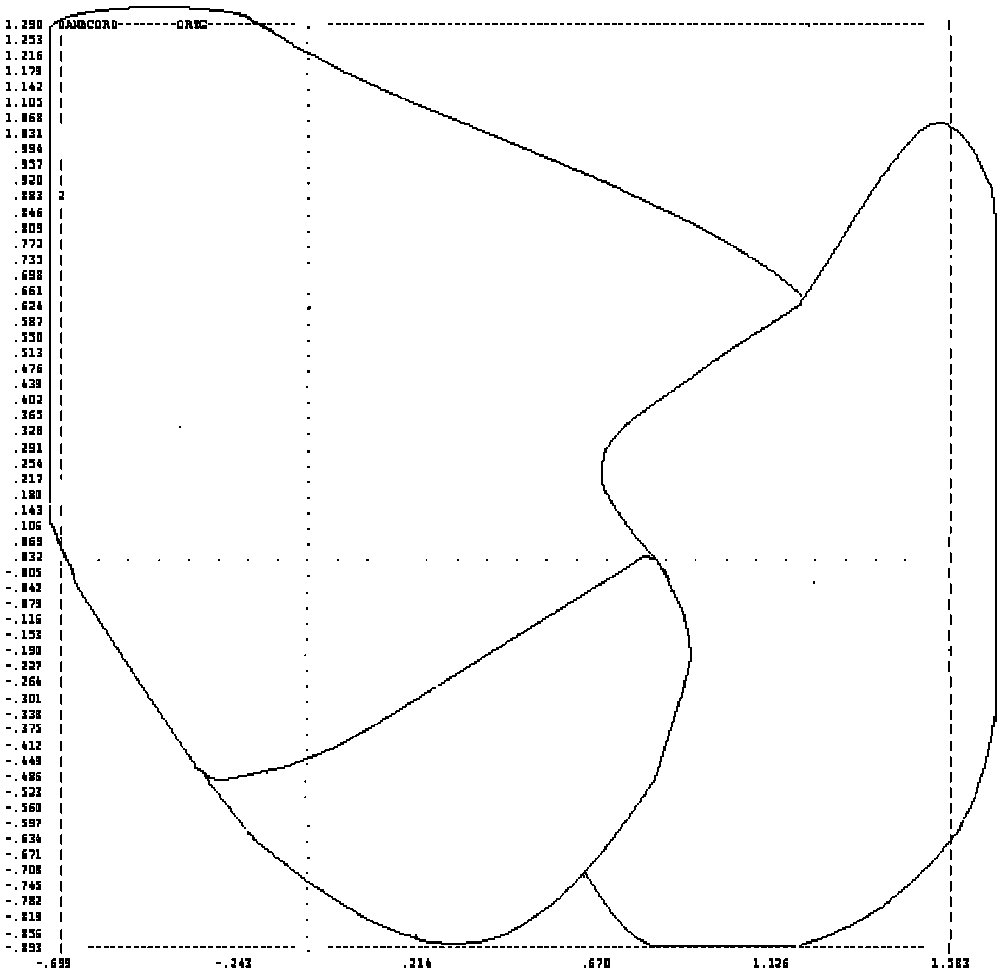
Maps of individuals positioning: In figure 1, composed by 100 variable and active and illustrative modalities plus 249 individual in a projection plan of 349 points on the shafts (factors 1 and 2.), three characteristic groups were found, that are shown in table 1.
Characterizing the first group as a group of small and middle properties, formed by 75.9% of the total of properties, 189 properties of the municipality of Florencia which are located in the counties of Danubio, San Pedro, Orteguaza and Caraño, properties with extensions between 1 and 100 hectares., with mountain chain topography, that have less than 200 animal.
With more than 6 persons depending on the property, and generating little employment, because both women and children work on field activities. Until 2 persons as useful labor on its development with an academic degree that includes primary and some grades at the intermediate level.
Complementing the first group, properties that possess different percentages of the total area in forests from 0 until 70% represented in stubbles and secondary forests, that sow more than 100 trees per year; those that have as principal type of vegetation the grass, do not use trees for gloomy in the cowherds, most of the properties that do not use the hedge but there is a reduced group of cattlemen that believe that it is a good technology; many of them do not protect the sources of water with trees.
They use wood, gas fuel, and a gas fuel combination as flammable to cook (especially in rainy era when the fuel wood is wet) and some use electricity.
In properties that present erosion intensity between null and very intensive; cattlemen do not use the forage trees neither the leguminous as food for the cattle; some practice burning as a method for the establishment of the grass, but others prefer to use other methods. There are other productive systems combined with the cattle-raising, the fowl as a means of subsistence, and the aquaculture with the purpose of production. In properties that possess less than 200 hectares in natural and introduced grass; the principal objective production is the cattle-raising united to the cultivation of the plantain and the yucca.
|
Table 1. Characteristic groups according to the projection in 349 points and the factors one and two. |
|||
|
ITEM |
GROUP 1 |
GROUP 2 |
GROUP 3 |
|
% Total |
75.9 |
22.5 |
1.6 |
|
Farm size ha. |
1 - 100 |
101 - 500 |
> 500 |
|
Topography |
Mountain range |
Piedte/small hills |
Valleys |
|
Dependent persons |
>6 |
2 |
<2 |
|
Employment generation |
<2 |
2-4 |
>4 |
|
Academic degree |
Basic level |
All levels |
All levels |
|
Objective of production. |
Livestock + crops |
Livestock + crops |
Livestock |
|
Area en wood |
0-70 |
<10 |
0 |
|
Soil use |
Pastures + crops |
Pastures + crops |
Pastures |
|
Fuel for the kitchen |
Log-gas |
Electricity |
Electricity |
|
Erosion intensity |
Nule to very intense |
Nule to very intense |
Nule to very intense |
|
Burnings |
Yes |
yes |
yes |
|
Optional systems |
Pisciculture |
- |
- |
It is characterized a second intermediate group with 22.5% of the total representation; 56 properties catalogued as very large, located in the counties of Santo Domingo, Venecia and San Martin. With topography of Piedemonte and small relieves of lomerío (small hills), large properties that have between 101 and 500 hectares, due to the great extension of the farms that hire between 2 and 4 employees as external labor, with more than 200 hectares in natural grass and less than 200 hectares in introduced grass; as principal objective of the production they have the cattle-raising and food cultivation as the plantain and the yucca; they use mainly electricity as a means to cook their foods.
The group three is composed solely by 1.6% of the total and is characterized by the vast properties, greater than 500 hectares, located mainly by the rivers, due to their great extension they possess great quantity of animals (more than 500 animals); properties with very few area in forests, with more than 200 hectares in introduced grass and that generate more than 5 employees, owners who don’t live in the farms and don’t use the family labor for their exploitation.
The results of the multivariate analysis permitted to establish 3 groups of properties. A majority first group characterized by small and middle properties of 100 hectares, a second intermediate group of properties with extensions between 101 and 500 hectares and finally a third very reduced group to which belong the very vast properties (greater than 500 hectares), establishing specific characteristics to each one.
Figure 1: Individuals characterization
The forests have been felled to establish cow herds for the cattle-raising and to use the wood for different purposes, initially for the marketing toward other zones out of the state, currently for the housing construction, fences and as fuel to cook. The cow herds are found to be cleared of trees the same as the sources of water; burning is used as method for the growing of the pasture, different erosion levels are present and there is no established reforestation programs in the properties.
The small properties are found in the mountain chain area, most of the properties greater than 100 hectares are located in the area of piedemonte and possess soft contours of lomerío (small hills), but the whole of the vast properties are established by the rivers in the most productive zones.
Many persons depend and they are used as labor in the small properties, in contrast with the large properties those which generate great quantity of labor to accomplish works of the property.
The academic degree of most of the owners corresponds to the basic level, including different primary and secondary levels; as well as a low quantity of owners who have done technological studies.
The low numbers of owners are illiterate, because they had to do the field activities since their childhood, they did not have enough money and resources and the limited opportunities to study due to the low number of rural schools.
The cattle-raising is established as the main production objective in the three established groups, but a very important alternative production subsystem known as pisciculture emerge.
Biodiversity has been deeply affected by cutting down the forests and by the hard hunt pressure accomplished by the man. Many wild species have disappeared among them the armadillo (Dasypus novemcinctus), the boruga (Agouti paca), the yulo or chiguiro (Hydrochaeris hydrochaeris), the danta (Tapirus terrestris) and the saino or manao (Tayassu tajacu) that previously were lived in this zone.
Technologies as the establishment of hedges, use of forage trees, protein and energy banks are not used by the peasant because they do not know their advantages and uses.
AKHTAR, A. S. 1990. Farming system methods in the planning, implementation and monitoring of sustainable livestock development. En. FAO. Strategies for sustainable animal agriculture in developing countries. No. 107. Roma. P. 207 a 213.
FAO. 1991. Guidelines: land evaluation for extensive grazing. FAO. Soil Bulletin. N° 58. Rome. P. 115.
FUJISAKA, S. 1997. Metodología para caracterizar sistemas de uso de tierras: Acre, Rondonia y Pucalpa en la Amazonia. En: LAZCANO, C.E. & HOLMANN, F. Conceptos y metodologías de la investigación en fincas con sistemas de producción animal de doble propósito. pp: 174-190. CIAT. Santiago de Cali, Colombia.
HOLDRIDGE, L. R. 1978. Ecología basada en zonas de vida. IICA. Serie de libros y materiales educativos. No. 34. 276 p.
IGAC. (1993). Aspectos ambientales para el ordenamiento territorial del Occidente del Departamento del Caquetá. 3 Tomos. Tercer Mundo Editores. Santafé de Bogotá, D.C. Estudios en la Amazonia Colombiana VI
Michelsen H. 1990. Análisis del desarrollo de la producción de leche en la zona tropical húmeda: El caso del Caquetá, Colombia. Working document no. 60. (CIAT: Cali, Colombia).
Ramírez A and Seré C. 1990. Brachiaria decumbens en el Caquetá: Adopción y uso en ganaderías de doble propósito. Proyecto colaborativo Nestlé de Colombia, Fondo Ganadero del Valle, INCORA, SENA, Universidad del Amazonas, ICA, CIAT. Working document no. 67. (CIAT: Cali, Colombia).
Enrique Murgueitio R.[267]
Since 1986 CIPAV -Center for Research on Sustainable Agricultural Production Systems- has worked in participatory research with entrepreneurial farmers and campesinos in southwestern Colombia. A large part of the progress made in the generation and application of knowledge is related to agroforestry, environmental re-conversion of livestock production, micro-watershed management, water decontamination and production of healthy food.
Achievements of CIPAV in the field of Agroforestry for Animal Production (including Silvopastoral Systems SSP) are the result of a clear understanding of the differences between agroindustrial enterprises and small campesino farms in terms of environmental offer, financial resources, technology, and above all, the needs related to knowledge and research (table 1).
Table 1. Environmental context, available resources, needs and solutions for small campesino farms in southwestern Colombia
|
ENVIRONMENTAL CONTEXT |
RESOURCES AVAILABLE |
KNOWLEDGE NEEDS |
|
|
|
|
In response to the demands of campesinos, an intensive cut-and-carry system was developed based on sugar cane and fodder trees and shrubs (10 species) planted in energy and protein banks. The productivity of this system is equivalent to 3 to 10 times that of traditional systems (Gómez M.E. 1997, Murgueitio E. 2000). This is linked to a productive water decontamination system based on a biodigester for firewood substitution and water plants as a source of fodder and fertilizer (Chará J. 2000). Other important elements are the production of poultry and fish with local resources, food processing and the release of low-productivity areas for the ecological restoration of micro-watersheds with native vegetation (Murgueitio E. & Espinel R. 2000).
For larger productive scales (entrepreneurial farmers) silvopastoral systems have been developed based on highly productive pastures (Cynodon plectostachyus, Panicum maximum var. Tanzania) associated with high-density Leucaena leucocephala (10,000 or more plants/Ha.). These systems eliminate the cost of nitrogen fertilization, allow increases in animal loads up to 5 animals Ha-1 and increase milk production above 12,000 l/yr (Mahecha et al. 1999, Murgueitio E. 1999).
Diversification in the use of sugar cane has resulted in the production of certified organic panela (dark sugar loafs) for export using animal manure as fertilizer and substituting herbicides with hair sheep and manual weed control. Sugar cane has also been used in steer fattening with stalks and tops combined with tree forages such as Gliricidia sepium planted in densities between 10,000 and 20,000 trees Ha-1 (Preston T.R. & Murgueitio R. 1992).
In swine production water is decontaminated using biodigesters that allow 20-25% reduction in the cost of electric power using a mixture of biogas and fossil fuel (diesel or gasoline) in internal combustion engines (Zapata A. 1998).
The use of tractors for low weight cartage is restricted through the use of animal draught, mainly buffaloes and mules, with a 50% reduction in the cost of these activities and environmental (emission reduction) and social (employment generation) benefits, while conserving the same efficiency (Galindo W. 1998).
Each one of the advances mentioned has implied a series of research and experimental tasks in which the requirements of the classical scientific method are not always met. An academic cost of this -the low number of publications in specialized international journals- is compensated with the positive social, economic and environmental benefits.
Table 2. Environmental context, available resources, needs and solutions for entrepreneurial farms in southwestern Colombia.
|
ENVIRONMENTAL CONTEXT |
RESOURCES AVAILABLE |
KNOWLEDGE NEEDS |
|
|
|
|
Two examples are provided to illustrate how knowledge related to two native species is being built through participatory research and rural development with campesino communities in the western and central Andes of Colombia.
1. Nacedero Trichanthera gigantea (H & B.) Nees. ACANTHACEAE
Trichanthera gigantea is a species native to the northern Andes traditionally used by rural indigenous and campesino communities in Colombia and Venezuela (Gómez et al. 1997). Its main uses are related to its medicinal properties and to increasing spring water. The water-attracting capacity has been mentioned by different authors (i.e. Patiño VM 1967) but has not yet been proved through formal scientific research.
Researchers from CIPAV learned from campesinos how to use this species as a fodder plant. Since then the combination of knowledge and research methods has allowed considerable progress in the knowledge related to this species, as is summarized in table 3.
Table 3. Subjects and products of participatory research on Trichanthera gigantea.
|
RESEARCH SUBJECTS |
PRODUCTS AND ACHIEVEMENTS |
|
|
|
Research priorities for this species in the near future (Rosales M. & Ríos C., 1999) are:
a. Evaluation of its effect on water flow in springs
b. Adjustment of forage quality index for different provenances to be used for cattle, sheep and pig nutrition
c. Feeding methods based on mixtures of tree, shrub and other plant materials
d. Selection of provenances adapted to dry ecosystems in AFS
e. Reproductive biology and seed production.
2. Arboloco Montanoa quadrangularis Shultz Bip. in K. Koch. ASTERACEAE.
Montanoa quadragularis is a tree species from the Andes of Colombia and Venezuela that grows fast in open habitats. For more than a century this species has been used for construction of houses and buildings, animal enclosures, coffee-drying sheds, corrals and furniture and as fencing material among other uses. Its white pith is used in handcrafts (Alvarez L. M. 1999).
Over the last two decades different studies have focused on cultural and socioeconomic aspects related to this species (De Fraume M.1992), its propagation and timber production (Alvarez L M 1999), transformation and uses in architecture and engineering (Martínez & Orozco 1997 Ospina & Sánchez 1995). The systematic revision of the genus Montanoa was done by Funk (1982).
However, considerable gaps exist in the knowledge related to natural history, phenology, pollination, interactions with pastures and native vegetation, regeneration in natural and human-altered habitats, ecological relations and performance in plantations. Additional effort from institutions and research groups is thus required.
Work done by CIPAV with M. quadrangularis is more recent than that centered on T. gigantea and relates mostly to phenology, regeneration, growth, rehabilitation of degraded pastures in Andean watersheds, plantations and agroforestry systems (Calle Z. 1999, 2001). Campesino youngsters trained to conduct rigorous periodic observations participate as co-researchers. In less than three years and with limited budget these studies have generated applicable products for campesinos and institutions, as shown in table 4.
Table 4. Subjects and products of participatory research on Montanoa quadrangularis
|
RESEARCH SUBJECTS |
PRODUCTS AND ACHIEVEMENTS |
|
|
|
Research focused on this species will continue during the following years partly due to its acceptance by farmers and excellent performance. Future studies will center on:
a. Mixed plantations for rehabilitation of degraded pastures
b. Homogeneous plantations as a source of timber
c. Evaluation of carbon sequestration in pure and mixed plantations and agroforestry systems
d. Associated insect fauna: pollinators, herbivores, pre-dispersal seed predators.
e. Diverse options for silvopastoral systems: isolated trees, live fences, stands, and intercropping with pastures and fodder shrubs
Interest from private entrepreneurs, campesinos and indigenous people from Colombia and other Latin American countries in the systems developed jointly by CIPAV and its network of producers, has continued growing. Numerous public institutions consider the scientific approaches and their applications in concrete environmental management programs and projects to be appropriate (Murgueitio E & Calle Z 1999, Murgueitio E and Espinel R.2000). These include the evaluation of impacts on soils and water, ecological restoration, biological corridors and management of buffer areas of national parks and reserves. The generated knowledge is applicable to the design of policies for environmental taxes and incentives, organic product certification and for defining strategic lines in science and technology.
The success of this approach has been recognized by international cooperation agencies such as FAO (Burley J & Speedy A. 1999, Sánchez M. 1999) and more recently, the World Bank. The keys to success can be summarized in the following points:
1. The existence of an arbitrary frontier between research and rural extension is rejected. Permanent feedback between both components makes them parts of a unique and continuous process.
2. Clear scientific principles exist but not dogmatic formulas. There is no search for “technology packages” but rather for alternatives that can be adapted to diverse agroecological and cultural contexts.
3. Planning and definition of research priorities are participatory jobs based on the analysis of demands from producers, environmental considerations and resource availability in each place.
4. A clear commitment from entrepreneurs and campesinos toward the generation of knowledge exists. This implies disposition toward shared risks and investments.
5. Indigenous or local knowledge is highly valued, as well as the scientific developments from other groups. Synergic interaction among both is sought.
6. Research-action is conceived as a series of activities privileged for undergraduate and postgraduate education in different disciplines and universities.
7. Local co-researchers accompany, learn from and contribute to research activities.
8. Producers evaluate research ideas or hypothesis from their economic perspective and cultural preferences.
9. The very limited financial resources have forced researchers and producers to be creative, avoid squandering resources and work without costly equipment and methodologies.
Alvarez Mejía Luis Miguel, (1999). Guía para el cultivo y aprovechamiento del Arboloco o Anime Montanoa quadrangularis Shultz Bip. In Koch.. Convenio Andrés Bello, Serie de Ciencia y Tecnología. Bogotá, Colombia, 48 p.
Burley J & Speedy A (1998). Investigación agroforestal, perspectivas globales. En: En:. AGROFORESTERÍA PARA LA PRODUCCIÓN ANIMAL EN LATINOAMÉRICA. Estudio FAO sobre producción y sanidad animal 143.Ed: M Sánchez y M Rosales Roma pp 37-52.
Calle Zoraida (1999). Germinación y crecimiento del arboloco Montanoa quadrangularis Sch. Bip. en suelos perturbados mediante pastoreo de cerdos y remoción manual del pasto. Primer Congreso Latinoamericano y VI Seminario Internacional sobre Agroforestería para la producción animal sostenible. Memorias electrónicas. Ed: Hector Osorio. Centro para la Investigación en Sistemas Sostenibles de Producción Agropecuaria CIPAV. Cali, Colombia.
Calle Zoraida (2001) Fenología, regeneración y crecimiento del arboloco Montanoa quadrangularis Sch. Bip. ASTERACEAE. Tesis de Maestría. Universidad del Valle, Cali, Colombia (en preparación)
Chará Julián, (2000). El potencial de las excretas porcinas para uso múltiple y los sistemas de descontaminación productiva. En: Revista Latinoamericana de Desarrollo Rural. Año V, vol 6 pp 72-85. Fida - Ciara, Fida, CAF. Caracas, Venezuela.
De Fraume Mélida, (1992). El arboloco Montanoa quadrangularis, aspectos ecoculturales y perspectivas socioeconómicas en el departamento de Caldas, Colombia. 68 p.
Funk A. Vicky, (1982). The systematics of Montanoa (Asteraceae, Heliantheae). In: Memoris of The New York Botanical Garden. Volume 36. The New York Botanical Garden, 133 p.
Galindo Walter (1999). Vigencia de la tracción animal en el mundo actual. En: Análisis y evaluación de tecnologías promisorias como estrategias que promuevan la integración y optimización del uso de recursos animales en sistemas agrosilvopecuarios. Memorias I Taller internacional. FAO, CIPAV, Colciencias. Cali, Colombia pp 84-90.
Gómez M E, Rodríguez L, Murgueitio E, Ríos C, Rosales M, Molina C H, Molina E, Molina C H y Molina J P. (1997). ARBOLES Y ARBUSTOS FORRAJEROS UTILIZADOS EN ALIMENTACIÓN ANIMAL COMO FUENTE PROTEICA. Segunda edición aumentada. Centro para la investigación en sistemas sostenibles de producción agropecuaria CIPAV. Cali, Colombia 147 p.
Gómez María Elena (1997). Evaluación de sistemas de producción de caña de azúcar y árboles forrajeros enfatizando en la fertilidad del suelo. Tesis de Maestría en Desarrollo sostenible de sistemas agrarios Universidad Javeriana - CIPAV - IMCA. Cali, Colombia, 62 p.
Mahecha L, Rosales, M & Molina, C H.(1999) Experiencias de un sistema silvopastoril de Leucaena leucocephala, Cynodon plectostachius y Prosopis juliflora en el Valle del Cauca. En:. AGROFORESTERÍA PARA LA PRODUCCIÓN ANIMAL EN LATINOAMÉRICA. Estudio FAO sobre producción y sanidad animal 143.Ed: M Sánchez y M Rosales Roma pp 407-420.
Martínez D & Orozco N. A. (1997). Proyecto de formulación de empresa transformadora de la madera de arboloco Montanoa quadrangularis. Tesis de grado, Facultad de Ciencias y Administración, Universidad Nacional de Colombia, sede Manizales. 180 p.
Murgueitio Enrique & Espinel Rubén, (2000). Estrategias de Multiplicación de Sistemas Sostenibles de producción agropecuaria. Propuesta de construcción de Granjas Integrales y el Ordenamiento Territorial Participativo del sector rural del Trópico. En: Revista Latinoamericana de Desarrollo Rural. Año V, vol 6 pp 48-71. Fida-Ciara, Fida, CAF. Caracas, Venezuela.
Murgueitio Enrique (2000). Sistemas Agroforestales para la Producción Ganadera en Colombia. En: INTENSIFICACIÓN DE LA GANADERÍA EN CENTROAMÉRICA - BENEFICIOS ECONÓMICOS Y AMBIENTALES. Editores: Carlos Pomareda y Henning Steinfeld. CATIE, FAO y SIDE. San José, Costa Rica.Pp 219-242
Murgueitio Enrique (1999).Reconversión social y ambiental de la ganadería bovina en Colombia. World Animal Review. FAO, #93 1999/2. Roma. Pp 2-15.
Murgueitio E & Calle Z.,(1999). Diversidad biológica en sistemas de ganadería bovina en Colombia. En:. AGROFORESTERÍA PARA LA PRODUCCIÓN ANIMAL EN LATINOAMÉRICA. Estudio FAO sobre producción y sanidad animal 143.Ed: M Sánchez y M Rosales Roma pp 53-88.
Murgueitio E, Rosales M & Gómez ME, (1999). AGROFORESTERÍA PARA LA PRODUCCIÓN ANIMAL SOSTENIBLE. Centro para la Investigación en Sistemas Sostenibles de Producción Agropecuaria CIPAV, Cali, Colombia. 67 pp.
Ospina D. J & Sánchez O. J. (1995). Nogal cafetero Cordial alliodora, arboloco Montanoa quadrangularis, hacia un proceso de industrialización en arquitectura. Tesis de grado. Facultad de Arquitectura, Universidad Nacional de Colombia, sede Manizales. 270 p.
Patiño Víctor Manuel, (1967). Plantas Cultivadas y Animales Domésticos en América Equinoccial. Tomo III. Fibras, Medicinas y Misceláneas. Imprenta Departamental del Valle del Cauca. Cali, Colombia p 330.
Preston T R & Murgueitio E, (1992/3) Sustainable intensive livestock systems for the humid tropics. World Animal Review, n 72 pp 2-8. FAO, Rome, Italy
Zapata Alvaro, (1998). Utilización del biogas para generación de electricidad. En: Análisis y evaluación de tecnologías promisorias como estrategias que promuevan la integración y optimización del uso de recursos animales en sistemas agrosilvopecuarios. Memorias I Taller internacional. FAO, CIPAV, Colciencias. Cali, Colombia pp 112-116.
| [257] Livestock Economist,
Coordinator, Tropileche Consortium. International Center for Tropical Agriculture
(CIAT) and International Livestock Research Institute (ILRI). P.O.Box 6713,
Cali, Colombia. ([email protected]) [258] Research professor and Silvopastoral Specialist, Tropical Agricultural Research and Training Centre (CATIE). P.O.Box 47, Turrialba, Costa Rica. ([email protected]) [259] Level 1 implies the adoption of new forage alternatives with the minimum area needed to eliminate the use of purchased feeds to supplement milking herd during the dry season and still maintain the same milk production and herd size. Level 2 implies the adoption of new alternatives to satisfy level 1 and in addition, to release the greatest amount of area currently allocated to livestock for other alternative uses. Level 3 implies the adoption of improved forages in the entire area allocated to livestock to estimate the greatest productive potential at the regional level. [260] Marginal increase regarding current situation of average farm surveyed in each country. [261] Marginal increase regarding current situation of average farm surveyed in each country. [262] Marginal increase regarding current situation of average farm surveyed in each country. [263] Marginal increase regarding current situation of average farm surveyed in each country. [264] Marginal increase regarding current situation of average farm surveyed in each country. [265] Marginal increase regarding current situation of average farm surveyed in each country. [266] Universidad de la Amazonia, Florencia-Caqueta, Colombia. [267] Executive director CIPAV-Center for Research on Sustainable Agricultural Production Systems-Cali, Colombia |

 Steep
topography
Steep
topography