Zoe Acosta Gutiérrez[268], Grisel Reyes Artiles[269], Josefa Primelles Fariñas[270]
Key words: cattle ecosystems, environmental strategies.
Camagüey is the largest and the flattest province in Cuba with 15 990.06 km2, which represent approximately 13.3% of the entire country. About 1 832 km2 correspond to the surrounding keys. The province is located at 20º 51'01¨-22º 29'00¨ latitude north and 76º 95'00¨-78o65'00¨ longitude west and its boundaries are the Old Channel of Bahamas on the North, the Caribbean Sea on the South, the province of Las Tunas on the East and the province of Ciego de Avila on the West (Instituto de Geografía, 1989).
The economical base of the province is supported by two main productions; cattle and sugar cane, the first being the most important with regard to the nation’s economy.
The largest cattle activity is developed in the Jimaguayú region by cattle enterprises which cover 793 km2 (about 6% of the province).
There are zones in this region where impractical agricultural methods have played a determinant role in the deterioration of available natural resources for cattle economy activity. For this reason, it is necessary to find alternatives that will allow a sustainable production and the restoration of damaged ecosystems.
Nowadays, cattle activity has found in Silvopastoral Systems (S.P.S.) a better way to use natural resources and the to warrant their sustainability. However, the success of these systems is conditioned to the knowledge of the particular characteristics of each place, which should be considered before establishing any strategy of exploitation (Acosta et al. 2000).
In this complex process, supporting systems play an important role where information is the main key. Geographic Information Systems (G.I.S.) are an excellent tool very convenient in developing environmental management which includes the establishment of sustainable agriculture systems such as S.P.S.
The objective of this paper was to establish a strategy to develop S.P.S. in the Jimaguayú region, supported by a G.I.S., which will contribute to the improvement of the environment and economy of this region.
A survey a diagnosis of working S.P.S. in Jimaguayú region was made. In each S.P.S. the following aspect were recorded:
I. Type of system: Natural Associations (NA), Artificial Associations (AA) and Protein Banks (PB).
II. Type of dominant trees or shrubs: woody (W), fruit-trees (F) and with legumes (L).
III. Type of pasture: natural or naturalized (NP) and artificial or introduced (IP).
IV. Cattle purpose: Bovine (b), ovine-goat (o-g) and equine (e).
V. Covered area in hectares.
VI. Total trees.
VII. Density of trees.
VIII. Age of functioning.
IX. Mean high of trees.
X. State of systems: all species are growing well (G), visible affectations in at least on dominant species (R) and large affectations in dominant species that denote damages in the system (B).
XI. Type of soil: is was take from the Soil Regional Scheme 1:100 000 (Montejo et al., 1984 and Pimentel et al., 1986).
XII. Floristic survey.
Information was also obtained concerning the behavior of main meteorological variables in the past 25 years; temperatures, rain fall, relative humidity and real evapotranspiration/potential evapotranspiration ratio (E/Eo). A matrix was made with the original data that includes 51 files, which correspond to each S.P.S. and 16 columns that represent all the analyzed variables to develop a statistical multivariate analysis. A G.I.S. was implemented in six steps: study of pre-factibility, analysis, design, development, operation and monitoring. As a part of the design of system, the conceptual, logic and physic models were made, defining in this step the use of vector and raster models to represent the spatial information and the relational model to elaborate tables of attributes. The pack of SPANS was used as a platform of G.I.S. and the digital cartography base of Jimaguayú region was from cartographic sheets 1:50 000. The typological and multi-criteria assessment methods were used to obtain the results expressed in maps.
The survey shows that there are 51 SPS in Jimaguayú region (Fig. 1), on 8 types of soils; Brawn with carbonate Typic, Brown without carbonate Typic, Humic carbonatic Typic, Dark Plastic no Gleyzade, Dark Brown, Fersialitic Brown Redish Typic, Fersialitic Brown Redish Lixiviate and Brown without carbonates/Fersialitic Brown Redish complex.
It was found that 55% of S.P.S. work (G), 39% (R) and 6% (B). The behavior of these items, and in regard with the type of systems, showed that 14 NA work (G), 11 (R) and 2 (B); 3 AA were (B) and 3 (R); and 11 PB were classified as (G), 6 as (R) and 1 as (B).
The main affectations in NA are related with management; old grass, inappropriate cutting trees, which visibly affect the pasture and no controlled infestations by “marabú” (Dichrostachys cinerea). On the other hand, AA showed better state in general, while PB sometimes became too high to be used for feeding animals directly, keeping for seed production and, in better cases, for cutting and carrying. Concerning dominant trees, it was found that in NA, 67, 44 and 30% of the hole trees correspond to (W), (L) and (F), respectively. In PB were found only two species; Gliricidia sepium and Leucaena leucocephala, which occurs in 28 and 82% respectively. The dominant pasture was NP in all S.P.S. The main object of cattle was milk production (bovine) which represent 90% of the total, and 6 and 4% for (ovine-goat) and (equine) productions respectively. As a result of the survey, there were found 74 species of plants, which belonged to 64 genera and 26 families which are better represented by Poaceae and Fabaceae, 18 and 19 species, respectively, being Poaceae the dominant in the grass layer in the most S.P.S.. The G.I.S. allowed to segregate 4 types of S.P.S. according to: tree layer density, climatic variables and soil, which correspond with the multivariate analysis. The projection for the establishment of new S.P.S. came from the multicriterial analysis according to equation:
|
LSSOo=P1.EA+P2.EC+P3.EH |
where LSSOo - optimal localization of SPS |
|
|
|
|
EA - Tree layer |
|
|
|
EC - Edafoclimatic conditions |
|
|
|
EH - Grass Layer |
|
|
|
P1=0.3 |
|
|
|
P2=0.5 |
|
|
|
P3=0.2 |
From this result, were localized the zones with optimal conditions to develop new SPS in Jimaguayú region.
The use of G.I.S. technology as a support of the recorded information in the Jimaguayú region, allowed to obtain useful information for the establishment of the reforestation strategy of this region.
Acosta Z, Godínez D (2000) El potencial silvopastorial del el Municipio Jumaguayú en Camagüey, Cuba. Segunda conferencia electrónica de la FAO sobre Agroforestería para la producción animal en Latinoamérica. http://www.fao.org/WAICENT/FAOINFO/AGRICULTAGP/agpp/.
INSTITUTO DE GEOGRAFÍA, ACADEMIA DE CIENCIAS DE CUBA (1989) Mapa Geográfico General. Em: Atlas de Camagüey. Editorial Academia, La Habana, pp 2-3.
Montejo J. L., Pimentel A, Broterson R y López J (1984) Esquema Regional Precisado de Suelo 1:100 000 de la vertiente norte de la provincia de Camagüey. Dpto. Agrología, Empresa de Hirdoeconomía, Camagüey.
Pimentel A, Montejo J L, Broterson R y López J (1986) Esquema Regional Precisado de Suelo 1:100 000 de la vertiente sur de la provincia de Camagüey. Dpto. Agrología, Empresa de Hirdoeconomía, Camagüey.
Angela Borroto Pérez[271], Rafael Pérez Carmenate, Carlos A. Mazorra Calero, Dayamí Fontes Marrero, María Borroto Pérez, Nieves Cubillas Iañes, Jorge L. López Rodríguez, Ana Elis of the Rosa, Liliaysis Tapia Argueyes, Lucas A. Rodríguez Pérez,.Ioan Rodríguez.
Key words: diversification, integration, ovine cattle, silvopastoril
The lands of the Cuban cattle raising have limitations in the quality of their soils, besides that, its alimentary resources are at the present time truly scarce, and their prices keep raising to the extent of being very hard to reach. On the other hand, the climatic conditions in the tropic are more and more severe, limiting the comfort of plants and animals and their productive potential. That situation is more critical in the traditional grassing systems with scarce trees. Because of that, in the early nineties, a reanalysis was done of the principles that sustained the Cuban agricultural development, which was highly dependent of foreign resources. According to this policy, it was considered to be necessary the study the coconut trees (Cocus nucífera) within the fruit crops, assessing the simultaneous development of leguminous coverings and silvopastoril systems. This would propitiate the minimizing of foreign resources, besides maximizing the recycling of nutrients, making possible a better, integral harmony of the system. The present work summarizes the available information, facilitating the producer alternatives and knowledge that it would enable him to establish an appropriate harmony among the zootechnical handling of its ovine flock, the covering and the main cultivation, with the aim of developing technologies that allow the diversification and animal integration in production coconut farms, with the use of coverings of leguminous.
The work was carried out as an experiment in a farm (Romero et al, 1990), from April 1995 until July 2000 in the farm “Santa Fe”, in a plantation of high coconut trees 8 years old, in moisturized red ferralitic soil and in palnted at 7 x 6 meters, belonging to the municipality of Morón, Ciego de Ávila, Cuba. The following studies were carried out: Initial diagnosis of the farm (Use of the land, production, available resources, plagues, use of by-products, general production indicators of the animals, plants with alimentary potentiality (gramineous and leguminous) as well as planting systems and establishment for promissory leguminous plants (Toledo, 1982). The main Impact main of the coverings on the soil physical, chemical and biological properties, (macrofauna) and plantation - fenology (Reynolds, 1995), and fitoclimate of the coconut trees. The economic effect was studied and a zooechnical plan was designed for their integral flock comparing them with the historical results of the farm.
Although in the prospecting in the coconuts areas some gramineous plants with grassing potentiality were reported such as: Panicum máximum and Sorghum halepense, their distribution is limited and it does not permit a sustainable animal production. On the other hand, a diversity of native leguminous,plants was found, among which stand out: Centrosema pubescens and Macroptilium atropurpureum, with a grassing potentiality that make possible to increase the animal production substantially. In order to achieve the quick establishment in rainy periods of herbaceous leguminous plants with a grassing potentiality inside coconut trees, the planting with a zero ploughing system is recommended (if herbicide Glyphosate is available) and on-line planting at a rate of 2 kg of pure germinative seed (PGS)/hr. It can also be recommended to plant with minimum ploughing, using the harrow with the same dose of seeds. For this system were particularly promissory the following leguminous plants: Neonotonia wightii cv tinaroo (Glycine); Arachis pintoii cv. CIAT 17434; Terannus labialis cv clear seed (Terannus) and Centrosema pubescens cv. IH 129 (Center 129).
The coverings with leguminous compared to the natural coverings positively influence the physical and chemical properties of the soil, with an emphasis on its density, structural state and moisture. The potential return of nutrients through the trash was considerable and fundamentally nitrogen and potassium, standing out in this leguminous N. wightii cv tinaroo (Glycine). The nitrogen transfer to the agroecosystem could be around 50 - 60 kg/which would allow to meet in a 40 - 42% the demands of the main cultivation. The productive potential of the plantation and the productivity of the soil is shown in table 1.
Table 1. Economic balance of the systems per hectare of coconut plantation.
|
Parameter |
System |
|
|
|
Natural Pasture |
Leguminous + Ovine cattle |
|
Exits of the system |
||
|
Cost of the establishment of a hectare of leguminous ($) |
- |
334.97 |
|
Cost of the inorganic nitrogenous fertilizer required ($) |
68.9 |
40.2 |
|
Subtotal |
68.9 |
375.17 |
|
Entrances of the system |
||
|
Contributions starting from the quantity of produced nuts |
5853.5 |
10478.8 |
|
Contribution by ovine meat |
- |
690 -1242 |
|
Subtotal |
5853.5 |
11168.8 |
|
Balance |
5784.6 |
10793.63 |
Notice: In the balance the installation costs, medications and necessary manpower in any cattle exploitation are not taken into consideration; neither are recognized the savings by concept of grass cutting that are obtained in the control of the leguminous and other plants carried out by the animals. The cost for concept of leguminous establishment will only be for the first year. For the calculation of the produced meat 5 animal/ha were considered; a price of $2.30/kg of alive meat; final weight of the animals of 30 kg and 2 fattening cycles a year. A price for the nuts of $0.25 and 230 plants/ha was also considered.
Once the leguminous coverings were established, a remarkable positive effect on coconut production was observed when compared to the natural coverings (Table 2), especially for leguminous Neonotonia wightii cv tinaroo (Glycine) and Arachis pintoii cv. CIAT 17434 (Arachis). The frequency of the floor macrofauna was increased under the effect of the coverings of leguminous, with better results in the trash and at the minimum depth (0-10 cm) of the soil.
Table 2. Productive Parameters of the coconut plantation with the integrated system of leguminous - ovine cattle.
| Parameter |
System |
|
| Natural Pasture |
Leguminous + Ovine cattle |
|
| No./bunches/plant |
10.5 |
13.5 |
| No./de coconuts/bunch |
4.85 |
6.75 |
| Coconut water weight (g) |
157.5 |
220 |
| Weight of copra/nut (g) |
280.5 |
272 |
| Nut weight (kg) |
1.30 |
1.52 |
| Thickness of copra (cm) |
1.22 |
1.3 |
| Nut weight without water (kg) |
1.14 |
1.3 |
| Number of nuts/plant |
50.9 |
91.12 |
| Copra/plant (kg) |
14.28 |
24.78 |
| Potential contribution of Nit. by the leguminous plants. (kg/ha.) |
- |
50 -60 |
| Amount of fattened sheep/ha |
- |
5 - 9 |
The covering with leguminous had a positive effect in the fitoclimate of the coconut trees, obtaining lower foliage temperatures of the plantation, air and soil, what implied that the thermal differential was inferior in the fruit crops with the coverings of this type and hat therefore these were always better supplied with water than those with a natural covering.
The ovine grazing on leguminous inside the coconut tree areas elevated the nutritional level of the animals and favorably influenced the general condition of the flock, with an average live weight gain of 100 g/in young animals. All the zootechnical and hygiene measures taken favorably influenced the productive and reproductive behavior of the flock, mainly in: Elimination in the flock of the not-lambing in the capable female sheep, reduction of the mortality from 20 (historical average) to 5%; Raising/lambing/year from 0,5 at 1,2; average weight of lambs at birth (kg) from <0 to 2,9; fattening cycle (days) (up to 30 kg LW) from 300 to 180; Average gain (grams/day) from <60 to> 100 with a decrease in gastrointestinal parasitism and foot root. This allowed revenues for meat lamb sales (carcas) (4,00 $/kg) with an income from 384 to 768 and an economic effect for meat sales from to 36,93 $/ha.
In addition to all mentioned above, it is known (Restrepo 1996) that this species (mature animals), it is able to provide daily an estimate of about 2,0 kg and 0,48 l/d of manure and urine respectively, the former with 80% of moisture and values of 0,55; 0,23; 0,60; 0,87 and 0,44% of N, P2O5, K2O, Ca and Mg with average tenors (ppm) of 1200; 763; 132 for the Fe, Mn and Zn respectively, which undoubtedly makes possible to enrich the soil and to guarantee a better recycling of nutrients in the system.
The adoption of any system will be determined by essential factors of social and economic character. The motivation to assume a policultivation system in the farm is not only related to the economy of the system, when offering a higher profitability per hectare, but also to the important role it plays as an assurance against the risk of crop losses, and on the other hand, what it represents from the ecological point of view, for making possible the diversification of the agricultural system. Because of this, in the tropical regions these systems in of fruit crop areas would permit a more effective and more profitable use of the soil. (Branckaert, and Mbayahaga, 1993).
Inside the coconuts plantations there are some gramineous with grassing potentiality such as: Panicum máximun and Sorghum halepense but a diversity of leguminous native with this potentiality was found among which stand out: Centrosema pubescens and Macroptilium atropurpureum. The recovering of this germoplasma, is a native reserve for shady agroecosystems, with a high use value, for agrosilvopastoril systems that are being used in the tropic.
For the quick establishment, in rainy periods, of herbaceous leguminous with grassing potentiality inside high coconut tree plantations, planted at 7 x 6 m, the planting with a zero ploughing system or minimum ploughing is recommended, and on-line planting at a rate of 2 kg of PGS/ha. The most promissory leguminous were: Neonotonia wightii cv tinaroo (Glycine); Arachis pintoii cv. CIAT 17434; Terannus labialis cv clear seed (Terannus) and Centrosema pubescens cv. IH 129 (I Center 129).
The coverings by leguminous, compared to the natural ones, positively influenced the physical and chemical properties of the soil with a considerable potential return of N and K, standing out leguminous N. wightii cv tinaroo (Glycine). The nitrogen transfer to the agroecosystem could be around 50 - 60 kg/ha, which would permit to meet from 40 to 42% the demands of the main cultivation with an economic effect of 28,7 $/ha.
The ovine grassing inside the coconut tree areas with coverings of leguminous, elevated the nutritional plane of the animal mass, with a favorable influence on the general condition of the integral flock and a very superior productive behavior to the historical, traditional system of handling, this permitted an economic effect for the possible commercialization of the meats (carcasa) of 36,93 $/ha.
Branckaert, R.& J. Mbayahaga (1993) El silvopastoralismo: una solución para el manejo ambiental. Revista Mundial Zootecnia 76(3):35-44
Reynolds S.G. (1995) Pasture - Catle - Coconut systems. Edit. FAO 668 p
Restrepo J.(1996) Abonos orgánicos fermentados, experiencias de agricultores en Centroamérica y Brasil. Primera Edit. San José 52 p
Toledo, J.M. (1982) Manual para la evaluación agronómica. Red Internacional Agronómica de Evaluación de pastos tropicales. CIAT 155 p
Romero, F; C. Lascano; G. Pichard; R. Quiroz; J. Zorrilla & R. Borel (1990) Recomendaciones sobre aspectos relacionadas con la experimentación en fincas. Nutrición de rumiantes. Guía metodológica de investigación. Edit. ALPA_IICA_RISPAL 344p.
Angela Borroto Pérez[272], Rafael Pérez Carmenate, Carlos A. Mazorra Calero, Dayamí Fontes Marrero, María Borroto Pérez, Nieves Cubillas Iañes, Norberto de la C. Hernández Ssa, Jorge L. López Rodríguez, Ana Elis de la Rosa, Liliaysis Tapia Argueyes, Lucas A. Rodríguez Pérez, Iván Rojas Gutierrez, Gerardo Martínez,.Ioan Rodríguez.
Key words: diversification, integration, ovine, silvopastoril
The integration of cattle raising with agriculture is one from the few alternatives at hand to produce food animal at a low cost. The introduction of animals in the agricultural systems may offer many advantages, being this integration the key to the design of agricultural production systems with an agricultural-ecological base. However, these systems are not very easy to manage. It is necessary to examine all the biological factors carefully in order to get the highest productivity of the system in a sustainable way (Sánchez,1995). Although this is an alternative to increase the animal production, without the need of new lands, there is some resistance in practice to achieving this diversification and integration. In this context, the possibility offered by citrus fruit areas for the exploitation of ovine cattle has been indicated (Borroto et al, 1995). The development of this work in fact sought as an objective: to go deeper into the knowledge about the acceptability of the branch of fruit crops, looking for dissuasive alternatives to the ovine cattle handling inside the plantations, aimed at finding handling systems that potentially enabled the meat production, but minimizing the damages to fruit crops(browsing of the branches) and this way to contribute to make real the diversification and animal integration in the farms of this crop in Cuba.
The work was carried out from 1994 and to the year 2000, in areas of the Cítricos Ciego Enterprise, in the collective farm “José Martí” and in the experimental areas of the University of Ciego of Ávila (UNICA), all in Ciego of Ávila, Cuba. For their realization 11 essays were designed, with the participation of 283 sheeps of race Pelibuey (commercial) and the impact on the soil was determined in terms of: physics [density, density of the solid phase, porosity and structural coefficient], chemistry [organic matter, pH, Ca, P, K, Mg], micro and macrobiology) and on the fruit crop (production of fruits and quality of the juice [(acidity, soluble solids and vitamin C]), as well as damages by plagues and disease. For the studies with animals the following experimental sequence was carried out: Studies etological (behavior) to discourage the browsing of the ovine cattle to the branches of fruit trees: 1.With a previous adaptation to the browsing of the branches of citric: 1.1 dissuasive devices (mechanical aversion) as method for the control of the browsing 1.2. Zootecnic - productive diagnosis of the collective farm (CF), design and implementation of a handling system for their integral flock pasturing inside citrus plantations. 2. Without a previous adaptation to the browsing: 2.1. Preference of ovine cattle for the branches of the main fruit crops in the territory (grapefruits, oranges, mangos, coconuts and guavas). 2.2. Using the forage of leguminous coming from coverings of fruit crops: 2.2.1 Ingestive behavior of stabled animals according to all of the different species of leguminous used to improve the coverings of the plantation. Effect of the time of exhibition to the leguminous on the later consumption of forage of citric and gramineous. Mineral - energetic supplement of fed animals with these previous diets. 2.2.2 Previous consumption to the grassing of forages of gramineous or leguminous. 2.3 Grassing on coverings of natural grass: 2.3.1 The Conditioned Aversion of the Flavor (CAF) (chemical aversion); The grassing on covers improved by leguminous and a study of different dissuasive methods (mechanical and chemical) and its combination. In all the cases, the modernized scientific methodologies were used, which obviously are not described in this work.
In the mechanical discouraging it was proved that the use of the dissuasive device “harness of polyester tape”, was the best, with a dissuasive power of 70% on the browsings, taking place fleetingly and at a distance from the soil to the branch of less than 30 cm. Independently from the device, increments of weights lightly superior to the 90 grams/day were obtained.
In the execution of the handling system designed for the integral flock of sheeps pasturing inside the citrus plantations of the CF, a high intensity of browsing was shown, especially by the adult animals, being also observed little mobility inside the electric fence that could limit the horizontal selection when they grassed in a free system. These animals consumed among 140-150 leaves for plant in each rotation, representing this an estimated potential affectation of some 5 040 leaves/grassing area. If the useful life of a leaf and leaf area to produce fruits are considered, then, the estimated damages would be of 250 kg of citrus fruits per hectare, that is to say some 2,2 t of fresh fruits not produced in the total area. This is economically unprofitable, due to which the system was stopped and other were carried out to discourage ovine cattle.
The index of preference of the ovine cattle for the branches of the fruit trees was significantly different (p <0,001) (ES 0,01) and in descending form for: mango (0,42a), grapefruit (0,19b), orange (0,22b), guava (0,12c) and coconut (0,05d) respectively. This preference stayed stable in time for all the fruit crops, except orange whose consumption decreased in a significant way. If it is intended to integrate ovine cattle in grassing inside these fruit plantations, to counteract their browsing, it will be necessary to use some more or less dissuasive method according to these results.
Using leguminous of the coverings of fruit crops it was proved that: Neonotonia wigthii cv. tinaroo (glycine) and Clytoria ternatea cvs. Sn-139 and tehuana (shells) offered as green forage, for animals in stables had a similar acceptability so much pure as blended, the Stylosantes guianensis cv. CIAT - 184 (stylo), showed the worst acceptability. Citrus leaf consumption (browsing) was not sensibly affected when using an energetic (honey C ad libintum) nor with a mineral supplement (a mixture of carbonate of calcium and phosphate of calcium that satisfy the requirements totally), nor with the combination of both (mineral - energetic). When using later on in silvopastoril system inside fields of citrus, no significant differences were found in the number nor in the total time of browsing among the groups that consumed previously (4 h) leguminous or gramineous, however, both groups differed (p < 0,001) with the control in these two indicators, what demonstrates that the previous consumption of forages before the grassing reduces significantly in 70% the browsing. This reduction was not influenced by the type of forages, (gramineous or leguminous), the consumption of these did not differ between them, being some 318 g of dry matter/animal/day. The percent of use of the grass was of 50% in all the treatments, that which corroborates the high capacity of selection of the species. It is more feasible to use leguminous forages for better weight profits without supplement and a shorter fattening time inside the fruit plantation.
When combining the mechanical and chemical discouraging, and the covering of leguminous, some differences between the quantity of browsings and the time used for every hour of grassing, among the treatment that combined the mechanical and chemical discouraging (B+Li) and the rest. There were not significant differences (p < 0,001) among the control treatments (T), chemical discouraging (Li) and mechanical discouraging (B), the browsing values in this last one were higher even to the control treatments. The quantity of browsings to the branches of the fruit trees per every grassing hour and the average time of these carried out by the control treatment animals (T), was very inferior to 0,186 and 19,3 sec. for animals of same category that pastured with equal load, in plantations with a natural covering of gramineous plants and very scarce presence of leguminous, what represented a reduction of 90 % and 56% respectively, for the quantity of browsings and the time of these. The total absence of browsing, found in the treatment where both dissuasive methods were combined (B+ Li), highlights the potentialities of the procedure to avoid totally this damage to the plantation, with weight increments above 100 grams/day, without protein - energetic supplements to these animals in growth.
It was proved that the physical properties of the soil indicated a favorable trend in the coverings with leguminous. As for the chemical properties a slight trend to the raising of the organic matter was observed, the pH was kept in an appropriate level as well as calcium and magnesium. Potassium exhibited high tenors and phosphorus low tenors, but always higher in the leguminous coverings. The potential return of nutrients (fundamentally nitrogen) was considerable, with 59,1 kg.ha.1. The micro and macro fauna showed their highest values for the coverings with leguminous, achieving average fruit yields 15% higher starting from the second year in these coverings with leguminous, with an economic effect compared to the natural covering of 1 101,77 and a quality of the more favorable juice quality, without damages by plagues and disease that affected the main crop due to the introduction of leguminous in the system not existing.
The browsing of the integral flock in the CF was notably higher, which was due to the previous adaptation of the palate and the preference of the species for the sour flavor (Borroto, 1988). For the animals in development, this could have been influenced by the social facilitation received. The preference for the branches of fruit trees could be related to the form and the size of the leaves, because the Pelibuey of Cuba presents in grassing a greater ingestion of bush species and of wide leaves. (Favoretto,1990). since the animals select their diet trying to satisfy their nutritious needs and avoiding the ingestion of toxic compounds (Provenza,1995), however it is necessary to supplement the nutritious values of the fruit crops. The behavior of ovine cattle in development, in silvopastoril system inside citrus plantations, fed previously with forage (gramineous or leguminous), is corroborated (Borroto, 1988). When the chemical, mechanical and leguminous covering discouraging, the quantity and time of browsings for the control treatment (T), were very inferior to those reported (Mazorra,1999) for similar ovine cattle pasturing (equal loads), on natural covering with scarce leguminous. These differences are determined by the covering, of the T. labialis (terannus) has a good leaf - stem relation and 20% of crude protein (PB) until maturity, also being able to influence the previous adaptation to the covering type. The social facilitation contributed to minimize the browsing and it increased the grassing, (Ralph and Provenza,1999). The weight increments demonstrate the possibility to substitute the necessary proteins by leguminous, what coincides with previous studies (Borroto, et al., 1995).
In the discouraging: mechanical, through the device called “harness of polyester tape”, had a dissuasive power of 70%. The coverings of leguminous reduced the quantity of browsing and the average time dedicated to these in a 90 % and 56%. The chemical discouraging by LiCl, was able to diminish the number of browsings and the time used in this activity in 86% and 93%. The dissuasive method combining the chemical aversion (for LICl) and mechanical (through the device type “ bigotera “ B + LiCl) eliminated totally (100%) the browsing in animals without a previous adaptation to the consumption of these branches. All these dissuasive variants can be employed according to the preference and the resources of the producer, effectively propitiating the ovine cattle integration to silvopastoril system in areas of this fruit plantation.
The use of coverings of grass perennial leguminous as a covering of citric fruit plantations influences favorably the physical and chemical characteristics, the micro and macro biology of the soil, achieving productions of superior fruits and of a better quality than those obtained with natural coverings.
Borroto, Angela. (1988) grassed potential of the by-products citrícolas for the meat production. Thesis in option to Doctor's scientific degree in Veterinary Sciences: 95p
Borroto, A. (1995) sustainable alternative Technologies to obtain sheep meat in those citrus properties. Scientific seminar Anniversary XXX of the ICA pp 127-130.
Favoretto, V. (1990) Pastagens for ovinos. In: Ovinos Produçao. Anais. Jaboticabal.
FUNEP. pp. 65-80.
Mazorra, C. (1999) Handling of voluminous diets to discourage the sheeps browsings shepherding inside citrus plantations. Thesis presented in option to the Academic Title of Master in Grasses and Forages. University of Matanzas - Indian EEPF Hatuey”. Cuba. 94p.
Provenza, F.D. (1995) Post ingestive feedback ace an elementary determinant of food preference and intake in ruminants. Journal of Range Management, 48:2 - 17.
Ralph, M. H. & Provenza, F.D. (1999) Conditioned food aversions: principles and practices, with special reference to social facilitation. Proceedings of the Nutrition Society, 58:1 - 8.
Sánchez (1995) Integration of the livestock with you cultivate perennial. Rev. World of Zootecnia 82(1): 50-57.
Jiménez-Ferrer Guillermo[273],
Soto-Pinto Lorena, Ben de Jong,
Nahed-Toral José, Ramírez-Avilés Luis[274],
Ku- Vera Juan.
Key words: maya-tzotzil, participatory research, sylvopastoral systems
In the last few years, agroforestry has been one of the options that has contributed to solve social, technical and economic problems of tropical producers in the search for sustainable alternatives for rural society (Muller and Scherr, 1990). In this context, the discussion of the best agroforestry strategies for development and research are of vital importance in order to implement robust production systems. The objective of current work is to contribute to the methodological process for designing agroforestry alternatives in Maya-Tzotzil communities in Northern Chiapas. The results are part of research and development project; “ Sustainable agroforestry use and carbon sequestration in northern Chiapas, Mexico” and “ Development alternatives for agrosylvopastoral systems in Chiapas, Mexico”.
The current work was carried out with the participation of the Southern Border College (El Colegio de la Frontera Sur-ECOSUR) and two indigenous producers groups in Northern Chiapas: UREAFA (Regional Union of Producers, Livestock and Farming and Forestry Communities) and URPCAFF (Regional Union of Livestock and Farming, Forestry and Small Coffee Producers), both being social solidarity societies with an important presence in the Maya-Tzotzil communities of the Simojovel, Huitiupán, El Bosque, Jitotol, Bochil and Pueblo Nuevo, Solistahuacán municipalities in Northern Chiapas, Mexico.
The main thrust of this experience was to adopt a different focus from the conventional agricultural research approach, which has centered on tackling separately the diverse components of agricultural processes (Parra, 1996). This research considered the necessity to approach diverse ecological, technological and social aspects of production systems, using a participatory methodology, in which several research stages were jointly covered by researchers and producers whose aim was to design agroforestry interventions for improving the local production systems.
The methodology was based upon the following aspects: a) a system focus to diagnose productive activities was adopted (Hart, 1985); b) The need to encourage participatory research actions from the beginning of the research process was recognized (Chambers, 1989); c) diverse agroforestry diagnostic and participatory design tools were used (Raintree, 1987). Five methodological phases were defined: planning and producers-research entailing, agroforestry and design, project gestion and monitoring of agroforestry alternatives.
Social Entailing
This phase consists of three stages. The first was to fit a multidisciplinary researcher-producers’ team. Later, a planning workshop was implemented by the team, among producers, who were representants from UREAFA and URPCAFF. This workshop was carried out in order to define main objectives and commitments for investigation and development. The last step was the sign of agreement among UREAFA, URPPCAF and ECOSUR and FONAES (Businesses in Solidarity National Fund- a governmental institution dedicated to financing development).
Diagnosis of production systems
Diagnosis activities for all production systems were based on the desire to generate information on historic, environmental, social and economic aspects at the regional and community levels. Methods and techniques included those conventional to farming and livestock sciences (interviews, plant collections, reviewing documental material and aerial photography) and tools for participatory research. These participatory techniques included community workshops, field transects, maps, calendars, and diagrams. The results of the diagnosis with respect to livestock production system were: a) the definition of livestock areas, b) Technological, ecological and socio-economic conditions for livestock communities and c) The structure and function of the different livestock systems and main constraints were characterized.
Design of agroforestry interventions
The criteria considered for design agroforestry-sylvopastoral interventions were: a) ranked problems, b) use of the traditional knowledge, c) local technical feasibility of agroforestry alternatives for livestock, d) joints actions between producers and researchers, f) compatibility between agricultural, livestock and forestry systems, and g) adoptability of technology.
In this phase, agro-forestry alternatives for two livestock systems were designed in Northern Chiapas: improvement to the forest-livestock system practiced in mountainous areas (± 2000 m above sea level) and improving the sylvopastoral system in low areas (± 600 m above sea level). Both systems proposals included territorial re-ordering, exclusion and incorporation of agricultural and forest lands, incorporation of sylvopastoral practices (protein bank and lives fences) and herd improvement.
The construction of alternatives is one of the more complicated phases in research and development process since it requires not only knowledge of local capacity and financial, but the obligation to prospectively analyze the social and technological feasibility. It is necessary to mention the difficulty in generating projects like territory re-ordering or unifying livestock herds, which is possible only when there is a social consensus and organizational abilities by the producers. Also, one must take into consideration the importance of participatory methodology tools in order to give a reliable dialogue between producers and researcher and an effective creation of ideas for the construction of images-objective.
Gestion of agroforestry alternatives
The phase of gestion represents a “watershed” event between scientific investigation and development activities. It constitutes one of the most important and decisive stages of development due to the fact that diverse abilities have been put to the test, the social producer’s organizations as well as the investigating group. This stage has permitted the implementation of agro-forestry projects to promote technical changes in farm systems. The critical phases identified in the management of an agroforestry-sylvopastoral project were the following: a) Project development. Understanding the definition of the responsibilities surrounding the technical elaboration of the project. In this case, work between the investigators, producers and consulting technicians and financial sources was required. b) Community consensus to carry out the project, and c) Financial gestion. This is a very delicate situation since the strategies and objective between the petitioners do not coincide with the development agencies.
Monitoring
Social organizations such us UREAFA and URPCAFF have begun to develop monitoring projects that have been developed over the last years. This process has shown that implementing agroforestry alternatives does not just deal with technical elements or with the capacities of the subjects involved, but that these processes are also determined by socio-cultural, financial and political dynamics that exist at regional, community and family levels.
Final thoughts
In spite of the severe productive and social crisis in the indigenous regions in Chiapas, Mexico (Parra, 1997), the agroforestry research (with the participation of indigenous, researchers and financial organizations) have shown important benefits as much in the area of social development as in the investigative areas.
The experience described in this study showed the importance of participatory research as well as the process of producers-researchers entailment and the recognition of the local knowledge for designing agroforestry interventions. Adoption of agroforestry practices needs to be evaluated in the future.
Chambers, R (1989) Institutions and practical changes. Reversals, institutions and change. En: Chambers, R. y Pacey, A. (Eds.), Farmer First. London, Intermediate Technology Publications.
Hart, R (1980) Agroecosistemas. Conceptos básicos. Serie Materiales de Enseñanza N° 1, Turrialba, Costa Rica, CATIE, 1980. 45 p.
Muller, E.U., y Scher, S.J (1990) Planning technical interventions in Agroforestry projects. Agroforestry systems 11, 23-44.
Parra, V.M. y B. Díaz (1997) Los Altos de Chiapas: agricultura y crisis rural. El Colegio de la Frontera Sur (ECOSUR), Chiapas, México, 192 p.
Parra, V.M., (1996) Innovación tecnológica o transformación rural por un enfoque integral de la investigación agronómica. En: Ecología aplicada a la agricultura. Temas selectos de México. Trujillo, J y de León, F. (Eds.), Universidad Autónoma Metropolitana, Unidad Xochimilco, México, 129-150.
Raintree, J.B (1987) The state of the art of agroforestry diagnosis and designs. Agroforestry systems 5:219-250.
Pilar Santacoloma[275]
Key words: family income, linear programming, smallholder systems, resources Use,
The present paper places emphasis on the impact that strategies of agro-forestry could have on smallholders systems in the Southwest region of the Brazilian savannah. Low soil fertility and land and capital resources constraints treat remarkably the sustainability these systems. Thus, the strategies to be tested include recovering soil fertility and producing fodder for livestock making use of the local resources, as the first priority. Impacts of these strategies on the living standards and resource allocation at the farm level are measured running linear programming models.
Socio-economic information is delivered from primary and secondary data collected in a survey during the agricultural year 1996/1997. The randomly selected sample represents families of native farmers located in riparian slopping areas (n=35), who produce milk for the local market and subsistence crops as predominant agricultural activities (Santacoloma, 2000).
After completing the data collection, the information is entered into a relational data management system. The study uses a linear programming model for static comparative analysis. A basic model describing the current situation is set up and validated. The basic model seeks to reflect the so defined reality using average parameters of the relation between input-output, the level of activities and restrictions in the sample of farm-families (Hazell and Norton, 1986). The objective function is to maximise family income and to optimise resource allocation, subject to a set of restrictions and activities. Once validated the model, it is compared with possible scenarios resulting from the application of the agro-forestry strategies. The static linear programming model in this analysis can be mathematically represented as follows:
|
Max. Z |
= |
|
|
|
|
Subject to |
|
|
= |
bj, all j= 1 to m |
|
and |
|
|
= |
0 all i= 1 to n |
Where:
Z = objective function; Xi = level of activities, household and external relations; Pi = price of the i output or service activity; Ci= cost per unit of the i input; aij = represents the functional constraints and are called input-output coefficient; and bj = the amount of j resource available.
Scenarios of Agroforesty
It is broadly recognised that agro-forestry generates countless preservative and productive benefits to farming systems (Solarte, 1997, ICRAF, 1999), however, as a strategy of farm development has been potentially unexplored. Agro-forestry with native nitrogen-fixing species bring direct benefits to soil fertility services, biological diversity and local cycles of water and nutrients. Productive services include fruits and leaves for food and fodder, wood for fuel, building material and stakes and bark for tanning and medicine (Solarte, 1997; Botero and Russo, 1998). Among the broad number of nitrogen-fixing species, native trees and shrubs species are highly recommended because of being adaptable to their environment and simple to establish (Benavides, 1998).
Model assumptions
Scenario A1
Integrating nitrogen-fixing species into the fodder crops sub- system. In order to simplify the model and considering agronomic properties, information related to Cratylia argentea is used. The main assumptions are based on results of experiments in Brazil (Xavier et al, 1990 cited by Argel and Lascano,1998), (Carvalho, 1999). C. argentea, a native legume shrub from South-America, is tolerant to poor and acidic soils and resistant to droughts for long periods. The biomass production, when sowing at high densities, may rise to 14.5 Ton. Important nutritional characteristics are the high crude protein content, 23.5 percent, and the low levels of tannins, which makes it an excellent source of nitrogen for livestock. This specie is relatively simple to establish under suitable conditions, requiring relative low demands in labour. The specific assumptions this scenario are as follows:
The production of C. argentea per shrub would be 430 g DM/year (leaves and soft stems), equivalent to 2.58 ton DM/year at a plant density of 6,000 trees/ha.
Replacement of concentrate as supplementary feeding for livestock by the leguminous fodder, which is rich in crude protein and is highly digestible (Argel and Lascano, 1998).
Increase in productivity of sugar cane and cutter grass by 15 percent due to improvements in the chemical traits of the soil (Isichei and Moughalu, 1992 cited by Carvahlo, 1998).
Partial replacement of maize as rich-energy sources of fodder for livestock,40 percent, by sugar cane and cutter grass.
Increase in milk production by 10 percent. It is a very conservative assumption considering that increases of more than 50 percent have been reported (Argel and Lascano, 1998).
Cost of sowing and maintenance of the C. argentea in the first year 120 Reais/ha.
Increase of labour use in 35 man/days. This includes labour for sowing and cutting activities.
Besides the assumptions for Scenario A1, a mixture of nitrogen-fixing trees within the pastures in one hectare is added. The specific assumptions are:
Increase of grass productivity of 20 percent due to impact of trees on soil features..
Increase in milk production of 20 percent in relation to the basic model due to synergetic effects of rich energy and rich protein sources of fodder.
Decrease in the use of maize for fodder up to 80 percent regarding the basic model and replacement with alternative sources of energy and protein.
Additional costs of establishment of the pasture and sowing of trees.
Both the scenarios of agro-forestry and silvo-pastoralism have significant positive impacts on the family income level. The introduction of agro-forestry, Scenario A1 alone, would increase the family income by 4 percent. If in addition, silvo-pastoralism is implemented, the increase in family income would be 11 percent (figure 1). The impact on the cash balance would be positive and stronger than on the family income: the increases of cash availability were 28.2 percent for Scenario A1 and 98.9 percent for Scenario A2. Increases in cash availability would result from increases in cash inflows derived by higher sales of milk and maize, as well as by the decrease in feeding costs due to the elimination of concentrates. The levels achieved are very significant, although they hardly overcome the negative cash balance in the system.
That is to say, in an optimal allocation of resources, the system would have positive economic results with strategies which are also environmentally friendly. However, additional incentives would be required to support this technological change during the transition phase.
Figure 1: Impact of agroforestry
strategies into the smallholder system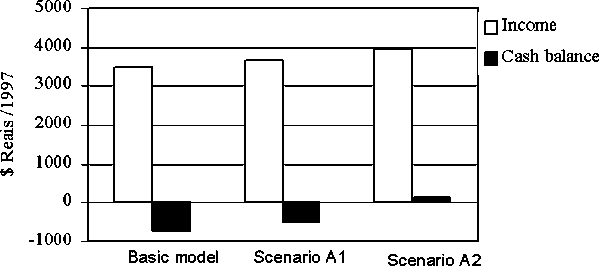
The most important impact on the resources use for the crop sub-system is the increase in maize production. It might be that liberating a part of the production of maize for fodder could stimulate its production for sales. This increase would be significantly higher in Scenario A1 than in Scenario A2 (table 1). Decreases in the livestock stock (-10%) might be interpreted as a result of competition for labour resources between the crop and livestock sub-systems. However, the no-feasible solution for the use of permanent labour, due to its low coefficient values in the model, does not allow us to give more clear picture about this conclusion. More significant results on the farm labour force is the increase of demand for seasonal labour, slighly higher in Scenario A1 than in Scenario A2. Apparently the integration of agroforestry would not have any significant impact in the allocation of labour force for off-farm activities. Another significant and positive impact is on rented land with increases to the upper limit in both tested scenarios.
In general sense, the stronger impact of the tested strategy on the resource allocation would be in Scenario A1, although better economic profit would be obtained with Scenario A2.
Table 1: Impacts of integrating agroforestry into the system on the use of resources
|
|
Basic model |
Scenario A1 |
Scenario A2 |
|
Maize (ha) |
1.16 |
1.85 |
1.27 |
|
Rice (ha) |
1.90 |
1.90 |
1.90 |
|
Beans (ha) |
2.34 |
2.34 |
2.34 |
|
Coffee (ha) |
0.22 |
0.22 |
0.22 |
|
Manioc (ha) |
0.33 |
0.25 |
0.25 |
|
Feeding crops |
|
|
|
|
Sugar-cane (ha) |
1.08 |
1.08 |
1.08 |
|
Cutter grass (ha) |
0.82 |
0.82 |
0.82 |
|
Forage trees (ha) |
0 |
0 |
1 |
|
Livestock (units) |
20 |
18 |
18 |
|
Rented land \(ha) |
3.06 |
5.0 |
5.0 |
|
Permanent labour (units) |
0.52 |
n.f |
n.f |
|
Seasonal labour (units) |
18.8 |
25.1 |
23.5 |
|
Off-farm (units) |
124 |
124 |
124 |
n.f. not feasible solution
In a scenario of optimal allocation of resources, the integration of agro-forestry into smallholder systems would deliver positive socio-economic impact. Its implementation would require, though, additional financial and labour investments from the farmers. Specific training, extension and research on this subject, as well as financial support, are complementary measures needed to implement successfully this strategy.
Argel P and Lascano C.E (1998) Cratylia argentea: una nueva leguminosa arbustiva para suelos ácidos en zones subhúmedas tropicales. In: Tercera Conferencia Electrónica de la FAO sobre Agroforestería para la producción animal en Latinoamerica.
Benavides J.E (1998) Arboles y arbustos forrajeros: una alternativa agroforestal para la ganadería. In: Tercera Conferencia Electrónica de la FAO sobre Agroforestería para la producción animal en Latinoamérica.
Botero R and Russo R (1998) Utilización de arboles y arbustos fijadores de nitrógeno in sistemas sostenibles de producción animal en suelos ácidos tropicales. In:Tercera Conferencia Electrónica de la FAO sobre Agroforestería para la producción animal en Latinoamérica.
Carvahlo MM (1998) Recuperação de pastagens degradadas em areas de relevo acidentado. In: Recuperação de areas degradadas. Sociedade Brasileira de Recuperação de areas degradadas. Pp 149-161
Carvahlo M.M., Freitas V. and Xavier D (1999) Comportamento de cinco leguminosas arbóreas exóticas em pastagem formada em solo de baixa fertilidade. In: Revista Arvore Vol. 23 No. 2 Pp 187-192
ICRAF (1999) Agorforestry-the basics. http:www.cgiar.org/icraf/ag-facts/ag-facts.htm
Santacoloma, P (2000) An Ecologically and Economically Balanced Development in the Brazilian Savannah: The Case of Irai de Minas. Farming Systems and Resources Economics in the Tropics No 36. Hohenheim Univ, Dissertation. Wissenchaftsverlag Vauk Kiel.
Solarte A (1997) Sustainable Livestock Systems based on Local Resources: CIPAVs Experiences. In: Second FAO Electronic Conference on Livestock Feed Resources within Integrated Farming Systems. September 1996-February 1997.
Plevich J O[276], Vita A[277], Julio G[278] and L. Gonzalez[279]
Key words: agrosilvopastoral planning, geographic information system, river basin,,
The river basin Los Rulos, located in the Fourth Region of Chile, is part of a sector of the agricultural community called Canela Alta. Within this ecosystem, a subsistence economy exists based on goat raising, agriculture on unirrigated land, and firewood gathering. These activities are carried out in a manner which produces a high level of desertification. Thus the importance of undertaking studies which would make it possible to identify the most adequate interventions in order to achieve sustainability in this type of environment. The study has as its objective the proposal of an ordination which would satisfy in a sustainable manner the firewood and forage needs of the Agricultural Community which inhabits this river basin.
The river basin studied is located between 71º 09’ and 71º 11’ West longitude and 31º 09’ and 31º 12’ South latitude. The software utilized for the elaboration of the Geographic Information System was ARCINFO. To develop solutions for a sustainable management of forage and firewood the methodological principles put forth by Banda, Rovira, and Lavanderos (1994) were utilized, and these were complemented by other authors (Gonzalos, 1989, Hidalgo, 1993, and Gasto et al., 1994). The construction of the dynamic of ecological, administrative, and spatial interrelationships was made possible by analyzing the following information systems: Ecological system, Administrative system, and Referencing and analysis of the ecological administrative space.
From here the formulation of agrosilvopastoral plans in order to achieve the objectives of the study was completed in an iterative manner contemplating serious restrictions, among which some of the more important restrictions are:
1. The production of forage had to be self-sufficient within the river basin, since today in Los Rulos seasonal migration is not a common practice.
2. The production of firewood using exotic species with irrigation requirements could not compete with the water needs of the human population, of the livestock, or of the production on the private irrigated areas which are used for growing crops (goces singulares), all of which are priority activities within the economy of the Agricultural Community.
3. Each plan corresponding to each one of the different proposed”cuarteles” (sections) had to present an internal rate of return of at least 12%, the minimum amount required by international agencies which support the development of this type of project.
The comprehension of the dynamic of the ecological-administrative-spatial interrelationships made possible the following results:
Analyzing the interrelationships between the current and potential soil use the type and degree of conflicts in soil use were observed. The conflicts in soil use which this analysis reveals are: a) overutilization (45.65%), b) underutilization (21.52%), and c) good use with management conflicts (32.83%).Considering qualitative and quantitative aspects related to the potential use of the soil, exposition, and vegetation, 7 natural, homogeneous units of the territory were determined.
The sites grouped together in these natural units show the following condition for the production of firewood: a) null (2.49%), b) very poor (65.88%), c) poor (21.64%), and d) regular (9.99%). The condition of the sites for forage production shows the following values: a) null (2.49%), b) low (38.51%), and c) regular (61.49%).
In order to analyze the process of desertification, the production values of firewood and forage measured in each natural unit were corrected using the rate of evolution of the degraded areas studied for the Fourth Region (Etienne, 1983) and projected on a timeline of 24 years. The desertification process shows a 30% decrease in the capacity to keep animals in this period (figure 1) and a decrease of 1.18 million KCAL/HA of firewood (figure 2). Following the ordination lineaments proposed by the Office National des Forets (1994) “cuarteles” (sections) and series for the agrosilvopastoral ordination were established in the natural units. For the objectives proposed in this study the criterion used to divide the area into sections was that used by Hidalgo (1993). Using this criterion the division was made in 2 large sections: 1) A production section, integrated by those soils that have agrosilvopastoral potential with a gentle slope (3-8%) and silvopastoral improved and managed with a slope from 8% to 30%, which permit, considering appropriate conservation measures, a use and management moderately high. 2) A second section of protection with restricted use was established considering those soils that require a silvopastoral use, with soils which have a high susceptibility to the erosive action of rainwater, but which would be utilizable with permanent vegetation. These sections under ordination, include the administrative units of the river basin: the “campo comun” (common areas), “lluvias“ (common areas on which crops are grown without irrigation, and “goces singulares” (private areas on which crops are grown with irrigation.
In the “campo comun” considering the proposal of Vita (1993) and Vita (1996), to carry out the interventions in the wooded area (trees and shrubs), the sections were divided into series and these into parcels or forestry units in a way which would make it possible to achieve a degree of homogeneity in regard to composition, structure and stage of development. In order to do this the method of division proposed by Prieto and Lopez (1994) was used, which establishes that for the case of low or medium woods, the section or series must be divided in as many parts as the number of years the chosen turn has for the dominant species.
In the “lluvias” under ordination in sites with gentle slopes (0-8%) and where it would be possible to irrigate, conservationist and captation techniques, accumulation and distribution of water were proposed based on experiences developed by the Development Corporation of Tarija (CODETAR), Bolivia (Salinas, 1995) and the productive technologies for hillside agroforestry systems with seasonal drought, developed by CATIE in Costa Rica (Radulovich, 1994).
In the case of “goces singulares” the proposed ordination had the objective of improving the exploitation of the underground water spring and increasing the current production of the horticultural crops. It takes as its basis the experience carried out in management of spring water through cistern wells, in the dry interior of Chile (FAO-INIA, 1995). The main characteristics of the agrosilvopastoral ordination with energy and forage objectives for the river basin Los Rulos are presented in table 1.
Table 1: Main characteristics of the agrosilvopastoral ordination of Los Rulos.
|
|
Protection cuartel with restricted use |
Production Cuartel |
||||
|
|
Serie 1 |
Serie 2 |
Serie 3 |
Serie 4 |
Serie 5 |
Serie 6 |
|
Function |
Forage firewood |
Forage firewood |
Forage firewood |
firewood |
Forage |
Cereals, garden vegetables, forage, firewood and wood |
|
Harvest time |
jan-april |
jan-april |
oct-dec |
aug-sept |
aug-sept |
may-july (forage) |
|
Structure |
woods with 3 stratums |
woods with 2 stratums |
woods with 2 stratums |
woods low regular |
shrubby |
low irrigation crops. |
|
Species |
Ac, Sm, Co y Am |
Ac, Ft, Co y Ag |
Ft, Ag y Co |
LC-PC |
An |
tr, ph, ts, so, ze, li, Eu, As |
|
VPN (US$) |
9.558,8 |
116.186,2 |
14.275,8 |
34.696,6 |
210.684,7 |
1.069.789,8 |
|
TIR |
13 % |
25 % |
14 % |
15 % |
21 % |
23 % |
Ac: Acacia caven, Ft: Flourensia thurifera, ph: Phalaris spp., Ag: Adesmia glutinosa, LC: Lithraea caustica, tr: Triticum aestivum, Am: Adesmia microphylla, ly: Lycopersicum sculentus, so: Solanum tuberosum, An: Atriplex nummularia, Sm: Schinus moll, ts: Trifolium subterraneum, As: Acacia saligna, PC: Porlieria chilensi, ze: Zea may, Co: Colliguaya odorifera, Eu: Eucalyptus camaldulensis
The ordination of the territory in the context of an agricultural community, attempts to program in form, space, and time the interventions and/or exploitations which need to be realized in order to optimize its production, in this case the production of firewood and forage, in a manner compatible with its perpetuation. As is known, the land division in the agricultural community is characterized by presenting as the majority of the surface area, the “campo comun”, which is used for pasturing and the extraction of firewood, and a smaller sector used for more intensive production, which are called “lluvias” and “goces singulares”.
The agroforestry character of the intervention and utilization in the “campo comun” and their integration with the “lluvias”and the “goces singulares” in order to achieve self-sufficiency imply a great complexity in their ordination. For that reasonas well as the regimen of indivisible property and the situation of the population in a subsistence economy, it is not strange that in spite of the importance of the Agricultural Community in the Fourth Region, the ordination of its resources is so infrequent.
In order to study this complexity, in this study a geographic information system was elaborated composed of the superimposition of different layers of information: physiobiological (climate, relief, soil, and vegetation) and socioeconomic (population, distribution and use of the land, etc.), which made it possibe to identify the homogeneous territorial units and to manage in an automized form numerous information maps, each one corresponding to one of the territorial elements. Using this information and the knowledge accumulated in the region, the country, and on an international level with respect to forestry ordination with multiple uses, made it possible to achieve the formulation of the proposed plans.
The application of these theoretical and methodological aspects and of the previously mentioned tool has facilitated the development of inventory, diagnosis, and planning of a group of ordination plans which make it possible to obtain the requirements of firewood in a sustainable manner and sufficient forage to maintain an admissible number of animals of 0.08 U.A./ha with internal rates of return which vary between 13% and 25%.
Banda C, Rovira A y Lavanderos L (1994). Sistemas de información territorial. In: Lavanderos L.; Gastó, J. y Rodrigo, P. (Eds). Hacia un ordenamiento ecológico-administrativo del territorio. Sistemas de información territorial. Ministerio de Bienes Nacionales, Pontificia Universidad Católica de Chile, Universidad Católica de Valparaiso y Corporación Chile- ambiente, Santiago, Chile. p. 123-160.
Etienne M, Caviedes E, y Prado C (1983). Bases ecológicas para el desarrollo. Elementos para una planificación a nivel regional. Facultad de Ciencias Agrarias y Forestales, Universidad de Chile, Santiago. 69 p.
FAO-INIA, (1995). Manual de prácticas conservacionistas VIII Región, Chile. Editores: Infante, A.; Saintraint, D.; Vergara F. Y Faiguenbaun S. Instituto de Investigaciones Agropecuarias (INIA). Centro Regional de Investigaciones Quilamapu y Organización de las Naciones Unidas para la Agricultura y la Alimentación (FAO). Santiago. 130 p.
Gastó J, Cosio F, Panario D y Gonzáles C., (1994). Sistema de clasificación de ecorregiones. In: Lavanderos L.; Gastó, J. y Rodrigo, P. (Eds). Hacia un ordenamiento ecológico-administrativo del territorio. Sistemas de información territorial. Ministerio de Bienes Nacionales, Pontificia Universidad Católica de Chile, Universidad Católica de Valparaiso y Corporación Chile- ambiente, Santiago, Chile. p. 63-96.
Gonzáles, L., (1989). La protección de cuencas altas: Una propuesta metodológica (borrador de análisis y discusión). Facultad de Ciencias Agrarias y Forestales, Universidad de Chile, Santiago. Mimeografiado. 56 p.
Hidalgo P, (1993). Primer Seminario de Planificación Ambiental Participativa para el Manejo de Cuencas Hidrográficas. Metodología para la planificación ambiental. Documento Nº 1: Marco conceptual.Documento Nº 3: Diagnóstico del suelo. Corporación Nacional Forestal (CONAF). Santiago, Chile. Mimeografiado. 50 p.
OFFICE NATIONAL DES FOREST, (1994). Manual de ordenación de montes.Traducida y ampliada por Prieto Rodrígez A. y López Quero M..Editorial Paraninfo.Madrid, España. 261 p.
Radulovich R., (1994). Tecnologías productivas para sistemas agrosilvopecuarios de ladera, con sequia estacional. CATIE. Turrialba, Costa Rica. 187 p.
Salinas S, (1995). Manual de prácticas conservacionistas existentes, Tarija, Bolivia. ED: Organización de las Naciones Unidas Para la Agricultura y el desarrollo (FAO). Santiago, Chile. 136 p.
Vita A, (1993). Ecosistemas de bosques y matorrales mediterráneos y sus tratamientos silviculturales en Chile. Santiago, Universidad de Chile. FO:DP/CHI/017. Documento de Trabajo Nº 21. 237 p.
Vita A, (1996). Los tratamientos silviculturales. Texto Nº 1. Facultad de Ciencias Agrarias y Forestales. Universidad de Chile.233 p.
Figure 1: Prognosis of firewood
production.
Figure 2: Prognosis of the number
of animals admissable.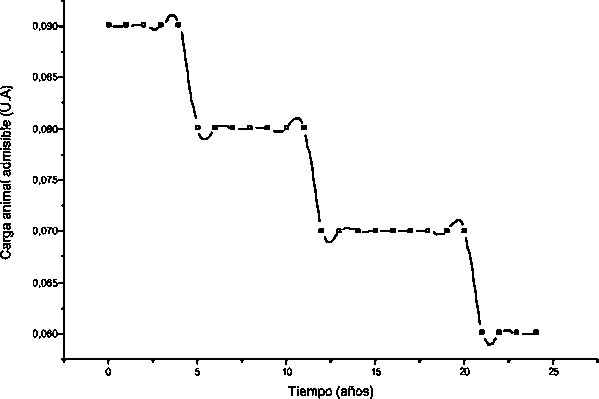
Yvette Alonzo[280], Muhammad Ibrahim[281]
Key words: farm characterisation, financial analysis, forage trees, labour, multivariate analysis.
Although livestock production is a major land use activity in the Cayo district of Belize, milk and beef productions are relatively low. Inefficient management of farms in Cayo has resulted in negative changes in pasture composition and quality, causing farmers to resort to the forest and woodlands in search of forage for their ruminants (Pulver et al 1996). In the dry months there are severe feed shortages, resulting in weight losses of cattle and, in extreme conditions, mortality of animals, low calving rates and long calving intervals. In 1996 fodder bank technologies and multistrata systems were implemented on dairy farms in Cayo to conduct farmer’s participatory research and to determine the preference of these banks in terms of fodder and annual production.
This study was carried out in Belize, situated along the eastern coast of Central America bounded on the north and northwest by Mexico and on the southwest by Guatemala. During the months of February and May 2000, 40 cattle farmers in the Cayo district were interviewed. The entire diary population (n=28) was surveyed while 12 beef farms were chosen at random. A multivariate analysis was applied to characterise the diary farms in that area. Descriptive analysis was used to identify the uses and importance given to the tree component on the farms as well as to identify constraints for adoption of SPSs. A financial analysis was done to determine the profitability of farms with silvopastoral systems (SPSs).
Farm Characterisation
The farms with SPSs represent 25% of the local diary farmers and 17.5% of all the farmers surveyed (n=40). These farmers have established small areas of fodder banks of Leucaena Leucocephala and multistrata systems consisting of Leucaena Leucocephala, improved grasses (Brachiaria brizantha and Cynodon nlemfuensis) and timber trees (Swietenia sp. and Cedrela odorata). The area for these systems range from 0.25 - 4 acres. The remaining farms with TSs are based on unproductive native pastures (Paspalum notatum, P. virgatium and Cynodon dactylon) that are of low productivity and quality (Ibrahim et al., 1998) and TSs commercial supplements, ground corn, wheat bran and mineral salts are used as supplements for the cattle.
The multivariate analysis identified 3 types of farms based on farm resources, milk production and costs of production (table 1).
Table 1. Parameters that distinguish the three groups from each other according to the cluster analysis.
|
Parameters |
Group 1 (n=11) |
Group 2 (n=13) |
Group 3 (n=4) |
|
Total area of pasture (acres) |
45 |
73 |
231 |
|
Total number of animals |
17 |
38 |
112 |
|
Total number of cows |
5 |
9 |
15 |
|
Milk production/farm/yr. (lbs.) |
6553 |
28465 |
61305 |
|
Total income from livestock production/yr. (BZ$) |
2966 |
12156 |
29211 |
Land use systems of cattle farms are pastures (mean 65%), primary forest (mean 22%), fallow (mean 7%) and crops (mean 6%). A regression analysis showed a positive relationship between farm size (X) and the following variables: pastures (R2 =0.78), primary forest (R2= 0.71) and fallow (R2= 0.76). 80% of the farms had more than 50% of the area under natural pastures. Dairy farms were characterised with a greater percentage of improved pastures compared to beef farms because diary animals have greater nutritional demands (NRC, 1989).
Importance of trees in pastures
All farmers (n = 40) interviewed responded positively to the use of trees for shade for animals in pastures. 80% of the farmers were familiar with the benefits provided with the use of foliage from trees such as Guazuma ulmifolia and Brosimum alicastrum for feeding cattle, 63% of the farmers indicated that forage was harvested from multipurpose trees to feed cattle in the dry season. Similar results were found from a study conducted in Green Park, Jamaica, which concluded that more than 70% (n=45) of dairy farmers knew about the use of fodder trees and shrubs for feeding cattle (Morrison et al., 1996).
Financial Analysis
In the financial analysis two model farms with SPSs were compared with twofarms with TSs. Income from the timber trees in the multistrata systems and environmental services accruing from the establishment of trees were considered in the analysis. Table 4 shows the characteristics of the farms analysed.
Table 2 Main characteristics of farms for which financial analysis was carried out.
|
Parameters |
SPSF1 |
SPSF2 |
TSF1 |
TSF2 |
|
Farm size (acres) |
75 |
46 |
69 |
47 |
|
Area of pasture (acres) |
54 |
40.5 |
55 |
43 |
|
No animals |
26 |
43 |
29 |
48 |
|
No milking cows |
11 |
8 |
7 |
10 |
|
Milk/farm/day (lbs.) |
198 |
144 |
140 |
130 |
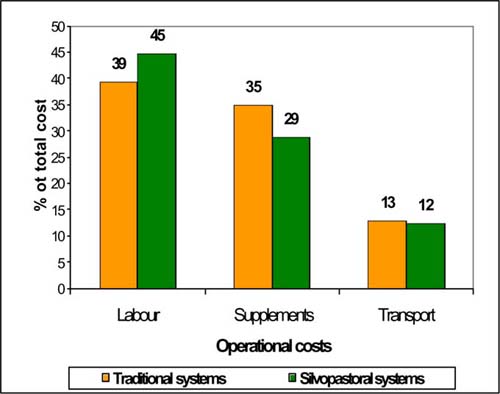
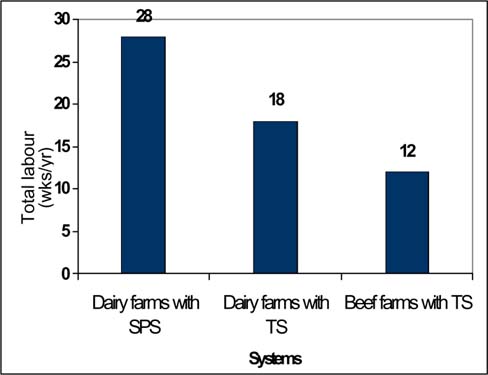
SPSs showed higher labour costs due to the fodder banks which require additional labour when a cut and carry feeding system is used. However supplement costs are lower since the use of commercial concentrate is decreased and replaced with forage (Fig. 1 & 2). The promotion of SPSs can create employment for workers in the rural zones, but will depend on labour costs. Beef production requires less labour because of extensive management systems (Holmann and Estrada, 1997).
Fig 1. Distribution of costs for both systems 1 week = 6 days
Fig. 2. Labour contracted in the three livestock production systems 1 week = 6 week
Table 3 shows better production indices for the two model farms with SPSs compared to two representative farms with TSs. On average milk production per acre was 34% more for farms with SPSs. Income from milk was also 53% greater and five cents per lb is saved on cost of production with SPSs. The financial indicators in table 4 show similar results. Income from the timber trees and the potential income from the environmental services provided by SPSs resulted in higher NPV/acre and B/C. These results agree with Benavides, 1994 who concluded that the incorporation of fodder trees on farms proves economically profitable and contribute to the improvement of the family's economic situation.
Table 3. Production indices for 2 model farms with SPSs and 2 farms with TSs (2 Bz$ = 1 US$).
|
Production indices |
SPSF1 |
SPSF2 |
SPSAvg |
TSF1 |
TSF2 |
TSAvg |
|
Milk production/acre/year (lbs.) |
880 |
864 |
874 |
649 |
650 |
650 |
|
Milk production/cow/day (lbs.) |
18 |
18 |
18 |
20 |
13 |
16.5 |
|
Income from milk production/acre/yr. (BZ$) |
329 |
250 |
290 |
161 |
218 |
190 |
|
Gross annual income (BZ$) |
20807 |
17950 |
19379 |
11505 |
12880 |
12193 |
|
Cost of production (BZ$/lb.) |
0.18 |
0.27 |
0.23 |
0.25 |
0.29 |
0.28 |
Table 4. Financial indicators over a 40 year period
| SYSTEMS |
VAN |
VAN/year |
VAN/acre |
B/C |
| TRADITIONAL DAIRY SYSTEMS FARM 1 |
60630 |
1516 |
1102 |
1.36 |
| TRADITIONAL DAIRY SYSTEMS FARM 2 |
57757 |
1444 |
1343 |
1.22 |
| Scenarios: Silvopastoral Systems Farm 1 |
||||
| With income from trees and carbon sequestration |
110828 |
2052 |
2186 |
1.68 |
| Without income from trees and carbon sequestration |
110510 |
2763 |
2046 |
1.68 |
| Scenarios: Silvopastoral Systems Farm 2 |
||||
| With income from trees and carbon sequestration |
118921 |
2973 |
2944 |
1.97 |
| Without income from trees and carbon sequestration |
117689 |
2942 |
2913 |
1.96 |
*indicators were calculated using a real discount rate of 6%
The sensitivity analysis showed high sensitivity to changes in labour prices, supplement costs and transportation costs in that order. Increasing labour cost by 10% resulted in a linear decrease in NPV values. Similar results were obtained when supplement and transportation costs were increased. However, increasing milk prices at the same rate (10%) quickly increases the NPV of these systems.
Constraints for adoption
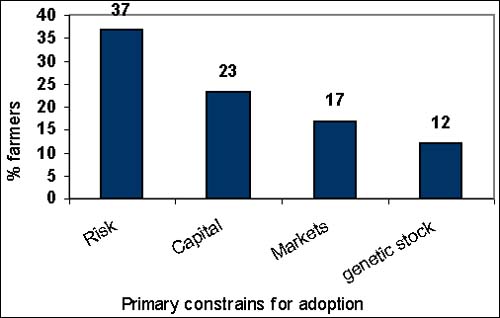
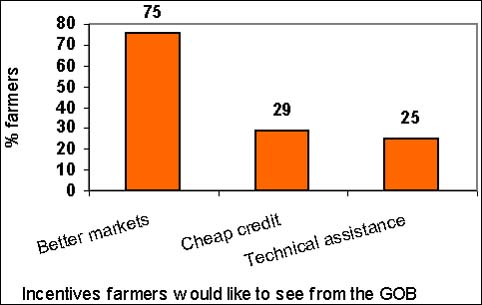
The major limiting factors for the adoption of silvopastoral technologies as reported by the farmers in this study, were: risk, capital, markets and poor genetic stock. Farmers are reluctant to change from traditional systems to new technologies associating these with higher risks. This reaction is mainly due to lack of knowledge of these systems (Aldy et al., 1998). The capital required for the initial investment for the establishment of these systems was reported as a limiting factor especially since farmers are reluctant to take loans from credit institutions mainly due to the high interest rates and collateral requirements. In Belize there are good examples where cattle farmers are currently selling their animals to pay old credits. Farmers also agree that better, more secure markets need to be identified for their product as producer price is too low for them to make a fair profit. Most of the cattle in Belize are of poor genetic stock, crosses of local criollo animals with Brahma animals and this has been significantly affecting the milk production on most farms. (fig. 3 and 4).
Fig. 3 Primary constraints for adoption of SPS as reported by the farmers (n=40) in Cayo, Belize.
Fig. 4 Incentives farmers would like to from the Government of Belize (GOB).
Conclusions
The impact of SPSs can be seen in the financial benefits - increase in net benefits of the farmers, higher B/C and NPV compared to the farms with TSs. However, the sensitivity analysis showed that increases in labour resulted in a significant reduction of NPV and this can affect the profitability and adoption of SPSs. Additional benefits provided by the SPSs which include timber, nitrogen in the soil, and carbon sequestration, increases the income of the farmers and reduces the risk through the diversification of the farms compared to the farms with TSs which are only oriented to livestock production. The multivariate analysis identified three groups of diary farms based on farm resources, level of milk production and costs of production. This is important when considering the implementation of SPS on the farms with TS since different type of farms have different requirements, different limitations and potentials. Among the major limiting factors identified by farmers for the adoption of silvopastoral systems are risk, capital, markets, and genetic stock.
ALDY, J.E.; HRUBOVCAK, J.; VASAVADA, U. 1998. The role of technology in sustaining agriculture and the environment. Ecological Economics 26: 81 - 96.
BENAVIDES, J.E. 1994. La investigación en árboles forrajeros. In Arboles y arbustos forrajeros en América Central. CATIE, Turrialba, Costa Rica. vol. I, p. 31.
CAMERO, A.R. 1996. Desarrollo de sistemas silvopastoriles y sus perspectivas en la producción de carne y leche en el trópico. Silvopastoreo: Alternativa para mejorar la sostenibilidad y competitividad de la ganadería colombiana. p. 13 - 31.
HOLMANN, F.; ESTRADA, D. 1997. Alternativas agropecuarias en la región pacífico central de Costa Rica: un modelo de simulación aplicable a sistemas de doble propósito. In Conceptos y metodologías de investigación en fincas con sistemas de producción animal de doble propósito. Ed. C.E. Lascano y F. Holmann. CIAT. Colombia. p. 134 - 150.
IBRAHIM, M.; HOLMANN F.; HERNANDEZ M.; CAMERO A.; CHANNA C. 1998. Forage yield and live weight gains of steers grazing unimproved pastures with daily browsing of Erythrina berteroana protein bank and or supplementation of green bananas. Agroforestry Systems.
MORRISON, B.; GOLD, M.; LANTAGNE, D. 1996. Incorporating indigenous knowledge of fodder trees into small-scale silvopastoral systems in Jamaica. Agroforestry Systems 34: 101- 117.
NRC. 1989. Nutrient requirements of dairy Cattle, 6th ed. National Academy of Sciences, Washington, D.C.
PULVER, E.; ARYA, L.;TZUL F.; CLARE, D. 1996. Conservation- Effective Livestock Production. Narmap, Belize. 7 p.
Vijay Paul Sharma[282]
Key words: attitude, awareness, benefit-cost ratio, net present value, socio. economic status, technology adoption
Adoption of technological innovations in agriculture has received considerable attention among development economists because new technologies seem to offer opportunities to increase production and income substantially. But the introduction of many new technologies has met with only partial success, as measured by the observed rates of adoption. The conventional wisdom is that the constraints to rapid adoption of innovations involve factors such as the non-availability of credit, limited access to information, small farm size, farm tenurial arrangements, high risks, inadequate and untimely supply of complementary inputs (such as seed, chemicals and irrigation water), and poor infrastructure. Removing these constraints was expected to result not only in the adoption of the improved practices but also in a change in crop composition, which was expected to increase average farm incomes further. However, because of natural resources, cultural, political and socio-economic differences, the importance of factors affecting technology adoption differs across countries/regions. So there is a need to conduct specific technology adoption studies in areas where extension and research programs are implemented to understand factors affecting adoption in these areas. Recent studies investigating factors influencing adoption of technology in agricultural sector have dealt with high-yielding varieties, fertilizers, pesticides, irrigation technologies and watershed development projects. Although an extensive body of literature exists for technology adoption in agricultural sector, relatively few empirical studies have examined the adoption of forestry innovations. Furthermore, the economic contribution of agroforestry at the farm-level has not been systematically assessed. This paper analyzes farm-level profitability of poplar-based agroforestry systems and identifies important socio-economic and institutional factors, which influence adoption of agroforestry programs in northwestern part of India.
Field study was conducted in Haryana State of India in 1997-98 to examine the farm-level profitability and influence of different socio-demographic characteristics, and communication and psychological factors on adoption of agroforestry practices. Out of eight social forestry divisions in the state, two divisions, namely Ambala and Panipat were purposively selected, because these two divisions accounted for about 40 per cent of the area under farm forestry plantations during the last five years in the state. Stratified random sampling design was adopted in selection of districts, villages and the respondents. The study was confined to four districts (two from each division), twelve villages and 140 households. Farm level data on various aspects of household’s socio-economic variables, production systems and land use, and the costs and benefits of agricultural crops and agroforestry systems were collected from the selected farmers through interview method on a well designed pre-tested questionnaire. Based on farm-level data, complemented by documented information on costs and prices, a financial analysis was carried out to assess the viability of different agroforestry systems, i.e. System I: poplar with sugarcane (Saccharum officinarum)-wheat (Triticum aestivum)-sorghum (Sorghum bicolor)-turmeric (Curcuma longa), II: poplar with sugarcane-wheat-sorghum-wheat-fallow, III: poplar with wheat-sorghum-fallow, IV: poplar on the field boundaries with sugarcane-rice (Oryza sativa)-wheat crops, and V: poplar on the boundaries of rice-wheat crop rotation (Sharma and Kumar, 2000). Financial indicators such as benefit-cost ratio (BCR), internal rate of return (IRR), net present value (NPV), payback period (PBP), and average annual margin/annuity value were calculated. Innovation-decision process has been applied extensively to investigate the adoption of agricultural technologies (Rogers, 1995). The decision either to adopt or not can be analyzed with binary choice models. Binary models are appropriate when the choice between two alternatives depends on the characteristics of problem. Application of linear probability model to this type of problem however suffers from number of deficiencies. Difficulties of the linear probability model can be circumvented through the use of monotonic transformation (probit or logit model), which guarantees that predictions lie within the unity interval. Information on socio-demographic characteristics, communication and psychological factors was used to ascertain if these factors affect the adoption of agroforestry practices. Following Trivedi (1963) and Singh (1985), a socio-economic status index for farmers was constructed on the basis of their educational level, caste, occupation, asset position, type of house owned, material possession and social participation. The communication factors are represented by the farmer’s awareness about agroforestry practices and are therefore expected to be positively associated with adoption of agroforestry. An awareness index developed by Alavalapati (1990) with slight modifications was constructed to determine the extent of knowledge about agroforestry practices. Psychological factors include farmers’ attitude towards agroforestry. Attitude has been defined as the degree of farmer’s positive or negative feelings towards an innovation. The attitude towards agroforestry was measured by an index developed by Singh (1985) with small modifications. Because of dichotomous nature of dependent variable, the logit model technique was employed. The final form of the logit model used in this study to analyze the adoption behavior of the farmers is:
Ii = a0 + a1 AWARENESS + a2 ATTITUDE + a3 STATUS + a4 OFF-FARM + a5 FARM SIZE + a6 AGE
The results of financial analysis revealed that all the agroforestry systems analyzed in the study were profitable at 15 per cent discount rate. Benefit-cost ratio was greater than one in all the systems studied. The benefit cost ratio was highest (3.60) for agroforestry model I, followed by agroforestry system II and the lowest (2.84) in case of agroforestry model V. When block and boundary components were compared, the block plantation provided a greater benefit-cost ratio. The agroforestry system I was superior to other alternatives at all the discount rates in terms of NPV and BCR. The internal rate of return worked out to be greater than 50 per cent in all the systems analyzed. The IRR was highest for model IV (71.18%), followed by model V (64.33%) and the lowest for model III (54.17%). The net present value of all agroforestry systems varied from Rs. 112,067 ha-1 in case of boundary plantation system V to Rs. 202,287 in block plantation system I. The NPV of block plantations was relatively higher as compared to NPV of boundary plantation systems. Payback periods were quite long for block planting systems (models I-III), averaging 6 years compared with 1.6 to 2 years for Systems IV and V with boundary plantations. The long gestation period commonly assumed for tree-based systems does not seem to be a problem for boundary plantation practices in the region. There is some trade-off between total benefits and a shortened payback period, but for most small and resource poor farmers the shorter payback period would be highly attractive, particularly since the most common alternative land use was annual crop production in the study area. Therefore majority of small farmers raised poplar plantations on the field boundaries. Sensitivity analysis showed that all the agroforestry models are financially viable at 20, 25 and 30 per cent discount rates. The results also revealed that average annual margin per hectare from all the agroforesty models exceeded the net returns per hectare from rice (non-basmati)-wheat crop rotation at 15 per cent discount rate. The above results clearly indicate that investment in agroforestry is profitable. Further its profitability is far greater than that of rice-wheat and sugarcane based cropping systems and thus justifies the investment in agroforestry projects.
Results of logit model indicate that of the six factors analyzed, the probability of farmers adopting agroforestry was significantly associated with all the factors (Table 1). All the variables were statistically significant at different levels of significance. Results from the equation of adoption behavior model show that all the variables other than age have positive and significant influence on the probability of adoption of agroforestry practices. Farmers’ attitude towards agroforestry was found to be the most important factor in determining adoption of agroforestry systems in the study area. Awareness about agroforestry, socio-economic status, sources of off-farm income and farm size have positive and statistically significant affect on agroforestry adoption. Age of the farmer had significantly negative affect on adoption behavior. The estimates of the variables listed in the Table 1 are not comparable with one another because the magnitudes of the coefficients depend on the unit of measurement and because they are expressed as indices, thus they have little interpretable value unless transformed into probabilities. Therefore, the elasticity at the mean values of each explanatory variable are also presented in the Table 1. These values indicate the effects of the changes in each independent variable on the likelihood of adoption of agroforestry assuming that changes in other variables are constant. The results suggest that awareness campaigns about tree planting have the potential to influence the farmers to adopt agroforestry. The results also suggest that although awareness programs about farm forestry may be important in disseminating information widely but the influence of extension agents on the attitude of potential adopters towards farm forestry is also a crucial factor. Farmers with sources of off-farm income are more likely to adopt agroforestry practices. Farm size was found to be less important factor affecting the adoption decision of the farmers. This is perhaps due to the fact that small and marginal farmers were also planting trees on boundaries of the fields.
Table 1. Maximum likelihood estimates and elasticity of determinants of agroforestry adoption in north-west India, 1997-98.
|
Variables |
Estimates (bj) |
Elasticity* |
|||
|
|
Sign |
Size |
Standard error |
Significance |
|
|
CONSTANT |
+ |
4.8780 |
4.7992 |
- |
0.0343 |
|
AWARENESS |
+ |
5.2305 |
2.3166 |
** |
0.0368 |
|
ATTITUDE |
+ |
5.8395 |
2.0828 |
** |
0.0411 |
|
STATUS |
+ |
2.0101 |
1.0421 |
*** |
0.0141 |
|
OFF-FARM |
+ |
3.5018 |
1.6630 |
** |
0.0246 |
|
FARM SIZE |
+ |
0.2181 |
0.1078 |
** |
0.0015 |
|
AGE |
- |
0.1867 |
0.0974 |
** |
-0.0013 |
***, **, * Significant at 0.001, 0.05 and 0.01 level, respectively; * computed at the sample mean
The results of financial analysis showed that all the poplar based agroforestry models analyzed were profitable at discount rates of 15 per cent and higher. The NPV was positive and BCR was found to greater than one in all the cases. The IRR was substantially higher than the prevailing market rate of interest. Among the five models, they are in order of Model I>Model II>Model III>Model IV>Model V. Agroforestry is more profitable option for the farmers than mono-culture agriculture, provided that the correct poplar-crop interplanting patterns and cultivars are used. The results of logit model indicate that the households’ attitude towards agroforestry practices, awareness, socio-economic status, farm size and off-farm income have a positive and significant influence on the adoption of agroforestry innovations. However, age of the farm operator had significantly negative impact on adoption. The results of the study suggest that the government should launch awareness campaigns/programs to disseminate knowledge/information about agroforestry practices and also create favorable attitude of potential adopters towards agroforestry through extension efforts. With about two-third of the farmers being small and marginal, the government should encourage these farmers to plant trees on the field boundaries. These measures will go a long way in increasing the income levels of the farmers and creating additional employment opportunities in the rural areas.
Alavalapati JRR (1990) An analysis of factors influencing social forestry adoption: implications for forestry extension. M.Sc. thesis (unpublished), University of Alberta
Rogers EM (1995) Diffusion of Innovations. 4th ed. The Free Press, New York
Sharma Vijay Paul and Kumar Arvind 2000 Factors influencing adoption of agroforestry program: a case study from northwest India. Indian Journal of Agricultural Economics 55(3): 500-510.
Singh KA 1985 An evaluation study on the effectiveness of social forestry program in Andhra Pradesh. M.Sc. thesis (unpublished) Andhra Pradesh Agricultural University, Hyderabad.
Trivedi G 1963 Measurement of analysis of socio-economic status of rural families, unpublished Ph. D. thesis, Indian Agricultural Research Institute, New Delhi.
David Kaimowitz[283]
Livestock researchers in Latin America have long argued that by generating and transferring improved cattle ranching technologies this will encourage ranchers to stop converting additional forest to pasture. The general idea behind this is that if ranchers can produce more beef and dairy products on a unit of land than less land will be required to meet the population's need r livestock products. Similarly, if improved techniques reduce pasture degradation and eliminate the need to abandon pastures after a relatively short period of time this also means that less pasture land will be need and hence less forest converted to pasture. Typically, the literature that makes such arguments does not specify the exact mechanisms through which these results will occur. Nor does it explain why new technologies that make cattle ranching more profitable will not lead ranchers to want to expand their operations, including their pastures. (Presumably ranchers will only adopt such technologies if they improve their profits.). Nevertheless, one can think of several possible causal mechanisms through which technological change in livestock production could lead to less deforestation or to the natural regeneration of forests on abandoned pastures. If the new technologies greatly increase total production of beef and/or dairy products than could lead make the price of these products decline. That, in turn, might discourage ranchers with low yields, poor soils, or high transportation costs from raising cattle. If the new technologies require much more labor, capital, or managerial effort per hectare than traditional technologies, ranchers that have limited access to labor or capital or managerial effort may decide to concentrate their available resources on a smaller area. They will not expand beyond that smaller area because they lack sufficient resources to do so. Imposing higher quality standards for beef and dairy production, which one can view as a technological innovation, may curtail pasture expansion if cattle raised in extensive systems is unable to meet the more stringent quality standards.
Using this same line of thinking also suggests a number of mechanisms through which technological change in livestock production might actually increase deforestation. If it makes livestock production more profitable and does not significantly reduce beef and/or dairy products and ranchers have unlimited access to labor, capital, and managerial skills, technological change should promote pasture expansion. Similarly, if ranchers are labor and/or capital constrained and technological changes increases their profits they may invest their additional income to purchase labor or capital goods (including cattle) and expand their pastures. Technological changes such as the eradication of hoof and mouth disease that allow ranchers to gain access to more lucrative markets should promote deforestation by making livestock production more profitable. The same applies to the establishment of processing facilities that produce refrigerated beef, which can be transported at much lower cost. Presented in this fashion, it becomes much easier to analyze whether new livestock technologies will increase or decrease pressure on forests. Key variables include: 1) how much they increase aggregate beef and/or dairy supply and how much prices decline as a result; 2) how they affect per hectare labor, capital, or managerial requirements and to what extent ranchers face constraints in their access to each of these factors; 3) how they affect rancher's ability to invest by providing additional funds made available by increased profits; 4) how they affect transport costs; 5) how they effect product quality, and hence product prices; and 6) to what extent cattle ranchers in certain ecological contexts and with certain types of livestock systems are more likely to adopt the technologies than others.
The previous discussion supposes that the sole reason landowners maintain pasture is to produce livestock. If pasture also serves as a relatively inexpensive way to obtain or guarantee property rights over the land itself, technological change in livestock production may not alter this or may only alter it indirectly through its effect on local land prices. The previous discussion also assumes that pasture and forest are two separate dichotomous variables. Silvopastoril system present the possibility of producing livestock products while retaining many of the products and services forests provide. This paper does not explicitly address that issue. The conceptual framework for this paper comes from a research project on how technological change in agriculture affects tropical deforestation, coordinated by Arild Angelsen and David Kaimowitz. Most of the empirical material comes from studies by Andrea Cattaneo, Pichon et. al., Vosti et. al., White et. al., and Yanggen and Reardon, carried out within the framework of the previously mentioned research project. The paper also draws from a study by David Kaimowitz of livestock and deforestation in Central America and research by Rene Poccard Chapuis on the livestock production and marketing systems in Para, Brazil. To address the issue of how technological change in livestock production may affect livestock product prices and hence the area allocated to pasture, Andrea Cattaneo has prepared a Computable General Equilibrium model of the Brazilian economy. His model shows that improved beef production yields in the Amazon are likely to lead to greater deforestation.
The negative feedback through lower product prices and higher labor, land, and capital prices are not sufficient to outweigh the impulse towards greater pasture expansion resulting from the fact that cattle ranching becomes more profitable. On the other hand, technological improvements outside the Amazon reduce deforestation in the Amazon because their main effect on cattle ranching in the Amazon is to lower the prices Amazonian ranchers receive for their products. If one just examines the aggregate figures for Brazil it becomes clear that although large numbers of cattle ranchers have adopted more intensive cattle ranching systems in the last few decades, particularly in eastern Para, total forest conversion to pasture in the Amazon has continued to increase. This does not necessarily demonstrate that intensification does not reduce pressure on forests, but it does suggest that if it does the aggregate effect has not been sufficient to significantly lower deforestation rates. The Kaimowitz study from Central America emphasizes that, contrary to the expectations of many analysts, declines in beef and dairy product prices may actually lead to greater declines in cattle ranching in traditional livestock production areas than along the agricultural frontier. This applies equally to price declines resulting from technological changes in livestock production and those resulting from other causes. The main reasons for this result is that on the agricultural frontier many ranchers use pasture expansion as a means of securing property rights and the ranchers that live their have fewer alternative options for investing their savings. Thus they continue to expand their pastures even when prices decline. In contrast, ranchers in traditional livestock areas do not need to expand their pastures to secure property rights and have more opportunities to invest their capital in other activities when ranching becomes less profitable.Vosti et. al. use linear programming models and data from small farms in agricultural colonization settlements in Acre, Brazil to analyze the likely impact of technological change. They conclude that just about anything that makes ranching more profitable will increase the rate of deforestation. Their scenarios show that small ranchers would have eventually cleared most of the forest on their land anyway, but improved pasture management and cattle raising technologies greatly accelerate that process. They do this both by drawing resources away from more land-intensive crop production activities and by generating additional profits that farmers can invest in livestock production.
In contrast, the Pichon et. al. study shows that under certain circumstances labor-intensive technological innovations may help conserve forest. The authors examine data from small farms in colonization settlements in the Ecuadorian Amazon and conclude that many of the farms that have adopted coffee production continue to have forest cover on a substantial portion of their area even several decades after their initial settlement. The authors conclude that the farmers are labor and capital constrained and since they invested a large portion of their available labor and capital in coffee production they don't have enough remaining resources to clear all of their forest and grow crops or pasture on it. They point out, however, that the better off farmers do not face such limitations and many of them have converted practically all of their forest to pasture. To the extent that these farms combine both tree crops and ranching, the case described by Pichon et. al. has particular relevance for the discussion on the potential environmental impacts of silvopastoril systems.Yanggen and Reardon look at the impact of introducing improved fallow systems involving kudzu in slash and burn crop rotation systems in Pucallpa, Peru. Even those these systems do not involve livestock production, the study is relevant because the claim that improved fallows will remove farmers' need to maintain large areas in fallow - and hence to deforest large areas - is quite similar to the claim that improved pasture varieties will reduce deforestation because ranchers will no longer need to abandon their pastures after several years. In this case, improved fallows actually increased total clearing of secondary and primary forest because they helped to reduce per hectare labor costs. Farmers now need less land to produce the same amount of crops, but they don't want to produce the same amount of crops. Reduced labor costs make it easier and more profitable to expand the amount of crops they produce. At the same time, the new technology has also increased farmers' preference for clearing fallow and secondary forests rather than primary forests because it increases labor productivity in the former more than the latter. This has led farmers to clear less primary forest than in the past. Poccard has systematically studied the production, processing, and marketing chains for livestock in the Uruara-Altamira region along the Transamazon Highway in Brazil. His work emphasizes the importance of changes in transportation technology, in the organization of the beef market, and in Brazilian sanitary regulations for slaughterhouses. These changes have led to greater demand for higher quality beef, which comes largely from the larger ranches, and have reduced the transportation costs associated with beef production. White et. al. use data from livestock research and development projects in Colombia, Costa Rica, and Peru to argue that once ranchers have depleted the available forest resources and occupied most of the territory the increase in land prices leads them to intensify their production. It is not that livestock intensification reduces deforestation, but rather that once most they have cleared most of the forest ranchers are forced to intensify. This implies that ranchers will only adopt silvopastoril systems and other production technologies that require more labor and capital per hectare once the extensive frontier has closed and land ceases to be an abundant resource. The only exceptions to this are likely to be in situations such as that described by Pichon et. al. where the incorporation of tree crop allows farmers to produce products that have particularly attractive markets. (In the Ecuadorian case, producers grew coffee because it had a guaranteed market and relatively stable prices.).
In summary, the evidence suggests that livestock intensification is mostly likely to reduce pressure on forests where it involves labor-intensive technologies in contexts within limited in-migration. Unfortunately, it is often difficult to convince ranchers to adopt labor-intensive technologies in agricultural frontier situations where land is abundant and labor is scarce. Situations where the labor intensive technologies allow ranchers to produce dairy products, tree crop products, or timber that have attractive markets may be exceptions to this. If the only way ranchers can take advantage of these markets is to use labor-intensive technologies they may be willing to do so even in contexts where labor is scarce and land is abundant. Improvements in livestock technology that greatly increase aggregate supply in contexts of inelastic demand and limited land speculation may also reduce deforestation. The role of improved technologies in generating additional saving that allow ranchers to overcome capital constraints may be important in many contexts and lead to medium-term and long-term consequences considerable different from those observed in the short-term.
| [268] Centro de Investigaciones
de Medio Ambiente de Camagüey, e-mail: [email protected] [269] Centro de Investigaciones de Medio Ambiente de Camagüey, e-mail: [email protected] [270] Centro de Investigaciones de Medio Ambiente de Camagüey, e-mail: [email protected] [271] All the authors are from the University of Ciego de Ávila, Cuba. [272] Note: All authors are the University of Ciego of Ávila (UNICA), Cuba [273] El Colegio de la Frontera Sur (ECOSUR), Carr. Pan. y Per. Sur s/n, 29200 San Cristóbal de las Casas, Chiapas, México. [email protected] [274] Facultad de Medicina Veterinaria y Zootecnia, Universidad Autónoma de Yucatán (FMVZ-UADY), Mérida, Yucatán, México. [275] Agricultural Support Systems Division , FAO [276] Departamento de Producción Vegetal, Facultad de Agronomía y Veterinaria, Universidad Nacional de Río Cuarto. Argentina. [277] Departamento de Silvicultura, Facultad de Ciencias Agrarias y Forestales, Universidad de Chile. Chile. [278] Departamento Manejo de Recursos Forestales. Facultad de Ciencias Agrarias y Forestales, Universidad de Chile. Chile. [279] Departamento Manejo de Recursos Forestales. Facultad de Ciencias Agrarias y Forestales, Universidad de Chile. Chile. [280] M. Sc. Enviromental Economic, CATIE, Turrialba, Costa Rica. 2000. [281] Research Profesor, CATIE, Turrialba, Costa Rica. Tel (506) 558-2595 E-mail: [email protected] [282] Indian Institute of Management, Ahmedabad 380 015 (India); Phone: 91-79-6307241, 6308357; Fax: 91-79-6306896; Email: [email protected] [283] Principal economist, Center for International Forestry Research |