2.1 ICRAF's Mission and Goals
2.2 Meeting the Goals: Needs and Constraints
2.3 Overcoming Constraints to Meeting Agroforestry Needs: ICRAF's Contributions
2.4 ICRAF's Achievements and Impacts
2.5 ICRAF's Current Programmes: Summary and Assessment
2.6 Linking ICRAF's Programme Activities to its Goals: The Panel's Overall Assessment
This Chapter provides an overall context for the specific strategic assessment of cross-cutting programme issues in Chapter 3, and management issues, in Chapter 4. The discussion in this Chapter addresses questions related to the mission and goals of ICRAF; how they relate to the overall CGIAR goals; how they relate to the needs in agroforestry to meet the goals; the constraints on meeting those needs; and how ICRAF's programme contributes to overcoming the constraints.
The activities of all the Centres in the CGIAR are undertaken in accord with their own mandates, which are consistent with the mission of the CGIAR: to contribute, through its research, to promoting sustainable agriculture for food security in developing countries. Their activities also are directly related to meeting their own goals and the fundamental one of the CGIAR: to alleviate poverty and protect natural resources so as to achieve sustainable food security.
ICRAF's evolving strategy for agroforestry integrates improvements that boost the functions of trees as providers of products and trees as providers of services, with improvements in policy and institutional arrangements that aim at widespread adoption of agroforestry by farmers. The focus and mission of ICRAF is the same as in 1993 and before. They are entirely consistent with those of the CGIAR. Thus, in the words of ICRAF, its overall mission is:
To increase the social, economic and nutritional well-being of peoples in developing countries through the use of research and related activities to integrate woody perennials in farming and related land-use systems in order to increase productivity, profitability, sustainability, diversity of output and the conservation of natural resources.
ICRAF's goals reflect this mission and also are consistent with the CGIAR goals. More specifically, ICRAF's envisions its contribution to improving human welfare in terms of the following goals:
· Reduce current, and prevent future poverty (poverty alleviation goal);· Increase food and nutritional security;
· Enhance environmental resilience (increasing soil conservation, increasing soil fertility, enhancing carbon sequestration, protecting watersheds, preserving biodiversity and decreasing greenhouse gas emissions);
In the above, the terms "reduction" and "prevention" have been added in relation to the fundamental CGIAR "poverty alleviation" goal. This is done to recognize that much of ICRAF's work is aimed not only at alleviating present poverty, but also at preventing future poverty, both among currently living farmers and for future populations. This latter work is focused on diversifying farm outputs to reduce risks and increase incomes, and on natural resources management systems work aimed at preventing deterioration in the future of presently adequate conditions, thus preventing or reducing the chances of farmers sinking into increasing levels of poverty and misery.
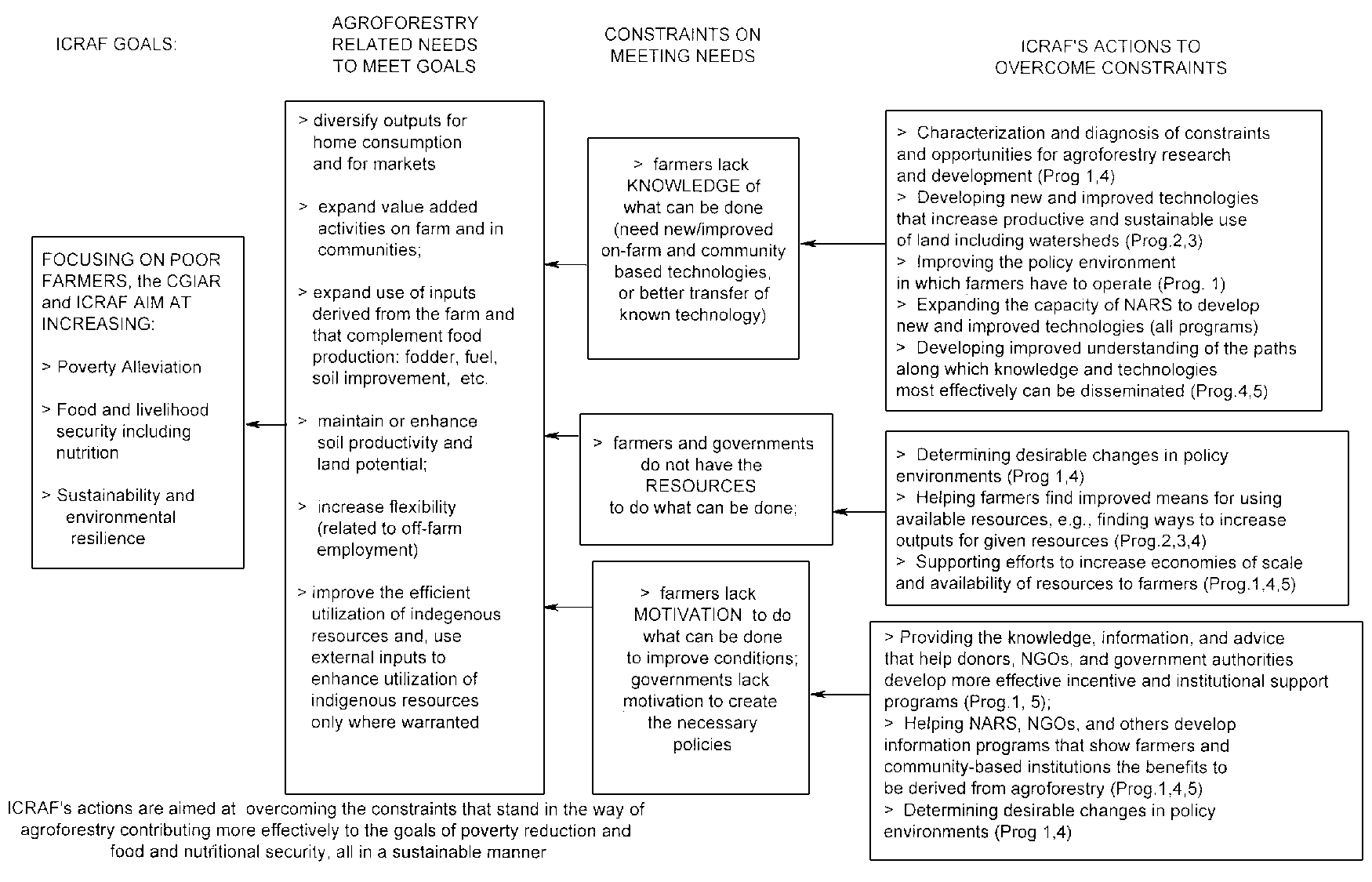
The first column of Figure 2.1 lists the goals of ICRAF, as they relate to its contributions to its and the CGIAR's goals through generation and dissemination of knowledge, technologies and institutional innovations for increasing the contribution of agroforestry to development.
Over the years, understanding has increased concerning what specifically is needed in agroforestry to meet the goals set by ICRAF (which are consistent for the most part with the goals of its partners). Similarly, the constraints that stand in the way of meeting those needs are quite clear in most instances. Thus, based on this understanding, and as indicated in column 2 of Figure 2.1, the Panel sees the types of farmer related needs that ICRAF could address as including the following:
· diversify and expand outputs for home consumption and for markets;· expand value added activities on farm and in communities;
· improve the efficient utilization of indigenous resources through agroforestry systems and, where appropriate, to strategically use external inputs to enhance the utilization of indigenous resources.
· maintain or enhance soil productivity and land potential; and
· increase flexibility (needed because family members leave for off-farm employment to gain income for the family).
The Panel interprets ICRAF as addressing three types of constraints to meeting these direct farmer needs. These are:
· constraints on researcher and government authorities, due to lack of knowledge of how farming systems can be improved through agroforestry in terms of both efficiency and effectiveness, as well as farmer access to that knowledge;· constraints on government and farmer access to the resources needed to implement needed and desired changes; and
· constraints on government motivation to create the conditions necessary for farmers to have access to knowledge and resources, and farmer motivation to undertake the needed investments of his or her time, funds and land.
The constraints are indicated in column 3 of Figure 2.1
Figure 2.1: ICRAF's GOALS IN RELATION TO AGROFORESTRY NEEDS, CONSTRAINTS, and ICRAF's PROGRAMME
ICRAF has set itself a broad, comprehensive set of objectives related to its contribution to overcoming the constraints. It also has a comprehensive strategy for meeting the goals. ICRAF recognizes well that to meet it goals, it has to focus on helping to overcome the constraints that stand in the way of widespread improvements in agroforestry for sustainable development and take advantage of the opportunities that arise to work on the constraints with its partners. The Panel interprets ICRAF's strategy in this regard as involving the following elements:
To overcome knowledge constraints, ICRAF (Programmes listed in parentheses) is involved in:
· characterization and diagnosis of constraints and opportunities for agroforestry research and development (Programmes 1, 4);· developing new knowledge and technologies that increase productive and sustainable use of land, including at the farm and watershed levels (Programmes 2, 3, 4);
· determining desirable changes in the policy environment in which farmers have to operate (Programmes 1, 4);
· expanding the capacity of NARS to develop new and improved technologies (all Programmes); and
· developing improved understanding of the paths along which knowledge and technologies most effectively can be disseminated to farmers and development authorities, i.e., effective development pathways (Programmes 4, 5);
· improving knowledge delivery systems (e.g., curriculum development) to incorporate multidisciplinary approaches to agroforestry (Programme 5).
To overcome resource constraints, ICRAF is involved in:
· helping farmers find improved means for using available resources, e.g., finding ways to increase outputs for given resources (primarily Programmes 2, 3, 4); and· supporting efforts to increase economies of scale and availability of resources to farmers, e.g., through changes in programmes that create access to capital, improved seed, fertilizers and other farm inputs (all Programmes);
· determining desirable changes in the policy environment (Programmes 1, 4).
To overcome motivation constraints, ICRAF is involved in:
· providing the knowledge, information and advice that help donors, NGOs and government authorities develop more effective policy and incentive and institutional support programmes (primarily Programmes 1, 5); and· helping NARS, NGOs and others develop information programmes that show farmers and community-based institutions the benefits to be derived from agroforestry (primarily Programmes 1, 4, 5);
· determining desirable changes in the policy environment (Programmes 1, 4).
ICRAF recognizes that the listed constraints and actions to deal with them are not independent of each other, nor is it an exhaustive list. They interact in nearly all cases and in different ways. Thus ICRAF takes a systems approach that focuses in an integrated fashion on natural resources management, technology development and institutional and policy issues. Comments on this approach are provided in Chapter 3.
2.4.1 ICRAF's Accomplishments
2.4.2 ICRAF's impacts
2.4.3 Panel Assessment of Achievements and Impacts
ICRAF already has built up a solid set of research and development outputs and achievements that fit within the general framework laid out in Figure 2.1; although the centre moved from one focused on information dissemination to a full fledged research centre only within the past 7 years.
Thus, in the Panel's view, the research producing these achievements was completed too recently for the outputs to have created large scale, direct impacts on farmers' welfare, on national policy change, and on changes related to natural resources management practices. However, there are indications from some countries, particularly in eastern, central, and southern Africa, that management changes are taking place that are in line with the results and recommendations flowing from ICRAF research. Some farmers are adopting and adapting technology and knowledge advances developed by ICRAF and its partners (e.g., related to stall feeding or zero-grazing, improved fallows, soil fertility replenishment, biomass transfers, rotational woodlots, erosion control, domesticated species improvements, and intercropping technologies).
Also, at the policy level, some changes in laws and regulations that favor poor, rural inhabitants have been made that benefitted from, or at least are consistent with ICRAF research-based advice (e.g., in Indonesia where ICRAF/ORSTOM research on farmer management of the forest margins led to policy research and advocacy for policy change. The eventual result was a Ministry of Forestry Decree recognizing community rights over and management of some 29,000 ha. of state forest land).
ICRAF's advances in research methods have been widely disseminated and used by various research groups (as indicated by publication in peer reviewed journals, evidence from reading and citation lists, joint publications with scientists from the south, etc.). Also, some activities, e.g., in training and education, and to some extent research, already have been successfully picked up by partner countries, indicating the relevance of the activities as well as partner satisfaction with them. Thus, these transfers provide indirect evidence of accomplishment. ICRAF's training programs have brought agroforestry research capacity to numerous NARS and individual researchers within them; and evidence exists that these scientists now are using the gained knowledge from ICRAF in their own research.
At the same time, resources for agroforestry research in NARS of Africa have not been increasing (in real terms), and have been declining in many countries. Thus, the potentials for expanded impacts associated with dissemination of results are hampered by the lack of local resources for research. This is a problem that needs to be addressed not only by ICRAF and other IARCs, but also most notably by the donor community at large, and most importantly by the national governments themselves. It is a familiar situation - improved local research capacity - hands on training, overseas education, etc., but no increase in the resources which are needed to allow such capacity to be utilized effectively on a sustainable basis back home.
Obviously, the ultimate extent of ICRAF's achievements and impacts will depend not only on improvements demonstrated in farmers' fields, but also on the broader priority and policy changes in governments. For this reason, the Panel is pleased to note that a major concern in ICRAF is the institutionalization of agroforestry in partner countries - an area in which ICRAF has not yet had as great achievement as in the case of its research and development activities at the farm and community levels. Again, the Panel stresses that this is a task that goes beyond ICRAF. There is need for much broader support for policy and resource shifts that support improved sustainable development approaches - production with protection of the resource base on which all production depends - that involve, among other things, expanded agroforestry inputs.
Before looking in more detail at ICRAF's achievements or accomplishments, the Panel wishes to emphasize - as has ICRAF itself in numerous places - that attribution of achievements and impacts directly to ICRAF's work is not possible, nor is it particularly desirable in the sense that ICRAF is a Centre that works through partnerships and collaboration; and in partnerships credit for the good (and blame for the bad) achievements needs to be shared
ICRAF's accomplishments can be classified in a number of ways. In the present discussion, the Panel uses the following categories of accomplishments:
· improved technology modelling and understanding of biophysical and social interactions and their implications for agroforestry technology - agroforestry systems interactions, soil fertility replenishment, etc.· improved trees for agroforestry - genetic resources related research, species and provenance selection, domestication accomplishments, seed availability, etc.
· improved understanding and application of natural resources management systems
· research methods improvements
· policy advice and analysis methods - long-term ecological/economic models for ex ante impact assessment - methods for assessing adoption potential
· training and capacity strengthening.
Main accomplishments are listed in Table 2.1 according to this classification. Obviously, the Panel also could have presented accomplishments by regions; and, in fact, in Table 2.1, the notations in parentheses indicate when a given accomplishment refers primarily to a regional output or to a global programme output. In a sense, however, there is strong overlaps and synthesis between the two types of programmes, and the allocation is somewhat arbitrary. It reflects ICRAF's own attribution of outputs to programmes.
The above categories of accomplishments can, in turn, be related through impacts - actual and intended - to the underlying mission and goals of ICRAF, as indicated earlier in this chapter.
ICRAF views its potential impacts at different levels of aggregation:
· At the global level:· leading in the transformation of agroforestry from a largely descriptive field of study to a multidisciplinary applied science; developing a more effective tree domestication paradigm; developing various methodologies and improving on others; impacts on the international development agenda, e.g., through ICRAF's work and leadership in soil fertility replenishment concepts and approaches; its leadership in the alternatives to slash and burn initiative; quantifying some of the global benefits of agroforestry;· At the national level:
· helping to get agroforestry integrated into a number of NARS, NGO, and university programmes in the tropics; training national professionals (around 360 per year); helping to get NARS moving from largely on-station research to the broader and more integrative NRM approach with heavy emphasis on on-farm work and social science input; assisting ministries to integrate ICRAF generated concepts and ideas into national programmes and policies; accomplishments occur particularly through regional networks;· At the farmer and community level:
· helping to improve an increasing number of farm family incomes through the integration of agroforestry improvements into farming systems, the development of improved communication and marketing systems for agroforestry ideas and products, the development of community and farmer associations of various types that help promote and make feasible various land use improvements, and the training of extension workers and members of NGOs in agroforestry. Types of ICRAF impacts at the farm level include:Farmer income increases over time due to:
· higher and more stable yields of crops and tree products.
· improved dairy systems
· more productive use of farmer's landFarmer cost reductions:
· reduced purchased input, e.g., fertilizer requirements
· reduced failure in crop production and other production activities
· improved technology of adoption, which reduces risk and potential lossesImproved sustainability of farm income:
· improved sustainability and soil fertility, e.g., through nutrient recycling, nitrogen fixation, reduced loss of topsoil, addition of rock phosphate;
ICRAF is taking seriously the need to develop information on impacts. In April of this year they hosted a system-wide workshop on impacts at NRM research.
Table 2.1 Selected ICRAF Achievements by Theme
|
TYPE OF ACHIEVEMENT |
RESEARCH ACHIEVEMENTS WITH PARTNERS |
|
IMPROVED MODELLING AND UNDERSTANDING OF BIOPHYSICAL AND SOCIAL INTERACTIONS |
· Quantification of carbon stocks/sequestration, greenhouse gas emissions, and above and below ground biodiversity for different land uses in Brazil, Cameroon, Indonesia and Peru. (r5, r4, r6) · Improved understanding of nutrient cycling potential of agroforestry systems. (r5, r2, r4, r6) · Characterization of ASB and AHI benchmark sites for use in identifying research priorities. (r5, r4, r6) · Phosphorus as capital investment in soil fertility (r2). Links between nitrogen concentration in topsoil in relation to maize yield responses in various agroforestry systems. (r1, r2) · Biomass transfer with Tithonia diversifolia found to have significant effect on maize and other crop yields. (r2) · Minjingu phosphate rock as effective as triple superphosphate as capital investment in soil fertility. (r2, p3, p4). · Improved understanding of tree-soil-crop interactions in peach palm and multistorey systems. (r5, r6). · Improved understanding of above and below ground interactions between rubber, other trees and vertebrate pests in rubber agroforests. (r6) · Developed the concept of soil fertility replenishment as an investment in natural resource capital for smallholder farmers in sub-Saharan Africa. (p3, p1, p4) · Analytical framework developed for quantifying tree-crop-environment interactions in agroforestry systems, and the data produced within ICRAF (jointly with collaborators) was summarised and available globally using this framework. (p3, p4) · The WaNuLCAS (water, nutrient and light capture in agroforestry systems) model was developed to determine resource capture and use, and predict productivity and environmental impacts of both simultaneous and sequential agroforestry systems. (p3) · Methods were developed for determining water use by trees (e.g., heat pulse method), and for quantitative determination of below-ground interactions between trees and crops (e.g., fractual methods). Using these and other techniques, the programme quantified complete water balances of typical tree/crop intercropping and contour hedgerow intercropping systems, and established limits to production in humid, subhumid semi-arid tropical climates. The programme also evaluated tree species and established criteria for identifying species for simultaneous agroforestry systems in water-limiting environments. (p3, p4) · The programme determined how and where short-duration planted tree or shrub fallows work agronomically and where they do not work; quantified the nutrient cycling processes (nutrient accumulation, transfers, offtake and losses) and nutrient budgets of fallow-crop rotations, which helped to determine the potentials/limitations of tree fallows for soil fertility improvement in different soil and climatic conditions; and identified characteristics of trees best suited for short-duration fallows. (p3, p4) · Available information was synthesised, and reviews prepared on the contribution of trees in general to soil fertility improvement. Global knowledge on short-duration fallows for soil fertility improvement was collated, and future research needs identified. (p3, p4) · It was found that traditional soil analysis methods do not reflect nutrient availability to crops in low-input organic (agroforestry)-based agriculture. The programme developed appropriate indicators of nitrogen and phosphorus availability to crops in these systems. (p3) · The programme accumulated long-term (>15 years) data quantitative information on soil chemical, physical and biological processes under annual systems and perennial and complex agroforestry systems, their productivity (biological and economic) and environmental benefits in the humid tropics of Latin America, which helped evaluate alternatives to slash-and-burn systems in the humid tropics. (p3) · The programme quantified the processes by which barrier hedgerow and mulch systems contribute to soil and water conservation on sloping lands in different climatic conditions. A spatial distribution model was developed for predictive evaluation of agroforestry systems for soil conservation at different scales. (p3) · In collaboration with Programme 1, a theoretical framework was developed for examining multi-functionality of aggregate vs. integrate land-use options at forest margins in the humid tropics, from the point of productivity and environmental benefits. Preliminary guidelines have been developed for scaling up results from plot to landscape under circumstances of lateral resource capture. (p3) · A tree-tree interaction model was developed for studying response of individual trees to neighbours and the environment in multispecies complex agroforestry systems, which should be helpful in understanding population dynamics, growth patterns etc. of trees, and in eventually developing management practices for complex agroforests. (p3) · The Programme has trained 28 MSc and 13 PhD students from 21 universities in 7 countries. (p3) |
|
TREE DOMESTICATION AND IMPROVED GENETIC RESOURCES FOR AGROFORESTRY SYSTEMS |
· Provenances of many species tested and information generated. (r1) · Agroforestry trees evaluated for use in systems. (r1) · Improved understanding of fruit trees. (r1) · Psyllid tolerant species of Leucaena tested. (r1) · Calliandra calothyrsus provenances identified for fodder technologies for small dairy farmers, including as high protein fodder. (r1, r2) · Discovery of 24 promising provenances of Sesbania Sesban out of 106 tested. (r1) · Identification of high biomass, fast growing acacias for fuel and tobacco curing in Tanzania. (r1) · Identification of upper storey trees for pole production on farms, including Alnus acuminata and Grevillea robusta in higher elevations. Farmer preference over eucalyptus species because of high compatibility with crops. (r2) · Identification of indigenous fodder tree species for central Kenya highlands. (r2) · Appropriate species for live hedges and fodder banks. (r3) · Established the basis for selection of trees for domestication research through robust priority-setting (all regions). · Identification of fast growing nitrogen fixing species suitable for acid and aluminum-toxic soils and which can be used in improved fallow mgt. (r4) · Establishment of germplasm gene bank of priority species and links to cloning and vegetative propagation for on-farm trials. (p2) · Identification of promising tree species for live fences and pasture rehabilitation. (r5) · Exploration and collection of Sesbania sesban (in a highly collaborative mode) with partners in southern Africa. (p2) · Germplasm collections for Adansonia digitata, Bactris gasipaes, Calycophyllum spruceanum, Crotalaria goodiiformis, Dacryodes edulis, Grevillea robusta, Guazuma crinita, Inga edulis, Irvingia gabonensis, Irvingia wombolu, Markhamia lutea, Melia volkensii, Pausinystalia johimbe, Prosopis africana, Prunus africana, Pterocarpus erinaceus, Sclerocarya birrea, Swietenia macrophylla, Tamarindus indica, Tephrosia vogelii and Uapaca kirkiana. (p2) · Seed documentation database (SISTEM+) was customised for handling, storage, ordering and dispatch of germplasm held in ICRAF. (p2). · Took part in the Review of CGIAR genebanks under FAO agreement. (p2) · Negotiated with the Oxford Forestry Institute to handle the long-term storage of orthodox seeds at the Royal Botanic Gardens, UK. (p2) · Genetic Resource Unit went on-line with the CGIAR SINGER (System-wide Information Network on Genetic Resources). (p2) · By 1998, approximately 100 ha of seed orchards had been established for: Calliandra calothyrsus, Crotalaria grahamiana, Gliricidia sepium, Grevillea robusta, Leucaena diversifolia, Leucaena esculenta, Leucaena pallida, Leucaena trichandra, Moringa oleifera, Prunus africana, Sesbania sesban, Swietenia macrophylla and Tephrosia vogelii. (p2) · In 1997, the Genetic Resource Unit dispatched 970 kg of seed for use in trials of ICRAF scientists and national partners. (p2) · Molecular studies using random amplified polymorphic DNAs (RAPDs) carried out for (1) nine provenances of Prunus africana showed clonal population differentiation and provenances to target for collection and conservation; (2) Sesbania sesban and close relatives showed pronounced provenance differentiation, subspecies rank and indicating a selfing mating system; (3) Calycophyllum spruceanum showed weak provenance differentiation although some population structuring due to river tributaries. (Consequently, material can be moved around Ucayali River basin in Peru without fears of genetic contamination): (4) Irvingia spp. showed a lack of interspecific hybridisation between two main species and some mislabelling of material in live genebanks. (p2) · Preliminary seed physiology and storage conditions were determined for the intermediate/recalcitrant species of Prunus africana and Sclerocarya birrea. (p2) · Vegetative propagation protocols were developed for Calliandra calothyrsus, Bauhinia rufuscens, Prosopis africana, Pterocarpus erinaceus, Melia volkensii and Prunus africana. (p2) · Germplasm demand and supply, and delivery pathways, were determined. (p2) · Decision frameworks were developed for domestication of agroforestry trees and demonstration of strategy formulation for individual species. (p2) · Leucaena taxa were evaluated across-site to identify productive species with psyllid resistance for use at ICRAF sites. (p2) · Quick assay methods were developed for carbohydrate analysis in vegetative propagules. (p2) · Guidelines for the systematic and rigorous setting of priorities amongst tree species were developed, tested and published with Programme 1 and ISNAR in 1995. (p2) · In September 1997, the Tree Seed Suppliers Directory was published. (p2) · The programme developed nursery improvement and operation modules. (p2) |
|
IMPROVED UNDERSTANDING AND APPLICATIONS OF NATURAL RESOURCES MANAGEMENT SYSTEMS |
· Improved fallows. (r1, r2, r4) · Fodder bank mgt. options for dairy systems. (r1, r2) · Rotational woodlots for wood, fodder and soil improvement. (r1) · Economic analysis has shown that high labor requirements for biomass transfer systems mainly profitable when used on high value crops (e.g., vegetables with high market demand). (r2) · Demonstration of the effectiveness of alternative contour hedge technologies (using trees and grasses) in soil erosion control. (r2) · Demonstration that tree species planted on upper side of terraces can help restore fertility to upper sides. (r2) · Increased understanding of Parkland agroforestry systems found throughout the Sahel (parkland typology, mgt.) · techniques, mkt. potentials for NTFPs, tree-crop interactions. (r3) · Appropriate conditions for live hedges and fodder banks better understood. (r3) · Rotational fallow mgt. techniques for soil mgt., weed control, and wood production. (r4) · Improved understanding of home garden systems. (r4) · Economic studies over 15 years provides perspective on diversified income potential and labor efficiency of 5 different multistrata land use systems. (r5) · Potentials for integrating livestock-tree systems using understory of herbacious legumes were documented. (r5) · Understanding rubber agroforests in terms of the segregate/integrate criterion at plot and landscape levels. (r6) · Empirical testing of the WaNuLCAS model for imperata grasslands. (r6) · Diagnosis of farmer objectives and constraints to adoption of agroforestry practices indicated that lack of sources of high-quality tree seed germplasm and quality nursery stock are the main limiting factors. (r5) · Understanding of how farmers use and manage tree germplasm based on tree functions and germplasm sources. (r5, others?) · Integrating livestock-tree systems, using under storey of herbaceous legumes and grazing livestock with upper storey trees can be done without reducing fruit production of trees and with beneficial nutrient cycling effect of legumes. Live weight gains of cattle were greatly superior to those achieved with the traditional (no trees) pastoral systems. (r5) · Quantification of consequences of land-use change in Sumatra for carbon stocks, greenhouse gas emissions, and below-ground biodiversity. (r6, p3) · Land degradation processes at selected benchmark sites, quantified and diagnosed and natural resource management options assessed at different scales in space and time. (p1) · Farm-scale ecological-economic simulation models were developed for evaluating the adoption potential and sustainability of existing and improved soil management practices. A case study was completed at farm-scale in eastern Africa. (p1) · Economic and ecological indicators of sustainability at the farming system, watershed and regional scales developed and published. (p1) · Two case studies of social and economic impact assessment: (1) northern Tanzania in an area where there was strong spontaneous on-farm tree planting over the past 50 years, and (2) Embu, Kenya, with same rationale and methods, at site where ICRAF intervened with improved agroforestry tree species. (p1) · Farm-scale evaluations (biophysical, social, economic, farmer assessments) have been made for the following techniques: hedgerow intercropping (eastern and southern Africa, Southeast Asia), improved fallows (eastern and southern Africa) biomass transfer (eastern and southern Africa) and live fencing (southern Africa, Sahel) in collaboration with Programme 4. (p1) · 37 participatory assessments of the adoption potential of agroforestry systems completed in ECA, SA, HULWA and the Sahel. (p4). |
|
RESEARCH METHODS IMPROVEMENTS |
· Development of methods/processes for identification of most promising tree species (all regions) (p1 and 2). Development and acceptance of methods for tree domestication. (r5) · On-farm participatory research approach developed and now widely accepted by NARS. (r5) · Developed a natural resources management research paradigm applied to agroforestry. (p1) · New methods (multiscalar characterisation, decision-support systems, ecological-economic models) have been developed and implemented in Latin America, Southeast Asia, HULWA and Eastern Africa. (p1) · Geo-referenced databases have been built for most characterisation parameters for all ASB and AHI sites and for southern Africa. (p1) · Diagnostic model for evaluating deforestation risk in the Congo and Amazon River basins (in publication). (p1) · Software for spatial characterisation has been developed and disseminated to ICRAF collaborators in Africa and Latin America. (p1) · Farm-scale ecological-economic simulation models were developed for evaluating the adoption potential and sustainability of existing and improved soil management practices. (p1) · A prototype spatial econometric model built with the World Bank and the Regional Centre for Tropical Biology of the Southeast Asian Ministries of Education Organisation to analyse determinants of land-use changes. (p1) · Participatory research methods developed for OFT trail typology, monitoring on farm trials, questionnaire development, assessing ranking of tree species, agroforestry systems and farm enterprises (p4) · Methods developed for assessing the feasibility, profitability and acceptability of agroforestry practices (p4) · Village level workshops utilized for the identification of biophysical and socioeconomic impact indicators (p1, p4) · Methods developed for the improved design and analyses of agroforestry experiments (RSU, p4) · Concept and practice of adaptive research and dissemination teams at benchmark locations, developed and instigated in all regions (p4) · Conceptual framework for the generation of IPG through adaptive research and dissemination developed (p4) |
|
POLICY ADVICE AND ANALYSIS METHODS |
· In collaboration with CIFOR, ANU and FINNIDA, an economic assessment of policy distortions and market imperfections found that the case is yet to be made for direct policy intervention to promote tree planting on grasslands by smallholders in Southeast Asia, even when carbon sequestration services are included. (p1) · A qualitative causal-loop model of forces driving deforestation in Sumatra was developed and was used to identify priorities for quantitative research activities and policy analyses. (p1) · In collaboration with IFPRI and other partners, econometric models were built to examine the effects of land and tree tenure on land use, resource management, and tree planting and links with population pressure farmers in eastern and southern Africa and the buffer zone of a major national park in Sumatra, Indonesia. Policy recommendations disseminated at national and local levels. (p1) |
|
TRAINING AND CAPACITY BUILDING |
· Workshops at the international, national, and local levels within Africa focused on improving policy making for natural resource management. (p1) · ICRAF and Thai agency working groups explored strategies for reforming agency operations to comply with the new Thai constitution and local government legislation mandating participation by local communities in natural resource management. Findings of the first major workshop were published and disseminated by the Royal Forest Department. (p1) · Convened or co-convened six international and regional workshops and trained more than 20 postgraduates students from a wide variety of universities. (p1) · The programme published a vegetative propagation course on the World Wide Web. (p2) · Tree domestication training courses for 12-20 participants were held in 1993, 1994, 1996 and 1997. (p2) · A training course for vegetative propagation was held for 17 participants in February 1998. (p2) · The Programme trained 6 MSc and 3 PhD students from 9 universities and 5 countries, who contributed to the research output. (p2) · A workshop on biodiversity was co-hosted in Nairobi with the African Centre for Technology Studies, the International Union for Nature Conservation, World Resources Institute and World-wide Fund for Nature in November 1997. (p2) · An international workshop on domestication and commercialisation of nontimber forest products in agroforestry systems was convened in February 1996, resulting in FAO Nontimber Forest Products Publication no. 9 (1997), now the basic reference of tree domestication. (p2) · Co-hosted a workshop on Prunus africana at ICRAF with the World-wide Fund for Nature, United Nations Scientific and Cultural Organisation and National Museums of Kenya in March 1997. (p2) · Convened an international policy workshop on tree germplasm demand and supply in October 1997. (p2) the programme has facilitated and co-ordinated a total of 46 group training courses organized for the benefit of 1148 participants throughout the regions a training database on group training courses, participants and individual ICRAF trainees has been developed and shared the programme has established mechanisms to develop course content and deliver effective training. · The programme has facilitated and co-ordinated a total of 46 group training courses organised for the benefit of 1148 participants throughout the regions. · A training database on group training courses, participants and individual ICRAF trainees has been developed and shared. · A series of agroforestry training materials in support of introductory and specialist courses (catalogue available) has been finalised. · The programme has established mechanisms to develop course content and deliver effective training. · Stakeholders in agroforestry education (mainly policy makers, universities and colleges) have been mobilised to act together on improvement of agricultural and natural resources education and training. · Useful tools (methods) and mechanisms were developed to assist colleges and universities. They include: methods on development or review of curricula to incorporate agroforestry; mechanisms to enhance inter-institutional collaboration; and mechanisms to strengthen and sustain the participation of universities in agroforestry research. · A pool of educators with agroforestry competence has been generated in Africa and is providing resource people and managing training courses. · ANAFE has evolved into the largest network of educators in Africa. It has also developed mechanisms for self-funding. · A global database on agroforestry training and educational institutions and programmes has been developed, produced, and shared widely. · Postgraduate education majoring in agroforestry has been established at 10 universities in Africa: Sokoine University of Agriculture, Tanzania; Moi University, Kenya; University of Science and Technology, Ghana; University of Ibadan, Nigeria; University of Yaoundé, Cameroon; University of Ouagadougou, Burkina Faso; University of Zimbabwe; Bunda College of Agriculture, University of Malawi; University of Stellenbosch, South Africa; and Makerere University, Uganda. |
Notes on Table 2.1:
r1 = Southern Africa
r2 = Highlands of eastern and central Africa
r3 = Semi-arid lowlands of west Africa
r4 = Humid tropics of west Africa
r5 = Humid tropics of Latin America
r6 = Humid tropics of SE Asiap1 = Programme 1: Natural Resources Strategies and Policy
p2 = Programme 2: Domestication of Agroforestry Trees
p3 = Programme 3: Ecosystem Rehabilitation
p4 = Programme 4: Systems Evaluation and Dissemination
p5 = Programme 5: Capacity and Institutional Strengthening
The Panel considers ICRAF's outputs and achievements to be solid ones that for the most part contribute directly to achieving its goals. Certainly, as would be expected, the quality of outputs in terms of potentials for impact vary widely. As indicated in Table 2.1, ICRAF has had solid output in all six categories of accomplishments listed in Section 2.1.
The Panel found that ICRAF's achievements and outputs are beginning to be translated into impacts in terms of its goals - poverty alleviation, food security, environmental enhancement. Some quantitative evidence exists on expanding farmer adoption and adaptation of ICRAF and partner research results, e.g., in the Southern Africa region. Yet, the Panel hesitates to go beyond anecdotal examples, since ICRAF and its actual research work (as distinct from its earlier functions as an information disseminating agency) are still too young to expect significant impacts at the ultimate beneficiary level, namely, positive impacts at the level of poor farmers and other rural (and to some extent urban) inhabitants. The danger in putting forth quantitative evidence on impacts at this early stage is that it will be taken out of context of the short time period of research that the impacts represent.
ICRAF manages its research and development programmes using a matrix system that involves six (soon to be five) regional programmes and five global programmes - each of the latter incorporating one of what ICRAF calls its five "pillars." Thus, the three pillars on the research side are: domestication of trees; soil fertility replenishment; and policy. On the development side, the two pillars are acceleration of impacts and institution capacity building. The corresponding programmes are:
Programme 1: Natural Resources Strategies and Policy
Programme 2: Domestication of Agroforestry Trees
Programme 3: Ecosystem Rehabilitation
Programme 4: Systems Evaluation and Dissemination
Programme 5: Capacity and Institutional strengthening
Recognizing that its success depends on a longer term presence in, and in-depth knowledge of, the regions and ecosystems that it has chosen to work in, ICRAF established six regional programmes, including:
· Subhumid highlands of eastern and central Africa (ECA)
· Subhumid plateau of southern Africa (SA)
· Semi-arid lowlands of West Africa (SALWA)
· Humid tropics of Latin America (LA)
· Humid tropics of Southeast Asia (SEA)
· Humid tropics of West Africa (HULWA) (soon to be eliminated as an ICRAF region)
The regional programmes are at varying levels of strength at present, and the HULWA region is being closed down as a regional programme, with its activity related to tree domestication becoming a line item within Global Programme 2. The Panel's assessment of the regional approach of ICRAF is provided in Section 3.2, with comments on the planning functions cutting across programmes and regions provided in Section 3.1.
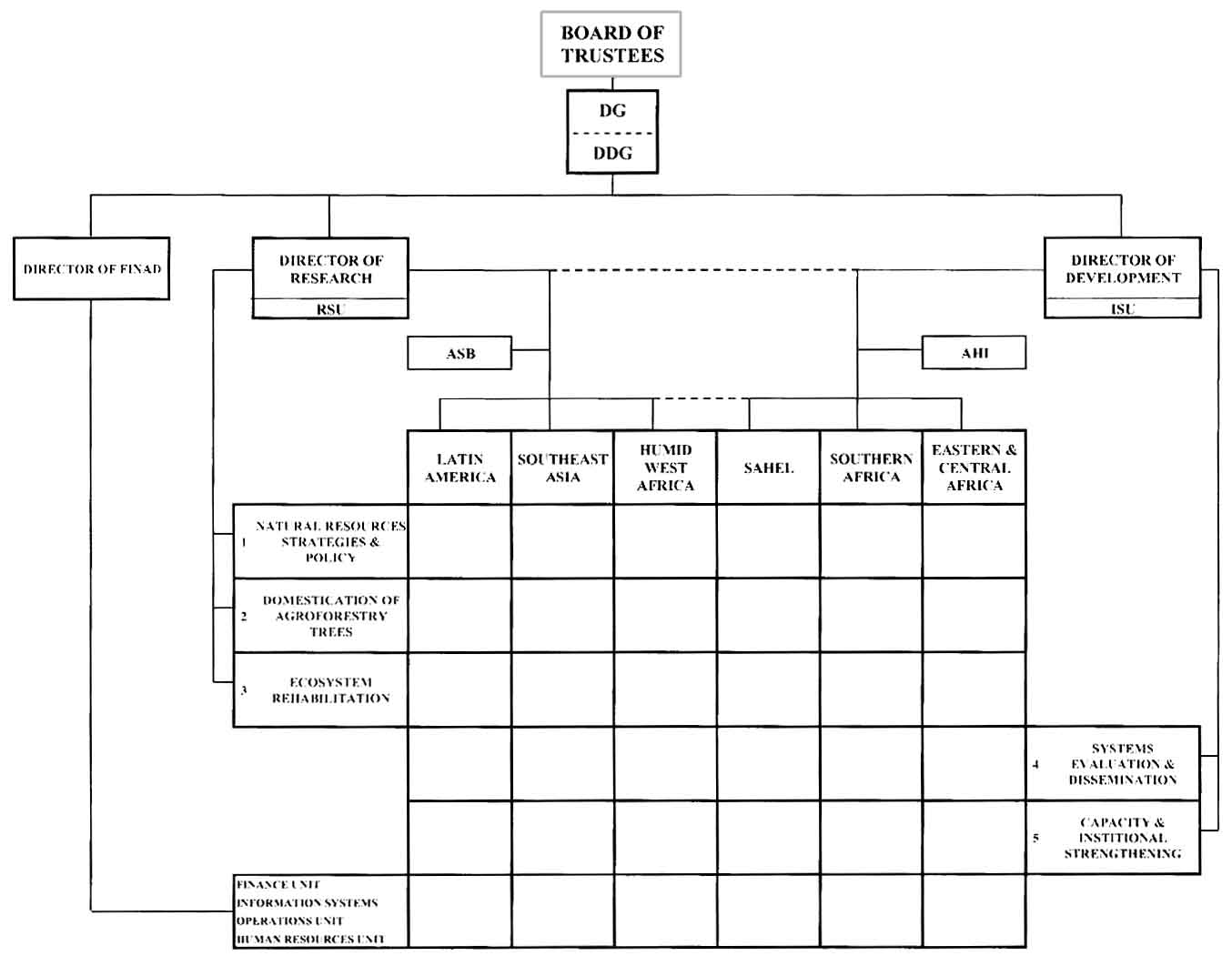
The five global programmes and six regional programmes are managed in a matrix format, as indicated in Figure 2.2, with global programmes serving more in an advisory and support role to the regions, which have the decision making authority over their projects under the direction of their respective Division Directors. This regionalizing of programmes has involved shifts in responsibilities for planning and implementation of activities from headquarters-based Programme Leaders to Regional Coordinators. As a result, and as noted in an April, 1998 Board-Management document, the job descriptions, decision-making authority, accountability (for staff supervision and evaluation, work planning and budgets, output monitoring and reporting, etc.) and fund raising responsibilities have recently been modified. Recognizing that the new system will take some time to get established, the Management and Board plan to monitor progress carefully and modify the matrix arrangements as needed.
In addition to their inputs into the region, the global programmes produce a number of cross regional strategic outputs which are utilized in more than one region, and that constitute a significant portion of the IPGs produced by ICRAF. As indicated in Figure 2.2, the Director of Research manages three global programmes and three regional programmes (soon to be 2), in addition to one of the Systemwide programmes - Alternatives to Slash and Burn (ASB) - and the Research Support Unit (RSU). Likewise, the Director of Development manages two global programmes and three regional programmes, in addition to one Systemwide programme - the African Highlands Initiative - and the Information Support Unit (ISU).
Figure 2.2: ICRAF OPERATIONAL STRUCTURE 1998-2000
Tables 2.2 and 2.3 provide an overview of the five global programmes and six regional programmes, their objectives and aims, and the Panel's assessment of issues and strengths associated with each. More detailed assessments of cross-cutting issues related to the programmes are provided in Chapters 3 and 4.
Over the past five years, since the last EPMR, ICRAF has further clarified and focused its activities to reflect its goals and objectives (as indicated above). It also has focused its priorities more on activities in which ICRAF believes that it has a comparative advantage and that can produce international public goods - a main aim of all the international Centres within the CGIAR. In a sense, with its broadened definition of agroforestry (see Chapter 1) ICRAF has broadened the scope of its mandate rather than narrowing it. At the same time, however, it appears that within this broadened context, the Centre has focused more clearly on a few priority areas of activity in which the Centre believes that it can make a difference.
Based on the Panel's review of ICRAF activities and performance since the previous EPMR, and based on its assessment of ICRAF plans for the near future, the Panel concludes that ICRAF's activities and plans generally are on target in terms of its goals. At the same time, the Panel has identified some cross cutting, programmatic issues - in some cases voids - on which it believes ICRAF needs to reflect and possibly take some action. Thus, in the following Chapter 3, the Panel draws the Centre's and the CGIAR's attention to these issues and needs; and the Panel provides some recommendations and suggestions for changes - for the most part small ones, but ones that might produce measurable, longer term improvements and benefits for ICRAF and its partners.
Thus assessment of, and discussion on, ICRAF's planning and prioritization process within and among programmes is provided in Section 3.1; on its move to regionalization in Section 2.2; on the balance between, and integration of research and development in Section 4.1, on programme quality in Section 3.3, and on partnerships and linkages in Section 4.2. Section 4.3 provides the Panel's assessment of ICRAF's capacity strengthening activities. More details on the individual global, regional, Systemwide, and support programmes are provided in Appendix IV, and comments on ICRAF's matrix management issues are provided in Chapter 5.
TABLE 2.2 ICRAF Global Programmes: Objectives and Intended Outputs and Panel Overview Assessment
|
GLOBAL PROGRAMME |
OBJECTIVES AND AIMS |
PANEL ASSESSMENT AND SUGGESTIONS |
|
Programme 1: Natural Resources Strategies and Policy |
First to identify the constraints affecting farmers by: · characterizing land use, agroecosystem dynamics and poverty levels, to identify the driving forces of poverty and resource degradation in ICRAF's ecoregions · identifying and predicting the role that trees can play in agroecosystems undergoing agricultural intensification · analysing the policy and institutional constraints to agroforestry adoption in the six ecoregions, and designing alternative policy instruments and implementation mechanisms to facilitate adoption and secondly to: · assess ex post the ecological, economic and social impact of agroforestry adoption; |
· ICRAF's decision to have activity that focuses on research impact assessment is endorsed; given that it deals with all ICRAF activity, some means of cost sharing with other programmes should be explored when the impact work involves other programmes; since ICRAF GIS capacity is located in Programme 1, the same suggestion also holds for GIS work done for other programmes. · ICRAF's intention to move more into national and regional level policy research related to agroforestry adoption and programme implementation is endorsed. · Agroforestry related policy work is needed in the Latin American and Salwa regions; and ICRAF is encouraged to pursue alternative options, including collaborative mechanisms for attaching policy research expertise to these regional programmes. · The programme needs to develop a sound strategic plan once the new head of Programme 1 is on board at ICRAF HQ; as ICRAF recognizes, the planning should take into account the results of an intended ICER of the programme, which also will be scheduled when the new head arrives. · Links to both CGIAR and other policy research institutions should be thought through carefully and rationalized. · The programme should consider developing perspective planning activity involving longer term forecasting of future conditions and the longer term role of ICRAF within such alternative perspectives. |
|
Programme 2: Domestication of Agroforestry Trees |
· develop a framework for the identification, production, management and adoption of improved agroforestry trees; · formulate and refine strategies for the domestication of priority species; · determine further priority species for domestication by participatory assessment of farmer needs, species used and economic valuation of species-also considering aspects of the researchability of problems, pathways for germplasm delivery and the extent of potentially useful intraspecies variation; · collect germplasm of priority species for on-station and on-farm evaluation and selection, as well as laboratory studies where appropriate; · proactively multiply and disseminate germplasm (seed and vegetative propagules). |
· The Panel suggests that Programme 2 integrate more with other Programmes (e.g. 1, 3, and 4) and get involved with broader issues related to trees on farms and at watershed scales; in the process, it needs to make sure that it responds sensitively to the priorities and needs of NARS partners. · A strong strategic plan is needed for this programme that takes into account the contextual issues which should drive the choice of activities. · Panel endorses management's decision not to move further upstream in terms of ICRAF facilities in biotech work over the next planning period. · It should consider linking with ILRI for molecular genetic characterization work that ICRAF needs done. · Capacity in vegetative propagation, nursery management and multiplication techniques should be increased. · Needs to work with the development division to develop capacity for market studies and potential value added (post harvest technology) development. |
|
Programme 3: Ecosystem Rehabilitation |
· Develop predictive understandings about: · the interaction between inorganic and organic sources of nutrients for various soil fertility replenishment strategies; · biophysical interactions among trees and crops at different spatial and temporal scales and their interactions with the environment, in terms of water and nutrients; · the effects of improved agroforestry practices on above- and below-ground biodiversity, carbon sequestration and greenhouse gas emissions; · the long-term resilience of the natural resource base, at plot and landscape scales. |
· Programme 3 ICER raises a number of critical issues; management and programme leader need to respond; the Panel's view on the ICER itself is discussed in section 3.2 of the text. · This programme needs to develop a strong strategic plan that links its activities to the broader environment in which it will operate; it needs to rethink its role in soils work viz a viz its work in component interactions; it needs to consider disciplinary balance: biophysics, climate, and water areas need consideration. · It needs to establish the basis for securing significant outside funding, since it currently is supported mainly by unrestricted core resources. · The programme needs to sort out staffing issues, including collaboration with institutes such as ICIPE in the area of pest management. · Needs to develop capacity to monitor and enhance nitrogen fixation. · Needs to link more closely with ILRI and CIMMYT networks on soil fertility replenishment. |
|
Programme 4: Systems Evaluation and Dissemination |
· Provide a coordinated, monitored and analytical mechanism for the participatory evaluation of promising agroforestry practices; · find best-bet management options and define their biophysical limits for further applied research; · help integrate these successful agroforestry practices with other agroforestry and non-agroforestry land-use practices in farmers' fields and the landscapes, to resemble successional agroecosystems; · act as a catalytic and action-oriented group for the wider dissemination of such agroecosystems in pilot areas, working in close collaboration with governments, NGOs and development projects; · provide feedback to and generate analytical information for a wide range of audiences on successes, constraints, farmer adaptation, adoption and impact of agroforestry research. |
· This programme has developed an interesting balance of conceptual and practical field work and has a useful approach to linking very site specific work with the eventual production of IPGs based on synthesis of results from numerous field sites. · The programme could benefit from thinking through more systematically the nature and intensity of its relations with other IARCs working in the agricultural systems area, e.g., ILRI, CIMMYT, CIAT, IITA, IFPRI; · The programme should consider to what extent it could improve its output and impact by getting involved in more work at the landscape level, bringing in more explicit consideration of external forces affecting farmer decisions; in this regard, the programme, working with Programme 1, might benefit from thinking through more completely the opportunities for complementarity in activities with Programmes 1, 3, and 4. |
|
Programme 5: Capacity and institutional Strengthening |
· Enhance the skills of researchers, technicians, policy-makers, development workers and NGOs through group and individual training and the development of teaching materials; · incorporate the multidisciplinary systems approach to agroforestry curricula in tertiary education institutions, at postgraduate, undergraduate and certificate levels; · develop the capacity of national programmes to access and manage relevant up-to-date information-a vital requisite for planning and implementing research and development projects; · continue the development of a global information base on the science and practice of agroforestry through four principal mechanisms: providing library and documentation services, publishing research and dissemination results, enhancing public awareness of agroforestry, and strengthening agroforestry information services in NARS. |
· The Panel endorses ICRAF's decision to hand over basic agroforestry training activities (its basic course) to the NARS; the relations with NARS and the links with the other programmes (including integrating researchers from these programmes into training) are good. · This programme needs to urgently pursue an assessment of the effects of past training and capacity strengthening activities. · The programme needs a strategic planning exercise involving its own personnel and representatives from the other programmes to plan out how the synergies and complementarities between the research and development activities of the centre and training and capacity strengthening activities can be more fully recognized and utilized. · The programme needs to make more explicit the knowledge base on which its activity is based, i.e., what knowledge bases beyond ICRAF are being tapped and how could the programme tap into other bases more effectively, including links with ISNAR. · The programme should consider the extent to which its needs assessment activities are adequate; · The programme should pursue more actively alternative sources of support for an expanded fellowship, visiting scientist, and internship programme. · The Panel believes that the Programme (and ICRAF as a whole) needs to systematically consider the appropriate levels of training in which ICRAF should become involved. · The Programme should become more involved in backstopping production of region-relevant training materials. · It should make use of proposed work from DSO project (involving quality control) to improve training effectiveness. · Where feasible, ICRAF should increase the use of modern electronic technology in training and capacity strengthening. |
TABLE 2.3 ICRAF Regional Programmes: Objectives and Intended Outputs, and Panel Assessment
|
REGIONAL PROGRAMME |
OBJECTIVES AND AIMS |
PANEL ASSESSMENT AND SUGGESTIONS |
|
Subhumid highlands of Eastern and Central Africa (ECA) |
· Facilitate sustainable agricultural production through improved natural resources management, especially the replenishment of phosphorus and nitrogen capital in the soil; · develop economic-ecological models to help address policies affecting soil fertility replenishment; · identify the priority tree species for domestication, with emphasis on high-value products; · domesticate the priority trees for production of wood, timber and fruit, extracts, such as derived from Prunus africana; · improve soil conservation and management on sloping lands at the landscape scale; · improve fodder production for smallholder periurban dairy systems; · provide capacity building and institutional support to ASARECA, member NARS and other partners. |
· The programme needs to consider with its partners in the region the desirable mix of responsibilities as strengths in the NARS partners such as KARI and KEFRI increase. · There is need for clarification of linkages between the ECA programme and the AHI programme; a clear statement of what ECA contributes to AHI is needed; agreement on comparative advantages and explicit recognition of linkages is needed. · ECA pilot projects need more involvement from ILRI in support of research fodder utilization. · The programme needs to strengthen research on the factors determining the effectiveness of the farmer participatory technology dissemination pathways (with Programme 4). |
|
Subhumid unimodal plateau of Southern Africa (SA) |
· Address nitrogen depletion through improved fallows with Sesbania sesban and other species and soil erosion with contour hedgerows; · domesticate the priority trees for fruits, animal fodder and industrial products. Current priority species include indigenous fruit trees like Uapaca kirkiana and Sclerocarya birrea and fodder species; · establish rotational woodlots to provide fuelwood in deforested areas; · identify policy constraints to the adoption of agroforestry; · build capacity at the postgraduate level with research institutes and universities; · promote the scaling up adoption of agroforestry technologies already developed with farmers groups and the extension services. |
· Increasing acceptance of improved fallow rotational woodlots, and fodderbank technologies indicate strong potentials for impact (already over 7,000 farmers involved). · It has a good approach to technology transfer via NARS and extension services; but needs stronger involvement of NARS. · An updated strategic plan for the region is needed; among other things, it should lay out explicitly the nature of cooperation and complementarity with CIFOR and other IARCs in the region. · This is a good region in which to address the broader policy context e.g., fertilizer subsidy policy, in relation to the attractiveness of alternative technologies (e.g., improved fallows) being addressed by the programme. · Links with NARS, including agreement on relative responsibilities for various activities need to be strengthened, including for extension; links to NGOs for technology dissemination need to be strengthened; Links with ARIs, IARCS, and bilateral programmes could be strengthened. · Programmes 2, 3, and 4 need to have more frequent and in depth contact with the region. |
|
Humid tropics of Latin America |
· Reduce the rate of tropical deforestation driven by slash-and-burn by the development and testing of 'best-bet' permanent agroforestry, both at the forest margins and in degraded pastures; · domesticate prioritized indigenous trees for timber (for example, mahogany) and indigenous fruits like Bactris gasipaes (peach palm); · identify policy constraints to the adoption of best-bet alternatives; · restore to a reasonable degree both above- and below-ground biodiversity and sequestered carbon in best-bet alternatives to slash-and-burn; · disseminate improved systems within the policy context of Peru, Mexico, Brazil and other countries; · strengthen capacity in agroforestry, particularly of NGOs, universities and local government bodies. |
· The question of dispersion of activity and personnel is a key strategic issue for this regional programme to come to grips with in the short term; a strategic plan for the region is urgently needed, both to give focus to the work of ICRAF and to provide clearer guidance to ICRAF's partnering in the region, both with other IARCs and with NARS and ARIs involved in the region. · A particular institution that needs to be explicitly considered is CATIE since that international institution has extensive activity in the area of agroforestry and works in a number of countries in the region. · ICRAF should use caution in placing isolated policy researchers/advisers in a country without full cost recovery and explicit links to other ICRAF research to produce IPGs. |
|
Humid tropics of Southeast Asia |
· Protect natural forests by intensifying agroforestry systems at the forest margins; · alleviate rural poverty among smallholder farmers at the forest margins; · rehabilitate imperata grasslands through tree-based farming systems, such as jungle rubber and complex agroforests, and soil fertility replenishment strategies, particularly in the buffer-zone areas of protected forests; · develop conservation farming systems using natural vegetative filter strips to sustain productivity of hillside farming; · promote a favourable policy environment for best-bet alternatives systems, scaling up from the farm to the landscape; · characterize the components of multistrata agroforestry and their impact on biodiversity; · restore to a reasonable degree both above- and below-ground biodiversity and sequestered carbon in best-bet alternatives to slash-and-burn; · continue developing modelling approaches to land-use strategies based on how to segregate and integrate agriculture and natural forests at the landscape scale; · improve the delivery of agroforestry at universities and extension services in the region, through the development of curricula and training materials. |
· This programme provides a good model for other regions to use as a base, although adaptations considering regional variations need to be explicitly considered. · The output from this programme in Indonesia and its work in Thailand provides a good example of what can be accomplished in terms of introducing the broader policy context into national level discussions concerning the role and potentials for agroforestry in development. · SEA regional programme needs to update its strategic plan or statement of purpose and approach, including its process for deciding on expansion to other countries in the region, and its linkages with other institutions. · The programme needs to assess ways to strengthen NARS capacity, especially those institutes with agroforestry programmes other than traditional agricultural research institutes; the Programme should draw on its good connections and relations with policy level national institutions to gain access to such groups. |
|
· Humid tropics of West Africa |
· Domesticating and integrating high-value indigenous agroforestry trees into traditional farming systems. This work is based on the results of a tree prioritization exercise that has identified indigenous trees such as Irvingia gabonensis; · improving multistrata agroforestry systems based on the traditional cocoa and coffee gardens as one of the best-bet alternatives to slash-and-burn agriculture; · restoring to a reasonable degree both above- and below-ground biodiversity and sequestered carbon in best-bet alternatives to slash-and-burn; · analysing existing policy and institutional constraints to adoption of improved agroforestry systems and design alternative policy instruments that would stimulate adoption; · promoting the adoption of improved fallow systems developed by the programme as a means to restore nitrogen fertility; · determining the environmental benefits of multistrata and improved fallow systems as best-bet alternatives to slash-and-burn; · strengthening NGOs, universities and government bodies in the practice of agroforestry. |
· Shortfall in funding has resulting in curtailing ICRAF activity in this area; the Panel endorses this decision and urges ICRAF to develop closer, productive links with IITA and its agroforestry related work in the region. · Continuation of the tree domestication work in the region, in the context of the ASB programme is endorsed. · It needs to safeguard the infrastructure that the HULWA programme has developed. · It should monitor the NGOs that have taken over the technology transfer, and should use this experience in overall ICRAF planning activities. |
|
Semi-arid lowlands of West Africa (SALWA) |
· Develop living hedges to replace the traditional dead fences made of sticks and crop residues, and so to protect valuable crops from wandering livestock. A key species is Ziziphus mauritania, which besides its protective function provides high-value fruits. Living hedges also decrease runoff and erosion during intensive rainfall and reinforce tenure rights; · develop improved (more efficient and effective) ways of establishing trees in dryland environments; · domesticate prioritized indigenous and exotic fodder trees, especially for dry-season production; · regenerate the parklands, by domesticating and planting indigenous trees such as Adansonia digitata and vitellaria paradoxa, to produce leafy vegetables and fruits for sale; · increase phosphorus and nitrogen capital of the soils, through a combination of agroforestry trees and applications of phosphorous fertilizers in sandy soils; · develop improved policies in support of the above activities; · build the technical capacity of NARIs, universities, technical colleges, NGOs and extension organizations. |
· This is a regional programme where
additional policy research on development linkages and institutional mechanisms,
(e.g. related to irrigation development, area development programmes)
could be usefully introduced to complement on-going technology oriented
work; this work would look at the implications for socio-economic changes
and for ICRAF's research and the types of technologies being developed
by it in programmes 2.4. · ICRAF headquarters together with programme staff need to think through carefully the critical minimum mass issue in this region. Agroforestry systems in semi arid regions of the world are extremely important; and ICRAF has to position itself carefully to make sure that its investment in the area makes maximum possible contributions. · Closer links and collaboration with ARIs and bilateral programmes working in the region (e.g., the French) could benefit the programme; need to synthesize extensive prior work done by bilateral and regional groups. · It needs to develop close links with CORAF. |