4.1 The Panel's View of ICRAF's Research to Development Continuum
4.2 External Linkages and Relations
4.3 Capacity and Institutional Strengthening
ICRAF is evolving into an institution that gives explicit and equal emphasis to research and to the development activities needed to make sure that the research results are as effectively, efficiently, and rapidly as possible put into use on farmers' fields and in ministers' offices. ICRAF focuses on generating effective "development pathways," or road maps for how it and its partners can get from research to development along a research-to-development (RtoD) continuum that yet remains to be defined in concrete terms.
ICRAF has been moving for some time towards a more explicit recognition of this RtoD continuum approach to its activity, i.e., one in which the research continues to be problem driven, but where the organizational culture emphasizes more the rapid dissemination and effective spread of technologies and institutional innovations developed by the centre and its partners. How does this RtoD continuum work in practice? How do ICRAF's linkages contribute to its realization, particularly given ICRAF's move to regionalization? What types of partnerships does ICRAF have, and how do they need to be modified in the future to make ICRAF more effective and efficient in meeting the overall objective of more rapid adoption of ICRAF and partner technologies? These are the cross-cutting themes addressed in the present chapter. They complement the discussion in the previous chapter which dealt with planning and prioritization and basic regionalization and quality issues.
In moving down this road to operationalizing the RtoD continuum, ICRAF has considered and put in place a number of elements. First, was the establishment of the Development Division and the decision to make it an equal and complementary programmatic force and not a "service" unit for the research division, as is done in a number research organizations. Second, as a result of ICRAF's medium term planning, the Centre changed to the new matrix management model and the regionalization of ICRAF's programme to more effectively bring to life the RtoD continuum by focusing activity at the concrete level of activities in the regions. These elements have already been covered in Chapters 2 and 3. Third, there was a renewed focus on rationalizing linkages with other groups - CGIAR centres, NARS, and other research and development organizations - to fit more into the needs as envisioned along the RtoD continuum. Fourth, the role of ICRAF in capacity strengthening and training is being rethought in the broader context of the RtoD continuum. The Panel emphasizes, to avoid the impression that these are revolutionary changes, that the thinking behind these changes has been evolving over a longer period of time and that evolutionary changes are the result of longer term planning over a number of years.
In what follows, the Panel describes briefly what is involved in each of the elements, assesses ICRAF's role, activity, and performance in each area, and provides, where warranted, some suggestions and recommendations.
4.1.1 The International Public Goods Nature of ICRAF Research
4.1.2 Dissemination of Research Results and Research on Dissemination
4.1.3 Marketing and Post-harvest Technology in the Research to Development Continuum: The role of ICRAF
The RtoD continuum, thought of in a dynamic context, has research problem identification as the starting point and feedback from implementation as the ending point, in a given cycle of the process. In between along the continuum are problem definition, research design, research implementation, translation of research results into ideas and technologies for development, dissemination, adoption and adaptation, and application and implementation.
A key strategic concern along this RtoD continuum is the area in the middle, where research gets translated into useful approaches to agroforestry that overcome the knowledge, resource, and motivation constraints that face farmers. Although it is an explicit concern of both the Research and the Development divisions, primary responsibility for operationalizing the concept lies with the Development Division. This is a new division, with its head having arrived to take up his duties during the main phase of the EPMR. The Division currently sees its mission as follows:
"to facilitate, catalyze, and support greater adoption and impact of agroforestry innovations."
What still remains to be clearly defined by ICRAF as a whole is how the link between this laudable mission and that of the Research Division best can be operationalized and developed into an institute wide process, i.e., how will ICRAF deal with the transition zone between research and development, and how will it decide what agroforestry innovations to "facilitate, catalyze, and support the adoption of" and then, how does it know which development pathways will be most effective for different types of innovations under different circumstances. An effective operational approach to effective implementation of the research to development continuum requires answers to such questions. And the Director of Development has identified this challenge as his highest priority for attention over the coming 6-12 months.
The Panel believes that operationalizing ICRAF's "development pathways" concept is a challenge for all of ICRAF, not just the Development Division. At the same time, there has to be some identifiable focal point in the organization for approaching the challenge. At present, this activity is being spearheaded in operational terms by the work being done in Programme 4, and in broader, more conceptual terms related to policy interventions, by parallel, complementary work being done in Programme 1. Programme 1's input is discussed further in Section 3.1. Here, it is instructive to provide a brief overview of the operational strategy and process developed by Programme 4 scientists, with input from the other programmes.
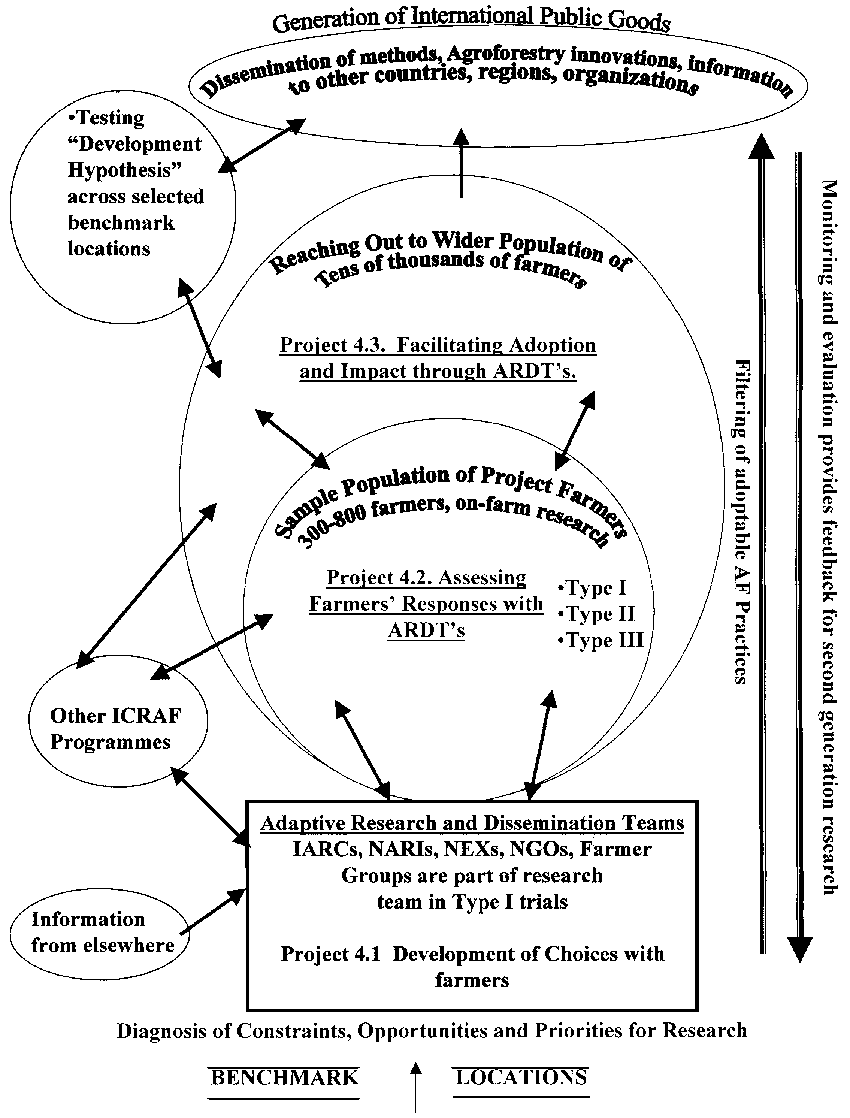
Figure 4.1 illustrates one concrete example of ICRAF's attempt to develop a strategy and process for operationalizing the research-development continuum in ICRAF within Programme 4. As indicated in the figure, Project 4.1 (development of choices with farmers) works through the ICRAF/NARS initiated Adaptive Research and Dissemination Teams (ARDTs) to identify farmers' problems and promising agroforestry technologies. This involves input from other ICRAF programmes and from the outside (including the IPG research results developed by Programme 4).
Promising technologies, when adequately researched through Programmes 1-3, then enter the second phase, which is the focus of project 4.2. This stage involves assessment of a limited group of farmers' responses to the technologies introduced.1 The ARDTs also are involved in the process. Information from this stage feeds back to Programme 4 as well as to the other relevant ICRAF programmes. As indicated in the figure, the next stage involves wider dissemination to a broader population of farmers - the true dissemination and development phase of the work for any given technology or system of technologies.
1 Assessment is based on the results of Type I research: researcher designed - researcher implemented trials; Type II research: researcher designed - farmer implemented research; and Type III research: farmer initiated-farmer implemented trials.
Finally, through Programme 5, NARS partners, and NGOs, there is widespread dissemination of results to other countries and organizations. This is where the IPG nature of this seemingly very local, hands-on research comes to the forefront. ICRAF develops and tests "development hypotheses" that can have widespread application, e.g., hypotheses related to conditions for farmer adoption, hypotheses related to dissemination techniques, and so forth, based on comparisons across a number of sites and countries, both with different and with similar conditions. Particular attention is given to the unique issues that affect the dissemination, adoption and adaptation of NRM innovations, which the Panel believes will have important implications beyond agroforestry. Work from a given benchmark site is brought together with that from other sites to develop general principles and ideas for further testing and dissemination; and such work becomes ICRAF's IPG contribution of the activity in this particular area.
Looking at the research to development continuum more broadly, a number of interesting questions surfaced for the Panel. They include the following:
ICRAF, as a CGIAR centre, has to focus on producing international public goods (IPGs). At the same time, many of the development activities pursued by ICRAF appear to be quite narrowly focused on adaptive issues for a particular region. What is the situation with regard to IPG in ICRAF?Should ICRAF be focusing on research on dissemination, or on dissemination itself, or some combination of both? Should ICRAF develop in-house professional capacity in dissemination? In dissemination research? in extension methods research?
What about expertise in marketing research or marketing itself - an obvious requirement along a number of common development pathways involving agroforestry products? What about expertise in the area of post-harvest technology assessment and development?
ICRAF is dealing for the main part with quite applied issues - agroforestry systems tend in general to be quite site specific, if the complexity of individual sites are adequately considered. However, as indicated above, it appears that ICRAF - and specifically Programme 4 - has developed the balance needed to take advantage of both the international and the longer term nature of ICRAF and its programme in developing IPGs from synthesis of results from specific sites where similarly designed and comparable research approaches were used. Thus, work in the field is brought together with more conceptual modelling to produce results that are of widespread interest across the regions of the world, particularly to scientists and institutions concerned with NRM. The same approach is used by researchers in Programme 1, and by the biophysical researchers associated with Programmes 2 and 3, who also do cross-country comparisons. In addition, ASB has been producing cross site and interdisciplinary syntheses and models.
The question addressed by the Panel was the extent to which ICRAF researchers are focusing on the full range of potential IPG contributions of its research. The Panel concluded that, in general, ICRAF scientists are aware that they need to focus on IPG research in order to get the substantial spillovers across countries and regions needed to justify the high cost per senior scientist. And most of them seem to be making a conscious effort to link their site specific work with broader IPG types of synthesis and modeling work.
Obviously, it is not a matter of one or the other, but rather the balance between the two that should be important to ICRAF. While ICRAF has a role to play in producing publications and working with NARS partners on dissemination of its and joint research results, as well as research methods and other knowledge, it clearly does not have, in the Panel's opinion, a comparative advantage in leading the actual dissemination activities at the field level. At the same time, in pursuing an effective approach to implementing the RtoD continuum within the ICRAF context, the centre does have a role to play in researching the effectiveness and efficiency associated with alternative dissemination pathways and approaches. The role requires that ICRAF participates as a partner in designing and assessing alternative dissemination approaches. This is in fact one of the charges given to Programme 4, although it still largely remains to be operationalized by the Programme, except in Southern Africa where an international dissemination specialist is engaged in such analyses.
The main constraint in the other regions at present is the lack of a researcher with expertise in this area. The Panel believes that this is an important area in which ICRAF should be involved. If it is going to focus on efficient RtoD pathways, it needs to understand much better the particular dissemination issues related to agroforestry technologies and systems. The issues are not necessarily the same as in either agriculture or forestry, since in agroforestry there is a mix of agencies and institutions involved that is different from the mix in either agriculture or forestry.
In sum, the Panel recommends that:
ICRAF develop an area of identifiable activity and increase the capacity at headquarters related to research on dissemination methods and techniques within Programme 4.
As indicated above, the Panel recognizes that there is some analytical and empirical field work in this area going on, e.g., in the Zambia project. However, the Panel believes that there is need for a strong presence at headquarters in this area to draw out the experience from around the world, help to develop broader lines of thinking in this area, and to do selected research in the area. At the same time ICRAF should explore possibilities for linking this area of research with the carrying out of constraint and needs analyses with partners. (In fact such analyses are needed input for work on alternative dissemination pathways and approaches).
Value added and market development, as well as marketing channels and activities, are key components in the development pathway for many agroforestry systems. Input related to these areas often is the missing link in the RtoD continuum, e.g., in the case of much of the agroforestry development in the Amazon, where key questions revolve around appropriate post harvest technologies for use in local value added activities and market channels and approaches for higher valued agroforestry outputs. Availability of effective marketing mechanisms and efficient value added processing opportunities are part of the delivery system needed, and can provide a major incentive for adoption and development of alternatives to slash and burn.
Market forces and policy dimensions of agroforestry product processing and marketing need to be understood. Some work has been undertaken in SE Asia by Programme 1 scientists. Are there alternative sources of supply for this type of research? Probably some, but certainly not many that have as yet focused on agroforestry marketing and market development issues. There is not widespread understanding of the markets for agroforestry products, and not much work is being done in this area. There is some work on subsistence products from extractive reserves, done by some NGOs. However, the economic situation involved in those cases is quite different from that envisioned by ICRAF in its work related to high value tree crops from local agroforestry systems. ICRAF needs the expertise to help NARS, NGOs and other groups working with agroforestry development projects understand how market forces can be tapped, how markets can be developed, and how marketing expertise can be utilized to introduce marketing into projects. In this respect, ICRAF organized an international workshop on marketing policies for agroforestry products, including non-timber tree products in Nairobi in 1997.
Hand in hand with need for marketing expertise is the need for expertise in post harvest technology (PHT) development - expertise in the process by which communities and individual farmers most effectively can develop value added activities for their agroforestry outputs, hopefully combined with some knowledge and understanding of the small scale technology options available to communities and farmers groups. Such activities can help generate scarce incomes for purchase of foods and other staples. The CGIAR has accepted the general principle that PHT may be a productive use of CGIAR funds in certain cases where it presents a constraint on effective development and utilization of CGIAR generated technologies in helping to alleviate poverty among poor rural people. For example, in the case of agroforestry, certain basic processing activities for tree products can be done effectively and efficiently on farm or in local communities, thus adding value to the outputs and incomes at the farm and community levels rather than at the middleman or commercial processing levels outside the communities. Marketing constraints often are exacerbated by lack of knowledge and access to post harvest technologies and processing facilities. Thus, the two go hand in hand.
Part of the dissemination research and development activity discussed earlier has to address the institutional questions related to PHT and marketing within farm communities. E.g., producer cooperatives, marketing boards, etc. need to be included in the work along the RtoD continuum. Institutional questions related to finance also need to be considered all along the value added pathways that communities choose. Often, credit is a key constraint in setting up value added activities.
In sum, the Panel supports the initiatives within ICRAF to develop the expertise in marketing and PHT research and development that will permit ICRAF to be more effective in supporting NARS and NGO activity in promoting development of local RtoD pathways for agroforestry and agroforestry products. At the same time, the Panel emphasizes that ICRAF's expertise should be focused on strategic planning and research in these areas. ICRAF can hardly afford to expand expertise in the actual areas of marketing and post harvest technology or value added development. The conditions around the world are too different in different agroforestry systems to be able to hire someone who can be effective at the international public goods level in the actual development of value added activities and marketing.
The Panel recommends that:
ICRAF pursue the establishment of activity and expertise at headquarters in the areas of market development research and strategic planning for value added activities (including the process of identifying, choosing and developing appropriate post-harvest technologies).
This activity could be situated in either the Research or the Development divisions. Although the Panel has no strong preference for either, it would seem that the activities might be situated together in the Development division, either in a separate programme or in Programme 4. Wherever the activities are located, they should be housed together to draw on the synergies between the two areas of expertise. Both relate to effective implementation of the RtoD continuum beyond the production of tree outputs on farm. Both are necessary ingredients for creating effective development pathways for agroforestry and for moving effectively along the RtoD continuum.
4.2.1 Links with Other CGIAR Centres
4.2.2 Links with NARS Partners and other Collaborators
4.2.3 Linkages: Panel Summary Assessment and Recommendations
ICRAF's history of formal collaboration dates back to 1984, when the first external review recommended that the mandate should include collaboration with national and regional institutions on agroforestry technologies research and development. In response to this, ICRAF developed partnership programmes through activities at headquarters and through a network approach. For Africa, the 4 Agroforestry Research Networks (AFRENAs) (based on agroecological zones) became established between 1986 and 1990 as partnerships between ICRAF and NARS of the Africa region. Since ICRAF became a member of the CGIAR in 1991 with a global mandate, regional programmes and partnerships also became established in Latin America and South-East Asia. The number of partners has been growing steadily over the years since ICRAF joined the CGIAR.
ICRAF views itself as a partnership-based, development-oriented research organization. It has more than 420 partnerships of varrying importance; and a significant portion of senior scientist time is spent on partnership-based activity. In fact, most ICRAF activity, and all field activities, are partnered; and more than 40 percent of ICRAF's published outputs over the 1993-97 period involved partner authors - an indication of true sharing of credit for intellectual outputs associated with the centre. Yet, some persons voiced concern to the Panel about a low level of partnering and collaboration with both CGIAR centres and non-CGIAR entities.2 Thus, the Panel has identified partnering as a theme meriting attention.
2 To put this concern in perspective, ICRAF should not be singled out. It is a common concern voiced across the CGIAR System by donors and others. The question is whether CGIAR centres work enough with each other to take advantage of the full range of synergies or complementarities available; and whether centres partner well with enough NARS and ARIs.
In terms of sheer numbers this concern is unfounded. As mentioned, ICRAF has about 420 partnerships on the books with other CGIAR Centres, NARS, NGOs, ARIs, universities, and other groups. ICRAF leads two CGIAR Systemwide programmes (SPs); both include many different partners. One of these, the Alternatives to Slash and Burn (ASB) Programme, is arguably the most successful of the SPs. ICRAF participates in an additional 8 SPs with other CGIAR Centres. In terms of numbers, it participates in more than most other Centres.
Thus, in terms of numbers, ICRAF is a Centre with many linkages - some would argue too many, rather than too few. By their own estimate, most ICRAF staff are putting up to one person month of time per year into partnerships, and this does not include time in the research and development activities associated with the partnership. (1998 Internal survey done for the EPMR). Thus, at first glance, the transactions costs of partnerships are substantial (although, as indicated below, this can be a misleading conclusion).
The concern of those who question ICRAF's level of partnering is not a matter of numbers. Rather, the key questions relate to other dimensions of partnerships - i.e., the balance, nature, and quality of partnerships with NARS, other CGIAR centres, and other institutions, such as advanced research institutions (ARIs).
In what follows, the Panel assesses ICRAF partnering with each of these groups, after a general review of partnering in ICRAF, including mention of the results of an internal survey of partnership activity. Unfortunately, the survey done for the EPMR did not break down the numbers by type of partnership - a task that ICRAF needs to undertake in the future, as it further systematizes and organizes its partnership activity to greatest mutual advantage. Also, it did not survey the partners themselves; also something that needs to be done in the future, as part of the activity of the Development Division in looking at the Research to Development Pathways. A final section in the Panel's report sums up the Panel's assessment of the theme and provides a recommendation.
In accordance with its mission, ICRAF is focusing its partnership programme on collaboration in research with increasing emphasis on systems development and promotion of information dissemination. It uses a wide variety of partnership formats, ranging from bilateral ones, through regional associations and consortia, to global partnerships, such as in the CGIAR SPs. The most common format is the network. Some of the larger integrated partnerships that have evolved through ICRAF initiative include:
> the Agroforestry Research Networks for Africa (AFRENA)
> the African Network for Agroforestry Education (ANAFE)
> the African Highlands Initiative (AHI)
> the Alternatives to Slash and Burn (ASB).
Both structure and content of the partnerships vary in relation to the wide range of framework conditions, priority problems and partners' needs in each of the regions. This presents a challenge for ICRAF that requires a more systematic and analytical approach to understanding its partnerships, their successes and failures, and the factors associated with such.
In addition to these formalized agreements there is informal, frequent, and often intensive, open collaboration among ICRAF scientists and colleagues at all levels and with numerous relevant research organizations. These interactions are important, although not noticable except to the scientists themselves. As the Panel talked to the various ICRAF scientists, it became encouraged by the widespread nature of these professional relationships with scientists in other organizations, including particularly in the other CGIAR Centres. The Panel suggests that management develop a mechanism for monitoring and evaluating such partnerships, encouraging them where appropriate, and making better known the widespread nature and benefits of such informal professional linkages.
At the same time, the Panel recognizes that thematic, regional and organizational diversity of ICRAF's work, and thus that its alliances with partners, complicate accountability, coherency, continuity, and monitoring and planning processes. The question of efficiency of partnerships needs some further attention and clarification by ICRAF.
4.2.1.1 Involvement in Systemwide Programmes
4.2.1.2 ICRAF Relations with CIFOR and Other IARCs
ICRAF has a significant number of linkages with the other Centres in the CGIAR System, many of them through the Systemwide programmes (SPs), most of which started since the last EPMR. They involve two main types of links: (1) ICRAF's involvement in SPs; and (2) specific agreements with one or more Centre(s) to do specific project activities, or to share responsibilities in a given activity or programme.
As mentioned above, ICRAF is lead institution for two SPs - the Alternatives to Slash and Burn, and the African Highlands Initiative, which is part of a broader SP on mountain environments (The Global Mountain Agricultural Development Programme, listed below). Both of these programmes are described in Annex IV, and, since they relate rather directly to ICRAF's work in the regions and its regionalization and decentralization of activity, further comments on them are provided in Section 3.2 dealing with regionalization, rather than here, where it is the linkage and partnership aspects that are of interest.
It is instructive to look at ICRAF's estimates of its costs for the coordinating role of the two systemwide programmes it coordinates. Thus, in 1997-98, the coordinating costs of the ASB programme were some $289,000 per year, which represents about 5 percent of the estimated total resources going into the programme in that year. The annual coordinating costs of the AHI programme was $375,000, or about 13 percent of the total resources going into it. If one looks at typical coordinating costs for programmes with which the Panel is familiar, then these costs incurred by ICRAF are below the norm as a percentage of total resources in the programme, which implies that ICRAF is fairly efficient in its coordination function.
ICRAF also participates in 8 other Systemwide programmes, as indicated in Table 4.1. As indicated in the Table, most of these Systemwide activities are not very active yet - most are new within the past two to four years and have not developed any effective strategies, operating mechanisms and style. However, when effective, such as in the case of the ASB or the AHI, participation can be productive, both for ICRAF in terms of its mission and goals, and for its partners, since ICRAF brings some unique talents and ideas to the table. The relatively high transactions costs (travel, meeting and negotiating time, etc.) can be justified when the programmes are successful. The leveraging effect of such transactions costs converts many of them into investment costs for the future programme and success of ICRAF.
When not effective, such systemwide initiatives could end up making a significant drain on ICRAF's scarce resources. Thus, in the overall context of rationalizing its partnering activity, the Panel cautions ICRAF to move very carefully in further commitments to programmes, unless the intended activities fit directly within the framework of ICRAF's strategy and MTP.
The first EMPR dealt comprehensively on the special relationship between ICRAF and CIFOR and the activities undertaken by the two centres. At that time various cautions were put forth regarding potential overlaps and duplication of efforts. Recognizing the need for clarification of this somewhat sensitive issue, and based on the recommendation of the previous 1993 ICRAF EPMR, The directors general of the two centres undertook a comprehensive study of their complementarities, as outlined in the CIFOR and ICRAF in the CGIAR, Partners in a System-wide Research Agenda (1994). The major areas of complementarity identified are in policy research and forest genetic resources, within the context of ASB, although other opportunities for collaboration will become available when addressing wider issues, e.g., those involved in tree domestication.
In terms of the situation today, in the Panel's view, and as noted also by the CIFOR EPMR: a) those formal relations that have been established between the two centres appear from both sides to have been cordial and productive; b) the amount of cooperation and joint involvement has been somewhat less than desirable, considering the potential complementarity of the talents and interests involved (one interested from the forest out to and including the forest margin, the other from the agricultural fields out to and including the forest margin - the point where the interests become mutual and, hopefully, the work complementary; and c) there is indication that the relations may become more productive in the future, given the facts that ICRAF has recently moved its Southeast Asia headquarters onto the CIFOR campus, where the Panel observed excellent informal interaction; and the Peruvian Amazon programmes of both centres (together with that of CIAT) are maturing to the point where some productive cooperation, collaboration, and sharing of facilities and expertise has become a reality. ICRAF depends on CIFOR's expertise on plant biodiversity and thus sees no need at this stage to develop in-house expertise in this area. With regard to the Latin American/Amazonian programme within the ASB, it is worth noting that ICRAF and CIAT were initially working together in Brazil, but funding limitations have stopped this collaboration on site. CIAT is still part of the ASB network in Latin America; and there is need to explore how its expertise in the area of policy research and spatially-based, decision support systems, could be more closely integrated with ICRAF's Regional Programme in Latin America.
Table 4.1 Description of ICRAF Involvement in Systemwide Programmes
|
NAME OF SYSTEMWIDE PROGRAMME |
DESCRIPTION OF ICRAF INVOLVEMENT |
|
Desert Margins Initiative (DMP) |
ICRAF is a member of the regional steering committee. The programme, however, is not yet operational |
|
Systemwide Livestock Programme (SLP) |
ICRAF is involved in the East African Highlands part of this programme, working with over 2000 farmers in participatory evaluation of high quality fodder shrubs and trees. They are joined by KARI and ILRI in this work. ICRAF sahelian activity also is funded in part by this SWI. The work deals with two of the most promising fodder banks species, Gliricidia sepium and Pterocarpus erinaceus |
|
Ecoregional Programme for the Humid and Subhumid Tropics of Africa (EPHTA) |
ICRAF's work in this programme is linked to its HULWA activities associated with the ASB programme, which it coordinates. IITA convenes EPHTA. ICRAF's participation is limited to involvement in the Humid Forest Consortium, one of three within the EPHTA. Within that Consortium, ICRAF's work is focused on domestication of high value indigenous tree species and integrating this work into improved tree based cropping systems through diversification. Funding has not been forthcoming in this programme, and it should be noted that to date, ICRAF and other international centres have received no resources from the programme. In fact, the responsibilities of member IARCs have yet to be officially defined. |
|
Systemwide Genetic Resources Programme (SGRP) |
Much of the work in this programme is carried out through the Inter-Centre Working Group on Genetic Resources (ICWG-GR), which is the steering committee for the SGRP. It meets annually. ICRAF maintains excellent formal links with the SGRP (it hosted the annual meeting in 1998); and informal links with many of the members of the ICWG-GR, particularly CIFOR, ILRI, and IPGRI. The SGRP has endorsed many of ICRAF's genetic resources initiatives in the past. It helped to fund a major workshop at ICRAF in 1997. |
|
Systemwide Initiative for Water Management (SWIM) |
ICRAF is one often centres represented on the steering committee of this initiative, which is led by IIMI and IFPRI. Of the current seven projects of SWIM, ICRAF is leading the project on Improved Water Utilization in a Watershed Perspective with IIMI, WARDA, IFPRI and ICRISAT. A concept note has been prepared to obtain funding for further work by ICRAF to test a prototype framework and various hydrological models using a long term data set of the University of Nairobi. A number of other partners are involved in this activity, including in Thailand. |
|
Systemwide Water and Nutrient Management (SWNM) Programme |
ICRAF was instrumental in helping CIAT and IBSRAM develop the overall SWNM strategy. Of the 4 SWNM thremes, ICRAF is involved in two: overcoming nutrient depletion in Africa (led by TSBF) and controlling soil erosion on hillsides in SE Asia (led by IBSRAM). ICRAF through AHI contributes to the nutrient depletion theme through many joint trieal in East and Southern Africa. In SE Asia, ICRAF contributes to SWNM through policy research in Thailand and biophysical research in Indonesia. |
|
Integrated Pest Management Programme (IPM) |
ICIPE represented ICRAF at the first meeting as a collaborator to the pest management research at ICRAF. Various proposals by ICRAF have not been included in the agenda of the initiative, and ICRAF has neither contributed much nor gained from the initiative so far. Yet ICRAF recognizes that IPM is important in an agroforestry context and will continue to monitor progress in it and participate where it seems appropriate. The initiative has, however, brought ICIPE and ICRAF together in several activities, since ICIPE also has an interest in pest management issues related to agroforestry. |
|
Common Property Rights Initiative (PRCA) |
The programme began in 1995 when IFPRI received some preliminary funding to coordinate efforts in this initiative. An ICRAF scientist is a member of the steering committee. The new head of programme 1 (formerly with ILRI) also is a member of the steering committee as representing ILRI. ICRAF staff have been active in this programme, although it has not gotten into much activity yet. The Southeast Asia regional team will likely become involved in the next planned activity of the initiative. |
|
Global Mountain Agricultural Development Programme (GMP) |
This programme includes the East African highlands (and ICRAF convened AHI programme - discussed elsewhere), the Andes, and the Himalayas. CIP is taking the lead in developing the overall programme (and leading the Andean component). To date, ICRAF's contribution has been through the AHI. |
The Panel notes that, although the mission statements of the CIFOR and ICRAF differ widely, it is difficult to delineate territorial boundaries at the forest margin segment of the continuum going from natural forest to the dominant agricultural fields of densely populated agricultural regions. ICRAF and CIFOR need to develop the relationships and mechanisms that allow them to complement and supplement each other where possible and share responsibilities jointly where their interests overlap. For example, both centres could jointly adopt a regional focus in such areas as grassland rehabilitation with trees, and community forestry that also involves agroforestry practices as part of the landscape development. At present, CIAT, CIFOR and ICRAF are housed at a new facility located within the Peruvian NARS at Pucallpa. This took place after a joint visit of the three DGs in November 1997. The result of this visit was a commitment to form a joint programme to cover the full range of Amazonian terrestrial ecosystems, from primary forest to degraded agricultural lands.
The only formal collaborative programme with CIFOR is related to CIFOR's role in the ASB programme, where CIFOR is responsible for above ground biodiversity work, and ICRAF is responsible for the C stocks work, while TSBF handles below ground biodiversity. In addition, there are many useful informal linkages between ICRAF and CIFOR, e.g., related to land tenure and other policy research, people-forest interactions, led by CIFOR's non-timber forest products programme, and work on rehabilitation of Imperata grassland on smallholder production systems. In addition a CIFOR economist is collaborating with ICRAF on tree domestication work in Cameroon.
In terms of linkages with other IARCs (other than through the SWIs or ERIs), the Panel only has a few comments. Interaction with IRRI occurs in the Philippines in the management of the acid uplands in Mindanao which grow rice. There ICRAF's role is one of comparing the ways erosion can be controlled and how trees and shrubs can be used to add value to the system either from NTFP's, or to provide mulch and thereby nutrients for crops. Discussions are in progress on a project to encourage the planting of trees on farms for NTFP's, fuelwood and timber and for communities to consider planting trees as part of an overall strategy for managing watersheds and this may involve IBSRAM, ACIAR and the Provincial government of Mindanao.
The CIMMYT coordinated East and Central Africa Maize and Wheat network has links with the AHI. However, to date this has provided little opportunity to integrate into the network activities the agroforestry technology ICRAF is helping to develop. In southern Africa both Centres have networks and both have research activity in Zimbabwe and Malawi. Although ICRAF has been working with CIMMYT's soil fertility network in Southern Africa, the full potential for closer Centre cooperation in their interaction with the NARS has not been realised.
In the case of IITA in the Humid West Africa regional programme, relations for a time were strained because the roles of the two institutes in the ASB initiative were not well defined; and the research programmes were poorly integrated and connected to the EPHTA, which IITA coordinates. ICRAF and IITA also need to come to a common understanding of the way the agroforestry technologies developed by the two organisations are presented to the world at large, particularly in the area of mixed tree and crop systems. This is important for the credibility of both organisations with the NARS. Other linkages are mentioned in the discussion of ICRAF in the Systemwide programmes.
The general CGIAR policy on collaboration with NARS focuses on capacity building and institutional strengthening through partnerships. In this context partnership means enabling NARS so they eventually can take over the activities and responsibilities initiated jointly with the IARCs in the areas of research, development, and training. The 1993 ICRAF EPMR recommended that ICRAF should develop a joint strategy with the NARS for devolution of ICRAF's country level agroforestry research to the appropriate NARS, while maintaining a strong support role through regionally-based teams and headquarters staff.
ICRAF Board and Management responded by emphasizing that the strategy, at least in Africa, will be directed to strengthening of AFRENAs for greater national responsibilities and maintaining of core elements of partnerships between NARS and ICRAF. This concept has been expressed in an ICRAF policy guideline paper (No. 8: Building Partnerships with NARS, March, 1997), promoting a comprehensive approach to partnerships, mainly through networks. The paper provides guidance on the criteria to consider in setting up partnerships, and it provides a description of the four types of partnership networks that ICRAF engages in and promotes. Finally, it provides a section entitled: "where do we stand to date." As such, it is a document that all staff should have read.
The Panel views this policy guideline paper more as a statement of principles and general justification for partnerships, than as paper that lays out operational guidelines for designing partnerships that have a maximum chance of success.
The comparative advantages of ICRAF for collaboration with NARS partners are mainly in the areas of:
· research quality control and process monitoring, particularly in the field of NRM;
· backstopping of planning, implementation and assessments as a service function;
· networking initiating, strengthening of operations;
· integrated in-service training at academic levels;
· facilitating the dissemination of agroforestry innovations.
A core question in terms of NARS partnership development is on the dissemination side. When and how are research results transferable and where are the constraints in acceptance and successful application and widespread adoption? The links from research to farmers's practices have long been seen as under the responsibility of different agents that researchers and research institutions. Researchers have seldom followed through from research to extension. Dissemination is more than elaboration of methods and technologies. Knowledge is to be connected with practical experience; and that requires strong collaboration between local extension and researchers, on the one hand, and the personnel of ICRAF, on the other hand. Thus, in a sense, a new partnership policy guideline document from ICRAF also would have to involve a statement on insights related to implementation of the RtoD continuum.
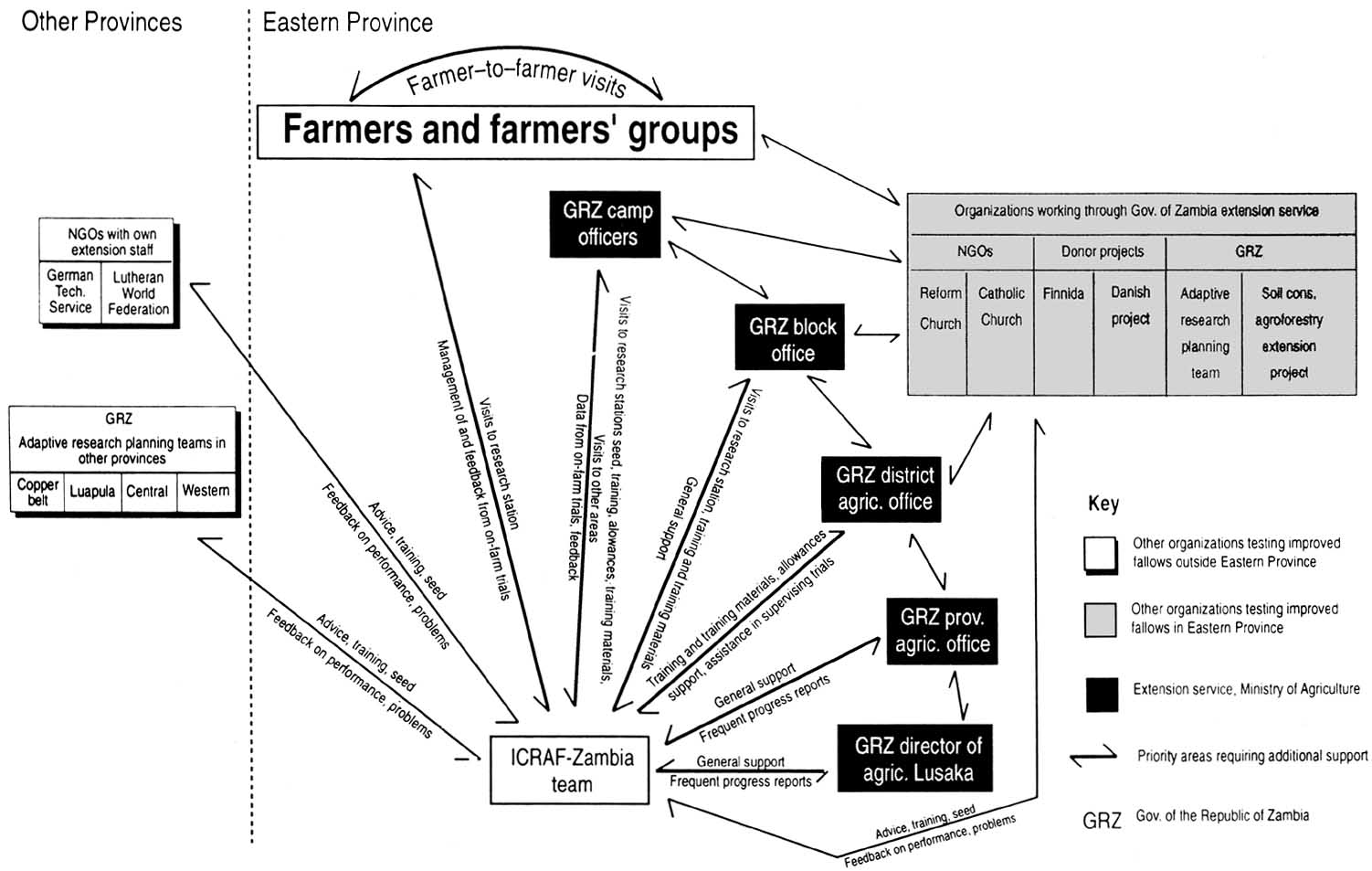
ICRAF, through the establishment and recognition of its Development Division as an equal partner with research, has indicated that it intends in the future to give more attention the contents and strategies in capacity building of not only research (NARS) but also national extension services. One useful approach to this broadened perspective of partners is represented by the link between ICRAF, GTZ, and ITFSP. This concept has been expanded to the SADC-Zambesi Basin Project where ICRAF staff in collaboration with national partners are developing a new quality of linking agroforestry research to rural development by technical training programmes for extensionists and implementation at farm level through Adaptive Research and Dissemination Teams (ARDT). An example of the intended and in some cases operational links among the ICRAF-Zambia team is indicated in Figure 4.2, taken from the 1996 Project Management Plan for the Zambesi Basin Agroforestry Project funded by Canada. The key to successful implementation of this excellent model of collaboration and interaction is the actual linkages that get established in the field, and that depends on personalities, on the rules accepted by the team, on the nature of the process of interaction adopted, and on many other factors that need to be studied.
The Panel believes that too many partnerships could become a concern for ICRAF in the future, unless it develops a much clearer policy and set of operational guidelines for partnering. Given this concern, the Panel believes that it is time for ICRAF to take a more analytical look at its experience with partnerships and to develop a firmer, more analytically based set of operational policy guidelines that take into account ICRAF's full range of experiences, as well as the reactions and opinions of the partners, obtained in a systematic fashion through questionnaires and interviews. Although the Panel is reluctant to suggest another working group and set of activities that will take time away from ICRAF's research, the Panel also feels that the subject and the size of the potential gains from rationalization of partnering are significant and great enough to warrant action; and thus.
The Panel recommends that:
ICRAF craft a strategy, operational policies and associated guidelines on partnerships that go beyond its current policy guidelines, and that these new statements be based on the results of a thorough analysis of ICRAF's partnership experience. Special attention should be given to the pathway for NARS strengthening and to ways to handle differences in organizational culture.
The Panel believes that the working group, which should include outside experts and have partner input, could provide ICRAF with very useful insights on the nature and causes of success and failure in partnerships. The working group should provide, based on its analyses, a) further understanding of the nature of the different kinds of partnerships in which ICRAF is involved; b) judgement on the relative success (at least in a qualitative sense) of the different types of partnerships; c) the proximate causes of failures and successes in partnerships; d) the rationales for ICRAF partnerships of different kinds; and e) a draft set of guidelines and a draft policy statement for ICRAF partnering. This issue of partnerships is bound to become more important in the future, as ICRAF struggles with its concerns for priority setting and impacts of its work. While the Centre has done a great deal of thinking on the subject, a more structured, systematic effort at this time - based to some extent on past experience - should benefit ICRAF and its partners.
ICRAF's capacity strengthening programme is comprised of a number of diverse activities. They include the development of curriculum and training methodology, group training programmes of varied lengths on a number of both introductory and specialized subjects that focus on the training of trainers, individualized training (mainly for students working on MSc or PhD theses) and the preparation of training materials using print and electronic media. In addition, staff work with universities in every one of ICRAF's regions to encourage the incorporation of agroforestry materials and full courses at the undergraduate and graduate levels. This has been an important impetus to the recognition of agroforestry as an applied science.
Participants in CIS activities include NARS staff, NGO personnel and students from universities in the regions and from donor countries. Between 1993 and 1998, 1067 participants from 72 countries were beneficiaries of one or another training programme. Most of these programmes were concentrated in Africa (42), with only three each in Latin America and Southeast Asia, and the Panel suggests that an effort be made to improve the distribution. On average, 50 students are attached to project staff at any point of time; they produce some 15 MSc/PhD theses per year.
Training materials were provided to all participants of ICRAF training courses. In addition ICRAF distributed materials to ANAFE's 98 member institutions and to more than 1750 individuals or institutions or individuals. ICRAF's training materials are also now available through the ICRAF web site and the centre is registering an average of 5 requests a week for these materials. The latter is expected to increase as more training and education institutions go on-line.
While the current work with students is commendable, there is a need to pursue more systematically ICRAF's objective of strengthening the capacity of NARS scientists. One way of doing this is to expand the programme of visiting scientists and seconded staff by providing additional opportunities to promising developing country scientists engaged in agroforestry research.
Accordingly, the Panel recommends that:
ICRAF establish a visiting scientist scheme to attract postgraduate researchers and mid-career scientists to work with the Centre's cutting edge scientists.
Staff from all five Programmes, the Regional Offices and the Research and Information Support Units provide the substantive input into these capacity strengthening activities, including acting as lecturers and course leaders and supervisors of thesis research. The staff of Programme 5 provide both substantive and logistical support, working closely with the Information Support Unit.
Programme 5, now termed Capacity and Institutional Strengthening, has evolved since 1993 from the former Training and Information Division that was established in 1989. The Division deepened the involvement in capacity strengthening that had been an aspect of the information and advocacy role of ICRAF in its days as a Council. As it looks to the future, the Programme will strengthen its emphasis on delivery of quality programmes and materials. It will be especially important, in this regard, that programmes and materials be made available to French and Spanish speaking participants in their own language. The Panel suggests that ICRAF seek a collaborator that can provide some translation/interpretation services at modest cost.
It will also be important for Programme 5 staff to develop a system to monitor the progress of participants and to track the careers of earlier participants. Together with an analysis of evaluations carried out at the conclusion of courses, this will provide the basis for determining the effectiveness of past training and for improvements that should be introduced. There are plans to do this. In addition, the Programme's future plans include the transfer of introductory level training from ICRAF to the NARS and to universities in the regions, although ICRAF staff will continue to provide backstopping as needed and to develop and supply training materials. They will also periodically update the trainers. The Panel supports this decision as appropriate and timely, in part because it will make it possible to respond efficiently to the increasing demand for agroforestry training that ICRAF's efforts to date have stimulated. ICRAF staff will then concentrate on the more advanced courses.
Consideration is also being given to ways in which technological advances will enable the Centre to reach even larger numbers of partner scientists, including use of the Internet and establishment of a distance learning studio and programme at headquarters. The latter will be linked to the World Bank-funded African Virtual University initiative.